Marketing Communication Report: Honest to Goodness Organic Foods
VerifiedAdded on 2020/03/23
|11
|2703
|47
Report
AI Summary
This report provides a comprehensive analysis of the marketing communication strategies employed by Honest to Goodness, an Australian organic and natural food company. The report begins with an executive summary and an introduction to integrated marketing communication (IMC). It then delves into the company's background and product description, followed by an examination of its target market, which is segmented into core, mid-level, and periphery consumers. The positioning strategy of Honest to Goodness, focusing on providing healthy and safe food options, is then explored. The report outlines the company's communication goals, which include educating the audience, generating referrals, and increasing sales. The AIDA framework is used to analyze the message strategy and executional tactics. Finally, the promotional mix and media strategy, including social media, SEO, email marketing, and traditional methods, are discussed, and the report concludes with a summary of the key findings and references.
Running head: MARKETING COMMUNICATION
Marketing Communication
Name of Student
Name of the University
Author Note
Marketing Communication
Name of Student
Name of the University
Author Note

Paraphrase This Document
Need a fresh take? Get an instant paraphrase of this document with our AI Paraphraser
1
MARKETING COMMUNICATION
Executive Summary
The integrated marketing communication is used for better communication with the customers
and enhances the brand image of the company. The selected company is Honest to Goodness
and the selected product is organic foods. This report would broaden the understanding of the
integrated marketing communication process in the organization for a real organization. The
various target market of the company would be defined. The positioning strategy of the company
would be analyzed along with the goals of the communication process. The promotional strategy
of the firm would be determined and the main message conveyed would be analyzed. This report
would help in better understanding of the IMC process in a real organization.
MARKETING COMMUNICATION
Executive Summary
The integrated marketing communication is used for better communication with the customers
and enhances the brand image of the company. The selected company is Honest to Goodness
and the selected product is organic foods. This report would broaden the understanding of the
integrated marketing communication process in the organization for a real organization. The
various target market of the company would be defined. The positioning strategy of the company
would be analyzed along with the goals of the communication process. The promotional strategy
of the firm would be determined and the main message conveyed would be analyzed. This report
would help in better understanding of the IMC process in a real organization.
2
MARKETING COMMUNICATION
Table of Contents
Introduction......................................................................................................................................3
Discussion........................................................................................................................................3
Company Background and Product Description.........................................................................3
Target Market..............................................................................................................................4
Positioning Strategy.....................................................................................................................4
Communication Goal...................................................................................................................5
Message Strategy and Executional Tactics..................................................................................6
Promotional Mix and Media Strategy..........................................................................................7
Conclusion.......................................................................................................................................8
References........................................................................................................................................9
Bibliography..................................................................................................................................10
MARKETING COMMUNICATION
Table of Contents
Introduction......................................................................................................................................3
Discussion........................................................................................................................................3
Company Background and Product Description.........................................................................3
Target Market..............................................................................................................................4
Positioning Strategy.....................................................................................................................4
Communication Goal...................................................................................................................5
Message Strategy and Executional Tactics..................................................................................6
Promotional Mix and Media Strategy..........................................................................................7
Conclusion.......................................................................................................................................8
References........................................................................................................................................9
Bibliography..................................................................................................................................10
⊘ This is a preview!⊘
Do you want full access?
Subscribe today to unlock all pages.

Trusted by 1+ million students worldwide
3
MARKETING COMMUNICATION
Introduction
There has been an increase in the integrated marketing communication tools being used
by the companies in order to survive in this competitive market. As opined by Percy (2014), the
integrated marketing communication can be defined as the application of the consistent brand
messages that are implemented in the traditional as well as non-traditional marketing channels.
There have been significant changes in the marketing process over the years and the companies
are increasingly accommodating the changing preferences of the consumers (Percy 2014). The
organizations have started developing holistic marketing campaigns that have helped them to
reach the target audience in a better way.
The selected product for the purpose of this report is organic foods and the company
selected is Honest to Goodness. The company background and the description of the product
would be done. The target market would be defined along with the positioning strategy of the
company. The goals of the communication methods would be outlined along with the concerned
message. The promotional mix of the new products would be analyzed and media strategy of the
company would be defined.
Discussion
Company Background and Product Description
Honest to Goodness is an Australian organic and natural food company that has been
voted as the “favorite organic food brand” of the country (Goodness.com.au 2017). The company
believes in the manufacturing, procuring and delivery of healthy foods and they believe in the
methods of sustainable food production. The product range of the brand is the naturally grown
healthy foods, which are available at affordable costs (Goodness.com.au 2017). Honest to
Goodness is a certified brand that operates as wholesaler, retailer and distributor of various
natural and organic foods (Goodness.com.au 2017). The food products are strictly handled under
the ACO guidelines. The company strives to encourage locally grown products where it supports
the local communities as well as regional Australia (Goodness.com.au 2017). The organic food
firm has a vision of creating a healthy, sustainable as well as better future for the community.
MARKETING COMMUNICATION
Introduction
There has been an increase in the integrated marketing communication tools being used
by the companies in order to survive in this competitive market. As opined by Percy (2014), the
integrated marketing communication can be defined as the application of the consistent brand
messages that are implemented in the traditional as well as non-traditional marketing channels.
There have been significant changes in the marketing process over the years and the companies
are increasingly accommodating the changing preferences of the consumers (Percy 2014). The
organizations have started developing holistic marketing campaigns that have helped them to
reach the target audience in a better way.
The selected product for the purpose of this report is organic foods and the company
selected is Honest to Goodness. The company background and the description of the product
would be done. The target market would be defined along with the positioning strategy of the
company. The goals of the communication methods would be outlined along with the concerned
message. The promotional mix of the new products would be analyzed and media strategy of the
company would be defined.
Discussion
Company Background and Product Description
Honest to Goodness is an Australian organic and natural food company that has been
voted as the “favorite organic food brand” of the country (Goodness.com.au 2017). The company
believes in the manufacturing, procuring and delivery of healthy foods and they believe in the
methods of sustainable food production. The product range of the brand is the naturally grown
healthy foods, which are available at affordable costs (Goodness.com.au 2017). Honest to
Goodness is a certified brand that operates as wholesaler, retailer and distributor of various
natural and organic foods (Goodness.com.au 2017). The food products are strictly handled under
the ACO guidelines. The company strives to encourage locally grown products where it supports
the local communities as well as regional Australia (Goodness.com.au 2017). The organic food
firm has a vision of creating a healthy, sustainable as well as better future for the community.
Paraphrase This Document
Need a fresh take? Get an instant paraphrase of this document with our AI Paraphraser
4
MARKETING COMMUNICATION
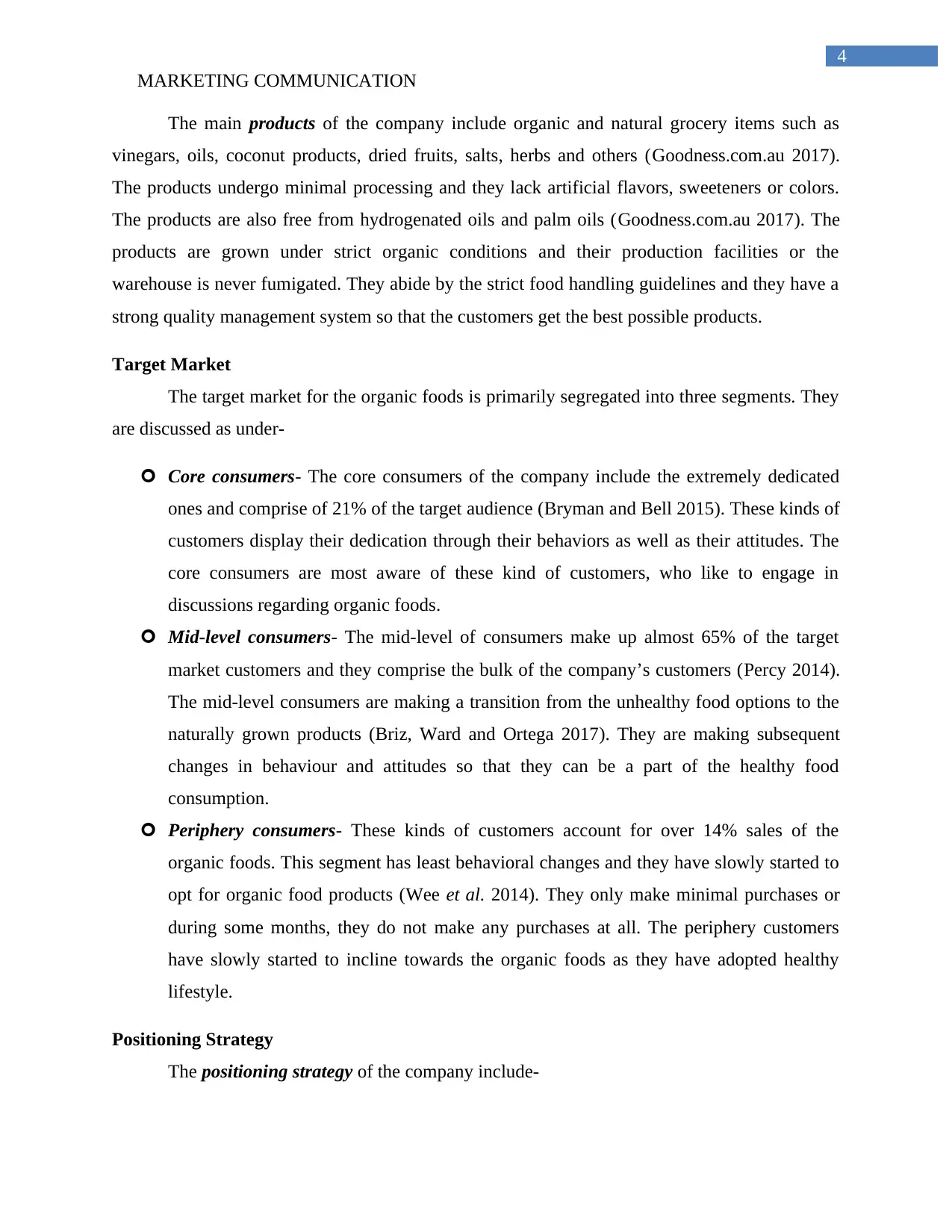
The main products of the company include organic and natural grocery items such as
vinegars, oils, coconut products, dried fruits, salts, herbs and others (Goodness.com.au 2017).
The products undergo minimal processing and they lack artificial flavors, sweeteners or colors.
The products are also free from hydrogenated oils and palm oils (Goodness.com.au 2017). The
products are grown under strict organic conditions and their production facilities or the
warehouse is never fumigated. They abide by the strict food handling guidelines and they have a
strong quality management system so that the customers get the best possible products.
Target Market
The target market for the organic foods is primarily segregated into three segments. They
are discussed as under-
Core consumers- The core consumers of the company include the extremely dedicated
ones and comprise of 21% of the target audience (Bryman and Bell 2015). These kinds of
customers display their dedication through their behaviors as well as their attitudes. The
core consumers are most aware of these kind of customers, who like to engage in
discussions regarding organic foods.
Mid-level consumers- The mid-level of consumers make up almost 65% of the target
market customers and they comprise the bulk of the company’s customers (Percy 2014).
The mid-level consumers are making a transition from the unhealthy food options to the
naturally grown products (Briz, Ward and Ortega 2017). They are making subsequent
changes in behaviour and attitudes so that they can be a part of the healthy food
consumption.
Periphery consumers- These kinds of customers account for over 14% sales of the
organic foods. This segment has least behavioral changes and they have slowly started to
opt for organic food products (Wee et al. 2014). They only make minimal purchases or
during some months, they do not make any purchases at all. The periphery customers
have slowly started to incline towards the organic foods as they have adopted healthy
lifestyle.
Positioning Strategy
The positioning strategy of the company include-
MARKETING COMMUNICATION
The main products of the company include organic and natural grocery items such as
vinegars, oils, coconut products, dried fruits, salts, herbs and others (Goodness.com.au 2017).
The products undergo minimal processing and they lack artificial flavors, sweeteners or colors.
The products are also free from hydrogenated oils and palm oils (Goodness.com.au 2017). The
products are grown under strict organic conditions and their production facilities or the
warehouse is never fumigated. They abide by the strict food handling guidelines and they have a
strong quality management system so that the customers get the best possible products.
Target Market
The target market for the organic foods is primarily segregated into three segments. They
are discussed as under-
Core consumers- The core consumers of the company include the extremely dedicated
ones and comprise of 21% of the target audience (Bryman and Bell 2015). These kinds of
customers display their dedication through their behaviors as well as their attitudes. The
core consumers are most aware of these kind of customers, who like to engage in
discussions regarding organic foods.
Mid-level consumers- The mid-level of consumers make up almost 65% of the target
market customers and they comprise the bulk of the company’s customers (Percy 2014).
The mid-level consumers are making a transition from the unhealthy food options to the
naturally grown products (Briz, Ward and Ortega 2017). They are making subsequent
changes in behaviour and attitudes so that they can be a part of the healthy food
consumption.
Periphery consumers- These kinds of customers account for over 14% sales of the
organic foods. This segment has least behavioral changes and they have slowly started to
opt for organic food products (Wee et al. 2014). They only make minimal purchases or
during some months, they do not make any purchases at all. The periphery customers
have slowly started to incline towards the organic foods as they have adopted healthy
lifestyle.
Positioning Strategy
The positioning strategy of the company include-
5
MARKETING COMMUNICATION
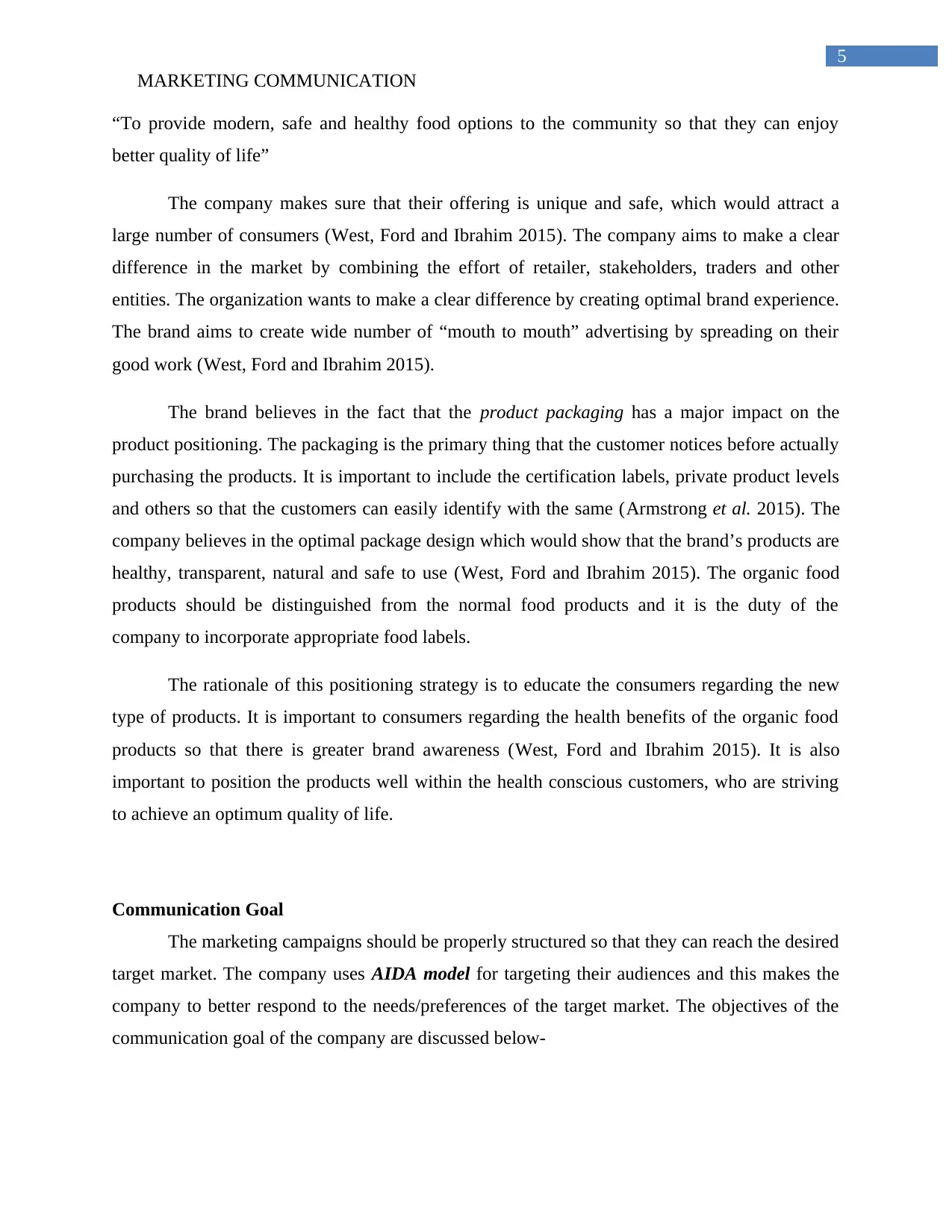
“To provide modern, safe and healthy food options to the community so that they can enjoy
better quality of life”
The company makes sure that their offering is unique and safe, which would attract a
large number of consumers (West, Ford and Ibrahim 2015). The company aims to make a clear
difference in the market by combining the effort of retailer, stakeholders, traders and other
entities. The organization wants to make a clear difference by creating optimal brand experience.
The brand aims to create wide number of “mouth to mouth” advertising by spreading on their
good work (West, Ford and Ibrahim 2015).
The brand believes in the fact that the product packaging has a major impact on the
product positioning. The packaging is the primary thing that the customer notices before actually
purchasing the products. It is important to include the certification labels, private product levels
and others so that the customers can easily identify with the same (Armstrong et al. 2015). The
company believes in the optimal package design which would show that the brand’s products are
healthy, transparent, natural and safe to use (West, Ford and Ibrahim 2015). The organic food
products should be distinguished from the normal food products and it is the duty of the
company to incorporate appropriate food labels.
The rationale of this positioning strategy is to educate the consumers regarding the new
type of products. It is important to consumers regarding the health benefits of the organic food
products so that there is greater brand awareness (West, Ford and Ibrahim 2015). It is also
important to position the products well within the health conscious customers, who are striving
to achieve an optimum quality of life.
Communication Goal
The marketing campaigns should be properly structured so that they can reach the desired
target market. The company uses AIDA model for targeting their audiences and this makes the
company to better respond to the needs/preferences of the target market. The objectives of the
communication goal of the company are discussed below-
MARKETING COMMUNICATION
“To provide modern, safe and healthy food options to the community so that they can enjoy
better quality of life”
The company makes sure that their offering is unique and safe, which would attract a
large number of consumers (West, Ford and Ibrahim 2015). The company aims to make a clear
difference in the market by combining the effort of retailer, stakeholders, traders and other
entities. The organization wants to make a clear difference by creating optimal brand experience.
The brand aims to create wide number of “mouth to mouth” advertising by spreading on their
good work (West, Ford and Ibrahim 2015).
The brand believes in the fact that the product packaging has a major impact on the
product positioning. The packaging is the primary thing that the customer notices before actually
purchasing the products. It is important to include the certification labels, private product levels
and others so that the customers can easily identify with the same (Armstrong et al. 2015). The
company believes in the optimal package design which would show that the brand’s products are
healthy, transparent, natural and safe to use (West, Ford and Ibrahim 2015). The organic food
products should be distinguished from the normal food products and it is the duty of the
company to incorporate appropriate food labels.
The rationale of this positioning strategy is to educate the consumers regarding the new
type of products. It is important to consumers regarding the health benefits of the organic food
products so that there is greater brand awareness (West, Ford and Ibrahim 2015). It is also
important to position the products well within the health conscious customers, who are striving
to achieve an optimum quality of life.
Communication Goal
The marketing campaigns should be properly structured so that they can reach the desired
target market. The company uses AIDA model for targeting their audiences and this makes the
company to better respond to the needs/preferences of the target market. The objectives of the
communication goal of the company are discussed below-
⊘ This is a preview!⊘
Do you want full access?
Subscribe today to unlock all pages.
Trusted by 1+ million students worldwide
6
MARKETING COMMUNICATION
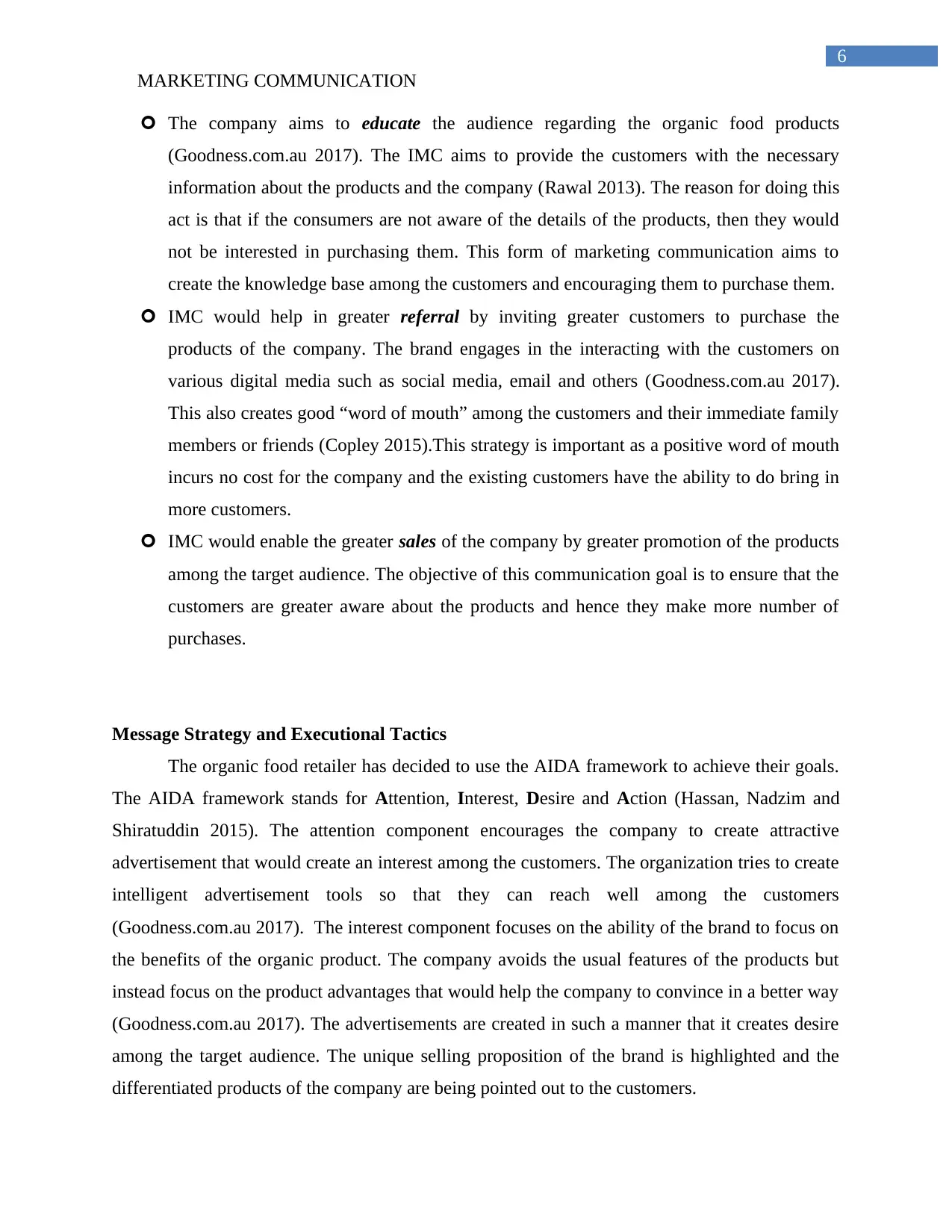
The company aims to educate the audience regarding the organic food products
(Goodness.com.au 2017). The IMC aims to provide the customers with the necessary
information about the products and the company (Rawal 2013). The reason for doing this
act is that if the consumers are not aware of the details of the products, then they would
not be interested in purchasing them. This form of marketing communication aims to
create the knowledge base among the customers and encouraging them to purchase them.
IMC would help in greater referral by inviting greater customers to purchase the
products of the company. The brand engages in the interacting with the customers on
various digital media such as social media, email and others (Goodness.com.au 2017).
This also creates good “word of mouth” among the customers and their immediate family
members or friends (Copley 2015).This strategy is important as a positive word of mouth
incurs no cost for the company and the existing customers have the ability to do bring in
more customers.
IMC would enable the greater sales of the company by greater promotion of the products
among the target audience. The objective of this communication goal is to ensure that the
customers are greater aware about the products and hence they make more number of
purchases.
Message Strategy and Executional Tactics
The organic food retailer has decided to use the AIDA framework to achieve their goals.
The AIDA framework stands for Attention, Interest, Desire and Action (Hassan, Nadzim and
Shiratuddin 2015). The attention component encourages the company to create attractive
advertisement that would create an interest among the customers. The organization tries to create
intelligent advertisement tools so that they can reach well among the customers
(Goodness.com.au 2017). The interest component focuses on the ability of the brand to focus on
the benefits of the organic product. The company avoids the usual features of the products but
instead focus on the product advantages that would help the company to convince in a better way
(Goodness.com.au 2017). The advertisements are created in such a manner that it creates desire
among the target audience. The unique selling proposition of the brand is highlighted and the
differentiated products of the company are being pointed out to the customers.
MARKETING COMMUNICATION
The company aims to educate the audience regarding the organic food products
(Goodness.com.au 2017). The IMC aims to provide the customers with the necessary
information about the products and the company (Rawal 2013). The reason for doing this
act is that if the consumers are not aware of the details of the products, then they would
not be interested in purchasing them. This form of marketing communication aims to
create the knowledge base among the customers and encouraging them to purchase them.
IMC would help in greater referral by inviting greater customers to purchase the
products of the company. The brand engages in the interacting with the customers on
various digital media such as social media, email and others (Goodness.com.au 2017).
This also creates good “word of mouth” among the customers and their immediate family
members or friends (Copley 2015).This strategy is important as a positive word of mouth
incurs no cost for the company and the existing customers have the ability to do bring in
more customers.
IMC would enable the greater sales of the company by greater promotion of the products
among the target audience. The objective of this communication goal is to ensure that the
customers are greater aware about the products and hence they make more number of
purchases.
Message Strategy and Executional Tactics
The organic food retailer has decided to use the AIDA framework to achieve their goals.
The AIDA framework stands for Attention, Interest, Desire and Action (Hassan, Nadzim and
Shiratuddin 2015). The attention component encourages the company to create attractive
advertisement that would create an interest among the customers. The organization tries to create
intelligent advertisement tools so that they can reach well among the customers
(Goodness.com.au 2017). The interest component focuses on the ability of the brand to focus on
the benefits of the organic product. The company avoids the usual features of the products but
instead focus on the product advantages that would help the company to convince in a better way
(Goodness.com.au 2017). The advertisements are created in such a manner that it creates desire
among the target audience. The unique selling proposition of the brand is highlighted and the
differentiated products of the company are being pointed out to the customers.
Paraphrase This Document
Need a fresh take? Get an instant paraphrase of this document with our AI Paraphraser
7
MARKETING COMMUNICATION
Honest to Goodness uses extensive advertisement strategies for attaining the
communication goals of the company (Goodness.com.au 2017). The organic food company is
aiming for creating brand awareness among the target audience. It is also achieving more
customer attitudes and modification of them (Goodness.com.au 2017). The company has adopted
content marketing strategy in which it engages in the creation and sharing of the online material
such as blogs, videos and social media posts. It does not directly promote the brand directly but it
creates interest among the target audience regarding the company’s products.
Promotional Mix and Media Strategy
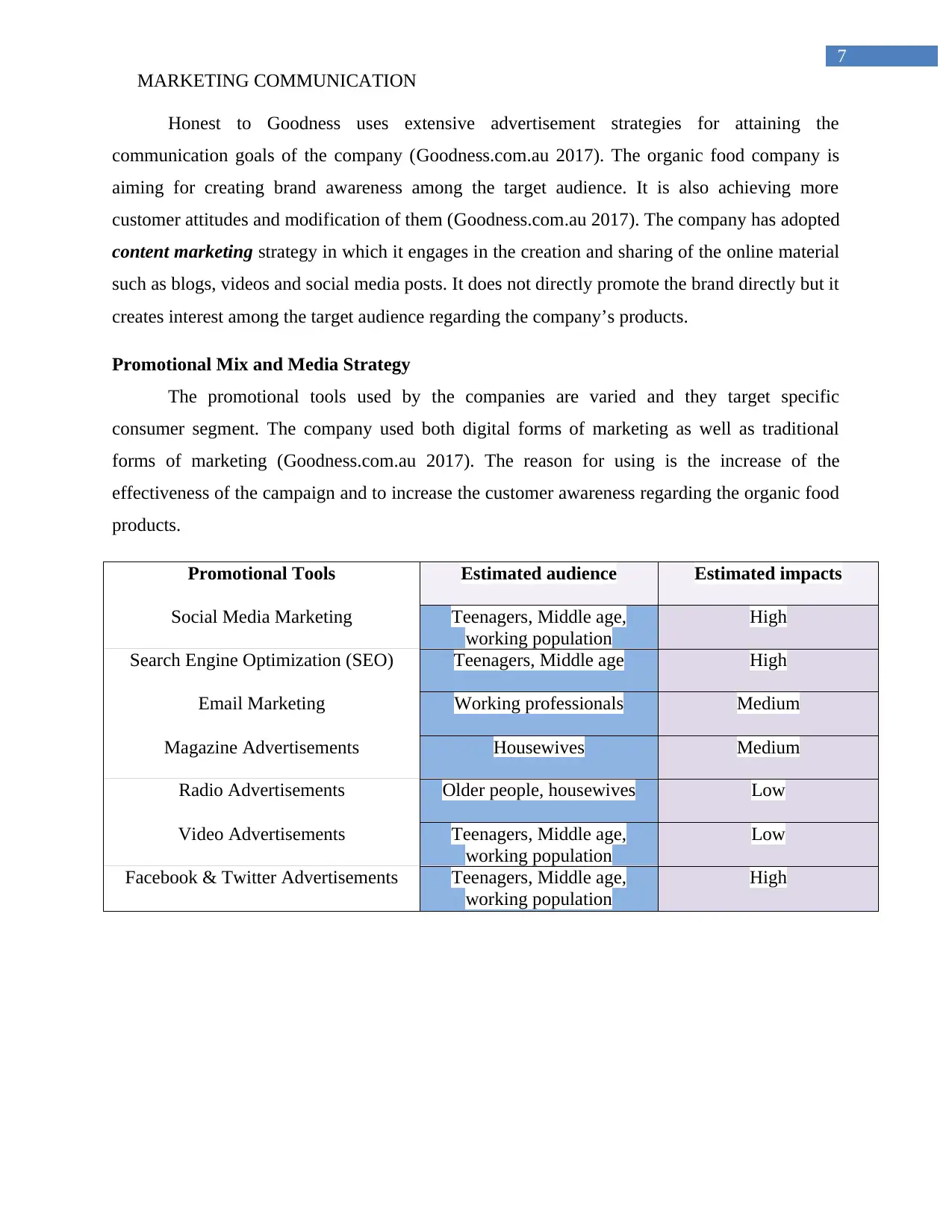
The promotional tools used by the companies are varied and they target specific
consumer segment. The company used both digital forms of marketing as well as traditional
forms of marketing (Goodness.com.au 2017). The reason for using is the increase of the
effectiveness of the campaign and to increase the customer awareness regarding the organic food
products.
Promotional Tools Estimated audience Estimated impacts
Social Media Marketing Teenagers, Middle age,
working population
High
Search Engine Optimization (SEO) Teenagers, Middle age High
Email Marketing Working professionals Medium
Magazine Advertisements Housewives Medium
Radio Advertisements Older people, housewives Low
Video Advertisements Teenagers, Middle age,
working population
Low
Facebook & Twitter Advertisements Teenagers, Middle age,
working population
High
MARKETING COMMUNICATION
Honest to Goodness uses extensive advertisement strategies for attaining the
communication goals of the company (Goodness.com.au 2017). The organic food company is
aiming for creating brand awareness among the target audience. It is also achieving more
customer attitudes and modification of them (Goodness.com.au 2017). The company has adopted
content marketing strategy in which it engages in the creation and sharing of the online material
such as blogs, videos and social media posts. It does not directly promote the brand directly but it
creates interest among the target audience regarding the company’s products.
Promotional Mix and Media Strategy
The promotional tools used by the companies are varied and they target specific
consumer segment. The company used both digital forms of marketing as well as traditional
forms of marketing (Goodness.com.au 2017). The reason for using is the increase of the
effectiveness of the campaign and to increase the customer awareness regarding the organic food
products.
Promotional Tools Estimated audience Estimated impacts
Social Media Marketing Teenagers, Middle age,
working population
High
Search Engine Optimization (SEO) Teenagers, Middle age High
Email Marketing Working professionals Medium
Magazine Advertisements Housewives Medium
Radio Advertisements Older people, housewives Low
Video Advertisements Teenagers, Middle age,
working population
Low
Facebook & Twitter Advertisements Teenagers, Middle age,
working population
High
8
MARKETING COMMUNICATION
Conclusion
The integrated marketing communication is used to better communicate with the
customers of the brand. Honest to Goodness is an Australian organic and natural food company
that has been voted as the “favorite organic food brand” of the country. The main products of the
company include organic and natural grocery items such as vinegars, oils, coconut products,
dried fruits, salts, herbs and others. The various target markets of the brand includes the Core
consumers, mid-level customers and the periphery customers. The company uses AIDA model
for targeting their audiences and this makes the company to better respond to the
needs/preferences of the target market. The main goals of the communication strategy are to
educate, gain referral and increase the sales of the company. The company has adopted content
marketing strategy in which it engages in the creation and sharing of the online material such as
blogs, videos and social media posts. It strives to use a combination of both digital as well as
traditional sources of marketing. This report would broaden the understanding of the integrated
marketing communication process in the organization for a real organization.
MARKETING COMMUNICATION
Conclusion
The integrated marketing communication is used to better communicate with the
customers of the brand. Honest to Goodness is an Australian organic and natural food company
that has been voted as the “favorite organic food brand” of the country. The main products of the
company include organic and natural grocery items such as vinegars, oils, coconut products,
dried fruits, salts, herbs and others. The various target markets of the brand includes the Core
consumers, mid-level customers and the periphery customers. The company uses AIDA model
for targeting their audiences and this makes the company to better respond to the
needs/preferences of the target market. The main goals of the communication strategy are to
educate, gain referral and increase the sales of the company. The company has adopted content
marketing strategy in which it engages in the creation and sharing of the online material such as
blogs, videos and social media posts. It strives to use a combination of both digital as well as
traditional sources of marketing. This report would broaden the understanding of the integrated
marketing communication process in the organization for a real organization.
⊘ This is a preview!⊘
Do you want full access?
Subscribe today to unlock all pages.
Trusted by 1+ million students worldwide
9
MARKETING COMMUNICATION
References
Armstrong, G., Kotler, P., Harker, M. and Brennan, R., 2015. Marketing: an introduction.
Pearson Education.
Briz, T., Ward, R.W. and Ortega, L.E., 2017. Relative impacts of health and obesity on US
household servings of fruits and vegetables. Renewable Agriculture and Food Systems, pp.1-13.
Bryman, A. and Bell, E., 2015. Business research methods. Oxford University Press, USA.
Copley, P., 2015. For the love of AIDA–developing the Hierarchy of Effects model in SME
social media marketing strategy.
Goodness.com.au. (2017). Honest to Goodness – Organic Food & Natural Products. [online]
Available at: http://www.goodness.com.au [Accessed 18 Sep. 2017].
Hassan, S., Nadzim, S.Z.A. and Shiratuddin, N., 2015. Strategic use of social media for small
business based on the AIDA model. Procedia-Social and Behavioral Sciences, 172, pp.262-269.
Percy, L., 2014. Strategic integrated marketing communications. Routledge.
Rawal, P., 2013. AIDA Marketing Communication Model: Stimulating a purchase decision in
the minds of the consumers through a linear progression of steps. International Journal of
Multidisciplinary Research in Social & Management Sciences, 1(1), pp.37-44.
Wee, C.S., Ariff, M.S.B.M., Zakuan, N., Tajudin, M.N.M., Ismail, K. and Ishak, N., 2014.
Consumers perception, purchase intention and actual purchase behavior of organic food
products. Review of Integrative Business and Economics Research, 3(2), p.378.
West, D.C., Ford, J. and Ibrahim, E., 2015. Strategic marketing: creating competitive advantage.
Oxford University Press, USA.
MARKETING COMMUNICATION
References
Armstrong, G., Kotler, P., Harker, M. and Brennan, R., 2015. Marketing: an introduction.
Pearson Education.
Briz, T., Ward, R.W. and Ortega, L.E., 2017. Relative impacts of health and obesity on US
household servings of fruits and vegetables. Renewable Agriculture and Food Systems, pp.1-13.
Bryman, A. and Bell, E., 2015. Business research methods. Oxford University Press, USA.
Copley, P., 2015. For the love of AIDA–developing the Hierarchy of Effects model in SME
social media marketing strategy.
Goodness.com.au. (2017). Honest to Goodness – Organic Food & Natural Products. [online]
Available at: http://www.goodness.com.au [Accessed 18 Sep. 2017].
Hassan, S., Nadzim, S.Z.A. and Shiratuddin, N., 2015. Strategic use of social media for small
business based on the AIDA model. Procedia-Social and Behavioral Sciences, 172, pp.262-269.
Percy, L., 2014. Strategic integrated marketing communications. Routledge.
Rawal, P., 2013. AIDA Marketing Communication Model: Stimulating a purchase decision in
the minds of the consumers through a linear progression of steps. International Journal of
Multidisciplinary Research in Social & Management Sciences, 1(1), pp.37-44.
Wee, C.S., Ariff, M.S.B.M., Zakuan, N., Tajudin, M.N.M., Ismail, K. and Ishak, N., 2014.
Consumers perception, purchase intention and actual purchase behavior of organic food
products. Review of Integrative Business and Economics Research, 3(2), p.378.
West, D.C., Ford, J. and Ibrahim, E., 2015. Strategic marketing: creating competitive advantage.
Oxford University Press, USA.
Paraphrase This Document
Need a fresh take? Get an instant paraphrase of this document with our AI Paraphraser
10
MARKETING COMMUNICATION
Bibliography
Belch, G.E., Belch, M.A., Kerr, G.F. and Powell, I., 2014. Advertising: An integrated marketing
communication perspective. McGraw-Hill Education.
Kim, J., Kim, J., Kim, J.E., Kim, J.E., Marshall, R. and Marshall, R., 2016. Are two arguments
always better than one? Persuasion knowledge moderating the effect of integrated marketing
communications. European Journal of Marketing, 50(7/8), pp.1399-1425.
Kitchen, P.J. and Burgmann, I., 2015. Integrated marketing communication: Making it work at a
strategic level. Journal of Business Strategy, 36(4), pp.34-39.
Luxton, S., Reid, M. and Mavondo, F., 2015. Integrated marketing communication capability
and brand performance. Journal of Advertising, 44(1), pp.37-46.
Madhavaram, S., Badrinarayanan, V. and Bicen, P., 2016. Integrated Marketing Communication
(IMC): Conceptual and Theoretical Lacunae, Foundational Premises, and Framework.
In Celebrating America’s Pastimes: Baseball, Hot Dogs, Apple Pie and Marketing? (pp. 335-
336). Springer International Publishing.
Schultz, D., Patti, C.H. and Kitchen, P.J., 2013. The evolution of integrated marketing
communications: The customer-driven marketplace. Routledge.
MARKETING COMMUNICATION
Bibliography
Belch, G.E., Belch, M.A., Kerr, G.F. and Powell, I., 2014. Advertising: An integrated marketing
communication perspective. McGraw-Hill Education.
Kim, J., Kim, J., Kim, J.E., Kim, J.E., Marshall, R. and Marshall, R., 2016. Are two arguments
always better than one? Persuasion knowledge moderating the effect of integrated marketing
communications. European Journal of Marketing, 50(7/8), pp.1399-1425.
Kitchen, P.J. and Burgmann, I., 2015. Integrated marketing communication: Making it work at a
strategic level. Journal of Business Strategy, 36(4), pp.34-39.
Luxton, S., Reid, M. and Mavondo, F., 2015. Integrated marketing communication capability
and brand performance. Journal of Advertising, 44(1), pp.37-46.
Madhavaram, S., Badrinarayanan, V. and Bicen, P., 2016. Integrated Marketing Communication
(IMC): Conceptual and Theoretical Lacunae, Foundational Premises, and Framework.
In Celebrating America’s Pastimes: Baseball, Hot Dogs, Apple Pie and Marketing? (pp. 335-
336). Springer International Publishing.
Schultz, D., Patti, C.H. and Kitchen, P.J., 2013. The evolution of integrated marketing
communications: The customer-driven marketplace. Routledge.

1 out of 11


Related Documents


Your All-in-One AI-Powered Toolkit for Academic Success.
+13062052269
info@desklib.com
Available 24*7 on WhatsApp / Email
![[object Object]](/_next/static/media/star-bottom.7253800d.svg)
Unlock your academic potential
Copyright © 2020–2026 A2Z Services. All Rights Reserved. Developed and managed by ZUCOL.