BTEC Unit 2: Marketing Essentials Report - Nestle's Marketing Strategy
VerifiedAdded on 2022/12/28
|11
|3246
|72
Report
AI Summary
This report provides a comprehensive analysis of Nestle's marketing strategies, focusing on the application of the marketing mix and the development of a marketing plan. The report begins with an introduction to marketing and its importance in the business world, using Nestle as a case study. It then delves into a comparative analysis of Nestle and its competitor Hershey's, examining how both companies utilize the marketing mix elements (product, price, promotion, place, people, physical evidence, and process) to achieve their business objectives. The report further explores the development of a basic marketing plan for Nestle, including a SMART objective, a SWOT analysis (strengths, weaknesses, opportunities, and threats), and the application of Porter's generic strategies. The report concludes with a discussion on the effectiveness of the marketing strategies and provides valuable insights into Nestle's approach to marketing.
Marketing Essentials
1
1

Paraphrase This Document
Need a fresh take? Get an instant paraphrase of this document with our AI Paraphraser
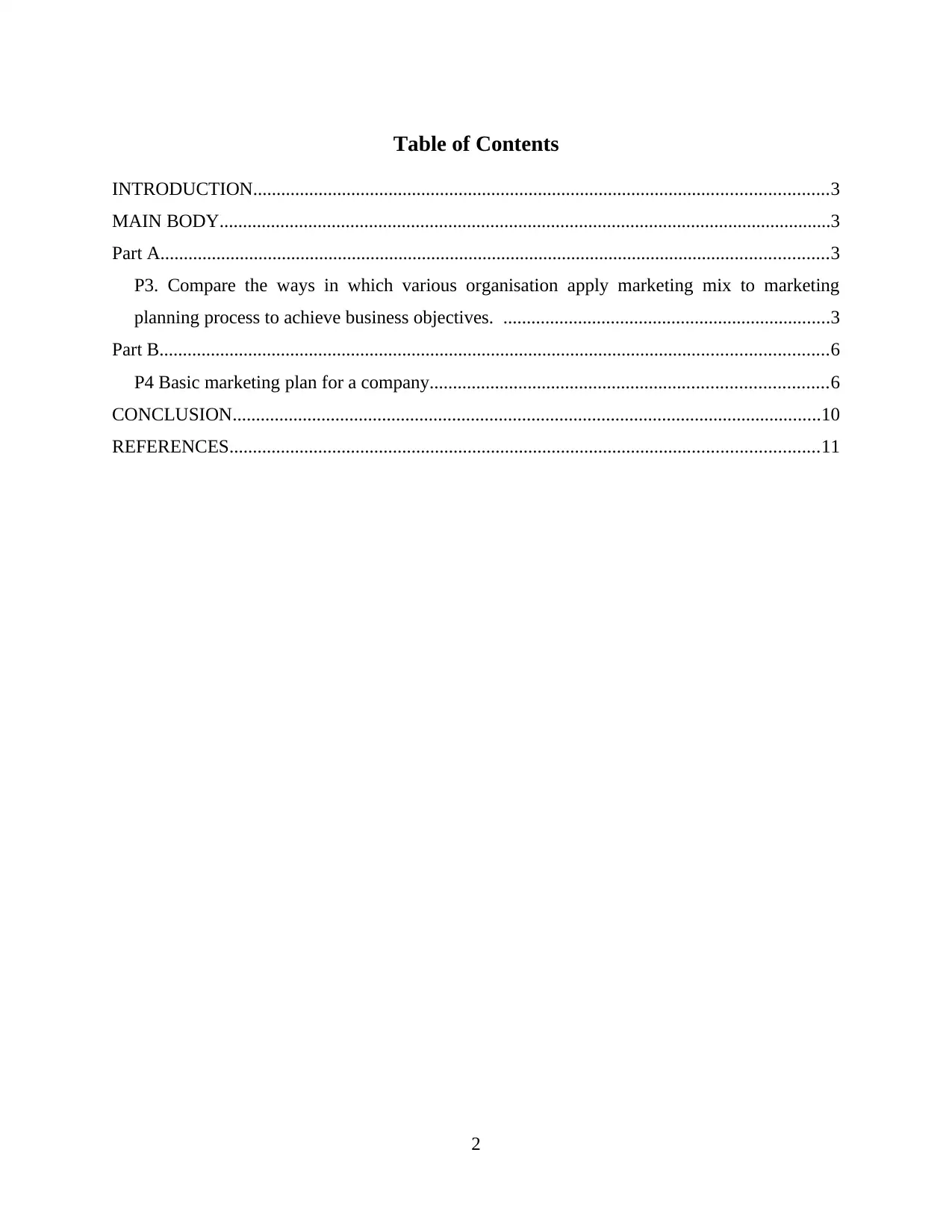
Table of Contents
INTRODUCTION...........................................................................................................................3
MAIN BODY...................................................................................................................................3
Part A...............................................................................................................................................3
P3. Compare the ways in which various organisation apply marketing mix to marketing
planning process to achieve business objectives. ......................................................................3
Part B...............................................................................................................................................6
P4 Basic marketing plan for a company.....................................................................................6
CONCLUSION..............................................................................................................................10
REFERENCES..............................................................................................................................11
2
INTRODUCTION...........................................................................................................................3
MAIN BODY...................................................................................................................................3
Part A...............................................................................................................................................3
P3. Compare the ways in which various organisation apply marketing mix to marketing
planning process to achieve business objectives. ......................................................................3
Part B...............................................................................................................................................6
P4 Basic marketing plan for a company.....................................................................................6
CONCLUSION..............................................................................................................................10
REFERENCES..............................................................................................................................11
2
INTRODUCTION
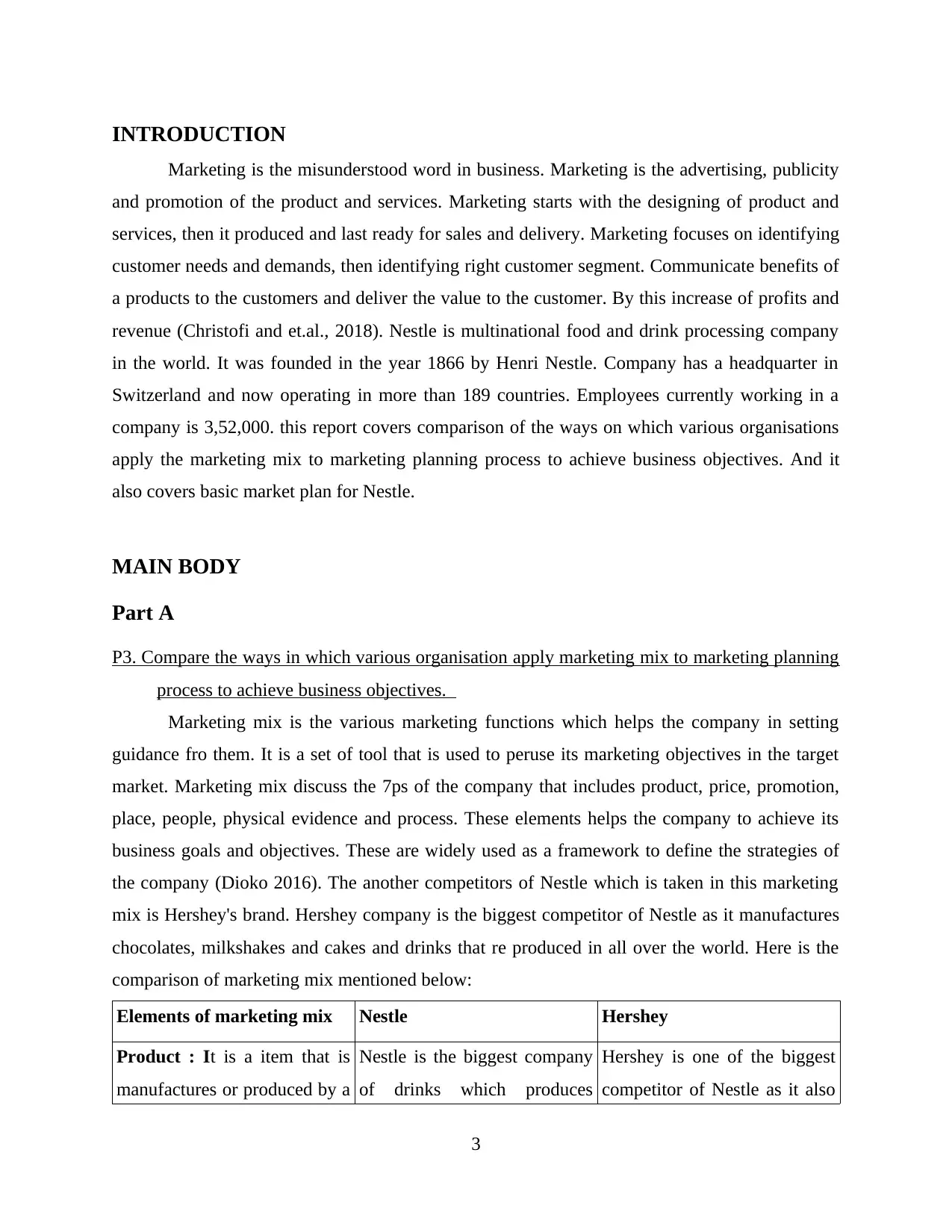
Marketing is the misunderstood word in business. Marketing is the advertising, publicity
and promotion of the product and services. Marketing starts with the designing of product and
services, then it produced and last ready for sales and delivery. Marketing focuses on identifying
customer needs and demands, then identifying right customer segment. Communicate benefits of
a products to the customers and deliver the value to the customer. By this increase of profits and
revenue (Christofi and et.al., 2018). Nestle is multinational food and drink processing company
in the world. It was founded in the year 1866 by Henri Nestle. Company has a headquarter in
Switzerland and now operating in more than 189 countries. Employees currently working in a
company is 3,52,000. this report covers comparison of the ways on which various organisations
apply the marketing mix to marketing planning process to achieve business objectives. And it
also covers basic market plan for Nestle.
MAIN BODY
Part A
P3. Compare the ways in which various organisation apply marketing mix to marketing planning
process to achieve business objectives.
Marketing mix is the various marketing functions which helps the company in setting
guidance fro them. It is a set of tool that is used to peruse its marketing objectives in the target
market. Marketing mix discuss the 7ps of the company that includes product, price, promotion,
place, people, physical evidence and process. These elements helps the company to achieve its
business goals and objectives. These are widely used as a framework to define the strategies of
the company (Dioko 2016). The another competitors of Nestle which is taken in this marketing
mix is Hershey's brand. Hershey company is the biggest competitor of Nestle as it manufactures
chocolates, milkshakes and cakes and drinks that re produced in all over the world. Here is the
comparison of marketing mix mentioned below:
Elements of marketing mix Nestle Hershey
Product : It is a item that is
manufactures or produced by a
Nestle is the biggest company
of drinks which produces
Hershey is one of the biggest
competitor of Nestle as it also
3
Marketing is the misunderstood word in business. Marketing is the advertising, publicity
and promotion of the product and services. Marketing starts with the designing of product and
services, then it produced and last ready for sales and delivery. Marketing focuses on identifying
customer needs and demands, then identifying right customer segment. Communicate benefits of
a products to the customers and deliver the value to the customer. By this increase of profits and
revenue (Christofi and et.al., 2018). Nestle is multinational food and drink processing company
in the world. It was founded in the year 1866 by Henri Nestle. Company has a headquarter in
Switzerland and now operating in more than 189 countries. Employees currently working in a
company is 3,52,000. this report covers comparison of the ways on which various organisations
apply the marketing mix to marketing planning process to achieve business objectives. And it
also covers basic market plan for Nestle.
MAIN BODY
Part A
P3. Compare the ways in which various organisation apply marketing mix to marketing planning
process to achieve business objectives.
Marketing mix is the various marketing functions which helps the company in setting
guidance fro them. It is a set of tool that is used to peruse its marketing objectives in the target
market. Marketing mix discuss the 7ps of the company that includes product, price, promotion,
place, people, physical evidence and process. These elements helps the company to achieve its
business goals and objectives. These are widely used as a framework to define the strategies of
the company (Dioko 2016). The another competitors of Nestle which is taken in this marketing
mix is Hershey's brand. Hershey company is the biggest competitor of Nestle as it manufactures
chocolates, milkshakes and cakes and drinks that re produced in all over the world. Here is the
comparison of marketing mix mentioned below:
Elements of marketing mix Nestle Hershey
Product : It is a item that is
manufactures or produced by a
Nestle is the biggest company
of drinks which produces
Hershey is one of the biggest
competitor of Nestle as it also
3
⊘ This is a preview!⊘
Do you want full access?
Subscribe today to unlock all pages.

Trusted by 1+ million students worldwide
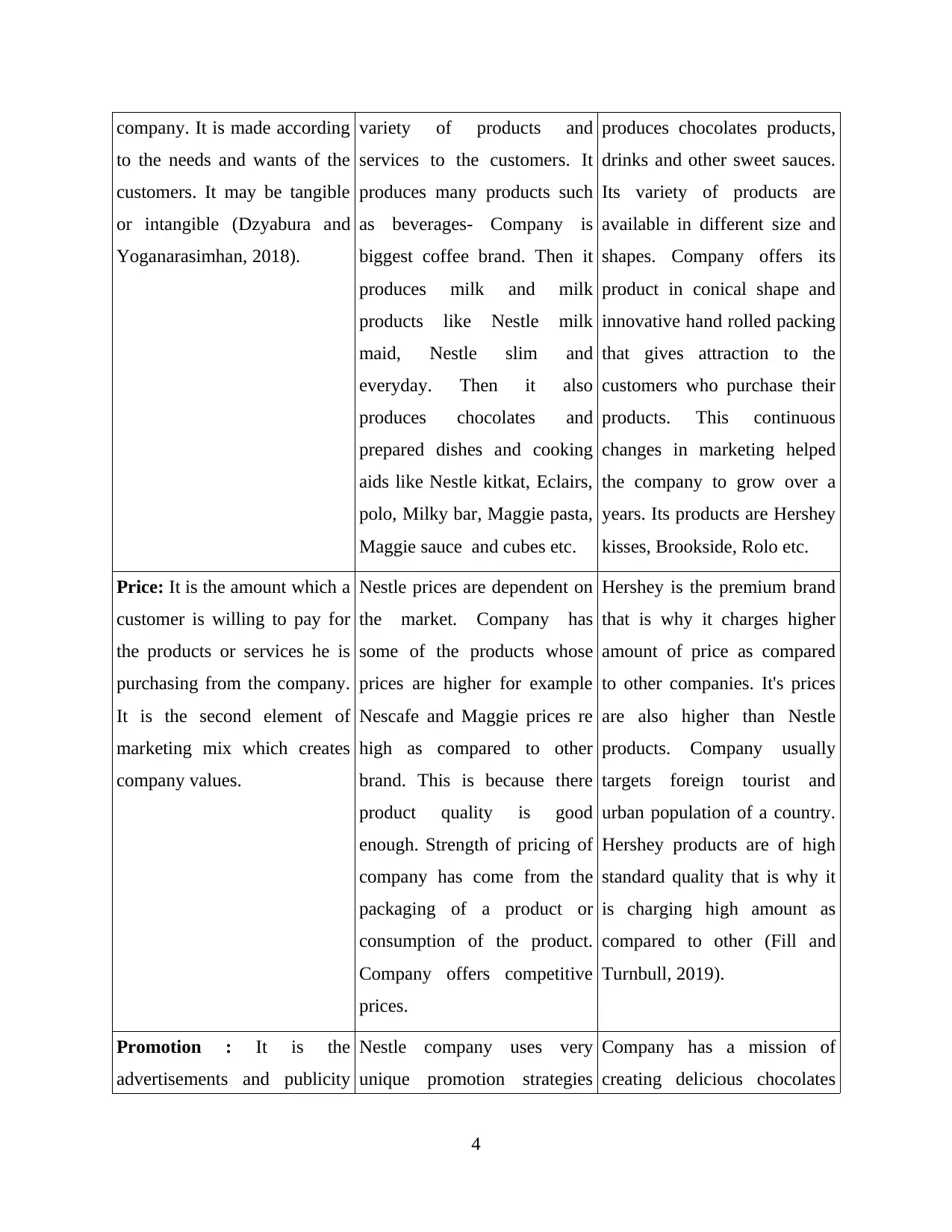
company. It is made according
to the needs and wants of the
customers. It may be tangible
or intangible (Dzyabura and
Yoganarasimhan, 2018).
variety of products and
services to the customers. It
produces many products such
as beverages- Company is
biggest coffee brand. Then it
produces milk and milk
products like Nestle milk
maid, Nestle slim and
everyday. Then it also
produces chocolates and
prepared dishes and cooking
aids like Nestle kitkat, Eclairs,
polo, Milky bar, Maggie pasta,
Maggie sauce and cubes etc.
produces chocolates products,
drinks and other sweet sauces.
Its variety of products are
available in different size and
shapes. Company offers its
product in conical shape and
innovative hand rolled packing
that gives attraction to the
customers who purchase their
products. This continuous
changes in marketing helped
the company to grow over a
years. Its products are Hershey
kisses, Brookside, Rolo etc.
Price: It is the amount which a
customer is willing to pay for
the products or services he is
purchasing from the company.
It is the second element of
marketing mix which creates
company values.
Nestle prices are dependent on
the market. Company has
some of the products whose
prices are higher for example
Nescafe and Maggie prices re
high as compared to other
brand. This is because there
product quality is good
enough. Strength of pricing of
company has come from the
packaging of a product or
consumption of the product.
Company offers competitive
prices.
Hershey is the premium brand
that is why it charges higher
amount of price as compared
to other companies. It's prices
are also higher than Nestle
products. Company usually
targets foreign tourist and
urban population of a country.
Hershey products are of high
standard quality that is why it
is charging high amount as
compared to other (Fill and
Turnbull, 2019).
Promotion : It is the
advertisements and publicity
Nestle company uses very
unique promotion strategies
Company has a mission of
creating delicious chocolates
4
to the needs and wants of the
customers. It may be tangible
or intangible (Dzyabura and
Yoganarasimhan, 2018).
variety of products and
services to the customers. It
produces many products such
as beverages- Company is
biggest coffee brand. Then it
produces milk and milk
products like Nestle milk
maid, Nestle slim and
everyday. Then it also
produces chocolates and
prepared dishes and cooking
aids like Nestle kitkat, Eclairs,
polo, Milky bar, Maggie pasta,
Maggie sauce and cubes etc.
produces chocolates products,
drinks and other sweet sauces.
Its variety of products are
available in different size and
shapes. Company offers its
product in conical shape and
innovative hand rolled packing
that gives attraction to the
customers who purchase their
products. This continuous
changes in marketing helped
the company to grow over a
years. Its products are Hershey
kisses, Brookside, Rolo etc.
Price: It is the amount which a
customer is willing to pay for
the products or services he is
purchasing from the company.
It is the second element of
marketing mix which creates
company values.
Nestle prices are dependent on
the market. Company has
some of the products whose
prices are higher for example
Nescafe and Maggie prices re
high as compared to other
brand. This is because there
product quality is good
enough. Strength of pricing of
company has come from the
packaging of a product or
consumption of the product.
Company offers competitive
prices.
Hershey is the premium brand
that is why it charges higher
amount of price as compared
to other companies. It's prices
are also higher than Nestle
products. Company usually
targets foreign tourist and
urban population of a country.
Hershey products are of high
standard quality that is why it
is charging high amount as
compared to other (Fill and
Turnbull, 2019).
Promotion : It is the
advertisements and publicity
Nestle company uses very
unique promotion strategies
Company has a mission of
creating delicious chocolates
4
Paraphrase This Document
Need a fresh take? Get an instant paraphrase of this document with our AI Paraphraser
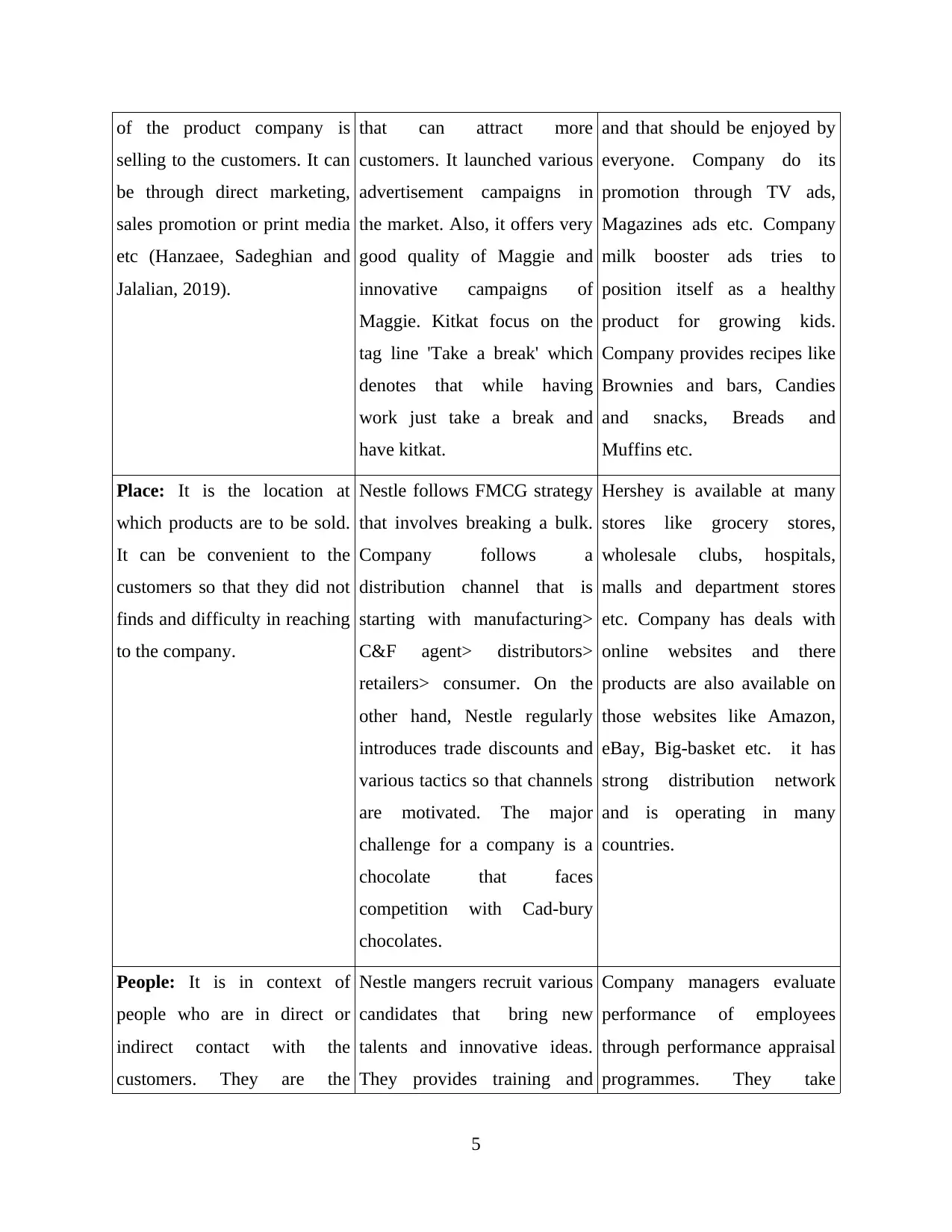
of the product company is
selling to the customers. It can
be through direct marketing,
sales promotion or print media
etc (Hanzaee, Sadeghian and
Jalalian, 2019).
that can attract more
customers. It launched various
advertisement campaigns in
the market. Also, it offers very
good quality of Maggie and
innovative campaigns of
Maggie. Kitkat focus on the
tag line 'Take a break' which
denotes that while having
work just take a break and
have kitkat.
and that should be enjoyed by
everyone. Company do its
promotion through TV ads,
Magazines ads etc. Company
milk booster ads tries to
position itself as a healthy
product for growing kids.
Company provides recipes like
Brownies and bars, Candies
and snacks, Breads and
Muffins etc.
Place: It is the location at
which products are to be sold.
It can be convenient to the
customers so that they did not
finds and difficulty in reaching
to the company.
Nestle follows FMCG strategy
that involves breaking a bulk.
Company follows a
distribution channel that is
starting with manufacturing>
C&F agent> distributors>
retailers> consumer. On the
other hand, Nestle regularly
introduces trade discounts and
various tactics so that channels
are motivated. The major
challenge for a company is a
chocolate that faces
competition with Cad-bury
chocolates.
Hershey is available at many
stores like grocery stores,
wholesale clubs, hospitals,
malls and department stores
etc. Company has deals with
online websites and there
products are also available on
those websites like Amazon,
eBay, Big-basket etc. it has
strong distribution network
and is operating in many
countries.
People: It is in context of
people who are in direct or
indirect contact with the
customers. They are the
Nestle mangers recruit various
candidates that bring new
talents and innovative ideas.
They provides training and
Company managers evaluate
performance of employees
through performance appraisal
programmes. They take
5
selling to the customers. It can
be through direct marketing,
sales promotion or print media
etc (Hanzaee, Sadeghian and
Jalalian, 2019).
that can attract more
customers. It launched various
advertisement campaigns in
the market. Also, it offers very
good quality of Maggie and
innovative campaigns of
Maggie. Kitkat focus on the
tag line 'Take a break' which
denotes that while having
work just take a break and
have kitkat.
and that should be enjoyed by
everyone. Company do its
promotion through TV ads,
Magazines ads etc. Company
milk booster ads tries to
position itself as a healthy
product for growing kids.
Company provides recipes like
Brownies and bars, Candies
and snacks, Breads and
Muffins etc.
Place: It is the location at
which products are to be sold.
It can be convenient to the
customers so that they did not
finds and difficulty in reaching
to the company.
Nestle follows FMCG strategy
that involves breaking a bulk.
Company follows a
distribution channel that is
starting with manufacturing>
C&F agent> distributors>
retailers> consumer. On the
other hand, Nestle regularly
introduces trade discounts and
various tactics so that channels
are motivated. The major
challenge for a company is a
chocolate that faces
competition with Cad-bury
chocolates.
Hershey is available at many
stores like grocery stores,
wholesale clubs, hospitals,
malls and department stores
etc. Company has deals with
online websites and there
products are also available on
those websites like Amazon,
eBay, Big-basket etc. it has
strong distribution network
and is operating in many
countries.
People: It is in context of
people who are in direct or
indirect contact with the
customers. They are the
Nestle mangers recruit various
candidates that bring new
talents and innovative ideas.
They provides training and
Company managers evaluate
performance of employees
through performance appraisal
programmes. They take
5
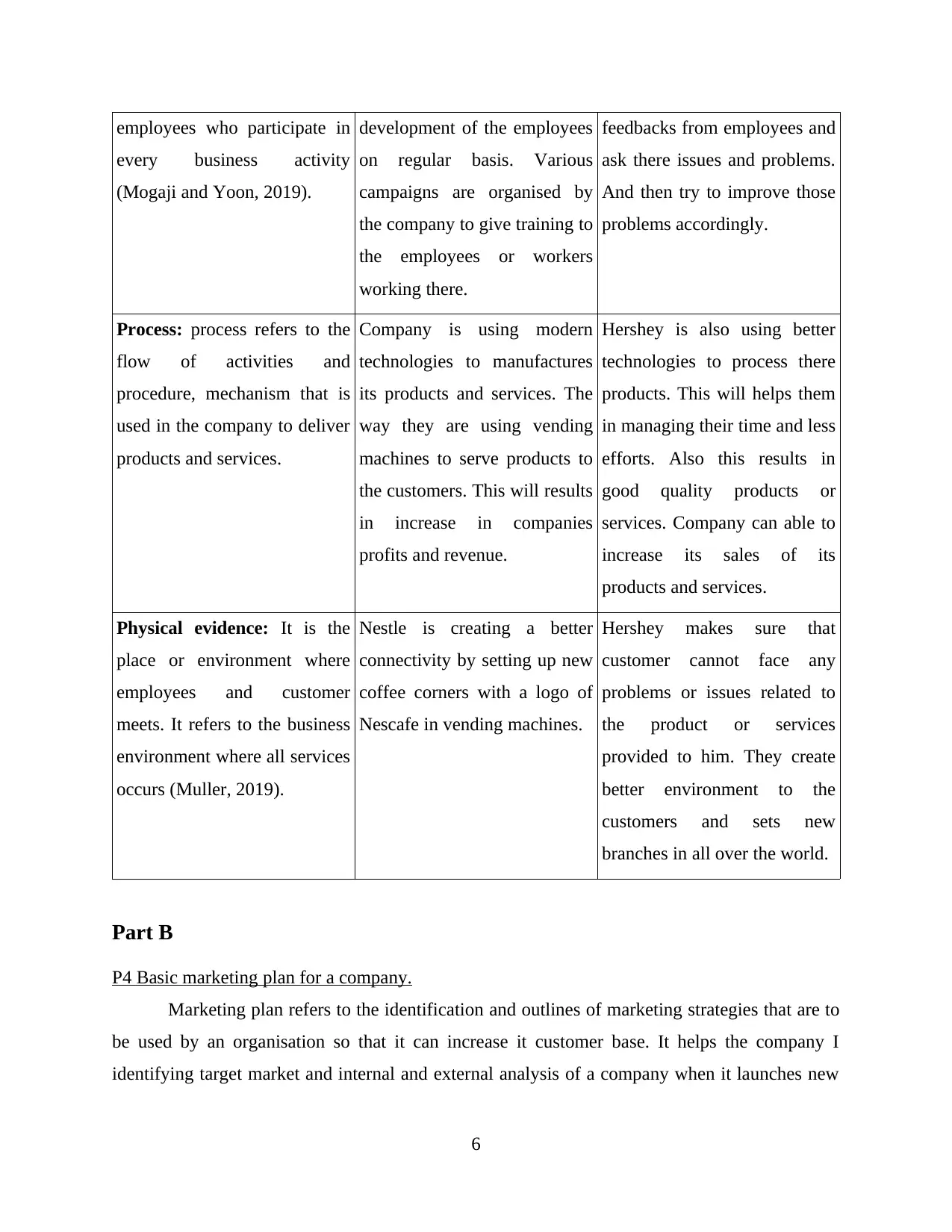
employees who participate in
every business activity
(Mogaji and Yoon, 2019).
development of the employees
on regular basis. Various
campaigns are organised by
the company to give training to
the employees or workers
working there.
feedbacks from employees and
ask there issues and problems.
And then try to improve those
problems accordingly.
Process: process refers to the
flow of activities and
procedure, mechanism that is
used in the company to deliver
products and services.
Company is using modern
technologies to manufactures
its products and services. The
way they are using vending
machines to serve products to
the customers. This will results
in increase in companies
profits and revenue.
Hershey is also using better
technologies to process there
products. This will helps them
in managing their time and less
efforts. Also this results in
good quality products or
services. Company can able to
increase its sales of its
products and services.
Physical evidence: It is the
place or environment where
employees and customer
meets. It refers to the business
environment where all services
occurs (Muller, 2019).
Nestle is creating a better
connectivity by setting up new
coffee corners with a logo of
Nescafe in vending machines.
Hershey makes sure that
customer cannot face any
problems or issues related to
the product or services
provided to him. They create
better environment to the
customers and sets new
branches in all over the world.
Part B
P4 Basic marketing plan for a company.
Marketing plan refers to the identification and outlines of marketing strategies that are to
be used by an organisation so that it can increase it customer base. It helps the company I
identifying target market and internal and external analysis of a company when it launches new
6
every business activity
(Mogaji and Yoon, 2019).
development of the employees
on regular basis. Various
campaigns are organised by
the company to give training to
the employees or workers
working there.
feedbacks from employees and
ask there issues and problems.
And then try to improve those
problems accordingly.
Process: process refers to the
flow of activities and
procedure, mechanism that is
used in the company to deliver
products and services.
Company is using modern
technologies to manufactures
its products and services. The
way they are using vending
machines to serve products to
the customers. This will results
in increase in companies
profits and revenue.
Hershey is also using better
technologies to process there
products. This will helps them
in managing their time and less
efforts. Also this results in
good quality products or
services. Company can able to
increase its sales of its
products and services.
Physical evidence: It is the
place or environment where
employees and customer
meets. It refers to the business
environment where all services
occurs (Muller, 2019).
Nestle is creating a better
connectivity by setting up new
coffee corners with a logo of
Nescafe in vending machines.
Hershey makes sure that
customer cannot face any
problems or issues related to
the product or services
provided to him. They create
better environment to the
customers and sets new
branches in all over the world.
Part B
P4 Basic marketing plan for a company.
Marketing plan refers to the identification and outlines of marketing strategies that are to
be used by an organisation so that it can increase it customer base. It helps the company I
identifying target market and internal and external analysis of a company when it launches new
6
⊘ This is a preview!⊘
Do you want full access?
Subscribe today to unlock all pages.
Trusted by 1+ million students worldwide
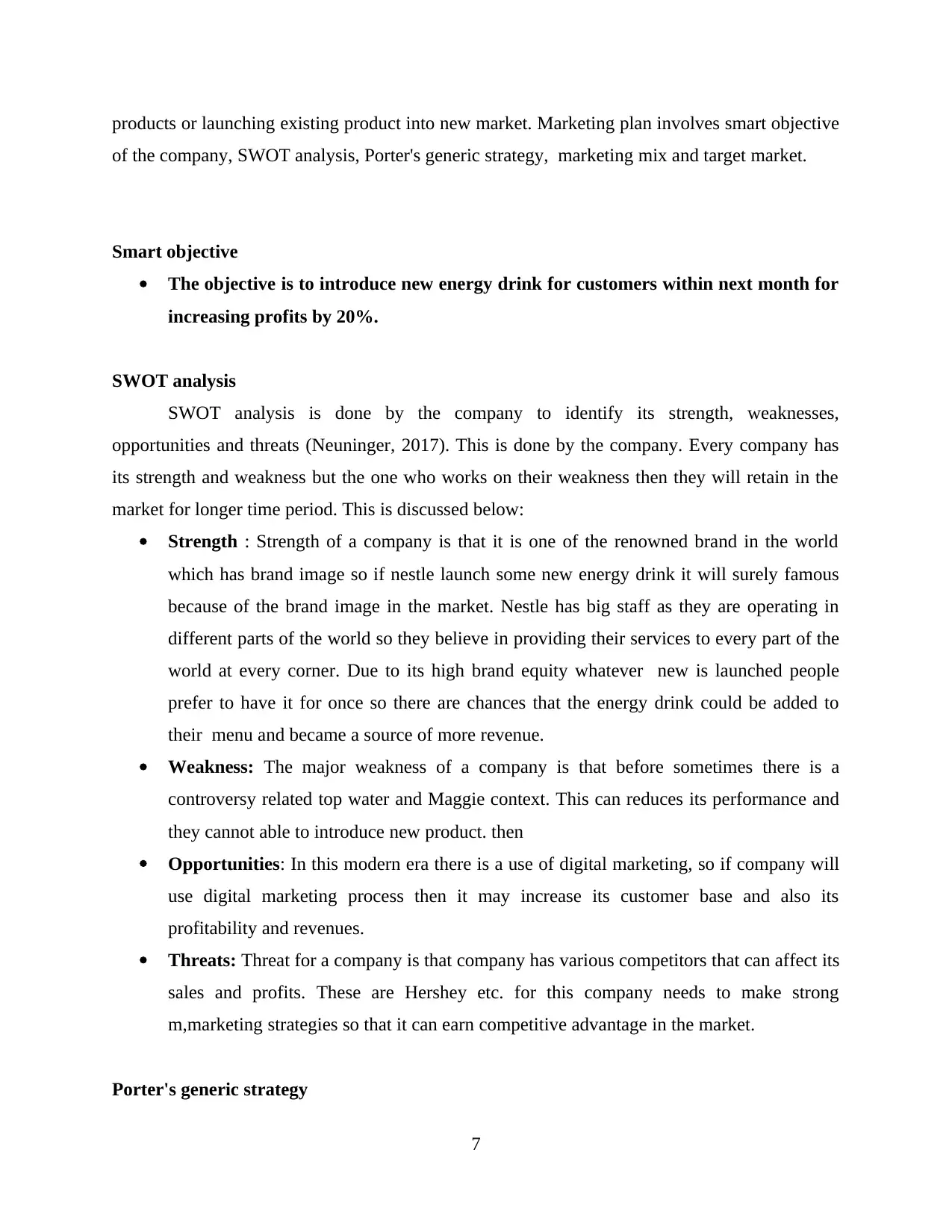
products or launching existing product into new market. Marketing plan involves smart objective
of the company, SWOT analysis, Porter's generic strategy, marketing mix and target market.
Smart objective
The objective is to introduce new energy drink for customers within next month for
increasing profits by 20%.
SWOT analysis
SWOT analysis is done by the company to identify its strength, weaknesses,
opportunities and threats (Neuninger, 2017). This is done by the company. Every company has
its strength and weakness but the one who works on their weakness then they will retain in the
market for longer time period. This is discussed below:
Strength : Strength of a company is that it is one of the renowned brand in the world
which has brand image so if nestle launch some new energy drink it will surely famous
because of the brand image in the market. Nestle has big staff as they are operating in
different parts of the world so they believe in providing their services to every part of the
world at every corner. Due to its high brand equity whatever new is launched people
prefer to have it for once so there are chances that the energy drink could be added to
their menu and became a source of more revenue.
Weakness: The major weakness of a company is that before sometimes there is a
controversy related top water and Maggie context. This can reduces its performance and
they cannot able to introduce new product. then
Opportunities: In this modern era there is a use of digital marketing, so if company will
use digital marketing process then it may increase its customer base and also its
profitability and revenues.
Threats: Threat for a company is that company has various competitors that can affect its
sales and profits. These are Hershey etc. for this company needs to make strong
m,marketing strategies so that it can earn competitive advantage in the market.
Porter's generic strategy
7
of the company, SWOT analysis, Porter's generic strategy, marketing mix and target market.
Smart objective
The objective is to introduce new energy drink for customers within next month for
increasing profits by 20%.
SWOT analysis
SWOT analysis is done by the company to identify its strength, weaknesses,
opportunities and threats (Neuninger, 2017). This is done by the company. Every company has
its strength and weakness but the one who works on their weakness then they will retain in the
market for longer time period. This is discussed below:
Strength : Strength of a company is that it is one of the renowned brand in the world
which has brand image so if nestle launch some new energy drink it will surely famous
because of the brand image in the market. Nestle has big staff as they are operating in
different parts of the world so they believe in providing their services to every part of the
world at every corner. Due to its high brand equity whatever new is launched people
prefer to have it for once so there are chances that the energy drink could be added to
their menu and became a source of more revenue.
Weakness: The major weakness of a company is that before sometimes there is a
controversy related top water and Maggie context. This can reduces its performance and
they cannot able to introduce new product. then
Opportunities: In this modern era there is a use of digital marketing, so if company will
use digital marketing process then it may increase its customer base and also its
profitability and revenues.
Threats: Threat for a company is that company has various competitors that can affect its
sales and profits. These are Hershey etc. for this company needs to make strong
m,marketing strategies so that it can earn competitive advantage in the market.
Porter's generic strategy
7
Paraphrase This Document
Need a fresh take? Get an instant paraphrase of this document with our AI Paraphraser
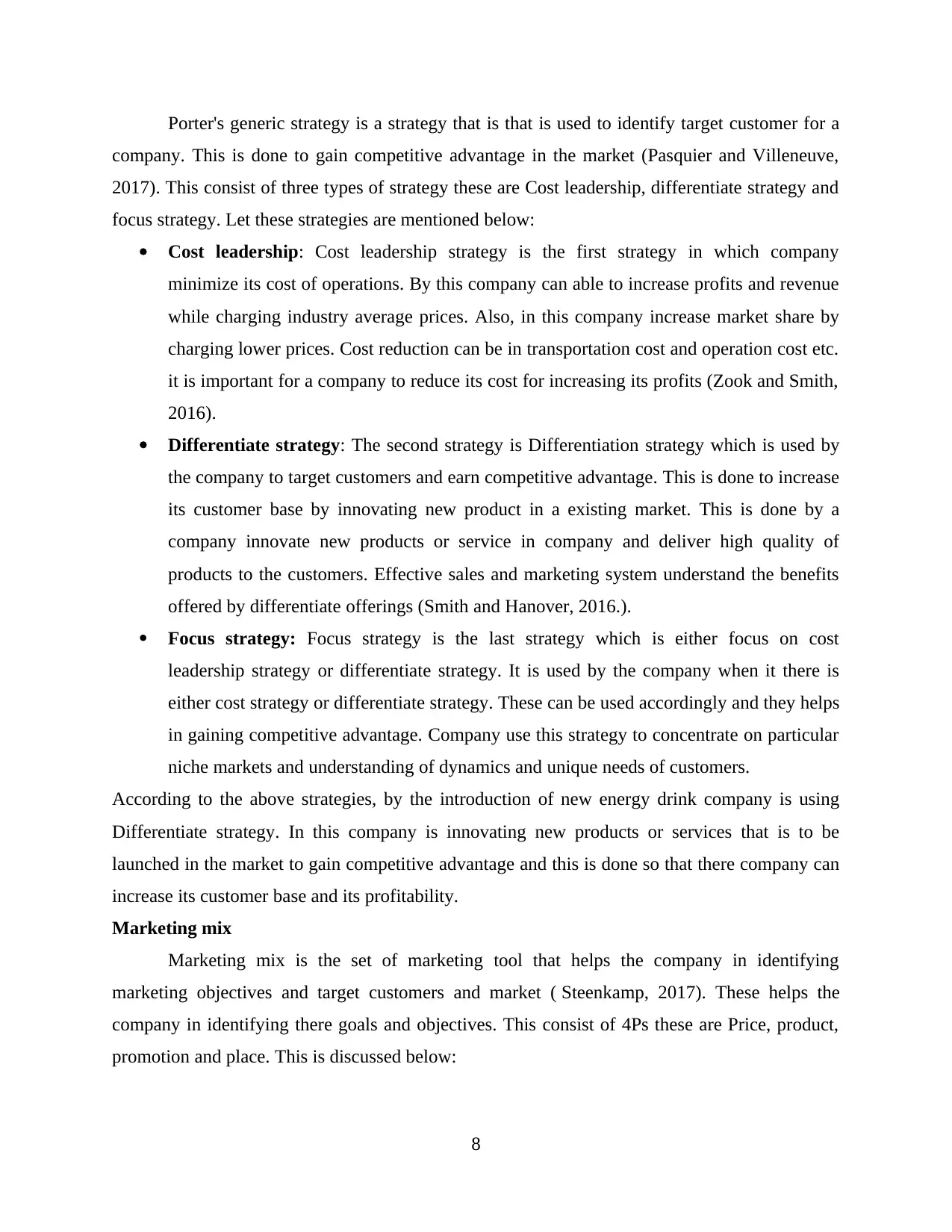
Porter's generic strategy is a strategy that is that is used to identify target customer for a
company. This is done to gain competitive advantage in the market (Pasquier and Villeneuve,
2017). This consist of three types of strategy these are Cost leadership, differentiate strategy and
focus strategy. Let these strategies are mentioned below:
Cost leadership: Cost leadership strategy is the first strategy in which company
minimize its cost of operations. By this company can able to increase profits and revenue
while charging industry average prices. Also, in this company increase market share by
charging lower prices. Cost reduction can be in transportation cost and operation cost etc.
it is important for a company to reduce its cost for increasing its profits (Zook and Smith,
2016).
Differentiate strategy: The second strategy is Differentiation strategy which is used by
the company to target customers and earn competitive advantage. This is done to increase
its customer base by innovating new product in a existing market. This is done by a
company innovate new products or service in company and deliver high quality of
products to the customers. Effective sales and marketing system understand the benefits
offered by differentiate offerings (Smith and Hanover, 2016.).
Focus strategy: Focus strategy is the last strategy which is either focus on cost
leadership strategy or differentiate strategy. It is used by the company when it there is
either cost strategy or differentiate strategy. These can be used accordingly and they helps
in gaining competitive advantage. Company use this strategy to concentrate on particular
niche markets and understanding of dynamics and unique needs of customers.
According to the above strategies, by the introduction of new energy drink company is using
Differentiate strategy. In this company is innovating new products or services that is to be
launched in the market to gain competitive advantage and this is done so that there company can
increase its customer base and its profitability.
Marketing mix
Marketing mix is the set of marketing tool that helps the company in identifying
marketing objectives and target customers and market ( Steenkamp, 2017). These helps the
company in identifying there goals and objectives. This consist of 4Ps these are Price, product,
promotion and place. This is discussed below:
8
company. This is done to gain competitive advantage in the market (Pasquier and Villeneuve,
2017). This consist of three types of strategy these are Cost leadership, differentiate strategy and
focus strategy. Let these strategies are mentioned below:
Cost leadership: Cost leadership strategy is the first strategy in which company
minimize its cost of operations. By this company can able to increase profits and revenue
while charging industry average prices. Also, in this company increase market share by
charging lower prices. Cost reduction can be in transportation cost and operation cost etc.
it is important for a company to reduce its cost for increasing its profits (Zook and Smith,
2016).
Differentiate strategy: The second strategy is Differentiation strategy which is used by
the company to target customers and earn competitive advantage. This is done to increase
its customer base by innovating new product in a existing market. This is done by a
company innovate new products or service in company and deliver high quality of
products to the customers. Effective sales and marketing system understand the benefits
offered by differentiate offerings (Smith and Hanover, 2016.).
Focus strategy: Focus strategy is the last strategy which is either focus on cost
leadership strategy or differentiate strategy. It is used by the company when it there is
either cost strategy or differentiate strategy. These can be used accordingly and they helps
in gaining competitive advantage. Company use this strategy to concentrate on particular
niche markets and understanding of dynamics and unique needs of customers.
According to the above strategies, by the introduction of new energy drink company is using
Differentiate strategy. In this company is innovating new products or services that is to be
launched in the market to gain competitive advantage and this is done so that there company can
increase its customer base and its profitability.
Marketing mix
Marketing mix is the set of marketing tool that helps the company in identifying
marketing objectives and target customers and market ( Steenkamp, 2017). These helps the
company in identifying there goals and objectives. This consist of 4Ps these are Price, product,
promotion and place. This is discussed below:
8
Price: Price is refers to the amount that is to be paid by the customers for purchase of the
product or services company is providing. This will be accurate and not so much high.
New energy drink price should be very accurate in previously and cannot be so much
high. Because high amount of price cannot be reach by middle class people. If prices are
high then there will be quality of product should be provided to customers.
Product: Product that is launched or introduced by the company is Nestle energy drink
for those person who are health secure and avoids junk foods. This will target those
people who are health secure. This product will carry no added flavours and just a type of
juice which can be taken by any age of people. But mostly it will focus on the age group
of 15 to 35 years of age people (Vuignier, 2017).
Promotion: Promotion of the new product will be through various platforms like print
media, online website and TV ads, radio, search engine optimization and social media
platform etc. company will introduce it in the existing market first to increase its base and
then shift to new market. This will helps them in earning more profit and revenues.
Place: Company will introduce new energy drink in existing market to test it among the
existing customer because it will first test that product that how it will be approved by the
customers (Yi, 2017). Then after it has approved and liked by the customers then it will
introduced in new market to increase customer base and profitability both.
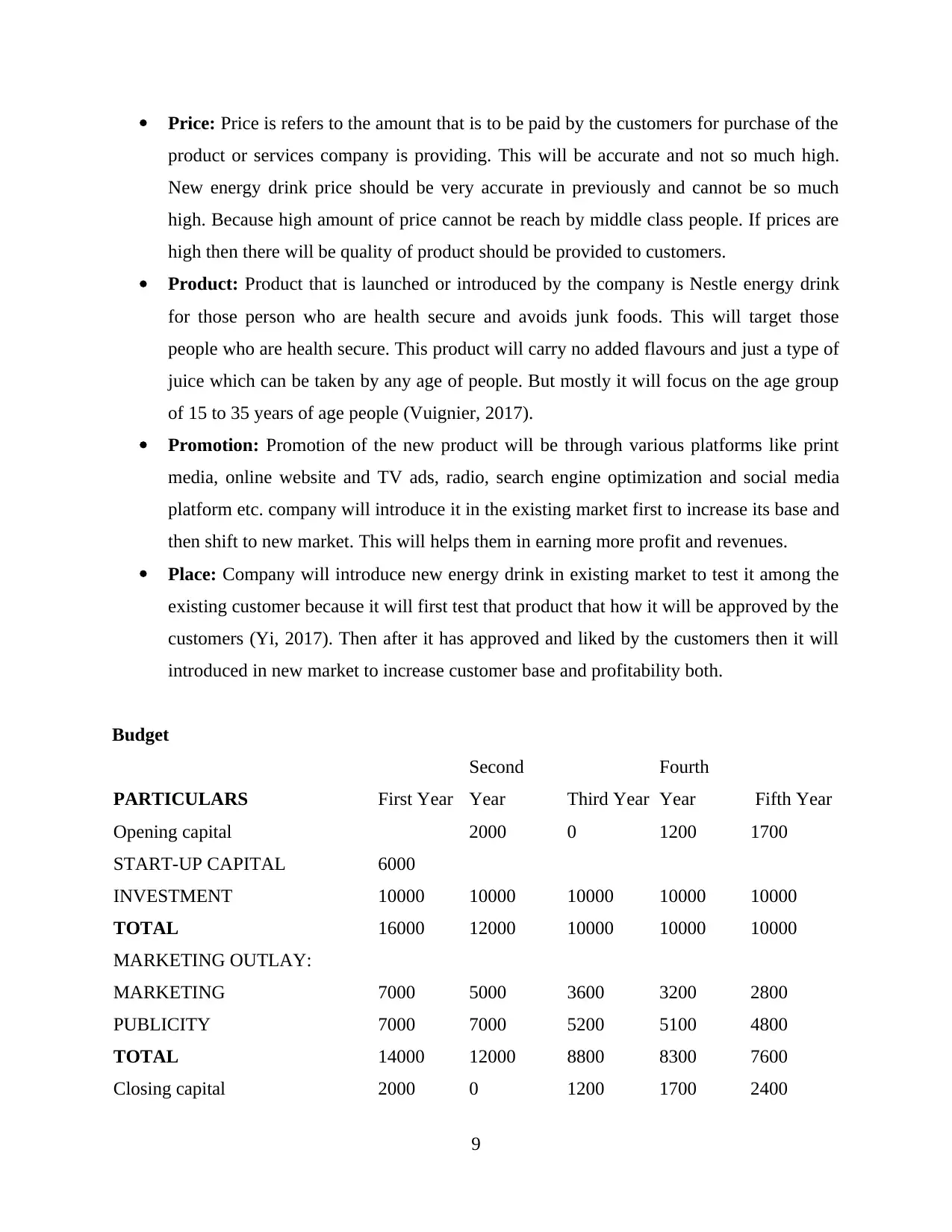
Budget
PARTICULARS First Year
Second
Year Third Year
Fourth
Year Fifth Year
Opening capital 2000 0 1200 1700
START-UP CAPITAL 6000
INVESTMENT 10000 10000 10000 10000 10000
TOTAL 16000 12000 10000 10000 10000
MARKETING OUTLAY:
MARKETING 7000 5000 3600 3200 2800
PUBLICITY 7000 7000 5200 5100 4800
TOTAL 14000 12000 8800 8300 7600
Closing capital 2000 0 1200 1700 2400
9
product or services company is providing. This will be accurate and not so much high.
New energy drink price should be very accurate in previously and cannot be so much
high. Because high amount of price cannot be reach by middle class people. If prices are
high then there will be quality of product should be provided to customers.
Product: Product that is launched or introduced by the company is Nestle energy drink
for those person who are health secure and avoids junk foods. This will target those
people who are health secure. This product will carry no added flavours and just a type of
juice which can be taken by any age of people. But mostly it will focus on the age group
of 15 to 35 years of age people (Vuignier, 2017).
Promotion: Promotion of the new product will be through various platforms like print
media, online website and TV ads, radio, search engine optimization and social media
platform etc. company will introduce it in the existing market first to increase its base and
then shift to new market. This will helps them in earning more profit and revenues.
Place: Company will introduce new energy drink in existing market to test it among the
existing customer because it will first test that product that how it will be approved by the
customers (Yi, 2017). Then after it has approved and liked by the customers then it will
introduced in new market to increase customer base and profitability both.
Budget
PARTICULARS First Year
Second
Year Third Year
Fourth
Year Fifth Year
Opening capital 2000 0 1200 1700
START-UP CAPITAL 6000
INVESTMENT 10000 10000 10000 10000 10000
TOTAL 16000 12000 10000 10000 10000
MARKETING OUTLAY:
MARKETING 7000 5000 3600 3200 2800
PUBLICITY 7000 7000 5200 5100 4800
TOTAL 14000 12000 8800 8300 7600
Closing capital 2000 0 1200 1700 2400
9
⊘ This is a preview!⊘
Do you want full access?
Subscribe today to unlock all pages.
Trusted by 1+ million students worldwide
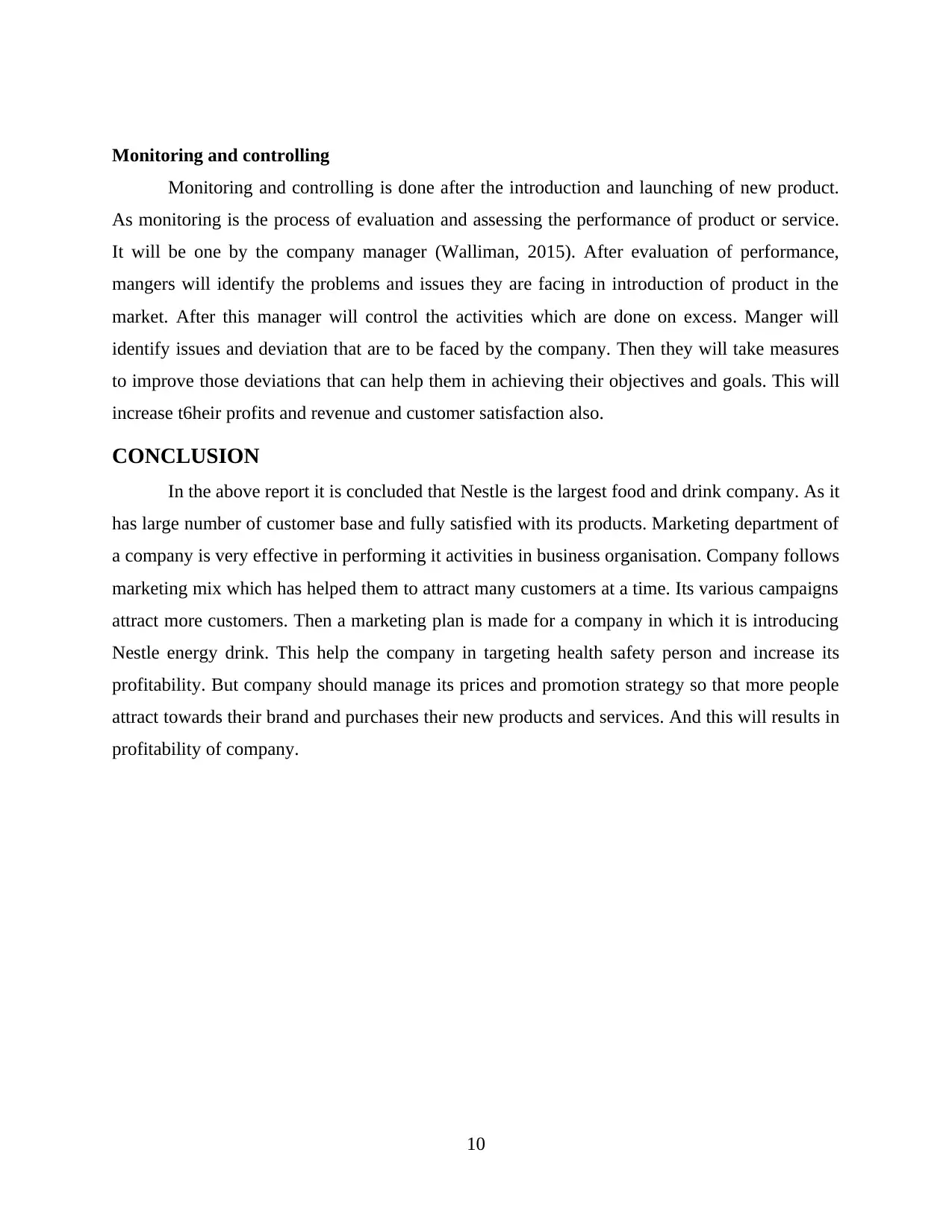
Monitoring and controlling
Monitoring and controlling is done after the introduction and launching of new product.
As monitoring is the process of evaluation and assessing the performance of product or service.
It will be one by the company manager (Walliman, 2015). After evaluation of performance,
mangers will identify the problems and issues they are facing in introduction of product in the
market. After this manager will control the activities which are done on excess. Manger will
identify issues and deviation that are to be faced by the company. Then they will take measures
to improve those deviations that can help them in achieving their objectives and goals. This will
increase t6heir profits and revenue and customer satisfaction also.
CONCLUSION
In the above report it is concluded that Nestle is the largest food and drink company. As it
has large number of customer base and fully satisfied with its products. Marketing department of
a company is very effective in performing it activities in business organisation. Company follows
marketing mix which has helped them to attract many customers at a time. Its various campaigns
attract more customers. Then a marketing plan is made for a company in which it is introducing
Nestle energy drink. This help the company in targeting health safety person and increase its
profitability. But company should manage its prices and promotion strategy so that more people
attract towards their brand and purchases their new products and services. And this will results in
profitability of company.
10
Monitoring and controlling is done after the introduction and launching of new product.
As monitoring is the process of evaluation and assessing the performance of product or service.
It will be one by the company manager (Walliman, 2015). After evaluation of performance,
mangers will identify the problems and issues they are facing in introduction of product in the
market. After this manager will control the activities which are done on excess. Manger will
identify issues and deviation that are to be faced by the company. Then they will take measures
to improve those deviations that can help them in achieving their objectives and goals. This will
increase t6heir profits and revenue and customer satisfaction also.
CONCLUSION
In the above report it is concluded that Nestle is the largest food and drink company. As it
has large number of customer base and fully satisfied with its products. Marketing department of
a company is very effective in performing it activities in business organisation. Company follows
marketing mix which has helped them to attract many customers at a time. Its various campaigns
attract more customers. Then a marketing plan is made for a company in which it is introducing
Nestle energy drink. This help the company in targeting health safety person and increase its
profitability. But company should manage its prices and promotion strategy so that more people
attract towards their brand and purchases their new products and services. And this will results in
profitability of company.
10
Paraphrase This Document
Need a fresh take? Get an instant paraphrase of this document with our AI Paraphraser
REFERENCES
Christofi and et.al., 2018. Customer engagement through choice in cause-related marketing: A
potential for global competitiveness. International Marketing Review.
Dioko, L.D.A., 2016. Progress and trends in destination branding and marketing–a brief and
broad review. International Journal of Culture, Tourism and Hospitality Research.
Dzyabura, D. and Yoganarasimhan, H., 2018. Machine learning and marketing. In Handbook of
Marketing Analytics. Edward Elgar Publishing.
Fill, C. and Turnbull, S., 2019. Marketing Communications: Touchpoints, Sharing and
Disruption. Pearson UK.
Hanzaee, K.H., Sadeghian, M. and Jalalian, S., 2019. Which can affect more? Cause marketing
or cause-related marketing. Journal of Islamic Marketing.
Mogaji, E. and Yoon, H., 2019. Thematic analysis of marketing messages in UK universities’
prospectuses. International Journal of Educational Management.
Muller, M., 2019. Essentials of inventory management. HarperCollins Leadership.
Neuninger, R., 2017. Qualitative marketing methodology. Routledge Handbook of Hospitality
Marketing.
Pasquier, M. and Villeneuve, J.P., 2017. Marketing management and communications in the
public sector. Routledge.
Smith, K. and Hanover, D., 2016. Experiential marketing: Secrets, strategies, and success stories
from the World's greatest brands. John Wiley & Sons.
Steenkamp, J.B., 2017. Global brand strategy: World-wise marketing in the age of branding.
Springer.
Vuignier, R., 2017. Place branding & place marketing 1976–2016: A multidisciplinary literature
review. International Review on Public and Nonprofit Marketing, 14(4), pp.447-473.
Walliman, N., 2015. Social research methods: The essentials. Sage.
Yi, Z.G., 2017. Marketing services and resources in information organizations. Chandos
Publishing.
Zook, Z. and Smith, P.R., 2016. Marketing communications: offline and online integration,
engagement and analytics. Kogan Page Publishers.
11
Christofi and et.al., 2018. Customer engagement through choice in cause-related marketing: A
potential for global competitiveness. International Marketing Review.
Dioko, L.D.A., 2016. Progress and trends in destination branding and marketing–a brief and
broad review. International Journal of Culture, Tourism and Hospitality Research.
Dzyabura, D. and Yoganarasimhan, H., 2018. Machine learning and marketing. In Handbook of
Marketing Analytics. Edward Elgar Publishing.
Fill, C. and Turnbull, S., 2019. Marketing Communications: Touchpoints, Sharing and
Disruption. Pearson UK.
Hanzaee, K.H., Sadeghian, M. and Jalalian, S., 2019. Which can affect more? Cause marketing
or cause-related marketing. Journal of Islamic Marketing.
Mogaji, E. and Yoon, H., 2019. Thematic analysis of marketing messages in UK universities’
prospectuses. International Journal of Educational Management.
Muller, M., 2019. Essentials of inventory management. HarperCollins Leadership.
Neuninger, R., 2017. Qualitative marketing methodology. Routledge Handbook of Hospitality
Marketing.
Pasquier, M. and Villeneuve, J.P., 2017. Marketing management and communications in the
public sector. Routledge.
Smith, K. and Hanover, D., 2016. Experiential marketing: Secrets, strategies, and success stories
from the World's greatest brands. John Wiley & Sons.
Steenkamp, J.B., 2017. Global brand strategy: World-wise marketing in the age of branding.
Springer.
Vuignier, R., 2017. Place branding & place marketing 1976–2016: A multidisciplinary literature
review. International Review on Public and Nonprofit Marketing, 14(4), pp.447-473.
Walliman, N., 2015. Social research methods: The essentials. Sage.
Yi, Z.G., 2017. Marketing services and resources in information organizations. Chandos
Publishing.
Zook, Z. and Smith, P.R., 2016. Marketing communications: offline and online integration,
engagement and analytics. Kogan Page Publishers.
11

1 out of 11


Related Documents


Your All-in-One AI-Powered Toolkit for Academic Success.
+13062052269
info@desklib.com
Available 24*7 on WhatsApp / Email
![[object Object]](/_next/static/media/star-bottom.7253800d.svg)
Unlock your academic potential
Copyright © 2020–2026 A2Z Services. All Rights Reserved. Developed and managed by ZUCOL.