Marketing Principles and Practice Report: Ford Motor Company Analysis
VerifiedAdded on 2021/01/01
|6
|1313
|58
Report
AI Summary
This report delves into the marketing principles and practices of Ford Motor Company, examining key marketing concepts and terminology, such as product and sales orientation, employed by the company. It analyzes the consumer decision-making process, outlining the stages customers go through when purchasing a Ford vehicle, from need recognition to post-purchase evaluation. The report highlights the significance of understanding consumer behavior and adapting marketing strategies to meet customer needs effectively. It also provides recommendations for Ford to enhance its marketing efforts, including cost reduction and product improvement to increase profitability and customer satisfaction. The report is based on research and analysis of existing literature and provides valuable insights into Ford's marketing approach.
Marketing Principles and
Practice Report
Practice Report
Paraphrase This Document
Need a fresh take? Get an instant paraphrase of this document with our AI Paraphraser

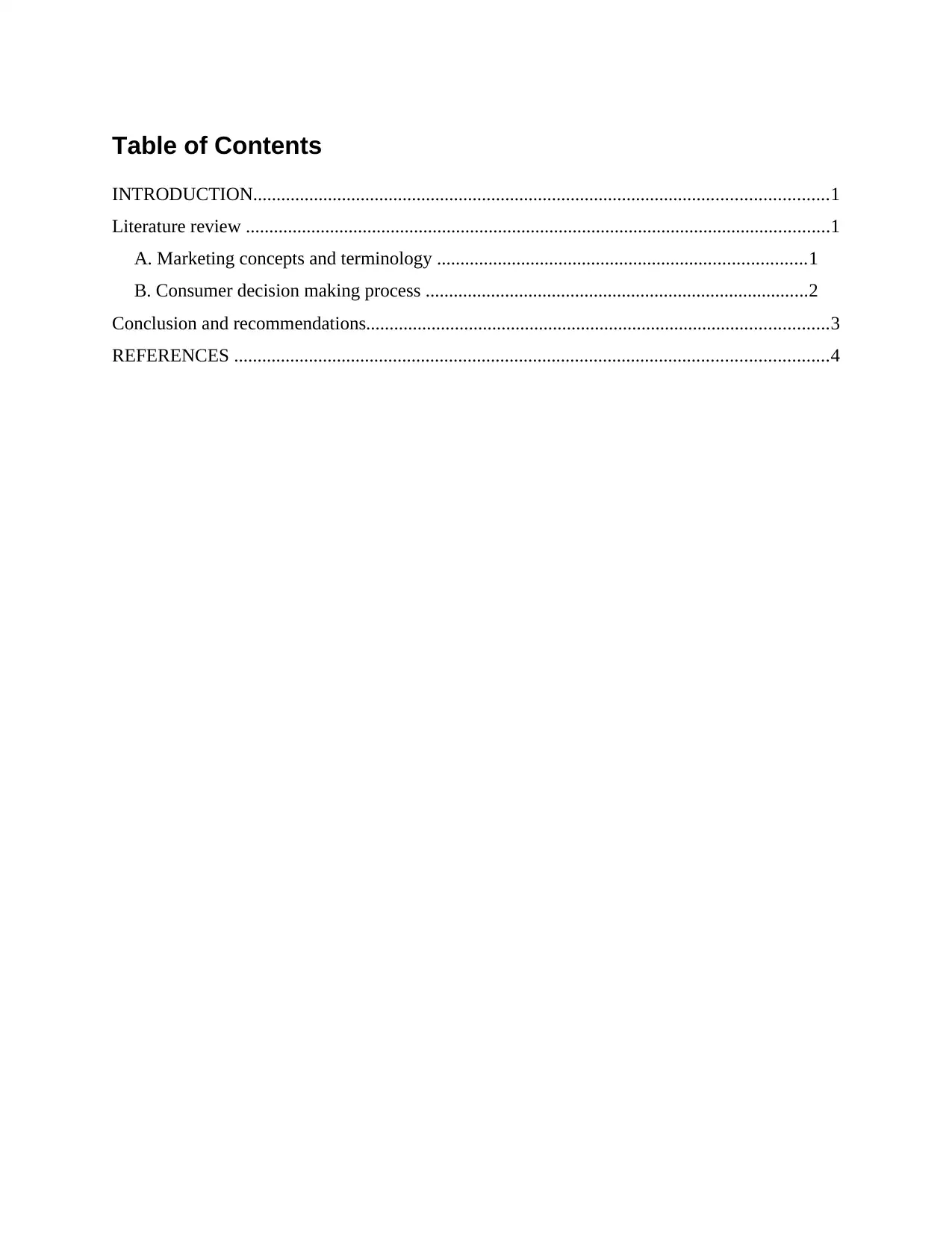
Table of Contents
INTRODUCTION...........................................................................................................................1
Literature review .............................................................................................................................1
A. Marketing concepts and terminology ...............................................................................1
B. Consumer decision making process ..................................................................................2
Conclusion and recommendations...................................................................................................3
REFERENCES ...............................................................................................................................4
INTRODUCTION...........................................................................................................................1
Literature review .............................................................................................................................1
A. Marketing concepts and terminology ...............................................................................1
B. Consumer decision making process ..................................................................................2
Conclusion and recommendations...................................................................................................3
REFERENCES ...............................................................................................................................4

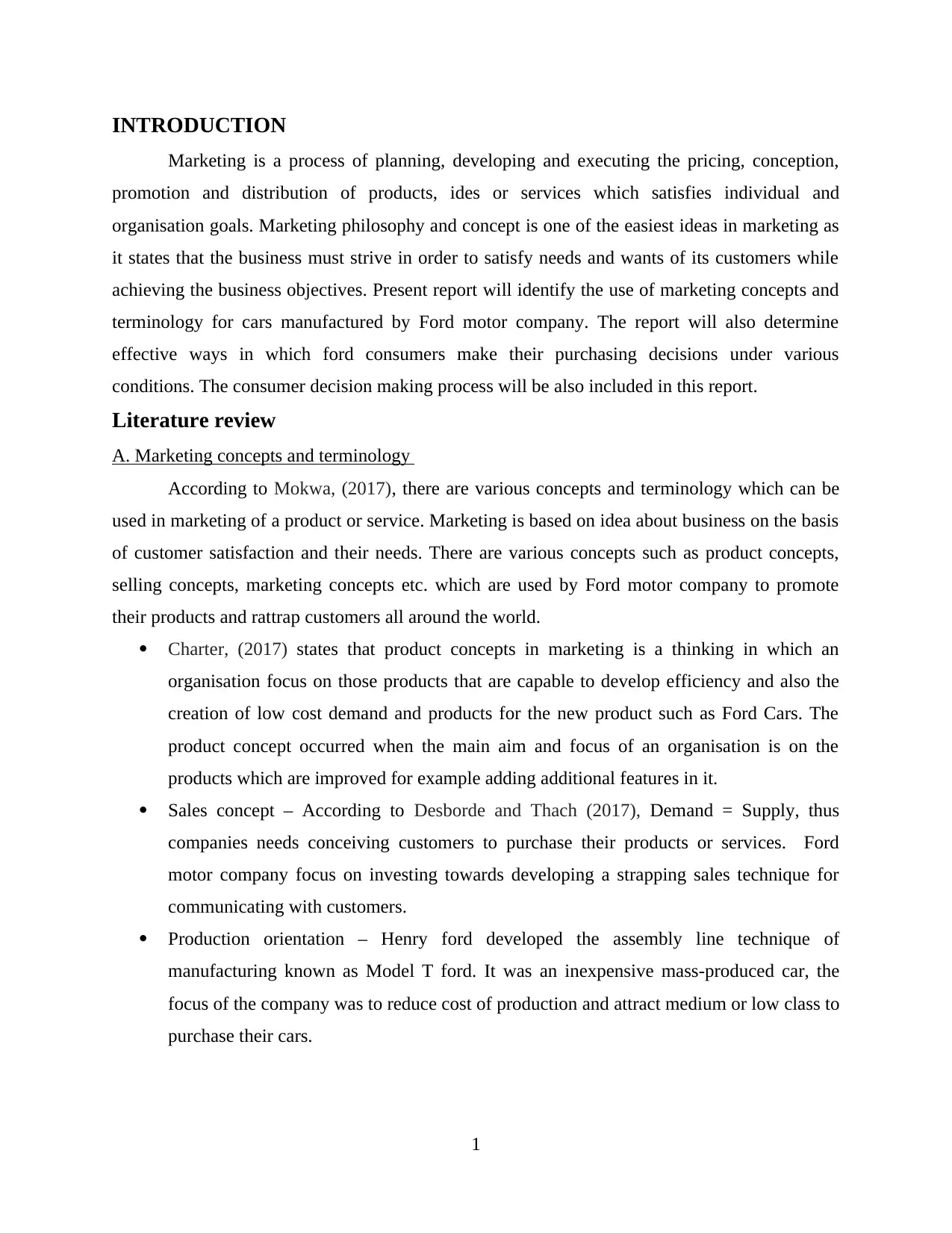
INTRODUCTION
Marketing is a process of planning, developing and executing the pricing, conception,
promotion and distribution of products, ides or services which satisfies individual and
organisation goals. Marketing philosophy and concept is one of the easiest ideas in marketing as
it states that the business must strive in order to satisfy needs and wants of its customers while
achieving the business objectives. Present report will identify the use of marketing concepts and
terminology for cars manufactured by Ford motor company. The report will also determine
effective ways in which ford consumers make their purchasing decisions under various
conditions. The consumer decision making process will be also included in this report.
Literature review
A. Marketing concepts and terminology
According to Mokwa, (2017), there are various concepts and terminology which can be
used in marketing of a product or service. Marketing is based on idea about business on the basis
of customer satisfaction and their needs. There are various concepts such as product concepts,
selling concepts, marketing concepts etc. which are used by Ford motor company to promote
their products and rattrap customers all around the world.
Charter, (2017) states that product concepts in marketing is a thinking in which an
organisation focus on those products that are capable to develop efficiency and also the
creation of low cost demand and products for the new product such as Ford Cars. The
product concept occurred when the main aim and focus of an organisation is on the
products which are improved for example adding additional features in it.
Sales concept – According to Desborde and Thach (2017), Demand = Supply, thus
companies needs conceiving customers to purchase their products or services. Ford
motor company focus on investing towards developing a strapping sales technique for
communicating with customers.
Production orientation – Henry ford developed the assembly line technique of
manufacturing known as Model T ford. It was an inexpensive mass-produced car, the
focus of the company was to reduce cost of production and attract medium or low class to
purchase their cars.
1
Marketing is a process of planning, developing and executing the pricing, conception,
promotion and distribution of products, ides or services which satisfies individual and
organisation goals. Marketing philosophy and concept is one of the easiest ideas in marketing as
it states that the business must strive in order to satisfy needs and wants of its customers while
achieving the business objectives. Present report will identify the use of marketing concepts and
terminology for cars manufactured by Ford motor company. The report will also determine
effective ways in which ford consumers make their purchasing decisions under various
conditions. The consumer decision making process will be also included in this report.
Literature review
A. Marketing concepts and terminology
According to Mokwa, (2017), there are various concepts and terminology which can be
used in marketing of a product or service. Marketing is based on idea about business on the basis
of customer satisfaction and their needs. There are various concepts such as product concepts,
selling concepts, marketing concepts etc. which are used by Ford motor company to promote
their products and rattrap customers all around the world.
Charter, (2017) states that product concepts in marketing is a thinking in which an
organisation focus on those products that are capable to develop efficiency and also the
creation of low cost demand and products for the new product such as Ford Cars. The
product concept occurred when the main aim and focus of an organisation is on the
products which are improved for example adding additional features in it.
Sales concept – According to Desborde and Thach (2017), Demand = Supply, thus
companies needs conceiving customers to purchase their products or services. Ford
motor company focus on investing towards developing a strapping sales technique for
communicating with customers.
Production orientation – Henry ford developed the assembly line technique of
manufacturing known as Model T ford. It was an inexpensive mass-produced car, the
focus of the company was to reduce cost of production and attract medium or low class to
purchase their cars.
1
⊘ This is a preview!⊘
Do you want full access?
Subscribe today to unlock all pages.

Trusted by 1+ million students worldwide

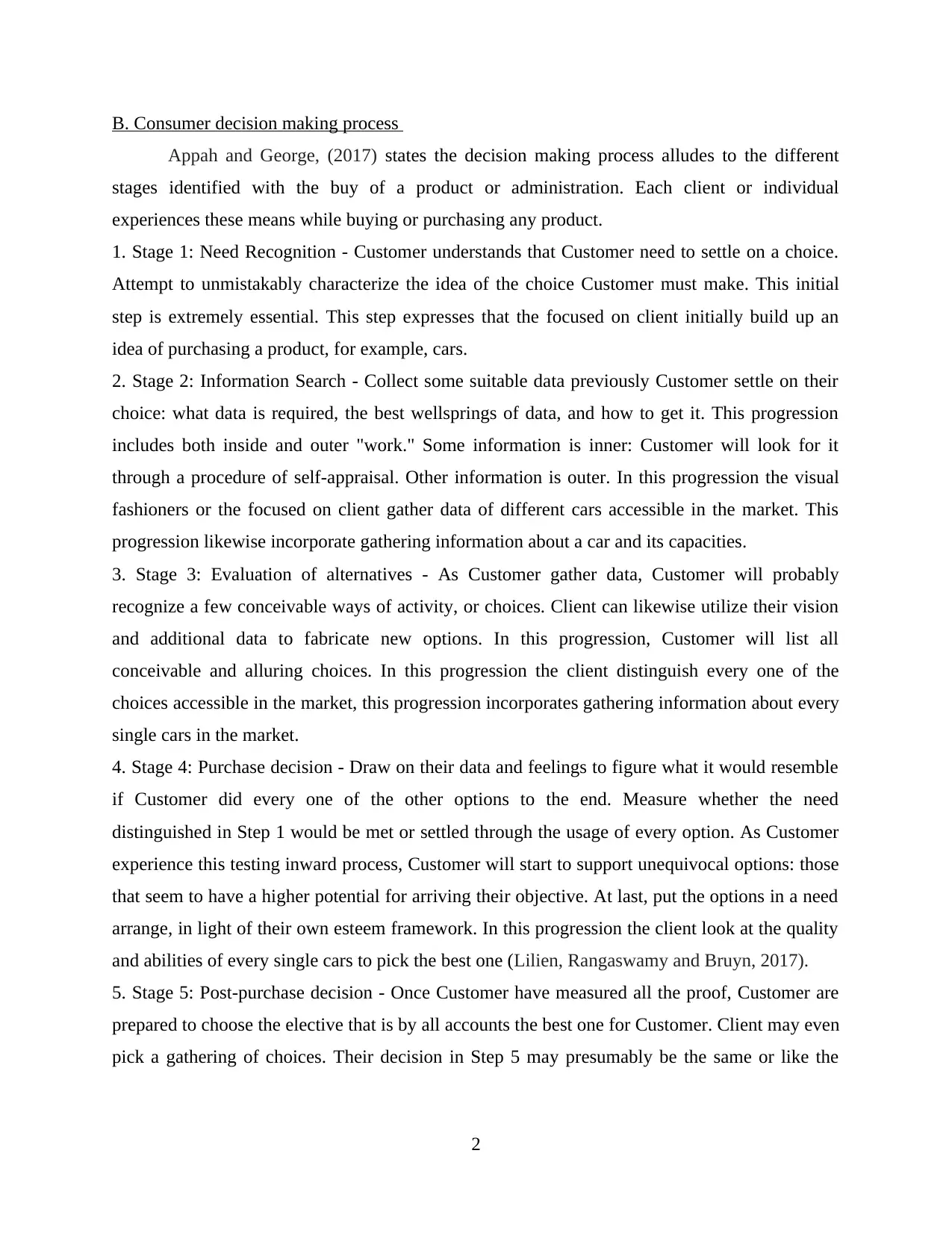
B. Consumer decision making process
Appah and George, (2017) states the decision making process alludes to the different
stages identified with the buy of a product or administration. Each client or individual
experiences these means while buying or purchasing any product.
1. Stage 1: Need Recognition - Customer understands that Customer need to settle on a choice.
Attempt to unmistakably characterize the idea of the choice Customer must make. This initial
step is extremely essential. This step expresses that the focused on client initially build up an
idea of purchasing a product, for example, cars.
2. Stage 2: Information Search - Collect some suitable data previously Customer settle on their
choice: what data is required, the best wellsprings of data, and how to get it. This progression
includes both inside and outer "work." Some information is inner: Customer will look for it
through a procedure of self-appraisal. Other information is outer. In this progression the visual
fashioners or the focused on client gather data of different cars accessible in the market. This
progression likewise incorporate gathering information about a car and its capacities.
3. Stage 3: Evaluation of alternatives - As Customer gather data, Customer will probably
recognize a few conceivable ways of activity, or choices. Client can likewise utilize their vision
and additional data to fabricate new options. In this progression, Customer will list all
conceivable and alluring choices. In this progression the client distinguish every one of the
choices accessible in the market, this progression incorporates gathering information about every
single cars in the market.
4. Stage 4: Purchase decision - Draw on their data and feelings to figure what it would resemble
if Customer did every one of the other options to the end. Measure whether the need
distinguished in Step 1 would be met or settled through the usage of every option. As Customer
experience this testing inward process, Customer will start to support unequivocal options: those
that seem to have a higher potential for arriving their objective. At last, put the options in a need
arrange, in light of their own esteem framework. In this progression the client look at the quality
and abilities of every single cars to pick the best one (Lilien, Rangaswamy and Bruyn, 2017).
5. Stage 5: Post-purchase decision - Once Customer have measured all the proof, Customer are
prepared to choose the elective that is by all accounts the best one for Customer. Client may even
pick a gathering of choices. Their decision in Step 5 may presumably be the same or like the
2
Appah and George, (2017) states the decision making process alludes to the different
stages identified with the buy of a product or administration. Each client or individual
experiences these means while buying or purchasing any product.
1. Stage 1: Need Recognition - Customer understands that Customer need to settle on a choice.
Attempt to unmistakably characterize the idea of the choice Customer must make. This initial
step is extremely essential. This step expresses that the focused on client initially build up an
idea of purchasing a product, for example, cars.
2. Stage 2: Information Search - Collect some suitable data previously Customer settle on their
choice: what data is required, the best wellsprings of data, and how to get it. This progression
includes both inside and outer "work." Some information is inner: Customer will look for it
through a procedure of self-appraisal. Other information is outer. In this progression the visual
fashioners or the focused on client gather data of different cars accessible in the market. This
progression likewise incorporate gathering information about a car and its capacities.
3. Stage 3: Evaluation of alternatives - As Customer gather data, Customer will probably
recognize a few conceivable ways of activity, or choices. Client can likewise utilize their vision
and additional data to fabricate new options. In this progression, Customer will list all
conceivable and alluring choices. In this progression the client distinguish every one of the
choices accessible in the market, this progression incorporates gathering information about every
single cars in the market.
4. Stage 4: Purchase decision - Draw on their data and feelings to figure what it would resemble
if Customer did every one of the other options to the end. Measure whether the need
distinguished in Step 1 would be met or settled through the usage of every option. As Customer
experience this testing inward process, Customer will start to support unequivocal options: those
that seem to have a higher potential for arriving their objective. At last, put the options in a need
arrange, in light of their own esteem framework. In this progression the client look at the quality
and abilities of every single cars to pick the best one (Lilien, Rangaswamy and Bruyn, 2017).
5. Stage 5: Post-purchase decision - Once Customer have measured all the proof, Customer are
prepared to choose the elective that is by all accounts the best one for Customer. Client may even
pick a gathering of choices. Their decision in Step 5 may presumably be the same or like the
2
Paraphrase This Document
Need a fresh take? Get an instant paraphrase of this document with our AI Paraphraser

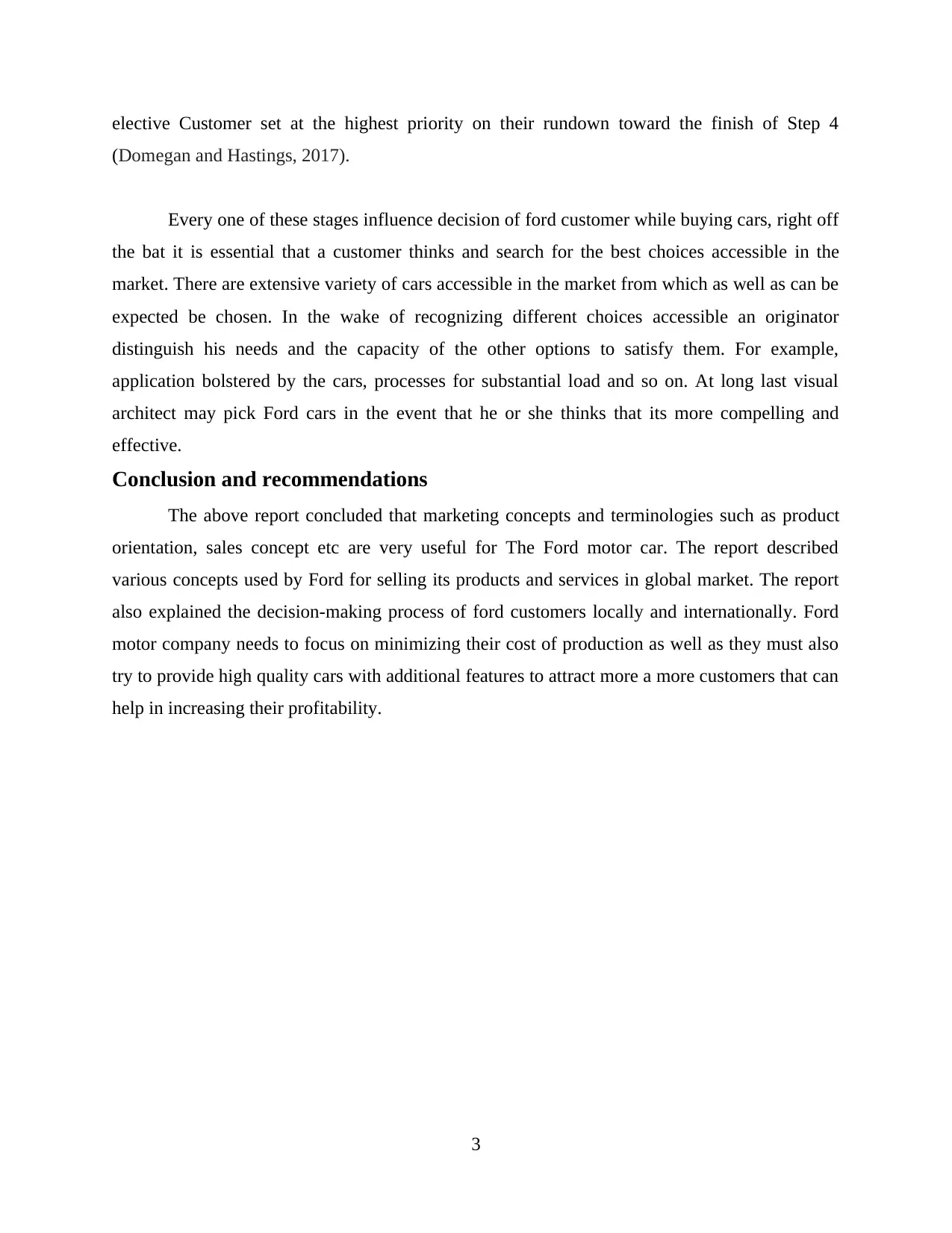
elective Customer set at the highest priority on their rundown toward the finish of Step 4
(Domegan and Hastings, 2017).
Every one of these stages influence decision of ford customer while buying cars, right off
the bat it is essential that a customer thinks and search for the best choices accessible in the
market. There are extensive variety of cars accessible in the market from which as well as can be
expected be chosen. In the wake of recognizing different choices accessible an originator
distinguish his needs and the capacity of the other options to satisfy them. For example,
application bolstered by the cars, processes for substantial load and so on. At long last visual
architect may pick Ford cars in the event that he or she thinks that its more compelling and
effective.
Conclusion and recommendations
The above report concluded that marketing concepts and terminologies such as product
orientation, sales concept etc are very useful for The Ford motor car. The report described
various concepts used by Ford for selling its products and services in global market. The report
also explained the decision-making process of ford customers locally and internationally. Ford
motor company needs to focus on minimizing their cost of production as well as they must also
try to provide high quality cars with additional features to attract more a more customers that can
help in increasing their profitability.
3
(Domegan and Hastings, 2017).
Every one of these stages influence decision of ford customer while buying cars, right off
the bat it is essential that a customer thinks and search for the best choices accessible in the
market. There are extensive variety of cars accessible in the market from which as well as can be
expected be chosen. In the wake of recognizing different choices accessible an originator
distinguish his needs and the capacity of the other options to satisfy them. For example,
application bolstered by the cars, processes for substantial load and so on. At long last visual
architect may pick Ford cars in the event that he or she thinks that its more compelling and
effective.
Conclusion and recommendations
The above report concluded that marketing concepts and terminologies such as product
orientation, sales concept etc are very useful for The Ford motor car. The report described
various concepts used by Ford for selling its products and services in global market. The report
also explained the decision-making process of ford customers locally and internationally. Ford
motor company needs to focus on minimizing their cost of production as well as they must also
try to provide high quality cars with additional features to attract more a more customers that can
help in increasing their profitability.
3

REFERENCES
Books and Journals
Domegan, C. and Hastings, G., 2017. Social marketing principles. In Social Marketing (pp. 26-
51). Routledge.
Appah, G.O. and George, B.P., 2017. Understanding Church Growth through Church Marketing:
An Analysis on the Roman Catholic Church’s Marketing Efforts in Ghana. Journal of
Economics & Business Research, 23(1).
Lilien, G.L., Rangaswamy, A. and De Bruyn, A., 2017.Principles of Marketing Engineering and
Analytics. DecisionPro.
Mokwa, M.P., 2017. The policy characteristics and organizational dynamics of social marketing.
In Marketing the Public Sector (pp. 43-55). Routledge.
Charter, M. ed., 2017. Greener marketing: A responsible approach to business. Routledge.
Desborde, R. and Thach, S., 2017. A Fine Arts Marketing Elective: Justification of Need and
Proposed Course Content.Atlantic Marketing Journal, 6(1), p.4.
4
Books and Journals
Domegan, C. and Hastings, G., 2017. Social marketing principles. In Social Marketing (pp. 26-
51). Routledge.
Appah, G.O. and George, B.P., 2017. Understanding Church Growth through Church Marketing:
An Analysis on the Roman Catholic Church’s Marketing Efforts in Ghana. Journal of
Economics & Business Research, 23(1).
Lilien, G.L., Rangaswamy, A. and De Bruyn, A., 2017.Principles of Marketing Engineering and
Analytics. DecisionPro.
Mokwa, M.P., 2017. The policy characteristics and organizational dynamics of social marketing.
In Marketing the Public Sector (pp. 43-55). Routledge.
Charter, M. ed., 2017. Greener marketing: A responsible approach to business. Routledge.
Desborde, R. and Thach, S., 2017. A Fine Arts Marketing Elective: Justification of Need and
Proposed Course Content.Atlantic Marketing Journal, 6(1), p.4.
4
⊘ This is a preview!⊘
Do you want full access?
Subscribe today to unlock all pages.

Trusted by 1+ million students worldwide
1 out of 6
Related Documents
Your All-in-One AI-Powered Toolkit for Academic Success.
+13062052269
info@desklib.com
Available 24*7 on WhatsApp / Email
Unlock your academic potential
Copyright © 2020–2026 A2Z Services. All Rights Reserved. Developed and managed by ZUCOL.