IKEA Marketing Plan: Functions, Organizational Context, and Analysis
VerifiedAdded on 2023/06/11
|10
|2686
|118
Report
AI Summary
This report provides a comprehensive analysis of marketing functions and their significance within an organization, using IKEA as a case study. It delves into the responsibilities of the marketing function, including brand management, public relations, and market research, highlighting their impact on organizational success. The report also examines the relationship between marketing and other departments such as HR, finance, operations, R&D, and legal, emphasizing the importance of collaboration. Furthermore, it applies marketing mix concepts, comparing IKEA and Marks & Spencer, and proposes an integrated marketing plan for IKEA to enhance customer interaction and sales, focusing on product, price, place, and promotion strategies. The report concludes by underscoring the importance of applying marketing principles for sustainable organizational growth.
UNIT 2
ASSESSMENT
1
ASSESSMENT
1

Paraphrase This Document
Need a fresh take? Get an instant paraphrase of this document with our AI Paraphraser
TABLE OF CONTENTS
INTROUDCTION...........................................................................................................................3
MAIN BODY..................................................................................................................................3
Responsibilities of marketing function........................................................................................3
Relation of marketing with wider organisational context............................................................4
Applying marketing mix concepts...............................................................................................5
Marketing plan.............................................................................................................................7
CONCLUSION................................................................................................................................9
REFERENCES..............................................................................................................................10
2
INTROUDCTION...........................................................................................................................3
MAIN BODY..................................................................................................................................3
Responsibilities of marketing function........................................................................................3
Relation of marketing with wider organisational context............................................................4
Applying marketing mix concepts...............................................................................................5
Marketing plan.............................................................................................................................7
CONCLUSION................................................................................................................................9
REFERENCES..............................................................................................................................10
2
INTROUDCTION
Marketing is defined as an organisational process to build and deliver value in terms of
efficient and good quality series and products so that needs of stakeholders can be meet (Lisna,
Pivavar and Ponomarenko, 2018). The organisational success depends greatly on marketing
tactics and thus organisations are highly focused on planning marketing. The lack of
contemporary marketing approaches can result in competitive disadvantage for the firms. This
report will discuss the functions and responsibility of marketing function and its contribution in
wider organisational context. It will also use the case study analysis of IKEA to analyse the
marketing plan of organisation.
MAIN BODY
Responsibilities of marketing function
Primary role of marketing is to promote business so that it can meet its business objectives.
Some of the major roles and responsibilities of marketing function are:
Brand management: In order to build and maintain a strong brand a high performing marketing
team is a must. It is the responsibility of marketing function to focus upon brand extension,
attributes and management specifications (Parra, 2018). The efficiency of marketing team to
communicate, research and develop innovative products result in creating strong brands which
capture competitive market. Brand management is function of marketing team so that brands
can be strongly groomed and business goals can be achieved.
Public relation: This is one of the most important function performed by marketing team as it
helps organisations to retain the customers and suppliers for long term. Marketing professionals
work closely on all aspects such as reputation, pricing, product development and service delivery
so that valuable services can be delivered to stakeholders. Strong relations built by marketing
team contributes in gaining competitive advantage and innovation in work.
Market research: In order to assure the creativity in work and to lead ahead of competitors,
continuous research and innovative developments are required in the work. It is the responsibility
of marketing team to conduct market research using variety of research tools to understand the
current market trends, future needs, competitive behaviour and expectations of customers
(Morgan and et.al., 2019). This type of research is vital in improving service quality and to
deliver the required value. Without this contribution organisation may not be able to survive in
competitive business environment.
3
Marketing is defined as an organisational process to build and deliver value in terms of
efficient and good quality series and products so that needs of stakeholders can be meet (Lisna,
Pivavar and Ponomarenko, 2018). The organisational success depends greatly on marketing
tactics and thus organisations are highly focused on planning marketing. The lack of
contemporary marketing approaches can result in competitive disadvantage for the firms. This
report will discuss the functions and responsibility of marketing function and its contribution in
wider organisational context. It will also use the case study analysis of IKEA to analyse the
marketing plan of organisation.
MAIN BODY
Responsibilities of marketing function
Primary role of marketing is to promote business so that it can meet its business objectives.
Some of the major roles and responsibilities of marketing function are:
Brand management: In order to build and maintain a strong brand a high performing marketing
team is a must. It is the responsibility of marketing function to focus upon brand extension,
attributes and management specifications (Parra, 2018). The efficiency of marketing team to
communicate, research and develop innovative products result in creating strong brands which
capture competitive market. Brand management is function of marketing team so that brands
can be strongly groomed and business goals can be achieved.
Public relation: This is one of the most important function performed by marketing team as it
helps organisations to retain the customers and suppliers for long term. Marketing professionals
work closely on all aspects such as reputation, pricing, product development and service delivery
so that valuable services can be delivered to stakeholders. Strong relations built by marketing
team contributes in gaining competitive advantage and innovation in work.
Market research: In order to assure the creativity in work and to lead ahead of competitors,
continuous research and innovative developments are required in the work. It is the responsibility
of marketing team to conduct market research using variety of research tools to understand the
current market trends, future needs, competitive behaviour and expectations of customers
(Morgan and et.al., 2019). This type of research is vital in improving service quality and to
deliver the required value. Without this contribution organisation may not be able to survive in
competitive business environment.
3
⊘ This is a preview!⊘
Do you want full access?
Subscribe today to unlock all pages.

Trusted by 1+ million students worldwide
Promotions and communication: Marketing team has direct interaction with the stakeholders
and thus they have significant role in promoting the services and vision of organisation.
Communication strategies used by marketing professionals create awareness among people so
that they can connect with the services of organisation. Without good promotional tactics by
marketing team IKEA may not be able to attract new customers or suppliers (Varadarajan, 2020).
The marketing approaches used by organisation has crucial and significant impact on completion
and customer retention. To some extent it also affects the public perception and other
organisational parameters such as talent attraction and retention and supplier relations.
Relation of marketing with wider organisational context
For the optimum success of organisational objectives marketing department works in close
integration with other organisational department. Some of the important relations in this context
are as follows:
Human resource department (HR): Significant of marketing is well known and thus IKEA has
to pay detailed focus on expertise marketing team (Ferrell, Hartline and Hochstein, 2021).
Marketing team and HR department work together to seek professionals who are capable to meet
marketing objectives and goals.
Finance: The marketing campaigns and promotional aids are vital for achieving financial goals.
However, the extent and budget of these campaigns must also be limited by some financial limits
which are set by accounting and financial experts as per organisational resources. Thus
marketing team also has association with finance team so that expected profit levels can be
maintained.
Operations and production: In order to deliver the desired and competitive services as identified
marketing and production must go in hand to hand. If operational team will not be able to
execute the marketing deliverables or if marketing will not give accurate description of customer
need then it can impose major service quality concerns. The lack of cooperation between both
the departments can have negative impact upon customer retention.
Research and development (R&D): One of the important function of marketing is to conduct
research (İpek, 2020). The research outcomes are required to be properly communicated and
implemented by R&D team so that value can be created through innovation in services. If both
4
and thus they have significant role in promoting the services and vision of organisation.
Communication strategies used by marketing professionals create awareness among people so
that they can connect with the services of organisation. Without good promotional tactics by
marketing team IKEA may not be able to attract new customers or suppliers (Varadarajan, 2020).
The marketing approaches used by organisation has crucial and significant impact on completion
and customer retention. To some extent it also affects the public perception and other
organisational parameters such as talent attraction and retention and supplier relations.
Relation of marketing with wider organisational context
For the optimum success of organisational objectives marketing department works in close
integration with other organisational department. Some of the important relations in this context
are as follows:
Human resource department (HR): Significant of marketing is well known and thus IKEA has
to pay detailed focus on expertise marketing team (Ferrell, Hartline and Hochstein, 2021).
Marketing team and HR department work together to seek professionals who are capable to meet
marketing objectives and goals.
Finance: The marketing campaigns and promotional aids are vital for achieving financial goals.
However, the extent and budget of these campaigns must also be limited by some financial limits
which are set by accounting and financial experts as per organisational resources. Thus
marketing team also has association with finance team so that expected profit levels can be
maintained.
Operations and production: In order to deliver the desired and competitive services as identified
marketing and production must go in hand to hand. If operational team will not be able to
execute the marketing deliverables or if marketing will not give accurate description of customer
need then it can impose major service quality concerns. The lack of cooperation between both
the departments can have negative impact upon customer retention.
Research and development (R&D): One of the important function of marketing is to conduct
research (İpek, 2020). The research outcomes are required to be properly communicated and
implemented by R&D team so that value can be created through innovation in services. If both
4
Paraphrase This Document
Need a fresh take? Get an instant paraphrase of this document with our AI Paraphraser
department does not share cooperation, then organisation may suffer from lack of creativity and
this can have significant competitive disadvantage for the IKEA.
Legal: Marketing campaigns and promises must not violate the regulations related to data
privacy, service commitment as well as other competitive regulations (Goncharova,
Solosichenko and Merzlyakova, 2019). Thus marketing standards and legal team must have
communication and cooperation. The lack of this communication can result in legal
consequences as well as adverse impact on the performance and brand value of the organisation.
Applying marketing mix concepts
Elements of marketing mix have great impact on organisational performance. Various
organisations apply these elements as per their vision and expected outcomes. The marketing
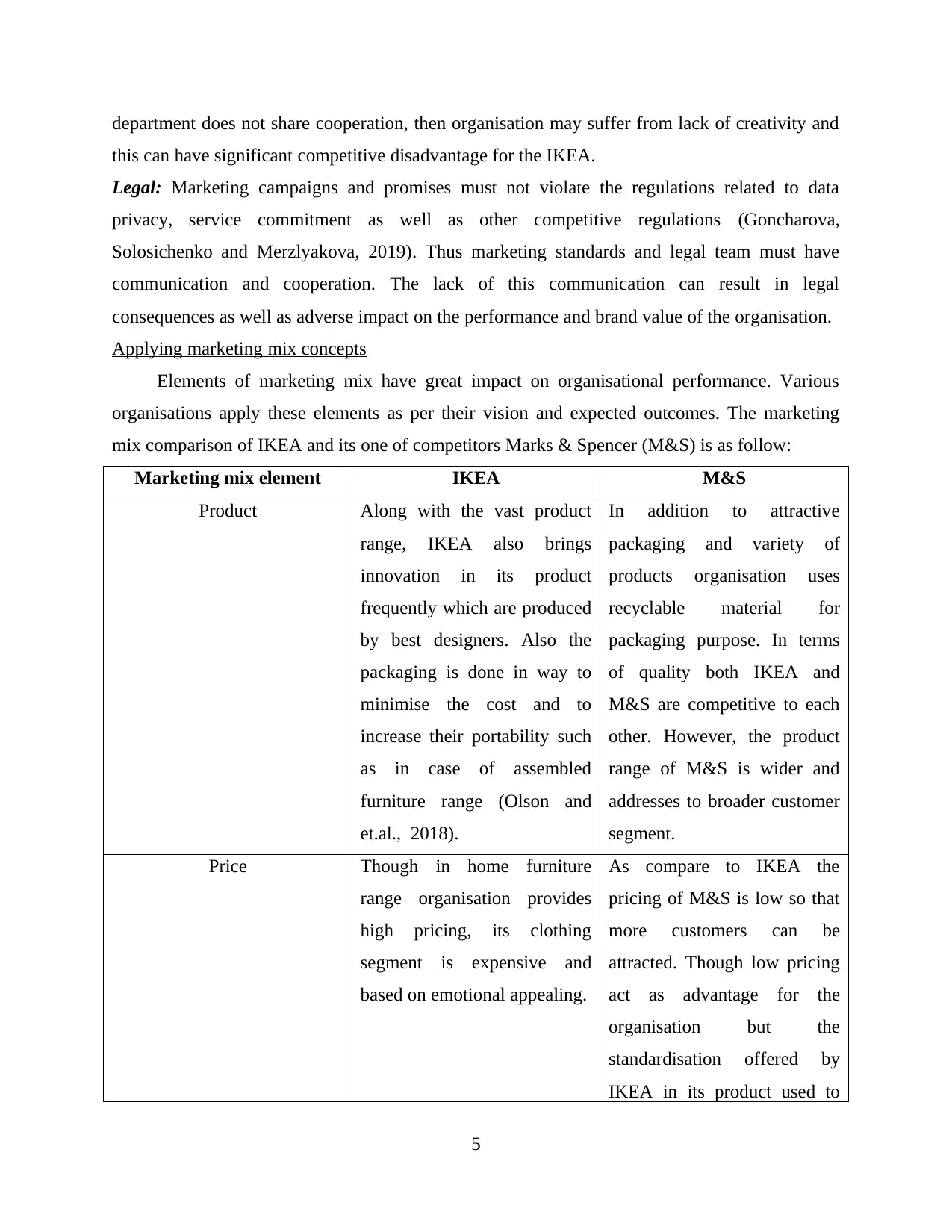
mix comparison of IKEA and its one of competitors Marks & Spencer (M&S) is as follow:
Marketing mix element IKEA M&S
Product Along with the vast product
range, IKEA also brings
innovation in its product
frequently which are produced
by best designers. Also the
packaging is done in way to
minimise the cost and to
increase their portability such
as in case of assembled
furniture range (Olson and
et.al., 2018).
In addition to attractive
packaging and variety of
products organisation uses
recyclable material for
packaging purpose. In terms
of quality both IKEA and
M&S are competitive to each
other. However, the product
range of M&S is wider and
addresses to broader customer
segment.
Price Though in home furniture
range organisation provides
high pricing, its clothing
segment is expensive and
based on emotional appealing.
As compare to IKEA the
pricing of M&S is low so that
more customers can be
attracted. Though low pricing
act as advantage for the
organisation but the
standardisation offered by
IKEA in its product used to
5
this can have significant competitive disadvantage for the IKEA.
Legal: Marketing campaigns and promises must not violate the regulations related to data
privacy, service commitment as well as other competitive regulations (Goncharova,
Solosichenko and Merzlyakova, 2019). Thus marketing standards and legal team must have
communication and cooperation. The lack of this communication can result in legal
consequences as well as adverse impact on the performance and brand value of the organisation.
Applying marketing mix concepts
Elements of marketing mix have great impact on organisational performance. Various
organisations apply these elements as per their vision and expected outcomes. The marketing
mix comparison of IKEA and its one of competitors Marks & Spencer (M&S) is as follow:
Marketing mix element IKEA M&S
Product Along with the vast product
range, IKEA also brings
innovation in its product
frequently which are produced
by best designers. Also the
packaging is done in way to
minimise the cost and to
increase their portability such
as in case of assembled
furniture range (Olson and
et.al., 2018).
In addition to attractive
packaging and variety of
products organisation uses
recyclable material for
packaging purpose. In terms
of quality both IKEA and
M&S are competitive to each
other. However, the product
range of M&S is wider and
addresses to broader customer
segment.
Price Though in home furniture
range organisation provides
high pricing, its clothing
segment is expensive and
based on emotional appealing.
As compare to IKEA the
pricing of M&S is low so that
more customers can be
attracted. Though low pricing
act as advantage for the
organisation but the
standardisation offered by
IKEA in its product used to
5
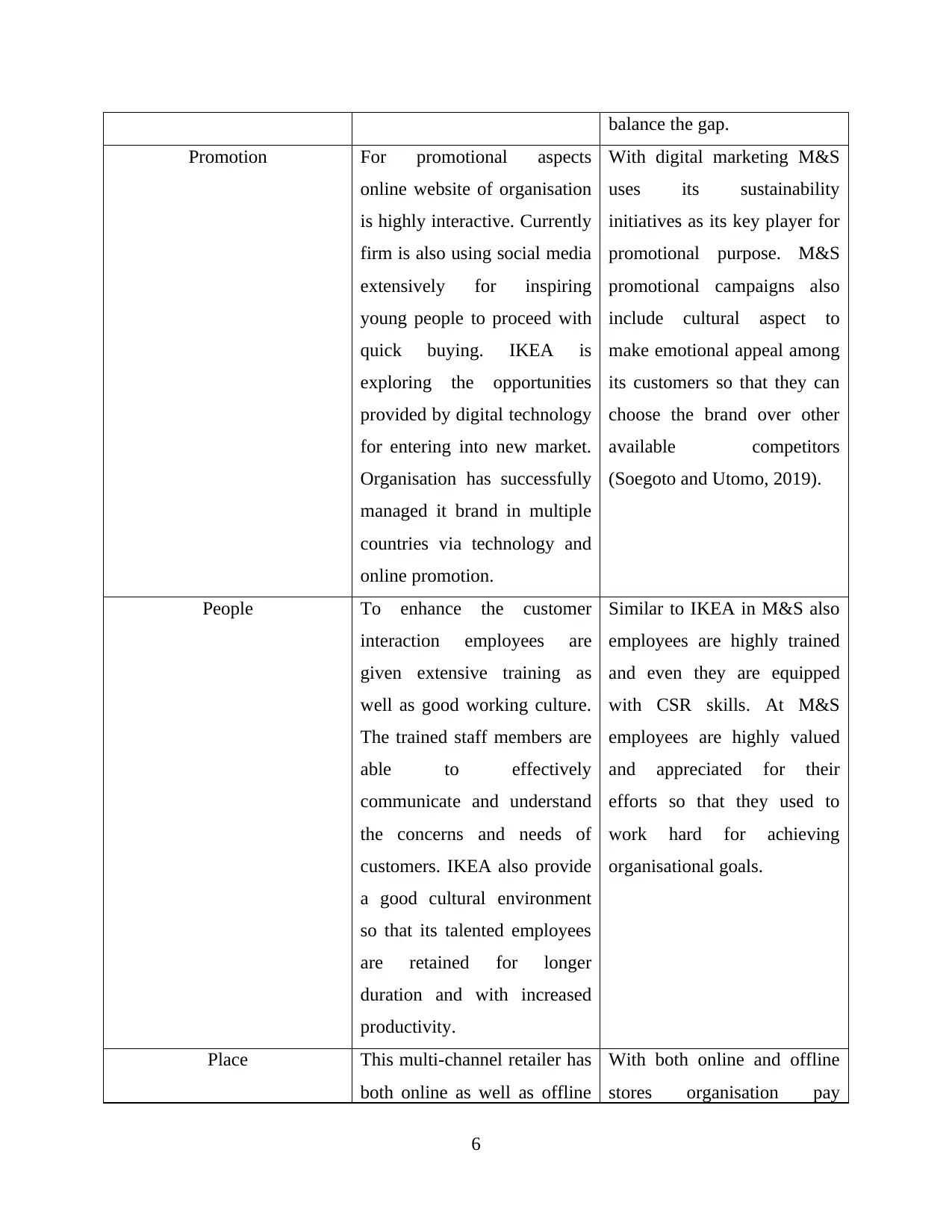
balance the gap.
Promotion For promotional aspects
online website of organisation
is highly interactive. Currently
firm is also using social media
extensively for inspiring
young people to proceed with
quick buying. IKEA is
exploring the opportunities
provided by digital technology
for entering into new market.
Organisation has successfully
managed it brand in multiple
countries via technology and
online promotion.
With digital marketing M&S
uses its sustainability
initiatives as its key player for
promotional purpose. M&S
promotional campaigns also
include cultural aspect to
make emotional appeal among
its customers so that they can
choose the brand over other
available competitors
(Soegoto and Utomo, 2019).
People To enhance the customer
interaction employees are
given extensive training as
well as good working culture.
The trained staff members are
able to effectively
communicate and understand
the concerns and needs of
customers. IKEA also provide
a good cultural environment
so that its talented employees
are retained for longer
duration and with increased
productivity.
Similar to IKEA in M&S also
employees are highly trained
and even they are equipped
with CSR skills. At M&S
employees are highly valued
and appreciated for their
efforts so that they used to
work hard for achieving
organisational goals.
Place This multi-channel retailer has
both online as well as offline
With both online and offline
stores organisation pay
6
Promotion For promotional aspects
online website of organisation
is highly interactive. Currently
firm is also using social media
extensively for inspiring
young people to proceed with
quick buying. IKEA is
exploring the opportunities
provided by digital technology
for entering into new market.
Organisation has successfully
managed it brand in multiple
countries via technology and
online promotion.
With digital marketing M&S
uses its sustainability
initiatives as its key player for
promotional purpose. M&S
promotional campaigns also
include cultural aspect to
make emotional appeal among
its customers so that they can
choose the brand over other
available competitors
(Soegoto and Utomo, 2019).
People To enhance the customer
interaction employees are
given extensive training as
well as good working culture.
The trained staff members are
able to effectively
communicate and understand
the concerns and needs of
customers. IKEA also provide
a good cultural environment
so that its talented employees
are retained for longer
duration and with increased
productivity.
Similar to IKEA in M&S also
employees are highly trained
and even they are equipped
with CSR skills. At M&S
employees are highly valued
and appreciated for their
efforts so that they used to
work hard for achieving
organisational goals.
Place This multi-channel retailer has
both online as well as offline
With both online and offline
stores organisation pay
6
⊘ This is a preview!⊘
Do you want full access?
Subscribe today to unlock all pages.
Trusted by 1+ million students worldwide
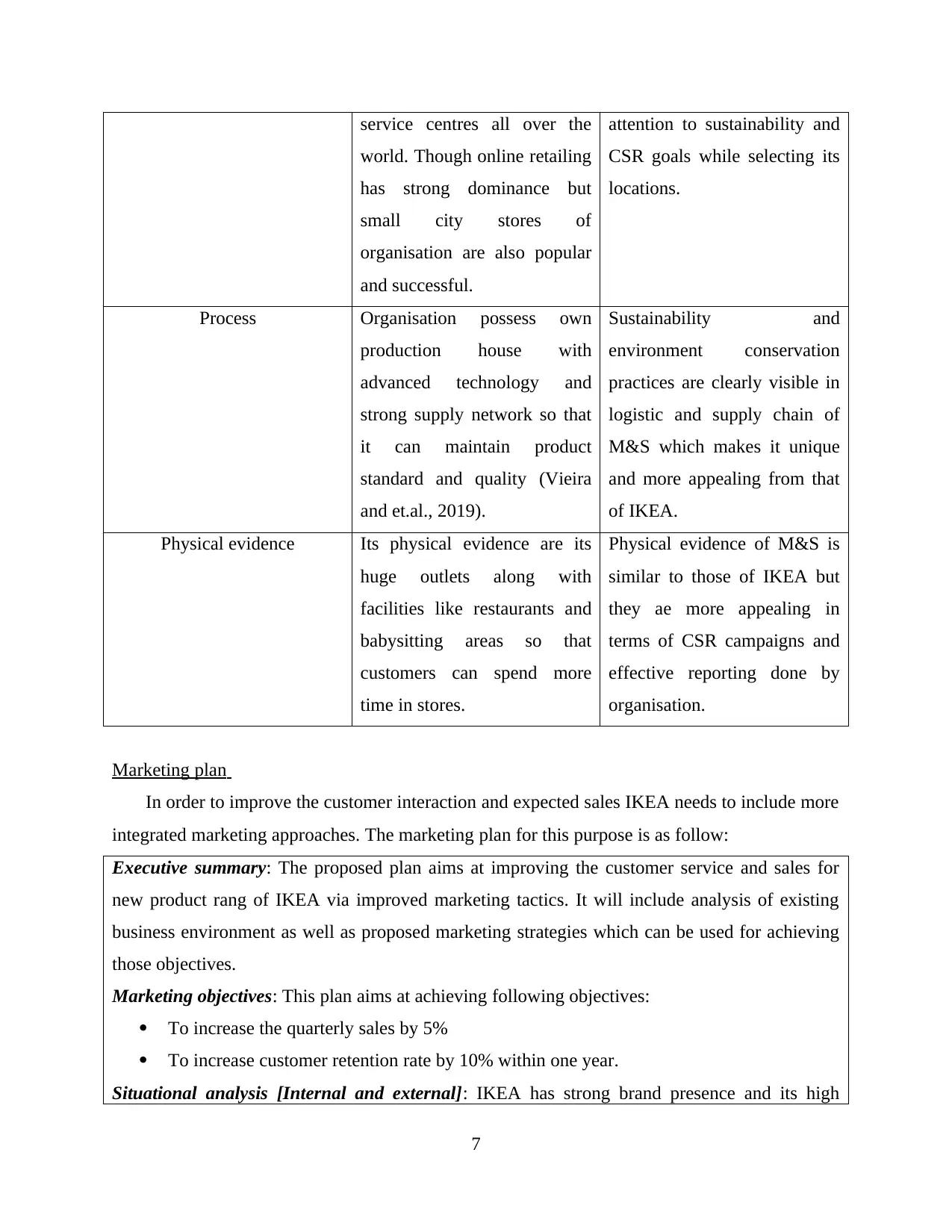
service centres all over the
world. Though online retailing
has strong dominance but
small city stores of
organisation are also popular
and successful.
attention to sustainability and
CSR goals while selecting its
locations.
Process Organisation possess own
production house with
advanced technology and
strong supply network so that
it can maintain product
standard and quality (Vieira
and et.al., 2019).
Sustainability and
environment conservation
practices are clearly visible in
logistic and supply chain of
M&S which makes it unique
and more appealing from that
of IKEA.
Physical evidence Its physical evidence are its
huge outlets along with
facilities like restaurants and
babysitting areas so that
customers can spend more
time in stores.
Physical evidence of M&S is
similar to those of IKEA but
they ae more appealing in
terms of CSR campaigns and
effective reporting done by
organisation.
Marketing plan
In order to improve the customer interaction and expected sales IKEA needs to include more
integrated marketing approaches. The marketing plan for this purpose is as follow:
Executive summary: The proposed plan aims at improving the customer service and sales for
new product rang of IKEA via improved marketing tactics. It will include analysis of existing
business environment as well as proposed marketing strategies which can be used for achieving
those objectives.
Marketing objectives: This plan aims at achieving following objectives:
To increase the quarterly sales by 5%
To increase customer retention rate by 10% within one year.
Situational analysis [Internal and external]: IKEA has strong brand presence and its high
7
world. Though online retailing
has strong dominance but
small city stores of
organisation are also popular
and successful.
attention to sustainability and
CSR goals while selecting its
locations.
Process Organisation possess own
production house with
advanced technology and
strong supply network so that
it can maintain product
standard and quality (Vieira
and et.al., 2019).
Sustainability and
environment conservation
practices are clearly visible in
logistic and supply chain of
M&S which makes it unique
and more appealing from that
of IKEA.
Physical evidence Its physical evidence are its
huge outlets along with
facilities like restaurants and
babysitting areas so that
customers can spend more
time in stores.
Physical evidence of M&S is
similar to those of IKEA but
they ae more appealing in
terms of CSR campaigns and
effective reporting done by
organisation.
Marketing plan
In order to improve the customer interaction and expected sales IKEA needs to include more
integrated marketing approaches. The marketing plan for this purpose is as follow:
Executive summary: The proposed plan aims at improving the customer service and sales for
new product rang of IKEA via improved marketing tactics. It will include analysis of existing
business environment as well as proposed marketing strategies which can be used for achieving
those objectives.
Marketing objectives: This plan aims at achieving following objectives:
To increase the quarterly sales by 5%
To increase customer retention rate by 10% within one year.
Situational analysis [Internal and external]: IKEA has strong brand presence and its high
7
Paraphrase This Document
Need a fresh take? Get an instant paraphrase of this document with our AI Paraphraser
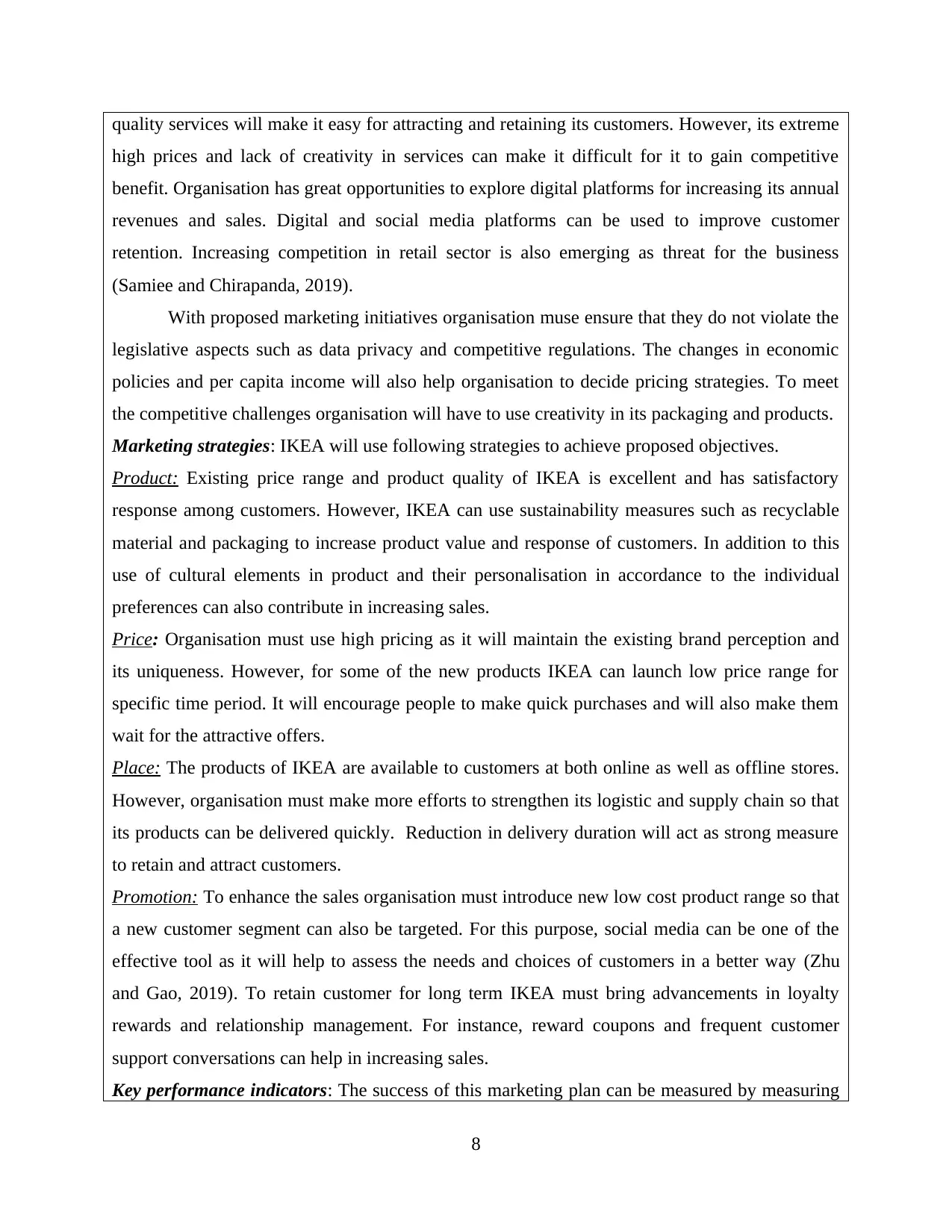
quality services will make it easy for attracting and retaining its customers. However, its extreme
high prices and lack of creativity in services can make it difficult for it to gain competitive
benefit. Organisation has great opportunities to explore digital platforms for increasing its annual
revenues and sales. Digital and social media platforms can be used to improve customer
retention. Increasing competition in retail sector is also emerging as threat for the business
(Samiee and Chirapanda, 2019).
With proposed marketing initiatives organisation muse ensure that they do not violate the
legislative aspects such as data privacy and competitive regulations. The changes in economic
policies and per capita income will also help organisation to decide pricing strategies. To meet
the competitive challenges organisation will have to use creativity in its packaging and products.
Marketing strategies: IKEA will use following strategies to achieve proposed objectives.
Product: Existing price range and product quality of IKEA is excellent and has satisfactory
response among customers. However, IKEA can use sustainability measures such as recyclable
material and packaging to increase product value and response of customers. In addition to this
use of cultural elements in product and their personalisation in accordance to the individual
preferences can also contribute in increasing sales.
Price: Organisation must use high pricing as it will maintain the existing brand perception and
its uniqueness. However, for some of the new products IKEA can launch low price range for
specific time period. It will encourage people to make quick purchases and will also make them
wait for the attractive offers.
Place: The products of IKEA are available to customers at both online as well as offline stores.
However, organisation must make more efforts to strengthen its logistic and supply chain so that
its products can be delivered quickly. Reduction in delivery duration will act as strong measure
to retain and attract customers.
Promotion: To enhance the sales organisation must introduce new low cost product range so that
a new customer segment can also be targeted. For this purpose, social media can be one of the
effective tool as it will help to assess the needs and choices of customers in a better way (Zhu
and Gao, 2019). To retain customer for long term IKEA must bring advancements in loyalty
rewards and relationship management. For instance, reward coupons and frequent customer
support conversations can help in increasing sales.
Key performance indicators: The success of this marketing plan can be measured by measuring
8
high prices and lack of creativity in services can make it difficult for it to gain competitive
benefit. Organisation has great opportunities to explore digital platforms for increasing its annual
revenues and sales. Digital and social media platforms can be used to improve customer
retention. Increasing competition in retail sector is also emerging as threat for the business
(Samiee and Chirapanda, 2019).
With proposed marketing initiatives organisation muse ensure that they do not violate the
legislative aspects such as data privacy and competitive regulations. The changes in economic
policies and per capita income will also help organisation to decide pricing strategies. To meet
the competitive challenges organisation will have to use creativity in its packaging and products.
Marketing strategies: IKEA will use following strategies to achieve proposed objectives.
Product: Existing price range and product quality of IKEA is excellent and has satisfactory
response among customers. However, IKEA can use sustainability measures such as recyclable
material and packaging to increase product value and response of customers. In addition to this
use of cultural elements in product and their personalisation in accordance to the individual
preferences can also contribute in increasing sales.
Price: Organisation must use high pricing as it will maintain the existing brand perception and
its uniqueness. However, for some of the new products IKEA can launch low price range for
specific time period. It will encourage people to make quick purchases and will also make them
wait for the attractive offers.
Place: The products of IKEA are available to customers at both online as well as offline stores.
However, organisation must make more efforts to strengthen its logistic and supply chain so that
its products can be delivered quickly. Reduction in delivery duration will act as strong measure
to retain and attract customers.
Promotion: To enhance the sales organisation must introduce new low cost product range so that
a new customer segment can also be targeted. For this purpose, social media can be one of the
effective tool as it will help to assess the needs and choices of customers in a better way (Zhu
and Gao, 2019). To retain customer for long term IKEA must bring advancements in loyalty
rewards and relationship management. For instance, reward coupons and frequent customer
support conversations can help in increasing sales.
Key performance indicators: The success of this marketing plan can be measured by measuring
8
and analysing the number of sales recorded every month. IKEA must also use good analytical
tools to evaluate the customer retention. For enhancing the customer satisfaction organisation
must also conduct some survey’s whose results and feedback can be considered as performance
indicator (Ferrell, Hartline and Hochstein, 2021).
CONCLUSION
It can be concluded from the above discussion that for sustainable growth marketing
principles must be successfully applied to organisational practices. The strong cooperation and
relation of marketing with other functional units of business can contribute in robust decision
making and effective business planning. Thus it must be emphasised greatly by the
organisations. It can also be suggested that for better marketing planning elements like market
research, monitoring and evaluation must also be taken into consideration.
9
tools to evaluate the customer retention. For enhancing the customer satisfaction organisation
must also conduct some survey’s whose results and feedback can be considered as performance
indicator (Ferrell, Hartline and Hochstein, 2021).
CONCLUSION
It can be concluded from the above discussion that for sustainable growth marketing
principles must be successfully applied to organisational practices. The strong cooperation and
relation of marketing with other functional units of business can contribute in robust decision
making and effective business planning. Thus it must be emphasised greatly by the
organisations. It can also be suggested that for better marketing planning elements like market
research, monitoring and evaluation must also be taken into consideration.
9
⊘ This is a preview!⊘
Do you want full access?
Subscribe today to unlock all pages.
Trusted by 1+ million students worldwide
REFERENCES
Books and Journals
Ferrell, O.C., Hartline, M. and Hochstein, B.W., 2021. Marketing strategy. Cengage Learning.
Goncharova, N.A., Solosichenko, T.Z. and Merzlyakova, N.V., 2019. Brand platform as an
element of a company marketing strategy. International Journal of Supply Chain
Management, 8(4), p.815.
İpek, İ., 2020. The relevance of international marketing strategy to emerging-market exporting
firms: from a systematic review towards a conceptual framework. International
Marketing Review.
Lisna, I.F., Pivavar, I.V. and Ponomarenko, O.O., 2018. Marketing research and marketing
planning at macro and micro levels. Бізнес Інформ, (11), pp.333-339.
Morgan, N.A. and et.al., 2019. Research in marketing strategy. Journal of the Academy of
Marketing Science, 47(1), pp.4-29.
Olson, E.M. and et.al., 2018. The application of human resource management policies within the
marketing organization: The impact on business and marketing strategy
implementation. Industrial Marketing Management, 69, pp.62-73.
Parra, E., 2018. Transfer prices assignment with integrated production and marketing
optimization models. Journal of Industrial Engineering and Management, 11(2),
pp.262-275.
Samiee, S. and Chirapanda, S., 2019. International marketing strategy in emerging-market
exporting firms. Journal of International Marketing, 27(1), pp.20-37.
Soegoto, E.S. and Utomo, A.T., 2019, November. Marketing Strategy Through Social Media.
In IOP Conference Series: Materials Science and Engineering (Vol. 662, No. 3, p.
032040). IOP Publishing.
Varadarajan, R., 2020. Customer information resources advantage, marketing strategy and
business performance: A market resources based view. Industrial Marketing
Management, 89, pp.89-97.
Vieira, V.A., and et.al., 2019. In pursuit of an effective B2B digital marketing strategy in an
emerging market. Journal of the Academy of Marketing Science, 47(6), pp.1085-
1108.
Zhu, G. and Gao, X., 2019. Precision retail marketing strategy based on digital marketing
model. Science Journal of Business and Management, 7(1), pp.33-37.
10
Books and Journals
Ferrell, O.C., Hartline, M. and Hochstein, B.W., 2021. Marketing strategy. Cengage Learning.
Goncharova, N.A., Solosichenko, T.Z. and Merzlyakova, N.V., 2019. Brand platform as an
element of a company marketing strategy. International Journal of Supply Chain
Management, 8(4), p.815.
İpek, İ., 2020. The relevance of international marketing strategy to emerging-market exporting
firms: from a systematic review towards a conceptual framework. International
Marketing Review.
Lisna, I.F., Pivavar, I.V. and Ponomarenko, O.O., 2018. Marketing research and marketing
planning at macro and micro levels. Бізнес Інформ, (11), pp.333-339.
Morgan, N.A. and et.al., 2019. Research in marketing strategy. Journal of the Academy of
Marketing Science, 47(1), pp.4-29.
Olson, E.M. and et.al., 2018. The application of human resource management policies within the
marketing organization: The impact on business and marketing strategy
implementation. Industrial Marketing Management, 69, pp.62-73.
Parra, E., 2018. Transfer prices assignment with integrated production and marketing
optimization models. Journal of Industrial Engineering and Management, 11(2),
pp.262-275.
Samiee, S. and Chirapanda, S., 2019. International marketing strategy in emerging-market
exporting firms. Journal of International Marketing, 27(1), pp.20-37.
Soegoto, E.S. and Utomo, A.T., 2019, November. Marketing Strategy Through Social Media.
In IOP Conference Series: Materials Science and Engineering (Vol. 662, No. 3, p.
032040). IOP Publishing.
Varadarajan, R., 2020. Customer information resources advantage, marketing strategy and
business performance: A market resources based view. Industrial Marketing
Management, 89, pp.89-97.
Vieira, V.A., and et.al., 2019. In pursuit of an effective B2B digital marketing strategy in an
emerging market. Journal of the Academy of Marketing Science, 47(6), pp.1085-
1108.
Zhu, G. and Gao, X., 2019. Precision retail marketing strategy based on digital marketing
model. Science Journal of Business and Management, 7(1), pp.33-37.
10

1 out of 10


Related Documents


Your All-in-One AI-Powered Toolkit for Academic Success.
+13062052269
info@desklib.com
Available 24*7 on WhatsApp / Email
![[object Object]](/_next/static/media/star-bottom.7253800d.svg)
Unlock your academic potential
Copyright © 2020–2025 A2Z Services. All Rights Reserved. Developed and managed by ZUCOL.