The Role of Marketing in Enterprises: Influence and Firm Performance
VerifiedAdded on 2023/06/15
|24
|12942
|312
AI Summary
This research paper investigates the role and influence of marketing departments in contemporary enterprises, with a focus on comparing firms headquartered in the USA, Europe, and Asia. It examines the antecedents of a marketing department's influence, its relationship with market orientation, and its impact on firm performance. Using data collected from both Western and Eastern firms and analyzed via partial least squares (PLS) modeling, the study finds that a strong and influential marketing department positively contributes to firm performance across different geographic regions and firm sizes. The influence of a marketing department is shown to depend more on its responsibilities and resources rather than internal contingency factors. Furthermore, the paper highlights differences in how marketing department influence affects firm performance in the West (both directly and indirectly via market orientation) versus the East (fully mediated). The research counters claims that the role of marketing departments is diminishing, emphasizing their continued importance in improving firm performance, particularly in marketing-savvy Western regions.
The role of marketing in
today’s enterprises
Jochen Wirtz
NUS Business School, NationalUniversity of Singapore, Singapore
Sven Tuzovic
Schoolof Business, Pacific Lutheran University, Tacoma,
Washington, USA, and
Volker G.Kuppelwieser
NEOMA Business School, Mont-Saint-Aignan Cedex, France
Abstract
Purpose – The purpose of this paper is to explore the role of marketing in today’s enterprises and
examines the antecedents of the marketing department’s influence and its relationship with market
orientation and firm performance.
Design/methodology/approach – Data were collected from the West (i.e. the USA and Europe) and
the East (i.e.Asia).Partial least squares (PLS) was used to estimate structural models.
Findings – The findings supportthe idea thata strong and influentialmarketing department
contributes positively to firm performance.This finding holds for Western and Asian,and for small/
medium and large firms alike. Second, the marketing department’s influence in a firm depends more on
its responsibilities and resources,and less on internalcontingency factors (i.e.a firm’s competitive
strategy or institutional attributes). Third, a marketing department’s influence in the West affects firm
performance both directly and indirectly (via market orientation). In contrast, this relationship is fully
mediated among Eastern firms. Fourth, low-cost strategies enhance the influence of a firm’s marketing
department in the East,but not in the West.
Research limitations/implications – The paper assumes explicitly that a marketing department’s
influence is an antecedent of its market orientation.While the paper finds support for this link,the
paper did not test for dual causality between the constructs.
Originality/value – Countering the frequentclaim in anecdotaland journalistic work thatthe
role ofthe marketing departmentdiminishes,the findings show thatacross differentgeographic
regions and firm sizes,strong marketing departments improve firm performance (especially in the
marketing-savvy West),and that they should continue to play an important role in firms.
Keywords Firm performance,Market orientation,East and West,Importance of marketing,
Marketing department,Marketing function
Paper type Research paper
Introduction
The role and influence ofmarketing departments has received much attention in
both the popular press and academic literature in recentyears (Dixon etal.,2014;
Gummesson et al., 2014; Strandvik et al., 2014). These articles commonly assert that the
marketing function has been diminished (Verhoef and Leeflang,2009;Webster et al.,
2005),that marketing has lost its strategic role (Murphy,2005),and that marketing
departments are now engaged in tactical rather than strategic decision making (Sheth
and Sisodia,2005;Klaus et al.,2014).Fournaise Marketing Group,a London-based
global marketing performance measurement and management firm, surveyed the chief
executive officers (CEOs)of 1,200 large corporations and small-and medium-sized
The current issue and full text archive of this journal is available at
www.emeraldinsight.com/1757-5818.htm
Received 14 February 2013
Revised 8 April 2013
Accepted 20 February 2014
Journal of Service Management
Vol.25 No.2,2014
pp.171-194
r Emerald Group Publishing Limited
1757-5818
DOI 10.1108/JOSM-01-2014-003All authors contributed equally to this article.
171
The role of
marketing
today’s enterprises
Jochen Wirtz
NUS Business School, NationalUniversity of Singapore, Singapore
Sven Tuzovic
Schoolof Business, Pacific Lutheran University, Tacoma,
Washington, USA, and
Volker G.Kuppelwieser
NEOMA Business School, Mont-Saint-Aignan Cedex, France
Abstract
Purpose – The purpose of this paper is to explore the role of marketing in today’s enterprises and
examines the antecedents of the marketing department’s influence and its relationship with market
orientation and firm performance.
Design/methodology/approach – Data were collected from the West (i.e. the USA and Europe) and
the East (i.e.Asia).Partial least squares (PLS) was used to estimate structural models.
Findings – The findings supportthe idea thata strong and influentialmarketing department
contributes positively to firm performance.This finding holds for Western and Asian,and for small/
medium and large firms alike. Second, the marketing department’s influence in a firm depends more on
its responsibilities and resources,and less on internalcontingency factors (i.e.a firm’s competitive
strategy or institutional attributes). Third, a marketing department’s influence in the West affects firm
performance both directly and indirectly (via market orientation). In contrast, this relationship is fully
mediated among Eastern firms. Fourth, low-cost strategies enhance the influence of a firm’s marketing
department in the East,but not in the West.
Research limitations/implications – The paper assumes explicitly that a marketing department’s
influence is an antecedent of its market orientation.While the paper finds support for this link,the
paper did not test for dual causality between the constructs.
Originality/value – Countering the frequentclaim in anecdotaland journalistic work thatthe
role ofthe marketing departmentdiminishes,the findings show thatacross differentgeographic
regions and firm sizes,strong marketing departments improve firm performance (especially in the
marketing-savvy West),and that they should continue to play an important role in firms.
Keywords Firm performance,Market orientation,East and West,Importance of marketing,
Marketing department,Marketing function
Paper type Research paper
Introduction
The role and influence ofmarketing departments has received much attention in
both the popular press and academic literature in recentyears (Dixon etal.,2014;
Gummesson et al., 2014; Strandvik et al., 2014). These articles commonly assert that the
marketing function has been diminished (Verhoef and Leeflang,2009;Webster et al.,
2005),that marketing has lost its strategic role (Murphy,2005),and that marketing
departments are now engaged in tactical rather than strategic decision making (Sheth
and Sisodia,2005;Klaus et al.,2014).Fournaise Marketing Group,a London-based
global marketing performance measurement and management firm, surveyed the chief
executive officers (CEOs)of 1,200 large corporations and small-and medium-sized
The current issue and full text archive of this journal is available at
www.emeraldinsight.com/1757-5818.htm
Received 14 February 2013
Revised 8 April 2013
Accepted 20 February 2014
Journal of Service Management
Vol.25 No.2,2014
pp.171-194
r Emerald Group Publishing Limited
1757-5818
DOI 10.1108/JOSM-01-2014-003All authors contributed equally to this article.
171
The role of
marketing

Paraphrase This Document
Need a fresh take? Get an instant paraphrase of this document with our AI Paraphraser
firms in Asia, Australia,Europeand North America.Their findingsclearly
demonstrated the bleak status of marketing in today’s enterprises:80 percent of the
CEOs surveyed either ranked marketers lowly in the hierarchy of their organizatio
executivecommittees,or did not includethem atall (Lukovitz,2012).Further,
64 percent of the “marketer-unhappy” CEOs reported that they have removed cri
responsibilitiesfrom marketing’straditionalcore functions,includingproduct
development,pricing and channel management (Lukovitz,2012).
However,as Verhoef et al.(2011,p. 59)note,“[y] the discussion remains mainly
qualitative,withoutstrong empiricalevidence in multiple countries.” Studies have
empirically demonstrated that strong marketing departments lead to superior bu
performance,regardless of a firm’s generalmarket orientation (Moorman and Rust,
1999).Go¨tz et al.(2009,p. 29)further argue that “marketing plays a crucialrole in
implementing and successfully managing market orientation.” That is,market-oriented
behavior in a firm can be enhanced because the marketing function champions th
customer’s voice internally,and is often also responsible for gathering,analyzing and
communicating internally relevant market,customer and competitor insights (Lovelock
and Wirtz,2011,pp.393-394).
The contribution ofthis study is twofold.First, we investigatethe role of
marketing departments offirms headquartered in the USA,Europe and Asia.
Although several empirical studies have already been conducted within this doma
a common weakness of such studies is their lack of cross-cultural comparison. Mo
are based on single-country data (e.g.Go¨tz et al.,2009;Merlo,2011;Wu,2004),with
the notable exceptions ofVerhoefet al. (2011)study which tested Verhoefand
Leeflang’s(2009)modelacrossseven industrialized Western nations.Engelen
and Brettel (2011) compare data from six Western and Asian countries and explo
the moderating effectsof threeculturaldimensions(i.e.individualism,power
distance and uncertainty avoidance) of a marketing department’s capabilities on
influence in the organization.The former study does not cover Asia,and the latter
study does notinvestigate the effects ofa marketing department’s influence on
firm performance.This gap of cross-cultural research motivates us to contrast the
antecedents and consequences (i.e.firm performance) of a marketing department’s
influence in the West (i.e. North America and Western Europe) to that in the East
Asia).This comparison could provide interesting insights,because most Eastern
companies,except for a few such as Singapore Airlines (cf.Heracleous and Wirtz,
2010),have been less advanced in their marketing efforts.Second,we contribute to
the growing body of literature examining the diminution of the role of marketing
departments because of their perceived lack of added value over and above a firm
overall market orientation.
Literature review and model development
Consistent with prior conceptualizations,we define marketing’s role within a firm as
the impactof the marketing department,relative to thatof otherdepartmental
functions,on strategic decisions important to the success of the business unit and/o
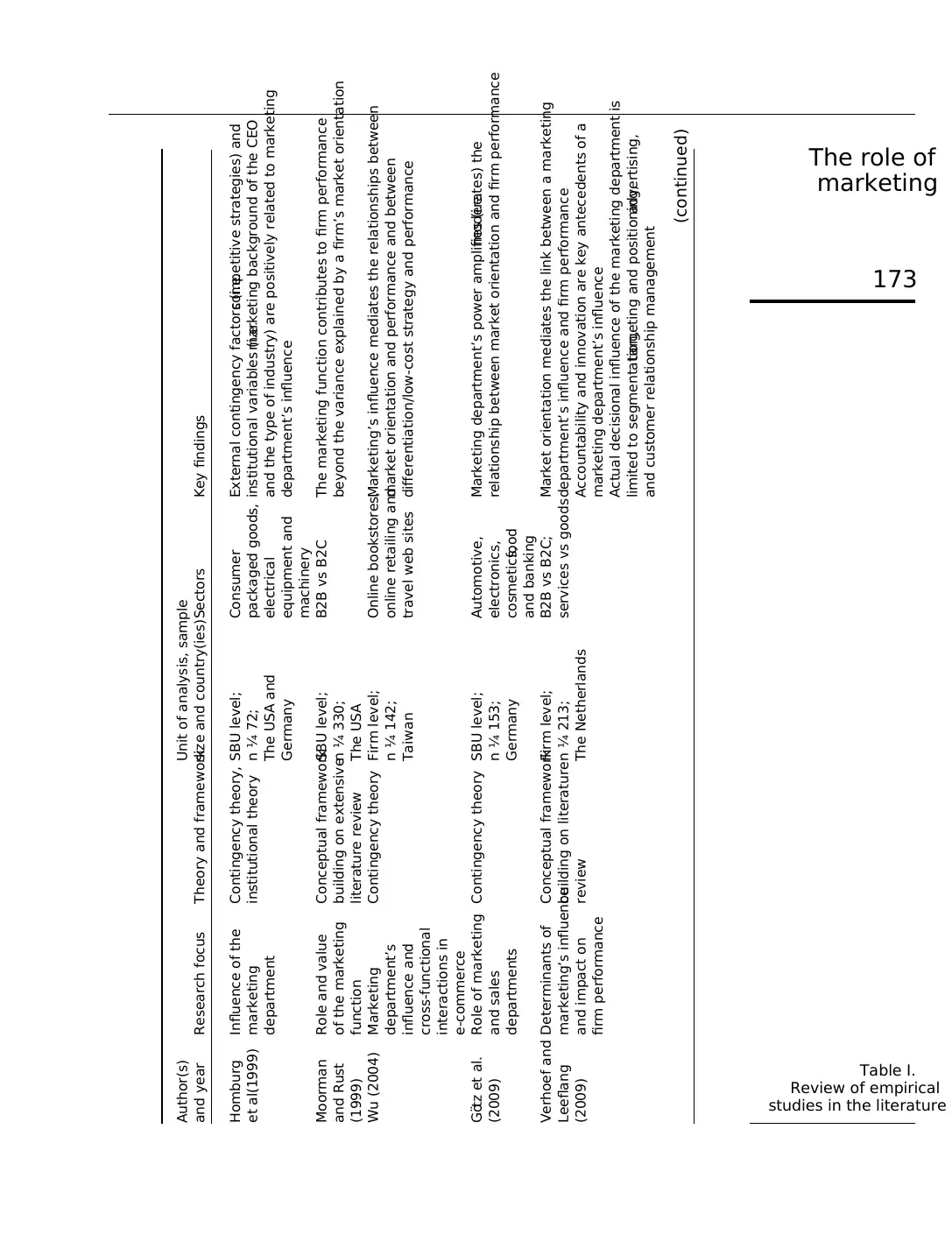
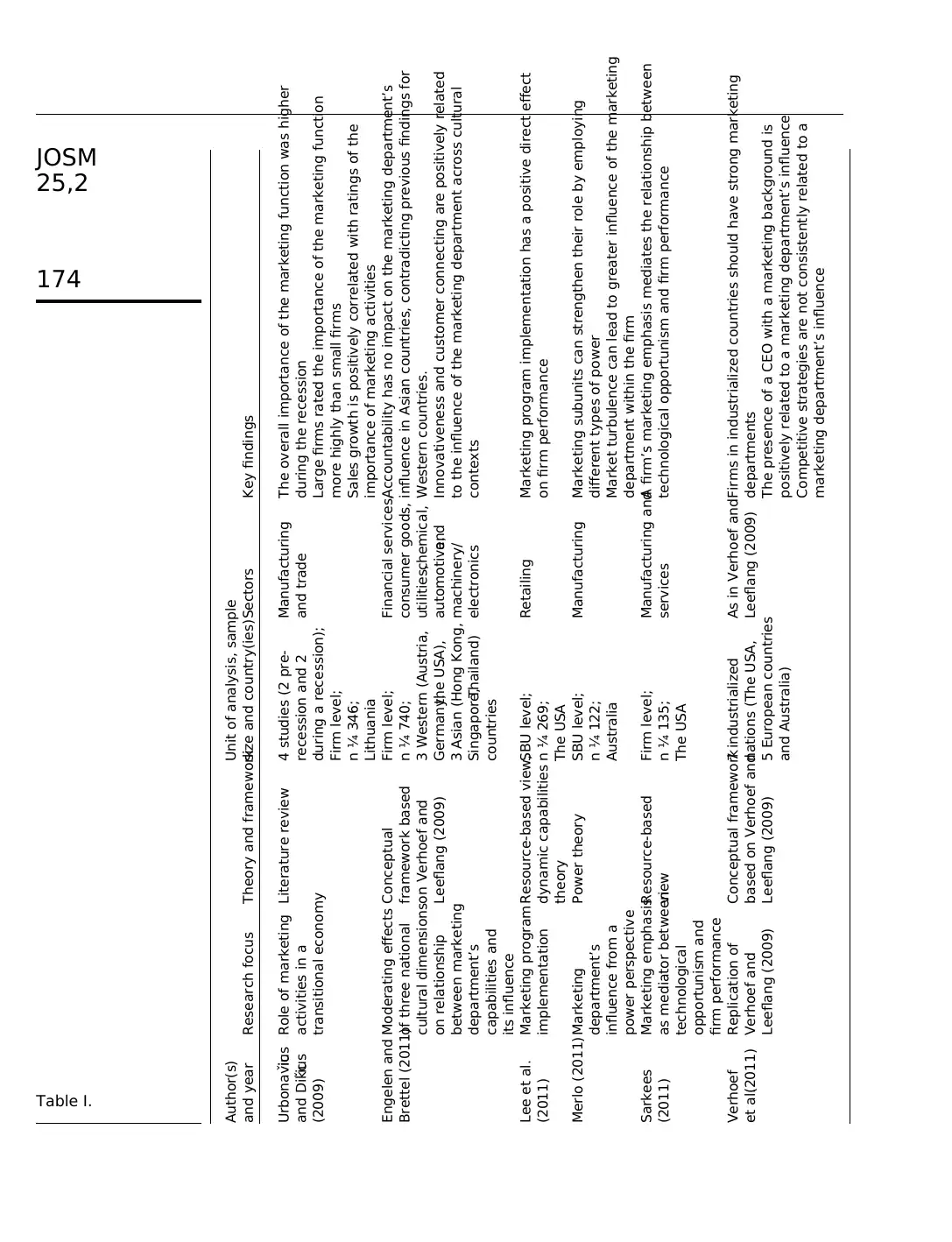
organization (Homburg et al.,1999;Merlo,2011).Over the last two decades,several
conceptual and empirical studies (see Table I) have explored the role of the mark
department in firms.While the terminology in the literature varies (e.g.marketing
power, marketing emphasis, marketing influence), we use these terms interchang
and define them as the influence of the marketing department on a firm’s strateg
decision making.
172
JOSM
25,2
demonstrated the bleak status of marketing in today’s enterprises:80 percent of the
CEOs surveyed either ranked marketers lowly in the hierarchy of their organizatio
executivecommittees,or did not includethem atall (Lukovitz,2012).Further,
64 percent of the “marketer-unhappy” CEOs reported that they have removed cri
responsibilitiesfrom marketing’straditionalcore functions,includingproduct
development,pricing and channel management (Lukovitz,2012).
However,as Verhoef et al.(2011,p. 59)note,“[y] the discussion remains mainly
qualitative,withoutstrong empiricalevidence in multiple countries.” Studies have
empirically demonstrated that strong marketing departments lead to superior bu
performance,regardless of a firm’s generalmarket orientation (Moorman and Rust,
1999).Go¨tz et al.(2009,p. 29)further argue that “marketing plays a crucialrole in
implementing and successfully managing market orientation.” That is,market-oriented
behavior in a firm can be enhanced because the marketing function champions th
customer’s voice internally,and is often also responsible for gathering,analyzing and
communicating internally relevant market,customer and competitor insights (Lovelock
and Wirtz,2011,pp.393-394).
The contribution ofthis study is twofold.First, we investigatethe role of
marketing departments offirms headquartered in the USA,Europe and Asia.
Although several empirical studies have already been conducted within this doma
a common weakness of such studies is their lack of cross-cultural comparison. Mo
are based on single-country data (e.g.Go¨tz et al.,2009;Merlo,2011;Wu,2004),with
the notable exceptions ofVerhoefet al. (2011)study which tested Verhoefand
Leeflang’s(2009)modelacrossseven industrialized Western nations.Engelen
and Brettel (2011) compare data from six Western and Asian countries and explo
the moderating effectsof threeculturaldimensions(i.e.individualism,power
distance and uncertainty avoidance) of a marketing department’s capabilities on
influence in the organization.The former study does not cover Asia,and the latter
study does notinvestigate the effects ofa marketing department’s influence on
firm performance.This gap of cross-cultural research motivates us to contrast the
antecedents and consequences (i.e.firm performance) of a marketing department’s
influence in the West (i.e. North America and Western Europe) to that in the East
Asia).This comparison could provide interesting insights,because most Eastern
companies,except for a few such as Singapore Airlines (cf.Heracleous and Wirtz,
2010),have been less advanced in their marketing efforts.Second,we contribute to
the growing body of literature examining the diminution of the role of marketing
departments because of their perceived lack of added value over and above a firm
overall market orientation.
Literature review and model development
Consistent with prior conceptualizations,we define marketing’s role within a firm as
the impactof the marketing department,relative to thatof otherdepartmental
functions,on strategic decisions important to the success of the business unit and/o
organization (Homburg et al.,1999;Merlo,2011).Over the last two decades,several
conceptual and empirical studies (see Table I) have explored the role of the mark
department in firms.While the terminology in the literature varies (e.g.marketing
power, marketing emphasis, marketing influence), we use these terms interchang
and define them as the influence of the marketing department on a firm’s strateg
decision making.
172
JOSM
25,2
Author(s)
and year Research focus Theory and framework
Unit of analysis, sample
size and country(ies)Sectors Key findings
Homburg
et al.(1999)
Influence of the
marketing
department
Contingency theory,
institutional theory
SBU level;
n ¼ 72;
The USA and
Germany
Consumer
packaged goods,
electrical
equipment and
machinery
External contingency factors (i.e.competitive strategies) and
institutional variables (i.e.marketing background of the CEO
and the type of industry) are positively related to marketing
department’s influence
Moorman
and Rust
(1999)
Role and value
of the marketing
function
Conceptual framework
building on extensive
literature review
SBU level;
n ¼ 330;
The USA
B2B vs B2C The marketing function contributes to firm performance
beyond the variance explained by a firm’s market orientation
Wu (2004) Marketing
department’s
influence and
cross-functional
interactions in
e-commerce
Contingency theory Firm level;
n ¼ 142;
Taiwan
Online bookstores,
online retailing and
travel web sites
Marketing’s influence mediates the relationships between
market orientation and performance and between
differentiation/low-cost strategy and performance
Go¨tz et al.
(2009)
Role of marketing
and sales
departments
Contingency theory SBU level;
n ¼ 153;
Germany
Automotive,
electronics,
cosmetics,food
and banking
Marketing department’s power amplifies (i.e.moderates) the
relationship between market orientation and firm performance
Verhoef and
Leeflang
(2009)
Determinants of
marketing’s influence
and impact on
firm performance
Conceptual framework
building on literature
review
Firm level;
n ¼ 213;
The Netherlands
B2B vs B2C;
services vs goods
Market orientation mediates the link between a marketing
department’s influence and firm performance
Accountability and innovation are key antecedents of a
marketing department’s influence
Actual decisional influence of the marketing department is
limited to segmentation,targeting and positioning,advertising,
and customer relationship management
(continued)
Table I.
Review of empirical
studies in the literature
173
The role of
marketing
and year Research focus Theory and framework
Unit of analysis, sample
size and country(ies)Sectors Key findings
Homburg
et al.(1999)
Influence of the
marketing
department
Contingency theory,
institutional theory
SBU level;
n ¼ 72;
The USA and
Germany
Consumer
packaged goods,
electrical
equipment and
machinery
External contingency factors (i.e.competitive strategies) and
institutional variables (i.e.marketing background of the CEO
and the type of industry) are positively related to marketing
department’s influence
Moorman
and Rust
(1999)
Role and value
of the marketing
function
Conceptual framework
building on extensive
literature review
SBU level;
n ¼ 330;
The USA
B2B vs B2C The marketing function contributes to firm performance
beyond the variance explained by a firm’s market orientation
Wu (2004) Marketing
department’s
influence and
cross-functional
interactions in
e-commerce
Contingency theory Firm level;
n ¼ 142;
Taiwan
Online bookstores,
online retailing and
travel web sites
Marketing’s influence mediates the relationships between
market orientation and performance and between
differentiation/low-cost strategy and performance
Go¨tz et al.
(2009)
Role of marketing
and sales
departments
Contingency theory SBU level;
n ¼ 153;
Germany
Automotive,
electronics,
cosmetics,food
and banking
Marketing department’s power amplifies (i.e.moderates) the
relationship between market orientation and firm performance
Verhoef and
Leeflang
(2009)
Determinants of
marketing’s influence
and impact on
firm performance
Conceptual framework
building on literature
review
Firm level;
n ¼ 213;
The Netherlands
B2B vs B2C;
services vs goods
Market orientation mediates the link between a marketing
department’s influence and firm performance
Accountability and innovation are key antecedents of a
marketing department’s influence
Actual decisional influence of the marketing department is
limited to segmentation,targeting and positioning,advertising,
and customer relationship management
(continued)
Table I.
Review of empirical
studies in the literature
173
The role of
marketing
⊘ This is a preview!⊘
Do you want full access?
Subscribe today to unlock all pages.

Trusted by 1+ million students worldwide
Author(s)
and year Research focus Theory and framework
Unit of analysis, sample
size and country(ies)Sectors Key findings
Urbonavicˇius
and Dikcˇius
(2009)
Role of marketing
activities in a
transitional economy
Literature review 4 studies (2 pre-
recession and 2
during a recession);
Firm level;
n ¼ 346;
Lithuania
Manufacturing
and trade
The overall importance of the marketing function was higher
during the recession
Large firms rated the importance of the marketing function
more highly than small firms
Sales growth is positively correlated with ratings of the
importance of marketing activities
Engelen and
Brettel (2011)
Moderating effects
of three national
cultural dimensions
on relationship
between marketing
department’s
capabilities and
its influence
Conceptual
framework based
on Verhoef and
Leeflang (2009)
Firm level;
n ¼ 740;
3 Western (Austria,
Germany,the USA),
3 Asian (Hong Kong,
Singapore,Thailand)
countries
Financial services,
consumer goods,
utilities,chemical,
automotive,and
machinery/
electronics
Accountability has no impact on the marketing department’s
influence in Asian countries, contradicting previous findings for
Western countries.
Innovativeness and customer connecting are positively related
to the influence of the marketing department across cultural
contexts
Lee et al.
(2011)
Marketing program
implementation
Resource-based view,
dynamic capabilities
theory
SBU level;
n ¼ 269;
The USA
Retailing Marketing program implementation has a positive direct effect
on firm performance
Merlo (2011)Marketing
department’s
influence from a
power perspective
Power theory SBU level;
n ¼ 122;
Australia
Manufacturing Marketing subunits can strengthen their role by employing
different types of power
Market turbulence can lead to greater influence of the marketing
department within the firm
Sarkees
(2011)
Marketing emphasis
as mediator between
technological
opportunism and
firm performance
Resource-based
view
Firm level;
n ¼ 135;
The USA
Manufacturing and
services
A firm’s marketing emphasis mediates the relationship between
technological opportunism and firm performance
Verhoef
et al.(2011)
Replication of
Verhoef and
Leeflang (2009)
Conceptual framework
based on Verhoef and
Leeflang (2009)
7 industrialized
nations (The USA,
5 European countries
and Australia)
As in Verhoef and
Leeflang (2009)
Firms in industrialized countries should have strong marketing
departments
The presence of a CEO with a marketing background is
positively related to a marketing department’s influence
Competitive strategies are not consistently related to a
marketing department’s influence
Table I.
174
JOSM
25,2
and year Research focus Theory and framework
Unit of analysis, sample
size and country(ies)Sectors Key findings
Urbonavicˇius
and Dikcˇius
(2009)
Role of marketing
activities in a
transitional economy
Literature review 4 studies (2 pre-
recession and 2
during a recession);
Firm level;
n ¼ 346;
Lithuania
Manufacturing
and trade
The overall importance of the marketing function was higher
during the recession
Large firms rated the importance of the marketing function
more highly than small firms
Sales growth is positively correlated with ratings of the
importance of marketing activities
Engelen and
Brettel (2011)
Moderating effects
of three national
cultural dimensions
on relationship
between marketing
department’s
capabilities and
its influence
Conceptual
framework based
on Verhoef and
Leeflang (2009)
Firm level;
n ¼ 740;
3 Western (Austria,
Germany,the USA),
3 Asian (Hong Kong,
Singapore,Thailand)
countries
Financial services,
consumer goods,
utilities,chemical,
automotive,and
machinery/
electronics
Accountability has no impact on the marketing department’s
influence in Asian countries, contradicting previous findings for
Western countries.
Innovativeness and customer connecting are positively related
to the influence of the marketing department across cultural
contexts
Lee et al.
(2011)
Marketing program
implementation
Resource-based view,
dynamic capabilities
theory
SBU level;
n ¼ 269;
The USA
Retailing Marketing program implementation has a positive direct effect
on firm performance
Merlo (2011)Marketing
department’s
influence from a
power perspective
Power theory SBU level;
n ¼ 122;
Australia
Manufacturing Marketing subunits can strengthen their role by employing
different types of power
Market turbulence can lead to greater influence of the marketing
department within the firm
Sarkees
(2011)
Marketing emphasis
as mediator between
technological
opportunism and
firm performance
Resource-based
view
Firm level;
n ¼ 135;
The USA
Manufacturing and
services
A firm’s marketing emphasis mediates the relationship between
technological opportunism and firm performance
Verhoef
et al.(2011)
Replication of
Verhoef and
Leeflang (2009)
Conceptual framework
based on Verhoef and
Leeflang (2009)
7 industrialized
nations (The USA,
5 European countries
and Australia)
As in Verhoef and
Leeflang (2009)
Firms in industrialized countries should have strong marketing
departments
The presence of a CEO with a marketing background is
positively related to a marketing department’s influence
Competitive strategies are not consistently related to a
marketing department’s influence
Table I.
174
JOSM
25,2
Paraphrase This Document
Need a fresh take? Get an instant paraphrase of this document with our AI Paraphraser
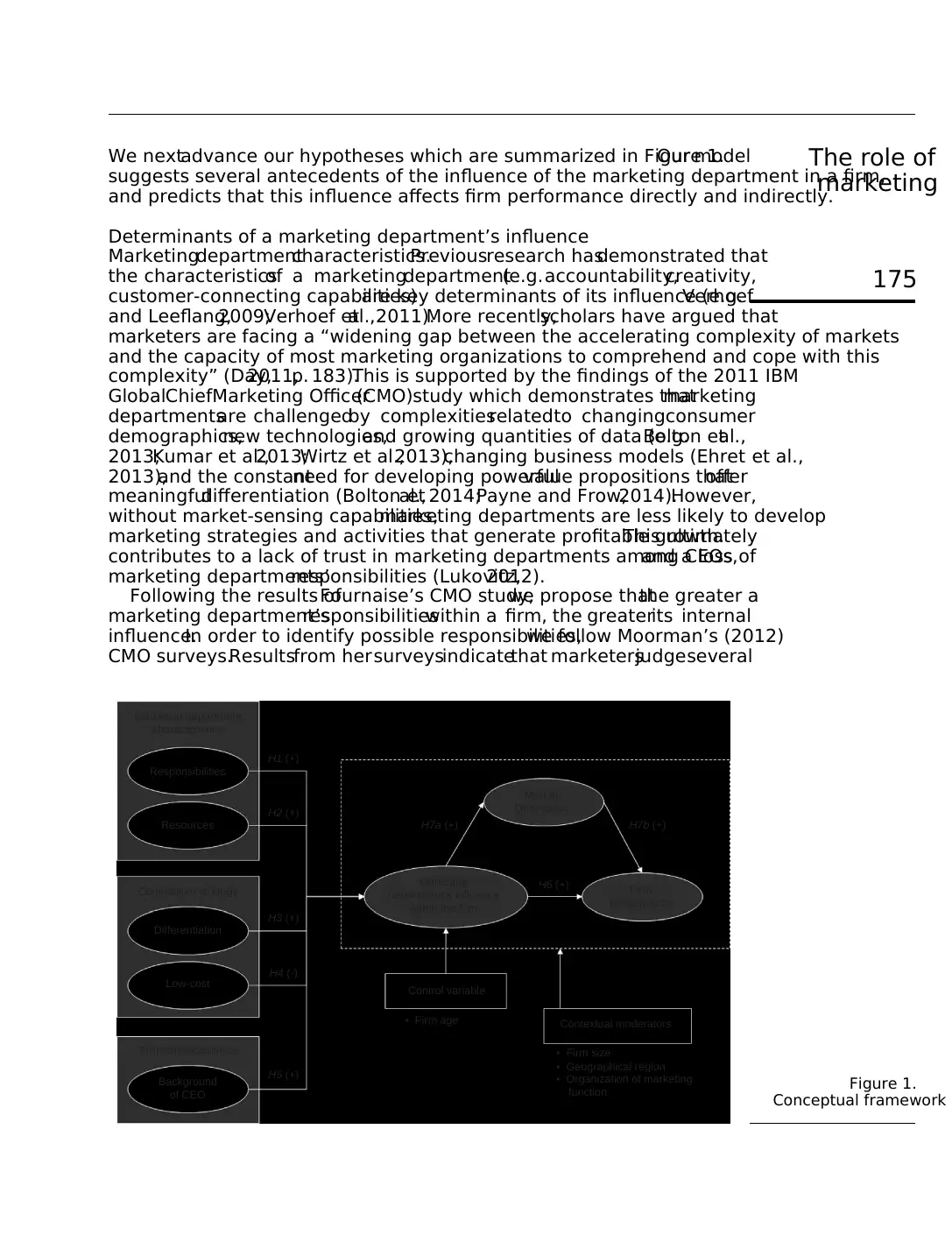
We nextadvance our hypotheses which are summarized in Figure 1.Our model
suggests several antecedents of the influence of the marketing department in a firm,
and predicts that this influence affects firm performance directly and indirectly.
Determinants of a marketing department’s influence
Marketingdepartmentcharacteristics.Previousresearch hasdemonstrated that
the characteristicsof a marketingdepartment(e.g.accountability,creativity,
customer-connecting capabilities)are key determinants of its influence (e.g.Verhoef
and Leeflang,2009;Verhoef etal.,2011).More recently,scholars have argued that
marketers are facing a “widening gap between the accelerating complexity of markets
and the capacity of most marketing organizations to comprehend and cope with this
complexity” (Day,2011,p. 183).This is supported by the findings of the 2011 IBM
GlobalChiefMarketing Officer(CMO)study which demonstrates thatmarketing
departmentsare challengedby complexitiesrelatedto changingconsumer
demographics,new technologies,and growing quantities of data (e.g.Bolton etal.,
2013;Kumar et al.,2013;Wirtz et al.,2013),changing business models (Ehret et al.,
2013),and the constantneed for developing powerfulvalue propositions thatoffer
meaningfuldifferentiation (Bolton etal., 2014;Payne and Frow,2014).However,
without market-sensing capabilities,marketing departments are less likely to develop
marketing strategies and activities that generate profitable growth.This ultimately
contributes to a lack of trust in marketing departments among CEOs,and a loss of
marketing departments’responsibilities (Lukovitz,2012).
Following the results ofFournaise’s CMO study,we propose thatthe greater a
marketing department’sresponsibilitieswithin a firm, the greaterits internal
influence.In order to identify possible responsibilities,we follow Moorman’s (2012)
CMO surveys.Resultsfrom hersurveysindicatethat marketersjudgeseveral
Marketing department
characteristics
Responsibilities
H1 (+)
H2 (+)
H7a (+) H7b (+)
H6 (+)
Market
Orientation
Marketing
department’s influence
within the firm
Firm
performance
Contextual moderators
• Firm size
• Geographical region
• Organization of marketing
function
Control variable
• Firm age
H3 (+)
H4 (-)
H5 (+)
Resources
Competitive strategy
Differentiation
Low-cost
Firm characteristics
Background
of CEO Figure 1.
Conceptual framework
175
The role of
marketing
suggests several antecedents of the influence of the marketing department in a firm,
and predicts that this influence affects firm performance directly and indirectly.
Determinants of a marketing department’s influence
Marketingdepartmentcharacteristics.Previousresearch hasdemonstrated that
the characteristicsof a marketingdepartment(e.g.accountability,creativity,
customer-connecting capabilities)are key determinants of its influence (e.g.Verhoef
and Leeflang,2009;Verhoef etal.,2011).More recently,scholars have argued that
marketers are facing a “widening gap between the accelerating complexity of markets
and the capacity of most marketing organizations to comprehend and cope with this
complexity” (Day,2011,p. 183).This is supported by the findings of the 2011 IBM
GlobalChiefMarketing Officer(CMO)study which demonstrates thatmarketing
departmentsare challengedby complexitiesrelatedto changingconsumer
demographics,new technologies,and growing quantities of data (e.g.Bolton etal.,
2013;Kumar et al.,2013;Wirtz et al.,2013),changing business models (Ehret et al.,
2013),and the constantneed for developing powerfulvalue propositions thatoffer
meaningfuldifferentiation (Bolton etal., 2014;Payne and Frow,2014).However,
without market-sensing capabilities,marketing departments are less likely to develop
marketing strategies and activities that generate profitable growth.This ultimately
contributes to a lack of trust in marketing departments among CEOs,and a loss of
marketing departments’responsibilities (Lukovitz,2012).
Following the results ofFournaise’s CMO study,we propose thatthe greater a
marketing department’sresponsibilitieswithin a firm, the greaterits internal
influence.In order to identify possible responsibilities,we follow Moorman’s (2012)
CMO surveys.Resultsfrom hersurveysindicatethat marketersjudgeseveral
Marketing department
characteristics
Responsibilities
H1 (+)
H2 (+)
H7a (+) H7b (+)
H6 (+)
Market
Orientation
Marketing
department’s influence
within the firm
Firm
performance
Contextual moderators
• Firm size
• Geographical region
• Organization of marketing
function
Control variable
• Firm age
H3 (+)
H4 (-)
H5 (+)
Resources
Competitive strategy
Differentiation
Low-cost
Firm characteristics
Background
of CEO Figure 1.
Conceptual framework
175
The role of
marketing
responsibilities as being highly relevant,including marketpositioning,promotion,
marketing research,social media,competitive intelligence,and public relations.
We propose further that a marketing department’s influence depends both on
market-sensing resources and capabilities,which we collectively label“resources.”
Previous research has adopted the resource-based or capabilities theory (Day,1994,
2011)to investigate how resources and capabilities relate to the marketing functio
(e.g.Lee et al.,2011;Sarkees et al.,2010).To investigate the relationship between a
marketing department’s responsibilities and resources,and its influence within the
firm,we propose that:
H1. The greater the marketing department’s responsibilities in a firm,the greater
the department’s influence in the firm.
H2. The greater the marketing department’s level of resources in a firm, the gre
the department’s influence in the firm.
Competitive strategy.Prior research suggests that the choice of a firm’s competitive
strategy is related to the influence of its marketing department.Some scholars have
found thata differentiation strategy is related positively to marketing’s influence,
whereas a low-cost strategy,similar to a “defender strategy” (Miles and Snow,1978),is
related negatively (Homburg etal.,1999;Wu, 2004).However,recentcross-country
results by Verhoef et al. (2011) indicate non-conclusive effects. In order to compa
relationships in Western firms with rapidly developing Eastern firms,we propose:
H3. A differentiation strategy is related positively to a marketing department’s
influence within a firm.
H4. A low-cost strategy is related negatively to a marketing department’s influe
within a firm.
Background of the CEO.Previous research has argued that the influence of functional
groups is related to the organizationalculture (Deshpande´ and Webster,1989)and
guidance by top management (Hambrick and Mason, 1984). There is empirical su
that if a firm’s CEO has a background in marketing,the marketing function has a
higher level of influence (Homburg et al., 1999; Verhoef et al., 2011). This is beca
background ofthe CEO serves “as a manifestation ofthe bureaucratic power of
marketing” (Merlo,2011,p. 1156),leading to greater legitimacy compared to other
functions.Thus,we propose:
H5. The marketing department has a stronger influence in firms in which the CE
has a marketing background compared to firms in which the CEO does not
have a marketing background.
Marketing department’s influence, market orientation and firm performance
Severalscholars supportthe idea thatmarketing departments are importantfor a
company’s performance (Day,1994;Webster,1997),affecting it directly and positively
(Moorman and Rust,1999;Wu,2004).Their rationale is thatmarketing departments
develop vital knowledge and skills that allow firms to connect customers to their
At the same time,numerous studies and severalmeta-analyses provide ample
evidence that firm performance is positively influenced by a firm’s market orienta
176
JOSM
25,2
marketing research,social media,competitive intelligence,and public relations.
We propose further that a marketing department’s influence depends both on
market-sensing resources and capabilities,which we collectively label“resources.”
Previous research has adopted the resource-based or capabilities theory (Day,1994,
2011)to investigate how resources and capabilities relate to the marketing functio
(e.g.Lee et al.,2011;Sarkees et al.,2010).To investigate the relationship between a
marketing department’s responsibilities and resources,and its influence within the
firm,we propose that:
H1. The greater the marketing department’s responsibilities in a firm,the greater
the department’s influence in the firm.
H2. The greater the marketing department’s level of resources in a firm, the gre
the department’s influence in the firm.
Competitive strategy.Prior research suggests that the choice of a firm’s competitive
strategy is related to the influence of its marketing department.Some scholars have
found thata differentiation strategy is related positively to marketing’s influence,
whereas a low-cost strategy,similar to a “defender strategy” (Miles and Snow,1978),is
related negatively (Homburg etal.,1999;Wu, 2004).However,recentcross-country
results by Verhoef et al. (2011) indicate non-conclusive effects. In order to compa
relationships in Western firms with rapidly developing Eastern firms,we propose:
H3. A differentiation strategy is related positively to a marketing department’s
influence within a firm.
H4. A low-cost strategy is related negatively to a marketing department’s influe
within a firm.
Background of the CEO.Previous research has argued that the influence of functional
groups is related to the organizationalculture (Deshpande´ and Webster,1989)and
guidance by top management (Hambrick and Mason, 1984). There is empirical su
that if a firm’s CEO has a background in marketing,the marketing function has a
higher level of influence (Homburg et al., 1999; Verhoef et al., 2011). This is beca
background ofthe CEO serves “as a manifestation ofthe bureaucratic power of
marketing” (Merlo,2011,p. 1156),leading to greater legitimacy compared to other
functions.Thus,we propose:
H5. The marketing department has a stronger influence in firms in which the CE
has a marketing background compared to firms in which the CEO does not
have a marketing background.
Marketing department’s influence, market orientation and firm performance
Severalscholars supportthe idea thatmarketing departments are importantfor a
company’s performance (Day,1994;Webster,1997),affecting it directly and positively
(Moorman and Rust,1999;Wu,2004).Their rationale is thatmarketing departments
develop vital knowledge and skills that allow firms to connect customers to their
At the same time,numerous studies and severalmeta-analyses provide ample
evidence that firm performance is positively influenced by a firm’s market orienta
176
JOSM
25,2
⊘ This is a preview!⊘
Do you want full access?
Subscribe today to unlock all pages.
Trusted by 1+ million students worldwide
independent of the marketing department’s role (e.g. Cano et al., 2004; Kirca et al., 2005).
Market orientation is a crucialconstruct in the marketing literature (e.g.Kohli and
Jaworski, 1990), and such an orientation has been conceptualized from both behavioral
and cultural perspectives (Homburg and Pflesser,2000).
Only few studieshaveinvestigated thesimultaneousrelationship between a
marketing department’sinfluenceand marketorientation on firm performance.
Moorman and Rust(1999)showed empirically thatstrong marketing departments
provide value over and above a firm’s market orientation and have a direct positive
effect on firm performance. The authors argue that, through its skill set, the marketing
departmentcontributesto new product performance,customerrelationship
performanceand to the financialperformanceof a firm beyond thevariance
explained by a firm’s market orientation,and that “the marketing function can and
should coexist with a market orientation” (Moorman and Rust,1999,p.180).
Two recentstudies suggests thatmarketorientation mediates the relationship
between a marketing department’s influence and firm performance (Verhoefand
Leeflang,2009;Verhoef et al.,2011).In fact,in Verhoef and Leeflang’s (2009)study,
market orientation fully mediated the effects of the marketing department’s influence
on firm performance.One explanation the authors offer for their finding is that since
Moorman and Rust’s (1999) study, “firms have become more market oriented, creating
a less strong need for an influentialmarketing department” (Verhoef and Leeflang,
2009,p.28).Verhoef et al.(2011) conclude that top management respect and decision
influence ofthe marketing departmentare directly and indirectly related to firm
performance. In order to explore these relationships in potentially more market-oriented
Western firms,and firms in rapidly developing Asia,we propose:
H6. The greater the marketing department’s influence in a firm, the better the firm’s
performance.
H7. The greater the marketing department’s influence in a firm,the higher its
market orientation,which in turn improves firm performance.
Empirical study
Sample and data collection
In order to testour hypotheses,we conducted a large-scale cross-sectionalsurvey
across three continents:North America,Europe,and Asia.Utilizing the student
directories of the authors’ and affiliated universities, we sent e-mails to approximately
2,930 MBA and EMBA alumni.In total,580 individuals participated,yielding an
overall response rate of 19.8 percent, which is comparable with that of prior research in
which data were obtained from commerciallist providers (e.g.Sarkees et al.,2010).
The response rate was also at the top end of the average response rates among managers,
which according to Menon et al.(1996),is between 15 and 20 percent.We excluded all
respondents who did not complete the entire survey, and a few respondents from Africa
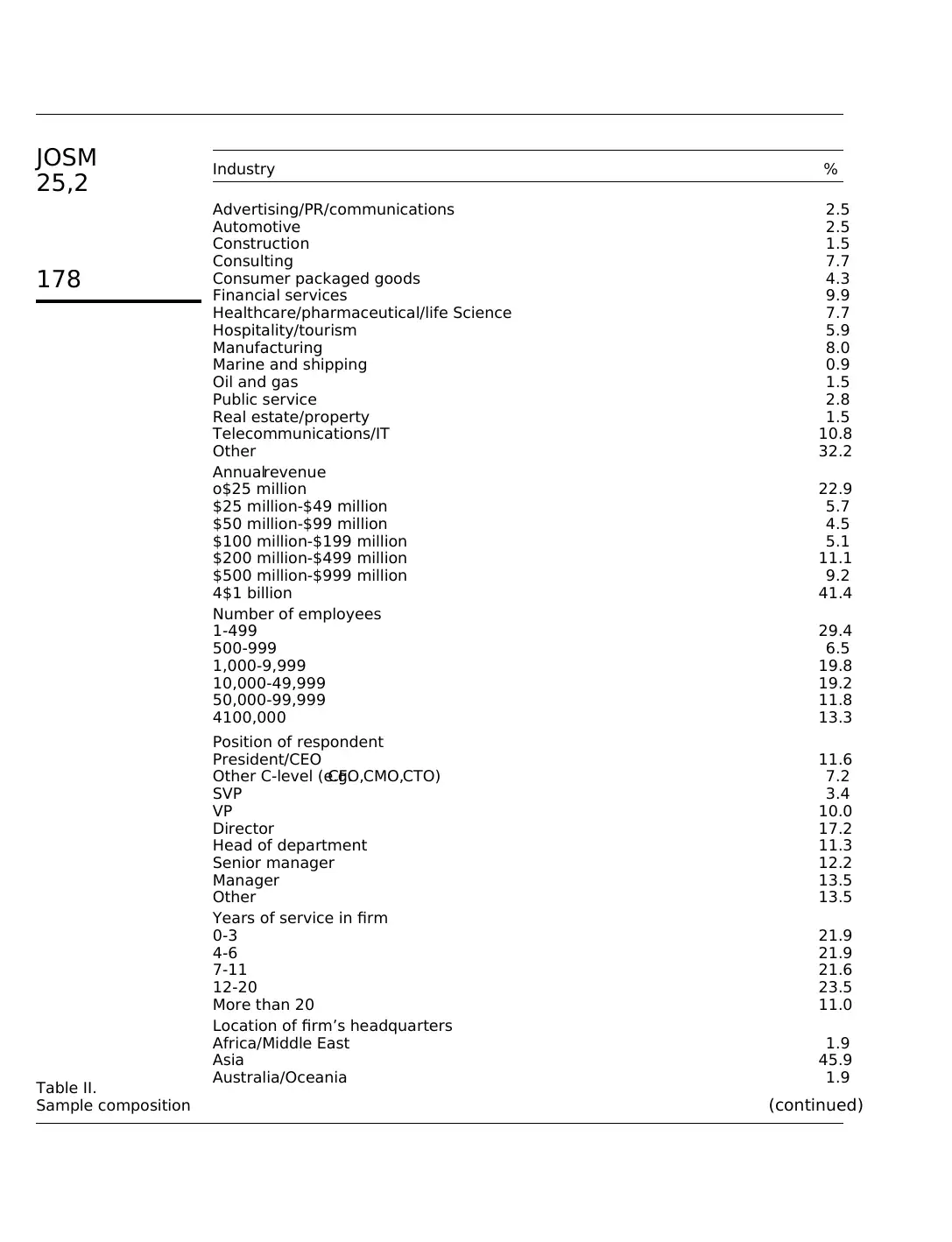
and Australia,leaving a final sample of 312 responses for analysis.Table II shows the
composition of the sample with regards to geography, industry, firm revenue, the number
of employees,as well as the respondents’background.
Measures
All measures are shown in Tables III and IV.
177
The role of
marketing
Market orientation is a crucialconstruct in the marketing literature (e.g.Kohli and
Jaworski, 1990), and such an orientation has been conceptualized from both behavioral
and cultural perspectives (Homburg and Pflesser,2000).
Only few studieshaveinvestigated thesimultaneousrelationship between a
marketing department’sinfluenceand marketorientation on firm performance.
Moorman and Rust(1999)showed empirically thatstrong marketing departments
provide value over and above a firm’s market orientation and have a direct positive
effect on firm performance. The authors argue that, through its skill set, the marketing
departmentcontributesto new product performance,customerrelationship
performanceand to the financialperformanceof a firm beyond thevariance
explained by a firm’s market orientation,and that “the marketing function can and
should coexist with a market orientation” (Moorman and Rust,1999,p.180).
Two recentstudies suggests thatmarketorientation mediates the relationship
between a marketing department’s influence and firm performance (Verhoefand
Leeflang,2009;Verhoef et al.,2011).In fact,in Verhoef and Leeflang’s (2009)study,
market orientation fully mediated the effects of the marketing department’s influence
on firm performance.One explanation the authors offer for their finding is that since
Moorman and Rust’s (1999) study, “firms have become more market oriented, creating
a less strong need for an influentialmarketing department” (Verhoef and Leeflang,
2009,p.28).Verhoef et al.(2011) conclude that top management respect and decision
influence ofthe marketing departmentare directly and indirectly related to firm
performance. In order to explore these relationships in potentially more market-oriented
Western firms,and firms in rapidly developing Asia,we propose:
H6. The greater the marketing department’s influence in a firm, the better the firm’s
performance.
H7. The greater the marketing department’s influence in a firm,the higher its
market orientation,which in turn improves firm performance.
Empirical study
Sample and data collection
In order to testour hypotheses,we conducted a large-scale cross-sectionalsurvey
across three continents:North America,Europe,and Asia.Utilizing the student
directories of the authors’ and affiliated universities, we sent e-mails to approximately
2,930 MBA and EMBA alumni.In total,580 individuals participated,yielding an
overall response rate of 19.8 percent, which is comparable with that of prior research in
which data were obtained from commerciallist providers (e.g.Sarkees et al.,2010).
The response rate was also at the top end of the average response rates among managers,
which according to Menon et al.(1996),is between 15 and 20 percent.We excluded all
respondents who did not complete the entire survey, and a few respondents from Africa
and Australia,leaving a final sample of 312 responses for analysis.Table II shows the
composition of the sample with regards to geography, industry, firm revenue, the number
of employees,as well as the respondents’background.
Measures
All measures are shown in Tables III and IV.
177
The role of
marketing
Paraphrase This Document
Need a fresh take? Get an instant paraphrase of this document with our AI Paraphraser
Industry %
Advertising/PR/communications 2.5
Automotive 2.5
Construction 1.5
Consulting 7.7
Consumer packaged goods 4.3
Financial services 9.9
Healthcare/pharmaceutical/life Science 7.7
Hospitality/tourism 5.9
Manufacturing 8.0
Marine and shipping 0.9
Oil and gas 1.5
Public service 2.8
Real estate/property 1.5
Telecommunications/IT 10.8
Other 32.2
Annualrevenue
o$25 million 22.9
$25 million-$49 million 5.7
$50 million-$99 million 4.5
$100 million-$199 million 5.1
$200 million-$499 million 11.1
$500 million-$999 million 9.2
4$1 billion 41.4
Number of employees
1-499 29.4
500-999 6.5
1,000-9,999 19.8
10,000-49,999 19.2
50,000-99,999 11.8
4100,000 13.3
Position of respondent
President/CEO 11.6
Other C-level (e.g.CFO,CMO,CTO) 7.2
SVP 3.4
VP 10.0
Director 17.2
Head of department 11.3
Senior manager 12.2
Manager 13.5
Other 13.5
Years of service in firm
0-3 21.9
4-6 21.9
7-11 21.6
12-20 23.5
More than 20 11.0
Location of firm’s headquarters
Africa/Middle East 1.9
Asia 45.9
Australia/Oceania 1.9
(continued)
Table II.
Sample composition
178
JOSM
25,2
Advertising/PR/communications 2.5
Automotive 2.5
Construction 1.5
Consulting 7.7
Consumer packaged goods 4.3
Financial services 9.9
Healthcare/pharmaceutical/life Science 7.7
Hospitality/tourism 5.9
Manufacturing 8.0
Marine and shipping 0.9
Oil and gas 1.5
Public service 2.8
Real estate/property 1.5
Telecommunications/IT 10.8
Other 32.2
Annualrevenue
o$25 million 22.9
$25 million-$49 million 5.7
$50 million-$99 million 4.5
$100 million-$199 million 5.1
$200 million-$499 million 11.1
$500 million-$999 million 9.2
4$1 billion 41.4
Number of employees
1-499 29.4
500-999 6.5
1,000-9,999 19.8
10,000-49,999 19.2
50,000-99,999 11.8
4100,000 13.3
Position of respondent
President/CEO 11.6
Other C-level (e.g.CFO,CMO,CTO) 7.2
SVP 3.4
VP 10.0
Director 17.2
Head of department 11.3
Senior manager 12.2
Manager 13.5
Other 13.5
Years of service in firm
0-3 21.9
4-6 21.9
7-11 21.6
12-20 23.5
More than 20 11.0
Location of firm’s headquarters
Africa/Middle East 1.9
Asia 45.9
Australia/Oceania 1.9
(continued)
Table II.
Sample composition
178
JOSM
25,2
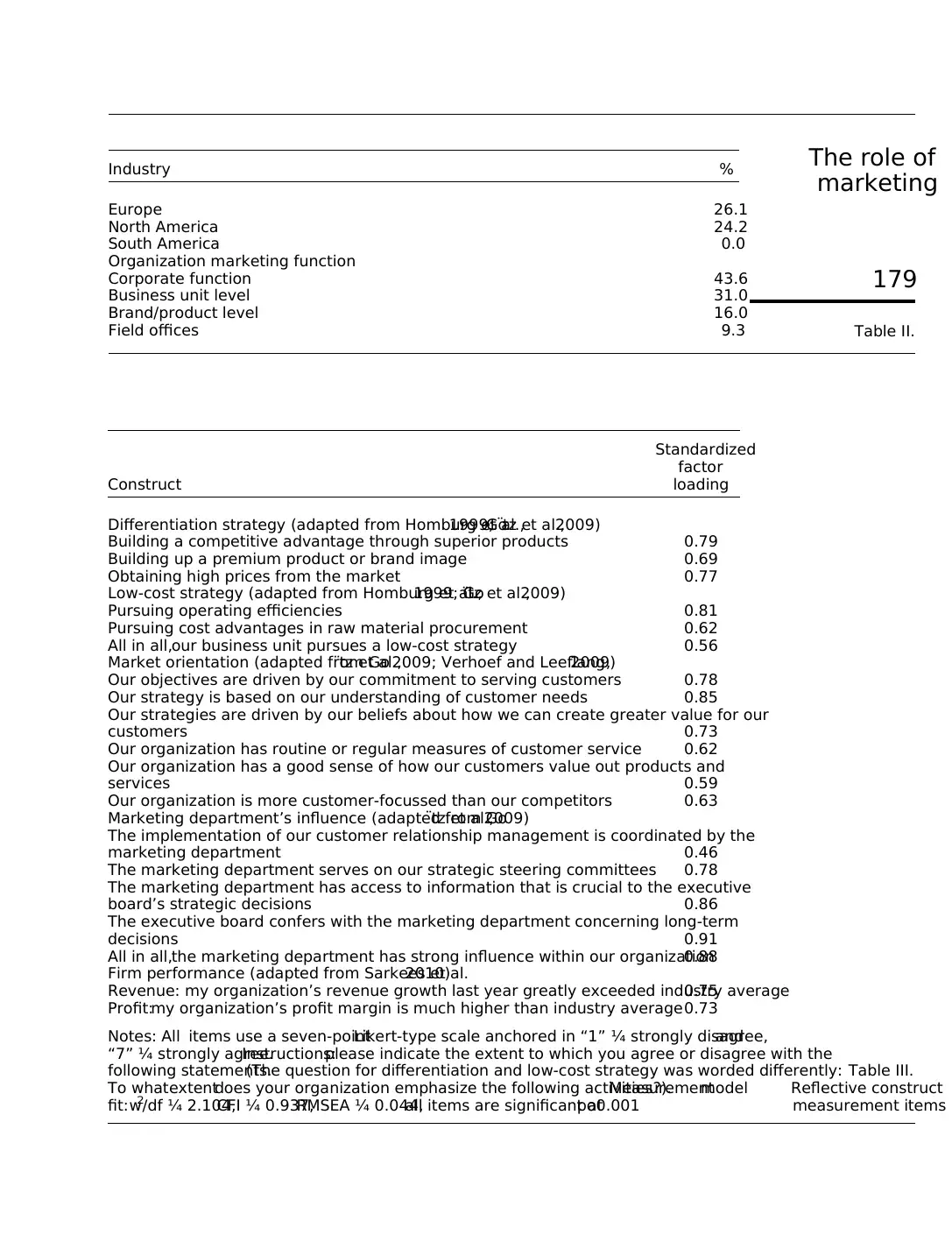
Industry %
Europe 26.1
North America 24.2
South America 0.0
Organization marketing function
Corporate function 43.6
Business unit level 31.0
Brand/product level 16.0
Field offices 9.3 Table II.
Construct
Standardized
factor
loading
Differentiation strategy (adapted from Homburg et al.,1999;Go¨tz et al.,2009)
Building a competitive advantage through superior products 0.79
Building up a premium product or brand image 0.69
Obtaining high prices from the market 0.77
Low-cost strategy (adapted from Homburg et al.,1999; Go¨tz et al.,2009)
Pursuing operating efficiencies 0.81
Pursuing cost advantages in raw material procurement 0.62
All in all,our business unit pursues a low-cost strategy 0.56
Market orientation (adapted from Go¨tz et al.,2009; Verhoef and Leeflang,2009)
Our objectives are driven by our commitment to serving customers 0.78
Our strategy is based on our understanding of customer needs 0.85
Our strategies are driven by our beliefs about how we can create greater value for our
customers 0.73
Our organization has routine or regular measures of customer service 0.62
Our organization has a good sense of how our customers value out products and
services 0.59
Our organization is more customer-focussed than our competitors 0.63
Marketing department’s influence (adapted from Go¨tz et al.,2009)
The implementation of our customer relationship management is coordinated by the
marketing department 0.46
The marketing department serves on our strategic steering committees 0.78
The marketing department has access to information that is crucial to the executive
board’s strategic decisions 0.86
The executive board confers with the marketing department concerning long-term
decisions 0.91
All in all,the marketing department has strong influence within our organization0.88
Firm performance (adapted from Sarkees et al.2010)
Revenue: my organization’s revenue growth last year greatly exceeded industry average0.75
Profit:my organization’s profit margin is much higher than industry average0.73
Notes: All items use a seven-pointLikert-type scale anchored in “1” ¼ strongly disagree,and
“7” ¼ strongly agree.Instructions:please indicate the extent to which you agree or disagree with the
following statements.(The question for differentiation and low-cost strategy was worded differently:
To whatextentdoes your organization emphasize the following activities?).Measurementmodel
fit:w2/df ¼ 2.104,CFI ¼ 0.937,RMSEA ¼ 0.044,all items are significant atpo0.001
Table III.
Reflective construct
measurement items
179
The role of
marketing
Europe 26.1
North America 24.2
South America 0.0
Organization marketing function
Corporate function 43.6
Business unit level 31.0
Brand/product level 16.0
Field offices 9.3 Table II.
Construct
Standardized
factor
loading
Differentiation strategy (adapted from Homburg et al.,1999;Go¨tz et al.,2009)
Building a competitive advantage through superior products 0.79
Building up a premium product or brand image 0.69
Obtaining high prices from the market 0.77
Low-cost strategy (adapted from Homburg et al.,1999; Go¨tz et al.,2009)
Pursuing operating efficiencies 0.81
Pursuing cost advantages in raw material procurement 0.62
All in all,our business unit pursues a low-cost strategy 0.56
Market orientation (adapted from Go¨tz et al.,2009; Verhoef and Leeflang,2009)
Our objectives are driven by our commitment to serving customers 0.78
Our strategy is based on our understanding of customer needs 0.85
Our strategies are driven by our beliefs about how we can create greater value for our
customers 0.73
Our organization has routine or regular measures of customer service 0.62
Our organization has a good sense of how our customers value out products and
services 0.59
Our organization is more customer-focussed than our competitors 0.63
Marketing department’s influence (adapted from Go¨tz et al.,2009)
The implementation of our customer relationship management is coordinated by the
marketing department 0.46
The marketing department serves on our strategic steering committees 0.78
The marketing department has access to information that is crucial to the executive
board’s strategic decisions 0.86
The executive board confers with the marketing department concerning long-term
decisions 0.91
All in all,the marketing department has strong influence within our organization0.88
Firm performance (adapted from Sarkees et al.2010)
Revenue: my organization’s revenue growth last year greatly exceeded industry average0.75
Profit:my organization’s profit margin is much higher than industry average0.73
Notes: All items use a seven-pointLikert-type scale anchored in “1” ¼ strongly disagree,and
“7” ¼ strongly agree.Instructions:please indicate the extent to which you agree or disagree with the
following statements.(The question for differentiation and low-cost strategy was worded differently:
To whatextentdoes your organization emphasize the following activities?).Measurementmodel
fit:w2/df ¼ 2.104,CFI ¼ 0.937,RMSEA ¼ 0.044,all items are significant atpo0.001
Table III.
Reflective construct
measurement items
179
The role of
marketing
⊘ This is a preview!⊘
Do you want full access?
Subscribe today to unlock all pages.
Trusted by 1+ million students worldwide
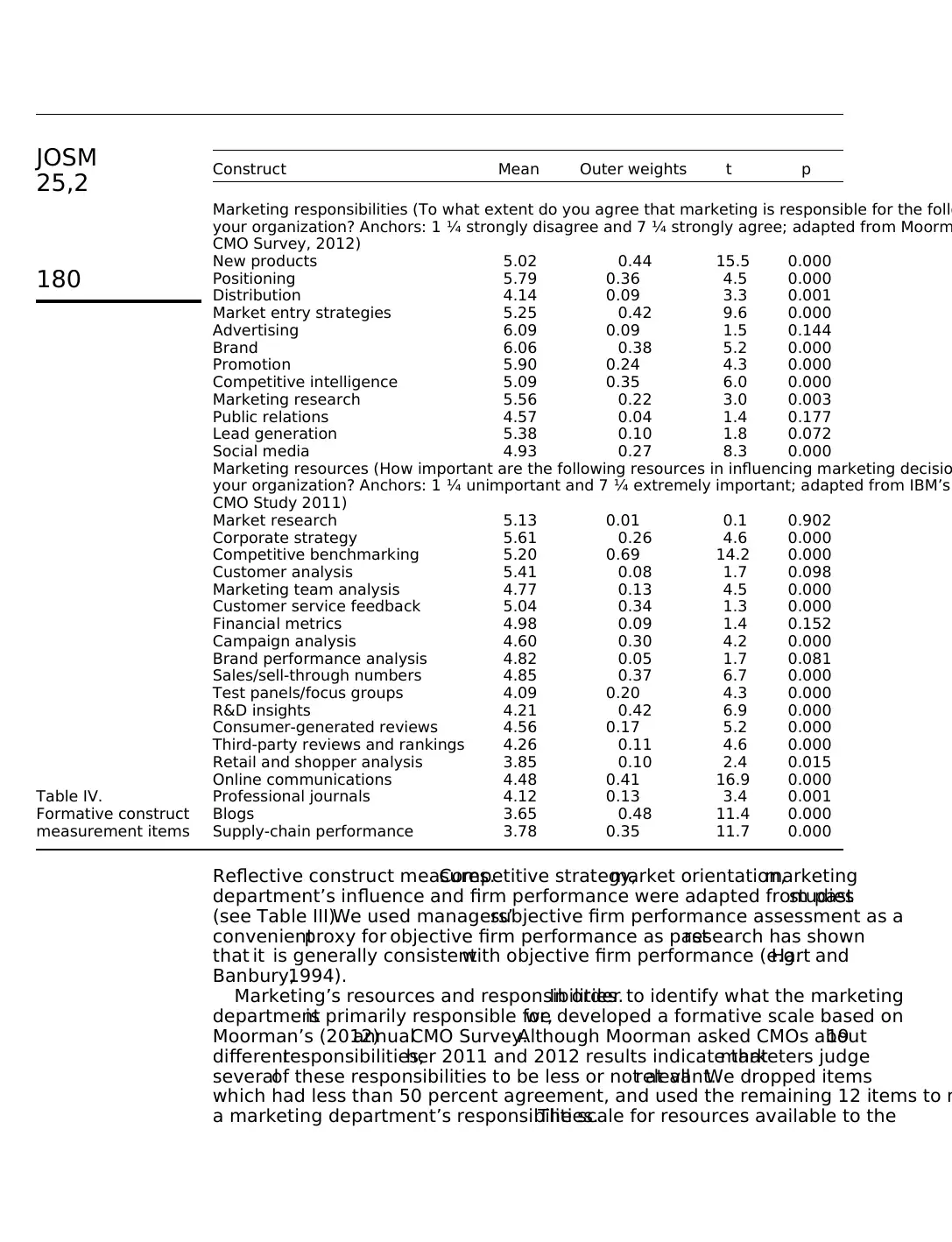
Reflective construct measures.Competitive strategy,market orientation,marketing
department’s influence and firm performance were adapted from paststudies
(see Table III).We used managers’subjective firm performance assessment as a
convenientproxy for objective firm performance as pastresearch has shown
that it is generally consistentwith objective firm performance (e.g.Hart and
Banbury,1994).
Marketing’s resources and responsibilities.In order to identify what the marketing
departmentis primarily responsible for,we developed a formative scale based on
Moorman’s (2012)annualCMO Survey.Although Moorman asked CMOs about19
differentresponsibilities,her 2011 and 2012 results indicate thatmarketers judge
severalof these responsibilities to be less or not at allrelevant.We dropped items
which had less than 50 percent agreement, and used the remaining 12 items to m
a marketing department’s responsibilities.The scale for resources available to the
Construct Mean Outer weights t p
Marketing responsibilities (To what extent do you agree that marketing is responsible for the follo
your organization? Anchors: 1 ¼ strongly disagree and 7 ¼ strongly agree; adapted from Moorm
CMO Survey, 2012)
New products 5.02 0.44 15.5 0.000
Positioning 5.79 0.36 4.5 0.000
Distribution 4.14 0.09 3.3 0.001
Market entry strategies 5.25 0.42 9.6 0.000
Advertising 6.09 0.09 1.5 0.144
Brand 6.06 0.38 5.2 0.000
Promotion 5.90 0.24 4.3 0.000
Competitive intelligence 5.09 0.35 6.0 0.000
Marketing research 5.56 0.22 3.0 0.003
Public relations 4.57 0.04 1.4 0.177
Lead generation 5.38 0.10 1.8 0.072
Social media 4.93 0.27 8.3 0.000
Marketing resources (How important are the following resources in influencing marketing decisio
your organization? Anchors: 1 ¼ unimportant and 7 ¼ extremely important; adapted from IBM’s
CMO Study 2011)
Market research 5.13 0.01 0.1 0.902
Corporate strategy 5.61 0.26 4.6 0.000
Competitive benchmarking 5.20 0.69 14.2 0.000
Customer analysis 5.41 0.08 1.7 0.098
Marketing team analysis 4.77 0.13 4.5 0.000
Customer service feedback 5.04 0.34 1.3 0.000
Financial metrics 4.98 0.09 1.4 0.152
Campaign analysis 4.60 0.30 4.2 0.000
Brand performance analysis 4.82 0.05 1.7 0.081
Sales/sell-through numbers 4.85 0.37 6.7 0.000
Test panels/focus groups 4.09 0.20 4.3 0.000
R&D insights 4.21 0.42 6.9 0.000
Consumer-generated reviews 4.56 0.17 5.2 0.000
Third-party reviews and rankings 4.26 0.11 4.6 0.000
Retail and shopper analysis 3.85 0.10 2.4 0.015
Online communications 4.48 0.41 16.9 0.000
Professional journals 4.12 0.13 3.4 0.001
Blogs 3.65 0.48 11.4 0.000
Supply-chain performance 3.78 0.35 11.7 0.000
Table IV.
Formative construct
measurement items
180
JOSM
25,2
department’s influence and firm performance were adapted from paststudies
(see Table III).We used managers’subjective firm performance assessment as a
convenientproxy for objective firm performance as pastresearch has shown
that it is generally consistentwith objective firm performance (e.g.Hart and
Banbury,1994).
Marketing’s resources and responsibilities.In order to identify what the marketing
departmentis primarily responsible for,we developed a formative scale based on
Moorman’s (2012)annualCMO Survey.Although Moorman asked CMOs about19
differentresponsibilities,her 2011 and 2012 results indicate thatmarketers judge
severalof these responsibilities to be less or not at allrelevant.We dropped items
which had less than 50 percent agreement, and used the remaining 12 items to m
a marketing department’s responsibilities.The scale for resources available to the
Construct Mean Outer weights t p
Marketing responsibilities (To what extent do you agree that marketing is responsible for the follo
your organization? Anchors: 1 ¼ strongly disagree and 7 ¼ strongly agree; adapted from Moorm
CMO Survey, 2012)
New products 5.02 0.44 15.5 0.000
Positioning 5.79 0.36 4.5 0.000
Distribution 4.14 0.09 3.3 0.001
Market entry strategies 5.25 0.42 9.6 0.000
Advertising 6.09 0.09 1.5 0.144
Brand 6.06 0.38 5.2 0.000
Promotion 5.90 0.24 4.3 0.000
Competitive intelligence 5.09 0.35 6.0 0.000
Marketing research 5.56 0.22 3.0 0.003
Public relations 4.57 0.04 1.4 0.177
Lead generation 5.38 0.10 1.8 0.072
Social media 4.93 0.27 8.3 0.000
Marketing resources (How important are the following resources in influencing marketing decisio
your organization? Anchors: 1 ¼ unimportant and 7 ¼ extremely important; adapted from IBM’s
CMO Study 2011)
Market research 5.13 0.01 0.1 0.902
Corporate strategy 5.61 0.26 4.6 0.000
Competitive benchmarking 5.20 0.69 14.2 0.000
Customer analysis 5.41 0.08 1.7 0.098
Marketing team analysis 4.77 0.13 4.5 0.000
Customer service feedback 5.04 0.34 1.3 0.000
Financial metrics 4.98 0.09 1.4 0.152
Campaign analysis 4.60 0.30 4.2 0.000
Brand performance analysis 4.82 0.05 1.7 0.081
Sales/sell-through numbers 4.85 0.37 6.7 0.000
Test panels/focus groups 4.09 0.20 4.3 0.000
R&D insights 4.21 0.42 6.9 0.000
Consumer-generated reviews 4.56 0.17 5.2 0.000
Third-party reviews and rankings 4.26 0.11 4.6 0.000
Retail and shopper analysis 3.85 0.10 2.4 0.015
Online communications 4.48 0.41 16.9 0.000
Professional journals 4.12 0.13 3.4 0.001
Blogs 3.65 0.48 11.4 0.000
Supply-chain performance 3.78 0.35 11.7 0.000
Table IV.
Formative construct
measurement items
180
JOSM
25,2
Paraphrase This Document
Need a fresh take? Get an instant paraphrase of this document with our AI Paraphraser
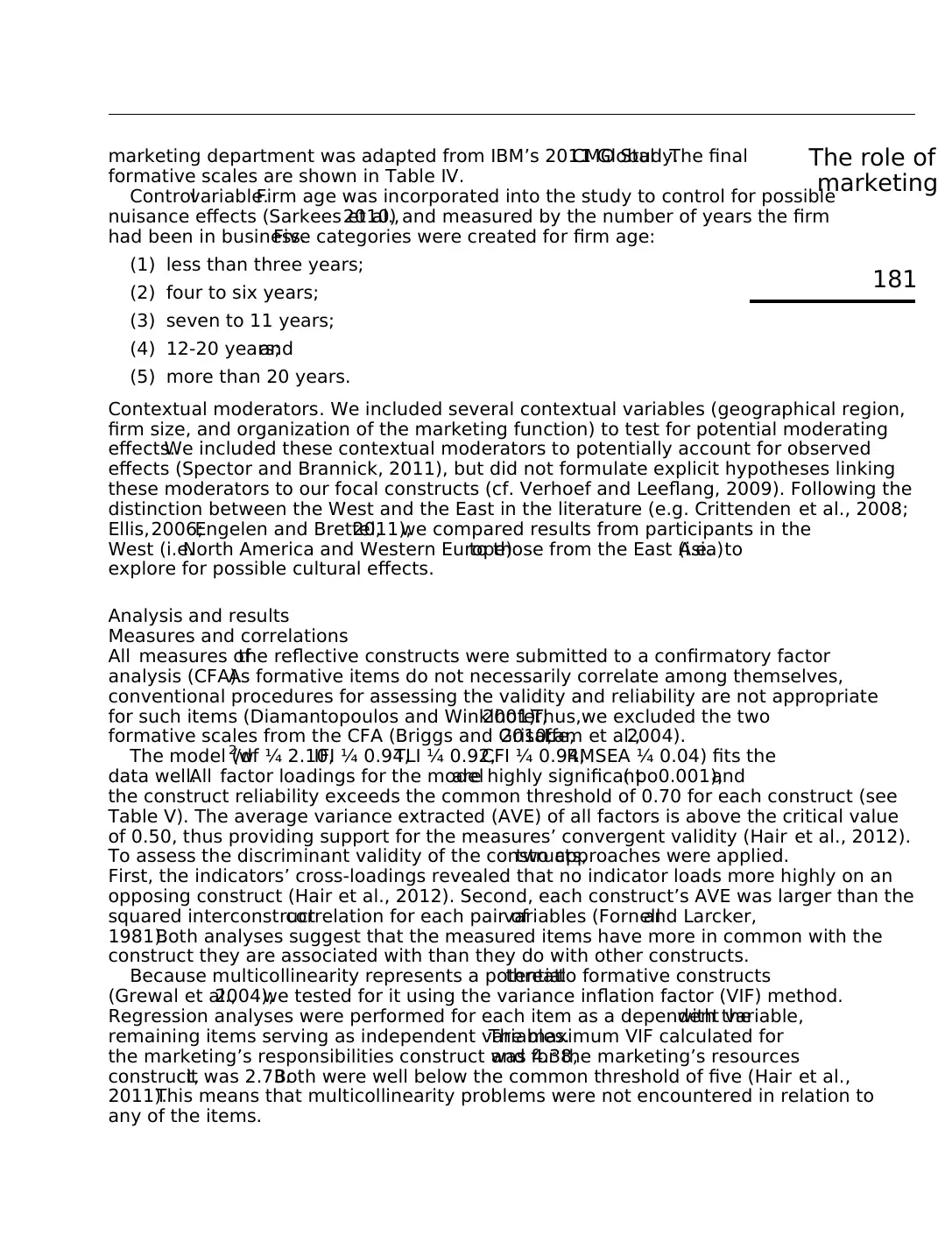
marketing department was adapted from IBM’s 2011 GlobalCMO Study.The final
formative scales are shown in Table IV.
Controlvariable.Firm age was incorporated into the study to control for possible
nuisance effects (Sarkees et al.,2010) and measured by the number of years the firm
had been in business.Five categories were created for firm age:
(1) less than three years;
(2) four to six years;
(3) seven to 11 years;
(4) 12-20 years;and
(5) more than 20 years.
Contextual moderators. We included several contextual variables (geographical region,
firm size, and organization of the marketing function) to test for potential moderating
effects.We included these contextual moderators to potentially account for observed
effects (Spector and Brannick, 2011), but did not formulate explicit hypotheses linking
these moderators to our focal constructs (cf. Verhoef and Leeflang, 2009). Following the
distinction between the West and the East in the literature (e.g. Crittenden et al., 2008;
Ellis,2006;Engelen and Brettel,2011),we compared results from participants in the
West (i.e.North America and Western Europe)to those from the East (i.e.Asia)to
explore for possible cultural effects.
Analysis and results
Measures and correlations
All measures ofthe reflective constructs were submitted to a confirmatory factor
analysis (CFA).As formative items do not necessarily correlate among themselves,
conventional procedures for assessing the validity and reliability are not appropriate
for such items (Diamantopoulos and Winklhofer,2001).Thus,we excluded the two
formative scales from the CFA (Briggs and Grisaffe,2010;Lam et al.,2004).
The model (w2/df ¼ 2.10,IFI ¼ 0.94,TLI ¼ 0.92,CFI ¼ 0.94,RMSEA ¼ 0.04) fits the
data well.All factor loadings for the modelare highly significant( po0.001),and
the construct reliability exceeds the common threshold of 0.70 for each construct (see
Table V). The average variance extracted (AVE) of all factors is above the critical value
of 0.50, thus providing support for the measures’ convergent validity (Hair et al., 2012).
To assess the discriminant validity of the constructs,two approaches were applied.
First, the indicators’ cross-loadings revealed that no indicator loads more highly on an
opposing construct (Hair et al., 2012). Second, each construct’s AVE was larger than the
squared interconstructcorrelation for each pair ofvariables (Fornelland Larcker,
1981).Both analyses suggest that the measured items have more in common with the
construct they are associated with than they do with other constructs.
Because multicollinearity represents a potentialthreatto formative constructs
(Grewal et al.,2004),we tested for it using the variance inflation factor (VIF) method.
Regression analyses were performed for each item as a dependent variable,with the
remaining items serving as independent variables.The maximum VIF calculated for
the marketing’s responsibilities construct was 4.38,and for the marketing’s resources
construct,it was 2.73.Both were well below the common threshold of five (Hair et al.,
2011).This means that multicollinearity problems were not encountered in relation to
any of the items.
181
The role of
marketing
formative scales are shown in Table IV.
Controlvariable.Firm age was incorporated into the study to control for possible
nuisance effects (Sarkees et al.,2010) and measured by the number of years the firm
had been in business.Five categories were created for firm age:
(1) less than three years;
(2) four to six years;
(3) seven to 11 years;
(4) 12-20 years;and
(5) more than 20 years.
Contextual moderators. We included several contextual variables (geographical region,
firm size, and organization of the marketing function) to test for potential moderating
effects.We included these contextual moderators to potentially account for observed
effects (Spector and Brannick, 2011), but did not formulate explicit hypotheses linking
these moderators to our focal constructs (cf. Verhoef and Leeflang, 2009). Following the
distinction between the West and the East in the literature (e.g. Crittenden et al., 2008;
Ellis,2006;Engelen and Brettel,2011),we compared results from participants in the
West (i.e.North America and Western Europe)to those from the East (i.e.Asia)to
explore for possible cultural effects.
Analysis and results
Measures and correlations
All measures ofthe reflective constructs were submitted to a confirmatory factor
analysis (CFA).As formative items do not necessarily correlate among themselves,
conventional procedures for assessing the validity and reliability are not appropriate
for such items (Diamantopoulos and Winklhofer,2001).Thus,we excluded the two
formative scales from the CFA (Briggs and Grisaffe,2010;Lam et al.,2004).
The model (w2/df ¼ 2.10,IFI ¼ 0.94,TLI ¼ 0.92,CFI ¼ 0.94,RMSEA ¼ 0.04) fits the
data well.All factor loadings for the modelare highly significant( po0.001),and
the construct reliability exceeds the common threshold of 0.70 for each construct (see
Table V). The average variance extracted (AVE) of all factors is above the critical value
of 0.50, thus providing support for the measures’ convergent validity (Hair et al., 2012).
To assess the discriminant validity of the constructs,two approaches were applied.
First, the indicators’ cross-loadings revealed that no indicator loads more highly on an
opposing construct (Hair et al., 2012). Second, each construct’s AVE was larger than the
squared interconstructcorrelation for each pair ofvariables (Fornelland Larcker,
1981).Both analyses suggest that the measured items have more in common with the
construct they are associated with than they do with other constructs.
Because multicollinearity represents a potentialthreatto formative constructs
(Grewal et al.,2004),we tested for it using the variance inflation factor (VIF) method.
Regression analyses were performed for each item as a dependent variable,with the
remaining items serving as independent variables.The maximum VIF calculated for
the marketing’s responsibilities construct was 4.38,and for the marketing’s resources
construct,it was 2.73.Both were well below the common threshold of five (Hair et al.,
2011).This means that multicollinearity problems were not encountered in relation to
any of the items.
181
The role of
marketing
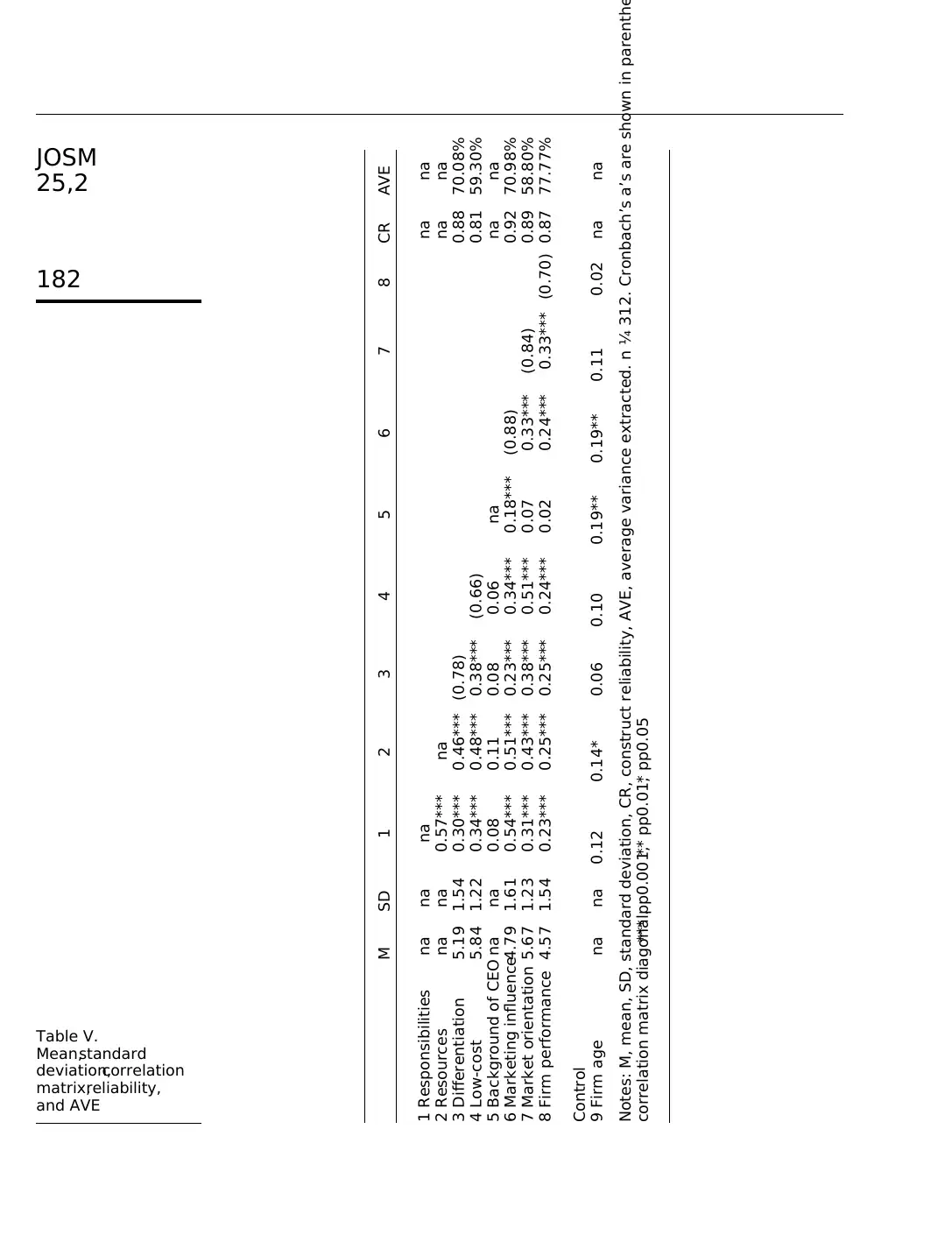
M SD 1 2 3 4 5 6 7 8 CR AVE
1 Responsibilities na na na na na
2 Resources na na 0.57*** na na na
3 Differentiation 5.19 1.54 0.30*** 0.46*** (0.78) 0.88 70.08%
4 Low-cost 5.84 1.22 0.34*** 0.48*** 0.38*** (0.66) 0.81 59.30%
5 Background of CEO na na 0.08 0.11 0.08 0.06 na na na
6 Marketing influence4.79 1.61 0.54*** 0.51*** 0.23*** 0.34*** 0.18*** (0.88) 0.92 70.98%
7 Market orientation 5.67 1.23 0.31*** 0.43*** 0.38*** 0.51*** 0.07 0.33*** (0.84) 0.89 58.80%
8 Firm performance 4.57 1.54 0.23*** 0.25*** 0.25*** 0.24*** 0.02 0.24*** 0.33*** (0.70) 0.87 77.77%
Control
9 Firm age na na 0.12 0.14* 0.06 0.10 0.19** 0.19** 0.11 0.02 na na
Notes: M, mean, SD, standard deviation, CR, construct reliability, AVE, average variance extracted. n ¼ 312. Cronbach’s a’s are shown in parenthe
correlation matrix diagonal.*** pp0.001,** pp0.01,* pp0.05
Table V.
Mean,standard
deviation,correlation
matrix,reliability,
and AVE
182
JOSM
25,2
1 Responsibilities na na na na na
2 Resources na na 0.57*** na na na
3 Differentiation 5.19 1.54 0.30*** 0.46*** (0.78) 0.88 70.08%
4 Low-cost 5.84 1.22 0.34*** 0.48*** 0.38*** (0.66) 0.81 59.30%
5 Background of CEO na na 0.08 0.11 0.08 0.06 na na na
6 Marketing influence4.79 1.61 0.54*** 0.51*** 0.23*** 0.34*** 0.18*** (0.88) 0.92 70.98%
7 Market orientation 5.67 1.23 0.31*** 0.43*** 0.38*** 0.51*** 0.07 0.33*** (0.84) 0.89 58.80%
8 Firm performance 4.57 1.54 0.23*** 0.25*** 0.25*** 0.24*** 0.02 0.24*** 0.33*** (0.70) 0.87 77.77%
Control
9 Firm age na na 0.12 0.14* 0.06 0.10 0.19** 0.19** 0.11 0.02 na na
Notes: M, mean, SD, standard deviation, CR, construct reliability, AVE, average variance extracted. n ¼ 312. Cronbach’s a’s are shown in parenthe
correlation matrix diagonal.*** pp0.001,** pp0.01,* pp0.05
Table V.
Mean,standard
deviation,correlation
matrix,reliability,
and AVE
182
JOSM
25,2
⊘ This is a preview!⊘
Do you want full access?
Subscribe today to unlock all pages.
Trusted by 1+ million students worldwide

1 out of 24


Your All-in-One AI-Powered Toolkit for Academic Success.
+13062052269
info@desklib.com
Available 24*7 on WhatsApp / Email
![[object Object]](/_next/static/media/star-bottom.7253800d.svg)
Unlock your academic potential
Copyright © 2020–2026 A2Z Services. All Rights Reserved. Developed and managed by ZUCOL.