Marketing Intelligence Report: Purchase Decisions and Buyer Behavior
VerifiedAdded on 2019/12/28
|20
|5340
|159
Report
AI Summary
This report provides a comprehensive analysis of The Coca-Cola Company's marketing intelligence. It begins by outlining the purchase decision-making process, including problem recognition, search, evaluation, selection, and post-purchase evaluation. The report then explores various buyer behavior theories, such as generic, cultural, environmental, and internal theories, and examines the factors influencing buyer behavior, including cultural, social, personal, and psychological factors. The study further investigates the relationships between brand loyalty, corporate image, and repeat purchasing. The report also delves into different market research techniques, including surveys, focus groups, personal interviews, and observations, and discusses the objectives of market research related to secondary data. Finally, the report assesses the validity and reliability of market research, covering aspects such as reliability over time, reliability across samples, internal validity, and external validity. This report provides a detailed overview of The Coca-Cola Company's marketing strategies.
Running head: MARKETING INTELLIGENCE
MARKETING INTELLIGENCE
STUDENT NAME:
STUDENT ID:
SUBJECT NAME:
PROFESSOR NAME:
MARKETING INTELLIGENCE
STUDENT NAME:
STUDENT ID:
SUBJECT NAME:
PROFESSOR NAME:

Paraphrase This Document
Need a fresh take? Get an instant paraphrase of this document with our AI Paraphraser
2MARKETING INTELLIGENCE
Table of content
Table of content
3MARKETING INTELLIGENCE
Introduction
The term market intelligence is the knowledge and information that are relevant to the
company's market which can be gathered and analysed for the purpose to accurate and be
confident in decision-making strategies on the aspects of market opportunity, development of
market and strategies of market penetration. The analyses have been made by The Coca-Cola
Company. It was founded on 8th May 1886 in the United States. The company serves over 500
brands and spread over 200 countries. Amborowati & Suyanto (2015) stated that, the company
has its main headquarter in Atlanta, the United States and Georgia. Muhtar Kent is the present
CEO of the company and has more than 123,200 employees all throughout the world.
The aim of the study is to understand the processes of purchase making, techniques used for
market research which can act as the beneficiary factors to develop the marketing plans of the
company. The study further elaborates the facts for the research findings and the source use of
secondary data. There are also the assessments of customer satisfaction. The study also discusses
the all possible aspects of the business intelligence for The Coca-Cola Company.
Task 1
1.1 The main stages for the process of making purchase decision
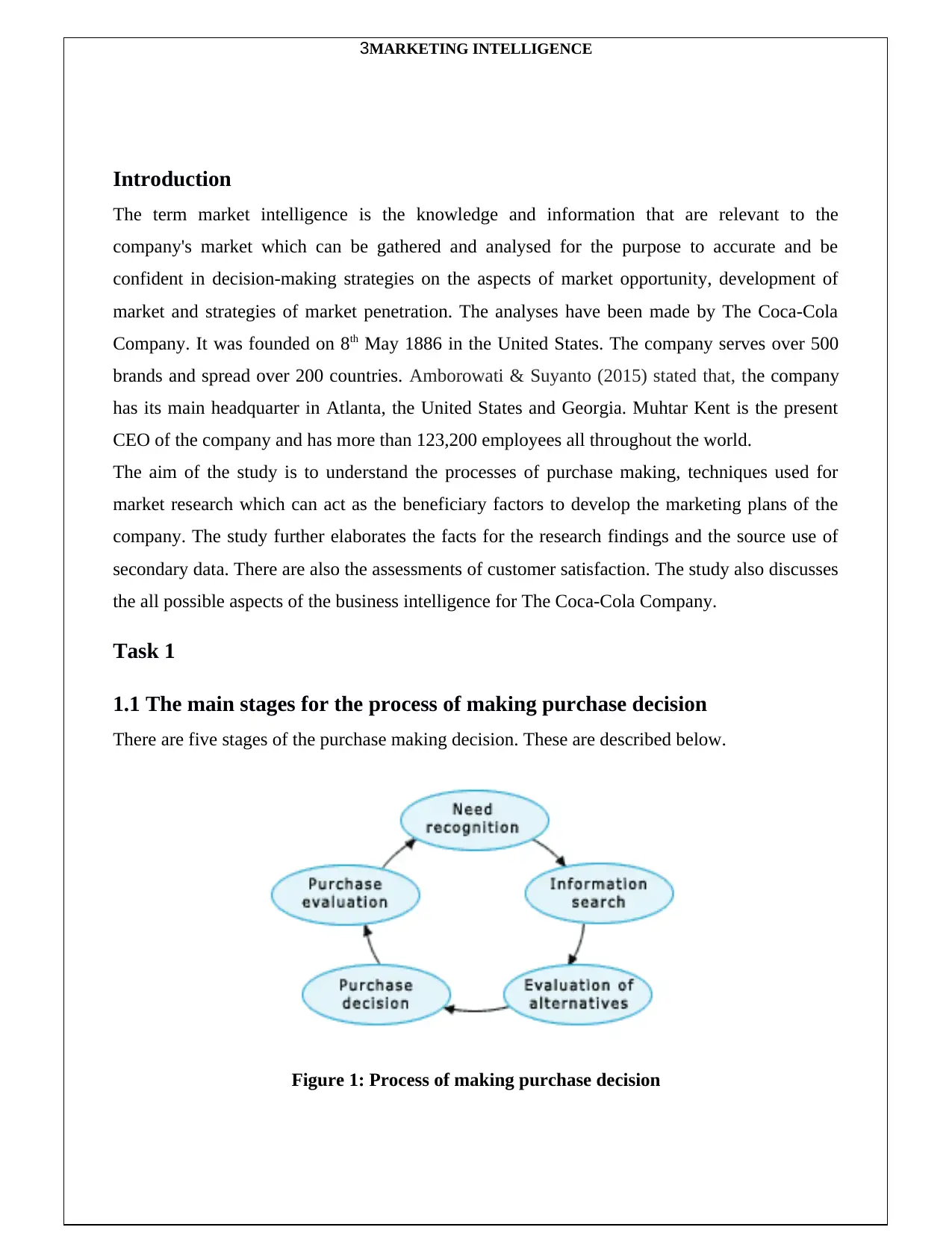
There are five stages of the purchase making decision. These are described below.
Figure 1: Process of making purchase decision
Introduction
The term market intelligence is the knowledge and information that are relevant to the
company's market which can be gathered and analysed for the purpose to accurate and be
confident in decision-making strategies on the aspects of market opportunity, development of
market and strategies of market penetration. The analyses have been made by The Coca-Cola
Company. It was founded on 8th May 1886 in the United States. The company serves over 500
brands and spread over 200 countries. Amborowati & Suyanto (2015) stated that, the company
has its main headquarter in Atlanta, the United States and Georgia. Muhtar Kent is the present
CEO of the company and has more than 123,200 employees all throughout the world.
The aim of the study is to understand the processes of purchase making, techniques used for
market research which can act as the beneficiary factors to develop the marketing plans of the
company. The study further elaborates the facts for the research findings and the source use of
secondary data. There are also the assessments of customer satisfaction. The study also discusses
the all possible aspects of the business intelligence for The Coca-Cola Company.
Task 1
1.1 The main stages for the process of making purchase decision
There are five stages of the purchase making decision. These are described below.
Figure 1: Process of making purchase decision
⊘ This is a preview!⊘
Do you want full access?
Subscribe today to unlock all pages.

Trusted by 1+ million students worldwide
4MARKETING INTELLIGENCE
(Source: Brennan, Tzempelikos & Wilson, 2014)
Recognition of problem
The decision making begins with certain problems. The customers find the need and the
satisfaction views from any purchase. They feel to have missed some points from the decision.
The customers need to find those problems which can be normalised through proper recognition
of them.
Search process
The customers are not expert on all aspects and have to make a search of the product or service
that can meet the satisfaction of them. According to Büchner & Mulvenna (2016), the search
engine on the internet has become the primary tool which can guide the customers for this issue.
This stage is risky for the customer and they might overcome the same from the reviews of the
pros and cons of the products. Bad experience from the good ones is to be reduced in this stage
of making the decision.
Evaluate the alternatives
In order to meet the satisfaction level the customers generally finds the alternatives of the
product, they desire to have. The best deal would comprise the product quality, price and various
other factors that satisfy the customer (Brennan, Tzempelikos & Wilson, 2014).
Selection stage
As the evaluation of the alternatives is done, therefore there should be the stage where the
customers have to select the desired product and the place of purchase.
Evaluation of the decision
As the purchase has been done, therefore the customer may become confused about the product
satisfaction. They are in controversy whether the product meets the requirements or not.
Whenever there is the bad experience from the product been purchased they move to another
product or location of purchasing.
1.2 Buyer behaviour theories in terms of individual and market
The theories are;
Generic theory
(Source: Brennan, Tzempelikos & Wilson, 2014)
Recognition of problem
The decision making begins with certain problems. The customers find the need and the
satisfaction views from any purchase. They feel to have missed some points from the decision.
The customers need to find those problems which can be normalised through proper recognition
of them.
Search process
The customers are not expert on all aspects and have to make a search of the product or service
that can meet the satisfaction of them. According to Büchner & Mulvenna (2016), the search
engine on the internet has become the primary tool which can guide the customers for this issue.
This stage is risky for the customer and they might overcome the same from the reviews of the
pros and cons of the products. Bad experience from the good ones is to be reduced in this stage
of making the decision.
Evaluate the alternatives
In order to meet the satisfaction level the customers generally finds the alternatives of the
product, they desire to have. The best deal would comprise the product quality, price and various
other factors that satisfy the customer (Brennan, Tzempelikos & Wilson, 2014).
Selection stage
As the evaluation of the alternatives is done, therefore there should be the stage where the
customers have to select the desired product and the place of purchase.
Evaluation of the decision
As the purchase has been done, therefore the customer may become confused about the product
satisfaction. They are in controversy whether the product meets the requirements or not.
Whenever there is the bad experience from the product been purchased they move to another
product or location of purchasing.
1.2 Buyer behaviour theories in terms of individual and market
The theories are;
Generic theory
Paraphrase This Document
Need a fresh take? Get an instant paraphrase of this document with our AI Paraphraser
5MARKETING INTELLIGENCE
For various purchases, the customer's do follow this theory through the process of making the
decision. The buyer does recognise their need and hence start the research on the products and
prices. Centeno, Hart & Dinnie (2013) stated that, the customer does investigate all the aspects
of the products in the market comparing with other alternatives. Thereafter the customer decides
the product and the place to buy the desired product.
Cultural theory
The influence from the cultural aspects can affect individual buying behaviour. The culture of an
individual reflects the value and the beliefs and these relate the product that the customer might
buy. The sheer force of personality makes the individual buy according to the culture.
Environmental theory
There is different buying behaviour from the same buyer which depends on the situations. The
behaviour of the customer depends on the environment coming from the different situation such
as buying the products for self-use and or buying for gifting to other (DeSoto et al. 2016). The
environment does affect the behaviour of the customer.
Internal theory
Various customers love to buy products and for these, they evaluate the product with alternatives
and examine to the last extent that they might go for the product. DeSoto et al. (2016) stated that,
some personality encourages them to select the product which is quite good and can satisfy the
need of the customer. There is great influence from the lifestyles of the customer. Some
customer buys product from the influence of others who already bought the same.
1.3 Factors affecting on buyer's behaviour
Four factors affect the buyer behaviour
Cultural
The cultural factor does affect the buying behaviour of the customers. The people of the different
culture buy different types of product. The culture reflects the variation of the product, for the
same purpose of different cultural people. The social class motivates or influences the other to
buy the same product that other have bought and actually not in need by the influenced person.
Social
For various purchases, the customer's do follow this theory through the process of making the
decision. The buyer does recognise their need and hence start the research on the products and
prices. Centeno, Hart & Dinnie (2013) stated that, the customer does investigate all the aspects
of the products in the market comparing with other alternatives. Thereafter the customer decides
the product and the place to buy the desired product.
Cultural theory
The influence from the cultural aspects can affect individual buying behaviour. The culture of an
individual reflects the value and the beliefs and these relate the product that the customer might
buy. The sheer force of personality makes the individual buy according to the culture.
Environmental theory
There is different buying behaviour from the same buyer which depends on the situations. The
behaviour of the customer depends on the environment coming from the different situation such
as buying the products for self-use and or buying for gifting to other (DeSoto et al. 2016). The
environment does affect the behaviour of the customer.
Internal theory
Various customers love to buy products and for these, they evaluate the product with alternatives
and examine to the last extent that they might go for the product. DeSoto et al. (2016) stated that,
some personality encourages them to select the product which is quite good and can satisfy the
need of the customer. There is great influence from the lifestyles of the customer. Some
customer buys product from the influence of others who already bought the same.
1.3 Factors affecting on buyer's behaviour
Four factors affect the buyer behaviour
Cultural
The cultural factor does affect the buying behaviour of the customers. The people of the different
culture buy different types of product. The culture reflects the variation of the product, for the
same purpose of different cultural people. The social class motivates or influences the other to
buy the same product that other have bought and actually not in need by the influenced person.
Social
6MARKETING INTELLIGENCE
The social factors do a great job to change the behaviour of the customer. According to Fan,
Lau, & Zhao (2015), the customer may buy the similar product that another customer has bought
or they might not buy the product, which is already bought by others in the society however, the
product is in actual need of the desired customer.
Personal
The buying behaviour does change as there is variation in the age and life cycle stages. Different
age group customer buys different products. The product behaviour becomes different related to
the occupation, income and lifestyles that the customers do lead for daily life.
Psychological
The psychology of different customer makes the variation in the behaviour of the customer or
individual. A different source of motivation, perception, learning, beliefs, and attitudes are
responsible for the different behaviour of customers to buy products or services.
1.4 The relationships between the brand loyalty, corporate images and the
repeat purchasing
The brand loyalty does represent the dedication and fidelity to the customer which is related to
the brand. The desires to purchase any particular products of the specified brand are shown in
this brand loyalty. The customers involve in the specified brand which they liked most and
prefer to have product from that brand only. While the corporate image does represent the
picture related to the psychology for the brand, present in mind of community that is widespread
among the people. Goi (2015) stated that, the company makes the relevant image of the brand
within the market that attempts to assist and progress for drawing the customer's attention. The
repeat purchasing states that the customers to purchase the product or receive services in the first
attempt, is pleased from it and buy the same products or take the service in later times.
Task 2
2.1 Different techniques of market research
Market research comprises of various techniques;
Survey
The social factors do a great job to change the behaviour of the customer. According to Fan,
Lau, & Zhao (2015), the customer may buy the similar product that another customer has bought
or they might not buy the product, which is already bought by others in the society however, the
product is in actual need of the desired customer.
Personal
The buying behaviour does change as there is variation in the age and life cycle stages. Different
age group customer buys different products. The product behaviour becomes different related to
the occupation, income and lifestyles that the customers do lead for daily life.
Psychological
The psychology of different customer makes the variation in the behaviour of the customer or
individual. A different source of motivation, perception, learning, beliefs, and attitudes are
responsible for the different behaviour of customers to buy products or services.
1.4 The relationships between the brand loyalty, corporate images and the
repeat purchasing
The brand loyalty does represent the dedication and fidelity to the customer which is related to
the brand. The desires to purchase any particular products of the specified brand are shown in
this brand loyalty. The customers involve in the specified brand which they liked most and
prefer to have product from that brand only. While the corporate image does represent the
picture related to the psychology for the brand, present in mind of community that is widespread
among the people. Goi (2015) stated that, the company makes the relevant image of the brand
within the market that attempts to assist and progress for drawing the customer's attention. The
repeat purchasing states that the customers to purchase the product or receive services in the first
attempt, is pleased from it and buy the same products or take the service in later times.
Task 2
2.1 Different techniques of market research
Market research comprises of various techniques;
Survey
⊘ This is a preview!⊘
Do you want full access?
Subscribe today to unlock all pages.
Trusted by 1+ million students worldwide
7MARKETING INTELLIGENCE
The survey for market research relates the process by which the company takes the survey of a
large number of customers in the targeted market and from this process; it can be analysed the
reliability of marketing the products in that market. The survey can be done through pure survey,
direct interaction with people with straight questionnaires, over telephone emails and online
processes.
Focus groups
The moderator does use the scripted series of the questions or related topics for leading the
discussion within the group of customers or people. According to Goi (2015), it can be
performed in a neutral location with some facilities of video recording, observation rooms which
consist of single way mirror. The focus group generally lasts for one to two hours with at least
three groups which are helpful to get balanced results.
Personal interview
The personal interviews which are consist of various open-ended and the unstructured question
that is asked to the people of targeted market in group or individual. This process is recorded for
future reference and last for an hour (Kumar, P. (2016)).
Observation
Observations of the customer behaviour are analysed by the companies that were recorded
through personal interview and focus group. From the analyses, they are able to understand the
requirements of the people and the way they use any particular products.
Field trials
Often new products are placed in some selected stores to test the customer response toward those
particular products which are done under real selling of the products from the stores. Heo &
Sutherland (2013) stated that, the response from the customer regarding the product helps the
company to manipulate further for betterments and adjust prices or any other change that might
attract the customers (Keelson, S. A. (2014).).
Brand awareness
Research also helps to enhance the brand awareness of the company which help to
increase the image of the company. Like, brand recall, Brand recognition, Brand image, Brand
trust, Customer profile etc.
Pricing Research
The survey for market research relates the process by which the company takes the survey of a
large number of customers in the targeted market and from this process; it can be analysed the
reliability of marketing the products in that market. The survey can be done through pure survey,
direct interaction with people with straight questionnaires, over telephone emails and online
processes.
Focus groups
The moderator does use the scripted series of the questions or related topics for leading the
discussion within the group of customers or people. According to Goi (2015), it can be
performed in a neutral location with some facilities of video recording, observation rooms which
consist of single way mirror. The focus group generally lasts for one to two hours with at least
three groups which are helpful to get balanced results.
Personal interview
The personal interviews which are consist of various open-ended and the unstructured question
that is asked to the people of targeted market in group or individual. This process is recorded for
future reference and last for an hour (Kumar, P. (2016)).
Observation
Observations of the customer behaviour are analysed by the companies that were recorded
through personal interview and focus group. From the analyses, they are able to understand the
requirements of the people and the way they use any particular products.
Field trials
Often new products are placed in some selected stores to test the customer response toward those
particular products which are done under real selling of the products from the stores. Heo &
Sutherland (2013) stated that, the response from the customer regarding the product helps the
company to manipulate further for betterments and adjust prices or any other change that might
attract the customers (Keelson, S. A. (2014).).
Brand awareness
Research also helps to enhance the brand awareness of the company which help to
increase the image of the company. Like, brand recall, Brand recognition, Brand image, Brand
trust, Customer profile etc.
Pricing Research
Paraphrase This Document
Need a fresh take? Get an instant paraphrase of this document with our AI Paraphraser
8MARKETING INTELLIGENCE
Research is also helps to measure the product price. Research is the most effective
method to identifying the competitors price and strategies.
2.2 Objectives of market research related to the secondary data
The secondary data refer to the data, which collected from the people other than the customer.
This type of collection of secondary data generally saves time, which could be spent on data
collection especially in the quantitative data analyses and can use larger and better quality
databases, which are easy for any researcher who collects the data. According to Huhmann et al.,
(2016), the secondary data are the collection of data that are obtained from the huge number of
people with certain analysis, which comprise of survey by face-to-face, online survey, through
phone calls, emails. This has calculated with the percentage of responses positively or negatively
for any information to collect by the organization.
The secondary data of the market research can be collected from various statistics and record. It
can also be found from internet researchers and different libraries. Various progress reports are
helpful to gather the secondary data.
2.3 Assessments of the market research validity and the reliability
The market research comprises of the first criteria called reliability. It is the measure of
consistency of the various scores over a long time. Reliability across time and reliability across
samples are the two types of reliability assessment for the market research. The reliability across
time is the result is, whether we can get the same result if the same study is done in some another
time. The other types which are related to the samples are the study of various samples that are
collected from different sources, different places and or different persons. The market research
done over a long period of time for any particular product which is satisfying the customer for a
long time are called the product reliability and are then assessed for the market research and the
product is being continued as it was or make some manipulation that can be further relied upon
by the customer with complete satisfaction. According to Huhmann et al. (2016), the reliability
over the sample is the product overview that is provided in positive means by the different
Research is also helps to measure the product price. Research is the most effective
method to identifying the competitors price and strategies.
2.2 Objectives of market research related to the secondary data
The secondary data refer to the data, which collected from the people other than the customer.
This type of collection of secondary data generally saves time, which could be spent on data
collection especially in the quantitative data analyses and can use larger and better quality
databases, which are easy for any researcher who collects the data. According to Huhmann et al.,
(2016), the secondary data are the collection of data that are obtained from the huge number of
people with certain analysis, which comprise of survey by face-to-face, online survey, through
phone calls, emails. This has calculated with the percentage of responses positively or negatively
for any information to collect by the organization.
The secondary data of the market research can be collected from various statistics and record. It
can also be found from internet researchers and different libraries. Various progress reports are
helpful to gather the secondary data.
2.3 Assessments of the market research validity and the reliability
The market research comprises of the first criteria called reliability. It is the measure of
consistency of the various scores over a long time. Reliability across time and reliability across
samples are the two types of reliability assessment for the market research. The reliability across
time is the result is, whether we can get the same result if the same study is done in some another
time. The other types which are related to the samples are the study of various samples that are
collected from different sources, different places and or different persons. The market research
done over a long period of time for any particular product which is satisfying the customer for a
long time are called the product reliability and are then assessed for the market research and the
product is being continued as it was or make some manipulation that can be further relied upon
by the customer with complete satisfaction. According to Huhmann et al. (2016), the reliability
over the sample is the product overview that is provided in positive means by the different
9MARKETING INTELLIGENCE
customers and is assessed by the different customer over time are called as sample reliability and
this helps to assess the product of the company which are appreciated by large number of the
customer over the longer period of time.
Besides of the reliability, there is certain aspect of the product which is called as the validity of
the product and the research validation. The reliability and validity are for the successful
assessment of the products. There are two types of validity such as internal validity and external
validity. The internal validly refers to the experiment where the conclusion can be made on some
kind of cause and the effects of the relationships. Thus it is the sure making of the cause and
effect of the relationships which are identified within the study and no other explanations
coming out of the results. The external validity of the research is the study of validation outside
of the experiment and is reliable for the company.
2.4 Marketing research plan
The Coca-Cola Company has implemented some plan for the market research which can do
benefit to their business. They have taken various steps that are within the research plan which
comprises of
Identification of the problem for marketing
All the market research begins with the problem and identification of the same. According to
Jamil et al. (2016), whenever any company finds the problem in its marketing, there raises the
need to find the problematic areas for the same. The Coca-Cola Company also do the same as
they find any problem to market their products. The clear identification helps them to allow the
required techniques for overcoming the issues.
Research objective statement
As the identification of the problem is done the statement for the same has to be done by the
company researcher and these may be in the form of qualitative or quantitative assessments.
Planning of research design
The research design is the master plans which are to be followed throughout the research done
for the marketing of the company and is a specific procedure which has to follow.
Sample planning
customers and is assessed by the different customer over time are called as sample reliability and
this helps to assess the product of the company which are appreciated by large number of the
customer over the longer period of time.
Besides of the reliability, there is certain aspect of the product which is called as the validity of
the product and the research validation. The reliability and validity are for the successful
assessment of the products. There are two types of validity such as internal validity and external
validity. The internal validly refers to the experiment where the conclusion can be made on some
kind of cause and the effects of the relationships. Thus it is the sure making of the cause and
effect of the relationships which are identified within the study and no other explanations
coming out of the results. The external validity of the research is the study of validation outside
of the experiment and is reliable for the company.
2.4 Marketing research plan
The Coca-Cola Company has implemented some plan for the market research which can do
benefit to their business. They have taken various steps that are within the research plan which
comprises of
Identification of the problem for marketing
All the market research begins with the problem and identification of the same. According to
Jamil et al. (2016), whenever any company finds the problem in its marketing, there raises the
need to find the problematic areas for the same. The Coca-Cola Company also do the same as
they find any problem to market their products. The clear identification helps them to allow the
required techniques for overcoming the issues.
Research objective statement
As the identification of the problem is done the statement for the same has to be done by the
company researcher and these may be in the form of qualitative or quantitative assessments.
Planning of research design
The research design is the master plans which are to be followed throughout the research done
for the marketing of the company and is a specific procedure which has to follow.
Sample planning
⊘ This is a preview!⊘
Do you want full access?
Subscribe today to unlock all pages.
Trusted by 1+ million students worldwide
10MARKETING INTELLIGENCE
This involves the procedures which use very less of items of the population to yield conclusion
for the research.
Collecting data
It refers to the data gathering which is to be used for solving the problems. This is generally of
primary and secondary types of the data collection.
Data processing and analysis
The collected data are to be converted into some format which can suggest the answers identify
and define the problem. Sharma & Dey (2015) stated that, the data processing is done by editing
the data that were collected.
Formulate the conclusion
Once the previous processes are done, there need to interpret the information and draw the
ultimate conclusion which is for managers decision.
Market size of the coca cola company is very large. It is a very leading company. It has
48.6 percent market share in overall beverages companies. It also provides several flavours and
varieties of drinks in the market. They always determine the customer needs and accordingly
provide product and services.
Task 3
3.1 Assessments on market size trends within the market
The coca cola company is the world's largest beverage manufacturing and serving company,
which serves the people form 1886, which started its business in the United States. It has more
than 500 brands spread over 200 countries. According to Jansen van Rensburg & Venter (2014),
there are three headquarters in the world. The present revenue of the company is 44.294 US
dollar in 2015, which was 45.998 billion dollar in 2014. This decreased by 3.7 %. However,
there is 3.6 % increase in the profit in the year 2015, which was 7.351 billion US dollar. The
company is having 123,200 employees in the year 2016. The second largest beverage company
in the leading market is PepsiCo Inc, which is the present market competitor and is playing very
important role in the market. The market size trends are the aspect that the company does require
to compare with the previous and present situations as well as future scope of marketing within
This involves the procedures which use very less of items of the population to yield conclusion
for the research.
Collecting data
It refers to the data gathering which is to be used for solving the problems. This is generally of
primary and secondary types of the data collection.
Data processing and analysis
The collected data are to be converted into some format which can suggest the answers identify
and define the problem. Sharma & Dey (2015) stated that, the data processing is done by editing
the data that were collected.
Formulate the conclusion
Once the previous processes are done, there need to interpret the information and draw the
ultimate conclusion which is for managers decision.
Market size of the coca cola company is very large. It is a very leading company. It has
48.6 percent market share in overall beverages companies. It also provides several flavours and
varieties of drinks in the market. They always determine the customer needs and accordingly
provide product and services.
Task 3
3.1 Assessments on market size trends within the market
The coca cola company is the world's largest beverage manufacturing and serving company,
which serves the people form 1886, which started its business in the United States. It has more
than 500 brands spread over 200 countries. According to Jansen van Rensburg & Venter (2014),
there are three headquarters in the world. The present revenue of the company is 44.294 US
dollar in 2015, which was 45.998 billion dollar in 2014. This decreased by 3.7 %. However,
there is 3.6 % increase in the profit in the year 2015, which was 7.351 billion US dollar. The
company is having 123,200 employees in the year 2016. The second largest beverage company
in the leading market is PepsiCo Inc, which is the present market competitor and is playing very
important role in the market. The market size trends are the aspect that the company does require
to compare with the previous and present situations as well as future scope of marketing within
Paraphrase This Document
Need a fresh take? Get an instant paraphrase of this document with our AI Paraphraser
11MARKETING INTELLIGENCE
the competition market. The market size has to analyse by the business organization and this
report would help to determine the overall potential of the market and its trends for gaining the
profitable coverage. The market analysis can be done with the help of Porter’s five-force model.
3.2 Analyses of the competitors
The coca cola company has faced the major competitor in the business market which is a threat
in the Kenyan market by the rival PepsiCo which produces 2.4 billion shilling manufacturing
plant in the Kenya. PepsiCo has exited the market of Kenya, however, they re-entered in 2010
with most of their products. The coca cola has brushed off the smaller competitor PepsiCo which
is second in the largest food and beverages in the world. Keelson (2014) stated that, the report
which was released by US consumer watchdog saying that the company brand coke contains
cancer chemical has put its level down in the business market. However, it has overcome from
the threat in the year 2013. According to Saeida Ardakani et al. (2015), there are some other
competitors in the market which comprise of Dr Pepper Snapple Group, Mondelez International,
Inc, Unilever Group, Kraft Foods Inc, Nestle S. A. and other smaller companies present industry
who serves beverages to the people of the world.
3.3 The opportunity of the organisation and threats from a specific product or
services (SWOT analysis)
The opportunities and the threats on the specific products
Strength
·The coca cola company has the brand
value of $77,839 billion.
·It is the largest beverage company in the
world.
·The company has strong marketing
strategies and well-developed advertising.
Weakness
·It is dependent on carbonated drinks. This
means the company depend on single kind
of products within the competition market
(Kumar, 2016).
·It lacks extend.
·It is less on publicity.
Opportunities Threats
the competition market. The market size has to analyse by the business organization and this
report would help to determine the overall potential of the market and its trends for gaining the
profitable coverage. The market analysis can be done with the help of Porter’s five-force model.
3.2 Analyses of the competitors
The coca cola company has faced the major competitor in the business market which is a threat
in the Kenyan market by the rival PepsiCo which produces 2.4 billion shilling manufacturing
plant in the Kenya. PepsiCo has exited the market of Kenya, however, they re-entered in 2010
with most of their products. The coca cola has brushed off the smaller competitor PepsiCo which
is second in the largest food and beverages in the world. Keelson (2014) stated that, the report
which was released by US consumer watchdog saying that the company brand coke contains
cancer chemical has put its level down in the business market. However, it has overcome from
the threat in the year 2013. According to Saeida Ardakani et al. (2015), there are some other
competitors in the market which comprise of Dr Pepper Snapple Group, Mondelez International,
Inc, Unilever Group, Kraft Foods Inc, Nestle S. A. and other smaller companies present industry
who serves beverages to the people of the world.
3.3 The opportunity of the organisation and threats from a specific product or
services (SWOT analysis)
The opportunities and the threats on the specific products
Strength
·The coca cola company has the brand
value of $77,839 billion.
·It is the largest beverage company in the
world.
·The company has strong marketing
strategies and well-developed advertising.
Weakness
·It is dependent on carbonated drinks. This
means the company depend on single kind
of products within the competition market
(Kumar, 2016).
·It lacks extend.
·It is less on publicity.
Opportunities Threats
12MARKETING INTELLIGENCE
·It can grow more in the beverage
consumption.
·In can increase the demand for bottled
water.
·It has reduced price of the production
material.
·
·The customers are changing their demand
on competitor’s drinks.
·There is the increase in the market
competition, which has to face by them
(Sharma & Dey, 2015).
·There are various local brands in various
countries which lack their sell.
Table 1: SWOT analyses of The Coca-Cola Company
(Source: Created by self)
Task 4
4.1 Techniques for the assessment of customer response
There are various ways through which the assessment of the customer response is measured. A
home customer survey can be done to assess the requirements and the customer expectations. It
may be with some little survey over email and phones. According to Kumar (2016), the customer
services also use some questionnaire to the customers to gather their responses. The suggestions
of the customers are taken by listening to them in surveys and can improve the service that the
companies generally use to serve people. The expectation is another technique used by the
company where each customer response are considered that may comprise of excitements, anger,
the expectation from the company and products along with any suggestion that the customers
would provide for the company (Nazari et al. 2015). The assessment can be done by the help of
competitors analysis, market intelligence, financial analysis, organizational analysis, technology
assessments, environmental assessments, forecasting and industry analysis. These would ensure
of the best information gathering by the market analyzer.
Customer satisfaction Survey: On the basis of measuring the performance of customer
preference. It is the best method to identify the customer needs and wants accordingly
company provides them the best quality of beverages.
·It can grow more in the beverage
consumption.
·In can increase the demand for bottled
water.
·It has reduced price of the production
material.
·
·The customers are changing their demand
on competitor’s drinks.
·There is the increase in the market
competition, which has to face by them
(Sharma & Dey, 2015).
·There are various local brands in various
countries which lack their sell.
Table 1: SWOT analyses of The Coca-Cola Company
(Source: Created by self)
Task 4
4.1 Techniques for the assessment of customer response
There are various ways through which the assessment of the customer response is measured. A
home customer survey can be done to assess the requirements and the customer expectations. It
may be with some little survey over email and phones. According to Kumar (2016), the customer
services also use some questionnaire to the customers to gather their responses. The suggestions
of the customers are taken by listening to them in surveys and can improve the service that the
companies generally use to serve people. The expectation is another technique used by the
company where each customer response are considered that may comprise of excitements, anger,
the expectation from the company and products along with any suggestion that the customers
would provide for the company (Nazari et al. 2015). The assessment can be done by the help of
competitors analysis, market intelligence, financial analysis, organizational analysis, technology
assessments, environmental assessments, forecasting and industry analysis. These would ensure
of the best information gathering by the market analyzer.
Customer satisfaction Survey: On the basis of measuring the performance of customer
preference. It is the best method to identify the customer needs and wants accordingly
company provides them the best quality of beverages.
⊘ This is a preview!⊘
Do you want full access?
Subscribe today to unlock all pages.
Trusted by 1+ million students worldwide

1 out of 20


Related Documents


Your All-in-One AI-Powered Toolkit for Academic Success.
+13062052269
info@desklib.com
Available 24*7 on WhatsApp / Email
![[object Object]](/_next/static/media/star-bottom.7253800d.svg)
Unlock your academic potential
Copyright © 2020–2026 A2Z Services. All Rights Reserved. Developed and managed by ZUCOL.