Evaluating Marketing Orientation: A Key to Competitive Advantage
VerifiedAdded on 2023/06/04
|14
|3485
|203
Essay
AI Summary
This essay provides a comprehensive analysis of marketing orientation within the business context, emphasizing its critical role in achieving sustained growth and competitive advantage. It contrasts marketing orientation with other business orientations such as customer, product, and competitor orientations, highlighting the supremacy of marketing in ensuring long-term organizational success. The essay delves into how marketing orientation facilitates inter-functional coordination and enhances shareholder value through effective promotional strategies and brand awareness. Ultimately, the discussion underscores that while customer and product-centric approaches are valuable, marketing orientation provides the overarching framework necessary for businesses to thrive in competitive markets by aligning organizational efforts with customer needs and market demands. Desklib offers a wide range of similar resources for students seeking to deepen their understanding of marketing principles.
Running Head: An essay on Marketing Orientation
Marketing Orientation
An essay
Student ID 1
Marketing Orientation
An essay
Student ID 1

Paraphrase This Document
Need a fresh take? Get an instant paraphrase of this document with our AI Paraphraser
Running Head: An essay on Marketing Orientation
Table of Contents
Introduction...........................................................................................................................................3
Analysis of marketing orientation......................................................................................................3
Different types of orientations in business.........................................................................................5
Customer Orientation....................................................................................................................5
Product Orientation........................................................................................................................6
Competitor Orientation..................................................................................................................7
Supremacy of marketing orientation..................................................................................................9
Conclusion...........................................................................................................................................12
References...........................................................................................................................................12
Student ID 2
Table of Contents
Introduction...........................................................................................................................................3
Analysis of marketing orientation......................................................................................................3
Different types of orientations in business.........................................................................................5
Customer Orientation....................................................................................................................5
Product Orientation........................................................................................................................6
Competitor Orientation..................................................................................................................7
Supremacy of marketing orientation..................................................................................................9
Conclusion...........................................................................................................................................12
References...........................................................................................................................................12
Student ID 2
Running Head: An essay on Marketing Orientation
Introduction
The business environment in each passing phase is becoming tougher for organizations and
they find it difficult to survive in competitive business without any fitting marketing plan and
strategies trailed by appropriate activities. Organizations cannot succeed in the market for the
long run unless the marketing approach is not adopted (Micheels and Gow, 2012). As long as
profit is required for organizational survival in competition, the importance of marketing
functions cannot be put aside. This always has high calling for a business direction that
essentially includes marketing as an orientation to have better visuals about future and
organizational operations to be certain of long-term survival. No organizations can ensure
long-term growth and survival in market if profit cannot be achieved (Anon, 2018). Surely
this highlights that business in order to strengthen its position in market needs to have
marketing approach and this cannot be possible without marketing orientation. In this essay
several orientations of business have been discussed and marketing orientation has been
evaluated in relation to others for understanding if marketing is more important and
orientation regarding this can help organizations running their business effectively in a
competitive market. Customers are the most important stakeholders and the ultimate
determinants of business fate in competitive markets which is the major cause for firms to
adopt marketing orientation which combines marketing activities as well as customers service
related performance for increasing satisfaction among customers (Dibb and Stern, 2000).
Analysis of marketing orientation
In earlier decades the organizational focus was largely confined to products making and
selling as invariable parts of commerce with no separate orientation of business (Anon,
2018). However, the central part of business operation used to be the profit making with less
amount of stress on the specialization of business depending on strength of business
operation. With gradual emergence of business sectors as well as consumers’ perception
towards services and products, business firms shifted their mundane notion of business
operation themed with only single kind of business orientation which is production and
selling (Drummond & Ensor, 2005). Firms started having knowledge about several types of
orientation which are viewed as an important basis of business operation for making a
business successful in a given industry. Among some important orientations, according to
Micheels and Gow (2012), firms are inclined to infuse customer orientation, competitor
orientation, product orientation, service orientation in pursuit of achieving better outcomes in
Student ID 3
Introduction
The business environment in each passing phase is becoming tougher for organizations and
they find it difficult to survive in competitive business without any fitting marketing plan and
strategies trailed by appropriate activities. Organizations cannot succeed in the market for the
long run unless the marketing approach is not adopted (Micheels and Gow, 2012). As long as
profit is required for organizational survival in competition, the importance of marketing
functions cannot be put aside. This always has high calling for a business direction that
essentially includes marketing as an orientation to have better visuals about future and
organizational operations to be certain of long-term survival. No organizations can ensure
long-term growth and survival in market if profit cannot be achieved (Anon, 2018). Surely
this highlights that business in order to strengthen its position in market needs to have
marketing approach and this cannot be possible without marketing orientation. In this essay
several orientations of business have been discussed and marketing orientation has been
evaluated in relation to others for understanding if marketing is more important and
orientation regarding this can help organizations running their business effectively in a
competitive market. Customers are the most important stakeholders and the ultimate
determinants of business fate in competitive markets which is the major cause for firms to
adopt marketing orientation which combines marketing activities as well as customers service
related performance for increasing satisfaction among customers (Dibb and Stern, 2000).
Analysis of marketing orientation
In earlier decades the organizational focus was largely confined to products making and
selling as invariable parts of commerce with no separate orientation of business (Anon,
2018). However, the central part of business operation used to be the profit making with less
amount of stress on the specialization of business depending on strength of business
operation. With gradual emergence of business sectors as well as consumers’ perception
towards services and products, business firms shifted their mundane notion of business
operation themed with only single kind of business orientation which is production and
selling (Drummond & Ensor, 2005). Firms started having knowledge about several types of
orientation which are viewed as an important basis of business operation for making a
business successful in a given industry. Among some important orientations, according to
Micheels and Gow (2012), firms are inclined to infuse customer orientation, competitor
orientation, product orientation, service orientation in pursuit of achieving better outcomes in
Student ID 3
⊘ This is a preview!⊘
Do you want full access?
Subscribe today to unlock all pages.

Trusted by 1+ million students worldwide
Running Head: An essay on Marketing Orientation
the market in terms of better growth of the business. Often firms are interested to keep their
business operations deeply rooted in their organizational culture which decides business
orientation to run operation and this helps business activities get into shape accordingly
(Grinstein, 2008).
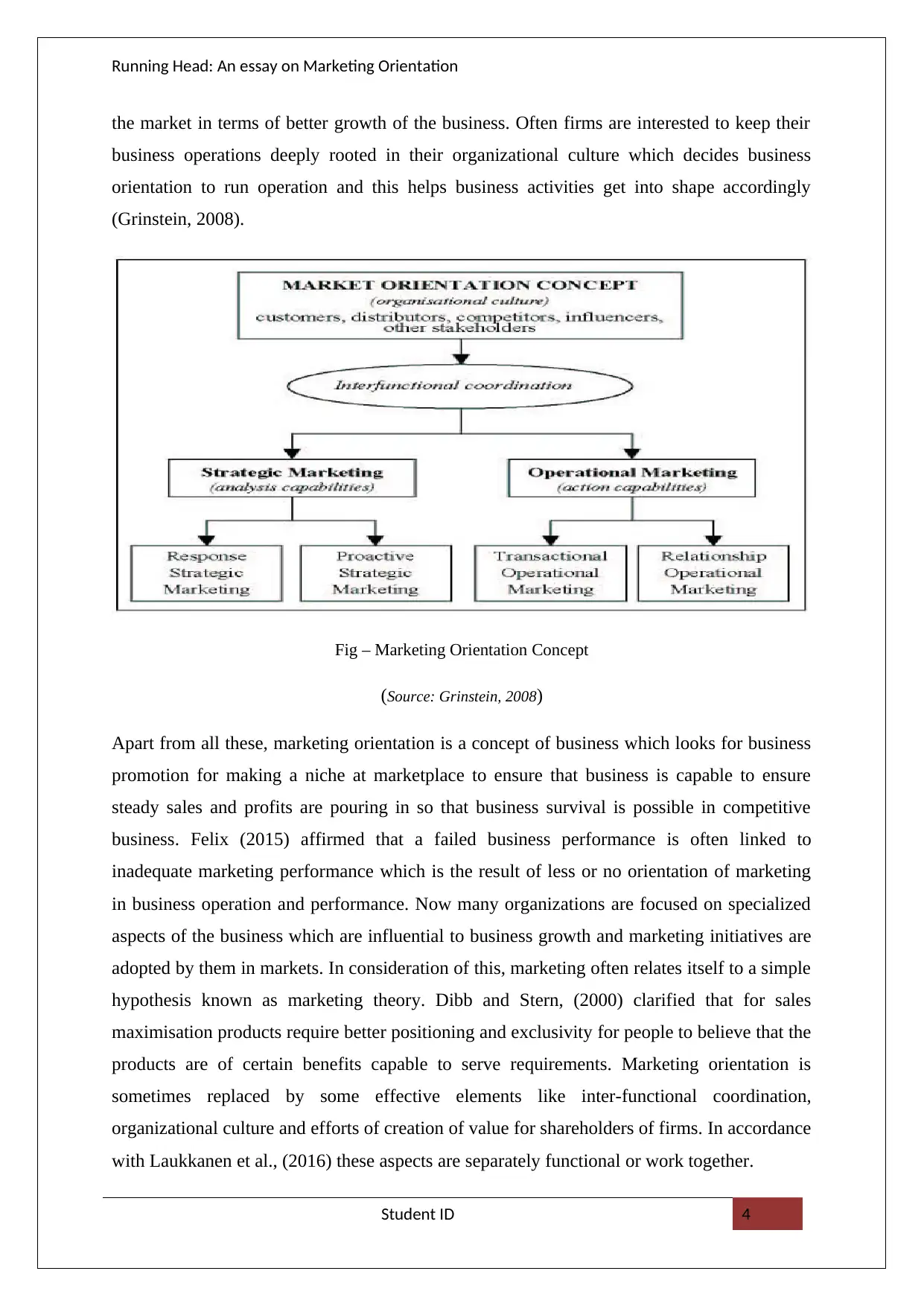
Fig – Marketing Orientation Concept
(Source: Grinstein, 2008)
Apart from all these, marketing orientation is a concept of business which looks for business
promotion for making a niche at marketplace to ensure that business is capable to ensure
steady sales and profits are pouring in so that business survival is possible in competitive
business. Felix (2015) affirmed that a failed business performance is often linked to
inadequate marketing performance which is the result of less or no orientation of marketing
in business operation and performance. Now many organizations are focused on specialized
aspects of the business which are influential to business growth and marketing initiatives are
adopted by them in markets. In consideration of this, marketing often relates itself to a simple
hypothesis known as marketing theory. Dibb and Stern, (2000) clarified that for sales
maximisation products require better positioning and exclusivity for people to believe that the
products are of certain benefits capable to serve requirements. Marketing orientation is
sometimes replaced by some effective elements like inter-functional coordination,
organizational culture and efforts of creation of value for shareholders of firms. In accordance
with Laukkanen et al., (2016) these aspects are separately functional or work together.
Student ID 4
the market in terms of better growth of the business. Often firms are interested to keep their
business operations deeply rooted in their organizational culture which decides business
orientation to run operation and this helps business activities get into shape accordingly
(Grinstein, 2008).
Fig – Marketing Orientation Concept
(Source: Grinstein, 2008)
Apart from all these, marketing orientation is a concept of business which looks for business
promotion for making a niche at marketplace to ensure that business is capable to ensure
steady sales and profits are pouring in so that business survival is possible in competitive
business. Felix (2015) affirmed that a failed business performance is often linked to
inadequate marketing performance which is the result of less or no orientation of marketing
in business operation and performance. Now many organizations are focused on specialized
aspects of the business which are influential to business growth and marketing initiatives are
adopted by them in markets. In consideration of this, marketing often relates itself to a simple
hypothesis known as marketing theory. Dibb and Stern, (2000) clarified that for sales
maximisation products require better positioning and exclusivity for people to believe that the
products are of certain benefits capable to serve requirements. Marketing orientation is
sometimes replaced by some effective elements like inter-functional coordination,
organizational culture and efforts of creation of value for shareholders of firms. In accordance
with Laukkanen et al., (2016) these aspects are separately functional or work together.
Student ID 4
Paraphrase This Document
Need a fresh take? Get an instant paraphrase of this document with our AI Paraphraser
Running Head: An essay on Marketing Orientation
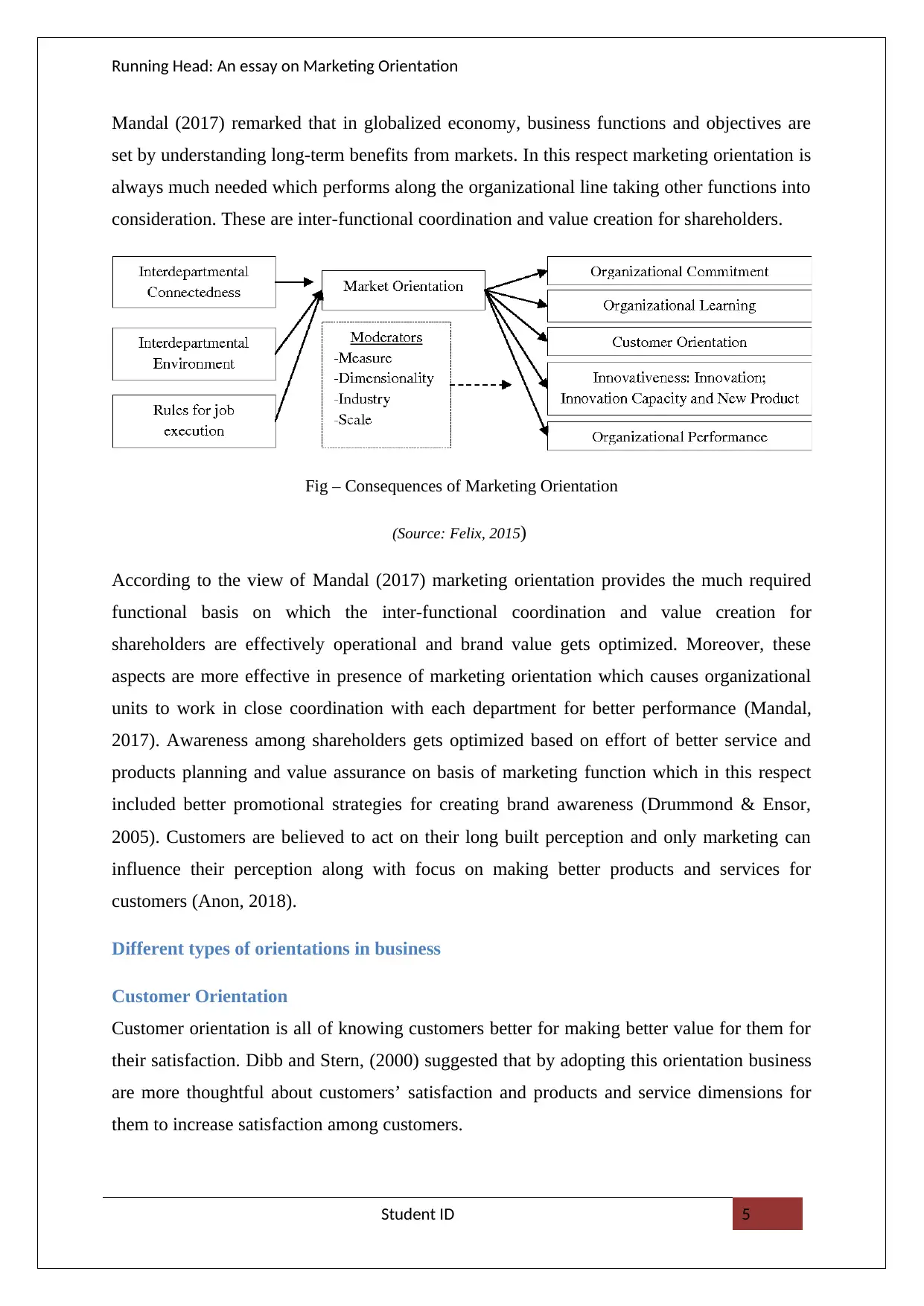
Mandal (2017) remarked that in globalized economy, business functions and objectives are
set by understanding long-term benefits from markets. In this respect marketing orientation is
always much needed which performs along the organizational line taking other functions into
consideration. These are inter-functional coordination and value creation for shareholders.
Fig – Consequences of Marketing Orientation
(Source: Felix, 2015)
According to the view of Mandal (2017) marketing orientation provides the much required
functional basis on which the inter-functional coordination and value creation for
shareholders are effectively operational and brand value gets optimized. Moreover, these
aspects are more effective in presence of marketing orientation which causes organizational
units to work in close coordination with each department for better performance (Mandal,
2017). Awareness among shareholders gets optimized based on effort of better service and
products planning and value assurance on basis of marketing function which in this respect
included better promotional strategies for creating brand awareness (Drummond & Ensor,
2005). Customers are believed to act on their long built perception and only marketing can
influence their perception along with focus on making better products and services for
customers (Anon, 2018).
Different types of orientations in business
Customer Orientation
Customer orientation is all of knowing customers better for making better value for them for
their satisfaction. Dibb and Stern, (2000) suggested that by adopting this orientation business
are more thoughtful about customers’ satisfaction and products and service dimensions for
them to increase satisfaction among customers.
Student ID 5
Mandal (2017) remarked that in globalized economy, business functions and objectives are
set by understanding long-term benefits from markets. In this respect marketing orientation is
always much needed which performs along the organizational line taking other functions into
consideration. These are inter-functional coordination and value creation for shareholders.
Fig – Consequences of Marketing Orientation
(Source: Felix, 2015)
According to the view of Mandal (2017) marketing orientation provides the much required
functional basis on which the inter-functional coordination and value creation for
shareholders are effectively operational and brand value gets optimized. Moreover, these
aspects are more effective in presence of marketing orientation which causes organizational
units to work in close coordination with each department for better performance (Mandal,
2017). Awareness among shareholders gets optimized based on effort of better service and
products planning and value assurance on basis of marketing function which in this respect
included better promotional strategies for creating brand awareness (Drummond & Ensor,
2005). Customers are believed to act on their long built perception and only marketing can
influence their perception along with focus on making better products and services for
customers (Anon, 2018).
Different types of orientations in business
Customer Orientation
Customer orientation is all of knowing customers better for making better value for them for
their satisfaction. Dibb and Stern, (2000) suggested that by adopting this orientation business
are more thoughtful about customers’ satisfaction and products and service dimensions for
them to increase satisfaction among customers.
Student ID 5
Running Head: An essay on Marketing Orientation
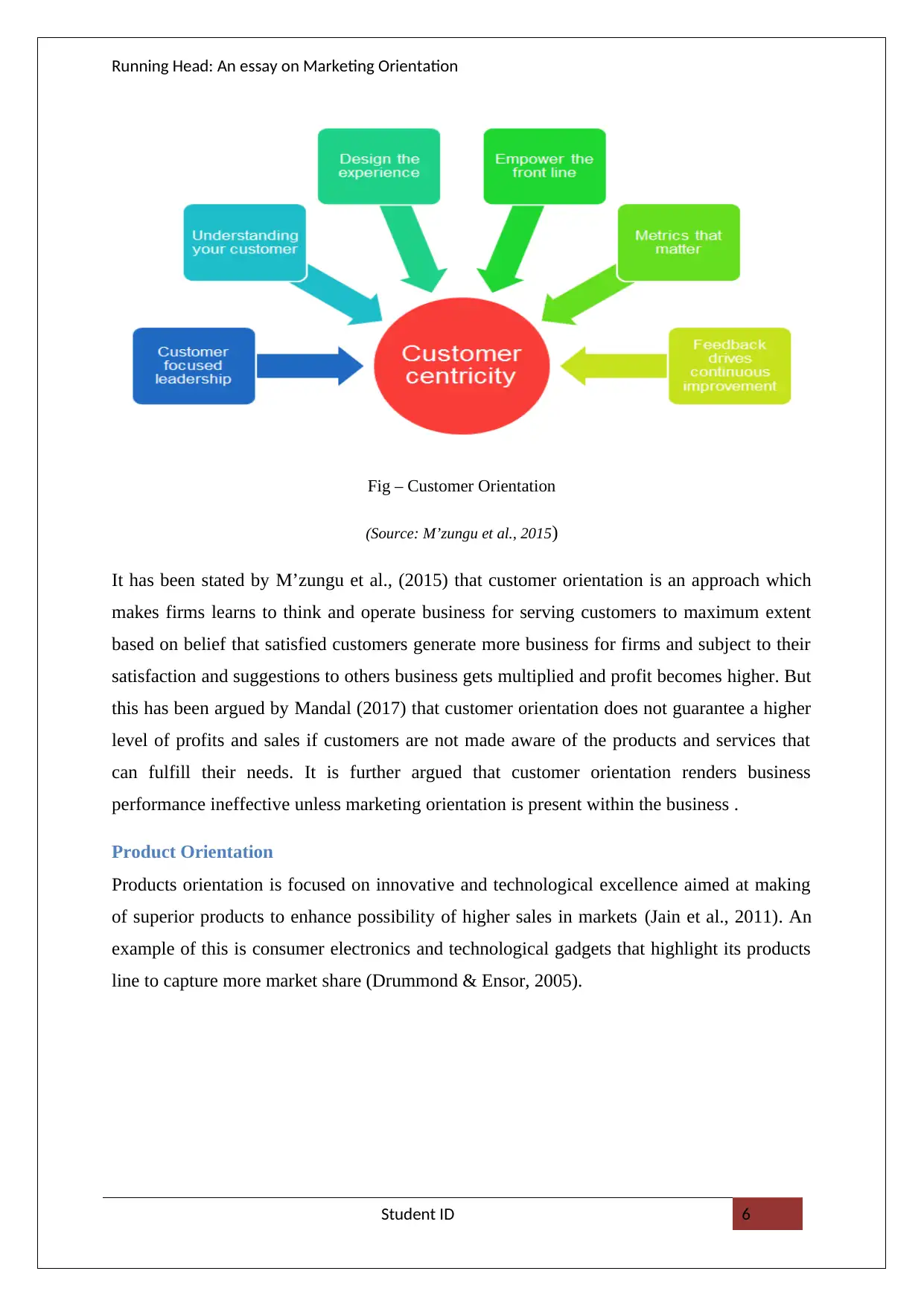
Fig – Customer Orientation
(Source: M’zungu et al., 2015)
It has been stated by M’zungu et al., (2015) that customer orientation is an approach which
makes firms learns to think and operate business for serving customers to maximum extent
based on belief that satisfied customers generate more business for firms and subject to their
satisfaction and suggestions to others business gets multiplied and profit becomes higher. But
this has been argued by Mandal (2017) that customer orientation does not guarantee a higher
level of profits and sales if customers are not made aware of the products and services that
can fulfill their needs. It is further argued that customer orientation renders business
performance ineffective unless marketing orientation is present within the business .
Product Orientation
Products orientation is focused on innovative and technological excellence aimed at making
of superior products to enhance possibility of higher sales in markets (Jain et al., 2011). An
example of this is consumer electronics and technological gadgets that highlight its products
line to capture more market share (Drummond & Ensor, 2005).
Student ID 6
Fig – Customer Orientation
(Source: M’zungu et al., 2015)
It has been stated by M’zungu et al., (2015) that customer orientation is an approach which
makes firms learns to think and operate business for serving customers to maximum extent
based on belief that satisfied customers generate more business for firms and subject to their
satisfaction and suggestions to others business gets multiplied and profit becomes higher. But
this has been argued by Mandal (2017) that customer orientation does not guarantee a higher
level of profits and sales if customers are not made aware of the products and services that
can fulfill their needs. It is further argued that customer orientation renders business
performance ineffective unless marketing orientation is present within the business .
Product Orientation
Products orientation is focused on innovative and technological excellence aimed at making
of superior products to enhance possibility of higher sales in markets (Jain et al., 2011). An
example of this is consumer electronics and technological gadgets that highlight its products
line to capture more market share (Drummond & Ensor, 2005).
Student ID 6
⊘ This is a preview!⊘
Do you want full access?
Subscribe today to unlock all pages.
Trusted by 1+ million students worldwide
Running Head: An essay on Marketing Orientation
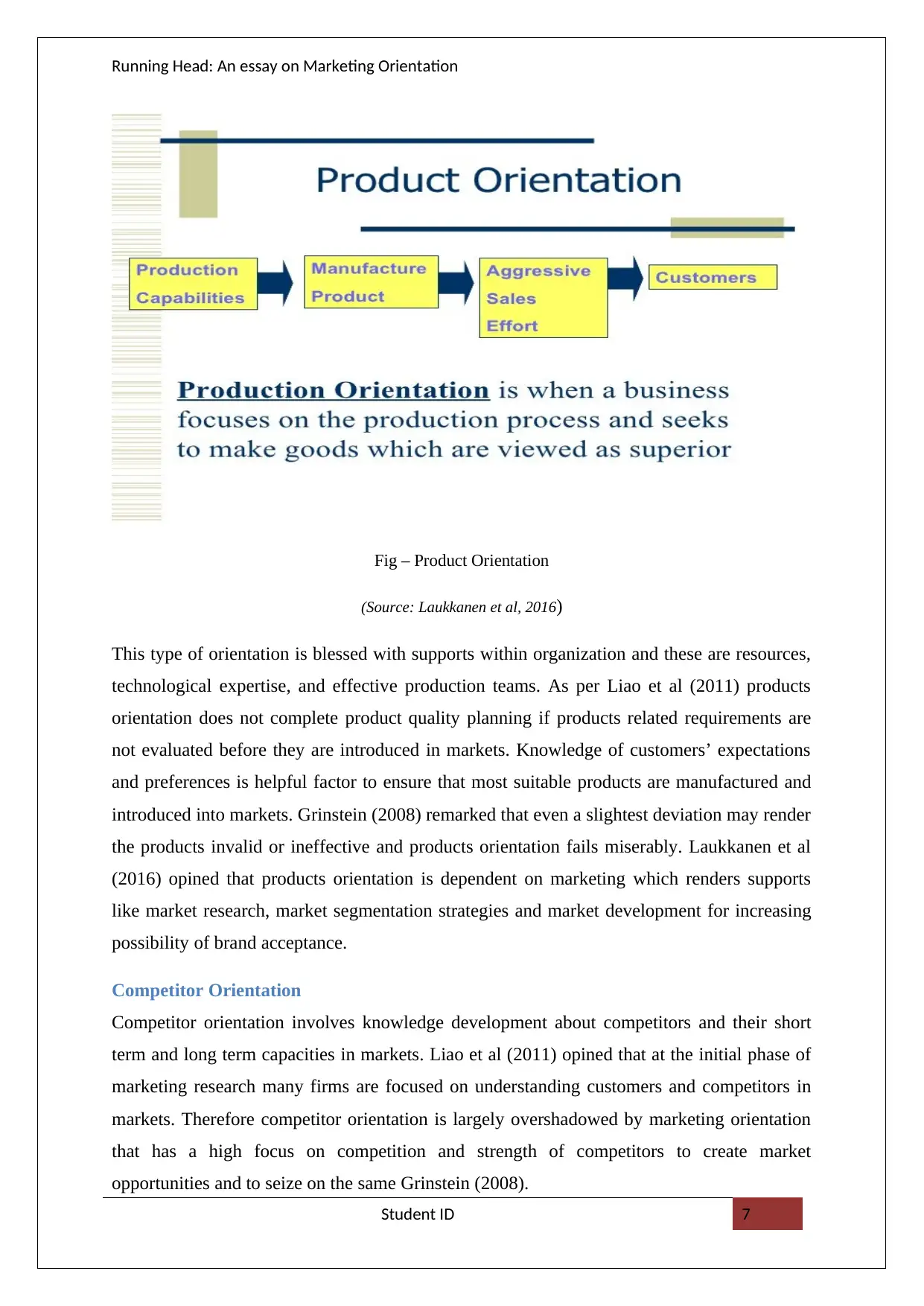
Fig – Product Orientation
(Source: Laukkanen et al, 2016)
This type of orientation is blessed with supports within organization and these are resources,
technological expertise, and effective production teams. As per Liao et al (2011) products
orientation does not complete product quality planning if products related requirements are
not evaluated before they are introduced in markets. Knowledge of customers’ expectations
and preferences is helpful factor to ensure that most suitable products are manufactured and
introduced into markets. Grinstein (2008) remarked that even a slightest deviation may render
the products invalid or ineffective and products orientation fails miserably. Laukkanen et al
(2016) opined that products orientation is dependent on marketing which renders supports
like market research, market segmentation strategies and market development for increasing
possibility of brand acceptance.
Competitor Orientation
Competitor orientation involves knowledge development about competitors and their short
term and long term capacities in markets. Liao et al (2011) opined that at the initial phase of
marketing research many firms are focused on understanding customers and competitors in
markets. Therefore competitor orientation is largely overshadowed by marketing orientation
that has a high focus on competition and strength of competitors to create market
opportunities and to seize on the same Grinstein (2008).
Student ID 7
Fig – Product Orientation
(Source: Laukkanen et al, 2016)
This type of orientation is blessed with supports within organization and these are resources,
technological expertise, and effective production teams. As per Liao et al (2011) products
orientation does not complete product quality planning if products related requirements are
not evaluated before they are introduced in markets. Knowledge of customers’ expectations
and preferences is helpful factor to ensure that most suitable products are manufactured and
introduced into markets. Grinstein (2008) remarked that even a slightest deviation may render
the products invalid or ineffective and products orientation fails miserably. Laukkanen et al
(2016) opined that products orientation is dependent on marketing which renders supports
like market research, market segmentation strategies and market development for increasing
possibility of brand acceptance.
Competitor Orientation
Competitor orientation involves knowledge development about competitors and their short
term and long term capacities in markets. Liao et al (2011) opined that at the initial phase of
marketing research many firms are focused on understanding customers and competitors in
markets. Therefore competitor orientation is largely overshadowed by marketing orientation
that has a high focus on competition and strength of competitors to create market
opportunities and to seize on the same Grinstein (2008).
Student ID 7
Paraphrase This Document
Need a fresh take? Get an instant paraphrase of this document with our AI Paraphraser
Running Head: An essay on Marketing Orientation
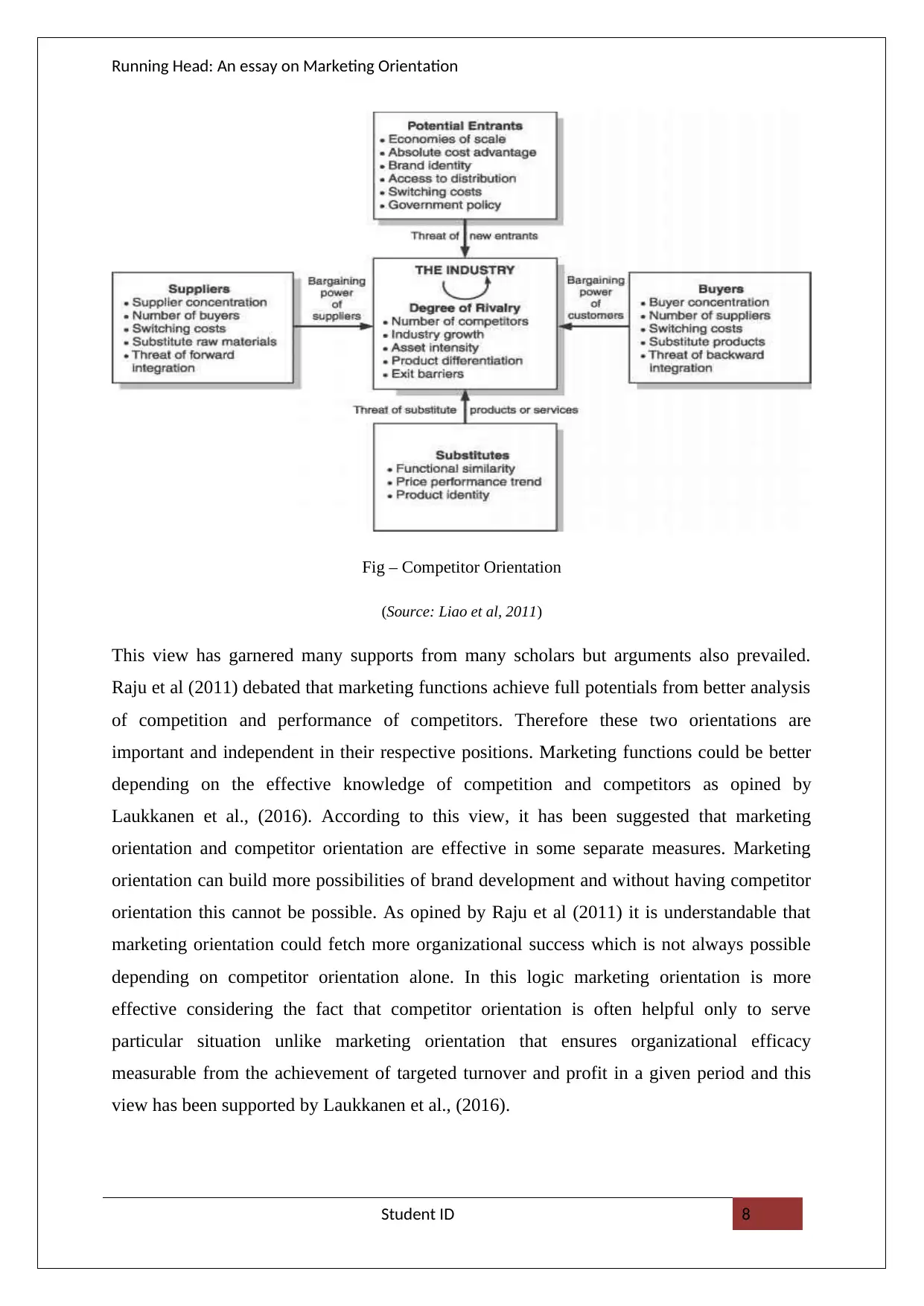
Fig – Competitor Orientation
(Source: Liao et al, 2011)
This view has garnered many supports from many scholars but arguments also prevailed.
Raju et al (2011) debated that marketing functions achieve full potentials from better analysis
of competition and performance of competitors. Therefore these two orientations are
important and independent in their respective positions. Marketing functions could be better
depending on the effective knowledge of competition and competitors as opined by
Laukkanen et al., (2016). According to this view, it has been suggested that marketing
orientation and competitor orientation are effective in some separate measures. Marketing
orientation can build more possibilities of brand development and without having competitor
orientation this cannot be possible. As opined by Raju et al (2011) it is understandable that
marketing orientation could fetch more organizational success which is not always possible
depending on competitor orientation alone. In this logic marketing orientation is more
effective considering the fact that competitor orientation is often helpful only to serve
particular situation unlike marketing orientation that ensures organizational efficacy
measurable from the achievement of targeted turnover and profit in a given period and this
view has been supported by Laukkanen et al., (2016).
Student ID 8
Fig – Competitor Orientation
(Source: Liao et al, 2011)
This view has garnered many supports from many scholars but arguments also prevailed.
Raju et al (2011) debated that marketing functions achieve full potentials from better analysis
of competition and performance of competitors. Therefore these two orientations are
important and independent in their respective positions. Marketing functions could be better
depending on the effective knowledge of competition and competitors as opined by
Laukkanen et al., (2016). According to this view, it has been suggested that marketing
orientation and competitor orientation are effective in some separate measures. Marketing
orientation can build more possibilities of brand development and without having competitor
orientation this cannot be possible. As opined by Raju et al (2011) it is understandable that
marketing orientation could fetch more organizational success which is not always possible
depending on competitor orientation alone. In this logic marketing orientation is more
effective considering the fact that competitor orientation is often helpful only to serve
particular situation unlike marketing orientation that ensures organizational efficacy
measurable from the achievement of targeted turnover and profit in a given period and this
view has been supported by Laukkanen et al., (2016).
Student ID 8
Running Head: An essay on Marketing Orientation
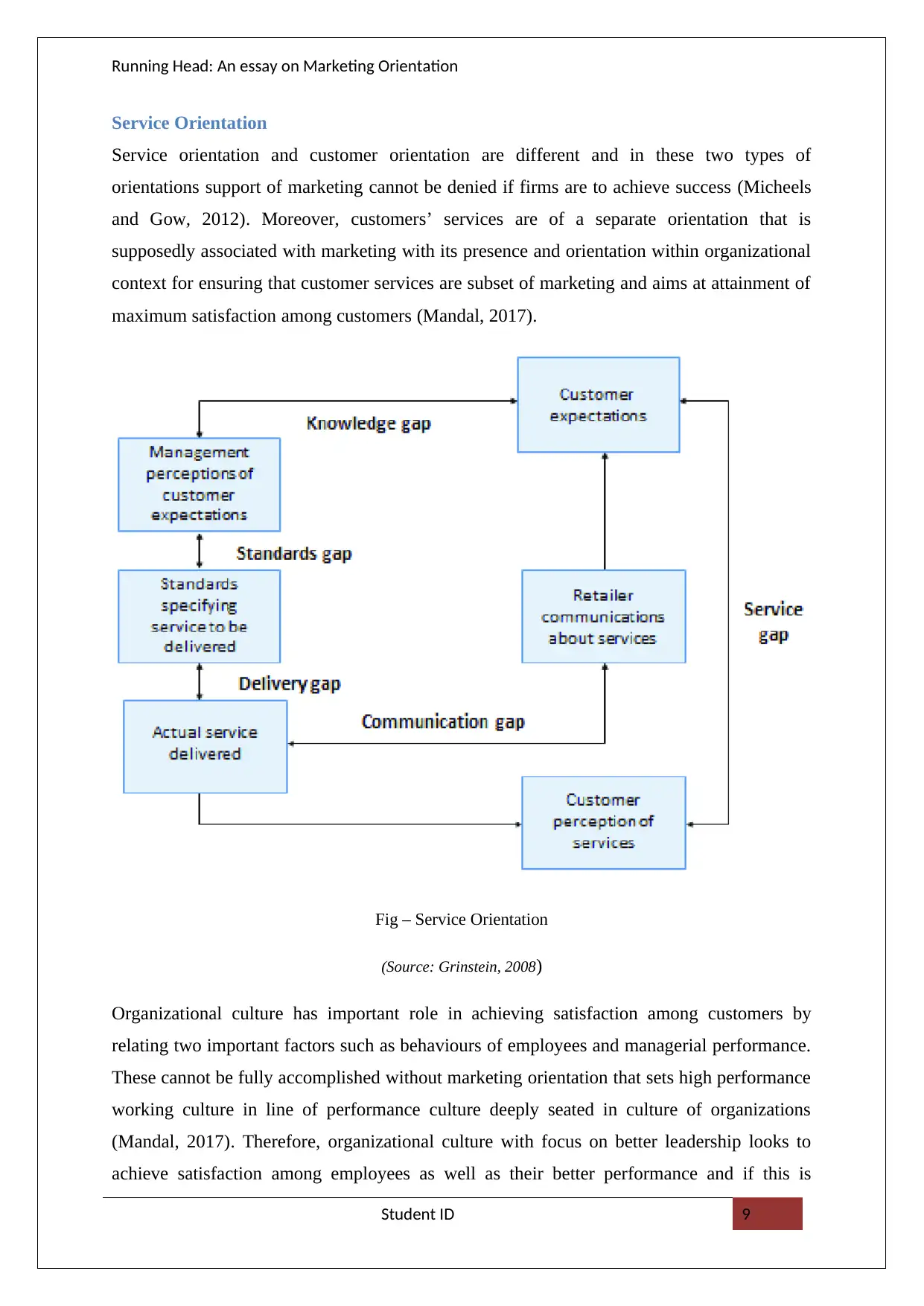
Service Orientation
Service orientation and customer orientation are different and in these two types of
orientations support of marketing cannot be denied if firms are to achieve success (Micheels
and Gow, 2012). Moreover, customers’ services are of a separate orientation that is
supposedly associated with marketing with its presence and orientation within organizational
context for ensuring that customer services are subset of marketing and aims at attainment of
maximum satisfaction among customers (Mandal, 2017).
Fig – Service Orientation
(Source: Grinstein, 2008)
Organizational culture has important role in achieving satisfaction among customers by
relating two important factors such as behaviours of employees and managerial performance.
These cannot be fully accomplished without marketing orientation that sets high performance
working culture in line of performance culture deeply seated in culture of organizations
(Mandal, 2017). Therefore, organizational culture with focus on better leadership looks to
achieve satisfaction among employees as well as their better performance and if this is
Student ID 9
Service Orientation
Service orientation and customer orientation are different and in these two types of
orientations support of marketing cannot be denied if firms are to achieve success (Micheels
and Gow, 2012). Moreover, customers’ services are of a separate orientation that is
supposedly associated with marketing with its presence and orientation within organizational
context for ensuring that customer services are subset of marketing and aims at attainment of
maximum satisfaction among customers (Mandal, 2017).
Fig – Service Orientation
(Source: Grinstein, 2008)
Organizational culture has important role in achieving satisfaction among customers by
relating two important factors such as behaviours of employees and managerial performance.
These cannot be fully accomplished without marketing orientation that sets high performance
working culture in line of performance culture deeply seated in culture of organizations
(Mandal, 2017). Therefore, organizational culture with focus on better leadership looks to
achieve satisfaction among employees as well as their better performance and if this is
Student ID 9
⊘ This is a preview!⊘
Do you want full access?
Subscribe today to unlock all pages.
Trusted by 1+ million students worldwide
Running Head: An essay on Marketing Orientation
ensured by firms then most favourable factor is marketing orientation which paves the way
for success and better survival in competitive markets (Raju et al, 2011).
Supremacy of marketing orientation
Slater et al (2010) suggested that marketing orientation involves marketing performance with
some focussed aspects of business and these are advertisements and promotion, high
performance for achieving sales target, arrangement and implementation of strategies for
expediting business growth to achieve more sales and more profits in business. Varadarajan
(2015) holds the same view and further highlighted that marketing orientation never limits
the concept of customers’ satisfaction and their requirements from business and most
essentially with help of marketing orientation, satisfaction among customers becomes higher
since customers are actually informed about availability of their products and they also get to
understand whether the products and services are on par with their needs understood by the
brands they are associated with. Therefore, the purpose of customer orientation becomes
justified. This view is also supported by Winer and Dhar (2014).
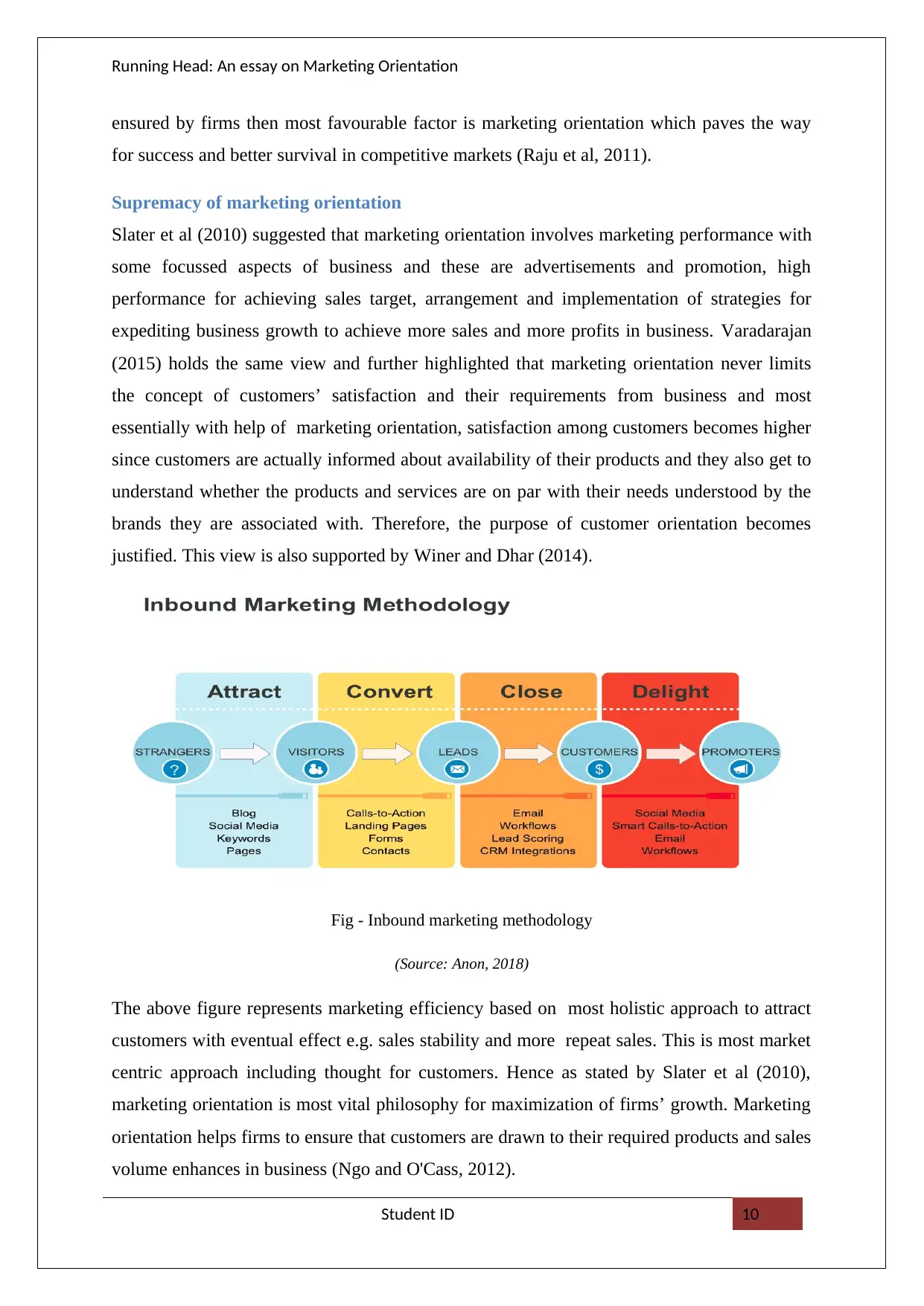
Fig - Inbound marketing methodology
(Source: Anon, 2018)
The above figure represents marketing efficiency based on most holistic approach to attract
customers with eventual effect e.g. sales stability and more repeat sales. This is most market
centric approach including thought for customers. Hence as stated by Slater et al (2010),
marketing orientation is most vital philosophy for maximization of firms’ growth. Marketing
orientation helps firms to ensure that customers are drawn to their required products and sales
volume enhances in business (Ngo and O'Cass, 2012).
Student ID 10
ensured by firms then most favourable factor is marketing orientation which paves the way
for success and better survival in competitive markets (Raju et al, 2011).
Supremacy of marketing orientation
Slater et al (2010) suggested that marketing orientation involves marketing performance with
some focussed aspects of business and these are advertisements and promotion, high
performance for achieving sales target, arrangement and implementation of strategies for
expediting business growth to achieve more sales and more profits in business. Varadarajan
(2015) holds the same view and further highlighted that marketing orientation never limits
the concept of customers’ satisfaction and their requirements from business and most
essentially with help of marketing orientation, satisfaction among customers becomes higher
since customers are actually informed about availability of their products and they also get to
understand whether the products and services are on par with their needs understood by the
brands they are associated with. Therefore, the purpose of customer orientation becomes
justified. This view is also supported by Winer and Dhar (2014).
Fig - Inbound marketing methodology
(Source: Anon, 2018)
The above figure represents marketing efficiency based on most holistic approach to attract
customers with eventual effect e.g. sales stability and more repeat sales. This is most market
centric approach including thought for customers. Hence as stated by Slater et al (2010),
marketing orientation is most vital philosophy for maximization of firms’ growth. Marketing
orientation helps firms to ensure that customers are drawn to their required products and sales
volume enhances in business (Ngo and O'Cass, 2012).
Student ID 10
Paraphrase This Document
Need a fresh take? Get an instant paraphrase of this document with our AI Paraphraser
Running Head: An essay on Marketing Orientation
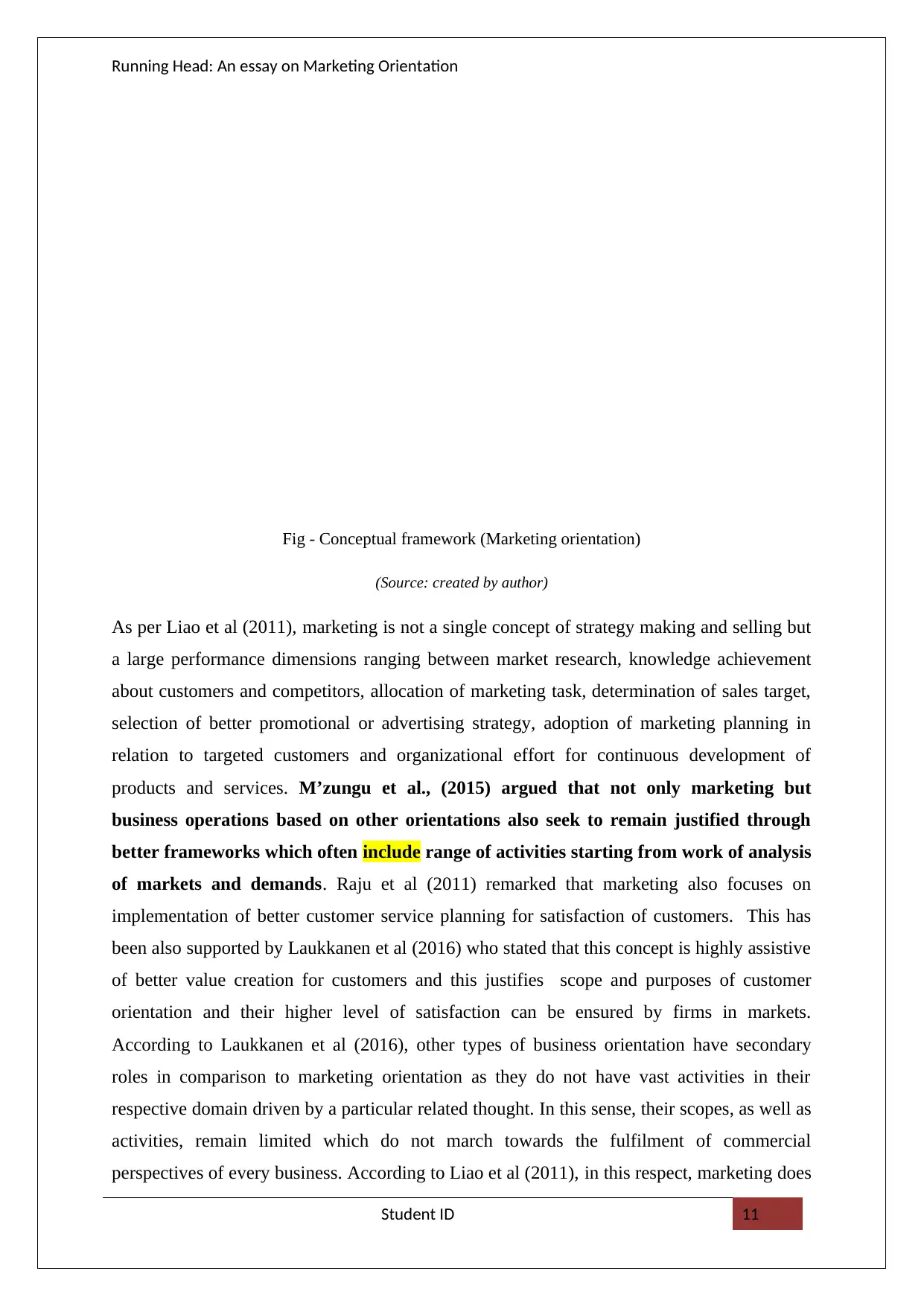
Fig - Conceptual framework (Marketing orientation)
(Source: created by author)
As per Liao et al (2011), marketing is not a single concept of strategy making and selling but
a large performance dimensions ranging between market research, knowledge achievement
about customers and competitors, allocation of marketing task, determination of sales target,
selection of better promotional or advertising strategy, adoption of marketing planning in
relation to targeted customers and organizational effort for continuous development of
products and services. M’zungu et al., (2015) argued that not only marketing but
business operations based on other orientations also seek to remain justified through
better frameworks which often include range of activities starting from work of analysis
of markets and demands. Raju et al (2011) remarked that marketing also focuses on
implementation of better customer service planning for satisfaction of customers. This has
been also supported by Laukkanen et al (2016) who stated that this concept is highly assistive
of better value creation for customers and this justifies scope and purposes of customer
orientation and their higher level of satisfaction can be ensured by firms in markets.
According to Laukkanen et al (2016), other types of business orientation have secondary
roles in comparison to marketing orientation as they do not have vast activities in their
respective domain driven by a particular related thought. In this sense, their scopes, as well as
activities, remain limited which do not march towards the fulfilment of commercial
perspectives of every business. According to Liao et al (2011), in this respect, marketing does
Student ID 11
MarketingOrientation(Marketing)MarketresearchMarketsegmentationMarketingplanningAchievementofsalestarget
Fig - Conceptual framework (Marketing orientation)
(Source: created by author)
As per Liao et al (2011), marketing is not a single concept of strategy making and selling but
a large performance dimensions ranging between market research, knowledge achievement
about customers and competitors, allocation of marketing task, determination of sales target,
selection of better promotional or advertising strategy, adoption of marketing planning in
relation to targeted customers and organizational effort for continuous development of
products and services. M’zungu et al., (2015) argued that not only marketing but
business operations based on other orientations also seek to remain justified through
better frameworks which often include range of activities starting from work of analysis
of markets and demands. Raju et al (2011) remarked that marketing also focuses on
implementation of better customer service planning for satisfaction of customers. This has
been also supported by Laukkanen et al (2016) who stated that this concept is highly assistive
of better value creation for customers and this justifies scope and purposes of customer
orientation and their higher level of satisfaction can be ensured by firms in markets.
According to Laukkanen et al (2016), other types of business orientation have secondary
roles in comparison to marketing orientation as they do not have vast activities in their
respective domain driven by a particular related thought. In this sense, their scopes, as well as
activities, remain limited which do not march towards the fulfilment of commercial
perspectives of every business. According to Liao et al (2011), in this respect, marketing does
Student ID 11
MarketingOrientation(Marketing)MarketresearchMarketsegmentationMarketingplanningAchievementofsalestarget
Running Head: An essay on Marketing Orientation
the main task of understanding customers to multiply product sales for profit maximization in
the particular industry. Raju et al (2011) argued that value creation for customers is only
properly justified when marketing is better coordinated and a marketing orientation is
adopted by firms.
This according to Anon, (2018) gives clear notion that marketing orientation is the main
aspects which could enable a firm to focus on products for ensuring that growth is possible
subject to increase in sales and profit based on products of the firm. Therefore, marketing
orientation is the key focus which can optimize customer services for multiplying satisfaction
among customers and sales growth as stated by Felix, (2015). Laukkanen et al,.(2016)
argued that marketing plays subordinate roles to other business orientations because
marketing does the task of getting products accepted in markets and this follows the
proper arrangement often ensured by other orientations. Mandal, (2017), argued with
this notion and stated that Marketing orientation is the prime requirement which an
organizational culture does proliferate and promote for confirming that business is adequately
thoughtful on satisfaction of customers and profit-making is the most vital objective which
helps firms to understand that only market orientation is helpful in strengthening position in
markets whereas other orientations are fully effective in presence of better marketing
approach that is again effective with help of marketing orientation in organizations in
competitive industry (M’zungu et al., 2015). Therefore, among all types of orientation,
marketing orientation is the most leading cause for customers’ satisfaction and successful
survival in the industry.
Conclusion
Organizations are always eager to serve their customers for ensuring their highest level of
satisfaction. This becomes possible in presence of a suitable orientation. There are several
types of orientations in business and these are customer orientation, customer service
orientation, product orientation, marketing orientation, competitor orientation, organizational
culture, inter-functional coordination. Organizational culture promotes performance and
marketing as effective tools for value creation and satisfaction of customers in competitive
markets (Ngo and O'Cass, 2012). Marketing orientation is, therefore, most important and has
supremacy over all types of orientations when successful business operation and survival in
markets are concerned.
Student ID 12
the main task of understanding customers to multiply product sales for profit maximization in
the particular industry. Raju et al (2011) argued that value creation for customers is only
properly justified when marketing is better coordinated and a marketing orientation is
adopted by firms.
This according to Anon, (2018) gives clear notion that marketing orientation is the main
aspects which could enable a firm to focus on products for ensuring that growth is possible
subject to increase in sales and profit based on products of the firm. Therefore, marketing
orientation is the key focus which can optimize customer services for multiplying satisfaction
among customers and sales growth as stated by Felix, (2015). Laukkanen et al,.(2016)
argued that marketing plays subordinate roles to other business orientations because
marketing does the task of getting products accepted in markets and this follows the
proper arrangement often ensured by other orientations. Mandal, (2017), argued with
this notion and stated that Marketing orientation is the prime requirement which an
organizational culture does proliferate and promote for confirming that business is adequately
thoughtful on satisfaction of customers and profit-making is the most vital objective which
helps firms to understand that only market orientation is helpful in strengthening position in
markets whereas other orientations are fully effective in presence of better marketing
approach that is again effective with help of marketing orientation in organizations in
competitive industry (M’zungu et al., 2015). Therefore, among all types of orientation,
marketing orientation is the most leading cause for customers’ satisfaction and successful
survival in the industry.
Conclusion
Organizations are always eager to serve their customers for ensuring their highest level of
satisfaction. This becomes possible in presence of a suitable orientation. There are several
types of orientations in business and these are customer orientation, customer service
orientation, product orientation, marketing orientation, competitor orientation, organizational
culture, inter-functional coordination. Organizational culture promotes performance and
marketing as effective tools for value creation and satisfaction of customers in competitive
markets (Ngo and O'Cass, 2012). Marketing orientation is, therefore, most important and has
supremacy over all types of orientations when successful business operation and survival in
markets are concerned.
Student ID 12
⊘ This is a preview!⊘
Do you want full access?
Subscribe today to unlock all pages.
Trusted by 1+ million students worldwide

1 out of 14


Related Documents


Your All-in-One AI-Powered Toolkit for Academic Success.
+13062052269
info@desklib.com
Available 24*7 on WhatsApp / Email
![[object Object]](/_next/static/media/star-bottom.7253800d.svg)
Unlock your academic potential
Copyright © 2020–2026 A2Z Services. All Rights Reserved. Developed and managed by ZUCOL.