Comprehensive Marketing Management Plan for Stanford Health Care
VerifiedAdded on 2020/10/05
|24
|6016
|60
Report
AI Summary
This report presents a comprehensive marketing management plan for Stanford Health Care, focusing on market analysis, segmentation, and potential. It examines the hospital's strengths, weaknesses, opportunities, and threats, followed by a detailed market segmentation analysis using psychographic factors. The plan outlines various marketing strategies tailored to different patient segments, emphasizing the importance of patient experience and customer acquisition costs. The report also covers the marketing mix strategies, patient experience recommendations, and the application of marketing metrics to measure performance. It concludes with recommendations to enhance patient experience and achieve marketing goals, highlighting the importance of data management, patient education, and social media engagement. This report is designed to provide a strategic framework for Stanford Health Care to maintain its leading role in the competitive healthcare industry.
Marketing
Management Plan for
a Hospital
Management Plan for
a Hospital

Paraphrase This Document
Need a fresh take? Get an instant paraphrase of this document with our AI Paraphraser
TABLE OF CONTENTS
UNIT 1.............................................................................................................................................1
Introduction to Stanford Health Care Marketing Plan.....................................................................1
UNIT 2.............................................................................................................................................3
Market analysis using market segmentation, market potential and strategies for Stanford Hospital
and Clinics.......................................................................................................................................3
INTRODUCTION...........................................................................................................................3
MAIN BODY..................................................................................................................................3
Stanford Hospital Market............................................................................................................3
Market segmentation for Stanford Hospital’s product................................................................3
Market potential...........................................................................................................................5
Market Strategies.........................................................................................................................5
Market Metrics.............................................................................................................................6
CONCLUSION................................................................................................................................6
UNIT 3.............................................................................................................................................7
Marketing Strategies the Customer and delivering a Positive Customer Experience AT Stanford
Hospital and Clinics.........................................................................................................................7
INTRODUCTION...........................................................................................................................7
MAIN BODY..................................................................................................................................7
Description of the Typical Customer at SHC..............................................................................7
Patient Experiences......................................................................................................................7
Recommendations to Enhance Patient Experience......................................................................8
CONCLUSION................................................................................................................................9
UNIT 4...........................................................................................................................................10
Marketing Mix Strategies at Stanford Hospital and Clinics..........................................................10
INTRODUCTION.........................................................................................................................10
MAIN BODY................................................................................................................................10
CONCLUSION..............................................................................................................................14
UNIT 5...........................................................................................................................................15
Apply Metrics to Measure Marketing Performance......................................................................15
INTRODUCTION.........................................................................................................................15
UNIT 1.............................................................................................................................................1
Introduction to Stanford Health Care Marketing Plan.....................................................................1
UNIT 2.............................................................................................................................................3
Market analysis using market segmentation, market potential and strategies for Stanford Hospital
and Clinics.......................................................................................................................................3
INTRODUCTION...........................................................................................................................3
MAIN BODY..................................................................................................................................3
Stanford Hospital Market............................................................................................................3
Market segmentation for Stanford Hospital’s product................................................................3
Market potential...........................................................................................................................5
Market Strategies.........................................................................................................................5
Market Metrics.............................................................................................................................6
CONCLUSION................................................................................................................................6
UNIT 3.............................................................................................................................................7
Marketing Strategies the Customer and delivering a Positive Customer Experience AT Stanford
Hospital and Clinics.........................................................................................................................7
INTRODUCTION...........................................................................................................................7
MAIN BODY..................................................................................................................................7
Description of the Typical Customer at SHC..............................................................................7
Patient Experiences......................................................................................................................7
Recommendations to Enhance Patient Experience......................................................................8
CONCLUSION................................................................................................................................9
UNIT 4...........................................................................................................................................10
Marketing Mix Strategies at Stanford Hospital and Clinics..........................................................10
INTRODUCTION.........................................................................................................................10
MAIN BODY................................................................................................................................10
CONCLUSION..............................................................................................................................14
UNIT 5...........................................................................................................................................15
Apply Metrics to Measure Marketing Performance......................................................................15
INTRODUCTION.........................................................................................................................15

Marketing Metrics.....................................................................................................................15
Recommendation.......................................................................................................................16
CONCLUSION..............................................................................................................................16
REFERENCES..............................................................................................................................18
Recommendation.......................................................................................................................16
CONCLUSION..............................................................................................................................16
REFERENCES..............................................................................................................................18
⊘ This is a preview!⊘
Do you want full access?
Subscribe today to unlock all pages.

Trusted by 1+ million students worldwide
UNIT 1
Introduction to Stanford Health Care Marketing Plan
Stanford Health Care (SHC) is among one of the best hospitals in the United States. Its goal
is to heal humanity through science compassion, one patient at a time. Its mission is to care, to
educate and to discover. At Stanford Hospital and Clinics, medical staffs and physicians are
achieving the hospital’s goal by providing extraordinary care and customer services that are
tailored to each patient’s needs. Hospital employees are continuously educating themselves,
colleagues, students and the community on the most advanced technologies and discoveries.
Physicians, nurses, and clinical laboratory scientists are relentlessly working in conjunction with
researchers at Stanford School of Medicine and Silicon Valley companies to develop new tests to
uncover the world’s most challenging medical problems. Health care, in many respects, is very
similar to products and services in other types of businesses. In order to maintain its leading role,
leaders at Stanford Health Care are continuing to develop new strategic plans to achieve its
mission.
According to recently released bondholder documents by Becker’s Hospital CFO Report1,
Stanford health system reported revenue of $1.16 billion in the first quarter of the fiscal year
2018. Its revenue was increasing from 6 percent to 12 percent when comparing to the income in
the same period of the year prior. Stanford Health Care is a non-profit organization. Its revenue
is used to reinvest in its care delivery system to support the level of services Stanford Health
Care provides. At current, one of the significant use of the funds was invested to ongoing
construction of a new 820,000-square-foot Stanford Hospital. The new Stanford Hospital will be
opened at the end of 2018. This expansion will allow Stanford Health Care to extended patient’s
care. The addition of 368 single occupancy rooms will give patient more privacy, comfort, and
safety. In addition, the hospital Trauma Center and Emergency Department will be as twice as
the size of the current facilities. As many other industries, competition in health care is
unavoidable. Kaiser Permanente, UCSF, and Sutter Health are among some of Stanford
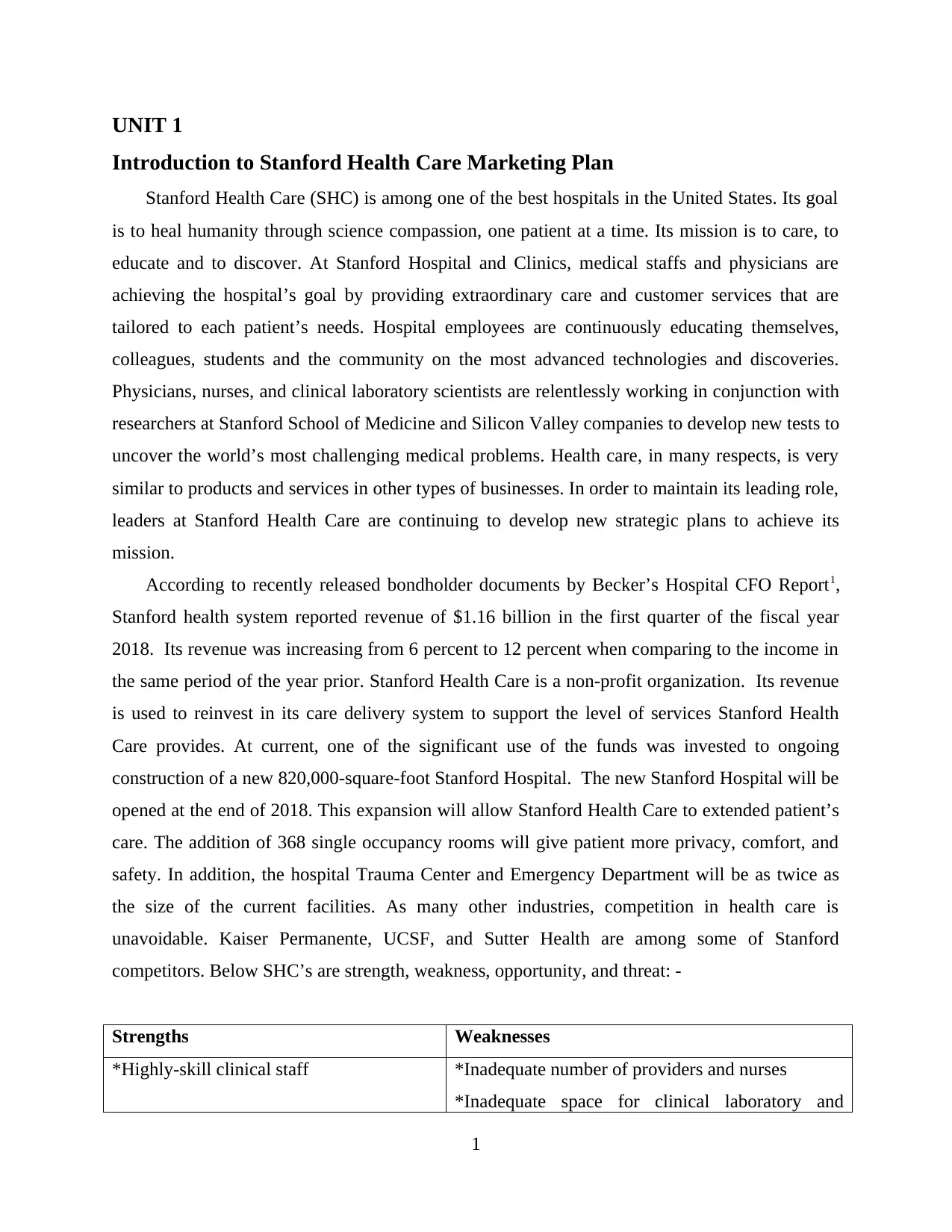
competitors. Below SHC’s are strength, weakness, opportunity, and threat: -
Strengths Weaknesses
*Highly-skill clinical staff *Inadequate number of providers and nurses
*Inadequate space for clinical laboratory and
1
Introduction to Stanford Health Care Marketing Plan
Stanford Health Care (SHC) is among one of the best hospitals in the United States. Its goal
is to heal humanity through science compassion, one patient at a time. Its mission is to care, to
educate and to discover. At Stanford Hospital and Clinics, medical staffs and physicians are
achieving the hospital’s goal by providing extraordinary care and customer services that are
tailored to each patient’s needs. Hospital employees are continuously educating themselves,
colleagues, students and the community on the most advanced technologies and discoveries.
Physicians, nurses, and clinical laboratory scientists are relentlessly working in conjunction with
researchers at Stanford School of Medicine and Silicon Valley companies to develop new tests to
uncover the world’s most challenging medical problems. Health care, in many respects, is very
similar to products and services in other types of businesses. In order to maintain its leading role,
leaders at Stanford Health Care are continuing to develop new strategic plans to achieve its
mission.
According to recently released bondholder documents by Becker’s Hospital CFO Report1,
Stanford health system reported revenue of $1.16 billion in the first quarter of the fiscal year
2018. Its revenue was increasing from 6 percent to 12 percent when comparing to the income in
the same period of the year prior. Stanford Health Care is a non-profit organization. Its revenue
is used to reinvest in its care delivery system to support the level of services Stanford Health
Care provides. At current, one of the significant use of the funds was invested to ongoing
construction of a new 820,000-square-foot Stanford Hospital. The new Stanford Hospital will be
opened at the end of 2018. This expansion will allow Stanford Health Care to extended patient’s
care. The addition of 368 single occupancy rooms will give patient more privacy, comfort, and
safety. In addition, the hospital Trauma Center and Emergency Department will be as twice as
the size of the current facilities. As many other industries, competition in health care is
unavoidable. Kaiser Permanente, UCSF, and Sutter Health are among some of Stanford
competitors. Below SHC’s are strength, weakness, opportunity, and threat: -
Strengths Weaknesses
*Highly-skill clinical staff *Inadequate number of providers and nurses
*Inadequate space for clinical laboratory and
1
Paraphrase This Document
Need a fresh take? Get an instant paraphrase of this document with our AI Paraphraser
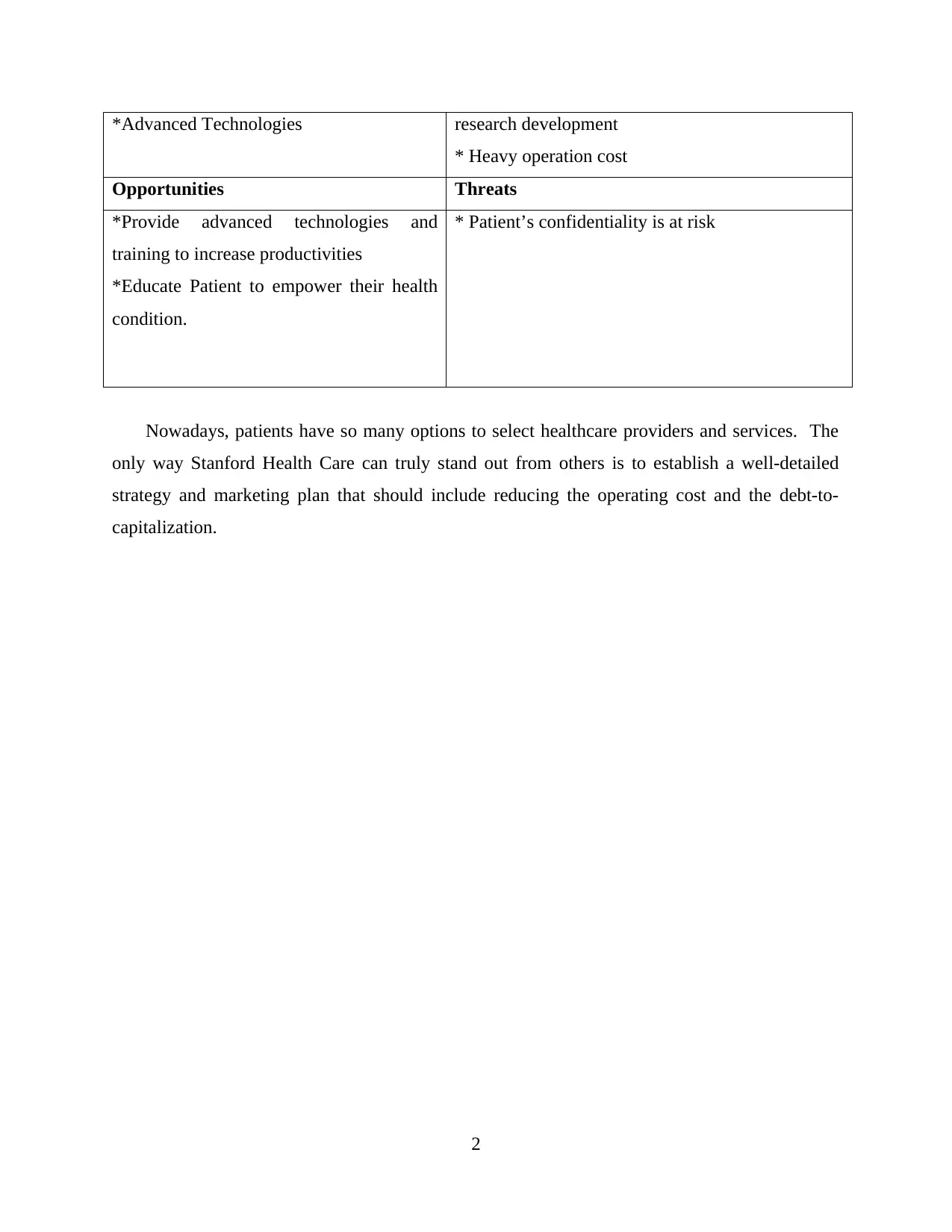
*Advanced Technologies research development
* Heavy operation cost
Opportunities Threats
*Provide advanced technologies and
training to increase productivities
*Educate Patient to empower their health
condition.
* Patient’s confidentiality is at risk
Nowadays, patients have so many options to select healthcare providers and services. The
only way Stanford Health Care can truly stand out from others is to establish a well-detailed
strategy and marketing plan that should include reducing the operating cost and the debt-to-
capitalization.
2
* Heavy operation cost
Opportunities Threats
*Provide advanced technologies and
training to increase productivities
*Educate Patient to empower their health
condition.
* Patient’s confidentiality is at risk
Nowadays, patients have so many options to select healthcare providers and services. The
only way Stanford Health Care can truly stand out from others is to establish a well-detailed
strategy and marketing plan that should include reducing the operating cost and the debt-to-
capitalization.
2
UNIT 2
Market analysis using market segmentation, market potential and strategies
for Stanford Hospital and Clinics
INTRODUCTION
This section has carried out the analysis of Stanford’s market to further determine some
potent areas of marketing. It has mainly referred to certain vital aspects of segmentation to
eventually find out such effective strategies that will play a significant role in the progress of
Stanford hospital.
MAIN BODY
Stanford Hospital Market
Stanford market is all consumers within the state seeking patient care. Most consumers of
healthcare demand for ease of access, convenience and value-based care in healthcare settings.
This includes patients with all kinds of illnesses and diseases ranging from mental illnesses and
physical illnesses such as injuries, terminal illnesses, terminal illnesses, child care, maternal
health care, geriatrics, and nutrition.
Market segmentation for Stanford Hospital’s product
Research shows that in health care services, patients may be segmented in various ways
such as geographic, demographic, psychographic, and behavioral. These segmentations will
provide some forms of utility for Stanford Hospital Leaders to formulate their marketing
strategies. In this project, the market of segmentation is psychographic which is further divided
into five subgroups such as direction takers, balance seekers, willful endures, priority jugglers,
and self-achievers. Below is a classification of health care consumers at Stanford Hospital.
3
Market analysis using market segmentation, market potential and strategies
for Stanford Hospital and Clinics
INTRODUCTION
This section has carried out the analysis of Stanford’s market to further determine some
potent areas of marketing. It has mainly referred to certain vital aspects of segmentation to
eventually find out such effective strategies that will play a significant role in the progress of
Stanford hospital.
MAIN BODY
Stanford Hospital Market
Stanford market is all consumers within the state seeking patient care. Most consumers of
healthcare demand for ease of access, convenience and value-based care in healthcare settings.
This includes patients with all kinds of illnesses and diseases ranging from mental illnesses and
physical illnesses such as injuries, terminal illnesses, terminal illnesses, child care, maternal
health care, geriatrics, and nutrition.
Market segmentation for Stanford Hospital’s product
Research shows that in health care services, patients may be segmented in various ways
such as geographic, demographic, psychographic, and behavioral. These segmentations will
provide some forms of utility for Stanford Hospital Leaders to formulate their marketing
strategies. In this project, the market of segmentation is psychographic which is further divided
into five subgroups such as direction takers, balance seekers, willful endures, priority jugglers,
and self-achievers. Below is a classification of health care consumers at Stanford Hospital.
3
⊘ This is a preview!⊘
Do you want full access?
Subscribe today to unlock all pages.
Trusted by 1+ million students worldwide
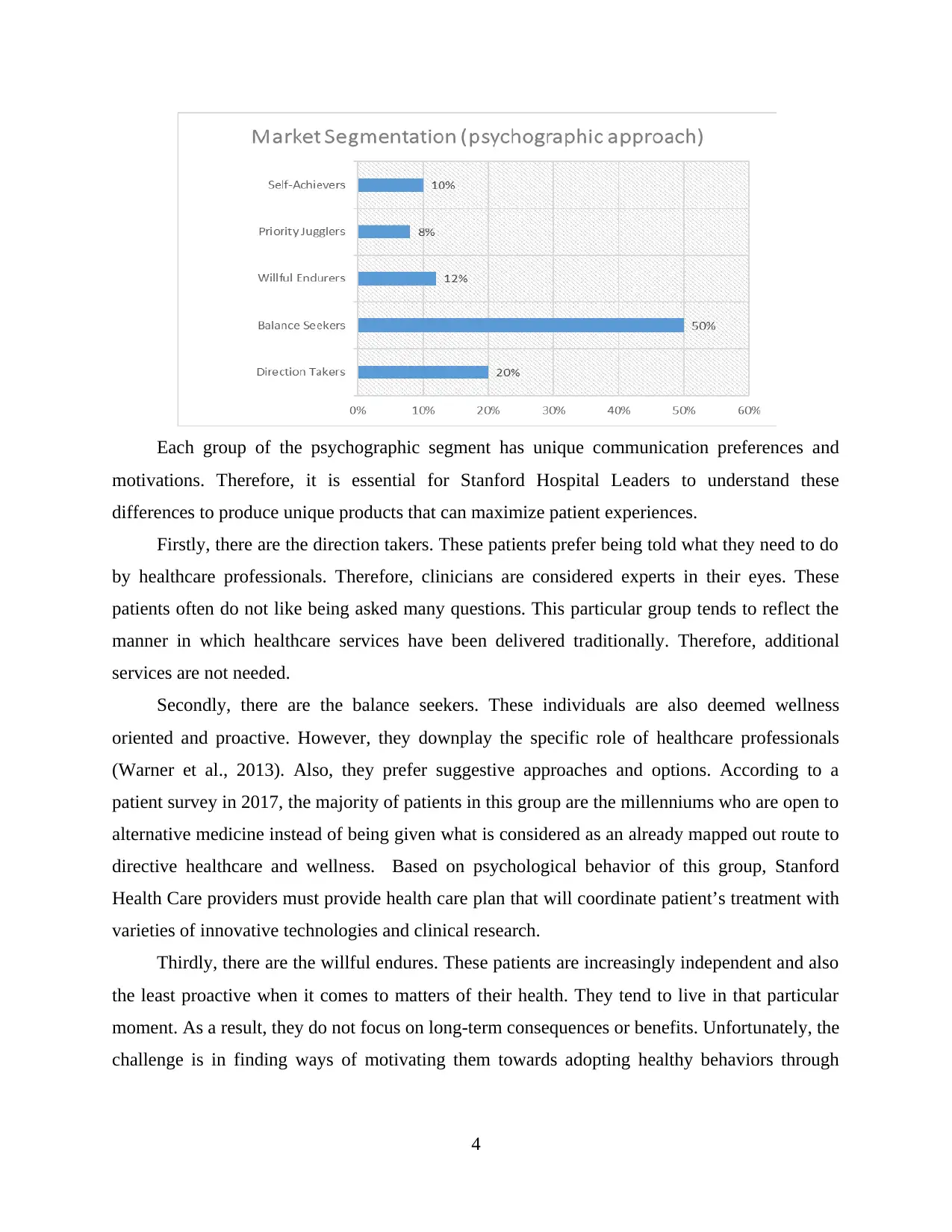
Each group of the psychographic segment has unique communication preferences and
motivations. Therefore, it is essential for Stanford Hospital Leaders to understand these
differences to produce unique products that can maximize patient experiences.
Firstly, there are the direction takers. These patients prefer being told what they need to do
by healthcare professionals. Therefore, clinicians are considered experts in their eyes. These
patients often do not like being asked many questions. This particular group tends to reflect the
manner in which healthcare services have been delivered traditionally. Therefore, additional
services are not needed.
Secondly, there are the balance seekers. These individuals are also deemed wellness
oriented and proactive. However, they downplay the specific role of healthcare professionals
(Warner et al., 2013). Also, they prefer suggestive approaches and options. According to a
patient survey in 2017, the majority of patients in this group are the millenniums who are open to
alternative medicine instead of being given what is considered as an already mapped out route to
directive healthcare and wellness. Based on psychological behavior of this group, Stanford
Health Care providers must provide health care plan that will coordinate patient’s treatment with
varieties of innovative technologies and clinical research.
Thirdly, there are the willful endures. These patients are increasingly independent and also
the least proactive when it comes to matters of their health. They tend to live in that particular
moment. As a result, they do not focus on long-term consequences or benefits. Unfortunately, the
challenge is in finding ways of motivating them towards adopting healthy behaviors through
4
motivations. Therefore, it is essential for Stanford Hospital Leaders to understand these
differences to produce unique products that can maximize patient experiences.
Firstly, there are the direction takers. These patients prefer being told what they need to do
by healthcare professionals. Therefore, clinicians are considered experts in their eyes. These
patients often do not like being asked many questions. This particular group tends to reflect the
manner in which healthcare services have been delivered traditionally. Therefore, additional
services are not needed.
Secondly, there are the balance seekers. These individuals are also deemed wellness
oriented and proactive. However, they downplay the specific role of healthcare professionals
(Warner et al., 2013). Also, they prefer suggestive approaches and options. According to a
patient survey in 2017, the majority of patients in this group are the millenniums who are open to
alternative medicine instead of being given what is considered as an already mapped out route to
directive healthcare and wellness. Based on psychological behavior of this group, Stanford
Health Care providers must provide health care plan that will coordinate patient’s treatment with
varieties of innovative technologies and clinical research.
Thirdly, there are the willful endures. These patients are increasingly independent and also
the least proactive when it comes to matters of their health. They tend to live in that particular
moment. As a result, they do not focus on long-term consequences or benefits. Unfortunately, the
challenge is in finding ways of motivating them towards adopting healthy behaviors through
4
Paraphrase This Document
Need a fresh take? Get an instant paraphrase of this document with our AI Paraphraser
what is commonly referred to as immediate gratification. This group does not require more than
essential health care services that are currently available.
The next group of psychographic is known as priority jugglers. These patients are less
engaged with their healthcare and less proactive because they put other matters and
responsibilities ahead of their health. This group does not require additional services. Lastly,
there are the self-achievers. This is the most wellness-oriented and proactive group. The self-
achievers are in most cases ready to take the initiative although they do appreciate taking
directive guidance. Task and goal oriented, they often understand measures for gauging progress
in their efforts. This particular group and the second groups are willing to spend any amount of
money it gets the best treatment when they need it.
Market potential
The market potential for healthcare is quite high. Human beings are prone to various diseases
and complications on a daily basis. Therefore, Stanford Hospital Marketer should understand the
psychology of each group, especially the self-achiever and the balance seekers, to tailor hospital
services to patient expectation, then it will create the potential to maximize profitability.
Market Strategies
Different marketing strategies may be implemented to fit the need of an individual group
of patient. Firstly, Stanford Hospital Leader needs to develop the most comprehensive health
care plan that is unique about the hospital services. This will ensure that the hospital will get
additional referrals.
Secondly, Stanford Hospital must develop a data management system for tracking patient
experiences and generating a report for the improvement process. This can be done by using
results from patient’s experience survey.
Thirdly, Stanford Hospital Educator should implement multiple patient education
programs. This is because; patients need information to help them make choices that will impact
their lives both directly and indirectly. Therefore, it is essential to educate them on matters about
health. Thus, the hospital’s website should include videos, blogs and a host of other kinds of
information on various topics such as childcare and geriatric lifestyles. Another marketing
strategy is social media engagement. Hospitals should develop communications plans for the
younger generation. They do have the potential of becoming lifetime consumers when engaged
5
essential health care services that are currently available.
The next group of psychographic is known as priority jugglers. These patients are less
engaged with their healthcare and less proactive because they put other matters and
responsibilities ahead of their health. This group does not require additional services. Lastly,
there are the self-achievers. This is the most wellness-oriented and proactive group. The self-
achievers are in most cases ready to take the initiative although they do appreciate taking
directive guidance. Task and goal oriented, they often understand measures for gauging progress
in their efforts. This particular group and the second groups are willing to spend any amount of
money it gets the best treatment when they need it.
Market potential
The market potential for healthcare is quite high. Human beings are prone to various diseases
and complications on a daily basis. Therefore, Stanford Hospital Marketer should understand the
psychology of each group, especially the self-achiever and the balance seekers, to tailor hospital
services to patient expectation, then it will create the potential to maximize profitability.
Market Strategies
Different marketing strategies may be implemented to fit the need of an individual group
of patient. Firstly, Stanford Hospital Leader needs to develop the most comprehensive health
care plan that is unique about the hospital services. This will ensure that the hospital will get
additional referrals.
Secondly, Stanford Hospital must develop a data management system for tracking patient
experiences and generating a report for the improvement process. This can be done by using
results from patient’s experience survey.
Thirdly, Stanford Hospital Educator should implement multiple patient education
programs. This is because; patients need information to help them make choices that will impact
their lives both directly and indirectly. Therefore, it is essential to educate them on matters about
health. Thus, the hospital’s website should include videos, blogs and a host of other kinds of
information on various topics such as childcare and geriatric lifestyles. Another marketing
strategy is social media engagement. Hospitals should develop communications plans for the
younger generation. They do have the potential of becoming lifetime consumers when engaged
5
early through appropriate channels. This group heavily relies on different social media sites to
drive its decisions.
Market Metrics
One of the marketing metrics is patient acquisition cost. The entire marketing budget for this
plan will be highly dependent on this number (Bruni et al., 2014). Therefore, it is crucial to
identify how much it will cost in acquiring a new patient. The different marketing sources such
as social media, referrals, and paid searches have different costs per lead. However, all these are
deemed as valuable ways of generating company’s new clients. It is critical to factor in a
patient’s lifetime value. For instance, a patient’s acquisition may be $400 but his or her lifetime
value may be over $15,000. This may be calculated by dividing all costs used for marketing
within a specific period by the particular number of new patients acquired in that period.
CONCLUSION
This section has summarised some important strategies for Stanford Hospital on the basis of
its undertaken marketing analysis. On considering the acquired market metrics, the cited firm is
apparent to attain successful outcomes after targeting its segmented set of customers. It is also on
referring to the market potential of hospitals like Stanford that depicts a higher scope of
achieving success, as per the planned approach.
6
drive its decisions.
Market Metrics
One of the marketing metrics is patient acquisition cost. The entire marketing budget for this
plan will be highly dependent on this number (Bruni et al., 2014). Therefore, it is crucial to
identify how much it will cost in acquiring a new patient. The different marketing sources such
as social media, referrals, and paid searches have different costs per lead. However, all these are
deemed as valuable ways of generating company’s new clients. It is critical to factor in a
patient’s lifetime value. For instance, a patient’s acquisition may be $400 but his or her lifetime
value may be over $15,000. This may be calculated by dividing all costs used for marketing
within a specific period by the particular number of new patients acquired in that period.
CONCLUSION
This section has summarised some important strategies for Stanford Hospital on the basis of
its undertaken marketing analysis. On considering the acquired market metrics, the cited firm is
apparent to attain successful outcomes after targeting its segmented set of customers. It is also on
referring to the market potential of hospitals like Stanford that depicts a higher scope of
achieving success, as per the planned approach.
6
⊘ This is a preview!⊘
Do you want full access?
Subscribe today to unlock all pages.
Trusted by 1+ million students worldwide
UNIT 3
Marketing Strategies the Customer and delivering a Positive Customer
Experience AT Stanford Hospital and Clinics
INTRODUCTION
The vision of the Stanford Hospital and Clinics (SHC) is to be the best medical center in the
nation. It provides health care that ranges from everyday health needs to complex diagnoses. It
specializes in organ transplants, cancer diagnosis and treatment, cardiovascular medicine and
surgery, and neurosciences. Nowadays, great competition has emerged in the medical sector as
large numbers of hospitals are opening up in the bay area, and patients are becoming more aware
of their rights and getting conscious of health care. As competition is increasing, doctors, nurses,
and medical staffs at SHC are seeking ways to commit to providing excellent services to patients
with outstanding qualities and compassion. This project focuses on Stanford Hospital and
Clinics to assess the typical customer in the facility while recommending strategies to deliver
positive customer experience.
MAIN BODY
Description of the Typical Customer at SHC
A typical customer at Stanford Hospital is a patient who is seeking healthcare services for
primary and specialized care. The customer comes to the hospital with the hope that his or her
health problem will be resolved and his or her quality of life will be improved. A typical
customer of Stanford Hospital is also a patient seeking affordable medical services.
Patient Experiences
Before the rapid rise of competition in business, customers, most likely, relied on brand
reputation. However, with the increasing technological advancement and social media,
customers make purchase decisions based on value (Best, 2009). Therefore, it is essential to
focus on customer experience.
As a healthcare organization, Stanford Hospital is focused on a customer-centric culture where
the patients are put first in the delivery of care (Rivers & Glover, 2018). The customer, in this
case, the patient, has expectations and attitudes regarding the type of service and care offered in
the hospital based on previous experiences and reviews from other patients. As such, the
7
Marketing Strategies the Customer and delivering a Positive Customer
Experience AT Stanford Hospital and Clinics
INTRODUCTION
The vision of the Stanford Hospital and Clinics (SHC) is to be the best medical center in the
nation. It provides health care that ranges from everyday health needs to complex diagnoses. It
specializes in organ transplants, cancer diagnosis and treatment, cardiovascular medicine and
surgery, and neurosciences. Nowadays, great competition has emerged in the medical sector as
large numbers of hospitals are opening up in the bay area, and patients are becoming more aware
of their rights and getting conscious of health care. As competition is increasing, doctors, nurses,
and medical staffs at SHC are seeking ways to commit to providing excellent services to patients
with outstanding qualities and compassion. This project focuses on Stanford Hospital and
Clinics to assess the typical customer in the facility while recommending strategies to deliver
positive customer experience.
MAIN BODY
Description of the Typical Customer at SHC
A typical customer at Stanford Hospital is a patient who is seeking healthcare services for
primary and specialized care. The customer comes to the hospital with the hope that his or her
health problem will be resolved and his or her quality of life will be improved. A typical
customer of Stanford Hospital is also a patient seeking affordable medical services.
Patient Experiences
Before the rapid rise of competition in business, customers, most likely, relied on brand
reputation. However, with the increasing technological advancement and social media,
customers make purchase decisions based on value (Best, 2009). Therefore, it is essential to
focus on customer experience.
As a healthcare organization, Stanford Hospital is focused on a customer-centric culture where
the patients are put first in the delivery of care (Rivers & Glover, 2018). The customer, in this
case, the patient, has expectations and attitudes regarding the type of service and care offered in
the hospital based on previous experiences and reviews from other patients. As such, the
7
Paraphrase This Document
Need a fresh take? Get an instant paraphrase of this document with our AI Paraphraser
customer seeks medical care from Stanford with the hope and expectation that quality care and
attention will be accorded to them throughout the treatment process (Rivers & Glover, 2018).
Recommendations to Enhance Patient Experience
Customer satisfaction is an essential goal for the long-term success of a business. Although it
may be difficult to measure and quantify customer experience in healthcare organizations,
Stanford Hospital should consider particular strategies to ensure that a positive customer
experience is delivered. A few recommendations are discussed below:
First, Stanford Hospital's leadership can ensure that the health care providers attend to the
patients based on their medical conditions rather than a hospital’s schedule (Worlu, Kehinde, &
Borishade, 2016). A schedule that is convenient for the hospital may not be suitable for patient
care. Long wait times for a follow-up and referral appointment will negatively influence a
patient's experience and dissatisfaction with the hospital’s services. As such, developing a
schedule that is convenient for the patient is critical to improving customer experience.
Secondly, the hospital can embrace excellent customer service by implanting the best
systems to improve efficiency in patient care (Worlu, Kehinde & Borishade, 2016). The hospital
can also focus on ensuring that the healthcare providers are trained to always show a positive
attitude and smile to the patient for active creation of therapeutic relationships that enhance
patient care. As such, positive customer experience would be delivered through these
relationships. Based on The Joint Commission Journal on Quality and Patient Safety, most SHC
patients stated that medical staffs are not friendly. They suggested the medical teams be
sympathetic, courteous and be more aware of cultural diversity (Levin & Hopkin, 2014). At
current, SHC promotes C-I-CARE (Connect, Introduce, Communicate, Ask Permission, and
Response) practice. However, this approach is only provided at orientation training for new
employees. To improve patients' experiences, the C-I-CARE method should be incorporated into
every interaction with every patient and among co-workers every day. This practice must
become part of SHC culture.
Finally, all healthcare providers at Stanford Hospital should be trained on how to handle
different complaints and concerns from the patients (Worlu, Kehinde, & Borishade, 2016).
When customers have their problems addressed, they develop satisfaction, and this can help in
delivering a positive customer experience. As such, the hospital management can ensure that all
the staff members follow the right procedures regarding patient complaints and concerns. A
8
attention will be accorded to them throughout the treatment process (Rivers & Glover, 2018).
Recommendations to Enhance Patient Experience
Customer satisfaction is an essential goal for the long-term success of a business. Although it
may be difficult to measure and quantify customer experience in healthcare organizations,
Stanford Hospital should consider particular strategies to ensure that a positive customer
experience is delivered. A few recommendations are discussed below:
First, Stanford Hospital's leadership can ensure that the health care providers attend to the
patients based on their medical conditions rather than a hospital’s schedule (Worlu, Kehinde, &
Borishade, 2016). A schedule that is convenient for the hospital may not be suitable for patient
care. Long wait times for a follow-up and referral appointment will negatively influence a
patient's experience and dissatisfaction with the hospital’s services. As such, developing a
schedule that is convenient for the patient is critical to improving customer experience.
Secondly, the hospital can embrace excellent customer service by implanting the best
systems to improve efficiency in patient care (Worlu, Kehinde & Borishade, 2016). The hospital
can also focus on ensuring that the healthcare providers are trained to always show a positive
attitude and smile to the patient for active creation of therapeutic relationships that enhance
patient care. As such, positive customer experience would be delivered through these
relationships. Based on The Joint Commission Journal on Quality and Patient Safety, most SHC
patients stated that medical staffs are not friendly. They suggested the medical teams be
sympathetic, courteous and be more aware of cultural diversity (Levin & Hopkin, 2014). At
current, SHC promotes C-I-CARE (Connect, Introduce, Communicate, Ask Permission, and
Response) practice. However, this approach is only provided at orientation training for new
employees. To improve patients' experiences, the C-I-CARE method should be incorporated into
every interaction with every patient and among co-workers every day. This practice must
become part of SHC culture.
Finally, all healthcare providers at Stanford Hospital should be trained on how to handle
different complaints and concerns from the patients (Worlu, Kehinde, & Borishade, 2016).
When customers have their problems addressed, they develop satisfaction, and this can help in
delivering a positive customer experience. As such, the hospital management can ensure that all
the staff members follow the right procedures regarding patient complaints and concerns. A
8
Service Recovery Tool Kit, including role-playing and coaching feedback, should be provided to
the medical teams. This training will help medical staff members feel far more comfortable when
handling a situation that has not gone well for the patient.
CONCLUSION
Providing positive customer experience is financially crucial to Stanford Hospital and
Clinics because it would cost seven times more to acquire a new patient than to keep an existing
one (Longo 2016). To enhance patient satisfaction, SHC leaders should work on reducing the
long waiting time to obtain an appointment or a referral and on providing excellent customer
service.
9
the medical teams. This training will help medical staff members feel far more comfortable when
handling a situation that has not gone well for the patient.
CONCLUSION
Providing positive customer experience is financially crucial to Stanford Hospital and
Clinics because it would cost seven times more to acquire a new patient than to keep an existing
one (Longo 2016). To enhance patient satisfaction, SHC leaders should work on reducing the
long waiting time to obtain an appointment or a referral and on providing excellent customer
service.
9
⊘ This is a preview!⊘
Do you want full access?
Subscribe today to unlock all pages.
Trusted by 1+ million students worldwide

1 out of 24


Related Documents


Your All-in-One AI-Powered Toolkit for Academic Success.
+13062052269
info@desklib.com
Available 24*7 on WhatsApp / Email
![[object Object]](/_next/static/media/star-bottom.7253800d.svg)
Unlock your academic potential
Copyright © 2020–2026 A2Z Services. All Rights Reserved. Developed and managed by ZUCOL.