Marketing Promotional Budget Report: Strategies and Analysis

Verified

Added on  2022/09/05

|3
|481
|21
Report
AI Summary
This report delves into the realm of promotional budgets, exploring various methods employed by companies to allocate resources for marketing initiatives. It begins by defining a promotional budget and its significance in promoting products and services. The report then examines four key methods: the affordable method, which is often used by companies that rely on word-of-mouth and view marketing as an expense; the percentage method, which bases the budget on sales or revenue targets and is commonly used for its direct link to revenue growth; the competitive-parity method, which involves aligning the budget with competitors; and the objective-and-task method, which sets specific goals and tasks with associated costs. The report emphasizes the importance of these methods, particularly when launching new products or services, and it also references relevant literature to support its findings. These methods are often used in combination to maximize outcomes.
Document Page
Running Head: Promotional Budget 0
Promotional budget
tabler-icon-diamond-filled.svg

Paraphrase This Document

Need a fresh take? Get an instant paraphrase of this document with our AI Paraphraser
Document Page
Promotional Budget 1
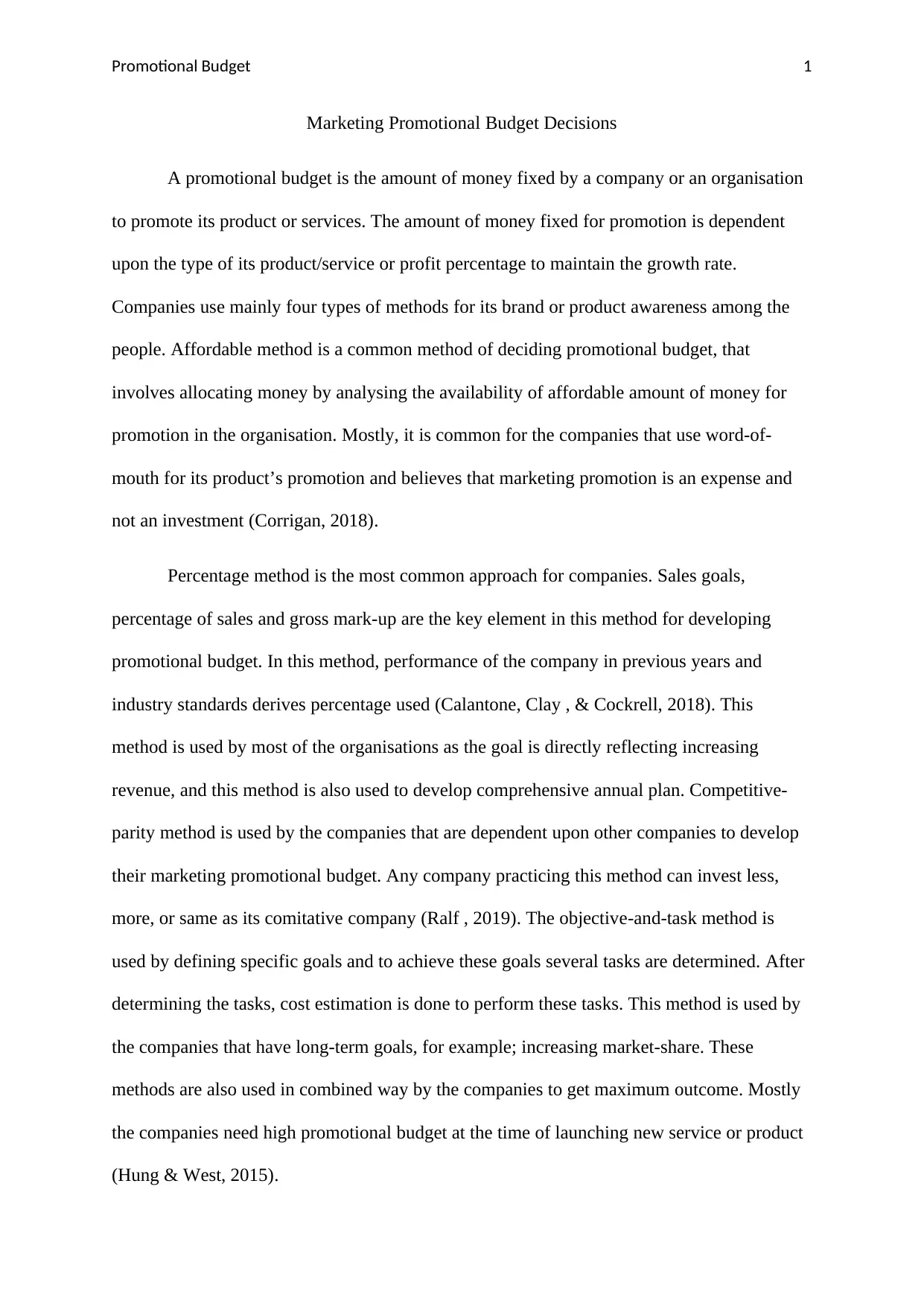
Marketing Promotional Budget Decisions
A promotional budget is the amount of money fixed by a company or an organisation
to promote its product or services. The amount of money fixed for promotion is dependent
upon the type of its product/service or profit percentage to maintain the growth rate.
Companies use mainly four types of methods for its brand or product awareness among the
people. Affordable method is a common method of deciding promotional budget, that
involves allocating money by analysing the availability of affordable amount of money for
promotion in the organisation. Mostly, it is common for the companies that use word-of-
mouth for its product’s promotion and believes that marketing promotion is an expense and
not an investment (Corrigan, 2018).
Percentage method is the most common approach for companies. Sales goals,
percentage of sales and gross mark-up are the key element in this method for developing
promotional budget. In this method, performance of the company in previous years and
industry standards derives percentage used (Calantone, Clay , & Cockrell, 2018). This
method is used by most of the organisations as the goal is directly reflecting increasing
revenue, and this method is also used to develop comprehensive annual plan. Competitive-
parity method is used by the companies that are dependent upon other companies to develop
their marketing promotional budget. Any company practicing this method can invest less,
more, or same as its comitative company (Ralf , 2019). The objective-and-task method is
used by defining specific goals and to achieve these goals several tasks are determined. After
determining the tasks, cost estimation is done to perform these tasks. This method is used by
the companies that have long-term goals, for example; increasing market-share. These
methods are also used in combined way by the companies to get maximum outcome. Mostly
the companies need high promotional budget at the time of launching new service or product
(Hung & West, 2015).
Document Page
Promotional Budget 2
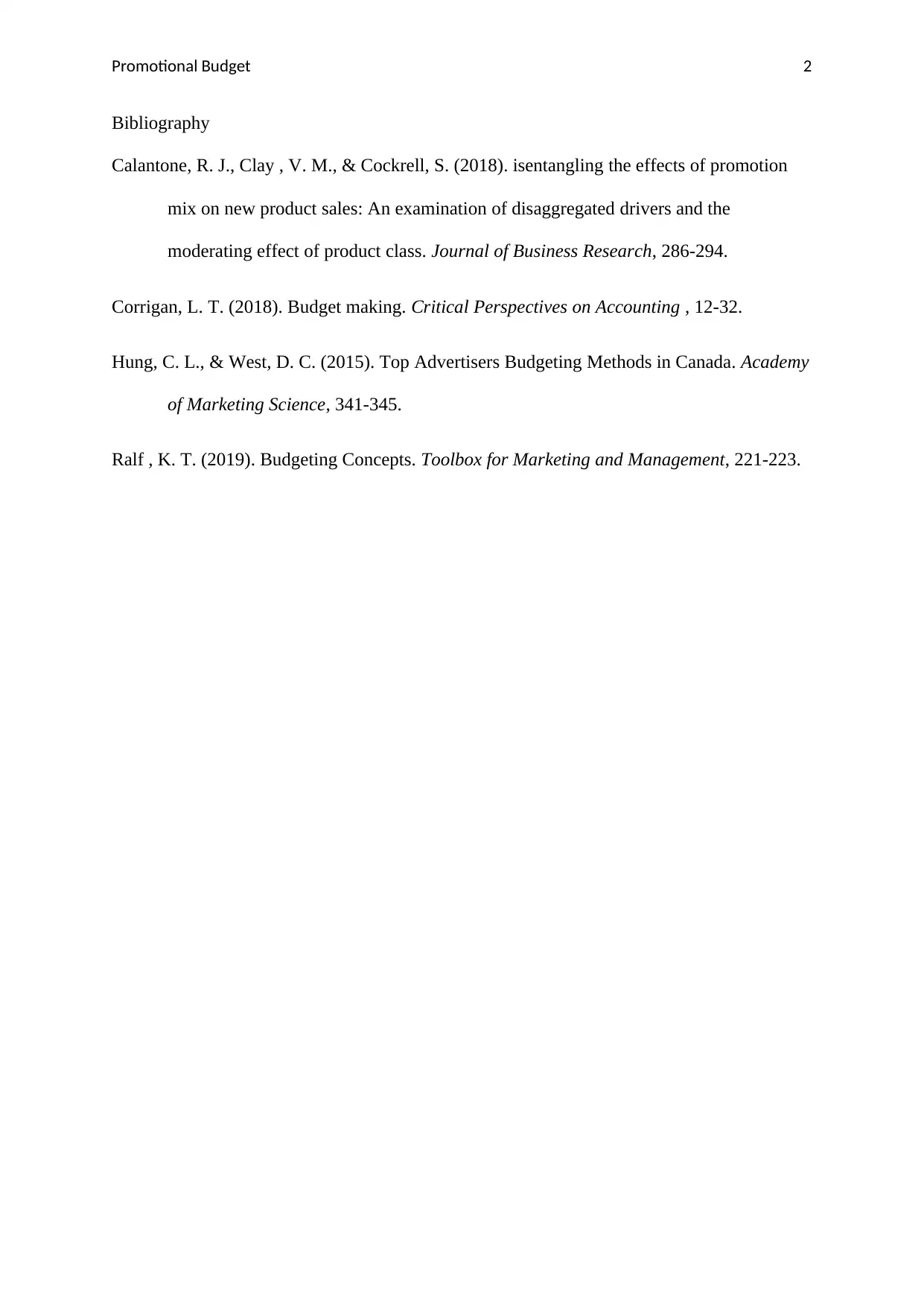
Bibliography
Calantone, R. J., Clay , V. M., & Cockrell, S. (2018). isentangling the effects of promotion
mix on new product sales: An examination of disaggregated drivers and the
moderating effect of product class. Journal of Business Research, 286-294.
Corrigan, L. T. (2018). Budget making. Critical Perspectives on Accounting , 12-32.
Hung, C. L., & West, D. C. (2015). Top Advertisers Budgeting Methods in Canada. Academy
of Marketing Science, 341-345.
Ralf , K. T. (2019). Budgeting Concepts. Toolbox for Marketing and Management, 221-223.
chevron_up_icon
1 out of 3
circle_padding
hide_on_mobile
zoom_out_icon
[object Object]