Marketing Strategies and Analysis for the Nestle Company Report
VerifiedAdded on 2023/01/13
|16
|5427
|36
Report
AI Summary
This report provides a comprehensive analysis of Nestle's marketing management within the retail industry, focusing on its operations in Europe. It begins with an introduction to marketing management and the retail sector, highlighting the industry's significance and Nestle's position. The report delves into Nestle's background, competitive analysis using Porter's Five Forces, and unique selling propositions (USP). A detailed marketing audit, including SWOT analysis, is presented to evaluate the company's internal and external factors. Furthermore, the report examines the 4Ps model (Product, Price, Place, Promotion) to understand Nestle's marketing mix. The conclusion summarizes the key findings, emphasizing Nestle's strategies for market success. The report aims to provide insights into Nestle's approach to marketing, its competitive advantages, and its adaptability within the dynamic retail environment.
MARKETING
MANAGEMENT
1
MANAGEMENT
1

Paraphrase This Document
Need a fresh take? Get an instant paraphrase of this document with our AI Paraphraser
TABLE OF CONTENTS
INTRODUCTION...........................................................................................................................4
MAIN BODY...................................................................................................................................4
1. INDUSTRY BACKGROUND................................................................................................4
2. COMPANY'S BACKGROUND.............................................................................................4
3. COMPETITIVE ANALYSIS OF THE COMPANY..............................................................6
4. MARKETING AUDIT............................................................................................................8
5. 4 P MODEL...........................................................................................................................12
CONCLUSION..............................................................................................................................14
REFERENCES..............................................................................................................................15
2
INTRODUCTION...........................................................................................................................4
MAIN BODY...................................................................................................................................4
1. INDUSTRY BACKGROUND................................................................................................4
2. COMPANY'S BACKGROUND.............................................................................................4
3. COMPETITIVE ANALYSIS OF THE COMPANY..............................................................6
4. MARKETING AUDIT............................................................................................................8
5. 4 P MODEL...........................................................................................................................12
CONCLUSION..............................................................................................................................14
REFERENCES..............................................................................................................................15
2
EXECUTIVE SUMMARY
Marketing management is the concept used in the businesses to plan, manage, organise,
control and implement the policies, rules, tactics and strategies on the business activities
performed by the companies. Here in this report marketing concepts would be discussed to gain
the insight knowledge about the firm activities. Retail industry will be taken to further study
along with company's background and its current market position. Nestle company is operating
in the retail industry to fulfil the needs of the customers of food and dairy products at affordable
prices. Company runs in European Union at well position by maintaining the supply chain. So it
has the discussion on the internal and external factors which help the company to run the
business smoothly in the country with the potential growth in the market. Its strengths and
weaknesses along with opportunities and threats are analysed to introduce new product, how it
would be placed in the market and get success.
3
Marketing management is the concept used in the businesses to plan, manage, organise,
control and implement the policies, rules, tactics and strategies on the business activities
performed by the companies. Here in this report marketing concepts would be discussed to gain
the insight knowledge about the firm activities. Retail industry will be taken to further study
along with company's background and its current market position. Nestle company is operating
in the retail industry to fulfil the needs of the customers of food and dairy products at affordable
prices. Company runs in European Union at well position by maintaining the supply chain. So it
has the discussion on the internal and external factors which help the company to run the
business smoothly in the country with the potential growth in the market. Its strengths and
weaknesses along with opportunities and threats are analysed to introduce new product, how it
would be placed in the market and get success.
3
⊘ This is a preview!⊘
Do you want full access?
Subscribe today to unlock all pages.

Trusted by 1+ million students worldwide
INTRODUCTION
Marketing management is the term used for defining the business objectives in which
planning, managing, organising, implementing and controlling of the business activities done by
firm. Such activities performed by the organisation to achieve growth in their business by
following specific marketing strategies, company's policies, tactics which are designed to meet
the requirement of the firm. Companies offer specific products and services to meet the needs of
the consumers which help them to generate required amount of profits. This report carries
different marketing approaches and strategies used by different companies. Also, it has
discussion on the current market situation of the company with their SWOT and PESTEL
analysis which help to gain the insight knowledge about potential growth in market. Later, report
discusses how the new product will take place in the market by preparing the action plans and
marketing strategies by analysing its strengths and opportunities.
MAIN BODY
1. INDUSTRY BACKGROUND
Retail Industry is the most valuable in any market because it shares a large part of it.
Retail is all about the selling the products and services to their consumers via multiple channels
which are linked with manufacturer, producer and distributors to generate profits. It has proper
management of supply chain to satisfy the demands of the public and mange the inventory of the
company. In Europe, retail industry has reached on another level in generating revenues which
supports the economy of the country (Deepak and Jeyakumar, 2019). Analysis of the market and
growth of the retail industry is totally dependent on the consumers demands and their power of
purchasing. Many companies are working in this industry, and they really perform well in terms
of achieving profits and satisfying the needs of consumers (Haider and et.al., 2017). Nestle
company is taken to do further study on the given topic.
2. COMPANY'S BACKGROUND
Nestle is a Swiss multinational company working in retail industry for 154 years. It was
founded by Henri Nestle in 1886, its headquarters are situated in Vevey, Switzerland and Vaud.
Nestle is operating a wide chain of food and drink products in approximately 189 countries such
4
Marketing management is the term used for defining the business objectives in which
planning, managing, organising, implementing and controlling of the business activities done by
firm. Such activities performed by the organisation to achieve growth in their business by
following specific marketing strategies, company's policies, tactics which are designed to meet
the requirement of the firm. Companies offer specific products and services to meet the needs of
the consumers which help them to generate required amount of profits. This report carries
different marketing approaches and strategies used by different companies. Also, it has
discussion on the current market situation of the company with their SWOT and PESTEL
analysis which help to gain the insight knowledge about potential growth in market. Later, report
discusses how the new product will take place in the market by preparing the action plans and
marketing strategies by analysing its strengths and opportunities.
MAIN BODY
1. INDUSTRY BACKGROUND
Retail Industry is the most valuable in any market because it shares a large part of it.
Retail is all about the selling the products and services to their consumers via multiple channels
which are linked with manufacturer, producer and distributors to generate profits. It has proper
management of supply chain to satisfy the demands of the public and mange the inventory of the
company. In Europe, retail industry has reached on another level in generating revenues which
supports the economy of the country (Deepak and Jeyakumar, 2019). Analysis of the market and
growth of the retail industry is totally dependent on the consumers demands and their power of
purchasing. Many companies are working in this industry, and they really perform well in terms
of achieving profits and satisfying the needs of consumers (Haider and et.al., 2017). Nestle
company is taken to do further study on the given topic.
2. COMPANY'S BACKGROUND
Nestle is a Swiss multinational company working in retail industry for 154 years. It was
founded by Henri Nestle in 1886, its headquarters are situated in Vevey, Switzerland and Vaud.
Nestle is operating a wide chain of food and drink products in approximately 189 countries such
4
Paraphrase This Document
Need a fresh take? Get an instant paraphrase of this document with our AI Paraphraser
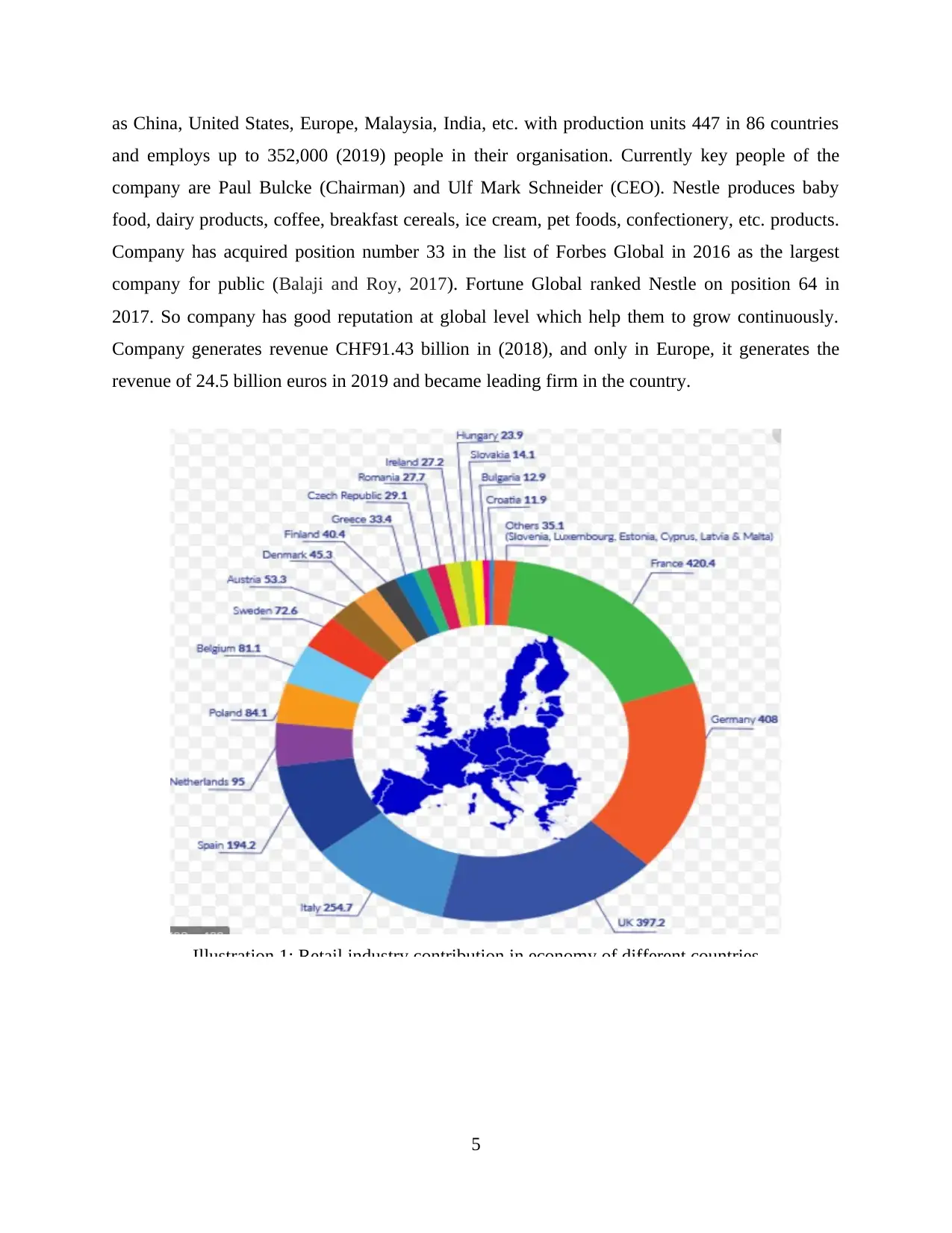
as China, United States, Europe, Malaysia, India, etc. with production units 447 in 86 countries
and employs up to 352,000 (2019) people in their organisation. Currently key people of the
company are Paul Bulcke (Chairman) and Ulf Mark Schneider (CEO). Nestle produces baby
food, dairy products, coffee, breakfast cereals, ice cream, pet foods, confectionery, etc. products.
Company has acquired position number 33 in the list of Forbes Global in 2016 as the largest
company for public (Balaji and Roy, 2017). Fortune Global ranked Nestle on position 64 in
2017. So company has good reputation at global level which help them to grow continuously.
Company generates revenue CHF91.43 billion in (2018), and only in Europe, it generates the
revenue of 24.5 billion euros in 2019 and became leading firm in the country.
5
Illustration 1: Retail industry contribution in economy of different countries
and employs up to 352,000 (2019) people in their organisation. Currently key people of the
company are Paul Bulcke (Chairman) and Ulf Mark Schneider (CEO). Nestle produces baby
food, dairy products, coffee, breakfast cereals, ice cream, pet foods, confectionery, etc. products.
Company has acquired position number 33 in the list of Forbes Global in 2016 as the largest
company for public (Balaji and Roy, 2017). Fortune Global ranked Nestle on position 64 in
2017. So company has good reputation at global level which help them to grow continuously.
Company generates revenue CHF91.43 billion in (2018), and only in Europe, it generates the
revenue of 24.5 billion euros in 2019 and became leading firm in the country.
5
Illustration 1: Retail industry contribution in economy of different countries
3. COMPETITIVE ANALYSIS OF THE COMPANY
To analyse the Nestle's competition in the European market, Porter's five forces model is
used to do the deep assessment
Porter's Five Forces model
Competition in the industry: This is the first force which is denoted to the existing number of
the competitors in the industry. As the large number of the competitors in the sector, it decreases
the power of the company. Nestle if operating in the retail industry in Europe, many other
companies are working in their industry which give them tough fight in terms to meet the desire
of the consumers. It is dependent on the company that how they gain the competitive advantage
in the industry (Peker, Kocyigit and Eren, 2017). For example company provide better quality
products at low prices, gives offers, discounts to attract the consumers and many more strategies
they follow.
Threat of Substitutes: it directly drives to focus on the substitutes. It is about that if consumers
don't find the products reliable, or affordable they go for the substitute of the same product at
low price and good quality. It is major force which affect the business in terms to possess threat
to the company. Nestle provides baby food, milk products, confectionery, etc. consumers goods
at good prices but many other substitutes are available in the market which lower their business.
Threat of new entrants: New entrant in the market possess harm to the existing companies in
the industry. If it progresses in less time and earn profit then it may cut the profits of other
companies. But there are may barriers to enter into the market and establish their position in it
(Simões and Sebastiani, 2017). Nestle is the leading brand in the retail industry in the Europe, so
they don't have much impact of the new entrant. Also, they prepare their marketing strategies in
such a way which help them to secure their market position.
Bargaining Power of Suppliers: It is major force to be considered, suppliers has great power to
affect the cost of the products. As they supply the raw materials to the company, so they are the
mains for any industry. It is dependent on the number of the suppliers present in the market for
the particular industry which they currently serve, if there is large number of suppliers then their
cost of input is less. If, there are fewer suppliers in the industry then they have high power of
bargaining (Burke, Van Stel and Thurik, 2016). Nestle does not affect the bargaining power of
suppliers due to large number of availability of the suppliers in the market which help them to
maintain their supply chain.
6
To analyse the Nestle's competition in the European market, Porter's five forces model is
used to do the deep assessment
Porter's Five Forces model
Competition in the industry: This is the first force which is denoted to the existing number of
the competitors in the industry. As the large number of the competitors in the sector, it decreases
the power of the company. Nestle if operating in the retail industry in Europe, many other
companies are working in their industry which give them tough fight in terms to meet the desire
of the consumers. It is dependent on the company that how they gain the competitive advantage
in the industry (Peker, Kocyigit and Eren, 2017). For example company provide better quality
products at low prices, gives offers, discounts to attract the consumers and many more strategies
they follow.
Threat of Substitutes: it directly drives to focus on the substitutes. It is about that if consumers
don't find the products reliable, or affordable they go for the substitute of the same product at
low price and good quality. It is major force which affect the business in terms to possess threat
to the company. Nestle provides baby food, milk products, confectionery, etc. consumers goods
at good prices but many other substitutes are available in the market which lower their business.
Threat of new entrants: New entrant in the market possess harm to the existing companies in
the industry. If it progresses in less time and earn profit then it may cut the profits of other
companies. But there are may barriers to enter into the market and establish their position in it
(Simões and Sebastiani, 2017). Nestle is the leading brand in the retail industry in the Europe, so
they don't have much impact of the new entrant. Also, they prepare their marketing strategies in
such a way which help them to secure their market position.
Bargaining Power of Suppliers: It is major force to be considered, suppliers has great power to
affect the cost of the products. As they supply the raw materials to the company, so they are the
mains for any industry. It is dependent on the number of the suppliers present in the market for
the particular industry which they currently serve, if there is large number of suppliers then their
cost of input is less. If, there are fewer suppliers in the industry then they have high power of
bargaining (Burke, Van Stel and Thurik, 2016). Nestle does not affect the bargaining power of
suppliers due to large number of availability of the suppliers in the market which help them to
maintain their supply chain.
6
⊘ This is a preview!⊘
Do you want full access?
Subscribe today to unlock all pages.
Trusted by 1+ million students worldwide
Bargaining Power of customers: it is quite high always, as the consumers find better quality
products at low price then they will choose the other brand. So it always threats the companies
because of their purchasing decision and bargaining power. Nestle's products are affordable and
reliable for the public in every country. In Europe, people preferred to buy the food and drinks
products of their brand. It imposes the high demand of their products in market, which help them
to take the competitive advantage in the market.
Nestle is well-established brand in the market of the Europe, it shares large part of
economy in the country. Its main competitors are Unilever and Danone in the country (Maulana,
Munawar and Nurjanah, 2019). They are the giant companies which provide the food products
and beverages to the consumers at affordable prices. This creates the barriers for the company to
sell their products in the country but Nestle give tough competition them and take the
competitive advantage in the market.
Unique Selling Proposition
Unique selling proposition is denoted to the uniquely exhibited benefits by the products,
services, company, brand which enable them to hold the position in the market by standing out
from existing competitors. It is mainly a feature which focuses the product's relevance to the
consumers (Fehér and Németh, 2017). It differentiates the company's product from other brands
which make the audience to change their buying decision.
Unique selling proposition (USP) is also known as unique selling point which help the
business to grow. USP is communicated to the public through branding, as they company
advertise about their products and services, it makes an image in the mind of audience and help
to attract them.
Method to create the USP
Describing the target audience: Businesses have to describe their target audience so that they
can implant their products and service into their heads. Segmenting the audience according to the
demographic, geographic, etc. basis. Nestle holds good position in the global market, in Europe
company segmented public according to the age, income, and many other factors wise. So they
launch their baby food products for infants, beverage and milk products for all age groups. This
helps them to prepare their advertising slogans for their products like chocolates.
7
products at low price then they will choose the other brand. So it always threats the companies
because of their purchasing decision and bargaining power. Nestle's products are affordable and
reliable for the public in every country. In Europe, people preferred to buy the food and drinks
products of their brand. It imposes the high demand of their products in market, which help them
to take the competitive advantage in the market.
Nestle is well-established brand in the market of the Europe, it shares large part of
economy in the country. Its main competitors are Unilever and Danone in the country (Maulana,
Munawar and Nurjanah, 2019). They are the giant companies which provide the food products
and beverages to the consumers at affordable prices. This creates the barriers for the company to
sell their products in the country but Nestle give tough competition them and take the
competitive advantage in the market.
Unique Selling Proposition
Unique selling proposition is denoted to the uniquely exhibited benefits by the products,
services, company, brand which enable them to hold the position in the market by standing out
from existing competitors. It is mainly a feature which focuses the product's relevance to the
consumers (Fehér and Németh, 2017). It differentiates the company's product from other brands
which make the audience to change their buying decision.
Unique selling proposition (USP) is also known as unique selling point which help the
business to grow. USP is communicated to the public through branding, as they company
advertise about their products and services, it makes an image in the mind of audience and help
to attract them.
Method to create the USP
Describing the target audience: Businesses have to describe their target audience so that they
can implant their products and service into their heads. Segmenting the audience according to the
demographic, geographic, etc. basis. Nestle holds good position in the global market, in Europe
company segmented public according to the age, income, and many other factors wise. So they
launch their baby food products for infants, beverage and milk products for all age groups. This
helps them to prepare their advertising slogans for their products like chocolates.
7
Paraphrase This Document
Need a fresh take? Get an instant paraphrase of this document with our AI Paraphraser
Explaining the problems which needs to be solved: company needs to define the barriers in the
market to achieve the required growth in the business (Chen and Chi, 2017). Nestle always
works according to their strategies to solve the problems they face.
Listing the benefits: Businesses main motive is to earn profit and sustaining future in the
market. Nestle launch their products according to the demands of the public, and they also design
their products uniquely, so it would be identified easily by the audience. It benefits them in
maintaining their image in public and profit earnings.
Defining the promise: companies have to define their promises which they made with public
and fulfil them. Nestle always make their promise and complete them in terms of the quality of
their products and prices.
Combining them and rework: businesses need to consider these points and follow them to
achieve the success. They have to work in the particular direction. Nestle work in the direction to
maintain their quality of the products and fulfilling the requirements of the consumers.
4. MARKETING AUDIT
Marketing audit is about the review of the plan, objectives and strategies they prepare to
achieve their target. Internal and external factors affect the business activities and help to make
the review bout the company's present condition in the market.
SWOT Analysis
Strengths
Research and development: Nestle has unmatched research and development criteria in
which they innovate new products. As they do the market research, it helps them to know
the requirement of the products and services. So, they do the work in the given direction
and make the research on it. From the sourcing of the raw material to selling the products
to the costumers. They do whole research about the scope. Also, they find the product's
relevance at primary stage, so they can invest in their research and development.
Strong Presence: Nestle possess strong presence in the global market by their marketing
strategies. They do the branding of their products at wide level which help them to be
identified easily by the audience (Choi and et.al., 2019). Company's geographic presence
is also very good, as they keep an eye on the market fluctuation which help them to gain
competitive advantage. Advertising is dependent on the products they prefer and their
8
market to achieve the required growth in the business (Chen and Chi, 2017). Nestle always
works according to their strategies to solve the problems they face.
Listing the benefits: Businesses main motive is to earn profit and sustaining future in the
market. Nestle launch their products according to the demands of the public, and they also design
their products uniquely, so it would be identified easily by the audience. It benefits them in
maintaining their image in public and profit earnings.
Defining the promise: companies have to define their promises which they made with public
and fulfil them. Nestle always make their promise and complete them in terms of the quality of
their products and prices.
Combining them and rework: businesses need to consider these points and follow them to
achieve the success. They have to work in the particular direction. Nestle work in the direction to
maintain their quality of the products and fulfilling the requirements of the consumers.
4. MARKETING AUDIT
Marketing audit is about the review of the plan, objectives and strategies they prepare to
achieve their target. Internal and external factors affect the business activities and help to make
the review bout the company's present condition in the market.
SWOT Analysis
Strengths
Research and development: Nestle has unmatched research and development criteria in
which they innovate new products. As they do the market research, it helps them to know
the requirement of the products and services. So, they do the work in the given direction
and make the research on it. From the sourcing of the raw material to selling the products
to the costumers. They do whole research about the scope. Also, they find the product's
relevance at primary stage, so they can invest in their research and development.
Strong Presence: Nestle possess strong presence in the global market by their marketing
strategies. They do the branding of their products at wide level which help them to be
identified easily by the audience (Choi and et.al., 2019). Company's geographic presence
is also very good, as they keep an eye on the market fluctuation which help them to gain
competitive advantage. Advertising is dependent on the products they prefer and their
8
slogans are very innovative. Each and every product is advertised according to their
category. Company invest a lot to maintain their market presence.
Brand value: Company is operating in approximately 189 countries, it provides wide
range of food and dairy products to the consumer. People in every country identify their
products easily as they have strong market presence as well they have brand value. In
Europe, Nestle has gained huge revenue in 2019 and it acquires the largest brand value
(Varma and Ravi, 2017). People have faith on their brand, so their primary choice is their
products for their infants and children. Young generation prefers to eat the breakfast
cereals produced by the Nestle.
Concern for environment: company is concerned for the environment, they do their
research and development by following the environmental laws. They don't break the
rules and laws associated with it (Ogedengbe, 2017). Also, they don't damage the nature
for their sake. Ownership of famous brands: many brands like Nescafe, Kitkat, Purina, Nestea and other
famous consumer brands are acquired by the Nestle. It earns huge profits because most of
the people prefer these brands to eat and drink.
Weaknesses
Criticized for consuming high water: Company has suffered form the allegation for high
water usage which enhance the scarcity of water. Nestle's manufacturer units do the
wastage of the water which is against the environmental law.
Anti unionism: company does not bare union at workplace. So it creates damage to their
image, and they have no proper communication with other brands on which they have
ownership.
Contaminated food: Nestle was alleged for providing contaminated food products which
harms the health of children. It imposed great effects on the company's reputation. People
denied using the products of this brand (Adelopo, 2016). It losses the company, inventory
losses, lowered the market share. Unethical practices: Nestle company is accused of the child labour which is breakage of
the law and justice. Company also found in other unethical practices. It loss the company
in terms of breaking of law and order. In Europe 2016 company had faced bad phase due
to economic crises.
9
category. Company invest a lot to maintain their market presence.
Brand value: Company is operating in approximately 189 countries, it provides wide
range of food and dairy products to the consumer. People in every country identify their
products easily as they have strong market presence as well they have brand value. In
Europe, Nestle has gained huge revenue in 2019 and it acquires the largest brand value
(Varma and Ravi, 2017). People have faith on their brand, so their primary choice is their
products for their infants and children. Young generation prefers to eat the breakfast
cereals produced by the Nestle.
Concern for environment: company is concerned for the environment, they do their
research and development by following the environmental laws. They don't break the
rules and laws associated with it (Ogedengbe, 2017). Also, they don't damage the nature
for their sake. Ownership of famous brands: many brands like Nescafe, Kitkat, Purina, Nestea and other
famous consumer brands are acquired by the Nestle. It earns huge profits because most of
the people prefer these brands to eat and drink.
Weaknesses
Criticized for consuming high water: Company has suffered form the allegation for high
water usage which enhance the scarcity of water. Nestle's manufacturer units do the
wastage of the water which is against the environmental law.
Anti unionism: company does not bare union at workplace. So it creates damage to their
image, and they have no proper communication with other brands on which they have
ownership.
Contaminated food: Nestle was alleged for providing contaminated food products which
harms the health of children. It imposed great effects on the company's reputation. People
denied using the products of this brand (Adelopo, 2016). It losses the company, inventory
losses, lowered the market share. Unethical practices: Nestle company is accused of the child labour which is breakage of
the law and justice. Company also found in other unethical practices. It loss the company
in terms of breaking of law and order. In Europe 2016 company had faced bad phase due
to economic crises.
9
⊘ This is a preview!⊘
Do you want full access?
Subscribe today to unlock all pages.
Trusted by 1+ million students worldwide
Opportunities
Transparency: Nestle can maintain the transparency in developing food products and
material sourcing for the public. It helps the company to win the hearts of the consumers.
Also, this will help to rectify their mistakes.
Small start-ups in Silicon valley: company can invest in small start-ups of the food
products in the Silicon valley, it helps them to achieve more profitability. People can
easily access their products at affordable prices.
Ready to drink products like tea and coffee: Nestle should focus on the ready to eat and
ready to drink products. It already provides some ready to food products, so now the can
think to serve the ready to drink beverages products which are less time-consuming for
the people and healthy for their healths (Raghunandan, 2019). Most people like to drink
tea and coffee, it will be proved good decision for the company. Clear and perfect labelling for products: company can clearly label the warning on the
packaged food, so it may easer the use of products. Also, they have to give the correct
information along with instruction to prepare the food item. So it will not create any kind
of confusion in the customers mind.
Threats
Bad quality of water: company use the poor quality of the water to manufacture of the
food items, it may damage the health of the audience. Scarcity of water is major issue, so
they have to control the usage of water in their manufacturing units. Otherwise, it may
create threat for the business.
Increment in competitors: In retail industry, majorly in food and beverages products
many competitors and new entrants are arising daily. It threats the company's position
and it distributes their profit share as well.
Prices of raw materials is risen: suppliers bargaining power is getting high due to many
competitors are available in the industry. They easily make new deals with other
businesses and sell their raw materials. Also, the cost of labour is increased. It imposes
great effects on the company's investment and funding. It less their profit amount and
increases their expenses.
PESTEL Analysis
10
Transparency: Nestle can maintain the transparency in developing food products and
material sourcing for the public. It helps the company to win the hearts of the consumers.
Also, this will help to rectify their mistakes.
Small start-ups in Silicon valley: company can invest in small start-ups of the food
products in the Silicon valley, it helps them to achieve more profitability. People can
easily access their products at affordable prices.
Ready to drink products like tea and coffee: Nestle should focus on the ready to eat and
ready to drink products. It already provides some ready to food products, so now the can
think to serve the ready to drink beverages products which are less time-consuming for
the people and healthy for their healths (Raghunandan, 2019). Most people like to drink
tea and coffee, it will be proved good decision for the company. Clear and perfect labelling for products: company can clearly label the warning on the
packaged food, so it may easer the use of products. Also, they have to give the correct
information along with instruction to prepare the food item. So it will not create any kind
of confusion in the customers mind.
Threats
Bad quality of water: company use the poor quality of the water to manufacture of the
food items, it may damage the health of the audience. Scarcity of water is major issue, so
they have to control the usage of water in their manufacturing units. Otherwise, it may
create threat for the business.
Increment in competitors: In retail industry, majorly in food and beverages products
many competitors and new entrants are arising daily. It threats the company's position
and it distributes their profit share as well.
Prices of raw materials is risen: suppliers bargaining power is getting high due to many
competitors are available in the industry. They easily make new deals with other
businesses and sell their raw materials. Also, the cost of labour is increased. It imposes
great effects on the company's investment and funding. It less their profit amount and
increases their expenses.
PESTEL Analysis
10
Paraphrase This Document
Need a fresh take? Get an instant paraphrase of this document with our AI Paraphraser
Nestle company operates in Europe and shares large market part in this country. So the
external environment affect the business a lot in many ways. To assess the external factors which
affects the company's position and competitive advantage (Petrova and Pokivailova, 2019).
PESTLE analysis
Political factors
Europe supports the free trade in their country. It helps to improve the country's
economic condition and give the opportunities to man businesses for their globalisation. Nestle
company has the opportunity to do their business activities in the country, as they have to pay
only small amount for the import and tax duties. They can sell their products in the stores at
cheap prices. It helps them to earn high profitability. But due to some political decisions of the
government like UK decides to leave the European Union, it imposes negative effect on the
company in terms to import and export and disturb the business activities (Mehra, 2017). It slows
the supply chain in the country.
Due to Brexit, tariffs and trade regulations changed, so it affects the many business
sectors. Retail industry has to face numerous loss due to trade rules, it results in increased cost of
the products for the costumers. So Nestle had to rise the cost of the products for the public to
earn the profit margins.
Economic Factors
Economic Condition of European Union is quite stable. It has positive impact on the
retail industry, people can afford the consumer goods easily. But there is large competition in the
industry on the prices of the products. So Nestle company have to focus on lowering the cost of
their products. It helps them to get the stability in the market. Otherwise, public can go for the
substitutes or other brands. It minimises their market value if the company do not take the
essential steps on time.
Socio Cultural factors
People in EU countries are every educated and active, they mostly refer the qualitative
products for their usage. So the company have the advantage to be the first choice to the public.
Buyers purchase the products of the Nestle company for the children and for themselves. But due
to fining of the contaminated food, they denied accepting the products which losses the
reputation of the company. They do protest against the food and beverages products and boycott
11
external environment affect the business a lot in many ways. To assess the external factors which
affects the company's position and competitive advantage (Petrova and Pokivailova, 2019).
PESTLE analysis
Political factors
Europe supports the free trade in their country. It helps to improve the country's
economic condition and give the opportunities to man businesses for their globalisation. Nestle
company has the opportunity to do their business activities in the country, as they have to pay
only small amount for the import and tax duties. They can sell their products in the stores at
cheap prices. It helps them to earn high profitability. But due to some political decisions of the
government like UK decides to leave the European Union, it imposes negative effect on the
company in terms to import and export and disturb the business activities (Mehra, 2017). It slows
the supply chain in the country.
Due to Brexit, tariffs and trade regulations changed, so it affects the many business
sectors. Retail industry has to face numerous loss due to trade rules, it results in increased cost of
the products for the costumers. So Nestle had to rise the cost of the products for the public to
earn the profit margins.
Economic Factors
Economic Condition of European Union is quite stable. It has positive impact on the
retail industry, people can afford the consumer goods easily. But there is large competition in the
industry on the prices of the products. So Nestle company have to focus on lowering the cost of
their products. It helps them to get the stability in the market. Otherwise, public can go for the
substitutes or other brands. It minimises their market value if the company do not take the
essential steps on time.
Socio Cultural factors
People in EU countries are every educated and active, they mostly refer the qualitative
products for their usage. So the company have the advantage to be the first choice to the public.
Buyers purchase the products of the Nestle company for the children and for themselves. But due
to fining of the contaminated food, they denied accepting the products which losses the
reputation of the company. They do protest against the food and beverages products and boycott
11
it completely (Vergassola, 2019). But company spread awareness about their products that they
are harm free and good quality, it brings them back in the market.
Technological factors
In EU countries approximately 90% public uses the mobile phones. So the company have
to think about shifting on the digital platform. It helps to enhance their reach towards potential
audiences. Online shopping is in trend, most of the public prefer to buy the online products. It
saves the timing and money for the travel to public. This is the opportunity for the Nestle to
provide their food and milk products by doing home delivery. Also, they have to propose the self
checkout facilities in stores and online shopping.
Environmental factors
Environmental laws in the country are very strict, so the businesses have to follow these
rules. They have to consider them on priority basis but Nestle has high water usage and waste it,
so they were accused by the government and had to pay the penalties for it.
Legal factors
Laws and legislation of justice are very strict in EU countries, business have to follow the
legal procedures to establish their company in the country. This process is very time-consuming
for them. Nestle took all the permissions for their business but it was found that they are doing
some unethical practices, so it would stop their business for sometime (Pereira, 2016). As they
get the clearance from the government they restart their business again.
Potential Market Growth
According to the internal and external factors assessment of the Nestle company in
Europe, it is cleared that they have high potential for the market growth. Also, company can plan
to spread their business in the uncovered area of EU countries. This helps them to earn high
profitability. Company can involve new products in their production range which will be
beneficial for their stability in market.
5. 4 P MODEL
Nestle sells different brands for food product and beverages in which its major products
are milk products, confectionery, ice cream, confectionery, liquid and powdered beverages, pet
foods. Company can introduce new product like ready-to-drink coffee and tea products. Nestle
12
are harm free and good quality, it brings them back in the market.
Technological factors
In EU countries approximately 90% public uses the mobile phones. So the company have
to think about shifting on the digital platform. It helps to enhance their reach towards potential
audiences. Online shopping is in trend, most of the public prefer to buy the online products. It
saves the timing and money for the travel to public. This is the opportunity for the Nestle to
provide their food and milk products by doing home delivery. Also, they have to propose the self
checkout facilities in stores and online shopping.
Environmental factors
Environmental laws in the country are very strict, so the businesses have to follow these
rules. They have to consider them on priority basis but Nestle has high water usage and waste it,
so they were accused by the government and had to pay the penalties for it.
Legal factors
Laws and legislation of justice are very strict in EU countries, business have to follow the
legal procedures to establish their company in the country. This process is very time-consuming
for them. Nestle took all the permissions for their business but it was found that they are doing
some unethical practices, so it would stop their business for sometime (Pereira, 2016). As they
get the clearance from the government they restart their business again.
Potential Market Growth
According to the internal and external factors assessment of the Nestle company in
Europe, it is cleared that they have high potential for the market growth. Also, company can plan
to spread their business in the uncovered area of EU countries. This helps them to earn high
profitability. Company can involve new products in their production range which will be
beneficial for their stability in market.
5. 4 P MODEL
Nestle sells different brands for food product and beverages in which its major products
are milk products, confectionery, ice cream, confectionery, liquid and powdered beverages, pet
foods. Company can introduce new product like ready-to-drink coffee and tea products. Nestle
12
⊘ This is a preview!⊘
Do you want full access?
Subscribe today to unlock all pages.
Trusted by 1+ million students worldwide

1 out of 16


Related Documents


Your All-in-One AI-Powered Toolkit for Academic Success.
+13062052269
info@desklib.com
Available 24*7 on WhatsApp / Email
![[object Object]](/_next/static/media/star-bottom.7253800d.svg)
Unlock your academic potential
Copyright © 2020–2026 A2Z Services. All Rights Reserved. Developed and managed by ZUCOL.