Marketing Plan Report: Nestle Organic Chocolate for HI5004 Management

Verified

Added on  2022/09/09

|8
|1583
|16
Report
AI Summary
This report presents a comprehensive marketing plan for Nestle's organic chocolate, addressing key aspects such as the competitive environment, environmental scanning, and the implementation of segmentation, targeting, and positioning (STP) strategies. The analysis begins by assessing the global and local competitive landscapes, highlighting factors like pricing, distribution channels, and promotional approaches. It then delves into environmental scanning, evaluating both micro and macro factors (PEST analysis) that influence the product's success. The report forecasts demand, considering factors like price elasticity. Finally, it outlines specific market segmentation strategies based on demographic and geographic factors, targeting statements, and positioning statements designed to resonate with consumers seeking healthier lifestyle choices, particularly within the Australian market. The report concludes by summarizing the key findings and recommendations for Nestle's organic chocolate launch.

Document Page
Running head: MANAGEMENT
MANAGEMENT
tabler-icon-diamond-filled.svg

Paraphrase This Document

Need a fresh take? Get an instant paraphrase of this document with our AI Paraphraser
Document Page
MANAGEMENT 2
Table of Contents
Introduction...........................................................................................................................................3
Competitive environment......................................................................................................................3
Environmental scanning........................................................................................................................4
Demand forecasted................................................................................................................................5
Specific market segmentation, targeting, and positioning strategy........................................................5
Market segmentation.........................................................................................................................6
Targeting statements..........................................................................................................................6
Positioning statements.......................................................................................................................6
Conclusion.............................................................................................................................................7
References.............................................................................................................................................8
Document Page
MANAGEMENT 3
Introduction
Nestle is planning for launching organic chocolate. This product is selected because
customers want a healthy lifestyle such as lowered blood pressure. It would be also beneficial
for increasing energy, creativity, alertness, as well as, enhances mood. Organic chocolate is
rich in antioxidants that aids in declining free radicals. This product is the need of the
customer in current times (Schlegelmilch, 2016).
This report presents the competitive environment and also discusses environmental scanning.
It further explains the demand forecasting and segmentation, targeting, and positioning for
organic chocolate.
Competitive environment
At a global level, organic chocolate has higher demand as compared to the local level.
Globally, the driver of expansion is continuing to change the taste in Asian pacific nations.
Since customers in these area’s expansion are familiar with western tastes and demand for
chocolate is booming. These changing tastes as well as, gaining per capita in India, China,
and other countries have predicted 30% increases in global demand by the year of 2020.
Under the domestic Australian market, there is no legislation particularly referencing
marketing and organic production needs (Sahu and Pradhan, 2017).
At a global level, nestle can quote higher prices while at the local level, it can provide organic
chocolate at a lower level. Moreover, at the global level, it can use online distribution
channels while at the local level, it can use the retail channel. In the context of promotion, it
can use social media at the global level while at the local level, it can use sales discount like
distributing free samples, and discounts on products (Groucutt and Hopkins, 2015).
At a global level, it can deliver prompt customer service and prompt response to customer
feedbacks whereas at the local level, it can use professionalism and courtesy for selling
product. At the global level, it can consider organic production standards in the process
Document Page
MANAGEMENT 4
while, at the local level, there is no such requirement in the process (Morah, 2019). At the
global level, it can create positioning by using a differentiation strategy while at the local
level, it can use a cost leadership strategy. At the global level, it can provide added value
products to customers that would aid to increase the sales, while at local level, it can provide
a discount to increase the demand of products as it directly affects its profitability (Fait,
Scorrano, Cavallo, and Iaia, 2016).
Environmental scanning
In existing times, nestle currently provides non-organic chocolate but now, it is planning to
launch the organic chocolate that has different benefits. These benefits are reducing
cholesterol, helps control appetite, and supports weight loss. In existing times, it uses plastic
packaging while nestle is planning to use green packaging for new product i.e. organic
chocolate. This packaging is effective for the environment since it is made of recycled waste
materials that can decline the consumption of resources (Visser and Tolhurst, 2017). It not
only emphasizes on financial goals but also meet the environmental goals. It also declines the
carbon footprint and environmental impact. It could be significant after it has dealt with its
purpose due to biodegradable packaging materials (Joselito and Aimee, 2018).
For evaluating environmental condition about organic chocolate, a firm can include both
micro and macro factors. It will be effective to understand different elements that can affect
that attainment of organic chocolate. It is evaluated as below:
Microanalysis
The micro assessment is significant to comprehend regarding internal factors that can affect
the business performance such as customers, market intermediates, competitors, and public.
The firm can deeply increase their knowledge regarding such components for gaining the
profitability of a firm (Trabold and Babbitt, 2018).
Macro analysis
tabler-icon-diamond-filled.svg

Paraphrase This Document

Need a fresh take? Get an instant paraphrase of this document with our AI Paraphraser
Document Page
MANAGEMENT 5
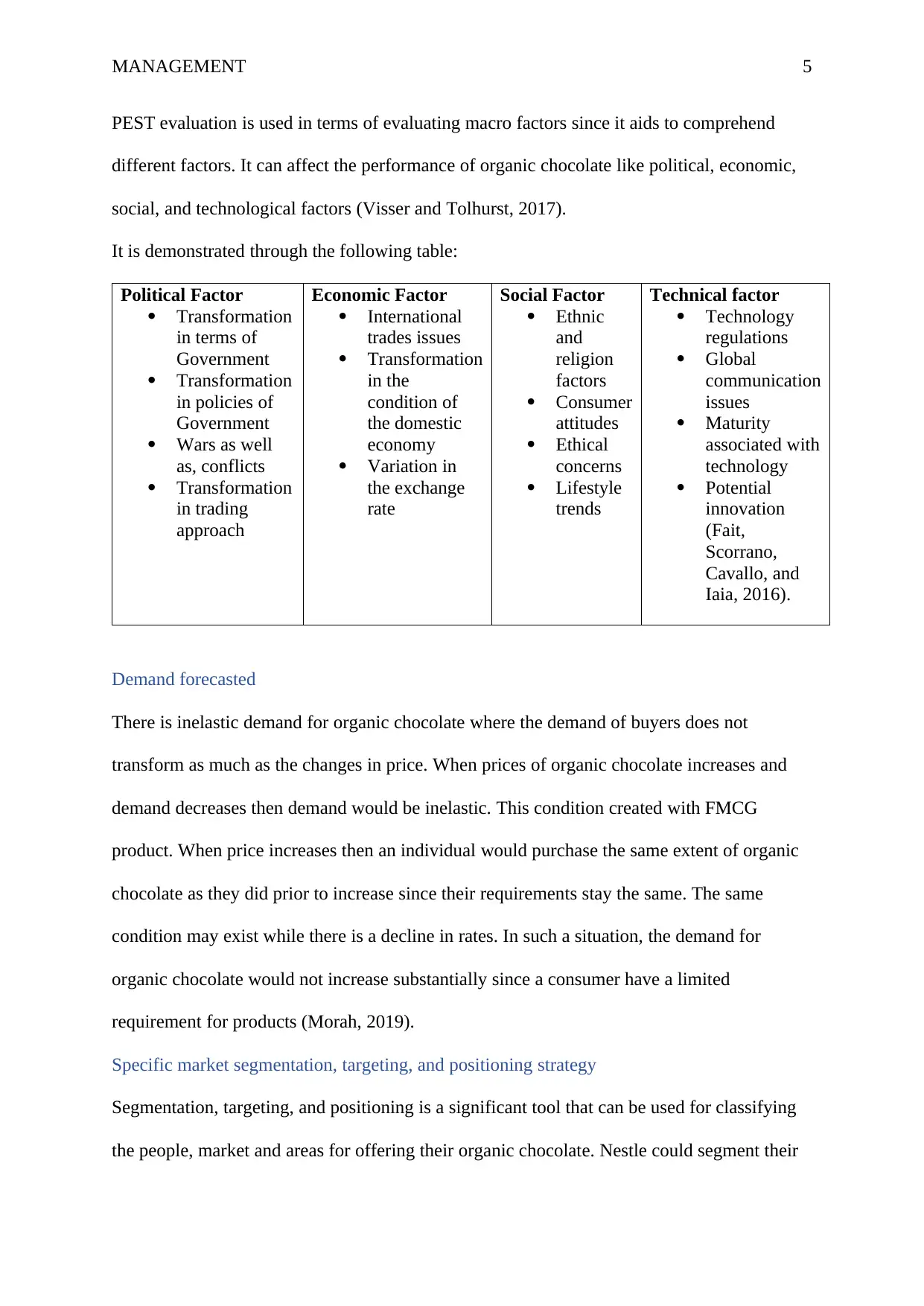
PEST evaluation is used in terms of evaluating macro factors since it aids to comprehend
different factors. It can affect the performance of organic chocolate like political, economic,
social, and technological factors (Visser and Tolhurst, 2017).
It is demonstrated through the following table:
Political Factor
Transformation
in terms of
Government
Transformation
in policies of
Government
Wars as well
as, conflicts
Transformation
in trading
approach
Economic Factor
International
trades issues
Transformation
in the
condition of
the domestic
economy
Variation in
the exchange
rate
Social Factor
Ethnic
and
religion
factors
Consumer
attitudes
Ethical
concerns
Lifestyle
trends
Technical factor
Technology
regulations
Global
communication
issues
Maturity
associated with
technology
Potential
innovation
(Fait,
Scorrano,
Cavallo, and
Iaia, 2016).
Demand forecasted
There is inelastic demand for organic chocolate where the demand of buyers does not
transform as much as the changes in price. When prices of organic chocolate increases and
demand decreases then demand would be inelastic. This condition created with FMCG
product. When price increases then an individual would purchase the same extent of organic
chocolate as they did prior to increase since their requirements stay the same. The same
condition may exist while there is a decline in rates. In such a situation, the demand for
organic chocolate would not increase substantially since a consumer have a limited
requirement for products (Morah, 2019).
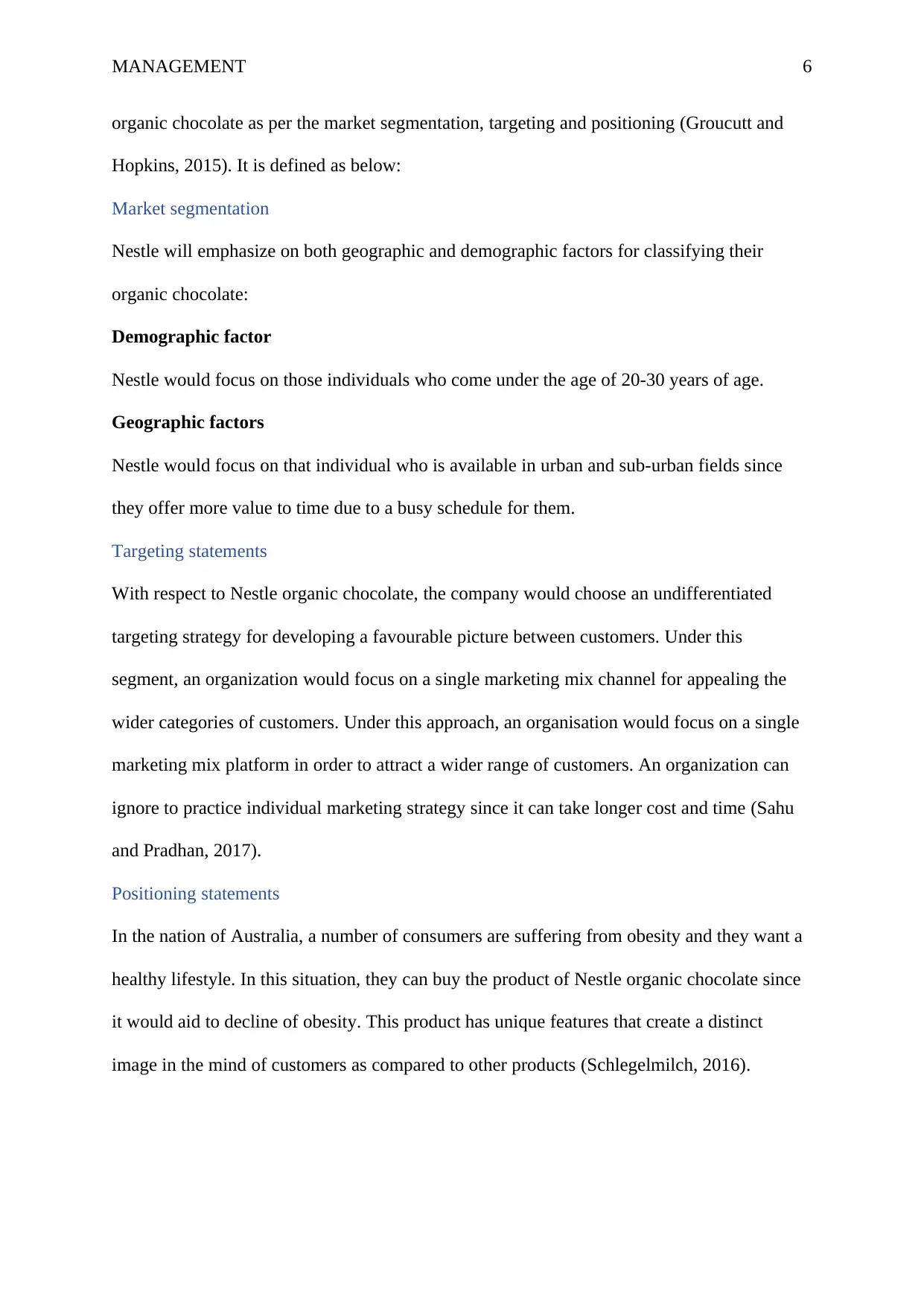
Specific market segmentation, targeting, and positioning strategy
Segmentation, targeting, and positioning is a significant tool that can be used for classifying
the people, market and areas for offering their organic chocolate. Nestle could segment their
Document Page
MANAGEMENT 6
organic chocolate as per the market segmentation, targeting and positioning (Groucutt and
Hopkins, 2015). It is defined as below:
Market segmentation
Nestle will emphasize on both geographic and demographic factors for classifying their
organic chocolate:
Demographic factor
Nestle would focus on those individuals who come under the age of 20-30 years of age.
Geographic factors
Nestle would focus on that individual who is available in urban and sub-urban fields since
they offer more value to time due to a busy schedule for them.
Targeting statements
With respect to Nestle organic chocolate, the company would choose an undifferentiated
targeting strategy for developing a favourable picture between customers. Under this
segment, an organization would focus on a single marketing mix channel for appealing the
wider categories of customers. Under this approach, an organisation would focus on a single
marketing mix platform in order to attract a wider range of customers. An organization can
ignore to practice individual marketing strategy since it can take longer cost and time (Sahu
and Pradhan, 2017).
Positioning statements
In the nation of Australia, a number of consumers are suffering from obesity and they want a
healthy lifestyle. In this situation, they can buy the product of Nestle organic chocolate since
it would aid to decline of obesity. This product has unique features that create a distinct
image in the mind of customers as compared to other products (Schlegelmilch, 2016).
Document Page
MANAGEMENT 7
Conclusion
From the above analysis, it can be concluded that Nestle is planning to launch organic
chocolate. It can be summarised that competitive analysis is used for assessing the
competitiveness of the market at the local and global levels by considering 8 Ps. It can be also
concluded that segmentation, targeting, and positioning strategies could be used for
classifying the customers as per their requirements.
tabler-icon-diamond-filled.svg

Paraphrase This Document

Need a fresh take? Get an instant paraphrase of this document with our AI Paraphraser
Document Page
MANAGEMENT 8
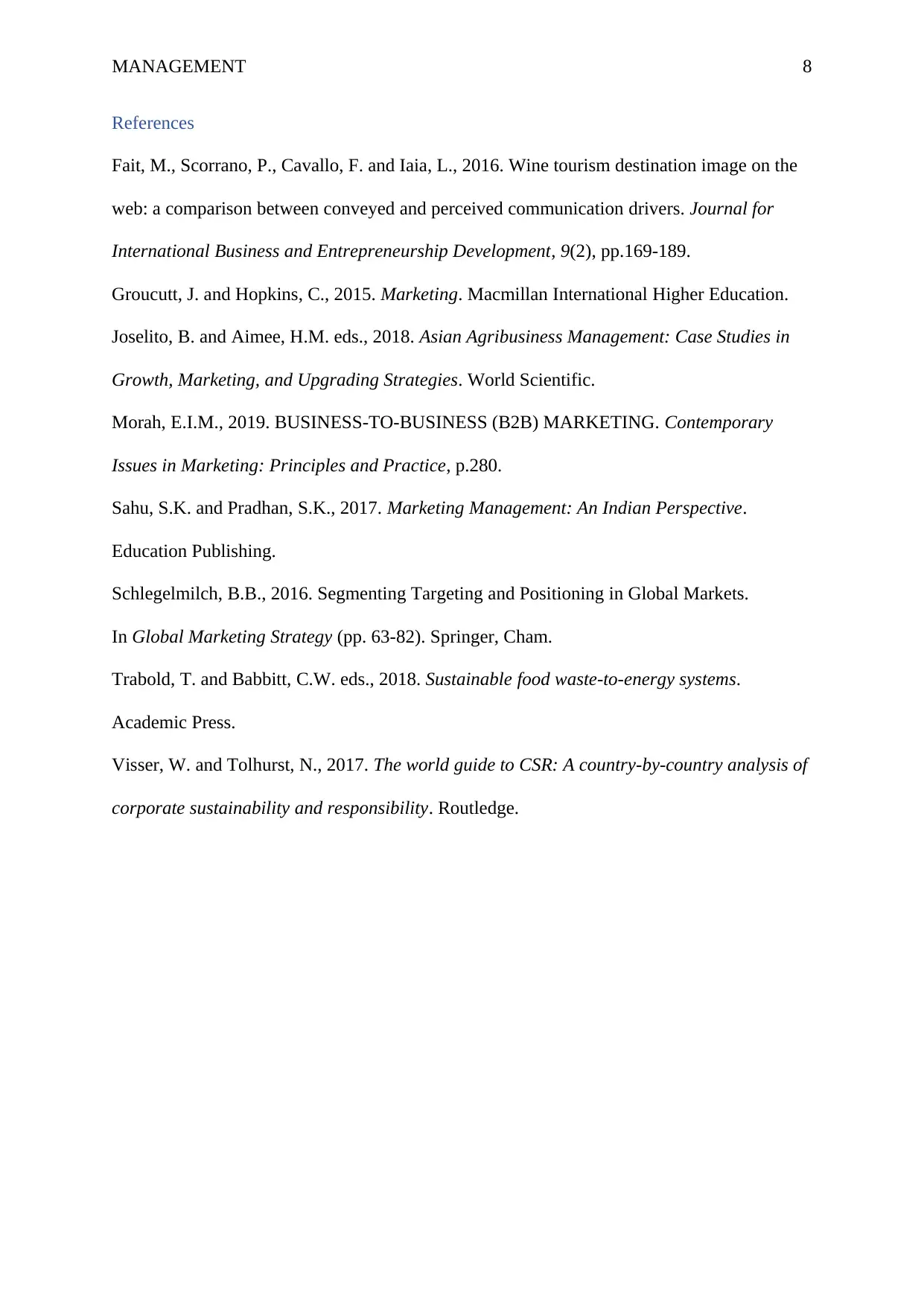
References
Fait, M., Scorrano, P., Cavallo, F. and Iaia, L., 2016. Wine tourism destination image on the
web: a comparison between conveyed and perceived communication drivers. Journal for
International Business and Entrepreneurship Development, 9(2), pp.169-189.
Groucutt, J. and Hopkins, C., 2015. Marketing. Macmillan International Higher Education.
Joselito, B. and Aimee, H.M. eds., 2018. Asian Agribusiness Management: Case Studies in
Growth, Marketing, and Upgrading Strategies. World Scientific.
Morah, E.I.M., 2019. BUSINESS-TO-BUSINESS (B2B) MARKETING. Contemporary
Issues in Marketing: Principles and Practice, p.280.
Sahu, S.K. and Pradhan, S.K., 2017. Marketing Management: An Indian Perspective.
Education Publishing.
Schlegelmilch, B.B., 2016. Segmenting Targeting and Positioning in Global Markets.
In Global Marketing Strategy (pp. 63-82). Springer, Cham.
Trabold, T. and Babbitt, C.W. eds., 2018. Sustainable food waste-to-energy systems.
Academic Press.
Visser, W. and Tolhurst, N., 2017. The world guide to CSR: A country-by-country analysis of
corporate sustainability and responsibility. Routledge.
chevron_up_icon
1 out of 8
circle_padding
hide_on_mobile
zoom_out_icon
[object Object]