Marketing Strategy and Plan: Australian Seafood Industry Analysis
VerifiedAdded on 2020/03/01
|12
|1868
|47
Report
AI Summary
This report provides a comprehensive analysis of the Australian seafood industry, focusing on market influences and strategic planning. It begins with an executive summary and table of contents, followed by an introduction that highlights the global recognition and growth of Australian seafood brands. The study employs PEST and Porter's Five Forces analyses to assess the political, social, economic, and technological factors impacting the industry, as well as the bargaining power of customers and suppliers, threats of new entrants and substitutes, and the level of rivalry. The PEST analysis reveals favorable political support and economic contributions from the seafood export business, but also highlights social and environmental challenges. The Porter's Five Forces analysis indicates high market competition. The report concludes with insights on the industry's sustainability, and references, and an appendix with additional data. The report aims to provide strategic recommendations for the long-term success of the Australian seafood market.
Running head: MARKETING STRATEGY AND PLAN
Marketing Strategy and Plan
Name of the Student:
Name of the University:
Author Note:
Marketing Strategy and Plan
Name of the Student:
Name of the University:
Author Note:
Paraphrase This Document
Need a fresh take? Get an instant paraphrase of this document with our AI Paraphraser

1
MARKETING STRATEGY AND PLAN
Executive Summary
The study provides the structured analysis of the market influence on the Seafood Industry in
Australia. The use of the PEST tool reflects that the political supports and the government
regulations are quite supportive towards the growth of the seafood market. Moreover, it is also
noticed that the seafood export business has contributed to the overall economy of the country.
However, the social obligations and the environmental impacts are quite against the long term
sustainability of seafood sector. The analysis of the five components from Porter’s Five Forces
Tool indicates that the market competition is much higher since there are the increasing demands
of the seafood among the customers. However, the strategic decision making and the
advancements of the technological process would be much beneficial for the industry to ensure
the long term sustainability in the Australian market.
MARKETING STRATEGY AND PLAN
Executive Summary
The study provides the structured analysis of the market influence on the Seafood Industry in
Australia. The use of the PEST tool reflects that the political supports and the government
regulations are quite supportive towards the growth of the seafood market. Moreover, it is also
noticed that the seafood export business has contributed to the overall economy of the country.
However, the social obligations and the environmental impacts are quite against the long term
sustainability of seafood sector. The analysis of the five components from Porter’s Five Forces
Tool indicates that the market competition is much higher since there are the increasing demands
of the seafood among the customers. However, the strategic decision making and the
advancements of the technological process would be much beneficial for the industry to ensure
the long term sustainability in the Australian market.

2
MARKETING STRATEGY AND PLAN
Table of Contents
Introduction......................................................................................................................................3
PEST Analysis.................................................................................................................................3
Porter’s Five Force Analysis...........................................................................................................5
Conclusion.......................................................................................................................................6
References........................................................................................................................................8
Appendix........................................................................................................................................10
MARKETING STRATEGY AND PLAN
Table of Contents
Introduction......................................................................................................................................3
PEST Analysis.................................................................................................................................3
Porter’s Five Force Analysis...........................................................................................................5
Conclusion.......................................................................................................................................6
References........................................................................................................................................8
Appendix........................................................................................................................................10
⊘ This is a preview!⊘
Do you want full access?
Subscribe today to unlock all pages.

Trusted by 1+ million students worldwide

3
MARKETING STRATEGY AND PLAN
Introduction
The seafood brands in Australia are globally recognized and ensuring growth in a
significant way. The country is continuing improvement practices in the fisheries and applying
the most advanced scientific findings. The eco-system based approaches will be undertaken by
the seafood industry to increase the sustainability scope in this competitive environment
(Denham et al. 2015). The popularity of the recreational fishing is the major limitation in the
seafood industry. It has been examined that the other nation producing seafood are utilizing the
most innovative techniques to ensure growth in this sector. Accordingly, the competition is
significantly increasing and it has become the biggest threat for the sustainable purpose of the
seafood industry in Australia (Lim-Camacho et al. 2015). Therefore, the study would provide a
considerable analysis of the seafood industry in Australia. The use of the PESTLE Tool and the
Porter’s Five Forces analysis would suggest the insightful ideas about the seafood market to
measure the capability of sustaining in this competitive scenario.
PEST Analysis
Establishment of the detailed business analysis by identifying the political, social,
economical, and technological influence on the industry is much beneficial for developing the
understanding (Dentoni and Klerkx 2015). The study focuses on the market acceptability of the
seafood in Australia. The development of the PEST analysis would provide the enriched ideas
about the subject matter.
Political Influence
MARKETING STRATEGY AND PLAN
Introduction
The seafood brands in Australia are globally recognized and ensuring growth in a
significant way. The country is continuing improvement practices in the fisheries and applying
the most advanced scientific findings. The eco-system based approaches will be undertaken by
the seafood industry to increase the sustainability scope in this competitive environment
(Denham et al. 2015). The popularity of the recreational fishing is the major limitation in the
seafood industry. It has been examined that the other nation producing seafood are utilizing the
most innovative techniques to ensure growth in this sector. Accordingly, the competition is
significantly increasing and it has become the biggest threat for the sustainable purpose of the
seafood industry in Australia (Lim-Camacho et al. 2015). Therefore, the study would provide a
considerable analysis of the seafood industry in Australia. The use of the PESTLE Tool and the
Porter’s Five Forces analysis would suggest the insightful ideas about the seafood market to
measure the capability of sustaining in this competitive scenario.
PEST Analysis
Establishment of the detailed business analysis by identifying the political, social,
economical, and technological influence on the industry is much beneficial for developing the
understanding (Dentoni and Klerkx 2015). The study focuses on the market acceptability of the
seafood in Australia. The development of the PEST analysis would provide the enriched ideas
about the subject matter.
Political Influence
Paraphrase This Document
Need a fresh take? Get an instant paraphrase of this document with our AI Paraphraser

4
MARKETING STRATEGY AND PLAN
The political scenario in Australia is quite favourable for the seafood sector development.
It is notified that The Australian Seafood Industry Council (ASIC) is considered as the main
parliamentary figure supporting the commercial fishing, and poor-harvest seafood industry in
Australia. The seafood industry in Australia generates the majority portion of the export
earnings, especially in the regional areas of Australia (Lamendin, Miller and Ward 2015).
Moreover, it has captured the fourth largest position in the list of the Primary Industry in
Australia. The efficiency maintained in the export market is highly supported by the political
figures. In fact, the government is looking forward to bring more innovations to the fishery
practices to ensure growth in the seafood sector in Australia (Agriculture.gov.au 2017).
Social Influence
The social factor has the greater influence on the growth of the seafood market. Majority
of the society oppose the practices of fishing since it harms the sea animals. Some of the fishing
areas are protected (Ibisworld.com.au 2017). However, in one type of social class, the demands
of the seafood are still much higher. Therefore, it can be considered that the social influence is
the considerable factor for the sustainability aspect of the seafood industry in Australia.
Economic Influence
It is reported that the country is generating more revenues from the export business of the
seafood. It can be estimated that the millions of revenue can be generated in next few years from
the export services of the sea food. The Australian Bureau of Agriculture and Resource
Economics and Science has presented the report that signifies the significant growth in the
economic level of the country (Ccpit.org 2017). Hence, the economic opportunities are quite
MARKETING STRATEGY AND PLAN
The political scenario in Australia is quite favourable for the seafood sector development.
It is notified that The Australian Seafood Industry Council (ASIC) is considered as the main
parliamentary figure supporting the commercial fishing, and poor-harvest seafood industry in
Australia. The seafood industry in Australia generates the majority portion of the export
earnings, especially in the regional areas of Australia (Lamendin, Miller and Ward 2015).
Moreover, it has captured the fourth largest position in the list of the Primary Industry in
Australia. The efficiency maintained in the export market is highly supported by the political
figures. In fact, the government is looking forward to bring more innovations to the fishery
practices to ensure growth in the seafood sector in Australia (Agriculture.gov.au 2017).
Social Influence
The social factor has the greater influence on the growth of the seafood market. Majority
of the society oppose the practices of fishing since it harms the sea animals. Some of the fishing
areas are protected (Ibisworld.com.au 2017). However, in one type of social class, the demands
of the seafood are still much higher. Therefore, it can be considered that the social influence is
the considerable factor for the sustainability aspect of the seafood industry in Australia.
Economic Influence
It is reported that the country is generating more revenues from the export business of the
seafood. It can be estimated that the millions of revenue can be generated in next few years from
the export services of the sea food. The Australian Bureau of Agriculture and Resource
Economics and Science has presented the report that signifies the significant growth in the
economic level of the country (Ccpit.org 2017). Hence, the economic opportunities are quite

5
MARKETING STRATEGY AND PLAN
commendable for the industry sustainability. However, the legal protection on the fishery
business may affect the economic level of the country.
Technological Influence
The seafood industry in Australia has been receiving the supports from the government
for using the advanced technologies for improving the fishing practices (Lamendin, Miller and
Ward 2015). Moreover, considering the environmental welfare purposes, the seafood industry is
also concentrating on utilizing more technological tools to bring more innovations to the seafood
cultures and industry.
Porter’s Five Force Analysis
The analytical tool of Michael Porter’s five force model is much helpful in analyzing the
external market opportunities and threats. This analytical tool contains five major components
that have the significant impact on the business industry. The five force analysis of the
Australian Seafood industry is discussed further:
Bargaining Power of the Customers (Moderate)
The customers are quite fond of consuming the seafood in Australia that has the
significant value in the export market. However, the environmental obligation and social
prevention are also limiting the consumption of the seafood (Dentoni and Klerkx 2015). The
considerable high prices of the seafood are also affecting the consumer behaviour. Hence, the
bargaining power of the customers is moderate.
Bargaining Power of the Suppliers (High)
MARKETING STRATEGY AND PLAN
commendable for the industry sustainability. However, the legal protection on the fishery
business may affect the economic level of the country.
Technological Influence
The seafood industry in Australia has been receiving the supports from the government
for using the advanced technologies for improving the fishing practices (Lamendin, Miller and
Ward 2015). Moreover, considering the environmental welfare purposes, the seafood industry is
also concentrating on utilizing more technological tools to bring more innovations to the seafood
cultures and industry.
Porter’s Five Force Analysis
The analytical tool of Michael Porter’s five force model is much helpful in analyzing the
external market opportunities and threats. This analytical tool contains five major components
that have the significant impact on the business industry. The five force analysis of the
Australian Seafood industry is discussed further:
Bargaining Power of the Customers (Moderate)
The customers are quite fond of consuming the seafood in Australia that has the
significant value in the export market. However, the environmental obligation and social
prevention are also limiting the consumption of the seafood (Dentoni and Klerkx 2015). The
considerable high prices of the seafood are also affecting the consumer behaviour. Hence, the
bargaining power of the customers is moderate.
Bargaining Power of the Suppliers (High)
⊘ This is a preview!⊘
Do you want full access?
Subscribe today to unlock all pages.

Trusted by 1+ million students worldwide

6
MARKETING STRATEGY AND PLAN
The availability of the limited options of the suppliers has made the bargaining power if
the suppliers quite higher (Agriculture.gov.au 2017). The trends with the fishery market are quite
profitable for the suppliers to generate more amount of money.
Threats of New Entrants (low)
The legal compilation rules on the fishery market and the environmental impact has made
the threats of the new entrants considerably lower (Lamendin, Miller and Ward 2015). The
dominant market of the local fisheries is developing the market status in the seafood industry.
Threats of Substitutes (Moderate)
The customers in Australia prefer the more variations and fascination in their food
culture. On the other hand, the demands of the sea food are also quite higher. Hence, the threats
of the substitutes are quite moderate (Dentoni and Klerkx 2015).
Rivalry (High)
The competition in the sea food market is quite high. The development of the
technological practices and the fishery techniques is improving the position of the seafood
makers. Hence, the competitive rivalry is quite higher in Australian market (Agriculture.gov.au
2017).
Conclusion
The study provides the insightful ideas about the external market influence on the
Seafood Industry in Australia. The PEST analysis indicates that in spite of the enormous
supports from the government, the Seafood industry has been facing the obligations from the
MARKETING STRATEGY AND PLAN
The availability of the limited options of the suppliers has made the bargaining power if
the suppliers quite higher (Agriculture.gov.au 2017). The trends with the fishery market are quite
profitable for the suppliers to generate more amount of money.
Threats of New Entrants (low)
The legal compilation rules on the fishery market and the environmental impact has made
the threats of the new entrants considerably lower (Lamendin, Miller and Ward 2015). The
dominant market of the local fisheries is developing the market status in the seafood industry.
Threats of Substitutes (Moderate)
The customers in Australia prefer the more variations and fascination in their food
culture. On the other hand, the demands of the sea food are also quite higher. Hence, the threats
of the substitutes are quite moderate (Dentoni and Klerkx 2015).
Rivalry (High)
The competition in the sea food market is quite high. The development of the
technological practices and the fishery techniques is improving the position of the seafood
makers. Hence, the competitive rivalry is quite higher in Australian market (Agriculture.gov.au
2017).
Conclusion
The study provides the insightful ideas about the external market influence on the
Seafood Industry in Australia. The PEST analysis indicates that in spite of the enormous
supports from the government, the Seafood industry has been facing the obligations from the
Paraphrase This Document
Need a fresh take? Get an instant paraphrase of this document with our AI Paraphraser

7
MARKETING STRATEGY AND PLAN
environment. The society objects since the lives of the water animals are harmed. On the other
hand, it is also implied that the seafood industry signifies considerable benefits in export
industry. The remarkable revenues gained from the export business of seafood are contributing to
the economic growth of the business in the country. The information derived from the porter’s
five forces analysis indicates that the competition in the market is much higher whereas the
customers are quite conscious about the lives of the sea animals. However, technological
development and concerns about the environmental welfare would be helpful for the seafood
industry to sustain the long term positioning.
MARKETING STRATEGY AND PLAN
environment. The society objects since the lives of the water animals are harmed. On the other
hand, it is also implied that the seafood industry signifies considerable benefits in export
industry. The remarkable revenues gained from the export business of seafood are contributing to
the economic growth of the business in the country. The information derived from the porter’s
five forces analysis indicates that the competition in the market is much higher whereas the
customers are quite conscious about the lives of the sea animals. However, technological
development and concerns about the environmental welfare would be helpful for the seafood
industry to sustain the long term positioning.

8
MARKETING STRATEGY AND PLAN
References
Agriculture.gov.au, 2017. [online] Available at:
<http://www.agriculture.gov.au/SiteCollectionDocuments/fisheries/aus-seafood-trade.pdf>
[Accessed 21 Aug. 2017].
Ccpit.org, 2017. [online] Available at:
<http://aaa.ccpit.org/Category7/mAttachment/2006/Dec/13/asset000070002007202file1.pdf>
[Accessed 21 Aug. 2017].
Denham, F.C., Howieson, J.R., Solah, V.A. and Biswas, W.K., 2015. Environmental supply
chain management in the seafood industry: past, present and future approaches. Journal of
cleaner production, 90, pp.82-90.
Dentoni, D. and Klerkx, L., 2015. Co-managing public research in Australian fisheries through
convergence–divergence processes. Marine Policy, 60, pp.259-271.
Ibisworld.com.au, 2017. Seafood Processing in Australia Market Research | IBISWorld. [online]
Ibisworld.com.au. Available at: <https://www.ibisworld.com.au/industry-trends/market-research-
reports/manufacturing/food-product/seafood-processing.html> [Accessed 21 Aug. 2017].
Lamendin, R., Miller, K. and Ward, R.D., 2015. Labelling accuracy in Tasmanian seafood: an
investigation using DNA barcoding. Food Control, 47, pp.436-443.
Lim-Camacho, L., Hobday, A.J., Bustamante, R.H., Farmery, A., Fleming, A., Frusher, S.,
Green, B.S., Norman-López, A., Pecl, G.T., Plagányi, É.E. and Schrobback, P., 2015. Facing the
MARKETING STRATEGY AND PLAN
References
Agriculture.gov.au, 2017. [online] Available at:
<http://www.agriculture.gov.au/SiteCollectionDocuments/fisheries/aus-seafood-trade.pdf>
[Accessed 21 Aug. 2017].
Ccpit.org, 2017. [online] Available at:
<http://aaa.ccpit.org/Category7/mAttachment/2006/Dec/13/asset000070002007202file1.pdf>
[Accessed 21 Aug. 2017].
Denham, F.C., Howieson, J.R., Solah, V.A. and Biswas, W.K., 2015. Environmental supply
chain management in the seafood industry: past, present and future approaches. Journal of
cleaner production, 90, pp.82-90.
Dentoni, D. and Klerkx, L., 2015. Co-managing public research in Australian fisheries through
convergence–divergence processes. Marine Policy, 60, pp.259-271.
Ibisworld.com.au, 2017. Seafood Processing in Australia Market Research | IBISWorld. [online]
Ibisworld.com.au. Available at: <https://www.ibisworld.com.au/industry-trends/market-research-
reports/manufacturing/food-product/seafood-processing.html> [Accessed 21 Aug. 2017].
Lamendin, R., Miller, K. and Ward, R.D., 2015. Labelling accuracy in Tasmanian seafood: an
investigation using DNA barcoding. Food Control, 47, pp.436-443.
Lim-Camacho, L., Hobday, A.J., Bustamante, R.H., Farmery, A., Fleming, A., Frusher, S.,
Green, B.S., Norman-López, A., Pecl, G.T., Plagányi, É.E. and Schrobback, P., 2015. Facing the
⊘ This is a preview!⊘
Do you want full access?
Subscribe today to unlock all pages.

Trusted by 1+ million students worldwide

9
MARKETING STRATEGY AND PLAN
wave of change: stakeholder perspectives on climate adaptation for Australian seafood supply
chains. Regional Environmental Change, 15(4), pp.595-606.
Sydneyfishmarket.com.au, 2017. [online] Available at:
<http://www.sydneyfishmarket.com.au/Portals/0/Deloitte%20Report%201_1.pdf> [Accessed 21
Aug. 2017].
MARKETING STRATEGY AND PLAN
wave of change: stakeholder perspectives on climate adaptation for Australian seafood supply
chains. Regional Environmental Change, 15(4), pp.595-606.
Sydneyfishmarket.com.au, 2017. [online] Available at:
<http://www.sydneyfishmarket.com.au/Portals/0/Deloitte%20Report%201_1.pdf> [Accessed 21
Aug. 2017].
Paraphrase This Document
Need a fresh take? Get an instant paraphrase of this document with our AI Paraphraser

10
MARKETING STRATEGY AND PLAN
Appendix
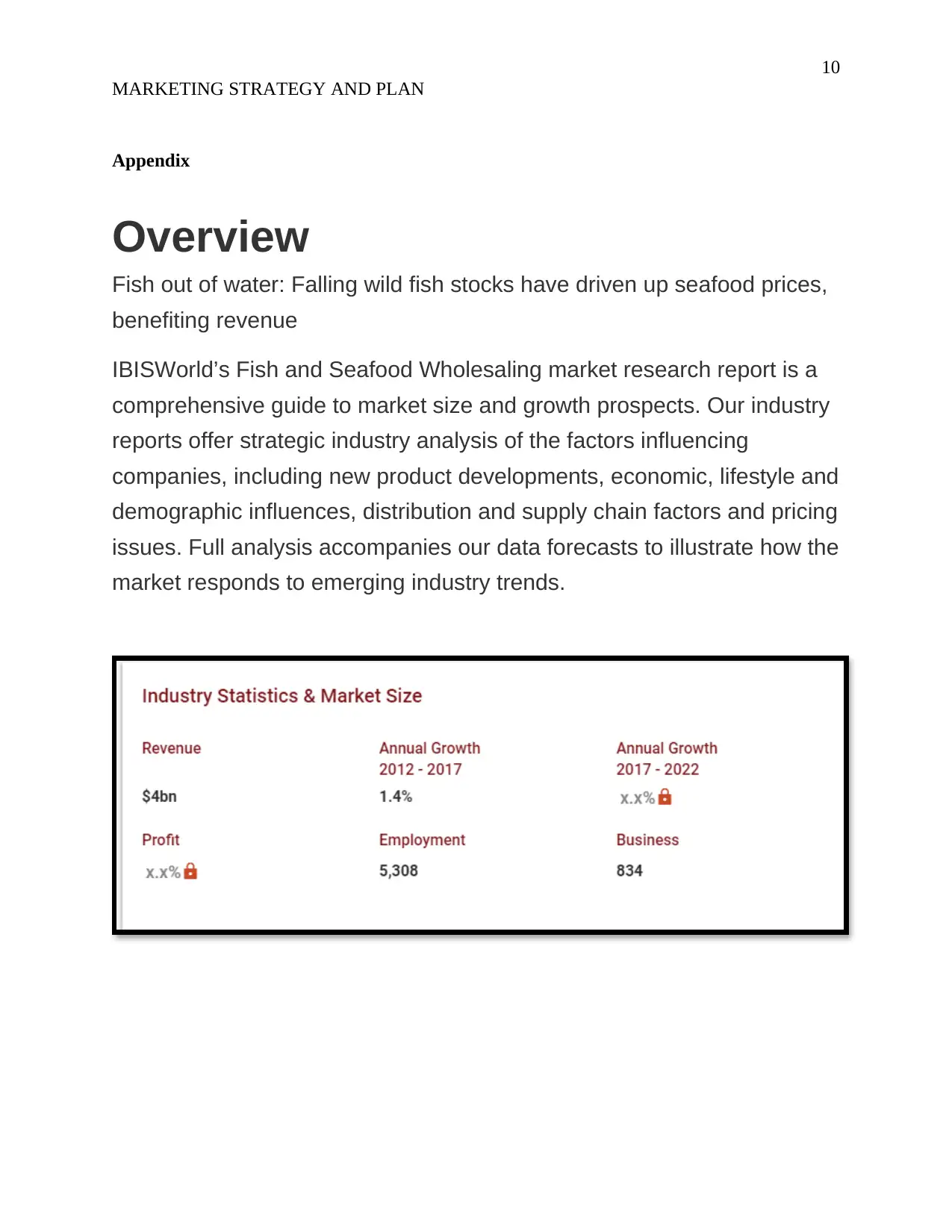
Overview
Fish out of water: Falling wild fish stocks have driven up seafood prices,
benefiting revenue
IBISWorld’s Fish and Seafood Wholesaling market research report is a
comprehensive guide to market size and growth prospects. Our industry
reports offer strategic industry analysis of the factors influencing
companies, including new product developments, economic, lifestyle and
demographic influences, distribution and supply chain factors and pricing
issues. Full analysis accompanies our data forecasts to illustrate how the
market responds to emerging industry trends.
MARKETING STRATEGY AND PLAN
Appendix
Overview
Fish out of water: Falling wild fish stocks have driven up seafood prices,
benefiting revenue
IBISWorld’s Fish and Seafood Wholesaling market research report is a
comprehensive guide to market size and growth prospects. Our industry
reports offer strategic industry analysis of the factors influencing
companies, including new product developments, economic, lifestyle and
demographic influences, distribution and supply chain factors and pricing
issues. Full analysis accompanies our data forecasts to illustrate how the
market responds to emerging industry trends.

11
MARKETING STRATEGY AND PLAN
Industry Analysis & Industry
Trends
The Fish and Seafood Wholesaling industry has performed modestly
over the past five years. Increased disposable incomes and rising health
consciousness have boosted seafood consumption over the past five
years. Growing seafood consumption, coupled with the rise of domestic
fish and seafood prices, has supported industry growth over this period.
However, demand for wholesale services from supermarkets, which are
key downstream customers, has declined over the past five years due to
wholesale bypass. The major supermarkets, Coles and Woolworths, are
increasingly purchasing directly from vertically-integrated fish and
seafood operators to gain greater control over their supply chains and
reduce costs. Weakened demand from supermarkets has limited
revenue growth over the past five years...
Source Link: https://www.ibisworld.com.au/industry-trends/market-research-reports/
wholesale-trade/grocery-liquor-tobacco-product-wholesaling/fish-seafood-wholesaling.html
MARKETING STRATEGY AND PLAN
Industry Analysis & Industry
Trends
The Fish and Seafood Wholesaling industry has performed modestly
over the past five years. Increased disposable incomes and rising health
consciousness have boosted seafood consumption over the past five
years. Growing seafood consumption, coupled with the rise of domestic
fish and seafood prices, has supported industry growth over this period.
However, demand for wholesale services from supermarkets, which are
key downstream customers, has declined over the past five years due to
wholesale bypass. The major supermarkets, Coles and Woolworths, are
increasingly purchasing directly from vertically-integrated fish and
seafood operators to gain greater control over their supply chains and
reduce costs. Weakened demand from supermarkets has limited
revenue growth over the past five years...
Source Link: https://www.ibisworld.com.au/industry-trends/market-research-reports/
wholesale-trade/grocery-liquor-tobacco-product-wholesaling/fish-seafood-wholesaling.html
⊘ This is a preview!⊘
Do you want full access?
Subscribe today to unlock all pages.

Trusted by 1+ million students worldwide
1 out of 12
Related Documents
Your All-in-One AI-Powered Toolkit for Academic Success.
+13062052269
info@desklib.com
Available 24*7 on WhatsApp / Email
Unlock your academic potential
Copyright © 2020–2026 A2Z Services. All Rights Reserved. Developed and managed by ZUCOL.