Detailed Analysis: The Role of Marketing in Modern Organisations
VerifiedAdded on 2021/08/16
|10
|2504
|42
Report
AI Summary
This report delves into the crucial role of marketing within organizations, providing a comprehensive overview of its core aspects and strategic importance. It defines marketing as the process of creating, capturing, communicating, delivering, and exchanging value for customers, clients, partners, and society. The report examines key elements such as customer needs, product development, pricing strategies, distribution (place), and promotional activities. It highlights the importance of market research, outlining the research process, data collection methods (including primary and secondary data), and the significance of problem definition. Furthermore, the report explores various marketing orientations (product, sales, and customer), the impact of marketing on stakeholders, and the importance of branding, including brand equity, awareness, associations, and loyalty. It also touches on product decisions, brand extensions, and the unique aspects of services marketing, emphasizing the value of intangible offerings and customer service. Overall, the report underscores how marketing enriches society and can be entrepreneurial, providing insights that are essential for business success and customer satisfaction.
The Role of Marketing in Organisations
What is Marketing?
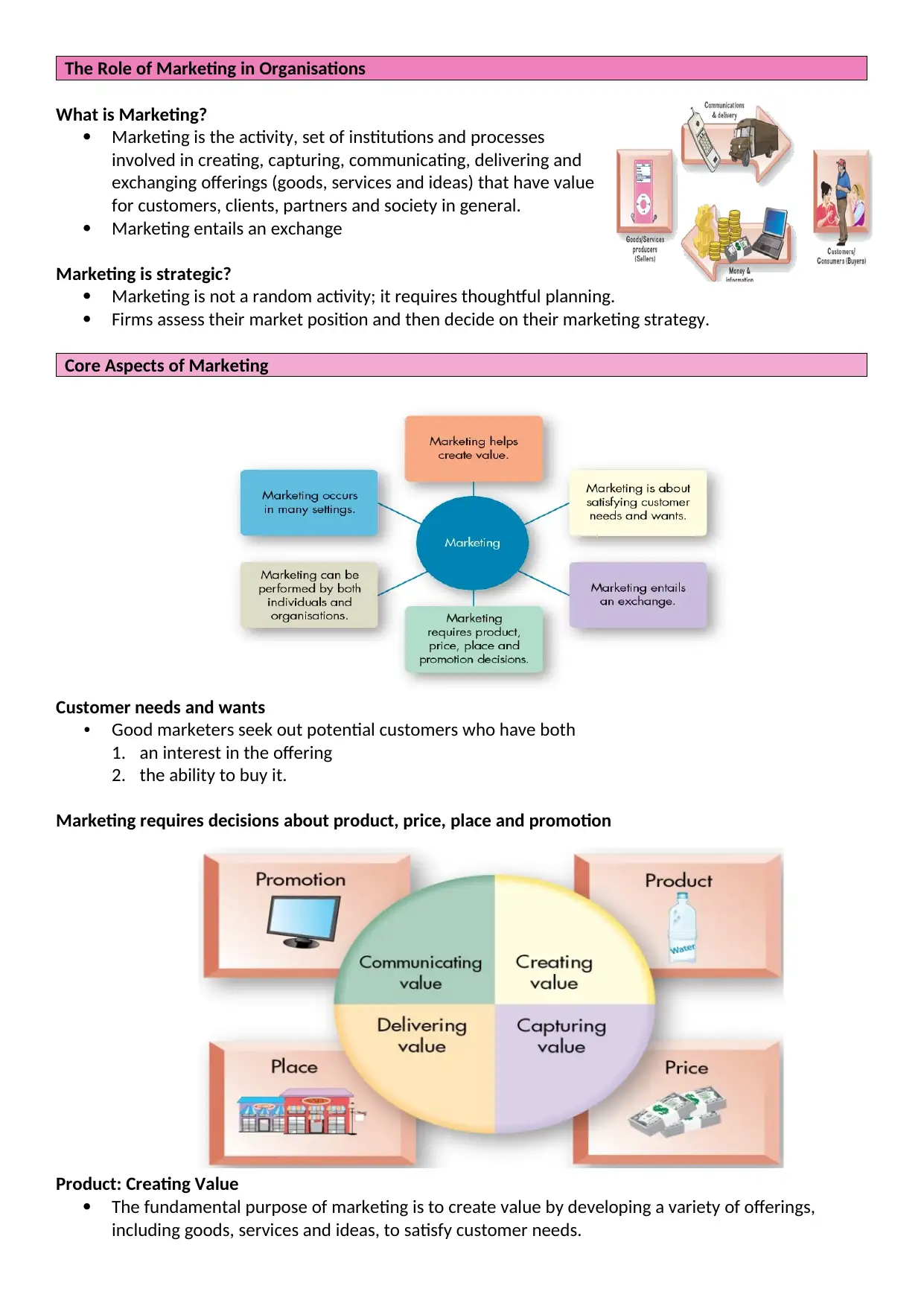
Marketing is the activity, set of institutions and processes
involved in creating, capturing, communicating, delivering and
exchanging offerings (goods, services and ideas) that have value
for customers, clients, partners and society in general.
Marketing entails an exchange
Marketing is strategic?
Marketing is not a random activity; it requires thoughtful planning.
Firms assess their market position and then decide on their marketing strategy.
Core Aspects of Marketing
Customer needs and wants
• Good marketers seek out potential customers who have both
1. an interest in the offering
2. the ability to buy it.
Marketing requires decisions about product, price, place and promotion
Product: Creating Value
The fundamental purpose of marketing is to create value by developing a variety of offerings,
including goods, services and ideas, to satisfy customer needs.
What is Marketing?
Marketing is the activity, set of institutions and processes
involved in creating, capturing, communicating, delivering and
exchanging offerings (goods, services and ideas) that have value
for customers, clients, partners and society in general.
Marketing entails an exchange
Marketing is strategic?
Marketing is not a random activity; it requires thoughtful planning.
Firms assess their market position and then decide on their marketing strategy.
Core Aspects of Marketing
Customer needs and wants
• Good marketers seek out potential customers who have both
1. an interest in the offering
2. the ability to buy it.
Marketing requires decisions about product, price, place and promotion
Product: Creating Value
The fundamental purpose of marketing is to create value by developing a variety of offerings,
including goods, services and ideas, to satisfy customer needs.

Paraphrase This Document
Need a fresh take? Get an instant paraphrase of this document with our AI Paraphraser
Goods, Services and Ideas:
- A Pink concert is a service.
- A Pink T-shirt purchased at the concert is a good.
- The possibility of getting the T-shirt signed by Pink is an idea.
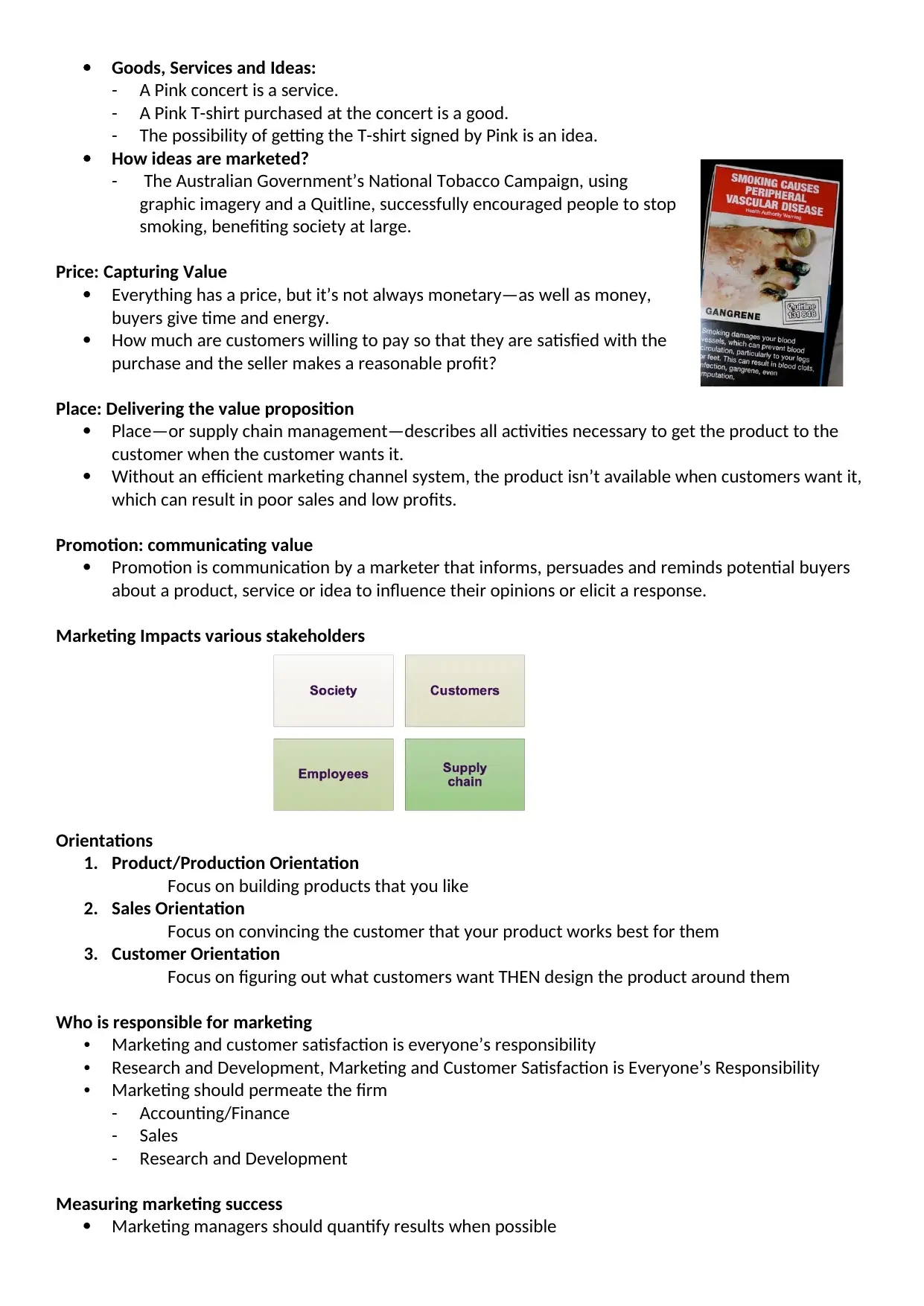
How ideas are marketed?
- The Australian Government’s National Tobacco Campaign, using
graphic imagery and a Quitline, successfully encouraged people to stop
smoking, benefiting society at large.
Price: Capturing Value
Everything has a price, but it’s not always monetary—as well as money,
buyers give time and energy.
How much are customers willing to pay so that they are satisfied with the
purchase and the seller makes a reasonable profit?
Place: Delivering the value proposition
Place—or supply chain management—describes all activities necessary to get the product to the
customer when the customer wants it.
Without an efficient marketing channel system, the product isn’t available when customers want it,
which can result in poor sales and low profits.
Promotion: communicating value
Promotion is communication by a marketer that informs, persuades and reminds potential buyers
about a product, service or idea to influence their opinions or elicit a response.
Marketing Impacts various stakeholders
Orientations
1. Product/Production Orientation
Focus on building products that you like
2. Sales Orientation
Focus on convincing the customer that your product works best for them
3. Customer Orientation
Focus on figuring out what customers want THEN design the product around them
Who is responsible for marketing
• Marketing and customer satisfaction is everyone’s responsibility
• Research and Development, Marketing and Customer Satisfaction is Everyone’s Responsibility
• Marketing should permeate the firm
- Accounting/Finance
- Sales
- Research and Development
Measuring marketing success
Marketing managers should quantify results when possible
- A Pink concert is a service.
- A Pink T-shirt purchased at the concert is a good.
- The possibility of getting the T-shirt signed by Pink is an idea.
How ideas are marketed?
- The Australian Government’s National Tobacco Campaign, using
graphic imagery and a Quitline, successfully encouraged people to stop
smoking, benefiting society at large.
Price: Capturing Value
Everything has a price, but it’s not always monetary—as well as money,
buyers give time and energy.
How much are customers willing to pay so that they are satisfied with the
purchase and the seller makes a reasonable profit?
Place: Delivering the value proposition
Place—or supply chain management—describes all activities necessary to get the product to the
customer when the customer wants it.
Without an efficient marketing channel system, the product isn’t available when customers want it,
which can result in poor sales and low profits.
Promotion: communicating value
Promotion is communication by a marketer that informs, persuades and reminds potential buyers
about a product, service or idea to influence their opinions or elicit a response.
Marketing Impacts various stakeholders
Orientations
1. Product/Production Orientation
Focus on building products that you like
2. Sales Orientation
Focus on convincing the customer that your product works best for them
3. Customer Orientation
Focus on figuring out what customers want THEN design the product around them
Who is responsible for marketing
• Marketing and customer satisfaction is everyone’s responsibility
• Research and Development, Marketing and Customer Satisfaction is Everyone’s Responsibility
• Marketing should permeate the firm
- Accounting/Finance
- Sales
- Research and Development
Measuring marketing success
Marketing managers should quantify results when possible
Sometimes the effectiveness of marketing programs is easy to quantify e. g.
1. Did the rebate coupon promotion lift sales? Measure the percentage sales increase, etc.
2. Did the direct mail campaign increase web usage? Measure the number of web visits, etc.
Why is marketing important
Marketing enriches society
All the top companies focus on a broader range of
considerations than just financial profitability.
Good corporate citizenship could include:
o Greener products
o Healthier food options
o Safer products
o Reduced carbon footprint
Marketing can be entrepreneurial
Entrepreneurs organise, operate and assume the
risk of a business venture that aims to satisfy
unfulfilled needs.
For example:
• OzHarvest
• Magic Millions
• TPG.
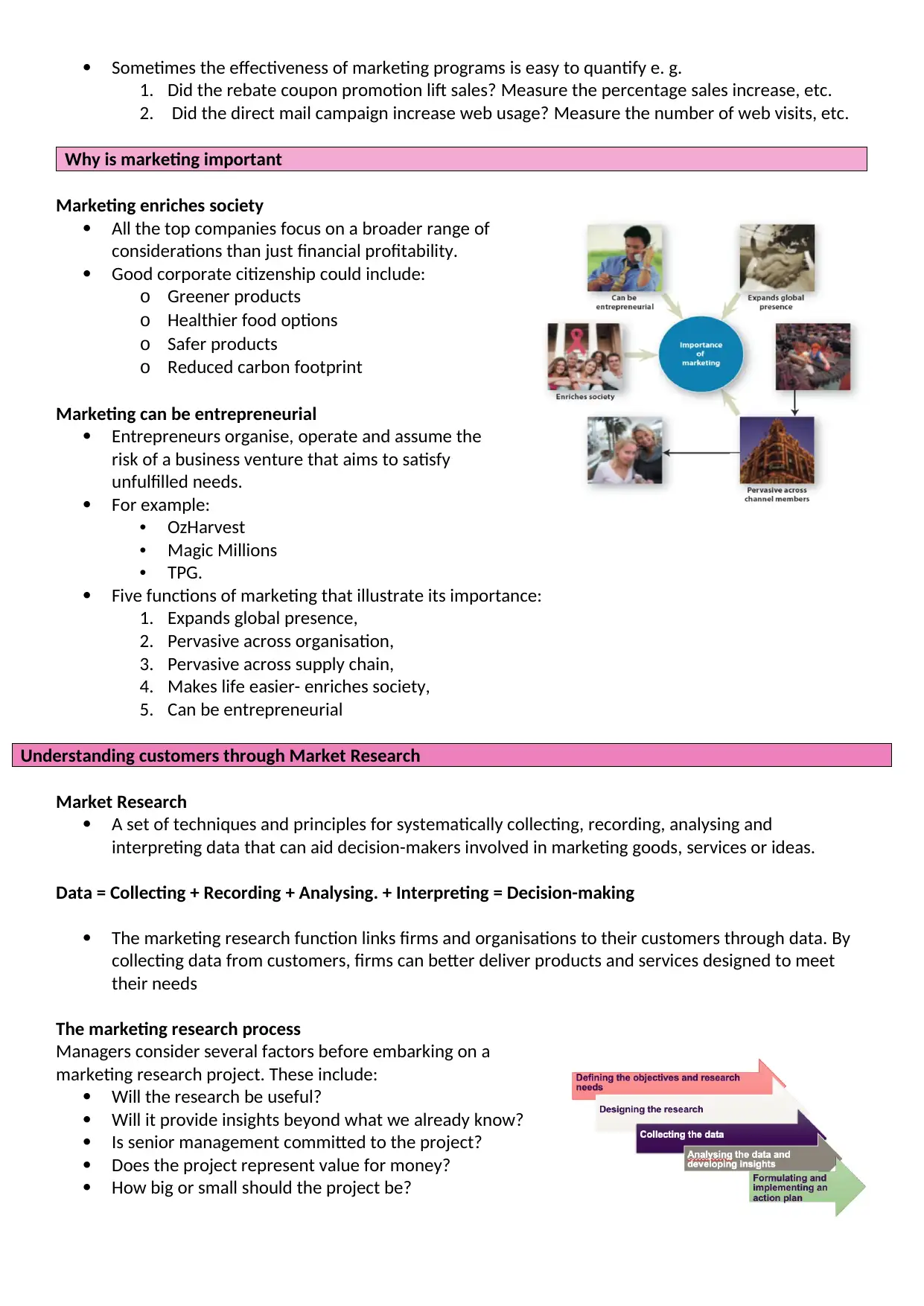
Five functions of marketing that illustrate its importance:
1. Expands global presence,
2. Pervasive across organisation,
3. Pervasive across supply chain,
4. Makes life easier- enriches society,
5. Can be entrepreneurial
Understanding customers through Market Research
Market Research
A set of techniques and principles for systematically collecting, recording, analysing and
interpreting data that can aid decision-makers involved in marketing goods, services or ideas.
Data = Collecting + Recording + Analysing. + Interpreting = Decision-making
The marketing research function links firms and organisations to their customers through data. By
collecting data from customers, firms can better deliver products and services designed to meet
their needs
The marketing research process
Managers consider several factors before embarking on a
marketing research project. These include:
Will the research be useful?
Will it provide insights beyond what we already know?
Is senior management committed to the project?
Does the project represent value for money?
How big or small should the project be?
1. Did the rebate coupon promotion lift sales? Measure the percentage sales increase, etc.
2. Did the direct mail campaign increase web usage? Measure the number of web visits, etc.
Why is marketing important
Marketing enriches society
All the top companies focus on a broader range of
considerations than just financial profitability.
Good corporate citizenship could include:
o Greener products
o Healthier food options
o Safer products
o Reduced carbon footprint
Marketing can be entrepreneurial
Entrepreneurs organise, operate and assume the
risk of a business venture that aims to satisfy
unfulfilled needs.
For example:
• OzHarvest
• Magic Millions
• TPG.
Five functions of marketing that illustrate its importance:
1. Expands global presence,
2. Pervasive across organisation,
3. Pervasive across supply chain,
4. Makes life easier- enriches society,
5. Can be entrepreneurial
Understanding customers through Market Research
Market Research
A set of techniques and principles for systematically collecting, recording, analysing and
interpreting data that can aid decision-makers involved in marketing goods, services or ideas.
Data = Collecting + Recording + Analysing. + Interpreting = Decision-making
The marketing research function links firms and organisations to their customers through data. By
collecting data from customers, firms can better deliver products and services designed to meet
their needs
The marketing research process
Managers consider several factors before embarking on a
marketing research project. These include:
Will the research be useful?
Will it provide insights beyond what we already know?
Is senior management committed to the project?
Does the project represent value for money?
How big or small should the project be?
⊘ This is a preview!⊘
Do you want full access?
Subscribe today to unlock all pages.

Trusted by 1+ million students worldwide
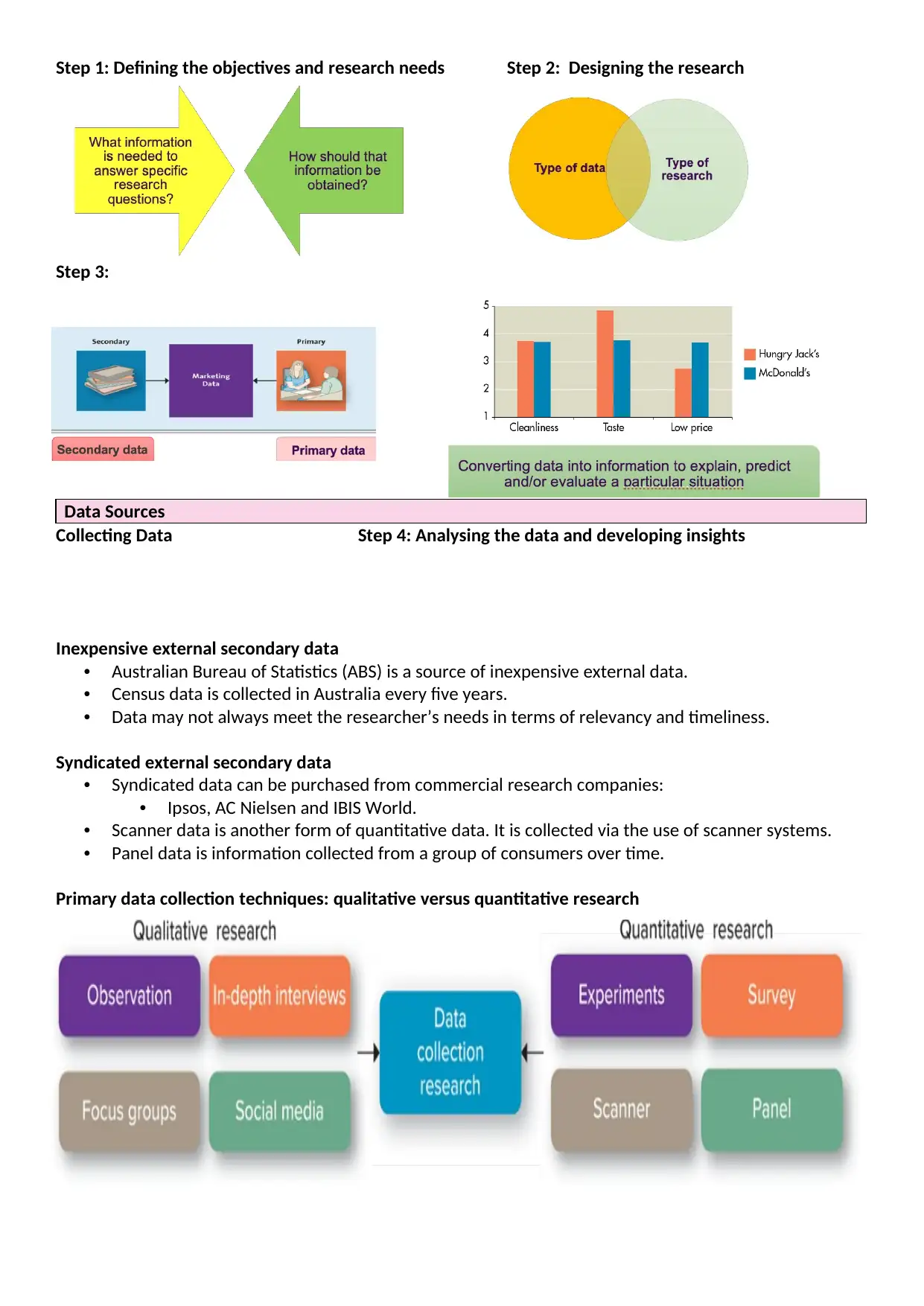
Step 1: Defining the objectives and research needs Step 2: Designing the research
Step 3:
Data Sources
Collecting Data Step 4: Analysing the data and developing insights
Inexpensive external secondary data
• Australian Bureau of Statistics (ABS) is a source of inexpensive external data.
• Census data is collected in Australia every five years.
• Data may not always meet the researcher’s needs in terms of relevancy and timeliness.
Syndicated external secondary data
• Syndicated data can be purchased from commercial research companies:
• Ipsos, AC Nielsen and IBIS World.
• Scanner data is another form of quantitative data. It is collected via the use of scanner systems.
• Panel data is information collected from a group of consumers over time.
Primary data collection techniques: qualitative versus quantitative research
Step 3:
Data Sources
Collecting Data Step 4: Analysing the data and developing insights
Inexpensive external secondary data
• Australian Bureau of Statistics (ABS) is a source of inexpensive external data.
• Census data is collected in Australia every five years.
• Data may not always meet the researcher’s needs in terms of relevancy and timeliness.
Syndicated external secondary data
• Syndicated data can be purchased from commercial research companies:
• Ipsos, AC Nielsen and IBIS World.
• Scanner data is another form of quantitative data. It is collected via the use of scanner systems.
• Panel data is information collected from a group of consumers over time.
Primary data collection techniques: qualitative versus quantitative research
Paraphrase This Document
Need a fresh take? Get an instant paraphrase of this document with our AI Paraphraser
Quantitative Research
• Qty R consists of structured responses that can be statistically tested.
• Once the firm has gained insights from doing qualitative research, it is likely to engage in
quantitative research, which consists of structured responses that can be statistically tested.
• Quantitative research provides information needed to confirm insights and hypotheses generated
via qualitative research or secondary data.
• Formal studies such as specific experiments, surveys, scanner and panel data (or some combination
of these) are quantitative in nature.
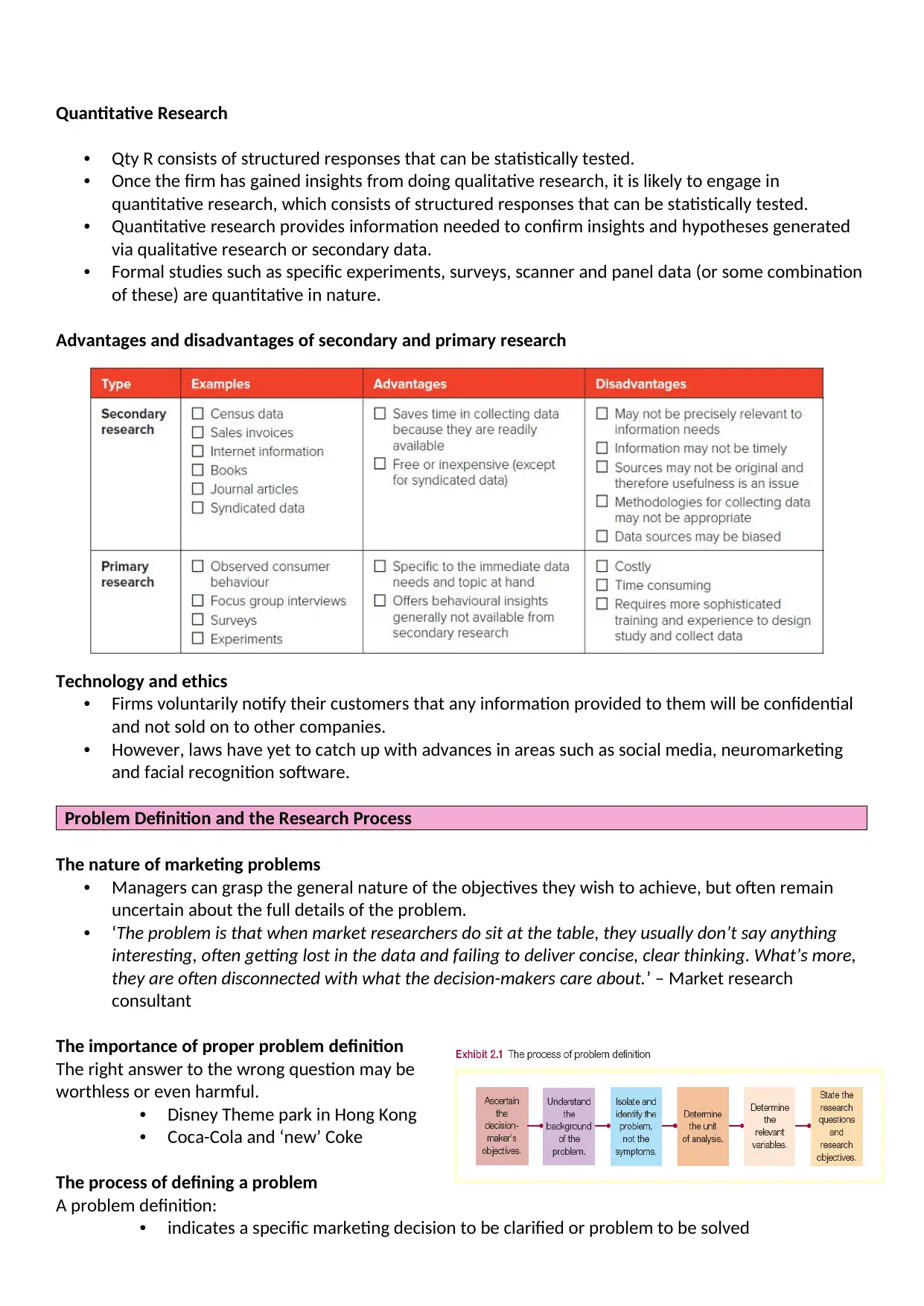
Advantages and disadvantages of secondary and primary research
Technology and ethics
• Firms voluntarily notify their customers that any information provided to them will be confidential
and not sold on to other companies.
• However, laws have yet to catch up with advances in areas such as social media, neuromarketing
and facial recognition software.
Problem Definition and the Research Process
The nature of marketing problems
• Managers can grasp the general nature of the objectives they wish to achieve, but often remain
uncertain about the full details of the problem.
• ‘The problem is that when market researchers do sit at the table, they usually don’t say anything
interesting, often getting lost in the data and failing to deliver concise, clear thinking. What’s more,
they are often disconnected with what the decision-makers care about.’ – Market research
consultant
The importance of proper problem definition
The right answer to the wrong question may be
worthless or even harmful.
• Disney Theme park in Hong Kong
• Coca-Cola and ‘new’ Coke
The process of defining a problem
A problem definition:
• indicates a specific marketing decision to be clarified or problem to be solved
• Qty R consists of structured responses that can be statistically tested.
• Once the firm has gained insights from doing qualitative research, it is likely to engage in
quantitative research, which consists of structured responses that can be statistically tested.
• Quantitative research provides information needed to confirm insights and hypotheses generated
via qualitative research or secondary data.
• Formal studies such as specific experiments, surveys, scanner and panel data (or some combination
of these) are quantitative in nature.
Advantages and disadvantages of secondary and primary research
Technology and ethics
• Firms voluntarily notify their customers that any information provided to them will be confidential
and not sold on to other companies.
• However, laws have yet to catch up with advances in areas such as social media, neuromarketing
and facial recognition software.
Problem Definition and the Research Process
The nature of marketing problems
• Managers can grasp the general nature of the objectives they wish to achieve, but often remain
uncertain about the full details of the problem.
• ‘The problem is that when market researchers do sit at the table, they usually don’t say anything
interesting, often getting lost in the data and failing to deliver concise, clear thinking. What’s more,
they are often disconnected with what the decision-makers care about.’ – Market research
consultant
The importance of proper problem definition
The right answer to the wrong question may be
worthless or even harmful.
• Disney Theme park in Hong Kong
• Coca-Cola and ‘new’ Coke
The process of defining a problem
A problem definition:
• indicates a specific marketing decision to be clarified or problem to be solved
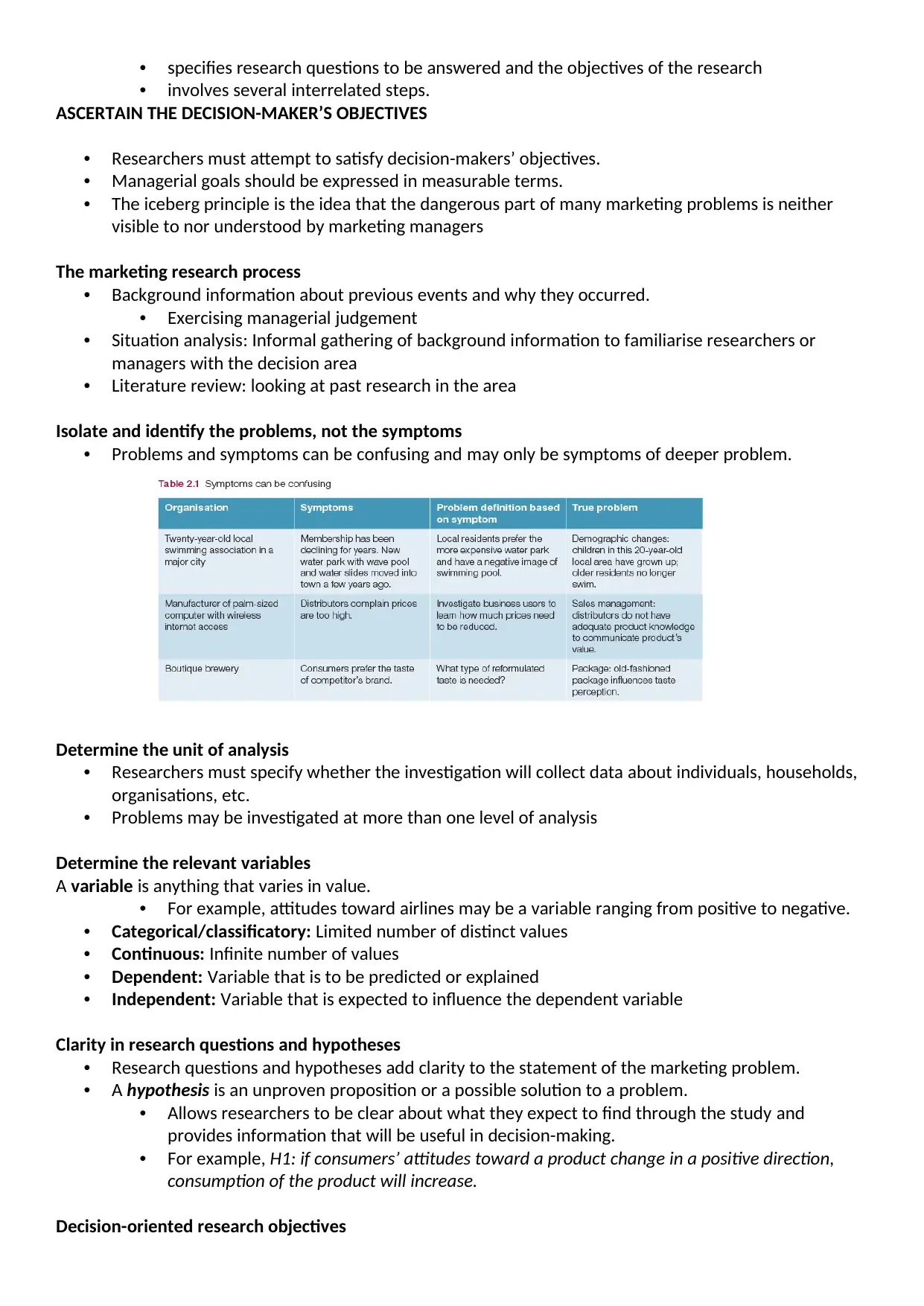
• specifies research questions to be answered and the objectives of the research
• involves several interrelated steps.
ASCERTAIN THE DECISION-MAKER’S OBJECTIVES
• Researchers must attempt to satisfy decision-makers’ objectives.
• Managerial goals should be expressed in measurable terms.
• The iceberg principle is the idea that the dangerous part of many marketing problems is neither
visible to nor understood by marketing managers
The marketing research process
• Background information about previous events and why they occurred.
• Exercising managerial judgement
• Situation analysis: Informal gathering of background information to familiarise researchers or
managers with the decision area
• Literature review: looking at past research in the area
Isolate and identify the problems, not the symptoms
• Problems and symptoms can be confusing and may only be symptoms of deeper problem.
Determine the unit of analysis
• Researchers must specify whether the investigation will collect data about individuals, households,
organisations, etc.
• Problems may be investigated at more than one level of analysis
Determine the relevant variables
A variable is anything that varies in value.
• For example, attitudes toward airlines may be a variable ranging from positive to negative.
• Categorical/classificatory: Limited number of distinct values
• Continuous: Infinite number of values
• Dependent: Variable that is to be predicted or explained
• Independent: Variable that is expected to influence the dependent variable
Clarity in research questions and hypotheses
• Research questions and hypotheses add clarity to the statement of the marketing problem.
• A hypothesis is an unproven proposition or a possible solution to a problem.
• Allows researchers to be clear about what they expect to find through the study and
provides information that will be useful in decision-making.
• For example, H1: if consumers’ attitudes toward a product change in a positive direction,
consumption of the product will increase.
Decision-oriented research objectives
• involves several interrelated steps.
ASCERTAIN THE DECISION-MAKER’S OBJECTIVES
• Researchers must attempt to satisfy decision-makers’ objectives.
• Managerial goals should be expressed in measurable terms.
• The iceberg principle is the idea that the dangerous part of many marketing problems is neither
visible to nor understood by marketing managers
The marketing research process
• Background information about previous events and why they occurred.
• Exercising managerial judgement
• Situation analysis: Informal gathering of background information to familiarise researchers or
managers with the decision area
• Literature review: looking at past research in the area
Isolate and identify the problems, not the symptoms
• Problems and symptoms can be confusing and may only be symptoms of deeper problem.
Determine the unit of analysis
• Researchers must specify whether the investigation will collect data about individuals, households,
organisations, etc.
• Problems may be investigated at more than one level of analysis
Determine the relevant variables
A variable is anything that varies in value.
• For example, attitudes toward airlines may be a variable ranging from positive to negative.
• Categorical/classificatory: Limited number of distinct values
• Continuous: Infinite number of values
• Dependent: Variable that is to be predicted or explained
• Independent: Variable that is expected to influence the dependent variable
Clarity in research questions and hypotheses
• Research questions and hypotheses add clarity to the statement of the marketing problem.
• A hypothesis is an unproven proposition or a possible solution to a problem.
• Allows researchers to be clear about what they expect to find through the study and
provides information that will be useful in decision-making.
• For example, H1: if consumers’ attitudes toward a product change in a positive direction,
consumption of the product will increase.
Decision-oriented research objectives
⊘ This is a preview!⊘
Do you want full access?
Subscribe today to unlock all pages.
Trusted by 1+ million students worldwide
The research objective is the researcher’s version of the marketing problem.
• Explains the purpose of the research in measurable terms
• Defines standards for what the research should accomplish
• Influences decisions about the research design
Products and Branding decisions
Types of Products
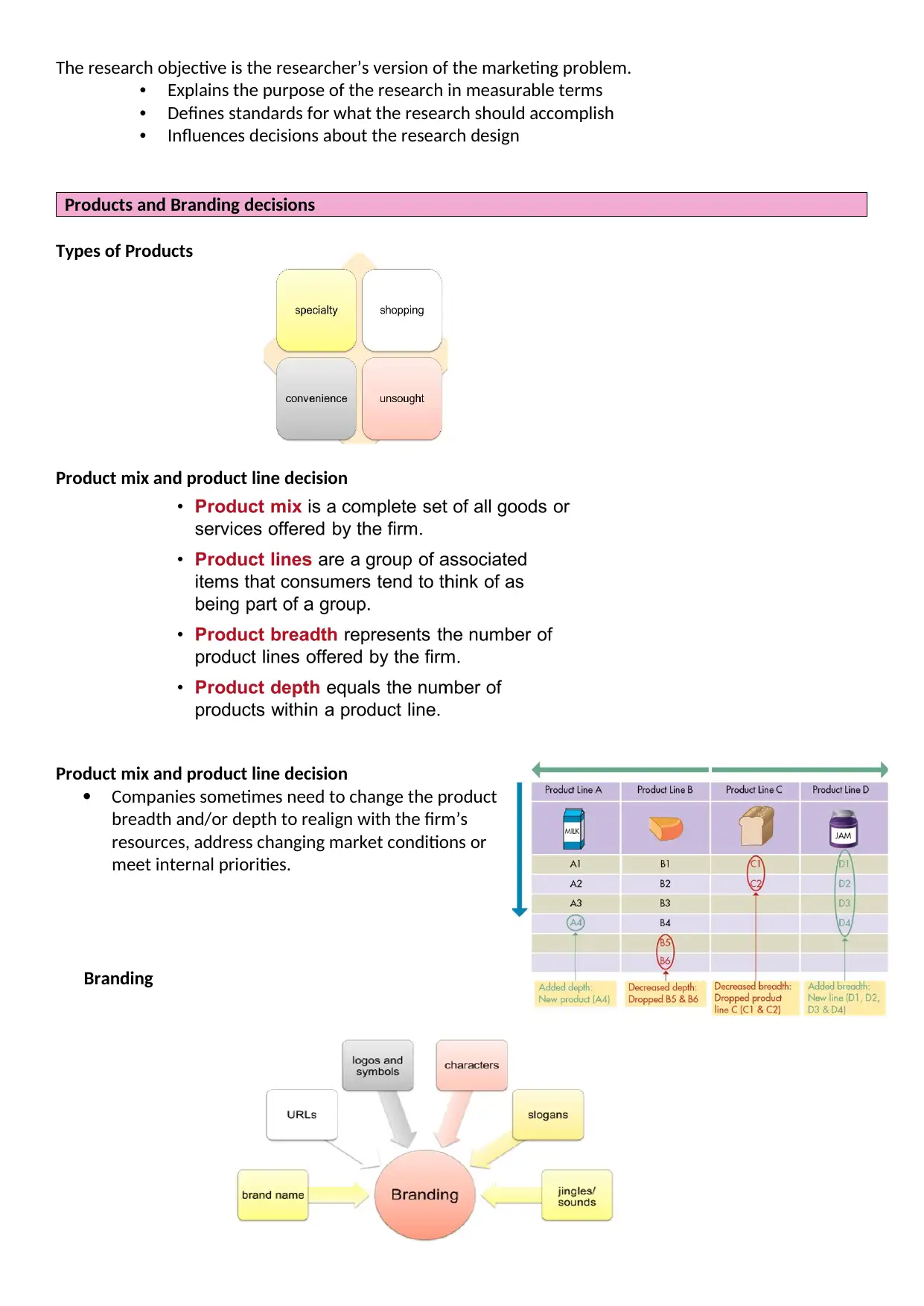
Product mix and product line decision
Product mix and product line decision
Companies sometimes need to change the product
breadth and/or depth to realign with the firm’s
resources, address changing market conditions or
meet internal priorities.
Branding
• Explains the purpose of the research in measurable terms
• Defines standards for what the research should accomplish
• Influences decisions about the research design
Products and Branding decisions
Types of Products
Product mix and product line decision
Product mix and product line decision
Companies sometimes need to change the product
breadth and/or depth to realign with the firm’s
resources, address changing market conditions or
meet internal priorities.
Branding
Paraphrase This Document
Need a fresh take? Get an instant paraphrase of this document with our AI Paraphraser
Brand Equity
Brand equity: the set of assets and liabilities linked to a brand that add to or subtract from the
value provided by the product.
Four aspects of a brand determine its equity:
1. Brand awareness;
2. perceived value;
3. brand associations;
4. brand loyalty.
Brand equity cuts both ways; customers dislike some brands because of the firm’s actions or their
negative perceptions. Nike has been the target of many activists, which causes some consumers to
refuse to purchase or wear Nike products.
Brand Awareness
Brand awareness measures how many consumers in a market are familiar with the brand and what
it stands for, as well as whether they have an opinion about it.
Brand Associations
1. Marketers control some brand associations
Product shape & packaging Logos, symbols & colors
Jingles & slogans
Spokespeople, etc.
2. Marketers should control what they can
Marketers do not control all associations
e.g. Personal memories about brands, etc.
Brand Name
A brand starts with a name
• Some names immediately convey information e.g. Super Geek
• Some names suggest their benefits e.g. Specsaver
• Some names are those of their founder e.g. Schweppe
Marketers should choose brand names that convey brand information
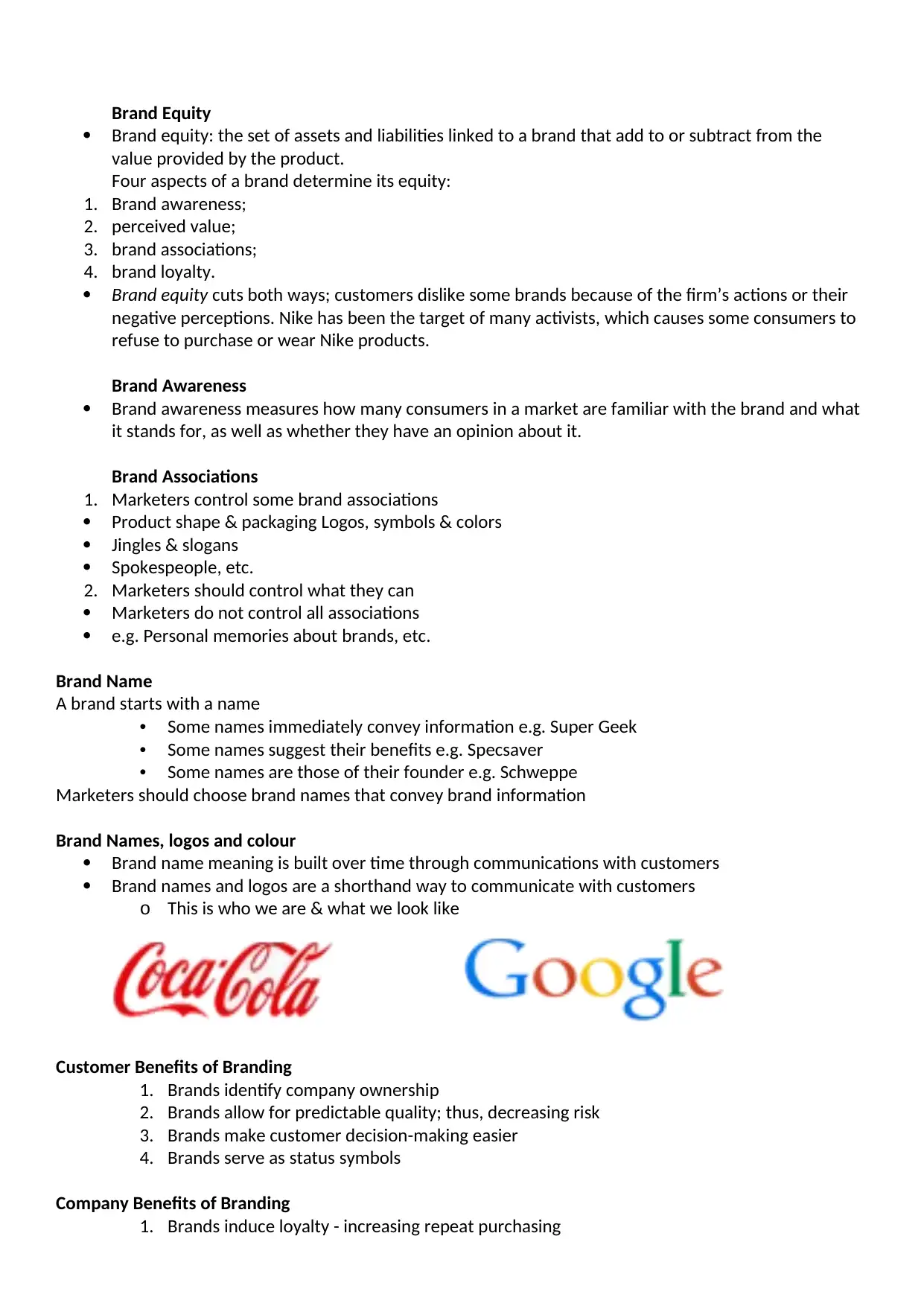
Brand Names, logos and colour
Brand name meaning is built over time through communications with customers
Brand names and logos are a shorthand way to communicate with customers
o This is who we are & what we look like
Customer Benefits of Branding
1. Brands identify company ownership
2. Brands allow for predictable quality; thus, decreasing risk
3. Brands make customer decision-making easier
4. Brands serve as status symbols
Company Benefits of Branding
1. Brands induce loyalty - increasing repeat purchasing
Brand equity: the set of assets and liabilities linked to a brand that add to or subtract from the
value provided by the product.
Four aspects of a brand determine its equity:
1. Brand awareness;
2. perceived value;
3. brand associations;
4. brand loyalty.
Brand equity cuts both ways; customers dislike some brands because of the firm’s actions or their
negative perceptions. Nike has been the target of many activists, which causes some consumers to
refuse to purchase or wear Nike products.
Brand Awareness
Brand awareness measures how many consumers in a market are familiar with the brand and what
it stands for, as well as whether they have an opinion about it.
Brand Associations
1. Marketers control some brand associations
Product shape & packaging Logos, symbols & colors
Jingles & slogans
Spokespeople, etc.
2. Marketers should control what they can
Marketers do not control all associations
e.g. Personal memories about brands, etc.
Brand Name
A brand starts with a name
• Some names immediately convey information e.g. Super Geek
• Some names suggest their benefits e.g. Specsaver
• Some names are those of their founder e.g. Schweppe
Marketers should choose brand names that convey brand information
Brand Names, logos and colour
Brand name meaning is built over time through communications with customers
Brand names and logos are a shorthand way to communicate with customers
o This is who we are & what we look like
Customer Benefits of Branding
1. Brands identify company ownership
2. Brands allow for predictable quality; thus, decreasing risk
3. Brands make customer decision-making easier
4. Brands serve as status symbols
Company Benefits of Branding
1. Brands induce loyalty - increasing repeat purchasing
2. Brands allow for premium prices
3. Brands allow a single firm to pursue multiple targets
Brand Loyalty
Brand loyalty occurs when a consumer buys or consumes the same brand’s product repeatedly over time,
rather than using multiple suppliers within the same category.
• Consumers are often less sensitive to price.
• Marketing costs are much lower.
• Firms are insulated from the competition.
Brand Ownership
1. Manufacturer brands or national brands
(owned and managed by manufacturer)
2. Retailer or store brands
(products developed by retailers)
• premium
• generic
Brand Extension
Brand extension refers to the use of the same brand name in a different product line.
A line extension is the use of the same brand name within the same product line and increasing the
product line’s depth.
Co-branding and brand licensing
Co-branding is the practice of marketing two or more brands together, on the same package or
promotion.
Brand licensing is a contractual agreement between firms, whereby one firm allows another to use
its brand name, logo, symbols and/or characters in exchange for a negotiated fee
Packaging
Packaging is an important brand element and has more tangible (or physical) benefits than other
brand elements.
The primary package is the one the consumer uses, for example a toothpaste tube.
The secondary package is the wrapper or exterior carton that contains the primary package and
provides the UPC label.
Firms may change their packaging:
1. As a subtle reminder of repositioning the product
2. To attract a new market
3. To appear more up to date to its current market
4. To encourage consumers to feel they are receiving something tangible in return for paying
higher prices.
Services Marketing
A service is any intangible offering that involves a deed, performance or effort.
Providing good customer service is one way firms add value to their products and services
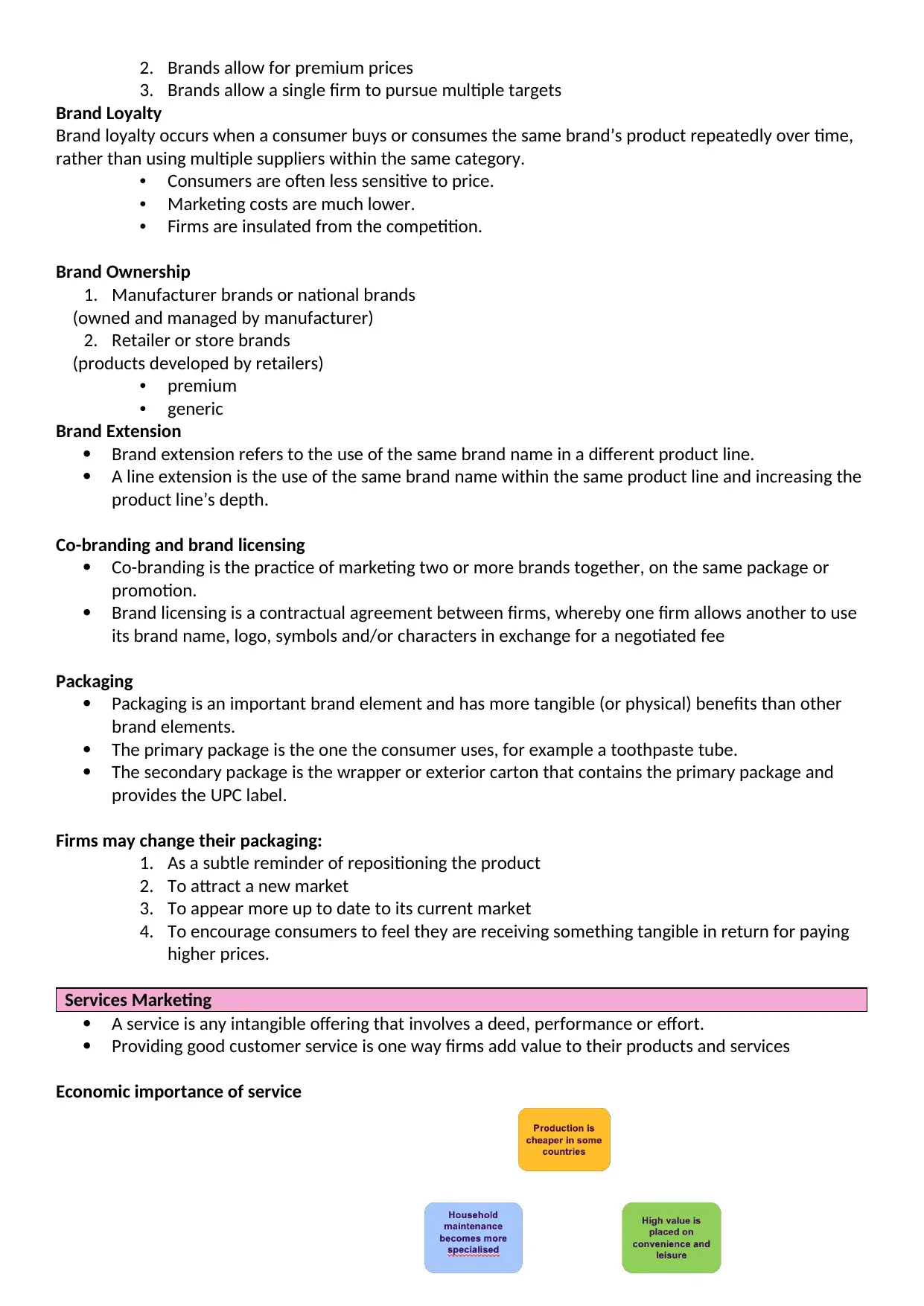
Economic importance of service
3. Brands allow a single firm to pursue multiple targets
Brand Loyalty
Brand loyalty occurs when a consumer buys or consumes the same brand’s product repeatedly over time,
rather than using multiple suppliers within the same category.
• Consumers are often less sensitive to price.
• Marketing costs are much lower.
• Firms are insulated from the competition.
Brand Ownership
1. Manufacturer brands or national brands
(owned and managed by manufacturer)
2. Retailer or store brands
(products developed by retailers)
• premium
• generic
Brand Extension
Brand extension refers to the use of the same brand name in a different product line.
A line extension is the use of the same brand name within the same product line and increasing the
product line’s depth.
Co-branding and brand licensing
Co-branding is the practice of marketing two or more brands together, on the same package or
promotion.
Brand licensing is a contractual agreement between firms, whereby one firm allows another to use
its brand name, logo, symbols and/or characters in exchange for a negotiated fee
Packaging
Packaging is an important brand element and has more tangible (or physical) benefits than other
brand elements.
The primary package is the one the consumer uses, for example a toothpaste tube.
The secondary package is the wrapper or exterior carton that contains the primary package and
provides the UPC label.
Firms may change their packaging:
1. As a subtle reminder of repositioning the product
2. To attract a new market
3. To appear more up to date to its current market
4. To encourage consumers to feel they are receiving something tangible in return for paying
higher prices.
Services Marketing
A service is any intangible offering that involves a deed, performance or effort.
Providing good customer service is one way firms add value to their products and services
Economic importance of service
⊘ This is a preview!⊘
Do you want full access?
Subscribe today to unlock all pages.
Trusted by 1+ million students worldwide
Intangible
cannot be touched, tasted or seen (as a product can be)
requires the use of cues to aid customers
atmosphere is important to convey value
images are used to convey benefit of value.
Inseparable production and consumption
Marketers can use the variable nature of services via a micromarketing segmentation strategy
customised to meet the consumers’ needs exactly.
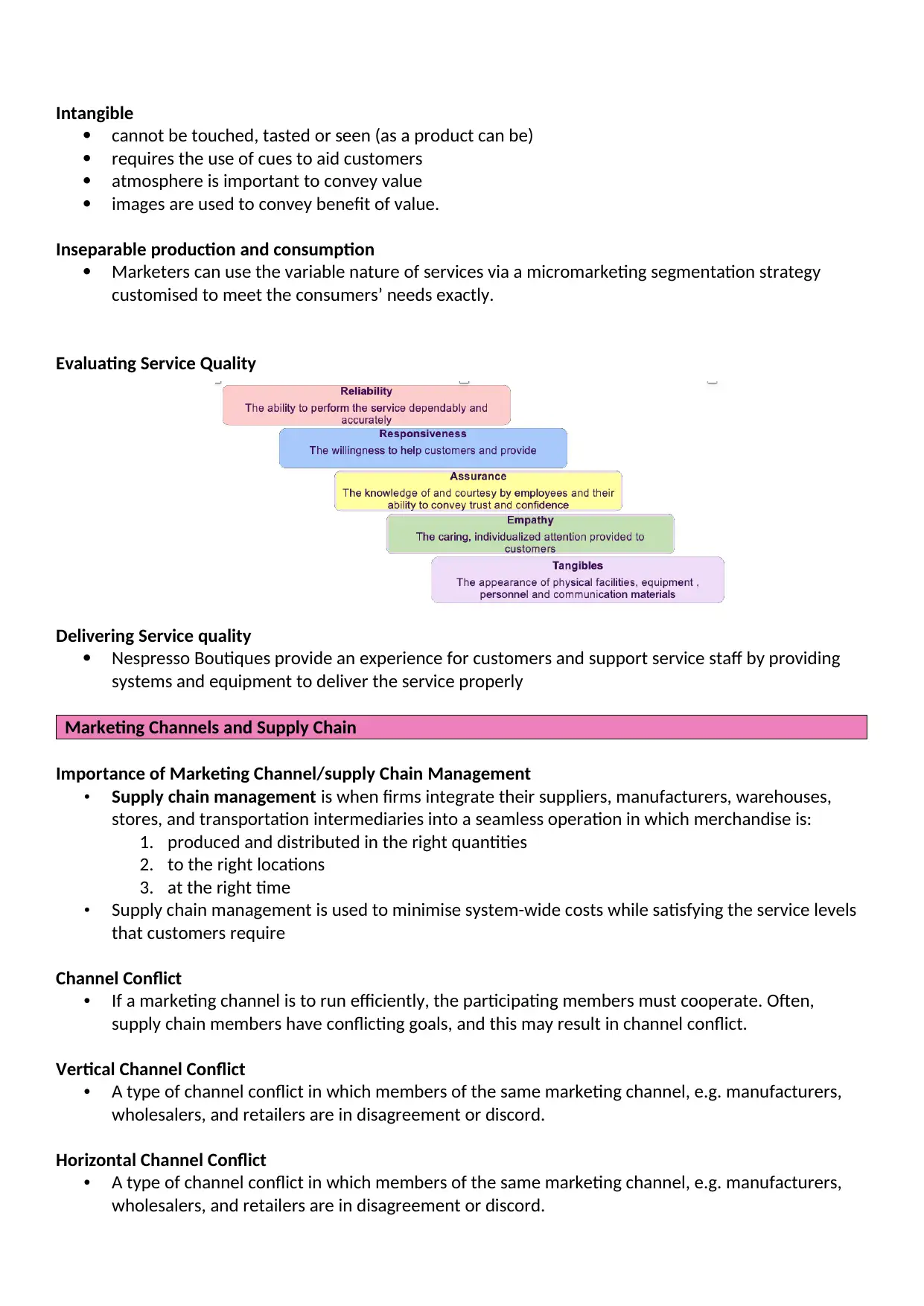
Evaluating Service Quality
Delivering Service quality
Nespresso Boutiques provide an experience for customers and support service staff by providing
systems and equipment to deliver the service properly
Marketing Channels and Supply Chain
Importance of Marketing Channel/supply Chain Management
• Supply chain management is when firms integrate their suppliers, manufacturers, warehouses,
stores, and transportation intermediaries into a seamless operation in which merchandise is:
1. produced and distributed in the right quantities
2. to the right locations
3. at the right time
• Supply chain management is used to minimise system-wide costs while satisfying the service levels
that customers require
Channel Conflict
• If a marketing channel is to run efficiently, the participating members must cooperate. Often,
supply chain members have conflicting goals, and this may result in channel conflict.
Vertical Channel Conflict
• A type of channel conflict in which members of the same marketing channel, e.g. manufacturers,
wholesalers, and retailers are in disagreement or discord.
Horizontal Channel Conflict
• A type of channel conflict in which members of the same marketing channel, e.g. manufacturers,
wholesalers, and retailers are in disagreement or discord.
cannot be touched, tasted or seen (as a product can be)
requires the use of cues to aid customers
atmosphere is important to convey value
images are used to convey benefit of value.
Inseparable production and consumption
Marketers can use the variable nature of services via a micromarketing segmentation strategy
customised to meet the consumers’ needs exactly.
Evaluating Service Quality
Delivering Service quality
Nespresso Boutiques provide an experience for customers and support service staff by providing
systems and equipment to deliver the service properly
Marketing Channels and Supply Chain
Importance of Marketing Channel/supply Chain Management
• Supply chain management is when firms integrate their suppliers, manufacturers, warehouses,
stores, and transportation intermediaries into a seamless operation in which merchandise is:
1. produced and distributed in the right quantities
2. to the right locations
3. at the right time
• Supply chain management is used to minimise system-wide costs while satisfying the service levels
that customers require
Channel Conflict
• If a marketing channel is to run efficiently, the participating members must cooperate. Often,
supply chain members have conflicting goals, and this may result in channel conflict.
Vertical Channel Conflict
• A type of channel conflict in which members of the same marketing channel, e.g. manufacturers,
wholesalers, and retailers are in disagreement or discord.
Horizontal Channel Conflict
• A type of channel conflict in which members of the same marketing channel, e.g. manufacturers,
wholesalers, and retailers are in disagreement or discord.

1 out of 10


Related Documents


Your All-in-One AI-Powered Toolkit for Academic Success.
+13062052269
info@desklib.com
Available 24*7 on WhatsApp / Email
![[object Object]](/_next/static/media/star-bottom.7253800d.svg)
Unlock your academic potential
Copyright © 2020–2026 A2Z Services. All Rights Reserved. Developed and managed by ZUCOL.