Marketing in Travel and Tourism: Strategies, Analysis, and Campaigns
VerifiedAdded on 2020/06/04
|10
|2764
|52
Report
AI Summary
This report provides a comprehensive analysis of marketing strategies within the travel and tourism industry, focusing on the Thomas Cook group. It delves into core marketing concepts like needs, demands, and wants, customer value, and market segmentation. The report examines the impact of the marketing environment, micro and macro factors, on the business, and discusses factors influencing customer motivation. It explores the principles of market segmentation, strategic marketing, including SWOT analysis, and the relevance of marketing research. Furthermore, it addresses the influence of marketing on society and the issues within the marketing mix elements of product, price, and place. The report also highlights the importance of service sector mix elements, the concept of the total tourism product, and the integrated nature and role of the promotional mix, including advertising, public relations, and sales promotions. Finally, the report provides justifications for an integrated promotional campaign, concluding with a summary of the findings.
Marketing in Travel and
Tourism
Tourism

Paraphrase This Document
Need a fresh take? Get an instant paraphrase of this document with our AI Paraphraser
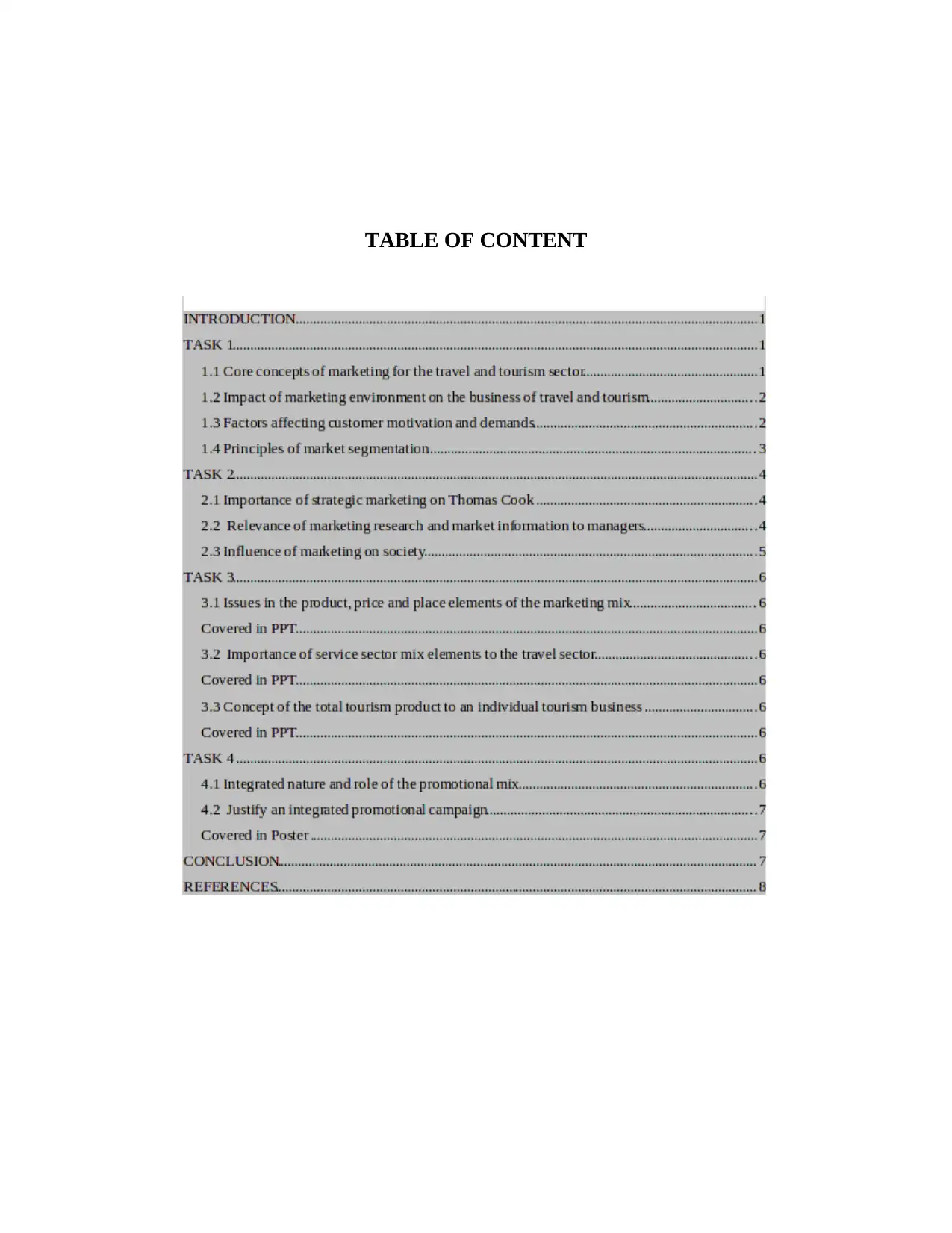
TABLE OF CONTENT
INTRODUCTION
Travel and tourism is one of the most flourishing industry of the economy. It is
contributing to GDP with around 10 percent of total GDP (Sigala, Christou and Gretzel, 2012).
Additionally, it is considered as largest growing section in comparison to auto – mobile, health,
or any financial sector. Furthermore, it is also contributing in generation of employment by
offering large number of jobs to the people in UK. Present report is settled on the marketing
activities of travel & tourism of Thomas Cook group. In this project, the core idea of marketing
for the travel & tourism sector is explained. Additionally, it describes the market segmentation
principle and its usage in making market strategies by the organisation.
TASK 1
1.1 Core concepts of marketing for the travel and tourism sector
Main reason behind concentrating the integral concepts of marketing is that it aids in
knowing the requirements and demands of the consumers and providing them products and
services as per that. Some of the key concepts of marketing are described below:
Needs, demands and wants : This aspect implies that demands, needs and wants differs
from consumer to consumer. It is essential for Thomas Cook to realise the requirements
and the basic needs of their travellers so that they can deliver them services according to
that. By this way they can stay on competitive and prospering. Different requirements of
consumers are safety, esteem, physiological, social and self-actualization (Xiang,
Magnini and Fesenmaier, 2015). Physiological needs refers to the fundamental needs of
individual regarding food, clothing and shelter. Coming to the safety needs, it is
associated with job and security of health. By concentrating on this prospect, Thomas
Cook should provide safety and security to the tourist at the time of travelling. On the
other hand, social requirements refers to the need of sense of belonging, friendly
relationship and family. And esteem needs is connected to the requirement of achieving
respect and regard from others. Thus, Thomas Cook should offer attractive tour packages
having all of these features along with that so that large number users gets attracted
towards their products and services.
Customer value and satisfaction : According to this prospect, venture insures that their
consumers receives value and satisfaction regarding costing of goods and services paid
1
Travel and tourism is one of the most flourishing industry of the economy. It is
contributing to GDP with around 10 percent of total GDP (Sigala, Christou and Gretzel, 2012).
Additionally, it is considered as largest growing section in comparison to auto – mobile, health,
or any financial sector. Furthermore, it is also contributing in generation of employment by
offering large number of jobs to the people in UK. Present report is settled on the marketing
activities of travel & tourism of Thomas Cook group. In this project, the core idea of marketing
for the travel & tourism sector is explained. Additionally, it describes the market segmentation
principle and its usage in making market strategies by the organisation.
TASK 1
1.1 Core concepts of marketing for the travel and tourism sector
Main reason behind concentrating the integral concepts of marketing is that it aids in
knowing the requirements and demands of the consumers and providing them products and
services as per that. Some of the key concepts of marketing are described below:
Needs, demands and wants : This aspect implies that demands, needs and wants differs
from consumer to consumer. It is essential for Thomas Cook to realise the requirements
and the basic needs of their travellers so that they can deliver them services according to
that. By this way they can stay on competitive and prospering. Different requirements of
consumers are safety, esteem, physiological, social and self-actualization (Xiang,
Magnini and Fesenmaier, 2015). Physiological needs refers to the fundamental needs of
individual regarding food, clothing and shelter. Coming to the safety needs, it is
associated with job and security of health. By concentrating on this prospect, Thomas
Cook should provide safety and security to the tourist at the time of travelling. On the
other hand, social requirements refers to the need of sense of belonging, friendly
relationship and family. And esteem needs is connected to the requirement of achieving
respect and regard from others. Thus, Thomas Cook should offer attractive tour packages
having all of these features along with that so that large number users gets attracted
towards their products and services.
Customer value and satisfaction : According to this prospect, venture insures that their
consumers receives value and satisfaction regarding costing of goods and services paid
1
⊘ This is a preview!⊘
Do you want full access?
Subscribe today to unlock all pages.

Trusted by 1+ million students worldwide
by them to attain such service or products. Furthermore, value of services provided by
organisation can be identified on the basis of users satisfaction.
Markets : It is that place where firm desires to offer its services. Thomas Cook should
provide their precious services in the national and global market with the help of
globalization. But at the same time, the opportunities and threat of targeted market have
to be recognised appropriately before taking any decision regarding offering services
(Moutinho, 2011). For example, as company desires to create a holidays for summer
2017 to visit Morocco and Egypt. But the activities of terrorism is increasing there which
is causing threat for the tourists. Therefore, Thomas Cook should look for other nations
where people would feel safe and secure such as Denmark, Japan, etc.
1.2 Impact of marketing environment on the business of travel and tourism
Since, Thomas Cook is designing to offer new summer package to their passengers to
visit beautiful and historical nations like Morocco and Egypt. Hence, it is necessary for the
venture to focus on different factors like micro and macro factors which influence on the
working of corporation.
Micro environment : Main micro elements that affects the internal factor available within the
Thomas Cook are listed below: Consumers : They play a vital role in the success of venture as they are the only one who
consumes the services provided by the corporation and create money for them (Hudson
and Thal, 2013). So, firm should design their products and services as per their need.
Workers : They are some one who provide services to the customers. So, Thomas Cook
should hire skilled workforce who contribute in the success of their venture.
Macro environment- Legal factor : There are various laws and legislations in UK which have to be follow by
the enterprise. If they would not follow then it impacts adversely on their business.
Technology : For offering best quality services to their clients, company should take use
of latest technologies.
1.3 Factors affecting customer motivation and demands
At the time of making any plan, Thomas Cook should consider the below listed factors as
they affects the motivation of users and their needs:
2
organisation can be identified on the basis of users satisfaction.
Markets : It is that place where firm desires to offer its services. Thomas Cook should
provide their precious services in the national and global market with the help of
globalization. But at the same time, the opportunities and threat of targeted market have
to be recognised appropriately before taking any decision regarding offering services
(Moutinho, 2011). For example, as company desires to create a holidays for summer
2017 to visit Morocco and Egypt. But the activities of terrorism is increasing there which
is causing threat for the tourists. Therefore, Thomas Cook should look for other nations
where people would feel safe and secure such as Denmark, Japan, etc.
1.2 Impact of marketing environment on the business of travel and tourism
Since, Thomas Cook is designing to offer new summer package to their passengers to
visit beautiful and historical nations like Morocco and Egypt. Hence, it is necessary for the
venture to focus on different factors like micro and macro factors which influence on the
working of corporation.
Micro environment : Main micro elements that affects the internal factor available within the
Thomas Cook are listed below: Consumers : They play a vital role in the success of venture as they are the only one who
consumes the services provided by the corporation and create money for them (Hudson
and Thal, 2013). So, firm should design their products and services as per their need.
Workers : They are some one who provide services to the customers. So, Thomas Cook
should hire skilled workforce who contribute in the success of their venture.
Macro environment- Legal factor : There are various laws and legislations in UK which have to be follow by
the enterprise. If they would not follow then it impacts adversely on their business.
Technology : For offering best quality services to their clients, company should take use
of latest technologies.
1.3 Factors affecting customer motivation and demands
At the time of making any plan, Thomas Cook should consider the below listed factors as
they affects the motivation of users and their needs:
2
Paraphrase This Document
Need a fresh take? Get an instant paraphrase of this document with our AI Paraphraser
Culture : Each and every travellers desires to purchase goods and services as per their
culture. Therefore before designing any product and services, Thomas Cook should
closely understand the culture and traditions of their targeted customers and design their
services according to that (Hays, Page and Buhalis, 2013). Personal factors : This consist of age, income and living style of people which impacts
the motivation level of users. If they earn high amount of money, they would try to
purchase most luxurious and costly services or goods. On the other hand, if this is low,
then they get demotivated and attempt to cut or minimise their travelling costs.
Company's service : If organisation is offering unique and high quality services or
products to their consumers then this will motivate or inspire people in purchasing
services from them.
1.4 Principles of market segmentation
Marketing segmentation can be simply defined as division of market into small groups in
order to focus on each appropriately. It is done as per the requirement, preferences and interest
of corporation. It aids in planning of market. After the segmentation, roles of targeted sector or
parts become affective and venture target any specific segment in order to sell their services.
Segmentation can be done on the following factors: Geographic : Division is done on the basis of geographic criteria and travellers are
targeted as per that. For example, Thomas Cook is providing new tour packages of Egypt
and Morocco mainly to people living in UK (Hall, Timothy and Duval, 2012). Behavioural : Segmentation is done here on the ground of behaviour, nature, attitudes
and loyalty status of passengers towards services which is being offered by enterprise.
Thomas Cook should focus on their brand loyal users firstly to take the benefits of new
tour package. Demographic : In this gender, family, income, age, etc. is taken into considerations
while segmenting.
Psycho-graphic : Division is done as per the living style, personality and social classes.
3
culture. Therefore before designing any product and services, Thomas Cook should
closely understand the culture and traditions of their targeted customers and design their
services according to that (Hays, Page and Buhalis, 2013). Personal factors : This consist of age, income and living style of people which impacts
the motivation level of users. If they earn high amount of money, they would try to
purchase most luxurious and costly services or goods. On the other hand, if this is low,
then they get demotivated and attempt to cut or minimise their travelling costs.
Company's service : If organisation is offering unique and high quality services or
products to their consumers then this will motivate or inspire people in purchasing
services from them.
1.4 Principles of market segmentation
Marketing segmentation can be simply defined as division of market into small groups in
order to focus on each appropriately. It is done as per the requirement, preferences and interest
of corporation. It aids in planning of market. After the segmentation, roles of targeted sector or
parts become affective and venture target any specific segment in order to sell their services.
Segmentation can be done on the following factors: Geographic : Division is done on the basis of geographic criteria and travellers are
targeted as per that. For example, Thomas Cook is providing new tour packages of Egypt
and Morocco mainly to people living in UK (Hall, Timothy and Duval, 2012). Behavioural : Segmentation is done here on the ground of behaviour, nature, attitudes
and loyalty status of passengers towards services which is being offered by enterprise.
Thomas Cook should focus on their brand loyal users firstly to take the benefits of new
tour package. Demographic : In this gender, family, income, age, etc. is taken into considerations
while segmenting.
Psycho-graphic : Division is done as per the living style, personality and social classes.
3
TASK 2
2.1 Importance of strategic marketing on Thomas Cook
Strategic marketing can be simply defined as a process through which venture can attain
its aims and objectives in very effective way. It also aids in determining the strength, weakness,
threats and opportunities of the firm. The main marketing strategies of Thomas Cook is to
improve their sales and enlarge their business internationally (Hall, 2013). With the help of
effectual strategic market planning, corporation can attract expected users for purchasing their
new tour packages. Before making strategies, Thomas cook should determine their strength,
weakness, threats and opportunities that can be recognised by doing SWOT analysis which is
described below:
Strength :
◦ It consist of larger market share which is acquired by merging their company with My
Travel and Kuoni.
◦ It offers best quality and varieties of products such as flights, financial services, etc.
Weaknesses :
◦ Fluctuation in the currency value in various nations creates loss for Thomas Cook.
◦ It has many debt obligations.
Opportunities :
◦ The demand of travel and tour packages are increasing internationally.
◦ Company consist of good financial resources and by taking help of those they can
enlarge their business.
Threats :
◦ Fluctuation are increasing in different sectors like policies, norms and market.
◦ Competition is rising and various ventures are providing the same services to the
passengers (Goeldner, and Ritchie, 2012). This reduces the number of consumers and
also the fair of tickets gets lower.
2.2 Relevance of marketing research and market information to managers
With the help of marketing research, Thomas Cook are able to determine the demands
and preferences of travellers and market. They also come to know that how their services are
full-filling the needs of their consumers. The information related to marketing furthermore aids
4
2.1 Importance of strategic marketing on Thomas Cook
Strategic marketing can be simply defined as a process through which venture can attain
its aims and objectives in very effective way. It also aids in determining the strength, weakness,
threats and opportunities of the firm. The main marketing strategies of Thomas Cook is to
improve their sales and enlarge their business internationally (Hall, 2013). With the help of
effectual strategic market planning, corporation can attract expected users for purchasing their
new tour packages. Before making strategies, Thomas cook should determine their strength,
weakness, threats and opportunities that can be recognised by doing SWOT analysis which is
described below:
Strength :
◦ It consist of larger market share which is acquired by merging their company with My
Travel and Kuoni.
◦ It offers best quality and varieties of products such as flights, financial services, etc.
Weaknesses :
◦ Fluctuation in the currency value in various nations creates loss for Thomas Cook.
◦ It has many debt obligations.
Opportunities :
◦ The demand of travel and tour packages are increasing internationally.
◦ Company consist of good financial resources and by taking help of those they can
enlarge their business.
Threats :
◦ Fluctuation are increasing in different sectors like policies, norms and market.
◦ Competition is rising and various ventures are providing the same services to the
passengers (Goeldner, and Ritchie, 2012). This reduces the number of consumers and
also the fair of tickets gets lower.
2.2 Relevance of marketing research and market information to managers
With the help of marketing research, Thomas Cook are able to determine the demands
and preferences of travellers and market. They also come to know that how their services are
full-filling the needs of their consumers. The information related to marketing furthermore aids
4
⊘ This is a preview!⊘
Do you want full access?
Subscribe today to unlock all pages.
Trusted by 1+ million students worldwide
managers in focussing on targeted users effectively. They gather data related to the consumers,
competitors and the marketing situations which will proved to be beneficial while formulating
strategies. It also assist in recognising the trip by identifying the people who are travelling with
the Venture or are interested in 2107 trip of Morocco and Egypt. Managers have to identify
following information which are very significant :
Determination, evaluation and refinement of marketing options which is available for
Thomas Cook
Observing and controlling the market performance.
Information regarding the cheaper hotels and restaurants
Some of the benefits of marketing research are listed below:
It ensures focus on major activities that become loopholes and it should be improved.
It is a customer centric approach where research concentrates on unsatisfied requirements
and preferences of people who are residing in Morocco which can be satisfied (Dolnicar
and Ring, 2014).
It aids in determining the level of competitions.
2.3 Influence of marketing on society
There is a great influence of marketing on the society that are discussed below: Advising to the consumers : By taking help of different activities of marketing, venture
provides knowledge to civilians about their goods and services. For instance, Thomas
Cook are telling about their summer holiday packages of 2017 to their customers through
marketing. Assessing requirement of users : Marketing is proved to be very aidful in recognising
the desires and needs of people which helps corporation in serving them as per their
wishes. Modelling behaviour : It is also very assisting in impacting significant customers so that
they get ready for buying their products and services (Buhalis and Michopoulou, 2011).
It is also noticed that websites of Thomas Cook is promoting different tourism activities
in various areas. It is one of the venture that is offering its services at cheaper rates.
Thought it is proved to be quite beneficial if the firm would offer couple of trips on
different dates such as it can start their tour packages in Easter break of 2017 where
people would love to visit Egypt to Morocco.
5
competitors and the marketing situations which will proved to be beneficial while formulating
strategies. It also assist in recognising the trip by identifying the people who are travelling with
the Venture or are interested in 2107 trip of Morocco and Egypt. Managers have to identify
following information which are very significant :
Determination, evaluation and refinement of marketing options which is available for
Thomas Cook
Observing and controlling the market performance.
Information regarding the cheaper hotels and restaurants
Some of the benefits of marketing research are listed below:
It ensures focus on major activities that become loopholes and it should be improved.
It is a customer centric approach where research concentrates on unsatisfied requirements
and preferences of people who are residing in Morocco which can be satisfied (Dolnicar
and Ring, 2014).
It aids in determining the level of competitions.
2.3 Influence of marketing on society
There is a great influence of marketing on the society that are discussed below: Advising to the consumers : By taking help of different activities of marketing, venture
provides knowledge to civilians about their goods and services. For instance, Thomas
Cook are telling about their summer holiday packages of 2017 to their customers through
marketing. Assessing requirement of users : Marketing is proved to be very aidful in recognising
the desires and needs of people which helps corporation in serving them as per their
wishes. Modelling behaviour : It is also very assisting in impacting significant customers so that
they get ready for buying their products and services (Buhalis and Michopoulou, 2011).
It is also noticed that websites of Thomas Cook is promoting different tourism activities
in various areas. It is one of the venture that is offering its services at cheaper rates.
Thought it is proved to be quite beneficial if the firm would offer couple of trips on
different dates such as it can start their tour packages in Easter break of 2017 where
people would love to visit Egypt to Morocco.
5
Paraphrase This Document
Need a fresh take? Get an instant paraphrase of this document with our AI Paraphraser
Competitive edge : One of the biggest competitive edge Thomas Cook is having on its
challengers as no one is offering such a tour package where they would take people to
visit Egypt to Morocco in a very affordable or low costing.
TASK 3
3.1 Issues in the product, price and place elements of the marketing mix
Covered in PPT
3.2 Importance of service sector mix elements to the travel sector
Covered in PPT
3.3 Concept of the total tourism product to an individual tourism business
Covered in PPT
TASK 4
4.1 Integrated nature and role of the promotional mix
Thomas Cook can take use of different elements of promotional mix for boosting up their
sales of new summer tour package 2017 which are described below: Advertising : It aids in recognition of brands and creating their positive image which as a
result increase their sales (Dasgupta, 2011). They can advertise their new tour package
on newspapers, radio, magazines and TV etc. Public relation : Thomas Cook can take use of their good relations with media in
increasing their goodwill in targeted market of Egypt and Morocco (Chon, 2015).
Additionally, they can utilise virtual reality which would assist venture in formulating
artificial environment of Egypt and Morocco by using high definition technology.
Sales promotions : It states the use of promotional tools such as premiums, discounts,
contests, etc. for increasing their sales. It furthermore impact individuals to buy the
services offered by the enterprises to utilise extra benefits.
6
challengers as no one is offering such a tour package where they would take people to
visit Egypt to Morocco in a very affordable or low costing.
TASK 3
3.1 Issues in the product, price and place elements of the marketing mix
Covered in PPT
3.2 Importance of service sector mix elements to the travel sector
Covered in PPT
3.3 Concept of the total tourism product to an individual tourism business
Covered in PPT
TASK 4
4.1 Integrated nature and role of the promotional mix
Thomas Cook can take use of different elements of promotional mix for boosting up their
sales of new summer tour package 2017 which are described below: Advertising : It aids in recognition of brands and creating their positive image which as a
result increase their sales (Dasgupta, 2011). They can advertise their new tour package
on newspapers, radio, magazines and TV etc. Public relation : Thomas Cook can take use of their good relations with media in
increasing their goodwill in targeted market of Egypt and Morocco (Chon, 2015).
Additionally, they can utilise virtual reality which would assist venture in formulating
artificial environment of Egypt and Morocco by using high definition technology.
Sales promotions : It states the use of promotional tools such as premiums, discounts,
contests, etc. for increasing their sales. It furthermore impact individuals to buy the
services offered by the enterprises to utilise extra benefits.
6
4.2 Justify an integrated promotional campaign
Covered in Poster
CONCLUSION
From the above stated report it can be concluded that travel & tourism is the fastest
growing sector which are providing large number of job opportunities to the people. Thomas
Cook is one of the oldest enterprise which is presently active in tourism sector. They are creating
a new summer tour package of Egypt and Morocco in 2017. They are using several promotional
activities in order to aware about this to their potential consumers.
7
Covered in Poster
CONCLUSION
From the above stated report it can be concluded that travel & tourism is the fastest
growing sector which are providing large number of job opportunities to the people. Thomas
Cook is one of the oldest enterprise which is presently active in tourism sector. They are creating
a new summer tour package of Egypt and Morocco in 2017. They are using several promotional
activities in order to aware about this to their potential consumers.
7
⊘ This is a preview!⊘
Do you want full access?
Subscribe today to unlock all pages.
Trusted by 1+ million students worldwide
REFERENCES
Books & journal
Buhalis, D. and Michopoulou, E., 2011. Information-enabled tourism destination marketing:
addressing the accessibility market. Current Issues in Tourism. 14(2). pp.145-168.
Chon, K. S., 2015. Traveler destination image modification process and its marketing
implications. In Proceedings of the 1990 Academy of Marketing Science (AMS) Annual
Conference (pp. 480-482). Springer, Cham.
Dasgupta, D., 2011. Tourism marketing. Pearson.
Dolnicar, S. and Ring, A., 2014. Tourism marketing research: Past, present and future. Annals of
Tourism Research. 47. pp.31-47.
Goeldner, C.R. and Ritchie, J.B., 2012. Tourism: principles, practices, philosophies (No. Ed. 12).
John Wiley and Sons, Inc.
Hall, C.M., 2013. Wine, food, and tourism marketing. Routledge.
Hall, C.M., Timothy, D.J. and Duval, D.T., 2012. Safety and security in tourism: relationships,
management, and marketing. Routledge.
Hays, S., Page, S. J. and Buhalis, D., 2013. Social media as a destination marketing tool: its use
by national tourism organisations. Current issues in Tourism. 16(3).pp.211-239.
Hudson, S. and Thal, K., 2013. The impact of social media on the consumer decision process:
Implications for tourism marketing. Journal of Travel & Tourism Marketing. 30(1-2).
pp.156-160.
Moutinho, L. ed., 2011. Strategic management in tourism. Cabi.
Sigala, M., Christou, E. and Gretzel, U. eds., 2012. Social media in travel, tourism and
hospitality: Theory, practice and cases. Ashgate Publishing, Ltd..
Soteriades, M., 2012. Tourism destination marketing: approaches improving effectiveness and
efficiency. Journal of Hospitality and Tourism Technology. 3(2). pp.107-120.
Truong, V. D. and Hall, C. M., 2013. Social marketing and tourism: What is the evidence?.
Social Marketing Quarterly. 19(2). pp.110-135.
Xiang, Z., Magnini, V. P. and Fesenmaier, D. R., 2015. Information technology and consumer
behavior in travel and tourism: Insights from travel planning using the internet. Journal
of Retailing and Consumer Services. 22. pp.244-249.
Zeng, B. and Gerritsen, R., 2014. What do we know about social media in tourism? A review.
Tourism Management Perspectives. 10. pp.27-36.
Online
How to achieve an effective promotional mix. 2017. [Online]. Available through :
<http://www.strategic-planet.com/2014/02/achieve-effective-promotional-mix/>.
Accessed on 10th October 2017.
8
Books & journal
Buhalis, D. and Michopoulou, E., 2011. Information-enabled tourism destination marketing:
addressing the accessibility market. Current Issues in Tourism. 14(2). pp.145-168.
Chon, K. S., 2015. Traveler destination image modification process and its marketing
implications. In Proceedings of the 1990 Academy of Marketing Science (AMS) Annual
Conference (pp. 480-482). Springer, Cham.
Dasgupta, D., 2011. Tourism marketing. Pearson.
Dolnicar, S. and Ring, A., 2014. Tourism marketing research: Past, present and future. Annals of
Tourism Research. 47. pp.31-47.
Goeldner, C.R. and Ritchie, J.B., 2012. Tourism: principles, practices, philosophies (No. Ed. 12).
John Wiley and Sons, Inc.
Hall, C.M., 2013. Wine, food, and tourism marketing. Routledge.
Hall, C.M., Timothy, D.J. and Duval, D.T., 2012. Safety and security in tourism: relationships,
management, and marketing. Routledge.
Hays, S., Page, S. J. and Buhalis, D., 2013. Social media as a destination marketing tool: its use
by national tourism organisations. Current issues in Tourism. 16(3).pp.211-239.
Hudson, S. and Thal, K., 2013. The impact of social media on the consumer decision process:
Implications for tourism marketing. Journal of Travel & Tourism Marketing. 30(1-2).
pp.156-160.
Moutinho, L. ed., 2011. Strategic management in tourism. Cabi.
Sigala, M., Christou, E. and Gretzel, U. eds., 2012. Social media in travel, tourism and
hospitality: Theory, practice and cases. Ashgate Publishing, Ltd..
Soteriades, M., 2012. Tourism destination marketing: approaches improving effectiveness and
efficiency. Journal of Hospitality and Tourism Technology. 3(2). pp.107-120.
Truong, V. D. and Hall, C. M., 2013. Social marketing and tourism: What is the evidence?.
Social Marketing Quarterly. 19(2). pp.110-135.
Xiang, Z., Magnini, V. P. and Fesenmaier, D. R., 2015. Information technology and consumer
behavior in travel and tourism: Insights from travel planning using the internet. Journal
of Retailing and Consumer Services. 22. pp.244-249.
Zeng, B. and Gerritsen, R., 2014. What do we know about social media in tourism? A review.
Tourism Management Perspectives. 10. pp.27-36.
Online
How to achieve an effective promotional mix. 2017. [Online]. Available through :
<http://www.strategic-planet.com/2014/02/achieve-effective-promotional-mix/>.
Accessed on 10th October 2017.
8

1 out of 10


Related Documents


Your All-in-One AI-Powered Toolkit for Academic Success.
+13062052269
info@desklib.com
Available 24*7 on WhatsApp / Email
![[object Object]](/_next/static/media/star-bottom.7253800d.svg)
Unlock your academic potential
Copyright © 2020–2026 A2Z Services. All Rights Reserved. Developed and managed by ZUCOL.