Business Review: Marks & Spencer Business Structure and Analysis
VerifiedAdded on 2023/01/18
|9
|2533
|64
Report
AI Summary
This report provides a comprehensive business review of Marks & Spencer, a UK-based global retailer. It begins by defining the business environment and its impact on organizations, then delves into the purpose and types of business organizations, distinguishing between private, public, and voluntary sectors. The report then examines the legal structures within the private sector, including sole traders, partnerships, private limited companies, and public limited companies. It analyzes how organizational structure, scope, and size align with overall business objectives, using Marks & Spencer as a case study and incorporating a SWOT analysis. The report also explores the complexities of various business structures, such as divisional, matrix, and flat structures, and emphasizes the benefits of interrelationships between different organizational functions. The conclusion reiterates the importance of competitive advantage, strategic planning, and effective organizational structures for business success.
BUSINESS
REVIEW
REVIEW

Paraphrase This Document
Need a fresh take? Get an instant paraphrase of this document with our AI Paraphraser
Table of Contents
INTRODUCTION...........................................................................................................................1
TASK 2............................................................................................................................................1
Mention about various purpose and types of business organisation...........................................1
Define varied kind of legal structure in private sector ...............................................................1
Analyse how organisational structure, scope and size of business can align with overall
business objectives and leads to products and services .............................................................1
Complexities in varied kind of business structures and benefits of interrelationship in different
organisational functions .............................................................................................................1
CONCLUSION................................................................................................................................1
REFERENCES................................................................................................................................2
INTRODUCTION...........................................................................................................................1
TASK 2............................................................................................................................................1
Mention about various purpose and types of business organisation...........................................1
Define varied kind of legal structure in private sector ...............................................................1
Analyse how organisational structure, scope and size of business can align with overall
business objectives and leads to products and services .............................................................1
Complexities in varied kind of business structures and benefits of interrelationship in different
organisational functions .............................................................................................................1
CONCLUSION................................................................................................................................1
REFERENCES................................................................................................................................2
INTRODUCTION
Business environment is defined to the total of all the extrinsic and intrinsic factors which
impacts the working of an organisation. These internal and external aspects are different in
nature but success of a company depends on both. If these factors are in favour of company,
attaining high advantage and growth became easy for a concerned organisation (Deshpande,
2018). This project is carried out in context with Marks & Spencer, a UK based global retailer
which deals in clothing, home decors and food items. This company has its main office present
in Westminster, London and well known for their luxurious services. This report will mention
about types and purpose of business firms along with legal structures present in private sector.
Also, role of size and scope of company on organisational objective is mentioned. At last, merits
of good relationship among organisational functions is discussed briefly.
TASK 2
Mention about various purpose and types of business organisation
In a marketplace, different kind of business firms are operating their business so that they
can achieve their goals and ambitions in a proper manner. Purpose of each organisation is
different due to which their way of performing work also varies. Basically, there are three kind
of business firms which operate in a market. These companies are private, voluntary and public
organisations. Information about these firms are discussed below:
Private organisation: These companies are established, run and owned by business
persons through privatisation. These kind of firms can be managed on individual basis or
in collaboration of different persons. For example, M&S that is multinational retailer
performing their work in global context. Major purpose of these companies is to attain
high profits and revenues in marketplace so that high business advantage can be attained
against rivals. This benefits these firms in becoming market leader (Huang and et. al.
2013).
Public organisation: This organisational sector is operated, managed and set up by
government officials and authorities. All the funds and finances which are required to
operate this business is managed by government. One example in this case is NHS that is
a UK based public company which give healthcare and medical service to UK residents.
1
Business environment is defined to the total of all the extrinsic and intrinsic factors which
impacts the working of an organisation. These internal and external aspects are different in
nature but success of a company depends on both. If these factors are in favour of company,
attaining high advantage and growth became easy for a concerned organisation (Deshpande,
2018). This project is carried out in context with Marks & Spencer, a UK based global retailer
which deals in clothing, home decors and food items. This company has its main office present
in Westminster, London and well known for their luxurious services. This report will mention
about types and purpose of business firms along with legal structures present in private sector.
Also, role of size and scope of company on organisational objective is mentioned. At last, merits
of good relationship among organisational functions is discussed briefly.
TASK 2
Mention about various purpose and types of business organisation
In a marketplace, different kind of business firms are operating their business so that they
can achieve their goals and ambitions in a proper manner. Purpose of each organisation is
different due to which their way of performing work also varies. Basically, there are three kind
of business firms which operate in a market. These companies are private, voluntary and public
organisations. Information about these firms are discussed below:
Private organisation: These companies are established, run and owned by business
persons through privatisation. These kind of firms can be managed on individual basis or
in collaboration of different persons. For example, M&S that is multinational retailer
performing their work in global context. Major purpose of these companies is to attain
high profits and revenues in marketplace so that high business advantage can be attained
against rivals. This benefits these firms in becoming market leader (Huang and et. al.
2013).
Public organisation: This organisational sector is operated, managed and set up by
government officials and authorities. All the funds and finances which are required to
operate this business is managed by government. One example in this case is NHS that is
a UK based public company which give healthcare and medical service to UK residents.
1
⊘ This is a preview!⊘
Do you want full access?
Subscribe today to unlock all pages.

Trusted by 1+ million students worldwide
Main purpose of these firms is to offer high support and welfare to common residents so
that they can sustain a good life.
Voluntary organisation: Under this sector, businesses are managed and operated by the
association of different individuals. These people are interested in serving people and
came forward so that they can attain their common objective in a productive manner.
These companies are funded by government. For example, OXFAM which is a UK based
firm that helps the victims of poverty and natural disasters in regaining a normal life.
Purpose of these companies is to offer standardised service to needy people so that they
can life a healthy and prosperous life (Wetherly, 2014).
Define varied kind of legal structure in private sector
Each sector has different legal structure. Distinct type of legal structures associated with
Private sector are mentioned below:
Sole trader: It is an individual based business that requires very small amount of funds
to start up and perform work in an efficient manner. Sole trader are those persons which
employs waged workers under them but all the risks and benefits which are concerned
with business are faced by them on individual basis. Sole trader face unlimited liability
for their debts.
Partnership: If a person is not able to perform work on sole basis, this legal structure to
manage business can be used. Partnership is defined as a group of people usually between
2 to 20 which manages and invest in business to achieve high profits. Each partner in this
legal structure have responsibility for partnership debt. This legal structure also have
unlimited liability in terms of debts (Georgescu and Popescul, 2015).
Private limited: It is basically a joint stock organisation where business posses a distinct
identity than its owner. Generally, private limited organisations are very small and family
managed businesses which are managed and run by shareholders. Every shareholder of
firm is part of business in this legal structure.
Public limited: It is an incorporated business which is managed and run by board of
directors of an organisation in behalf of business shareholders. In this legal structure, a
company can sell off their shares to common people and earn more finances in
comparison with private limited. M&S is a public limited organisation which earns
annual revenues of around 10,377 million pounds (Hillary, 2017).
2
that they can sustain a good life.
Voluntary organisation: Under this sector, businesses are managed and operated by the
association of different individuals. These people are interested in serving people and
came forward so that they can attain their common objective in a productive manner.
These companies are funded by government. For example, OXFAM which is a UK based
firm that helps the victims of poverty and natural disasters in regaining a normal life.
Purpose of these companies is to offer standardised service to needy people so that they
can life a healthy and prosperous life (Wetherly, 2014).
Define varied kind of legal structure in private sector
Each sector has different legal structure. Distinct type of legal structures associated with
Private sector are mentioned below:
Sole trader: It is an individual based business that requires very small amount of funds
to start up and perform work in an efficient manner. Sole trader are those persons which
employs waged workers under them but all the risks and benefits which are concerned
with business are faced by them on individual basis. Sole trader face unlimited liability
for their debts.
Partnership: If a person is not able to perform work on sole basis, this legal structure to
manage business can be used. Partnership is defined as a group of people usually between
2 to 20 which manages and invest in business to achieve high profits. Each partner in this
legal structure have responsibility for partnership debt. This legal structure also have
unlimited liability in terms of debts (Georgescu and Popescul, 2015).
Private limited: It is basically a joint stock organisation where business posses a distinct
identity than its owner. Generally, private limited organisations are very small and family
managed businesses which are managed and run by shareholders. Every shareholder of
firm is part of business in this legal structure.
Public limited: It is an incorporated business which is managed and run by board of
directors of an organisation in behalf of business shareholders. In this legal structure, a
company can sell off their shares to common people and earn more finances in
comparison with private limited. M&S is a public limited organisation which earns
annual revenues of around 10,377 million pounds (Hillary, 2017).
2
Paraphrase This Document
Need a fresh take? Get an instant paraphrase of this document with our AI Paraphraser
Analyse how organisational structure, scope and size of business can align with overall business
objectives and leads to products and services
M&S is a Britain based successful retailer which is widely popular for their standardised
services and products. In order to perform organisational work in a productive manner, a
company is needed to adopt right organisational structure. In case of M&S, company uses flat
organisational structure which have very few management level between bottom level employees
and administrative level. This kind of business structure is followed by a company to involve
their workforce in decision making activities. Due to this, there is decreased level of bureaucracy
in company and two way communication is promoted (Schaltegger, Hansen and Lüdeke-Freund,
2016).
Size and Scope of M&S
Size of company is big as its operates 1000 stores in UK only and around 1600 stores in
global context. Out of 1000 stores in UK, around 600 stores provide high quality food to their
customers. Products and services offered by firm is of high quality due to which company is
operating successfully worldwide. This shows that scope of firm is wide.
Objective: Main objective of firm is to achieve maximised profits so that they can
became a market leader in global manner. As company has big size and scope, this means it is
easier for firm to attain high revenues and advantage against rivals in a proper manner. By this,
attainment of organisational objectives will be easier (Pearson, 2017). For this, company is
needed to acknowledge their weaknesses, strengths and potential opportunities in a proper
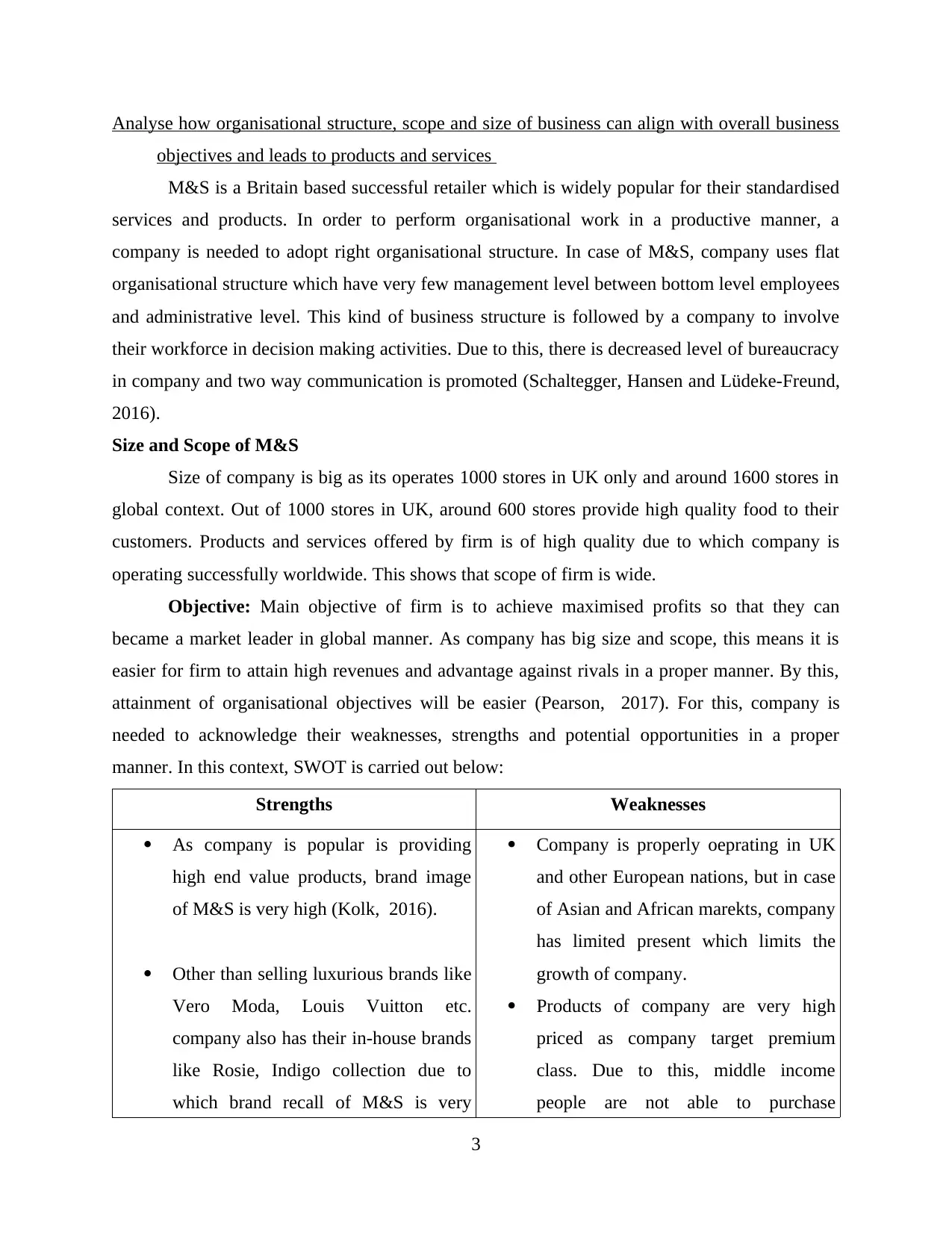
manner. In this context, SWOT is carried out below:
Strengths Weaknesses
As company is popular is providing
high end value products, brand image
of M&S is very high (Kolk, 2016).
Other than selling luxurious brands like
Vero Moda, Louis Vuitton etc.
company also has their in-house brands
like Rosie, Indigo collection due to
which brand recall of M&S is very
Company is properly oeprating in UK
and other European nations, but in case
of Asian and African marekts, company
has limited present which limits the
growth of company.
Products of company are very high
priced as company target premium
class. Due to this, middle income
people are not able to purchase
3
objectives and leads to products and services
M&S is a Britain based successful retailer which is widely popular for their standardised
services and products. In order to perform organisational work in a productive manner, a
company is needed to adopt right organisational structure. In case of M&S, company uses flat
organisational structure which have very few management level between bottom level employees
and administrative level. This kind of business structure is followed by a company to involve
their workforce in decision making activities. Due to this, there is decreased level of bureaucracy
in company and two way communication is promoted (Schaltegger, Hansen and Lüdeke-Freund,
2016).
Size and Scope of M&S
Size of company is big as its operates 1000 stores in UK only and around 1600 stores in
global context. Out of 1000 stores in UK, around 600 stores provide high quality food to their
customers. Products and services offered by firm is of high quality due to which company is
operating successfully worldwide. This shows that scope of firm is wide.
Objective: Main objective of firm is to achieve maximised profits so that they can
became a market leader in global manner. As company has big size and scope, this means it is
easier for firm to attain high revenues and advantage against rivals in a proper manner. By this,
attainment of organisational objectives will be easier (Pearson, 2017). For this, company is
needed to acknowledge their weaknesses, strengths and potential opportunities in a proper
manner. In this context, SWOT is carried out below:
Strengths Weaknesses
As company is popular is providing
high end value products, brand image
of M&S is very high (Kolk, 2016).
Other than selling luxurious brands like
Vero Moda, Louis Vuitton etc.
company also has their in-house brands
like Rosie, Indigo collection due to
which brand recall of M&S is very
Company is properly oeprating in UK
and other European nations, but in case
of Asian and African marekts, company
has limited present which limits the
growth of company.
Products of company are very high
priced as company target premium
class. Due to this, middle income
people are not able to purchase
3
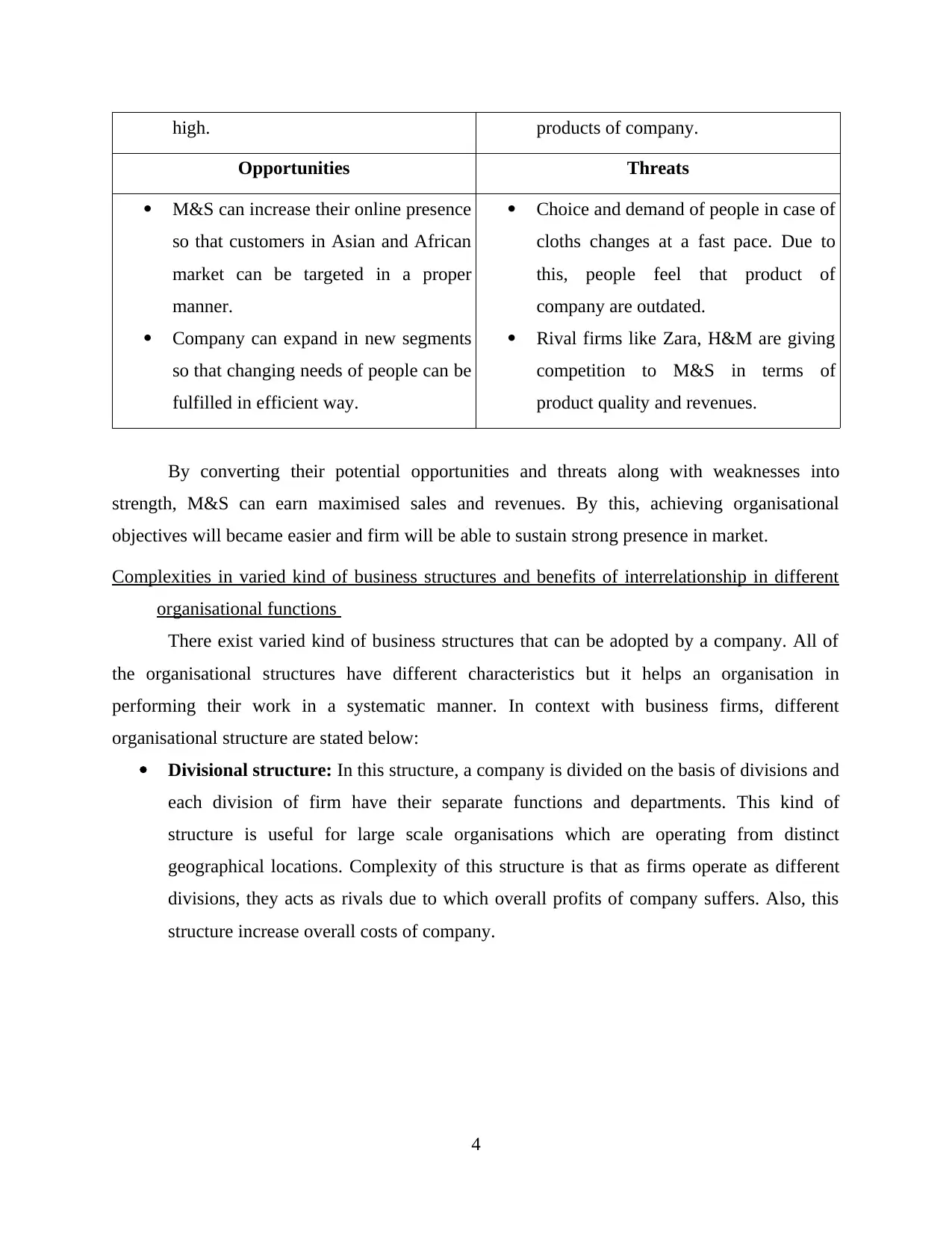
high. products of company.
Opportunities Threats
M&S can increase their online presence
so that customers in Asian and African
market can be targeted in a proper
manner.
Company can expand in new segments
so that changing needs of people can be
fulfilled in efficient way.
Choice and demand of people in case of
cloths changes at a fast pace. Due to
this, people feel that product of
company are outdated.
Rival firms like Zara, H&M are giving
competition to M&S in terms of
product quality and revenues.
By converting their potential opportunities and threats along with weaknesses into
strength, M&S can earn maximised sales and revenues. By this, achieving organisational
objectives will became easier and firm will be able to sustain strong presence in market.
Complexities in varied kind of business structures and benefits of interrelationship in different
organisational functions
There exist varied kind of business structures that can be adopted by a company. All of
the organisational structures have different characteristics but it helps an organisation in
performing their work in a systematic manner. In context with business firms, different
organisational structure are stated below:
Divisional structure: In this structure, a company is divided on the basis of divisions and
each division of firm have their separate functions and departments. This kind of
structure is useful for large scale organisations which are operating from distinct
geographical locations. Complexity of this structure is that as firms operate as different
divisions, they acts as rivals due to which overall profits of company suffers. Also, this
structure increase overall costs of company.
4
Opportunities Threats
M&S can increase their online presence
so that customers in Asian and African
market can be targeted in a proper
manner.
Company can expand in new segments
so that changing needs of people can be
fulfilled in efficient way.
Choice and demand of people in case of
cloths changes at a fast pace. Due to
this, people feel that product of
company are outdated.
Rival firms like Zara, H&M are giving
competition to M&S in terms of
product quality and revenues.
By converting their potential opportunities and threats along with weaknesses into
strength, M&S can earn maximised sales and revenues. By this, achieving organisational
objectives will became easier and firm will be able to sustain strong presence in market.
Complexities in varied kind of business structures and benefits of interrelationship in different
organisational functions
There exist varied kind of business structures that can be adopted by a company. All of
the organisational structures have different characteristics but it helps an organisation in
performing their work in a systematic manner. In context with business firms, different
organisational structure are stated below:
Divisional structure: In this structure, a company is divided on the basis of divisions and
each division of firm have their separate functions and departments. This kind of
structure is useful for large scale organisations which are operating from distinct
geographical locations. Complexity of this structure is that as firms operate as different
divisions, they acts as rivals due to which overall profits of company suffers. Also, this
structure increase overall costs of company.
4
⊘ This is a preview!⊘
Do you want full access?
Subscribe today to unlock all pages.
Trusted by 1+ million students worldwide
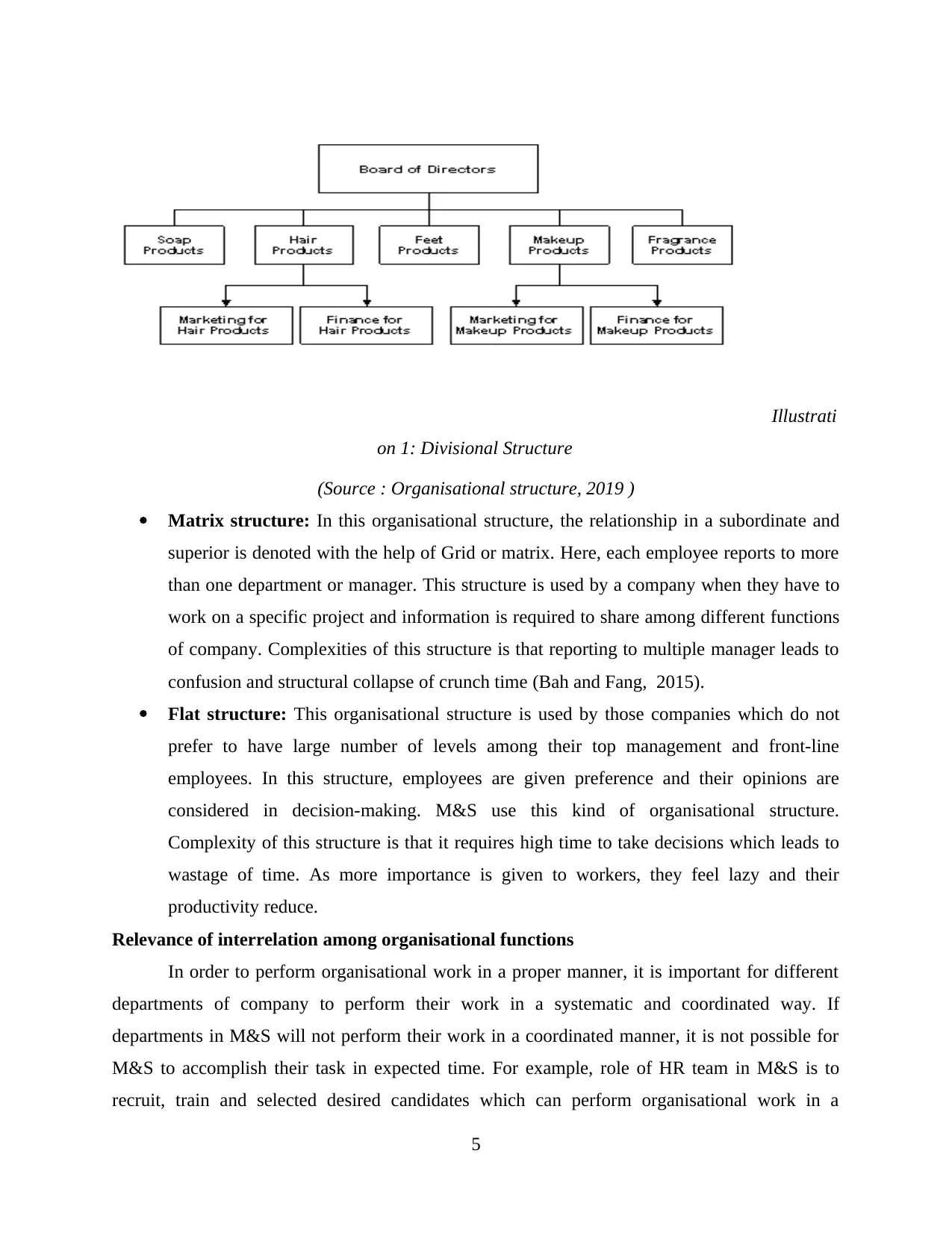
Illustrati
on 1: Divisional Structure
(Source : Organisational structure, 2019 )
Matrix structure: In this organisational structure, the relationship in a subordinate and
superior is denoted with the help of Grid or matrix. Here, each employee reports to more
than one department or manager. This structure is used by a company when they have to
work on a specific project and information is required to share among different functions
of company. Complexities of this structure is that reporting to multiple manager leads to
confusion and structural collapse of crunch time (Bah and Fang, 2015).
Flat structure: This organisational structure is used by those companies which do not
prefer to have large number of levels among their top management and front-line
employees. In this structure, employees are given preference and their opinions are
considered in decision-making. M&S use this kind of organisational structure.
Complexity of this structure is that it requires high time to take decisions which leads to
wastage of time. As more importance is given to workers, they feel lazy and their
productivity reduce.
Relevance of interrelation among organisational functions
In order to perform organisational work in a proper manner, it is important for different
departments of company to perform their work in a systematic and coordinated way. If
departments in M&S will not perform their work in a coordinated manner, it is not possible for
M&S to accomplish their task in expected time. For example, role of HR team in M&S is to
recruit, train and selected desired candidates which can perform organisational work in a
5
on 1: Divisional Structure
(Source : Organisational structure, 2019 )
Matrix structure: In this organisational structure, the relationship in a subordinate and
superior is denoted with the help of Grid or matrix. Here, each employee reports to more
than one department or manager. This structure is used by a company when they have to
work on a specific project and information is required to share among different functions
of company. Complexities of this structure is that reporting to multiple manager leads to
confusion and structural collapse of crunch time (Bah and Fang, 2015).
Flat structure: This organisational structure is used by those companies which do not
prefer to have large number of levels among their top management and front-line
employees. In this structure, employees are given preference and their opinions are
considered in decision-making. M&S use this kind of organisational structure.
Complexity of this structure is that it requires high time to take decisions which leads to
wastage of time. As more importance is given to workers, they feel lazy and their
productivity reduce.
Relevance of interrelation among organisational functions
In order to perform organisational work in a proper manner, it is important for different
departments of company to perform their work in a systematic and coordinated way. If
departments in M&S will not perform their work in a coordinated manner, it is not possible for
M&S to accomplish their task in expected time. For example, role of HR team in M&S is to
recruit, train and selected desired candidates which can perform organisational work in a
5
Paraphrase This Document
Need a fresh take? Get an instant paraphrase of this document with our AI Paraphraser
productive manner. For this, marketing team helps HR team in posting about vacant positions
due to which large number of applicants applies for job. Finance team provides funds to HR
team so that activities of recruitment and training can be carried out properly. In return HR team
provide skilled employees to Marketing and Finance team so that they can perform their work in
efficient way. This shows that all the departments in M&S are dependent on each other for their
smooth functioning. If these departments will not work in cooperation, their efficiency will
reduce and attainment of organisational goals will not be possible (Georgescu and Popescul,
2015).
CONCLUSION
This discussed report summarises that achieving competitive advantage in market place is
not an easier aspect. Different firms have varied strategies to achieve success and expected goals.
Private, voluntary and public sector posses different purpose , services, vision and objectives.
There are different kind of organisational structures which can be adopted by an organisation so
that all the work can be carried out in a systematic manner. Also, good relationship among
different departments of a company assure that all the work can be performed in a productive and
systematic manner so that high profits can be gained.
6
due to which large number of applicants applies for job. Finance team provides funds to HR
team so that activities of recruitment and training can be carried out properly. In return HR team
provide skilled employees to Marketing and Finance team so that they can perform their work in
efficient way. This shows that all the departments in M&S are dependent on each other for their
smooth functioning. If these departments will not work in cooperation, their efficiency will
reduce and attainment of organisational goals will not be possible (Georgescu and Popescul,
2015).
CONCLUSION
This discussed report summarises that achieving competitive advantage in market place is
not an easier aspect. Different firms have varied strategies to achieve success and expected goals.
Private, voluntary and public sector posses different purpose , services, vision and objectives.
There are different kind of organisational structures which can be adopted by an organisation so
that all the work can be carried out in a systematic manner. Also, good relationship among
different departments of a company assure that all the work can be performed in a productive and
systematic manner so that high profits can be gained.
6
REFERENCES
Books and Journals
Deshpande, A., 2018, November. Technology neutrality as a practice: A discussion of two UK
interventions on broadband and associated outcomes. In 2018 11th CMI International
Conference: Prospects and Challenges Towards Developing a Digital Economy within
the EU (pp. 1-6). IEEE.
Huang, H.C. and et. al. 2013. Overcoming organizational inertia to strengthen business model
innovation: An open innovation perspective. Journal of Organizational Change
Management, 26(6). pp.977-1002.
Wetherly, P., 2014. The business environment: themes and issues in a globalizing world. Oxford
University Press.Charter, M., 2017. Greener marketing: A responsible approach to
business. Routledge.
Georgescu, M. and Popescul, D., 2015. Social Media–the new paradigm of collaboration and
communication for business environment. Procedia Economics and Finance. 20.
pp.277-282.
Hillary, R. ed., 2017. Small and medium-sized enterprises and the environment: business
imperatives. Routledge.
Schaltegger, S., Hansen, E. G. and Lüdeke-Freund, F., 2016. Business models for sustainability:
Origins, present research, and future avenues.
Pearson, R., 2017. Business ethics as communication ethics: Public relations practice and the
idea of dialogue. In Public relations theory (pp. 111-131). Routledge.
Kolk, A., 2016. The social responsibility of international business: From ethics and the
environment to CSR and sustainable development. Journal of World Business. 51(1).
pp.23-34.
Georgescu, M. and Popescul, D., 2015. Social Media–the new paradigm of collaboration and
communication for business environment. Procedia Economics and Finance. 20.
pp.277-282.
Bah, E. H. and Fang, L., 2015. Impact of the business environment on output and productivity in
Africa. Journal of Development Economics. 114. pp.159-171.
Online
Analysing The Organisational Structure. 2019. [Online] Available
through<https://www.ukessays.com/essays/business/analysing-the-organizational-
structure-of-syngenta.php>
7
Books and Journals
Deshpande, A., 2018, November. Technology neutrality as a practice: A discussion of two UK
interventions on broadband and associated outcomes. In 2018 11th CMI International
Conference: Prospects and Challenges Towards Developing a Digital Economy within
the EU (pp. 1-6). IEEE.
Huang, H.C. and et. al. 2013. Overcoming organizational inertia to strengthen business model
innovation: An open innovation perspective. Journal of Organizational Change
Management, 26(6). pp.977-1002.
Wetherly, P., 2014. The business environment: themes and issues in a globalizing world. Oxford
University Press.Charter, M., 2017. Greener marketing: A responsible approach to
business. Routledge.
Georgescu, M. and Popescul, D., 2015. Social Media–the new paradigm of collaboration and
communication for business environment. Procedia Economics and Finance. 20.
pp.277-282.
Hillary, R. ed., 2017. Small and medium-sized enterprises and the environment: business
imperatives. Routledge.
Schaltegger, S., Hansen, E. G. and Lüdeke-Freund, F., 2016. Business models for sustainability:
Origins, present research, and future avenues.
Pearson, R., 2017. Business ethics as communication ethics: Public relations practice and the
idea of dialogue. In Public relations theory (pp. 111-131). Routledge.
Kolk, A., 2016. The social responsibility of international business: From ethics and the
environment to CSR and sustainable development. Journal of World Business. 51(1).
pp.23-34.
Georgescu, M. and Popescul, D., 2015. Social Media–the new paradigm of collaboration and
communication for business environment. Procedia Economics and Finance. 20.
pp.277-282.
Bah, E. H. and Fang, L., 2015. Impact of the business environment on output and productivity in
Africa. Journal of Development Economics. 114. pp.159-171.
Online
Analysing The Organisational Structure. 2019. [Online] Available
through<https://www.ukessays.com/essays/business/analysing-the-organizational-
structure-of-syngenta.php>
7
⊘ This is a preview!⊘
Do you want full access?
Subscribe today to unlock all pages.
Trusted by 1+ million students worldwide

1 out of 9


Related Documents


Your All-in-One AI-Powered Toolkit for Academic Success.
+13062052269
info@desklib.com
Available 24*7 on WhatsApp / Email
![[object Object]](/_next/static/media/star-bottom.7253800d.svg)
Unlock your academic potential
Copyright © 2020–2026 A2Z Services. All Rights Reserved. Developed and managed by ZUCOL.