Business Environment Analysis: M&S Macro and Internal Analysis
VerifiedAdded on 2020/11/23
|13
|3334
|382
Report
AI Summary
This report provides a comprehensive analysis of the business environment of Marks & Spencer (M&S). It begins with an introduction to the business environment and its key factors, including political, economic, social, technological, legal, and environmental (PESTLE) aspects. The report then examines the interrelation between different organizational departments within M&S, such as operations, human resources, marketing, research, and finance, and how these departments contribute to achieving organizational objectives. A PESTLE analysis is conducted to assess the impact of macro-environmental factors on M&S's business operations. Furthermore, a SWOT analysis is performed to identify the internal strengths and weaknesses of M&S, along with external opportunities and threats. The report also explores the relationship between M&S's strengths and weaknesses and external macro factors. The analysis considers M&S's organizational structure and its impact on business operations, along with the influence of social and technological factors. The report concludes with a summary of the key findings and implications for M&S's strategic decision-making.
Business Environment
1
1

Paraphrase This Document
Need a fresh take? Get an instant paraphrase of this document with our AI Paraphraser
Table of Contents
INTRODUCTION...........................................................................................................................4
TASK 1............................................................................................................................................4
Covered in PPT.......................................................................................................................4
TASK 2............................................................................................................................................4
P3 Interrelation between different organisational departments and their link to objectives. .4
TASK 3............................................................................................................................................7
P4 Impact of macro-environmental factors on business of an organisation...........................7
TASK 4............................................................................................................................................8
P5 Internal and external analysis of Marks & Spencer organisation......................................8
P7 Interrelation of Strength and weakness with external Macro factors .............11
CONCLUSION..............................................................................................................................11
REFERENCES..............................................................................................................................12
2
INTRODUCTION...........................................................................................................................4
TASK 1............................................................................................................................................4
Covered in PPT.......................................................................................................................4
TASK 2............................................................................................................................................4
P3 Interrelation between different organisational departments and their link to objectives. .4
TASK 3............................................................................................................................................7
P4 Impact of macro-environmental factors on business of an organisation...........................7
TASK 4............................................................................................................................................8
P5 Internal and external analysis of Marks & Spencer organisation......................................8
P7 Interrelation of Strength and weakness with external Macro factors .............11
CONCLUSION..............................................................................................................................11
REFERENCES..............................................................................................................................12
2
INTRODUCTION
Business environment is refers as such platform where large number of organisations are
established and performs their functions for earning profits and development of the community
as a whole. Running and managing of organisation is not easy task because many responsibilities
are attached with their functions which are needed to achieve effectively for the benefit of
stakeholders and society (Agarwal, Grassl and Pahl, 2012). Those factors which are present in
business environment includes political, economical, social, technological, legal and
environmental. All these factors and conditions are different in various nations. The major
impact is ascertained by such organisations that are having their operations in many countries. It
is the obligation upon manager of organisation is to consider these factors while preparing their
plans. It improves the internal strength of organisation which provides opportunity to them is to
expand their operations through satisfy the needs of large people of society. M&S is retail
organisation operates functions in many nations (Aterido, Hallward-Driemeier and Pagés, 2011).
The products provided by them include clothing, food and home products.
In the present explain about, organisations of different types along with their objectives,
scope and size of these type of companies and interrelationship between different types of
functions of organisation and their contribution in achievement of objectives. Also, PESTLE
analysis to ascertain the impact of different factors on organisational functions, SWOT analysis
for the purpose of identification of their strengths to grab the opportunities and relationship of
the external factors with the strength and weaknesses.
TASK 1
Covered in PPT
TASK 2
P3 Interrelation between different organisational departments and their link to objectives
3
Business environment is refers as such platform where large number of organisations are
established and performs their functions for earning profits and development of the community
as a whole. Running and managing of organisation is not easy task because many responsibilities
are attached with their functions which are needed to achieve effectively for the benefit of
stakeholders and society (Agarwal, Grassl and Pahl, 2012). Those factors which are present in
business environment includes political, economical, social, technological, legal and
environmental. All these factors and conditions are different in various nations. The major
impact is ascertained by such organisations that are having their operations in many countries. It
is the obligation upon manager of organisation is to consider these factors while preparing their
plans. It improves the internal strength of organisation which provides opportunity to them is to
expand their operations through satisfy the needs of large people of society. M&S is retail
organisation operates functions in many nations (Aterido, Hallward-Driemeier and Pagés, 2011).
The products provided by them include clothing, food and home products.
In the present explain about, organisations of different types along with their objectives,
scope and size of these type of companies and interrelationship between different types of
functions of organisation and their contribution in achievement of objectives. Also, PESTLE
analysis to ascertain the impact of different factors on organisational functions, SWOT analysis
for the purpose of identification of their strengths to grab the opportunities and relationship of
the external factors with the strength and weaknesses.
TASK 1
Covered in PPT
TASK 2
P3 Interrelation between different organisational departments and their link to objectives
3
⊘ This is a preview!⊘
Do you want full access?
Subscribe today to unlock all pages.

Trusted by 1+ million students worldwide
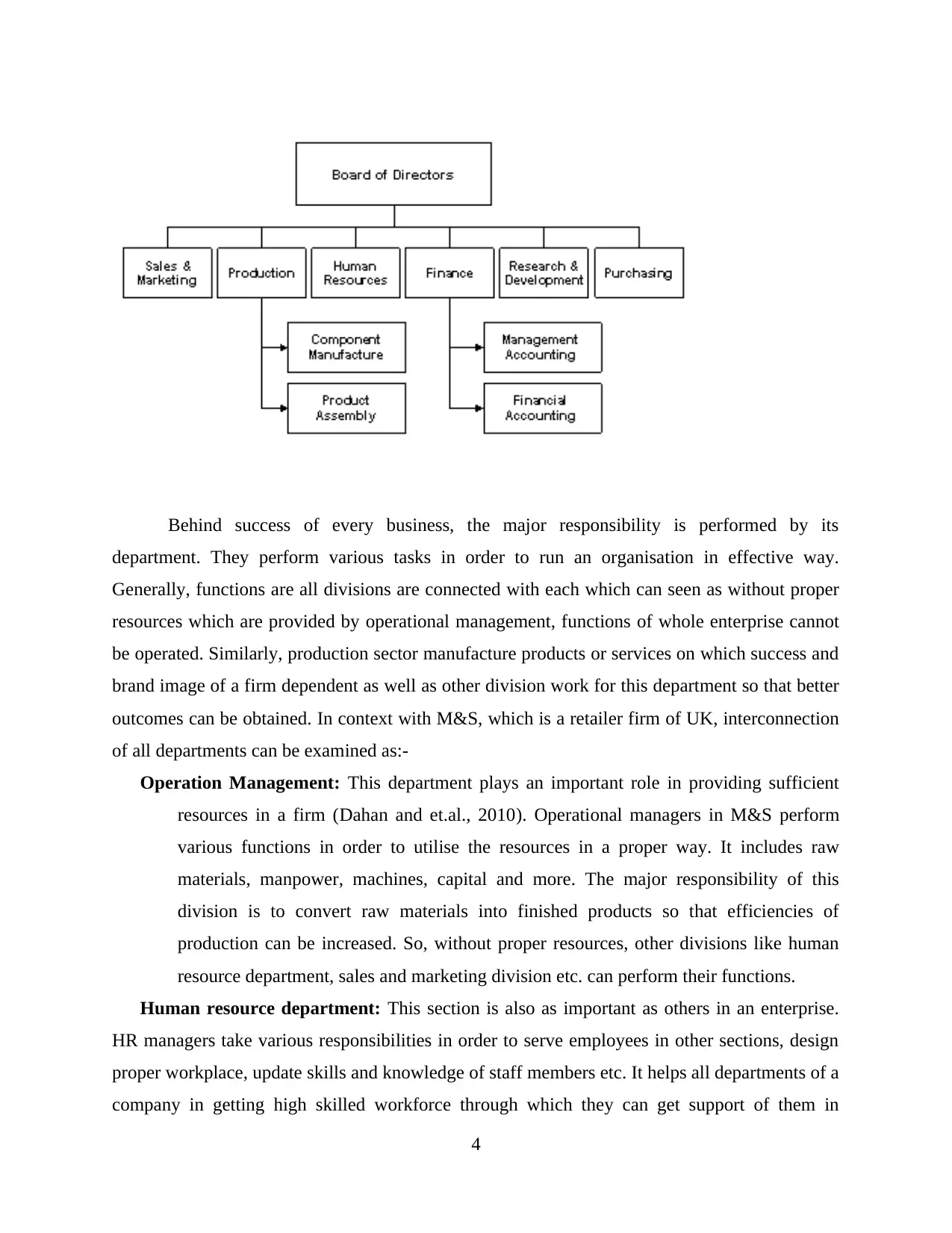
Behind success of every business, the major responsibility is performed by its
department. They perform various tasks in order to run an organisation in effective way.
Generally, functions are all divisions are connected with each which can seen as without proper
resources which are provided by operational management, functions of whole enterprise cannot
be operated. Similarly, production sector manufacture products or services on which success and
brand image of a firm dependent as well as other division work for this department so that better
outcomes can be obtained. In context with M&S, which is a retailer firm of UK, interconnection
of all departments can be examined as:-
Operation Management: This department plays an important role in providing sufficient
resources in a firm (Dahan and et.al., 2010). Operational managers in M&S perform
various functions in order to utilise the resources in a proper way. It includes raw
materials, manpower, machines, capital and more. The major responsibility of this
division is to convert raw materials into finished products so that efficiencies of
production can be increased. So, without proper resources, other divisions like human
resource department, sales and marketing division etc. can perform their functions.
Human resource department: This section is also as important as others in an enterprise.
HR managers take various responsibilities in order to serve employees in other sections, design
proper workplace, update skills and knowledge of staff members etc. It helps all departments of a
company in getting high skilled workforce through which they can get support of them in
4
department. They perform various tasks in order to run an organisation in effective way.
Generally, functions are all divisions are connected with each which can seen as without proper
resources which are provided by operational management, functions of whole enterprise cannot
be operated. Similarly, production sector manufacture products or services on which success and
brand image of a firm dependent as well as other division work for this department so that better
outcomes can be obtained. In context with M&S, which is a retailer firm of UK, interconnection
of all departments can be examined as:-
Operation Management: This department plays an important role in providing sufficient
resources in a firm (Dahan and et.al., 2010). Operational managers in M&S perform
various functions in order to utilise the resources in a proper way. It includes raw
materials, manpower, machines, capital and more. The major responsibility of this
division is to convert raw materials into finished products so that efficiencies of
production can be increased. So, without proper resources, other divisions like human
resource department, sales and marketing division etc. can perform their functions.
Human resource department: This section is also as important as others in an enterprise.
HR managers take various responsibilities in order to serve employees in other sections, design
proper workplace, update skills and knowledge of staff members etc. It helps all departments of a
company in getting high skilled workforce through which they can get support of them in
4
Paraphrase This Document
Need a fresh take? Get an instant paraphrase of this document with our AI Paraphraser
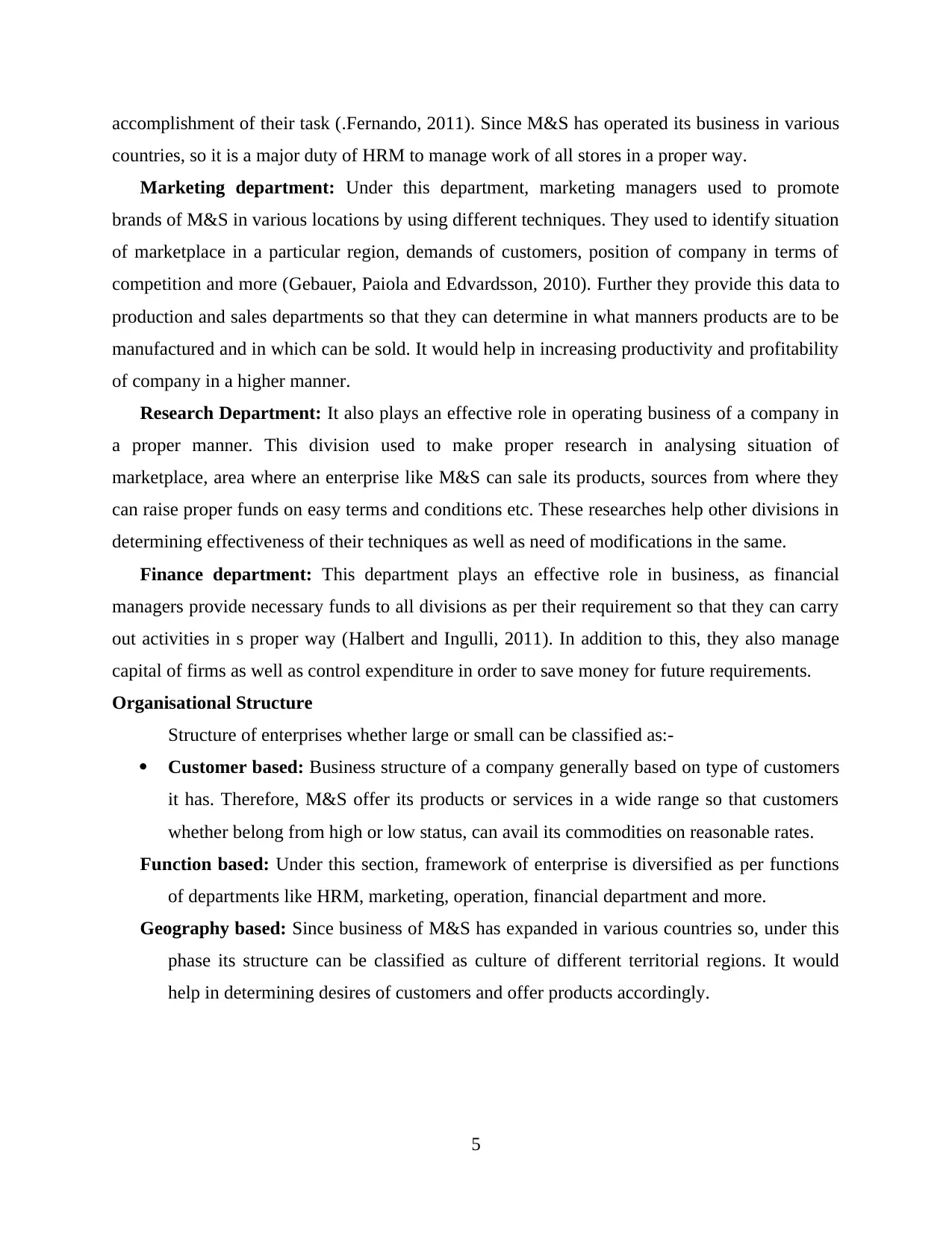
accomplishment of their task (.Fernando, 2011). Since M&S has operated its business in various
countries, so it is a major duty of HRM to manage work of all stores in a proper way.
Marketing department: Under this department, marketing managers used to promote
brands of M&S in various locations by using different techniques. They used to identify situation
of marketplace in a particular region, demands of customers, position of company in terms of
competition and more (Gebauer, Paiola and Edvardsson, 2010). Further they provide this data to
production and sales departments so that they can determine in what manners products are to be
manufactured and in which can be sold. It would help in increasing productivity and profitability
of company in a higher manner.
Research Department: It also plays an effective role in operating business of a company in
a proper manner. This division used to make proper research in analysing situation of
marketplace, area where an enterprise like M&S can sale its products, sources from where they
can raise proper funds on easy terms and conditions etc. These researches help other divisions in
determining effectiveness of their techniques as well as need of modifications in the same.
Finance department: This department plays an effective role in business, as financial
managers provide necessary funds to all divisions as per their requirement so that they can carry
out activities in s proper way (Halbert and Ingulli, 2011). In addition to this, they also manage
capital of firms as well as control expenditure in order to save money for future requirements.
Organisational Structure
Structure of enterprises whether large or small can be classified as:-
Customer based: Business structure of a company generally based on type of customers
it has. Therefore, M&S offer its products or services in a wide range so that customers
whether belong from high or low status, can avail its commodities on reasonable rates.
Function based: Under this section, framework of enterprise is diversified as per functions
of departments like HRM, marketing, operation, financial department and more.
Geography based: Since business of M&S has expanded in various countries so, under this
phase its structure can be classified as culture of different territorial regions. It would
help in determining desires of customers and offer products accordingly.
5
countries, so it is a major duty of HRM to manage work of all stores in a proper way.
Marketing department: Under this department, marketing managers used to promote
brands of M&S in various locations by using different techniques. They used to identify situation
of marketplace in a particular region, demands of customers, position of company in terms of
competition and more (Gebauer, Paiola and Edvardsson, 2010). Further they provide this data to
production and sales departments so that they can determine in what manners products are to be
manufactured and in which can be sold. It would help in increasing productivity and profitability
of company in a higher manner.
Research Department: It also plays an effective role in operating business of a company in
a proper manner. This division used to make proper research in analysing situation of
marketplace, area where an enterprise like M&S can sale its products, sources from where they
can raise proper funds on easy terms and conditions etc. These researches help other divisions in
determining effectiveness of their techniques as well as need of modifications in the same.
Finance department: This department plays an effective role in business, as financial
managers provide necessary funds to all divisions as per their requirement so that they can carry
out activities in s proper way (Halbert and Ingulli, 2011). In addition to this, they also manage
capital of firms as well as control expenditure in order to save money for future requirements.
Organisational Structure
Structure of enterprises whether large or small can be classified as:-
Customer based: Business structure of a company generally based on type of customers
it has. Therefore, M&S offer its products or services in a wide range so that customers
whether belong from high or low status, can avail its commodities on reasonable rates.
Function based: Under this section, framework of enterprise is diversified as per functions
of departments like HRM, marketing, operation, financial department and more.
Geography based: Since business of M&S has expanded in various countries so, under this
phase its structure can be classified as culture of different territorial regions. It would
help in determining desires of customers and offer products accordingly.
5
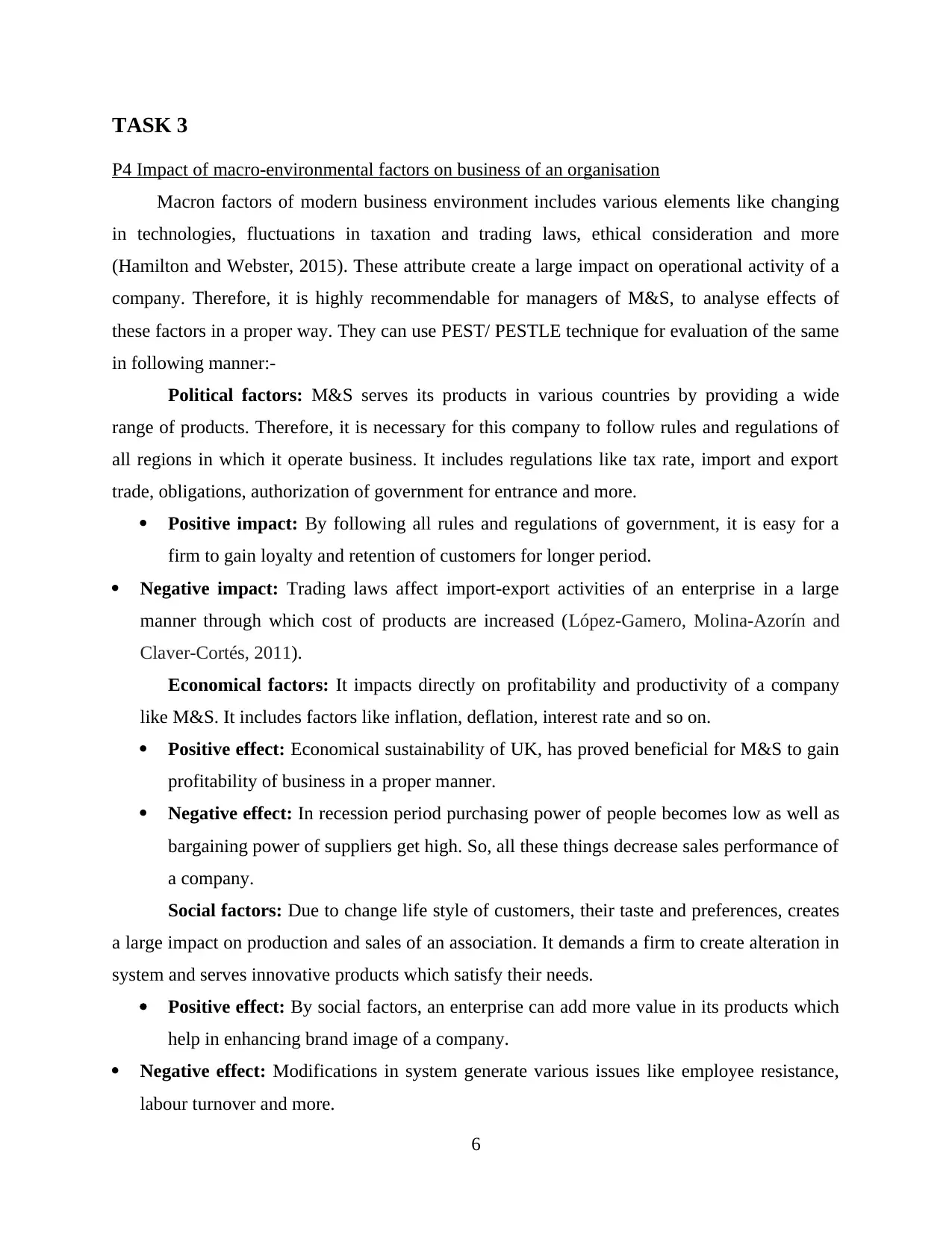
TASK 3
P4 Impact of macro-environmental factors on business of an organisation
Macron factors of modern business environment includes various elements like changing
in technologies, fluctuations in taxation and trading laws, ethical consideration and more
(Hamilton and Webster, 2015). These attribute create a large impact on operational activity of a
company. Therefore, it is highly recommendable for managers of M&S, to analyse effects of
these factors in a proper way. They can use PEST/ PESTLE technique for evaluation of the same
in following manner:-
Political factors: M&S serves its products in various countries by providing a wide
range of products. Therefore, it is necessary for this company to follow rules and regulations of
all regions in which it operate business. It includes regulations like tax rate, import and export
trade, obligations, authorization of government for entrance and more.
Positive impact: By following all rules and regulations of government, it is easy for a
firm to gain loyalty and retention of customers for longer period.
Negative impact: Trading laws affect import-export activities of an enterprise in a large
manner through which cost of products are increased (López-Gamero, Molina-Azorín and
Claver-Cortés, 2011).
Economical factors: It impacts directly on profitability and productivity of a company
like M&S. It includes factors like inflation, deflation, interest rate and so on.
Positive effect: Economical sustainability of UK, has proved beneficial for M&S to gain
profitability of business in a proper manner.
Negative effect: In recession period purchasing power of people becomes low as well as
bargaining power of suppliers get high. So, all these things decrease sales performance of
a company.
Social factors: Due to change life style of customers, their taste and preferences, creates
a large impact on production and sales of an association. It demands a firm to create alteration in
system and serves innovative products which satisfy their needs.
Positive effect: By social factors, an enterprise can add more value in its products which
help in enhancing brand image of a company.
Negative effect: Modifications in system generate various issues like employee resistance,
labour turnover and more.
6
P4 Impact of macro-environmental factors on business of an organisation
Macron factors of modern business environment includes various elements like changing
in technologies, fluctuations in taxation and trading laws, ethical consideration and more
(Hamilton and Webster, 2015). These attribute create a large impact on operational activity of a
company. Therefore, it is highly recommendable for managers of M&S, to analyse effects of
these factors in a proper way. They can use PEST/ PESTLE technique for evaluation of the same
in following manner:-
Political factors: M&S serves its products in various countries by providing a wide
range of products. Therefore, it is necessary for this company to follow rules and regulations of
all regions in which it operate business. It includes regulations like tax rate, import and export
trade, obligations, authorization of government for entrance and more.
Positive impact: By following all rules and regulations of government, it is easy for a
firm to gain loyalty and retention of customers for longer period.
Negative impact: Trading laws affect import-export activities of an enterprise in a large
manner through which cost of products are increased (López-Gamero, Molina-Azorín and
Claver-Cortés, 2011).
Economical factors: It impacts directly on profitability and productivity of a company
like M&S. It includes factors like inflation, deflation, interest rate and so on.
Positive effect: Economical sustainability of UK, has proved beneficial for M&S to gain
profitability of business in a proper manner.
Negative effect: In recession period purchasing power of people becomes low as well as
bargaining power of suppliers get high. So, all these things decrease sales performance of
a company.
Social factors: Due to change life style of customers, their taste and preferences, creates
a large impact on production and sales of an association. It demands a firm to create alteration in
system and serves innovative products which satisfy their needs.
Positive effect: By social factors, an enterprise can add more value in its products which
help in enhancing brand image of a company.
Negative effect: Modifications in system generate various issues like employee resistance,
labour turnover and more.
6
⊘ This is a preview!⊘
Do you want full access?
Subscribe today to unlock all pages.
Trusted by 1+ million students worldwide
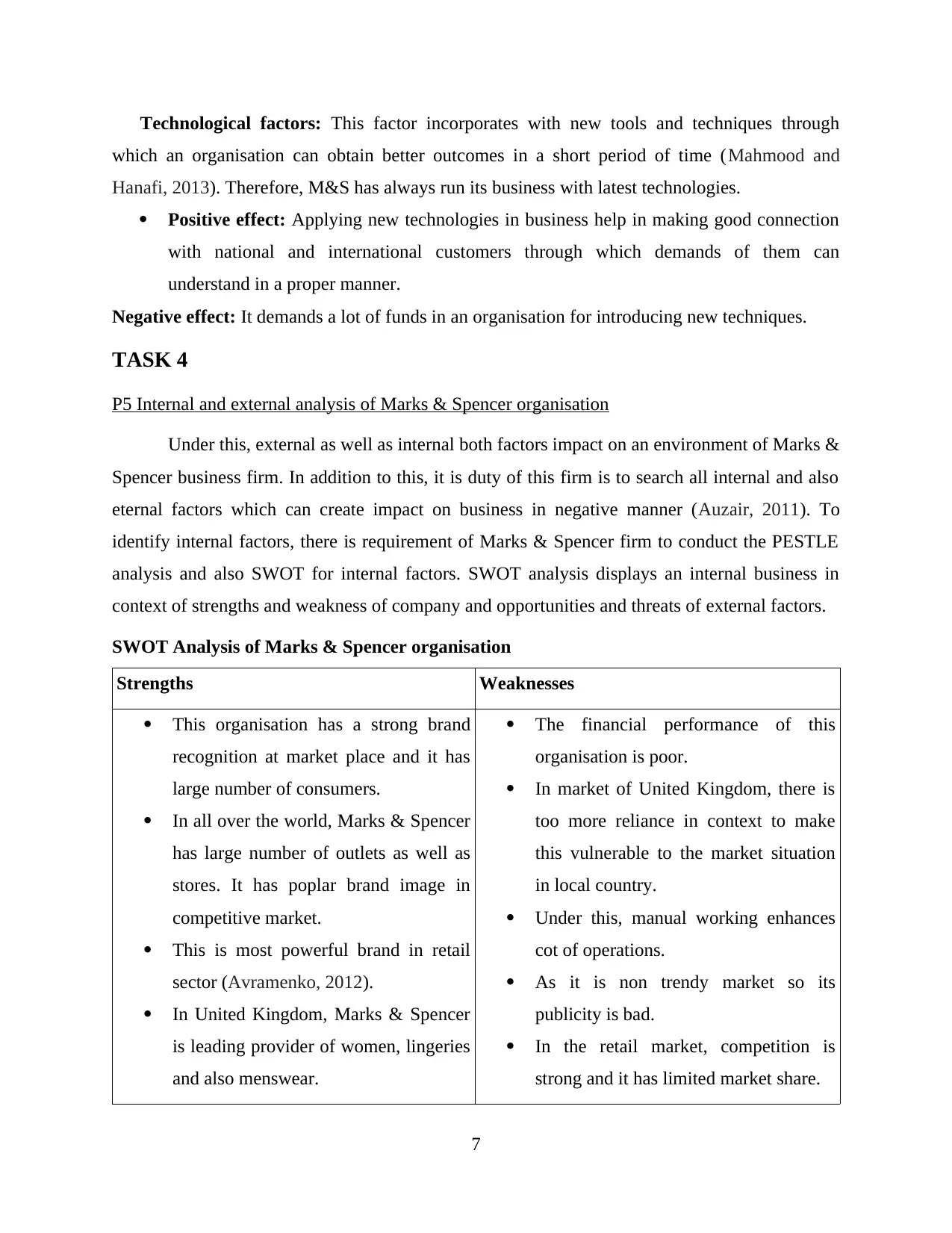
Technological factors: This factor incorporates with new tools and techniques through
which an organisation can obtain better outcomes in a short period of time (Mahmood and
Hanafi, 2013). Therefore, M&S has always run its business with latest technologies.
Positive effect: Applying new technologies in business help in making good connection
with national and international customers through which demands of them can
understand in a proper manner.
Negative effect: It demands a lot of funds in an organisation for introducing new techniques.
TASK 4
P5 Internal and external analysis of Marks & Spencer organisation
Under this, external as well as internal both factors impact on an environment of Marks &
Spencer business firm. In addition to this, it is duty of this firm is to search all internal and also
eternal factors which can create impact on business in negative manner (Auzair, 2011). To
identify internal factors, there is requirement of Marks & Spencer firm to conduct the PESTLE
analysis and also SWOT for internal factors. SWOT analysis displays an internal business in
context of strengths and weakness of company and opportunities and threats of external factors.
SWOT Analysis of Marks & Spencer organisation
Strengths Weaknesses
This organisation has a strong brand
recognition at market place and it has
large number of consumers.
In all over the world, Marks & Spencer
has large number of outlets as well as
stores. It has poplar brand image in
competitive market.
This is most powerful brand in retail
sector (Avramenko, 2012).
In United Kingdom, Marks & Spencer
is leading provider of women, lingeries
and also menswear.
The financial performance of this
organisation is poor.
In market of United Kingdom, there is
too more reliance in context to make
this vulnerable to the market situation
in local country.
Under this, manual working enhances
cot of operations.
As it is non trendy market so its
publicity is bad.
In the retail market, competition is
strong and it has limited market share.
7
which an organisation can obtain better outcomes in a short period of time (Mahmood and
Hanafi, 2013). Therefore, M&S has always run its business with latest technologies.
Positive effect: Applying new technologies in business help in making good connection
with national and international customers through which demands of them can
understand in a proper manner.
Negative effect: It demands a lot of funds in an organisation for introducing new techniques.
TASK 4
P5 Internal and external analysis of Marks & Spencer organisation
Under this, external as well as internal both factors impact on an environment of Marks &
Spencer business firm. In addition to this, it is duty of this firm is to search all internal and also
eternal factors which can create impact on business in negative manner (Auzair, 2011). To
identify internal factors, there is requirement of Marks & Spencer firm to conduct the PESTLE
analysis and also SWOT for internal factors. SWOT analysis displays an internal business in
context of strengths and weakness of company and opportunities and threats of external factors.
SWOT Analysis of Marks & Spencer organisation
Strengths Weaknesses
This organisation has a strong brand
recognition at market place and it has
large number of consumers.
In all over the world, Marks & Spencer
has large number of outlets as well as
stores. It has poplar brand image in
competitive market.
This is most powerful brand in retail
sector (Avramenko, 2012).
In United Kingdom, Marks & Spencer
is leading provider of women, lingeries
and also menswear.
The financial performance of this
organisation is poor.
In market of United Kingdom, there is
too more reliance in context to make
this vulnerable to the market situation
in local country.
Under this, manual working enhances
cot of operations.
As it is non trendy market so its
publicity is bad.
In the retail market, competition is
strong and it has limited market share.
7
Paraphrase This Document
Need a fresh take? Get an instant paraphrase of this document with our AI Paraphraser
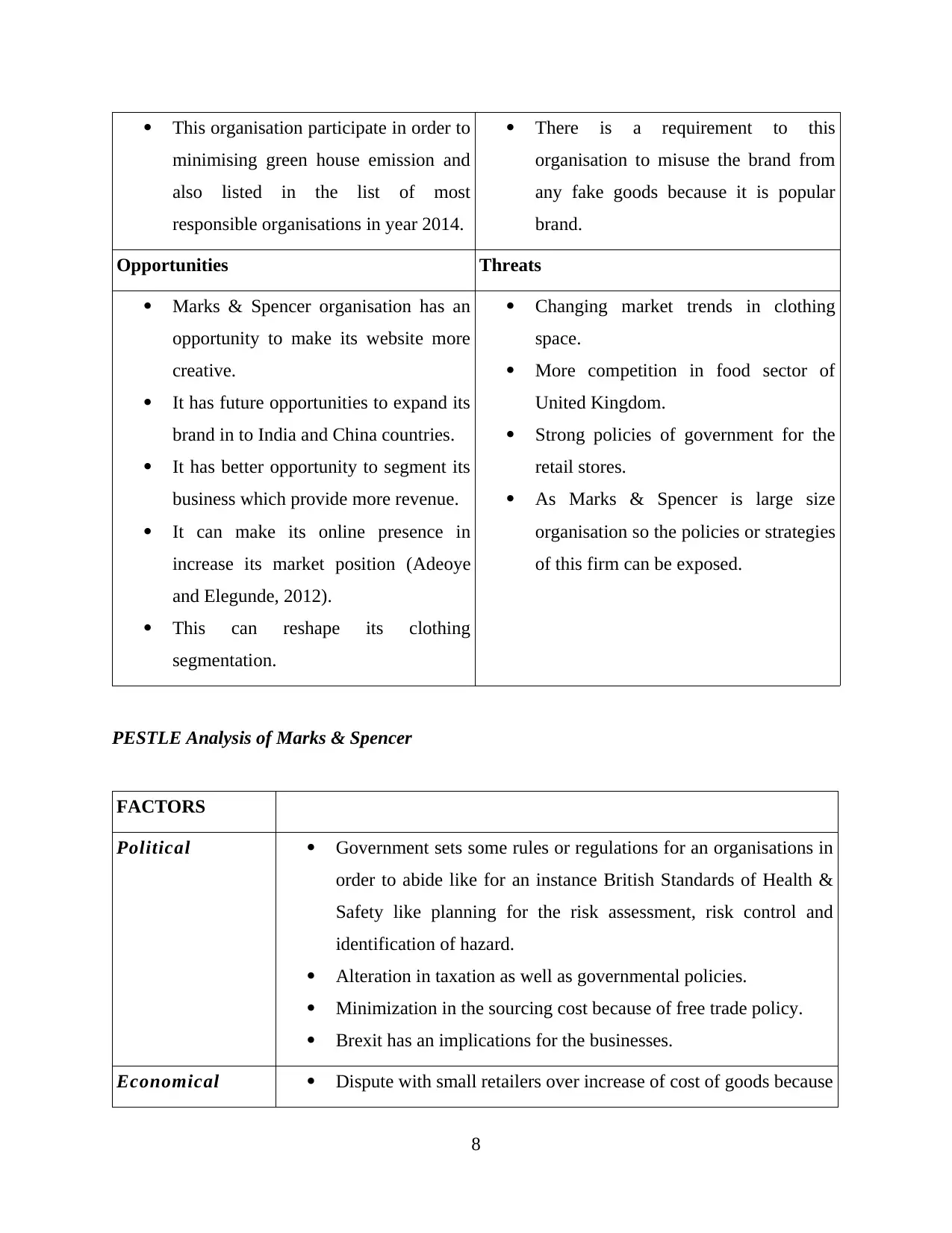
This organisation participate in order to
minimising green house emission and
also listed in the list of most
responsible organisations in year 2014.
There is a requirement to this
organisation to misuse the brand from
any fake goods because it is popular
brand.
Opportunities Threats
Marks & Spencer organisation has an
opportunity to make its website more
creative.
It has future opportunities to expand its
brand in to India and China countries.
It has better opportunity to segment its
business which provide more revenue.
It can make its online presence in
increase its market position (Adeoye
and Elegunde, 2012).
This can reshape its clothing
segmentation.
Changing market trends in clothing
space.
More competition in food sector of
United Kingdom.
Strong policies of government for the
retail stores.
As Marks & Spencer is large size
organisation so the policies or strategies
of this firm can be exposed.
PESTLE Analysis of Marks & Spencer
FACTORS
Political Government sets some rules or regulations for an organisations in
order to abide like for an instance British Standards of Health &
Safety like planning for the risk assessment, risk control and
identification of hazard.
Alteration in taxation as well as governmental policies.
Minimization in the sourcing cost because of free trade policy.
Brexit has an implications for the businesses.
Economical Dispute with small retailers over increase of cost of goods because
8
minimising green house emission and
also listed in the list of most
responsible organisations in year 2014.
There is a requirement to this
organisation to misuse the brand from
any fake goods because it is popular
brand.
Opportunities Threats
Marks & Spencer organisation has an
opportunity to make its website more
creative.
It has future opportunities to expand its
brand in to India and China countries.
It has better opportunity to segment its
business which provide more revenue.
It can make its online presence in
increase its market position (Adeoye
and Elegunde, 2012).
This can reshape its clothing
segmentation.
Changing market trends in clothing
space.
More competition in food sector of
United Kingdom.
Strong policies of government for the
retail stores.
As Marks & Spencer is large size
organisation so the policies or strategies
of this firm can be exposed.
PESTLE Analysis of Marks & Spencer
FACTORS
Political Government sets some rules or regulations for an organisations in
order to abide like for an instance British Standards of Health &
Safety like planning for the risk assessment, risk control and
identification of hazard.
Alteration in taxation as well as governmental policies.
Minimization in the sourcing cost because of free trade policy.
Brexit has an implications for the businesses.
Economical Dispute with small retailers over increase of cost of goods because
8
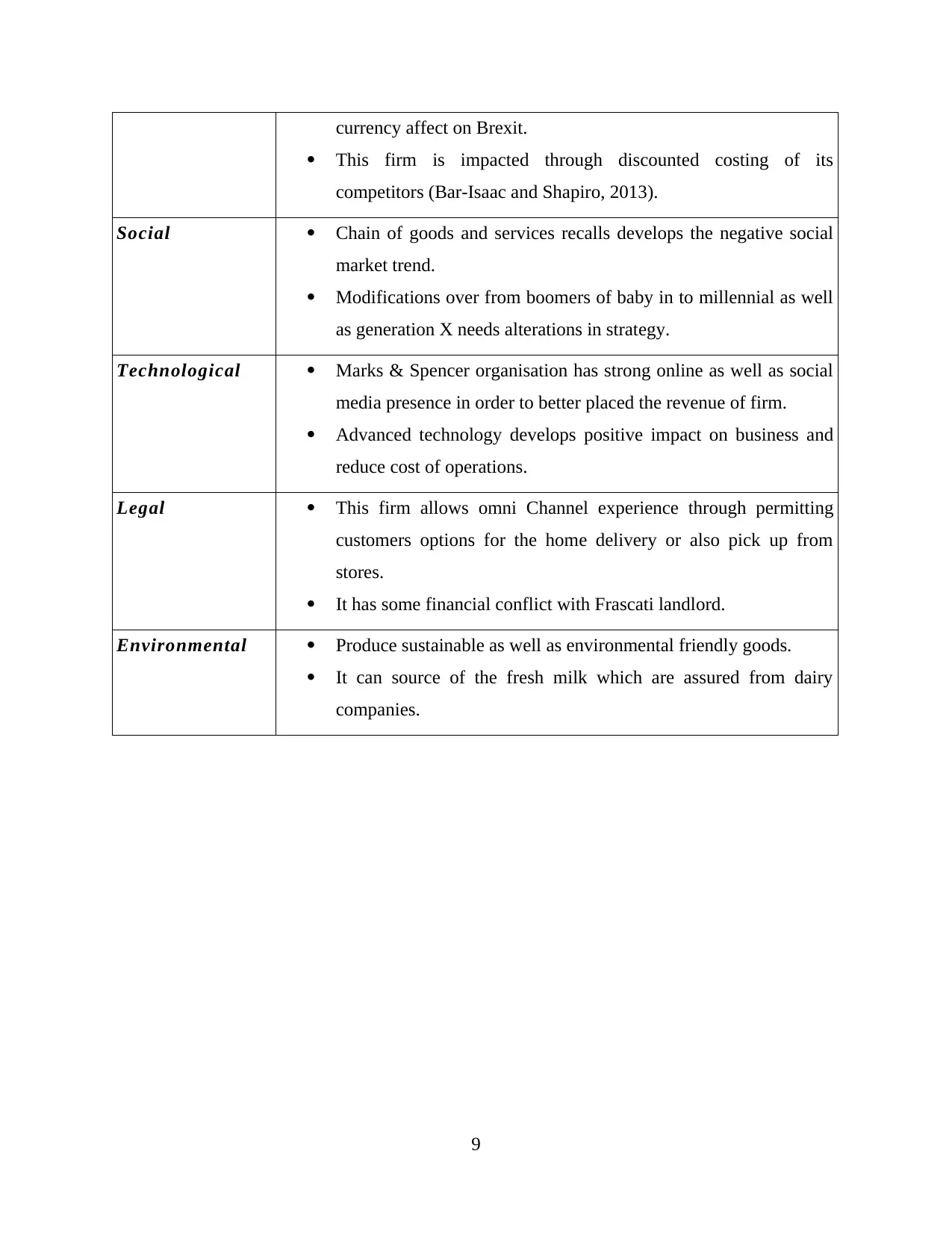
currency affect on Brexit.
This firm is impacted through discounted costing of its
competitors (Bar-Isaac and Shapiro, 2013).
Social Chain of goods and services recalls develops the negative social
market trend.
Modifications over from boomers of baby in to millennial as well
as generation X needs alterations in strategy.
Technological Marks & Spencer organisation has strong online as well as social
media presence in order to better placed the revenue of firm.
Advanced technology develops positive impact on business and
reduce cost of operations.
Legal This firm allows omni Channel experience through permitting
customers options for the home delivery or also pick up from
stores.
It has some financial conflict with Frascati landlord.
Environmental Produce sustainable as well as environmental friendly goods.
It can source of the fresh milk which are assured from dairy
companies.
9
This firm is impacted through discounted costing of its
competitors (Bar-Isaac and Shapiro, 2013).
Social Chain of goods and services recalls develops the negative social
market trend.
Modifications over from boomers of baby in to millennial as well
as generation X needs alterations in strategy.
Technological Marks & Spencer organisation has strong online as well as social
media presence in order to better placed the revenue of firm.
Advanced technology develops positive impact on business and
reduce cost of operations.
Legal This firm allows omni Channel experience through permitting
customers options for the home delivery or also pick up from
stores.
It has some financial conflict with Frascati landlord.
Environmental Produce sustainable as well as environmental friendly goods.
It can source of the fresh milk which are assured from dairy
companies.
9
⊘ This is a preview!⊘
Do you want full access?
Subscribe today to unlock all pages.
Trusted by 1+ million students worldwide
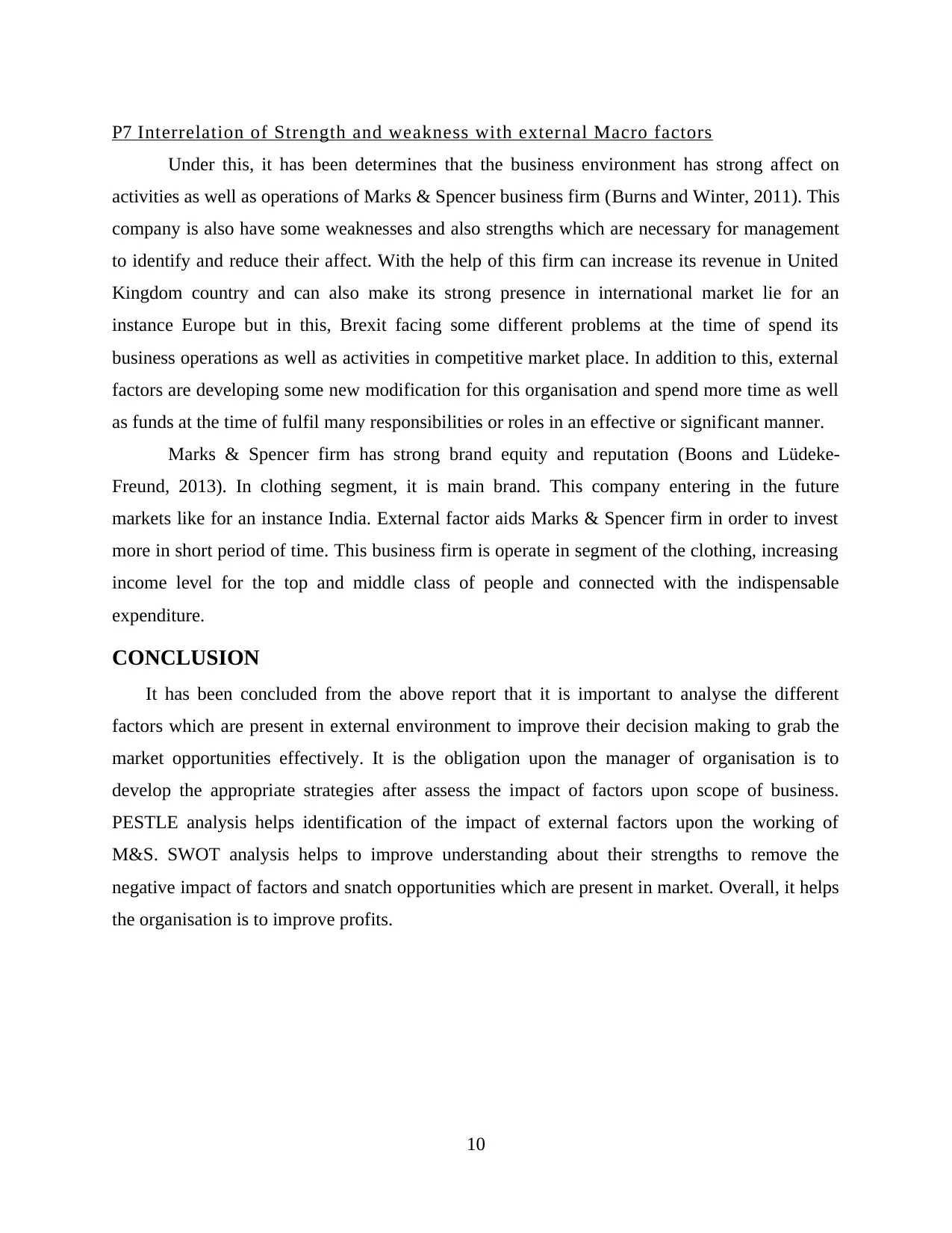
P7 Interrelation of Strength and weakness with external Macro factors
Under this, it has been determines that the business environment has strong affect on
activities as well as operations of Marks & Spencer business firm (Burns and Winter, 2011). This
company is also have some weaknesses and also strengths which are necessary for management
to identify and reduce their affect. With the help of this firm can increase its revenue in United
Kingdom country and can also make its strong presence in international market lie for an
instance Europe but in this, Brexit facing some different problems at the time of spend its
business operations as well as activities in competitive market place. In addition to this, external
factors are developing some new modification for this organisation and spend more time as well
as funds at the time of fulfil many responsibilities or roles in an effective or significant manner.
Marks & Spencer firm has strong brand equity and reputation (Boons and Lüdeke-
Freund, 2013). In clothing segment, it is main brand. This company entering in the future
markets like for an instance India. External factor aids Marks & Spencer firm in order to invest
more in short period of time. This business firm is operate in segment of the clothing, increasing
income level for the top and middle class of people and connected with the indispensable
expenditure.
CONCLUSION
It has been concluded from the above report that it is important to analyse the different
factors which are present in external environment to improve their decision making to grab the
market opportunities effectively. It is the obligation upon the manager of organisation is to
develop the appropriate strategies after assess the impact of factors upon scope of business.
PESTLE analysis helps identification of the impact of external factors upon the working of
M&S. SWOT analysis helps to improve understanding about their strengths to remove the
negative impact of factors and snatch opportunities which are present in market. Overall, it helps
the organisation is to improve profits.
10
Under this, it has been determines that the business environment has strong affect on
activities as well as operations of Marks & Spencer business firm (Burns and Winter, 2011). This
company is also have some weaknesses and also strengths which are necessary for management
to identify and reduce their affect. With the help of this firm can increase its revenue in United
Kingdom country and can also make its strong presence in international market lie for an
instance Europe but in this, Brexit facing some different problems at the time of spend its
business operations as well as activities in competitive market place. In addition to this, external
factors are developing some new modification for this organisation and spend more time as well
as funds at the time of fulfil many responsibilities or roles in an effective or significant manner.
Marks & Spencer firm has strong brand equity and reputation (Boons and Lüdeke-
Freund, 2013). In clothing segment, it is main brand. This company entering in the future
markets like for an instance India. External factor aids Marks & Spencer firm in order to invest
more in short period of time. This business firm is operate in segment of the clothing, increasing
income level for the top and middle class of people and connected with the indispensable
expenditure.
CONCLUSION
It has been concluded from the above report that it is important to analyse the different
factors which are present in external environment to improve their decision making to grab the
market opportunities effectively. It is the obligation upon the manager of organisation is to
develop the appropriate strategies after assess the impact of factors upon scope of business.
PESTLE analysis helps identification of the impact of external factors upon the working of
M&S. SWOT analysis helps to improve understanding about their strengths to remove the
negative impact of factors and snatch opportunities which are present in market. Overall, it helps
the organisation is to improve profits.
10
Paraphrase This Document
Need a fresh take? Get an instant paraphrase of this document with our AI Paraphraser
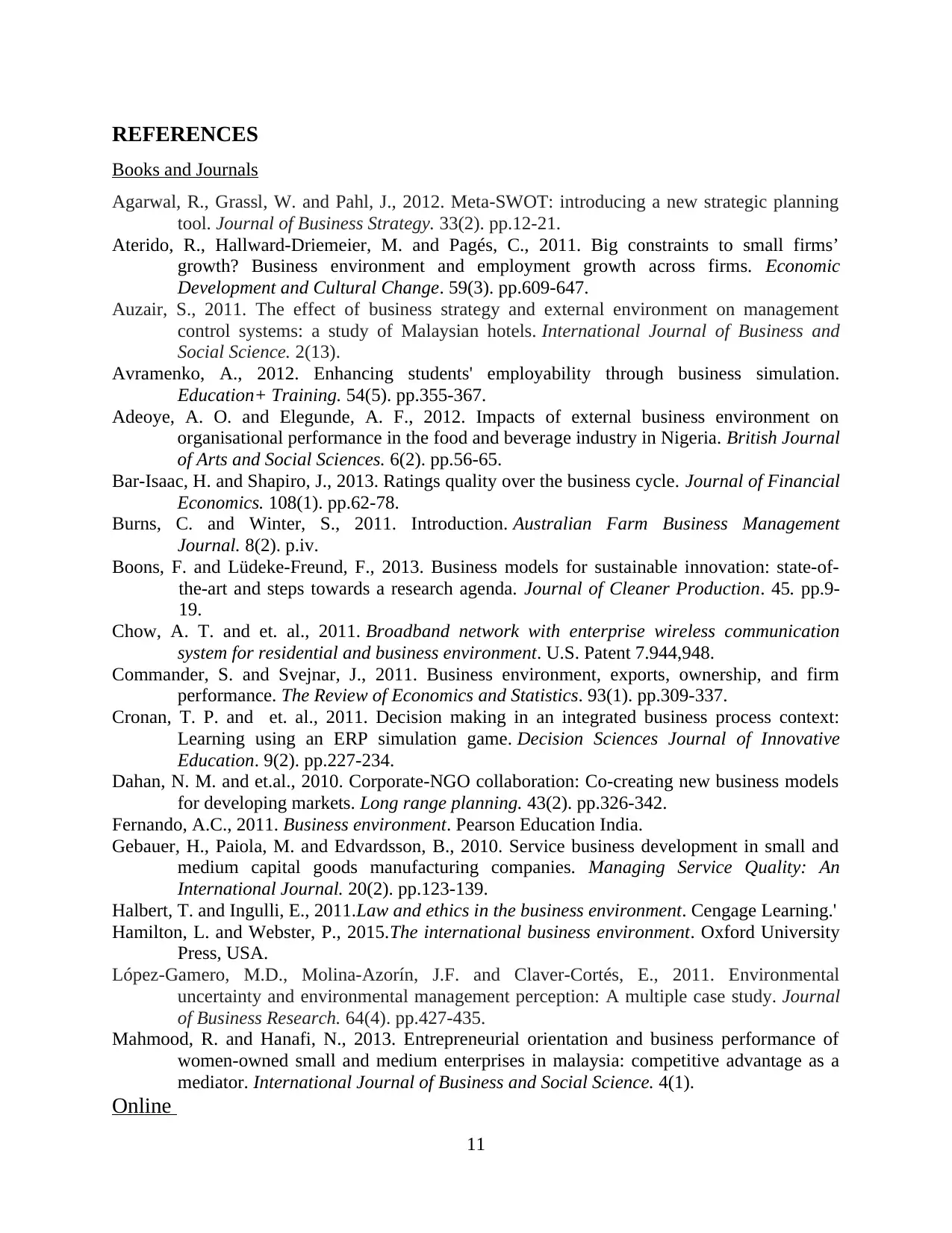
REFERENCES
Books and Journals
Agarwal, R., Grassl, W. and Pahl, J., 2012. Meta-SWOT: introducing a new strategic planning
tool. Journal of Business Strategy. 33(2). pp.12-21.
Aterido, R., Hallward-Driemeier, M. and Pagés, C., 2011. Big constraints to small firms’
growth? Business environment and employment growth across firms. Economic
Development and Cultural Change. 59(3). pp.609-647.
Auzair, S., 2011. The effect of business strategy and external environment on management
control systems: a study of Malaysian hotels. International Journal of Business and
Social Science. 2(13).
Avramenko, A., 2012. Enhancing students' employability through business simulation.
Education+ Training. 54(5). pp.355-367.
Adeoye, A. O. and Elegunde, A. F., 2012. Impacts of external business environment on
organisational performance in the food and beverage industry in Nigeria. British Journal
of Arts and Social Sciences. 6(2). pp.56-65.
Bar-Isaac, H. and Shapiro, J., 2013. Ratings quality over the business cycle. Journal of Financial
Economics. 108(1). pp.62-78.
Burns, C. and Winter, S., 2011. Introduction. Australian Farm Business Management
Journal. 8(2). p.iv.
Boons, F. and Lüdeke-Freund, F., 2013. Business models for sustainable innovation: state-of-
the-art and steps towards a research agenda. Journal of Cleaner Production. 45. pp.9-
19.
Chow, A. T. and et. al., 2011. Broadband network with enterprise wireless communication
system for residential and business environment. U.S. Patent 7.944,948.
Commander, S. and Svejnar, J., 2011. Business environment, exports, ownership, and firm
performance. The Review of Economics and Statistics. 93(1). pp.309-337.
Cronan, T. P. and et. al., 2011. Decision making in an integrated business process context:
Learning using an ERP simulation game. Decision Sciences Journal of Innovative
Education. 9(2). pp.227-234.
Dahan, N. M. and et.al., 2010. Corporate-NGO collaboration: Co-creating new business models
for developing markets. Long range planning. 43(2). pp.326-342.
Fernando, A.C., 2011. Business environment. Pearson Education India.
Gebauer, H., Paiola, M. and Edvardsson, B., 2010. Service business development in small and
medium capital goods manufacturing companies. Managing Service Quality: An
International Journal. 20(2). pp.123-139.
Halbert, T. and Ingulli, E., 2011.Law and ethics in the business environment. Cengage Learning.'
Hamilton, L. and Webster, P., 2015.The international business environment. Oxford University
Press, USA.
López-Gamero, M.D., Molina-Azorín, J.F. and Claver-Cortés, E., 2011. Environmental
uncertainty and environmental management perception: A multiple case study. Journal
of Business Research. 64(4). pp.427-435.
Mahmood, R. and Hanafi, N., 2013. Entrepreneurial orientation and business performance of
women-owned small and medium enterprises in malaysia: competitive advantage as a
mediator. International Journal of Business and Social Science. 4(1).
Online
11
Books and Journals
Agarwal, R., Grassl, W. and Pahl, J., 2012. Meta-SWOT: introducing a new strategic planning
tool. Journal of Business Strategy. 33(2). pp.12-21.
Aterido, R., Hallward-Driemeier, M. and Pagés, C., 2011. Big constraints to small firms’
growth? Business environment and employment growth across firms. Economic
Development and Cultural Change. 59(3). pp.609-647.
Auzair, S., 2011. The effect of business strategy and external environment on management
control systems: a study of Malaysian hotels. International Journal of Business and
Social Science. 2(13).
Avramenko, A., 2012. Enhancing students' employability through business simulation.
Education+ Training. 54(5). pp.355-367.
Adeoye, A. O. and Elegunde, A. F., 2012. Impacts of external business environment on
organisational performance in the food and beverage industry in Nigeria. British Journal
of Arts and Social Sciences. 6(2). pp.56-65.
Bar-Isaac, H. and Shapiro, J., 2013. Ratings quality over the business cycle. Journal of Financial
Economics. 108(1). pp.62-78.
Burns, C. and Winter, S., 2011. Introduction. Australian Farm Business Management
Journal. 8(2). p.iv.
Boons, F. and Lüdeke-Freund, F., 2013. Business models for sustainable innovation: state-of-
the-art and steps towards a research agenda. Journal of Cleaner Production. 45. pp.9-
19.
Chow, A. T. and et. al., 2011. Broadband network with enterprise wireless communication
system for residential and business environment. U.S. Patent 7.944,948.
Commander, S. and Svejnar, J., 2011. Business environment, exports, ownership, and firm
performance. The Review of Economics and Statistics. 93(1). pp.309-337.
Cronan, T. P. and et. al., 2011. Decision making in an integrated business process context:
Learning using an ERP simulation game. Decision Sciences Journal of Innovative
Education. 9(2). pp.227-234.
Dahan, N. M. and et.al., 2010. Corporate-NGO collaboration: Co-creating new business models
for developing markets. Long range planning. 43(2). pp.326-342.
Fernando, A.C., 2011. Business environment. Pearson Education India.
Gebauer, H., Paiola, M. and Edvardsson, B., 2010. Service business development in small and
medium capital goods manufacturing companies. Managing Service Quality: An
International Journal. 20(2). pp.123-139.
Halbert, T. and Ingulli, E., 2011.Law and ethics in the business environment. Cengage Learning.'
Hamilton, L. and Webster, P., 2015.The international business environment. Oxford University
Press, USA.
López-Gamero, M.D., Molina-Azorín, J.F. and Claver-Cortés, E., 2011. Environmental
uncertainty and environmental management perception: A multiple case study. Journal
of Business Research. 64(4). pp.427-435.
Mahmood, R. and Hanafi, N., 2013. Entrepreneurial orientation and business performance of
women-owned small and medium enterprises in malaysia: competitive advantage as a
mediator. International Journal of Business and Social Science. 4(1).
Online
11
SWOT Analysis of Marks & Spencer.2017.[Online].Available
through:<https://businessteacher.org.uk/swot/marks-and-spencer.php >.
12
through:<https://businessteacher.org.uk/swot/marks-and-spencer.php >.
12
⊘ This is a preview!⊘
Do you want full access?
Subscribe today to unlock all pages.
Trusted by 1+ million students worldwide

1 out of 13


Related Documents


Your All-in-One AI-Powered Toolkit for Academic Success.
+13062052269
info@desklib.com
Available 24*7 on WhatsApp / Email
![[object Object]](/_next/static/media/star-bottom.7253800d.svg)
Unlock your academic potential
Copyright © 2020–2026 A2Z Services. All Rights Reserved. Developed and managed by ZUCOL.