Organisational Behaviour: Culture, Power and Politics at M&S
VerifiedAdded on 2023/06/15
|14
|4860
|125
Report
AI Summary
This report provides an analysis of organisational behaviour within Marks and Spencer (M&S), a multinational company headquartered in London. It explores the impact of culture, politics, and power on both individual and firm performance, examining how these factors influence employee behaviour, productivity, and commitment. The report also discusses content and process theories of motivation, including Maslow's hierarchy of needs and Vroom's expectancy theory, and their application in achieving organisational goals. Furthermore, it differentiates between effective and ineffective teams, highlighting the key elements that contribute to team success. The analysis applies organisational behaviour concepts and philosophies to specific situations within M&S, suggesting the adoption of a role culture and reward power to motivate employees and improve overall organisational performance. The report concludes by emphasizing the importance of evaluating culture, power, and politics to positively influence individual and team behaviour, ultimately driving the company towards target accomplishment.
Organisational
Behaviour
Behaviour
Paraphrase This Document
Need a fresh take? Get an instant paraphrase of this document with our AI Paraphraser

Table of Contents
INTRODUCTION ..........................................................................................................................3
MAIN BODY ..................................................................................................................................3
Analyse the impact of culture, politics and power on the behaviour and performance of the
individual and the firm................................................................................................................3
Analyse how content and process theories of motivation and its techniques helps in achieving
the goals in an organisation.........................................................................................................6
Explain what makes an effective team as opposed to an ineffective team.................................8
Apply concepts and philosophies of organisational behaviour to a given situation in an
organisation...............................................................................................................................10
CONCLUSION .............................................................................................................................11
REFERENCES..............................................................................................................................12
INTRODUCTION ..........................................................................................................................3
MAIN BODY ..................................................................................................................................3
Analyse the impact of culture, politics and power on the behaviour and performance of the
individual and the firm................................................................................................................3
Analyse how content and process theories of motivation and its techniques helps in achieving
the goals in an organisation.........................................................................................................6
Explain what makes an effective team as opposed to an ineffective team.................................8
Apply concepts and philosophies of organisational behaviour to a given situation in an
organisation...............................................................................................................................10
CONCLUSION .............................................................................................................................11
REFERENCES..............................................................................................................................12

INTRODUCTION
Organisational behaviour can be defined as a study of human behaviour in isolation or in
a group or in an organisation. It describes the manner, in which employees interact with each
other and its impact on the organisational performance. It consists of four elements- Technology,
Structure, People and the external environment. It also identifies the ways through which
management can make their employees to work with more efficiency (Zeidan, 2021). The
company chosen in the report is Marks and Spencer. It is a multinational company,
headquartered in London. It deals in home products, clothes and food products usually of its own
label. The report discuss about the impact of culture, power and politics on the behaviour and
performance of individual and of the team along with the motivational theories and techniques to
attain organisational goals. The report also differentiates the effective and ineffective team and
the concept and philosophies of organisational behaviour in a business situation.
MAIN BODY
Analyse the impact of culture, politics and power on the behaviour and performance of the
individual and the firm.
The behaviour and the performance of the individual and the firm depends on the various
factors inside and outside the organisation. These factors affects the productivity and
commitment of the employee towards the firm. Culture, Politics and the power of the company
are some factors which have a great impact on the behaviour and the performance.
Organisational Culture
A set of expectations, values and the practices that guide the way people behave in the
organisation comprises of organisational culture. It also includes the organisation's vision,
norms, language, habits and beliefs. Charles Handy gave a model in which it presented four
types of culture followed by the companies (PELLEGRINI, 2018). These four types are:
Power Culture- In this type of culture, the power to take decision is in the hands of few
people only, generally the owners and the managers. They keep the system centralised
and delegate the duties to be performed by the subordinates. This culture is basically for
small organisations where there is only one leader and he/ she can directly communicate
to the members of the team. In this type of culture the decisions are very quick and
responsive as there is one leader to decide. This culture will be inappropriate for the
Organisational behaviour can be defined as a study of human behaviour in isolation or in
a group or in an organisation. It describes the manner, in which employees interact with each
other and its impact on the organisational performance. It consists of four elements- Technology,
Structure, People and the external environment. It also identifies the ways through which
management can make their employees to work with more efficiency (Zeidan, 2021). The
company chosen in the report is Marks and Spencer. It is a multinational company,
headquartered in London. It deals in home products, clothes and food products usually of its own
label. The report discuss about the impact of culture, power and politics on the behaviour and
performance of individual and of the team along with the motivational theories and techniques to
attain organisational goals. The report also differentiates the effective and ineffective team and
the concept and philosophies of organisational behaviour in a business situation.
MAIN BODY
Analyse the impact of culture, politics and power on the behaviour and performance of the
individual and the firm.
The behaviour and the performance of the individual and the firm depends on the various
factors inside and outside the organisation. These factors affects the productivity and
commitment of the employee towards the firm. Culture, Politics and the power of the company
are some factors which have a great impact on the behaviour and the performance.
Organisational Culture
A set of expectations, values and the practices that guide the way people behave in the
organisation comprises of organisational culture. It also includes the organisation's vision,
norms, language, habits and beliefs. Charles Handy gave a model in which it presented four
types of culture followed by the companies (PELLEGRINI, 2018). These four types are:
Power Culture- In this type of culture, the power to take decision is in the hands of few
people only, generally the owners and the managers. They keep the system centralised
and delegate the duties to be performed by the subordinates. This culture is basically for
small organisations where there is only one leader and he/ she can directly communicate
to the members of the team. In this type of culture the decisions are very quick and
responsive as there is one leader to decide. This culture will be inappropriate for the
⊘ This is a preview!⊘
Do you want full access?
Subscribe today to unlock all pages.

Trusted by 1+ million students worldwide

M&S because it is a large organisation and will not be successful because there are
different departments and one loader cannot handle everything on large scale.
Task Culture- This culture is result oriented rather than focussing on rule. Organisations
forms a team to perform a particular task or to find a solution to the problem and seeks
equal contribution from all the members of the group. Employees in this group are
experienced and professionals and realize the goals in an innovative manner. The
organisations which follow such culture are characterised by high degree of centralisation
and low degree of formalisation . This culture is quite flexible and result oriented . If
M&S follow this culture then there will be no conflicts between the team members of the
company as the task will be divided equally to each employee and there is different
departments and task for each employee.
Person Culture- In this type of culture, employees feel themselves more important than the
organisation. Employees come to the office with a view to earn money and are not
attached to the company. They seldom decide in the favour of the organisation. This
culture focuses on work environment which is self directed and defined which means that
in such type of culture each individual is rewarded on the basis of their performance so
there is no team work or coordination. If M&S adopts such culture the employees will be
self motivated and the goals of the company are easily achievable .
Role Culture- In this type of culture, employees are assigned roles and responsibilities with
respect to their qualification, specialization and interest. Employees willingly decides that
what they can do for the organisation and put all their efforts to perform that task. The
culture gives power with responsibilities to the people. This culture is categorised which
have high degree of formalization and a high degree of centralization There are well
establish formal rules and regulations and a well defined organizational hierarchy and if
the company M&S adopts this culture than the advantage of such culture is that
employee can understand exactly what is expected from them by the company
Marks and Spencer can adopt role culture in the organisation. This culture will motivate the
employees to perform with more dedication and will allow the management to use the experience
and skills of their people (Wood and Logsdon, 2017).
Organisational Politics
different departments and one loader cannot handle everything on large scale.
Task Culture- This culture is result oriented rather than focussing on rule. Organisations
forms a team to perform a particular task or to find a solution to the problem and seeks
equal contribution from all the members of the group. Employees in this group are
experienced and professionals and realize the goals in an innovative manner. The
organisations which follow such culture are characterised by high degree of centralisation
and low degree of formalisation . This culture is quite flexible and result oriented . If
M&S follow this culture then there will be no conflicts between the team members of the
company as the task will be divided equally to each employee and there is different
departments and task for each employee.
Person Culture- In this type of culture, employees feel themselves more important than the
organisation. Employees come to the office with a view to earn money and are not
attached to the company. They seldom decide in the favour of the organisation. This
culture focuses on work environment which is self directed and defined which means that
in such type of culture each individual is rewarded on the basis of their performance so
there is no team work or coordination. If M&S adopts such culture the employees will be
self motivated and the goals of the company are easily achievable .
Role Culture- In this type of culture, employees are assigned roles and responsibilities with
respect to their qualification, specialization and interest. Employees willingly decides that
what they can do for the organisation and put all their efforts to perform that task. The
culture gives power with responsibilities to the people. This culture is categorised which
have high degree of formalization and a high degree of centralization There are well
establish formal rules and regulations and a well defined organizational hierarchy and if
the company M&S adopts this culture than the advantage of such culture is that
employee can understand exactly what is expected from them by the company
Marks and Spencer can adopt role culture in the organisation. This culture will motivate the
employees to perform with more dedication and will allow the management to use the experience
and skills of their people (Wood and Logsdon, 2017).
Organisational Politics
Paraphrase This Document
Need a fresh take? Get an instant paraphrase of this document with our AI Paraphraser

Organisational Politics are the unofficial or informal activities executed by the people to
gain or enhance and use power and other resources to attain preferred results in the
circumstances where there is uncertainty or conflict. There are four types of organisational
politics.
The weeds- In this type of politics an informal network develops naturally which can be
beneficial for the organisation as they can bring desirable change in the firm. But on the
other hand, if they are left free, they can choke the authority of the boss or can resist their
peers from adapting the change.
The Rocks- They represents a steady force which helps in stabilizing the firm at the time
of crises. But at the same time they can also create havoc in the organisation by misusing
their power. So, these rocks need to redirect their energy in positive shot.
The High Ground- They are like rails for the rocks. They links organisational system to
the formal authority involving structures, rules, procedures and policies. These people are
at advantage in an organisation and can also misapply their power in breaching the
company interest (Yao, Qiu and Wei, 2019).
The Woods- In this, individuals find a comfortable or frustrating environment in which
innovative ideas and necessary changes tend to lost. For this, they ask their clients, or
new employees about their experience and observations and identify the things which
they themselves are not able to see. They converts implicit into explicit.
Marks and Spencer can go on with the Woods politics as it brings observations from the eyes of
outsiders and the new joiners and can generate the information which they are not holding.
Organisational Power
Organisational Power is the ability of a person to control the behaviour of others in a
company. High power in the hands of an individual makes the other people dependent on that
person and gives it a force to direct the actions in a firm. A few types of powers are discussed
below: Referent Power- This is based on interpersonal attraction for one individual to another .
Suppose person a looks up or admires person A as a result a will follow B largely
because of person B qualities and reputation in the organisation . This is seen in
advertising because the public is influenced by the celebrates promoting a product. If
gain or enhance and use power and other resources to attain preferred results in the
circumstances where there is uncertainty or conflict. There are four types of organisational
politics.
The weeds- In this type of politics an informal network develops naturally which can be
beneficial for the organisation as they can bring desirable change in the firm. But on the
other hand, if they are left free, they can choke the authority of the boss or can resist their
peers from adapting the change.
The Rocks- They represents a steady force which helps in stabilizing the firm at the time
of crises. But at the same time they can also create havoc in the organisation by misusing
their power. So, these rocks need to redirect their energy in positive shot.
The High Ground- They are like rails for the rocks. They links organisational system to
the formal authority involving structures, rules, procedures and policies. These people are
at advantage in an organisation and can also misapply their power in breaching the
company interest (Yao, Qiu and Wei, 2019).
The Woods- In this, individuals find a comfortable or frustrating environment in which
innovative ideas and necessary changes tend to lost. For this, they ask their clients, or
new employees about their experience and observations and identify the things which
they themselves are not able to see. They converts implicit into explicit.
Marks and Spencer can go on with the Woods politics as it brings observations from the eyes of
outsiders and the new joiners and can generate the information which they are not holding.
Organisational Power
Organisational Power is the ability of a person to control the behaviour of others in a
company. High power in the hands of an individual makes the other people dependent on that
person and gives it a force to direct the actions in a firm. A few types of powers are discussed
below: Referent Power- This is based on interpersonal attraction for one individual to another .
Suppose person a looks up or admires person A as a result a will follow B largely
because of person B qualities and reputation in the organisation . This is seen in
advertising because the public is influenced by the celebrates promoting a product. If

M&S uses this power it will be benefited to the company in its profits as it can promote
its products by advertising with collaboration with a famous celebrity which will
influence the customers. Expert Power- This means that the person A has more power than the person B because
person A has more knowledge and experience in the business organisation . For example
a professor has more power in classroom for its knowledge and degree that the professor
have with the experience. In context of M&S there are certain departments where each
individual is known for its domain. Suppose in finance department the accountant person
will have more power in rest of the members because of its knowledge. Reward Power- It exists when a person A is rewarded for its better work in the
organisation over the person B . Person A basically takes more advantage with the more
responsibilities. If M&S follows this by rewarding employees based on their performance
by promoting them , increase in salary , appreciating their work will increase in job
performance and in the output will be more of profits for the business organisation .
Legitimate Power- Here the manager controls the employees as it has power because of
its authority and position . The manger controls and regulate the day to day activities
conducted in business organisation . This is good strategy for the M&S as the employees
will be controlled and the task will be completed on time and this will improve in
achieving the goals of the company .
From the above explanation it is suggested that the company should adopt the reward power to
motivates its employees for the better results of the organisation. If the employees will be happy
and motivated by appreciating their work and rewarding for their performance they will increase
more in their work and this will increase the company's profits.
Marks and Spencer can use reward power in their organisation as it will keep the
environment calm and will make the employees to work in a friendly environment (Caldwell and
Peters, 2018).
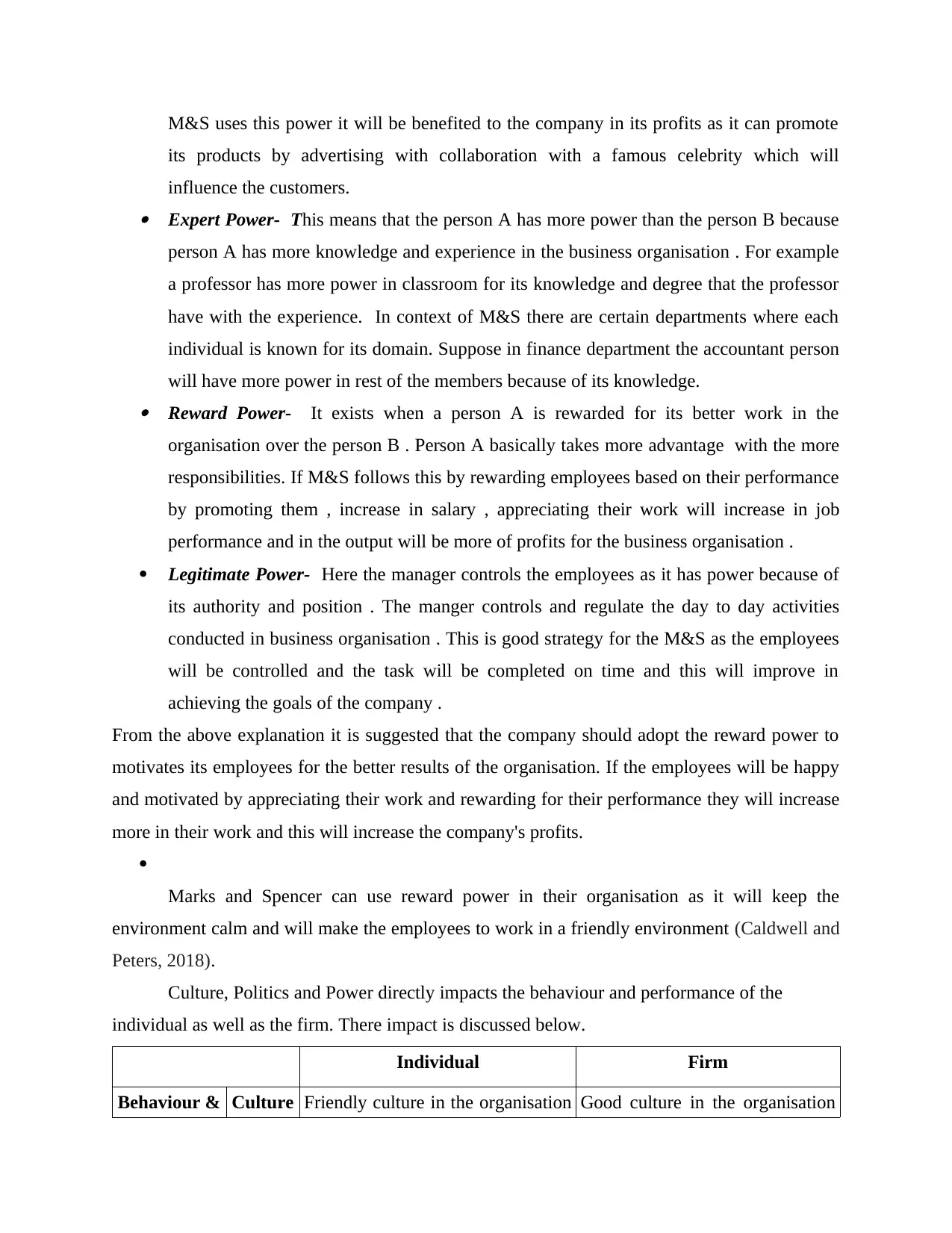
Culture, Politics and Power directly impacts the behaviour and performance of the
individual as well as the firm. There impact is discussed below.
Individual Firm
Behaviour & Culture Friendly culture in the organisation Good culture in the organisation
its products by advertising with collaboration with a famous celebrity which will
influence the customers. Expert Power- This means that the person A has more power than the person B because
person A has more knowledge and experience in the business organisation . For example
a professor has more power in classroom for its knowledge and degree that the professor
have with the experience. In context of M&S there are certain departments where each
individual is known for its domain. Suppose in finance department the accountant person
will have more power in rest of the members because of its knowledge. Reward Power- It exists when a person A is rewarded for its better work in the
organisation over the person B . Person A basically takes more advantage with the more
responsibilities. If M&S follows this by rewarding employees based on their performance
by promoting them , increase in salary , appreciating their work will increase in job
performance and in the output will be more of profits for the business organisation .
Legitimate Power- Here the manager controls the employees as it has power because of
its authority and position . The manger controls and regulate the day to day activities
conducted in business organisation . This is good strategy for the M&S as the employees
will be controlled and the task will be completed on time and this will improve in
achieving the goals of the company .
From the above explanation it is suggested that the company should adopt the reward power to
motivates its employees for the better results of the organisation. If the employees will be happy
and motivated by appreciating their work and rewarding for their performance they will increase
more in their work and this will increase the company's profits.
Marks and Spencer can use reward power in their organisation as it will keep the
environment calm and will make the employees to work in a friendly environment (Caldwell and
Peters, 2018).
Culture, Politics and Power directly impacts the behaviour and performance of the
individual as well as the firm. There impact is discussed below.
Individual Firm
Behaviour & Culture Friendly culture in the organisation Good culture in the organisation
⊘ This is a preview!⊘
Do you want full access?
Subscribe today to unlock all pages.

Trusted by 1+ million students worldwide

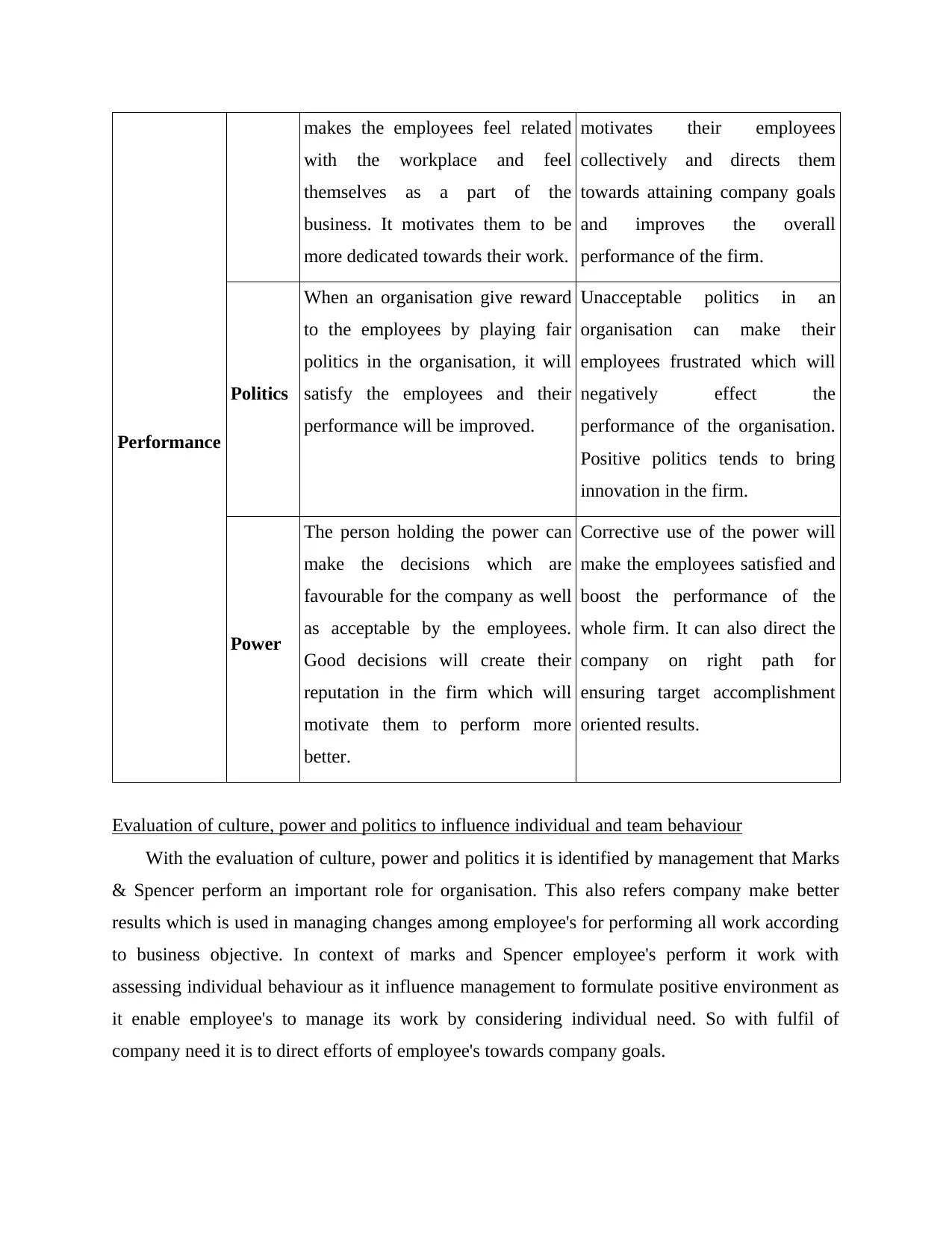
Performance
makes the employees feel related
with the workplace and feel
themselves as a part of the
business. It motivates them to be
more dedicated towards their work.
motivates their employees
collectively and directs them
towards attaining company goals
and improves the overall
performance of the firm.
Politics
When an organisation give reward
to the employees by playing fair
politics in the organisation, it will
satisfy the employees and their
performance will be improved.
Unacceptable politics in an
organisation can make their
employees frustrated which will
negatively effect the
performance of the organisation.
Positive politics tends to bring
innovation in the firm.
Power
The person holding the power can
make the decisions which are
favourable for the company as well
as acceptable by the employees.
Good decisions will create their
reputation in the firm which will
motivate them to perform more
better.
Corrective use of the power will
make the employees satisfied and
boost the performance of the
whole firm. It can also direct the
company on right path for
ensuring target accomplishment
oriented results.
Evaluation of culture, power and politics to influence individual and team behaviour
With the evaluation of culture, power and politics it is identified by management that Marks
& Spencer perform an important role for organisation. This also refers company make better
results which is used in managing changes among employee's for performing all work according
to business objective. In context of marks and Spencer employee's perform it work with
assessing individual behaviour as it influence management to formulate positive environment as
it enable employee's to manage its work by considering individual need. So with fulfil of
company need it is to direct efforts of employee's towards company goals.
makes the employees feel related
with the workplace and feel
themselves as a part of the
business. It motivates them to be
more dedicated towards their work.
motivates their employees
collectively and directs them
towards attaining company goals
and improves the overall
performance of the firm.
Politics
When an organisation give reward
to the employees by playing fair
politics in the organisation, it will
satisfy the employees and their
performance will be improved.
Unacceptable politics in an
organisation can make their
employees frustrated which will
negatively effect the
performance of the organisation.
Positive politics tends to bring
innovation in the firm.
Power
The person holding the power can
make the decisions which are
favourable for the company as well
as acceptable by the employees.
Good decisions will create their
reputation in the firm which will
motivate them to perform more
better.
Corrective use of the power will
make the employees satisfied and
boost the performance of the
whole firm. It can also direct the
company on right path for
ensuring target accomplishment
oriented results.
Evaluation of culture, power and politics to influence individual and team behaviour
With the evaluation of culture, power and politics it is identified by management that Marks
& Spencer perform an important role for organisation. This also refers company make better
results which is used in managing changes among employee's for performing all work according
to business objective. In context of marks and Spencer employee's perform it work with
assessing individual behaviour as it influence management to formulate positive environment as
it enable employee's to manage its work by considering individual need. So with fulfil of
company need it is to direct efforts of employee's towards company goals.
1 out of 14
Related Documents
Your All-in-One AI-Powered Toolkit for Academic Success.
+13062052269
info@desklib.com
Available 24*7 on WhatsApp / Email
Unlock your academic potential
Copyright © 2020–2025 A2Z Services. All Rights Reserved. Developed and managed by ZUCOL.