Business Environment Analysis: Marks and Spencer Report
VerifiedAdded on 2020/12/24
|12
|4181
|454
Report
AI Summary
This report provides a comprehensive analysis of the business environment, focusing on different types of organizations: private (Marks and Spencer), public (The Child Support Agency), and voluntary (Oxfam). It explores their purposes, legal structures, and scopes, highlighting the interrelationships between various functional departments within Marks and Spencer, such as marketing, sales, and production. The report also examines the impact of macro-environmental factors, using PESTLE analysis to assess political, economic, social, technological, legal, and environmental influences on business operations. Furthermore, it delves into the internal and external analysis to identify strengths, weaknesses, and how these relate to external macro factors, providing insights into how businesses adapt to and navigate their environments. The report emphasizes the importance of organizational structure and its role in achieving business objectives, providing a holistic view of the business environment.
Business environment

Paraphrase This Document
Need a fresh take? Get an instant paraphrase of this document with our AI Paraphraser
Contents
INTRODUCTION.........................................................................................................................................3
TASK 1..........................................................................................................................................................3
P1 Different types and purpose of organization........................................................................................3
P2 Size and scope of range of different type of association......................................................................4
TASK 2..........................................................................................................................................................6
P3 Relationship between different relationship between differ organizational function and link with
organizational objective s and structure.....................................................................................................6
TASK 3..........................................................................................................................................................7
P4 Macro environment factors with its positive and negative aspects......................................................7
TASK 4..........................................................................................................................................................9
P5 Internal and external analysis to identify strengths and weaknesses....................................................9
P6 Strengths and weakness interrelated with external macro factors........................................................9
CONCLUSION............................................................................................................................................10
REFERENCES............................................................................................................................................11
INTRODUCTION.........................................................................................................................................3
TASK 1..........................................................................................................................................................3
P1 Different types and purpose of organization........................................................................................3
P2 Size and scope of range of different type of association......................................................................4
TASK 2..........................................................................................................................................................6
P3 Relationship between different relationship between differ organizational function and link with
organizational objective s and structure.....................................................................................................6
TASK 3..........................................................................................................................................................7
P4 Macro environment factors with its positive and negative aspects......................................................7
TASK 4..........................................................................................................................................................9
P5 Internal and external analysis to identify strengths and weaknesses....................................................9
P6 Strengths and weakness interrelated with external macro factors........................................................9
CONCLUSION............................................................................................................................................10
REFERENCES............................................................................................................................................11
INTRODUCTION
Business organization is the place where number of people working them same galas and
organization. Business can be run with ideas such as improving condition of children. There are
many factors which affects business operations such as change in demand of consumers, so it is
responsibility top analyse market and then provide goods and services . There is difference in
working style of various organizations hence there is difference in their legal structure and status
(Al-Swidi and Al-Hosam, 2012). Business can be sustainable, when they perform operations
according to legal policies. This report is based on Marks and Spencer as private, The Child
Support Agency as public and Oxfam as Voluntary organization. This report covers different
types of organizations, inter relationship among various functional departments, positive and
impact of macro environment on business operations, internal strengths and weakness of specific
business.
TASK 1
P1 Different types and purpose of organization
Business organization is a place where person or number of persons are working to attain
same goals and objectives. There are different types of organization which are working in society
having different purpose. Every business has their own aims and objectives. There are mainly
three typoes of business i.e. Private, public and voluntary organization. These organizations runs
having their different purpose. Thee are discussed as under in detail-
Private organization- Private organizations are business enterprises which are owned,
managed and organized by private individual or group of individuals. There are many private
organizations, so there is competition among these associations. Main purpose of such
organization is to expand in industry and earn good profits. Marks and Spencer is the example of
private organization (Bryman and Bell, 2015). This is the organization which deals in retail
sector. Legal structure of private organization are as under-
Sole proprietor- Sole proprietor business is run by single individual or family members.
This is the smallest scale business which works to earn livelihood. They do not accept external
changes because of lack of funds. Carpenter, cobbler, etc. are example of sole proprietor.
Partnership- In partnership there are two or more people working to achieve same goals
and objectives. In partnership, there is division of profits, losses, capital, etc. in pre determined
ratio. Partnership is registered under partnership act and has partnership deed as legal document.
Corporation- Corporation is company registered under companies act. Company accepts
external changes frequently, so they can create trust among customers. Corporation ahs main aim
is to increase sales and good profits, so brand expansion is possible.
Business organization is the place where number of people working them same galas and
organization. Business can be run with ideas such as improving condition of children. There are
many factors which affects business operations such as change in demand of consumers, so it is
responsibility top analyse market and then provide goods and services . There is difference in
working style of various organizations hence there is difference in their legal structure and status
(Al-Swidi and Al-Hosam, 2012). Business can be sustainable, when they perform operations
according to legal policies. This report is based on Marks and Spencer as private, The Child
Support Agency as public and Oxfam as Voluntary organization. This report covers different
types of organizations, inter relationship among various functional departments, positive and
impact of macro environment on business operations, internal strengths and weakness of specific
business.
TASK 1
P1 Different types and purpose of organization
Business organization is a place where person or number of persons are working to attain
same goals and objectives. There are different types of organization which are working in society
having different purpose. Every business has their own aims and objectives. There are mainly
three typoes of business i.e. Private, public and voluntary organization. These organizations runs
having their different purpose. Thee are discussed as under in detail-
Private organization- Private organizations are business enterprises which are owned,
managed and organized by private individual or group of individuals. There are many private
organizations, so there is competition among these associations. Main purpose of such
organization is to expand in industry and earn good profits. Marks and Spencer is the example of
private organization (Bryman and Bell, 2015). This is the organization which deals in retail
sector. Legal structure of private organization are as under-
Sole proprietor- Sole proprietor business is run by single individual or family members.
This is the smallest scale business which works to earn livelihood. They do not accept external
changes because of lack of funds. Carpenter, cobbler, etc. are example of sole proprietor.
Partnership- In partnership there are two or more people working to achieve same goals
and objectives. In partnership, there is division of profits, losses, capital, etc. in pre determined
ratio. Partnership is registered under partnership act and has partnership deed as legal document.
Corporation- Corporation is company registered under companies act. Company accepts
external changes frequently, so they can create trust among customers. Corporation ahs main aim
is to increase sales and good profits, so brand expansion is possible.
⊘ This is a preview!⊘
Do you want full access?
Subscribe today to unlock all pages.

Trusted by 1+ million students worldwide
PUBLIC ORGANISATION
These are the organization which are headed and controlled by government. They have
purpose top provide facilities to society in order to improve living of standards. Revenue earned
by such organizations are re- invested to provide best services to society. The Child Support
Agency is the example of public organization which works to improve condition of children
residing in society. Legal structure of public organizations’ are-
Local government- This is the lowest level of government which works within small
geographical region such as village (Christopher and Holweg, 2011). Etc. these government
deals with issues of small villages, grams, etc.
State government- State government works within particular state. This is the
government which workers in matters of local government to provide solution to victims.
Central government- Central government is highest authority. This is the government
which is at highest level in hierarchy. If state government fails to give any decision or victim is
not satisfied with solution of state government, then they can contact central government.
VOLUNTARTY ORGANISATION
These are the organizations which works with some specific purpose. For instance:
measures taken to reduce poverty, taking care of old age people, etc. are some purpose of such
organization. These organizations have motto to improve living of standard of organization.
Oxfam is example of voluntary organization.
Charitable trust, association of people are part of legal structure of voluntary organization. These
organizations to improve living of standards and provides good services to employees (Cross and
Miller, 2011),
P2 Size and scope of range of different type of association
As there is difference in purpose, size of business organization, hence there is variation in
their size, scope, working style. When there is difference in sacope, so development prospects
also difference. Promoters has to promote business after analyzing organizational objectives.
Background, size, scope, mission, vision of such organizations are discussed as under-
PUBLIC COMPANY- The Child Support Agency
Background- The child Support agency is the organization which provides services in UK in
order to improve condition of children (Dibrell, Craig and Hansen, 2011). They working to
improve and growth of unprivileged children. This organization was established in 1993.
Product and services- They provide services to up-liftment and improve situation of children in
UK. This helps to provide them safe and healthy future which is effective for overall UK.
These are the organization which are headed and controlled by government. They have
purpose top provide facilities to society in order to improve living of standards. Revenue earned
by such organizations are re- invested to provide best services to society. The Child Support
Agency is the example of public organization which works to improve condition of children
residing in society. Legal structure of public organizations’ are-
Local government- This is the lowest level of government which works within small
geographical region such as village (Christopher and Holweg, 2011). Etc. these government
deals with issues of small villages, grams, etc.
State government- State government works within particular state. This is the
government which workers in matters of local government to provide solution to victims.
Central government- Central government is highest authority. This is the government
which is at highest level in hierarchy. If state government fails to give any decision or victim is
not satisfied with solution of state government, then they can contact central government.
VOLUNTARTY ORGANISATION
These are the organizations which works with some specific purpose. For instance:
measures taken to reduce poverty, taking care of old age people, etc. are some purpose of such
organization. These organizations have motto to improve living of standard of organization.
Oxfam is example of voluntary organization.
Charitable trust, association of people are part of legal structure of voluntary organization. These
organizations to improve living of standards and provides good services to employees (Cross and
Miller, 2011),
P2 Size and scope of range of different type of association
As there is difference in purpose, size of business organization, hence there is variation in
their size, scope, working style. When there is difference in sacope, so development prospects
also difference. Promoters has to promote business after analyzing organizational objectives.
Background, size, scope, mission, vision of such organizations are discussed as under-
PUBLIC COMPANY- The Child Support Agency
Background- The child Support agency is the organization which provides services in UK in
order to improve condition of children (Dibrell, Craig and Hansen, 2011). They working to
improve and growth of unprivileged children. This organization was established in 1993.
Product and services- They provide services to up-liftment and improve situation of children in
UK. This helps to provide them safe and healthy future which is effective for overall UK.
Paraphrase This Document
Need a fresh take? Get an instant paraphrase of this document with our AI Paraphraser
Size and scope- Scope of this organization is all over UK. This organization was established
under different legal norms.
Vision- Vision of Child Support agency is to give good future to children.
Mission- Mission is to provide them services, so they good and healthy person for society.
Business objective- Objectives of Child Support Agency is to make changes which are relevant
and significant for better future of children.
Legal structure- This organization was headed by national government of UK.
Stakeholders- Stake holders for this organization is children, government (Gharajedaghi, 2011).
PRIVATE COMPANY- . Marks and Spencer
Background- Marks and Spencer was established in 1884. This is major British multinational
retailer headquarter in London. This business was established in partnership between Michael
Marks and Thomas Spencer.
Product and services- This organization provides clothes, home products and luxury product.
Size and scope- marks and Spencer is large organization which has around 979 stores across UK.
this organization operates its business in different parts of country such as Europe, Netherland,
India, etc.
Vision- Vision of Marks and Spencer is to provide against which other brands are measured.
This helps organization to get good USP in industry.
Mission- Mission of Marks and Spencer is to provide inspirational quality accessible to all. They
have aim to be in touch of every income level. This helps to improve sales and brand image in
industry (López-Gamero, Molina-Azorín and Claver-Cortés, 2011).
Business objective- Business objectives is to earn more profits with business expansion.
Legal structure- Legal structure was private limited company which aims at earning good profits
and brand image in industry.
Stakeholders- In this company there are many stakeholders such as suppliers, customers,
employees, customers, etc.
VOLUNTARY ORGANISATION- Oxfam
Background- Oxfam is a voluntary organization which has legal status and covers 19 charitable
trust under its name.
under different legal norms.
Vision- Vision of Child Support agency is to give good future to children.
Mission- Mission is to provide them services, so they good and healthy person for society.
Business objective- Objectives of Child Support Agency is to make changes which are relevant
and significant for better future of children.
Legal structure- This organization was headed by national government of UK.
Stakeholders- Stake holders for this organization is children, government (Gharajedaghi, 2011).
PRIVATE COMPANY- . Marks and Spencer
Background- Marks and Spencer was established in 1884. This is major British multinational
retailer headquarter in London. This business was established in partnership between Michael
Marks and Thomas Spencer.
Product and services- This organization provides clothes, home products and luxury product.
Size and scope- marks and Spencer is large organization which has around 979 stores across UK.
this organization operates its business in different parts of country such as Europe, Netherland,
India, etc.
Vision- Vision of Marks and Spencer is to provide against which other brands are measured.
This helps organization to get good USP in industry.
Mission- Mission of Marks and Spencer is to provide inspirational quality accessible to all. They
have aim to be in touch of every income level. This helps to improve sales and brand image in
industry (López-Gamero, Molina-Azorín and Claver-Cortés, 2011).
Business objective- Business objectives is to earn more profits with business expansion.
Legal structure- Legal structure was private limited company which aims at earning good profits
and brand image in industry.
Stakeholders- In this company there are many stakeholders such as suppliers, customers,
employees, customers, etc.
VOLUNTARY ORGANISATION- Oxfam
Background- Oxfam is a voluntary organization which has legal status and covers 19 charitable
trust under its name.
Product and services- they provide services in order to improve living of standard and reduce
poverty from society (Kolk, 2016).
Size and scope- Oxfam is one of the latest non profit organization operates in all over UK since
1942. This is confederation of 20 independent charitable associations.
Vision- Vision of Oxfam is to work in group and provide basic rights to people so they can
manage and live life.
Mission- Program to address the structure cause of poverty and other related issues is mission of
this organization.
Business objective- This organization has objective to deal with social issues such as poverty
which affects growth rate of nation.
Legal structure- Oxfam has legal structure of trust, which gets donations and headed by
volunteers who want to serve society for betterment (Li and et. al., 2011).
Stakeholders- Stakeholders of voluntary organizations is society, public and government.
TASK 2
P3 Relationship between different relationship between differ organizational function and link
with organizational objective s and structure
Marks and Spencer have good brand image in retail sector. This is because they have
appropriate way to perform operations. This is relevant and significant for attaining
organizational objectives. There are many departments i.e. purchase, sales, marketing, IT, etc.
which helps to provide customer satisfaction (Meiners, Ringleb and Edwards, 2014). This
organization has functional structure hence there are different departments which work according
to assigned task such as purchase of raw material, marketing of new product and service, etc.
There is interrelationship among these departments. This is discussed as under-
Marketing and sales- Marks and Spencer has good brand image in industry. These days
there is much competition in retail sector, so it is essential to market product and services.
Marketing manager of Marks and Spencer has to market product and services so there is positive
impact on sales and revenue.
Production and sales- Production department of Marks and Spencer deals in
manufacturing, packaging, etc. While sales department delivers product at society. Sales
department has to keep contact with production department to tell about sales so further
production can be done.
Marketing and research- There are many changes taking place in external market, such as
change in demand of customer. This is responsibility of marketing to analyse external changes
poverty from society (Kolk, 2016).
Size and scope- Oxfam is one of the latest non profit organization operates in all over UK since
1942. This is confederation of 20 independent charitable associations.
Vision- Vision of Oxfam is to work in group and provide basic rights to people so they can
manage and live life.
Mission- Program to address the structure cause of poverty and other related issues is mission of
this organization.
Business objective- This organization has objective to deal with social issues such as poverty
which affects growth rate of nation.
Legal structure- Oxfam has legal structure of trust, which gets donations and headed by
volunteers who want to serve society for betterment (Li and et. al., 2011).
Stakeholders- Stakeholders of voluntary organizations is society, public and government.
TASK 2
P3 Relationship between different relationship between differ organizational function and link
with organizational objective s and structure
Marks and Spencer have good brand image in retail sector. This is because they have
appropriate way to perform operations. This is relevant and significant for attaining
organizational objectives. There are many departments i.e. purchase, sales, marketing, IT, etc.
which helps to provide customer satisfaction (Meiners, Ringleb and Edwards, 2014). This
organization has functional structure hence there are different departments which work according
to assigned task such as purchase of raw material, marketing of new product and service, etc.
There is interrelationship among these departments. This is discussed as under-
Marketing and sales- Marks and Spencer has good brand image in industry. These days
there is much competition in retail sector, so it is essential to market product and services.
Marketing manager of Marks and Spencer has to market product and services so there is positive
impact on sales and revenue.
Production and sales- Production department of Marks and Spencer deals in
manufacturing, packaging, etc. While sales department delivers product at society. Sales
department has to keep contact with production department to tell about sales so further
production can be done.
Marketing and research- There are many changes taking place in external market, such as
change in demand of customer. This is responsibility of marketing to analyse external changes
⊘ This is a preview!⊘
Do you want full access?
Subscribe today to unlock all pages.
Trusted by 1+ million students worldwide
which are talking place in taster of consumer. Research department conduct research on it and
then provide best solution to accomplish it. This is effective for reducing cost and increase
profits for Marks and Spencer. Hence there is relation between marketing and research
department (Nishitani, Kaneko, Fujii and Komatsu, 2012).
Organizational structure
Organizational structure means how activities within organization are organized,
allocated, directed and supervised to attain organizational goals and objectives. Organization
need to be work in systematic manner,, so there are less possibilities of duplication and wastage
of resource. Marks and Spencer is big organization which deals in various product and services,
so they have to manage and organize commercial activities in appropriate manner.
Marks and Spencer uses hieratical structure. As per this structure, there are different level
of hierarchy which work to work according to external environment and assist in attaining goals
and objectives. In this system there are different levels i.e. top level, middle level, lower level
which works interrelated. For instance to level managers provide guidance to middle level
managers and subordinates work according to orders and direction of middle level personnel
(Onetti, Zucchella, Jones and McDougall-Covin, 2012).
TASK 3
P4 Macro environment factors with its positive and negative aspects
Business operates in society, there are many changes taking place in industry which are
relevant and significant for improving brand image and sales. These changes can be internally or
externally related to business organization. Internal changes include less labor resistance, so
managers’ of marks and Spencer has to take actions in order to deal with them. While external
changes include change in political party, increment in tax rate, etc. which are not on control of
managers but they have alter business policies in order to be existence in industry. External
environment can be understood with PESTLE analysis (Palo and Tähtinen, 2011).
Political- In political factor, governmental politics, tax policies, foreign trade policy, etc.
Government policies are crucial for organizational development. Managers of Marks and
Spencer has to foolow it. Brexit is example of political factor.
Positive impact of Brexit is that Marks and Spencer can operate in different parts of
company with globalised image. While negative impact of Brexit is there are more trade policies,
legal laws and regulations which affects core business operations of Marks and Spencer.
Economical- In economic factor, tax rate, inflation, deflation, bank loan rate, etc.,. are
covered. In UK, there are many inflation rate and currency fluctuation is more.
then provide best solution to accomplish it. This is effective for reducing cost and increase
profits for Marks and Spencer. Hence there is relation between marketing and research
department (Nishitani, Kaneko, Fujii and Komatsu, 2012).
Organizational structure
Organizational structure means how activities within organization are organized,
allocated, directed and supervised to attain organizational goals and objectives. Organization
need to be work in systematic manner,, so there are less possibilities of duplication and wastage
of resource. Marks and Spencer is big organization which deals in various product and services,
so they have to manage and organize commercial activities in appropriate manner.
Marks and Spencer uses hieratical structure. As per this structure, there are different level
of hierarchy which work to work according to external environment and assist in attaining goals
and objectives. In this system there are different levels i.e. top level, middle level, lower level
which works interrelated. For instance to level managers provide guidance to middle level
managers and subordinates work according to orders and direction of middle level personnel
(Onetti, Zucchella, Jones and McDougall-Covin, 2012).
TASK 3
P4 Macro environment factors with its positive and negative aspects
Business operates in society, there are many changes taking place in industry which are
relevant and significant for improving brand image and sales. These changes can be internally or
externally related to business organization. Internal changes include less labor resistance, so
managers’ of marks and Spencer has to take actions in order to deal with them. While external
changes include change in political party, increment in tax rate, etc. which are not on control of
managers but they have alter business policies in order to be existence in industry. External
environment can be understood with PESTLE analysis (Palo and Tähtinen, 2011).
Political- In political factor, governmental politics, tax policies, foreign trade policy, etc.
Government policies are crucial for organizational development. Managers of Marks and
Spencer has to foolow it. Brexit is example of political factor.
Positive impact of Brexit is that Marks and Spencer can operate in different parts of
company with globalised image. While negative impact of Brexit is there are more trade policies,
legal laws and regulations which affects core business operations of Marks and Spencer.
Economical- In economic factor, tax rate, inflation, deflation, bank loan rate, etc.,. are
covered. In UK, there are many inflation rate and currency fluctuation is more.
Paraphrase This Document
Need a fresh take? Get an instant paraphrase of this document with our AI Paraphraser
Positive impact of economic factor is that due to increase in inflation rate, purchasing
power of consumer increase. While negative impact is this factor is due to increase in currency
rate, production cost will increase in UK.
Social- As per social factor, belief, social values, etc. are covered. In this factor,
population growth, age, career attitude of people are also covered (Pham, Segers and Gijselaers,
2013).
Positive impact of this factor is if managers’ of Marks and Spencer must analyze changes
taking place on trend of consumer, so this is improves brand image of association in UK.
Negative impact of this factor is that these days online shopping is more in UK, so this affects
sales of Marks and Spencer outlet.
Technological- Technological changes means change in technique such as up-gradation
of software, use of latest check in check out methods, etc. These changes are relevant and
important for upgrading performance of Marks and Spencer.
Positive impact of technological change is operational efficiency of employees as well as
organization improved. This helps to increase brand image of Marks and Spencer. While
negative impact of technological changes are training cost, installation cost, etc.
Legal- Legal factor includes legal laws regulations which ahs to be followed by Marks
and Spencer. Changes in labour law, employment act, etc. are part of legal alterations (Pikka,
Iskanius and Page, 2011).
Positive impact of this factor that policies of remuneration are according to legal norms
and acts. Hence it makes long term a relations with stakeholders. While negative impact of this
factor is there is requirement of legal advisor for guidance and monitoring of policies. This
sounds to be fixed cost for Marks and Spencer.
Environmental- Environmental factor includes change taking place in environmental
level where Marks and Spencer works. These days, there is more trend of conserving and using
renewable sources of energy (Scheer, 2012).
Positive impact of environmental factor is use of solar heater, e- machines, etc. through
which natural energy can be used. While negative impact of this factor is delay in operations of
Marks and Spencer because in case renewable source is not available then this affects working
style of workforce.
power of consumer increase. While negative impact is this factor is due to increase in currency
rate, production cost will increase in UK.
Social- As per social factor, belief, social values, etc. are covered. In this factor,
population growth, age, career attitude of people are also covered (Pham, Segers and Gijselaers,
2013).
Positive impact of this factor is if managers’ of Marks and Spencer must analyze changes
taking place on trend of consumer, so this is improves brand image of association in UK.
Negative impact of this factor is that these days online shopping is more in UK, so this affects
sales of Marks and Spencer outlet.
Technological- Technological changes means change in technique such as up-gradation
of software, use of latest check in check out methods, etc. These changes are relevant and
important for upgrading performance of Marks and Spencer.
Positive impact of technological change is operational efficiency of employees as well as
organization improved. This helps to increase brand image of Marks and Spencer. While
negative impact of technological changes are training cost, installation cost, etc.
Legal- Legal factor includes legal laws regulations which ahs to be followed by Marks
and Spencer. Changes in labour law, employment act, etc. are part of legal alterations (Pikka,
Iskanius and Page, 2011).
Positive impact of this factor that policies of remuneration are according to legal norms
and acts. Hence it makes long term a relations with stakeholders. While negative impact of this
factor is there is requirement of legal advisor for guidance and monitoring of policies. This
sounds to be fixed cost for Marks and Spencer.
Environmental- Environmental factor includes change taking place in environmental
level where Marks and Spencer works. These days, there is more trend of conserving and using
renewable sources of energy (Scheer, 2012).
Positive impact of environmental factor is use of solar heater, e- machines, etc. through
which natural energy can be used. While negative impact of this factor is delay in operations of
Marks and Spencer because in case renewable source is not available then this affects working
style of workforce.
TASK 4
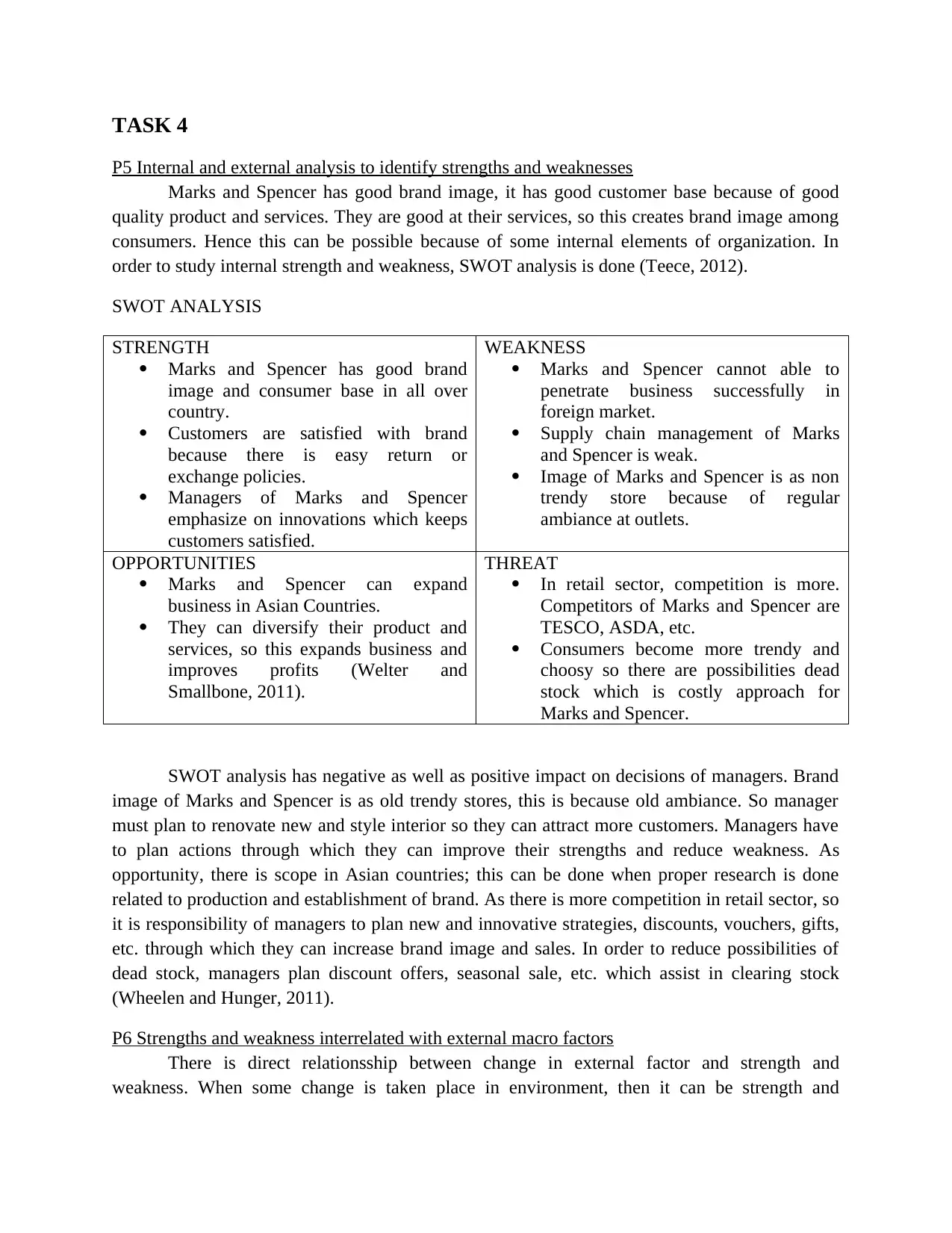
P5 Internal and external analysis to identify strengths and weaknesses
Marks and Spencer has good brand image, it has good customer base because of good
quality product and services. They are good at their services, so this creates brand image among
consumers. Hence this can be possible because of some internal elements of organization. In
order to study internal strength and weakness, SWOT analysis is done (Teece, 2012).
SWOT ANALYSIS
STRENGTH
Marks and Spencer has good brand
image and consumer base in all over
country.
Customers are satisfied with brand
because there is easy return or
exchange policies.
Managers of Marks and Spencer
emphasize on innovations which keeps
customers satisfied.
WEAKNESS
Marks and Spencer cannot able to
penetrate business successfully in
foreign market.
Supply chain management of Marks
and Spencer is weak.
Image of Marks and Spencer is as non
trendy store because of regular
ambiance at outlets.
OPPORTUNITIES
Marks and Spencer can expand
business in Asian Countries.
They can diversify their product and
services, so this expands business and
improves profits (Welter and
Smallbone, 2011).
THREAT
In retail sector, competition is more.
Competitors of Marks and Spencer are
TESCO, ASDA, etc.
Consumers become more trendy and
choosy so there are possibilities dead
stock which is costly approach for
Marks and Spencer.
SWOT analysis has negative as well as positive impact on decisions of managers. Brand
image of Marks and Spencer is as old trendy stores, this is because old ambiance. So manager
must plan to renovate new and style interior so they can attract more customers. Managers have
to plan actions through which they can improve their strengths and reduce weakness. As
opportunity, there is scope in Asian countries; this can be done when proper research is done
related to production and establishment of brand. As there is more competition in retail sector, so
it is responsibility of managers to plan new and innovative strategies, discounts, vouchers, gifts,
etc. through which they can increase brand image and sales. In order to reduce possibilities of
dead stock, managers plan discount offers, seasonal sale, etc. which assist in clearing stock
(Wheelen and Hunger, 2011).
P6 Strengths and weakness interrelated with external macro factors
There is direct relationsship between change in external factor and strength and
weakness. When some change is taken place in environment, then it can be strength and
P5 Internal and external analysis to identify strengths and weaknesses
Marks and Spencer has good brand image, it has good customer base because of good
quality product and services. They are good at their services, so this creates brand image among
consumers. Hence this can be possible because of some internal elements of organization. In
order to study internal strength and weakness, SWOT analysis is done (Teece, 2012).
SWOT ANALYSIS
STRENGTH
Marks and Spencer has good brand
image and consumer base in all over
country.
Customers are satisfied with brand
because there is easy return or
exchange policies.
Managers of Marks and Spencer
emphasize on innovations which keeps
customers satisfied.
WEAKNESS
Marks and Spencer cannot able to
penetrate business successfully in
foreign market.
Supply chain management of Marks
and Spencer is weak.
Image of Marks and Spencer is as non
trendy store because of regular
ambiance at outlets.
OPPORTUNITIES
Marks and Spencer can expand
business in Asian Countries.
They can diversify their product and
services, so this expands business and
improves profits (Welter and
Smallbone, 2011).
THREAT
In retail sector, competition is more.
Competitors of Marks and Spencer are
TESCO, ASDA, etc.
Consumers become more trendy and
choosy so there are possibilities dead
stock which is costly approach for
Marks and Spencer.
SWOT analysis has negative as well as positive impact on decisions of managers. Brand
image of Marks and Spencer is as old trendy stores, this is because old ambiance. So manager
must plan to renovate new and style interior so they can attract more customers. Managers have
to plan actions through which they can improve their strengths and reduce weakness. As
opportunity, there is scope in Asian countries; this can be done when proper research is done
related to production and establishment of brand. As there is more competition in retail sector, so
it is responsibility of managers to plan new and innovative strategies, discounts, vouchers, gifts,
etc. through which they can increase brand image and sales. In order to reduce possibilities of
dead stock, managers plan discount offers, seasonal sale, etc. which assist in clearing stock
(Wheelen and Hunger, 2011).
P6 Strengths and weakness interrelated with external macro factors
There is direct relationsship between change in external factor and strength and
weakness. When some change is taken place in environment, then it can be strength and
⊘ This is a preview!⊘
Do you want full access?
Subscribe today to unlock all pages.
Trusted by 1+ million students worldwide
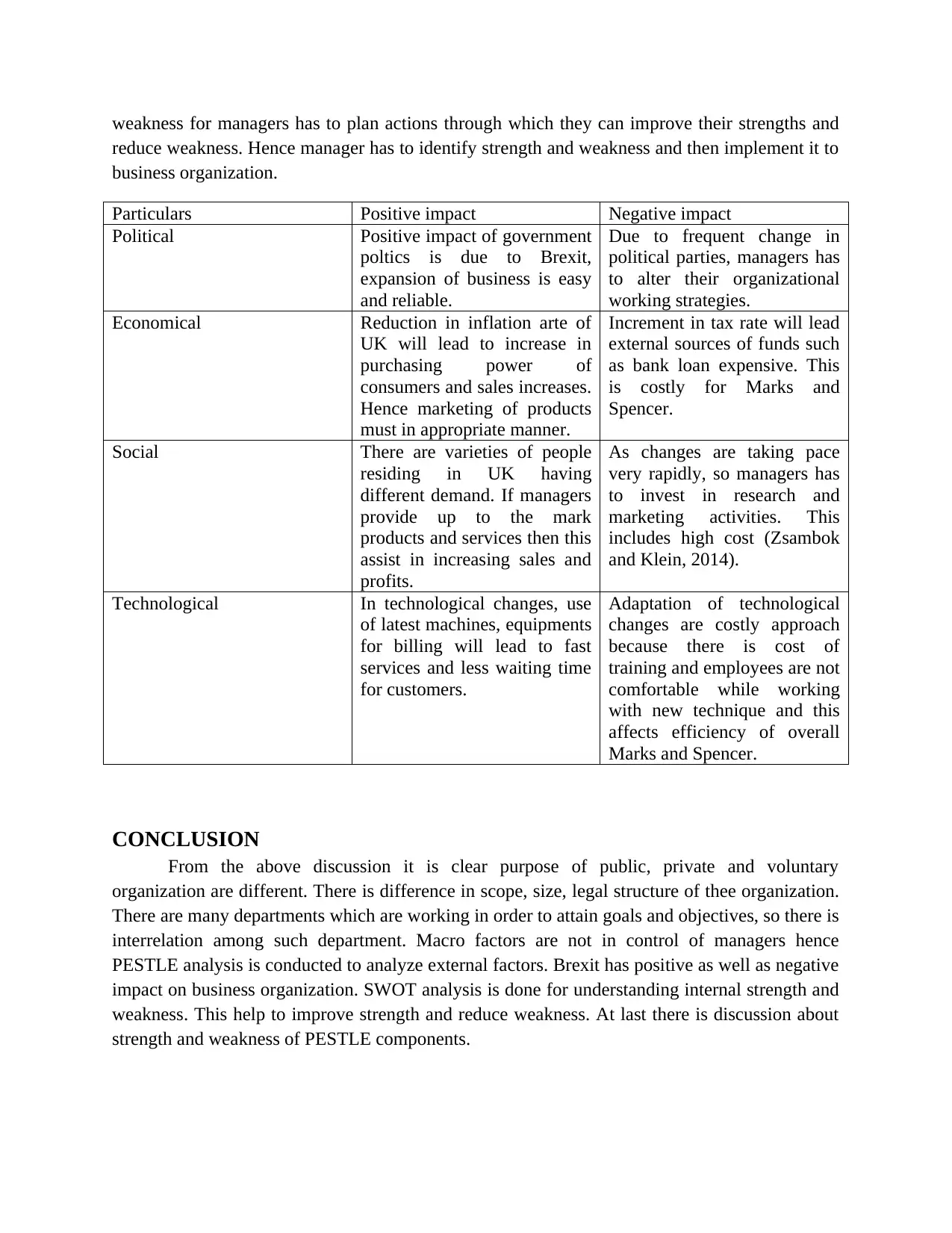
weakness for managers has to plan actions through which they can improve their strengths and
reduce weakness. Hence manager has to identify strength and weakness and then implement it to
business organization.
Particulars Positive impact Negative impact
Political Positive impact of government
poltics is due to Brexit,
expansion of business is easy
and reliable.
Due to frequent change in
political parties, managers has
to alter their organizational
working strategies.
Economical Reduction in inflation arte of
UK will lead to increase in
purchasing power of
consumers and sales increases.
Hence marketing of products
must in appropriate manner.
Increment in tax rate will lead
external sources of funds such
as bank loan expensive. This
is costly for Marks and
Spencer.
Social There are varieties of people
residing in UK having
different demand. If managers
provide up to the mark
products and services then this
assist in increasing sales and
profits.
As changes are taking pace
very rapidly, so managers has
to invest in research and
marketing activities. This
includes high cost (Zsambok
and Klein, 2014).
Technological In technological changes, use
of latest machines, equipments
for billing will lead to fast
services and less waiting time
for customers.
Adaptation of technological
changes are costly approach
because there is cost of
training and employees are not
comfortable while working
with new technique and this
affects efficiency of overall
Marks and Spencer.
CONCLUSION
From the above discussion it is clear purpose of public, private and voluntary
organization are different. There is difference in scope, size, legal structure of thee organization.
There are many departments which are working in order to attain goals and objectives, so there is
interrelation among such department. Macro factors are not in control of managers hence
PESTLE analysis is conducted to analyze external factors. Brexit has positive as well as negative
impact on business organization. SWOT analysis is done for understanding internal strength and
weakness. This help to improve strength and reduce weakness. At last there is discussion about
strength and weakness of PESTLE components.
reduce weakness. Hence manager has to identify strength and weakness and then implement it to
business organization.
Particulars Positive impact Negative impact
Political Positive impact of government
poltics is due to Brexit,
expansion of business is easy
and reliable.
Due to frequent change in
political parties, managers has
to alter their organizational
working strategies.
Economical Reduction in inflation arte of
UK will lead to increase in
purchasing power of
consumers and sales increases.
Hence marketing of products
must in appropriate manner.
Increment in tax rate will lead
external sources of funds such
as bank loan expensive. This
is costly for Marks and
Spencer.
Social There are varieties of people
residing in UK having
different demand. If managers
provide up to the mark
products and services then this
assist in increasing sales and
profits.
As changes are taking pace
very rapidly, so managers has
to invest in research and
marketing activities. This
includes high cost (Zsambok
and Klein, 2014).
Technological In technological changes, use
of latest machines, equipments
for billing will lead to fast
services and less waiting time
for customers.
Adaptation of technological
changes are costly approach
because there is cost of
training and employees are not
comfortable while working
with new technique and this
affects efficiency of overall
Marks and Spencer.
CONCLUSION
From the above discussion it is clear purpose of public, private and voluntary
organization are different. There is difference in scope, size, legal structure of thee organization.
There are many departments which are working in order to attain goals and objectives, so there is
interrelation among such department. Macro factors are not in control of managers hence
PESTLE analysis is conducted to analyze external factors. Brexit has positive as well as negative
impact on business organization. SWOT analysis is done for understanding internal strength and
weakness. This help to improve strength and reduce weakness. At last there is discussion about
strength and weakness of PESTLE components.
Paraphrase This Document
Need a fresh take? Get an instant paraphrase of this document with our AI Paraphraser
REFERENCES
Books and Journals
Al-Swidi, A. K. and Al-Hosam, A., 2012. The effect of entrepreneurial orientation on the
organizational performance: A study on the Islamic banks in Yemen using the partial
least squares approach. Arabian Journal of Business and Management Review (Oman
Chapter). 2(1). p.73.
Bryman, A. and Bell, E., 2015. Business research methods. Oxford University Press, USA.
Christopher, M. and Holweg, M., 2011. “Supply Chain 2.0”: managing supply chains in the era
of turbulence. International Journal of Physical Distribution & Logistics Management.
41(1). pp.63-82.
Cross, F. B. and Miller, R. L., 2011. The Legal Environment of Business: Text and Cases:
Ethical, Regulatory, Global, and Corporate Issues. Cengage Learning.
Dibrell, C., Craig, J. and Hansen, E., 2011. Natural environment, market orientation, and firm
innovativeness: An organizational life cycle perspective. Journal of Small Business
Management. 49(3). pp.467-489.
Gharajedaghi, J., 2011. Systems thinking: Managing chaos and complexity: A platform for
designing business architecture. Elsevier.
Kolk, A., 2016. The social responsibility of international business: From ethics and the
environment to CSR and sustainable development. Journal of World Business. 51(1).
pp.23-34.
Li and et. al., 2011. Towards the business–information technology alignment in cloud computing
environment: anapproach based on collaboration points and agents. International
Journal of Computer Integrated Manufacturing. 24(11). pp.1038-1057.
López-Gamero, M. D., Molina-Azorín, J. F. and Claver-Cortés, E., 2011. Environmental
uncertainty and environmental management perception: A multiple case study. Journal
of Business Research. 64(4). pp.427-435.
Meiners, R. E., Ringleb, A. H. and Edwards, F. L., 2014. The legal environment of business.
Cengage Learning.
Nishitani, K., Kaneko, S., Fujii, H. and Komatsu, S., 2012. Are firms' voluntary environmental
management activities beneficial for the environment and business? An empirical study
focusing on Japanese manufacturing firms. Journal of environmental management, 105,
pp.121-130.
Books and Journals
Al-Swidi, A. K. and Al-Hosam, A., 2012. The effect of entrepreneurial orientation on the
organizational performance: A study on the Islamic banks in Yemen using the partial
least squares approach. Arabian Journal of Business and Management Review (Oman
Chapter). 2(1). p.73.
Bryman, A. and Bell, E., 2015. Business research methods. Oxford University Press, USA.
Christopher, M. and Holweg, M., 2011. “Supply Chain 2.0”: managing supply chains in the era
of turbulence. International Journal of Physical Distribution & Logistics Management.
41(1). pp.63-82.
Cross, F. B. and Miller, R. L., 2011. The Legal Environment of Business: Text and Cases:
Ethical, Regulatory, Global, and Corporate Issues. Cengage Learning.
Dibrell, C., Craig, J. and Hansen, E., 2011. Natural environment, market orientation, and firm
innovativeness: An organizational life cycle perspective. Journal of Small Business
Management. 49(3). pp.467-489.
Gharajedaghi, J., 2011. Systems thinking: Managing chaos and complexity: A platform for
designing business architecture. Elsevier.
Kolk, A., 2016. The social responsibility of international business: From ethics and the
environment to CSR and sustainable development. Journal of World Business. 51(1).
pp.23-34.
Li and et. al., 2011. Towards the business–information technology alignment in cloud computing
environment: anapproach based on collaboration points and agents. International
Journal of Computer Integrated Manufacturing. 24(11). pp.1038-1057.
López-Gamero, M. D., Molina-Azorín, J. F. and Claver-Cortés, E., 2011. Environmental
uncertainty and environmental management perception: A multiple case study. Journal
of Business Research. 64(4). pp.427-435.
Meiners, R. E., Ringleb, A. H. and Edwards, F. L., 2014. The legal environment of business.
Cengage Learning.
Nishitani, K., Kaneko, S., Fujii, H. and Komatsu, S., 2012. Are firms' voluntary environmental
management activities beneficial for the environment and business? An empirical study
focusing on Japanese manufacturing firms. Journal of environmental management, 105,
pp.121-130.
Onetti, A., Zucchella, A., Jones, M.V. and McDougall-Covin, P.P., 2012. Internationalization,
innovation and entrepreneurship: business models for new technology-based firms.
Journal of Management & Governance. 16(3). pp.337-368.
Palo, T. and Tähtinen, J., 2011. A network perspective on business models for emerging
technology-based services. Journal of Business & Industrial Marketing. 26(5). pp.377-
388.
Pham, N. T., Segers, M. S. and Gijselaers, W. H., 2013. Effects of work environment on transfer
of training: empirical evidence from Master of Business Administration programs in
Vietnam. International Journal of Training and Development. 17(1). pp.1-19.
Pikka, V., Iskanius, P. and Page, T., 2011. The business enabling network–a tool for regional
development. International Journal of Innovation and Regional Development. 3(3-4).
pp.324-344.
Scheer, A. W., 2012. Business process engineering: reference models for industrial enterprises.
Springer Science & Business Media.
Teece, D. J., 2012. Dynamic capabilities: Routines versus entrepreneurial action. Journal of
management studies. 49(8). pp.1395-1401.
Welter, F. and Smallbone, D., 2011. Institutional perspectives on entrepreneurial behavior in
challenging environments. Journal of Small Business Management. 49(1). pp.107-125.
Wheelen, T. L. and Hunger, J. D., 2011. Concepts in strategic management and business policy.
Pearson Education India.
Zsambok, C. E. and Klein, G. eds., 2014. Naturalistic decision making. Psychology Press.
Online
business environment. 2018. [Online]. Available through:
<http://www.yourdictionary.com/business-environment>.
innovation and entrepreneurship: business models for new technology-based firms.
Journal of Management & Governance. 16(3). pp.337-368.
Palo, T. and Tähtinen, J., 2011. A network perspective on business models for emerging
technology-based services. Journal of Business & Industrial Marketing. 26(5). pp.377-
388.
Pham, N. T., Segers, M. S. and Gijselaers, W. H., 2013. Effects of work environment on transfer
of training: empirical evidence from Master of Business Administration programs in
Vietnam. International Journal of Training and Development. 17(1). pp.1-19.
Pikka, V., Iskanius, P. and Page, T., 2011. The business enabling network–a tool for regional
development. International Journal of Innovation and Regional Development. 3(3-4).
pp.324-344.
Scheer, A. W., 2012. Business process engineering: reference models for industrial enterprises.
Springer Science & Business Media.
Teece, D. J., 2012. Dynamic capabilities: Routines versus entrepreneurial action. Journal of
management studies. 49(8). pp.1395-1401.
Welter, F. and Smallbone, D., 2011. Institutional perspectives on entrepreneurial behavior in
challenging environments. Journal of Small Business Management. 49(1). pp.107-125.
Wheelen, T. L. and Hunger, J. D., 2011. Concepts in strategic management and business policy.
Pearson Education India.
Zsambok, C. E. and Klein, G. eds., 2014. Naturalistic decision making. Psychology Press.
Online
business environment. 2018. [Online]. Available through:
<http://www.yourdictionary.com/business-environment>.
⊘ This is a preview!⊘
Do you want full access?
Subscribe today to unlock all pages.
Trusted by 1+ million students worldwide

1 out of 12


Related Documents


Your All-in-One AI-Powered Toolkit for Academic Success.
+13062052269
info@desklib.com
Available 24*7 on WhatsApp / Email
![[object Object]](/_next/static/media/star-bottom.7253800d.svg)
Unlock your academic potential
Copyright © 2020–2026 A2Z Services. All Rights Reserved. Developed and managed by ZUCOL.