Financial Decision Making: Investor Presentation on Marks & Spencer

Verified

Added on  2023/06/13

|8
|759
|69
Presentation
AI Summary
This presentation provides a financial analysis of Marks & Spencer Plc for potential investors, covering key aspects such as working capital requirements, the mix of existing finance, and strategies for raising new finance. It assesses the company's performance post-COVID-19, highlighting the restructuring of its business model and the strong performance of its food segment. The presentation also discusses strategic planning, including maintaining a strong position in the food segment and transitioning to Ocado retail to increase the customer base. Furthermore, it addresses the company's organizational structure, global competition, and market challenges, particularly in the fashion clothing segment. The analysis includes a ratio analysis of financial statements, covering profitability, liquidity, activity, and solvency ratios, with data from 2020 and 2021. References to relevant academic sources are also provided.

Document Page
FINANCIAL
MANAGEMENT FOR
DECISION
MAKING
tabler-icon-diamond-filled.svg

Paraphrase This Document

Need a fresh take? Get an instant paraphrase of this document with our AI Paraphraser
Document Page
Content
Presentation Based on Annual Report and Internal Information of Marks
and Spenser Plc. to Potential Investor
Document Page
Presentation Based on Annual Report and Internal
Information of Marks and Spenser Plc. to Potential Investor
Working capital requirements: The current assets of marks and spencer’s comprising majority
portion of Stock which is nearly about £m 624.60, accounts receivables of £m 209.60 and
cash and cash equivalent which is £m 674.40 in financial Year 2020-2021. Where the major
liability that hold is Trade payable of £m1599 and short-term borrowings £m 432.80.
Form / Mix of existing finance: The existing capital structure of the entity showcase that their
borrowing is more as compare to equity which is not a good sign for the organization. They
raise funds from the equity nearly about £m489.20 and debt portion they hold is 3659.90
which signifies risk as they have to pay regular interest to debt holders (Kamran, M., 2018).
Document Page
Continue…
Raising of new Finance: In order to increase the market,
share it is important for them in raise funds from equity
instead of debt and loan from the financial institution as
it makes financial risk on the organization.
Performance of the company: After Covid 19 pandemic,
that entity restructure its business model such as they
repositioned their food segment which provides them
major revenue having the 10.40% approx. the food sales
(Arfi, W.B., Hikkerova, L. and Sahut, J.M., 2018).
tabler-icon-diamond-filled.svg

Paraphrase This Document

Need a fresh take? Get an instant paraphrase of this document with our AI Paraphraser
Document Page
Continue…
Strategic Planning: The strategic planning is to maintain strong position in food
segment so that it growth targets cab be achieved. In order to increase customer base
a successful transition on Ocada retail has been made for the products of M&S.
Structure of the Business: M&S follows a flat organizational structure or we can say
that this type of structure has limited management levels. This can be explained as
the gap between administrative and employees working in front has been kept low so
that employees can be encouraged for decision making process of the business
concern.
Document Page
Continue…
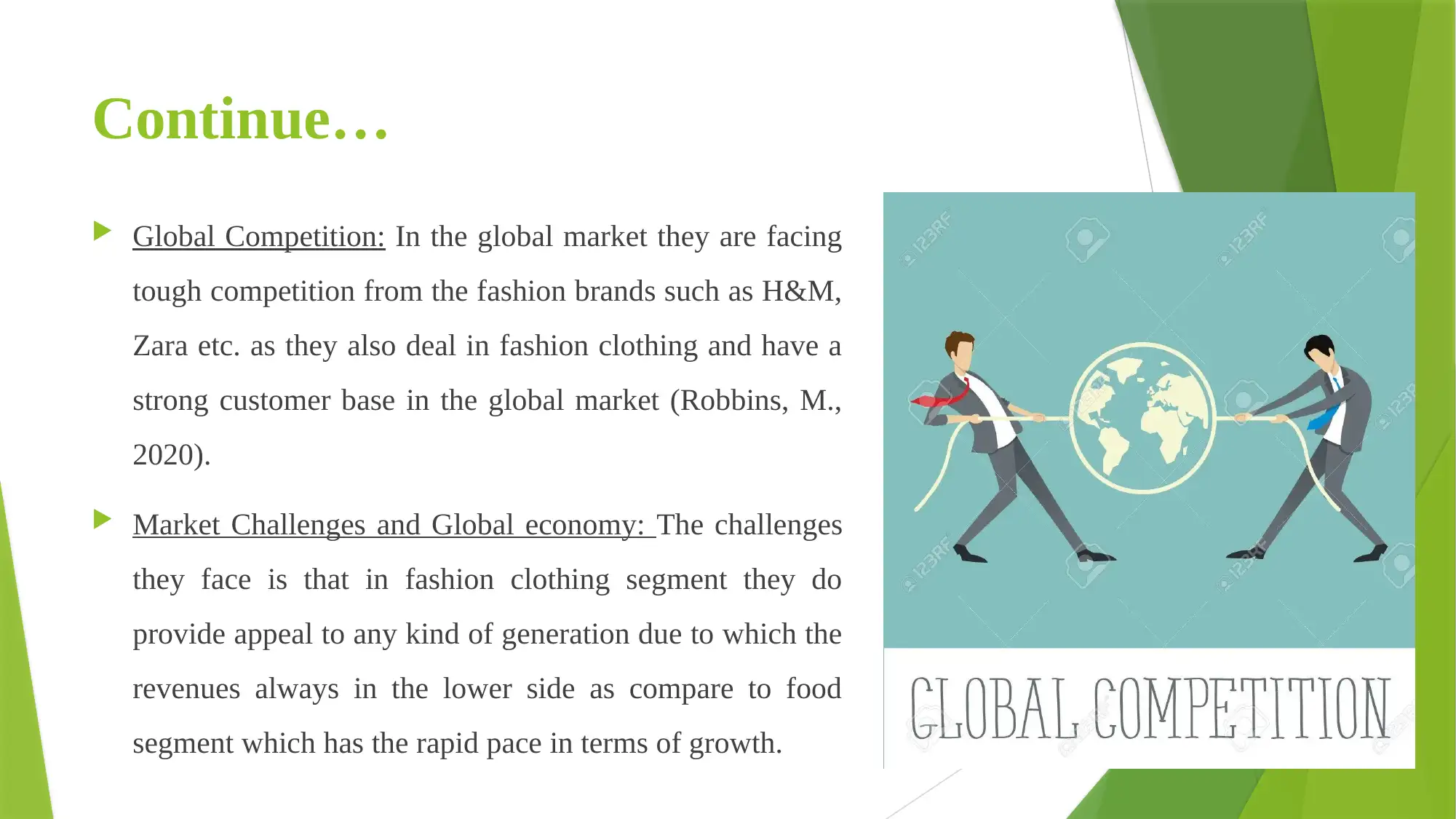
Global Competition: In the global market they are facing
tough competition from the fashion brands such as H&M,
Zara etc. as they also deal in fashion clothing and have a
strong customer base in the global market (Robbins, M.,
2020).
Market Challenges and Global economy: The challenges
they face is that in fashion clothing segment they do
provide appeal to any kind of generation due to which the
revenues always in the lower side as compare to food
segment which has the rapid pace in terms of growth.
Document Page
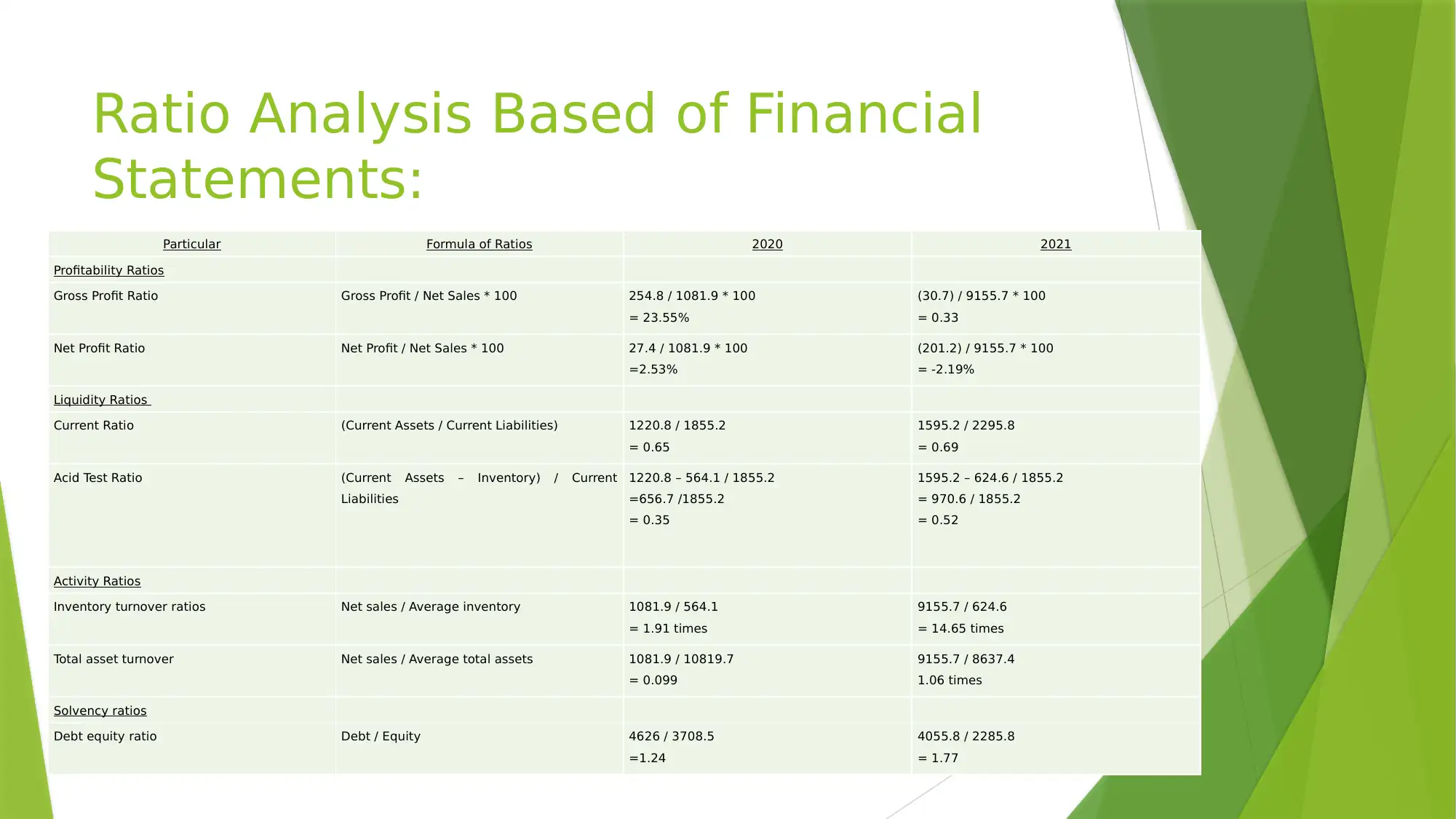
Ratio Analysis Based of Financial
Statements:
Particular Formula of Ratios 2020 2021
Profitability Ratios
Gross Profit Ratio Gross Profit / Net Sales * 100 254.8 / 1081.9 * 100
= 23.55%
(30.7) / 9155.7 * 100
= 0.33
Net Profit Ratio Net Profit / Net Sales * 100 27.4 / 1081.9 * 100
=2.53%
(201.2) / 9155.7 * 100
= -2.19%
Liquidity Ratios
Current Ratio (Current Assets / Current Liabilities) 1220.8 / 1855.2
= 0.65
1595.2 / 2295.8
= 0.69
Acid Test Ratio (Current Assets Inventory) / Current
Liabilities
1220.8 – 564.1 / 1855.2
=656.7 /1855.2
= 0.35
1595.2 – 624.6 / 1855.2
= 970.6 / 1855.2
= 0.52
Activity Ratios
Inventory turnover ratios Net sales / Average inventory 1081.9 / 564.1
= 1.91 times
9155.7 / 624.6
= 14.65 times
Total asset turnover Net sales / Average total assets 1081.9 / 10819.7
= 0.099
9155.7 / 8637.4
1.06 times
Solvency ratios
Debt equity ratio Debt / Equity 4626 / 3708.5
=1.24
4055.8 / 2285.8
= 1.77
tabler-icon-diamond-filled.svg

Paraphrase This Document

Need a fresh take? Get an instant paraphrase of this document with our AI Paraphraser
Document Page
REFERENCES
Taylor, L., 2019. The crisis and thereafter: Macroeconomic policy problems in Mexico.
In Mexico and the United States (pp. 147-182). Routledge.
Kamran, M., 2018. Current status and future success of renewable energy in
Pakistan. Renewable and Sustainable Energy Reviews, 82, pp.609-617.
Arfi, W.B., Hikkerova, L. and Sahut, J.M., 2018. External knowledge sources, green
innovation and performance. Technological Forecasting and Social Change, 129,
pp.210-220.
chevron_up_icon
1 out of 8
circle_padding
hide_on_mobile
zoom_out_icon
[object Object]