Leadership and Management in Operations: A Marks and Spencer Analysis
VerifiedAdded on 2020/07/22
|17
|5330
|71
Report
AI Summary
This report provides a detailed analysis of leadership and management, focusing on their roles, characteristics, and applications within a business context, specifically using Marks and Spencer (M&S) as a case study. The report begins by comparing the roles of leaders and managers, highlighting the key differences in their responsibilities and approaches. It then explores how leaders and managers function in various situations, such as decision-making, delegation of authority, and employee engagement. Furthermore, the report delves into different leadership theories and models, including situational leadership and system theory, and how they are applied in operational management. The importance and value of operational management are discussed, along with the impact of the business environment on operational strategies. The report emphasizes the significance of effective leadership and management in achieving organizational goals, improving efficiency, and fostering employee satisfaction. The report includes an analysis of the management structure within M&S, illustrating how leadership and management functions at different levels of the organization.
Management and
Operations
Operations

Paraphrase This Document
Need a fresh take? Get an instant paraphrase of this document with our AI Paraphraser
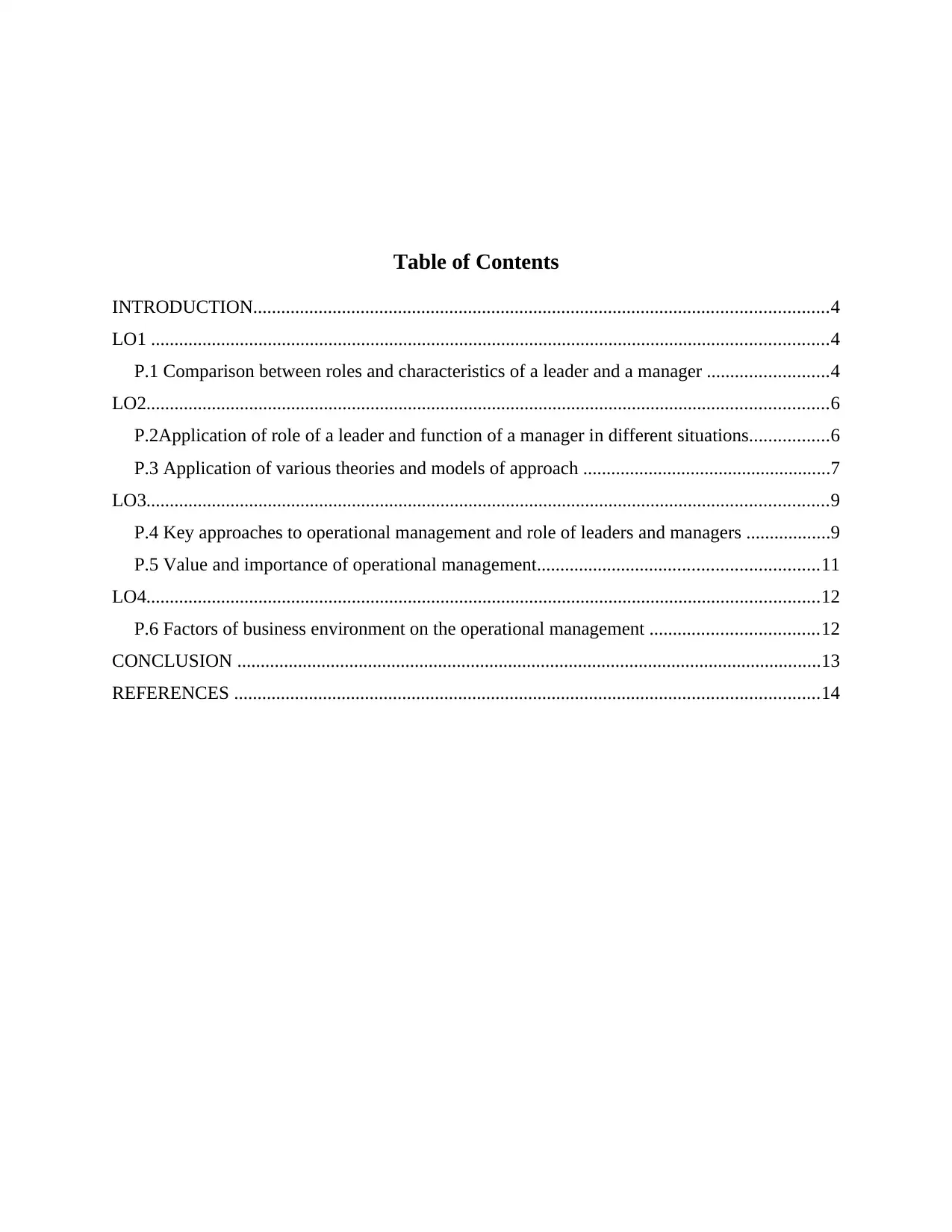
Table of Contents
INTRODUCTION...........................................................................................................................4
LO1 .................................................................................................................................................4
P.1 Comparison between roles and characteristics of a leader and a manager ..........................4
LO2..................................................................................................................................................6
P.2Application of role of a leader and function of a manager in different situations.................6
P.3 Application of various theories and models of approach .....................................................7
LO3..................................................................................................................................................9
P.4 Key approaches to operational management and role of leaders and managers ..................9
P.5 Value and importance of operational management............................................................11
LO4................................................................................................................................................12
P.6 Factors of business environment on the operational management ....................................12
CONCLUSION .............................................................................................................................13
REFERENCES .............................................................................................................................14
INTRODUCTION...........................................................................................................................4
LO1 .................................................................................................................................................4
P.1 Comparison between roles and characteristics of a leader and a manager ..........................4
LO2..................................................................................................................................................6
P.2Application of role of a leader and function of a manager in different situations.................6
P.3 Application of various theories and models of approach .....................................................7
LO3..................................................................................................................................................9
P.4 Key approaches to operational management and role of leaders and managers ..................9
P.5 Value and importance of operational management............................................................11
LO4................................................................................................................................................12
P.6 Factors of business environment on the operational management ....................................12
CONCLUSION .............................................................................................................................13
REFERENCES .............................................................................................................................14
INTRODUCTION
Management and operations play an important role in running a business. Operational
management is the administration of all activities and tasks of the business. This is done so that
firm can run effectively and efficiently. Company has to monitor the time of converting raw
materials into finished products. It is being done so that manufacturing process runs smoothly
and successfully. Assignment discusses about Marks and Spencer, UK, which is a retail firm and
deals with the food products and clothes (Ageron,Gunasekaran and Spalanzani,2011). The
comparison of different roles and characteristics of a leader and a manager is done in the report.
Further, role of a leader and manager in various situations as well as key approaches to
operational management are discussed. The importance and value of operational management to
achieve the business objectives are highlighted as well. Apart from that, factors of business
environment which affect the operational management and decision of leaders and managers are
studied here as well.
LO1
P.1 Comparison between roles and characteristics of a leader and a manager
Leadership is the process in which leader influences people and supports them so that
they can perform better. Thus, all staff members can perform better and give good results. By the
same, employees achieve their objectives effectually within stipulated period of time.
However, on the other hand, management is the process in which all tasks and human
resources in firm are managed. It consists of a process of 5 steps which are planning, organizing,
staffing, directing and controlling.
Characteristics of manager-
Creates the plans and policies – Manager create the plans and policies of the
organization. Manager delegates the work to all the employees.
Confident – Manager is confident in handling and dealing with various situations.
(Alderton and Saieva,2013)Manager creates different plans and policies in various
situations.
Characteristics of leader -
Motivates employees – Leader motives all the employees so that they can perform better.
It increases the energy level of employees so that they can give good results.
Management and operations play an important role in running a business. Operational
management is the administration of all activities and tasks of the business. This is done so that
firm can run effectively and efficiently. Company has to monitor the time of converting raw
materials into finished products. It is being done so that manufacturing process runs smoothly
and successfully. Assignment discusses about Marks and Spencer, UK, which is a retail firm and
deals with the food products and clothes (Ageron,Gunasekaran and Spalanzani,2011). The
comparison of different roles and characteristics of a leader and a manager is done in the report.
Further, role of a leader and manager in various situations as well as key approaches to
operational management are discussed. The importance and value of operational management to
achieve the business objectives are highlighted as well. Apart from that, factors of business
environment which affect the operational management and decision of leaders and managers are
studied here as well.
LO1
P.1 Comparison between roles and characteristics of a leader and a manager
Leadership is the process in which leader influences people and supports them so that
they can perform better. Thus, all staff members can perform better and give good results. By the
same, employees achieve their objectives effectually within stipulated period of time.
However, on the other hand, management is the process in which all tasks and human
resources in firm are managed. It consists of a process of 5 steps which are planning, organizing,
staffing, directing and controlling.
Characteristics of manager-
Creates the plans and policies – Manager create the plans and policies of the
organization. Manager delegates the work to all the employees.
Confident – Manager is confident in handling and dealing with various situations.
(Alderton and Saieva,2013)Manager creates different plans and policies in various
situations.
Characteristics of leader -
Motivates employees – Leader motives all the employees so that they can perform better.
It increases the energy level of employees so that they can give good results.
⊘ This is a preview!⊘
Do you want full access?
Subscribe today to unlock all pages.

Trusted by 1+ million students worldwide
Effective decision making – Leader can the decisions related to various plans and policies
(Burns,2014). It results in accomplishment of objectives.
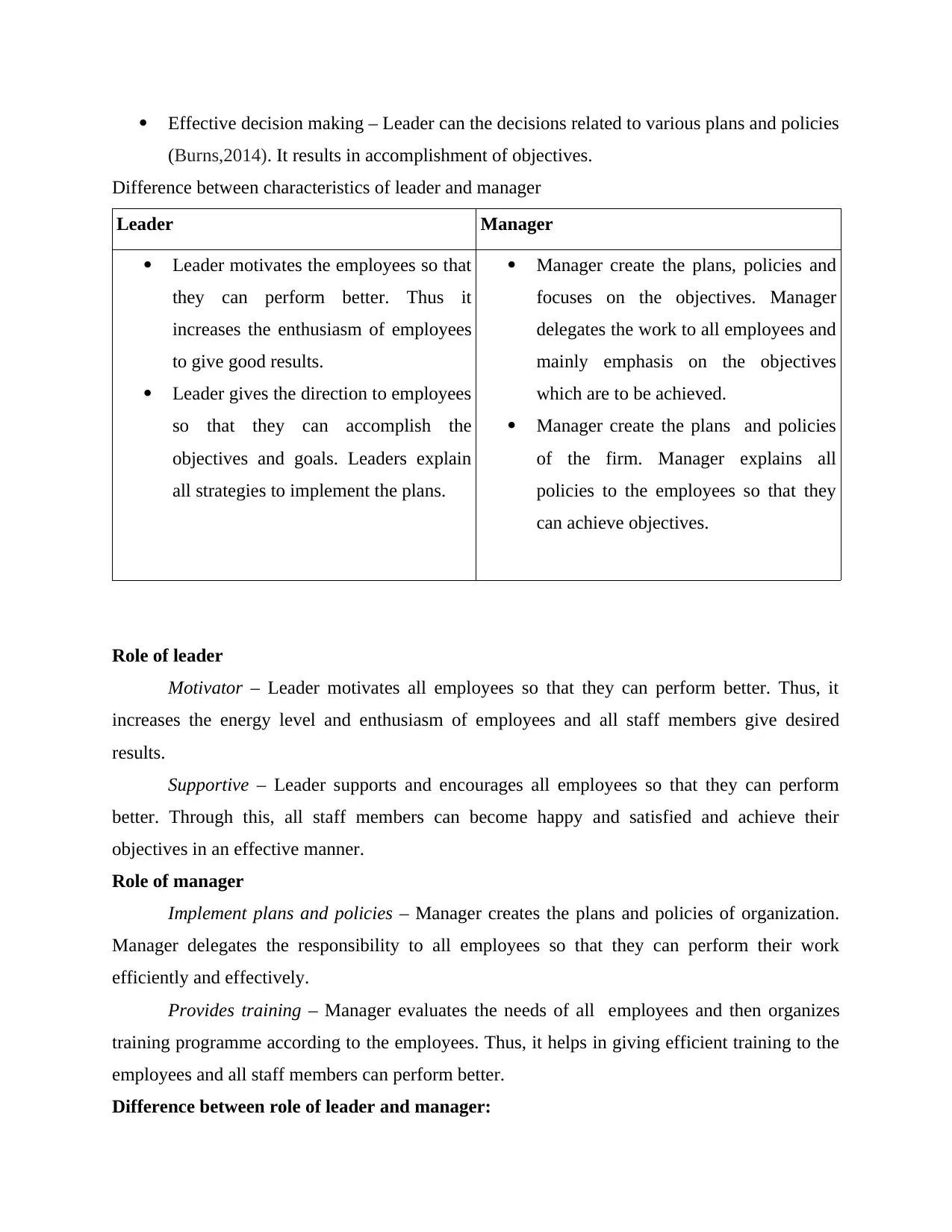
Difference between characteristics of leader and manager
Leader Manager
Leader motivates the employees so that
they can perform better. Thus it
increases the enthusiasm of employees
to give good results.
Leader gives the direction to employees
so that they can accomplish the
objectives and goals. Leaders explain
all strategies to implement the plans.
Manager create the plans, policies and
focuses on the objectives. Manager
delegates the work to all employees and
mainly emphasis on the objectives
which are to be achieved.
Manager create the plans and policies
of the firm. Manager explains all
policies to the employees so that they
can achieve objectives.
Role of leader
Motivator – Leader motivates all employees so that they can perform better. Thus, it
increases the energy level and enthusiasm of employees and all staff members give desired
results.
Supportive – Leader supports and encourages all employees so that they can perform
better. Through this, all staff members can become happy and satisfied and achieve their
objectives in an effective manner.
Role of manager
Implement plans and policies – Manager creates the plans and policies of organization.
Manager delegates the responsibility to all employees so that they can perform their work
efficiently and effectively.
Provides training – Manager evaluates the needs of all employees and then organizes
training programme according to the employees. Thus, it helps in giving efficient training to the
employees and all staff members can perform better.
Difference between role of leader and manager:
(Burns,2014). It results in accomplishment of objectives.
Difference between characteristics of leader and manager
Leader Manager
Leader motivates the employees so that
they can perform better. Thus it
increases the enthusiasm of employees
to give good results.
Leader gives the direction to employees
so that they can accomplish the
objectives and goals. Leaders explain
all strategies to implement the plans.
Manager create the plans, policies and
focuses on the objectives. Manager
delegates the work to all employees and
mainly emphasis on the objectives
which are to be achieved.
Manager create the plans and policies
of the firm. Manager explains all
policies to the employees so that they
can achieve objectives.
Role of leader
Motivator – Leader motivates all employees so that they can perform better. Thus, it
increases the energy level and enthusiasm of employees and all staff members give desired
results.
Supportive – Leader supports and encourages all employees so that they can perform
better. Through this, all staff members can become happy and satisfied and achieve their
objectives in an effective manner.
Role of manager
Implement plans and policies – Manager creates the plans and policies of organization.
Manager delegates the responsibility to all employees so that they can perform their work
efficiently and effectively.
Provides training – Manager evaluates the needs of all employees and then organizes
training programme according to the employees. Thus, it helps in giving efficient training to the
employees and all staff members can perform better.
Difference between role of leader and manager:
Paraphrase This Document
Need a fresh take? Get an instant paraphrase of this document with our AI Paraphraser
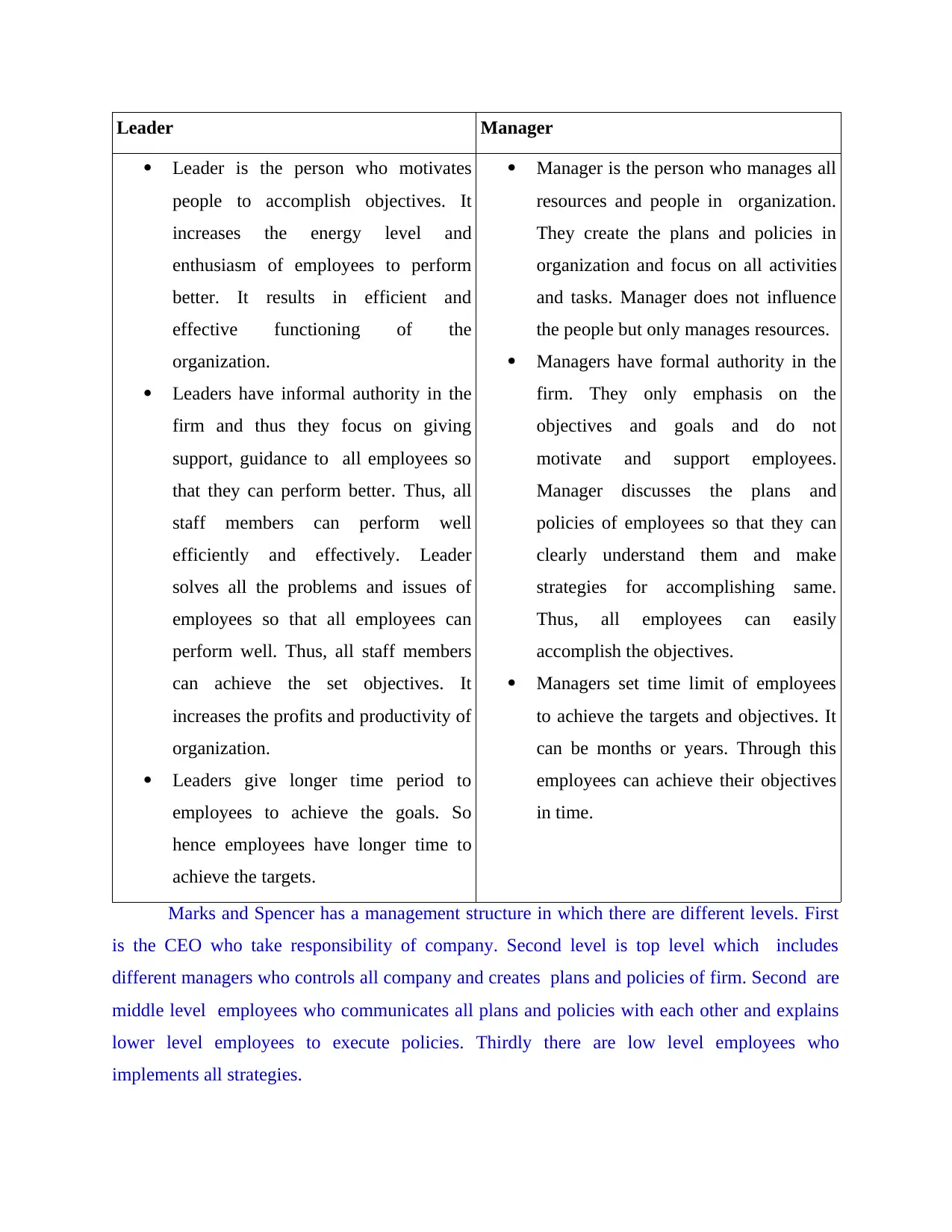
Leader Manager
Leader is the person who motivates
people to accomplish objectives. It
increases the energy level and
enthusiasm of employees to perform
better. It results in efficient and
effective functioning of the
organization.
Leaders have informal authority in the
firm and thus they focus on giving
support, guidance to all employees so
that they can perform better. Thus, all
staff members can perform well
efficiently and effectively. Leader
solves all the problems and issues of
employees so that all employees can
perform well. Thus, all staff members
can achieve the set objectives. It
increases the profits and productivity of
organization.
Leaders give longer time period to
employees to achieve the goals. So
hence employees have longer time to
achieve the targets.
Manager is the person who manages all
resources and people in organization.
They create the plans and policies in
organization and focus on all activities
and tasks. Manager does not influence
the people but only manages resources.
Managers have formal authority in the
firm. They only emphasis on the
objectives and goals and do not
motivate and support employees.
Manager discusses the plans and
policies of employees so that they can
clearly understand them and make
strategies for accomplishing same.
Thus, all employees can easily
accomplish the objectives.
Managers set time limit of employees
to achieve the targets and objectives. It
can be months or years. Through this
employees can achieve their objectives
in time.
Marks and Spencer has a management structure in which there are different levels. First
is the CEO who take responsibility of company. Second level is top level which includes
different managers who controls all company and creates plans and policies of firm. Second are
middle level employees who communicates all plans and policies with each other and explains
lower level employees to execute policies. Thirdly there are low level employees who
implements all strategies.
Leader is the person who motivates
people to accomplish objectives. It
increases the energy level and
enthusiasm of employees to perform
better. It results in efficient and
effective functioning of the
organization.
Leaders have informal authority in the
firm and thus they focus on giving
support, guidance to all employees so
that they can perform better. Thus, all
staff members can perform well
efficiently and effectively. Leader
solves all the problems and issues of
employees so that all employees can
perform well. Thus, all staff members
can achieve the set objectives. It
increases the profits and productivity of
organization.
Leaders give longer time period to
employees to achieve the goals. So
hence employees have longer time to
achieve the targets.
Manager is the person who manages all
resources and people in organization.
They create the plans and policies in
organization and focus on all activities
and tasks. Manager does not influence
the people but only manages resources.
Managers have formal authority in the
firm. They only emphasis on the
objectives and goals and do not
motivate and support employees.
Manager discusses the plans and
policies of employees so that they can
clearly understand them and make
strategies for accomplishing same.
Thus, all employees can easily
accomplish the objectives.
Managers set time limit of employees
to achieve the targets and objectives. It
can be months or years. Through this
employees can achieve their objectives
in time.
Marks and Spencer has a management structure in which there are different levels. First
is the CEO who take responsibility of company. Second level is top level which includes
different managers who controls all company and creates plans and policies of firm. Second are
middle level employees who communicates all plans and policies with each other and explains
lower level employees to execute policies. Thirdly there are low level employees who
implements all strategies.
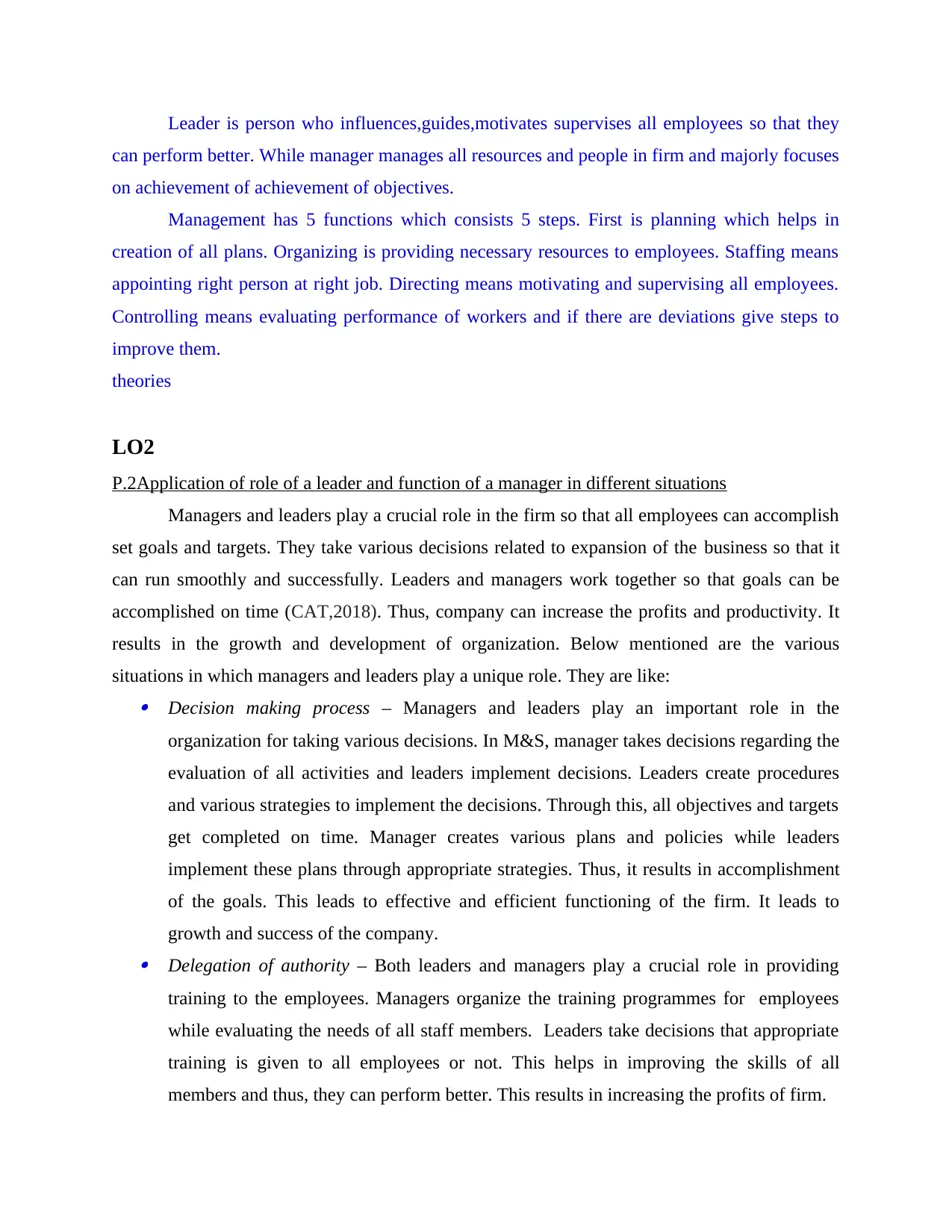
Leader is person who influences,guides,motivates supervises all employees so that they
can perform better. While manager manages all resources and people in firm and majorly focuses
on achievement of achievement of objectives.
Management has 5 functions which consists 5 steps. First is planning which helps in
creation of all plans. Organizing is providing necessary resources to employees. Staffing means
appointing right person at right job. Directing means motivating and supervising all employees.
Controlling means evaluating performance of workers and if there are deviations give steps to
improve them.
theories
LO2
P.2Application of role of a leader and function of a manager in different situations
Managers and leaders play a crucial role in the firm so that all employees can accomplish
set goals and targets. They take various decisions related to expansion of the business so that it
can run smoothly and successfully. Leaders and managers work together so that goals can be
accomplished on time (CAT,2018). Thus, company can increase the profits and productivity. It
results in the growth and development of organization. Below mentioned are the various
situations in which managers and leaders play a unique role. They are like: Decision making process – Managers and leaders play an important role in the
organization for taking various decisions. In M&S, manager takes decisions regarding the
evaluation of all activities and leaders implement decisions. Leaders create procedures
and various strategies to implement the decisions. Through this, all objectives and targets
get completed on time. Manager creates various plans and policies while leaders
implement these plans through appropriate strategies. Thus, it results in accomplishment
of the goals. This leads to effective and efficient functioning of the firm. It leads to
growth and success of the company. Delegation of authority – Both leaders and managers play a crucial role in providing
training to the employees. Managers organize the training programmes for employees
while evaluating the needs of all staff members. Leaders take decisions that appropriate
training is given to all employees or not. This helps in improving the skills of all
members and thus, they can perform better. This results in increasing the profits of firm.
can perform better. While manager manages all resources and people in firm and majorly focuses
on achievement of achievement of objectives.
Management has 5 functions which consists 5 steps. First is planning which helps in
creation of all plans. Organizing is providing necessary resources to employees. Staffing means
appointing right person at right job. Directing means motivating and supervising all employees.
Controlling means evaluating performance of workers and if there are deviations give steps to
improve them.
theories
LO2
P.2Application of role of a leader and function of a manager in different situations
Managers and leaders play a crucial role in the firm so that all employees can accomplish
set goals and targets. They take various decisions related to expansion of the business so that it
can run smoothly and successfully. Leaders and managers work together so that goals can be
accomplished on time (CAT,2018). Thus, company can increase the profits and productivity. It
results in the growth and development of organization. Below mentioned are the various
situations in which managers and leaders play a unique role. They are like: Decision making process – Managers and leaders play an important role in the
organization for taking various decisions. In M&S, manager takes decisions regarding the
evaluation of all activities and leaders implement decisions. Leaders create procedures
and various strategies to implement the decisions. Through this, all objectives and targets
get completed on time. Manager creates various plans and policies while leaders
implement these plans through appropriate strategies. Thus, it results in accomplishment
of the goals. This leads to effective and efficient functioning of the firm. It leads to
growth and success of the company. Delegation of authority – Both leaders and managers play a crucial role in providing
training to the employees. Managers organize the training programmes for employees
while evaluating the needs of all staff members. Leaders take decisions that appropriate
training is given to all employees or not. This helps in improving the skills of all
members and thus, they can perform better. This results in increasing the profits of firm.
⊘ This is a preview!⊘
Do you want full access?
Subscribe today to unlock all pages.
Trusted by 1+ million students worldwide
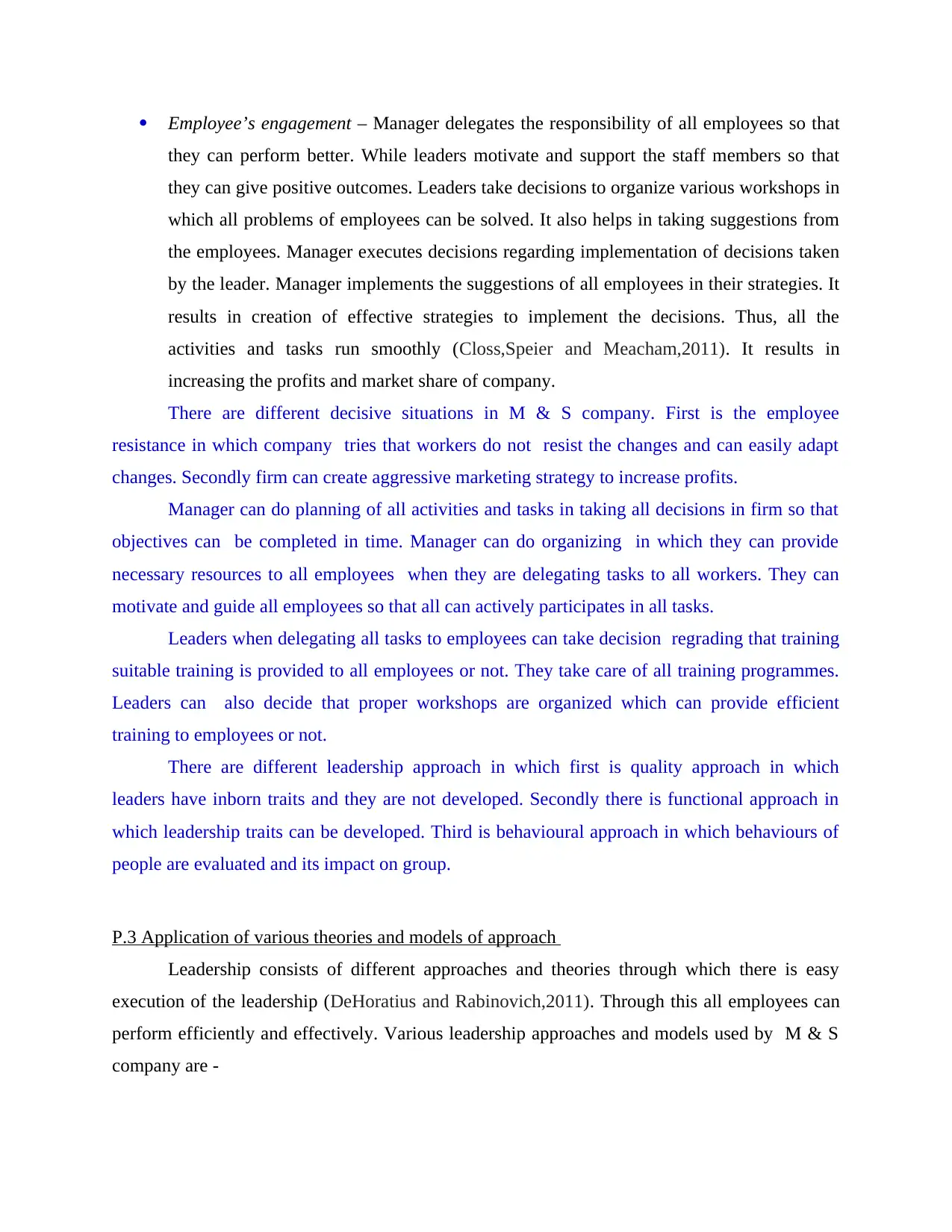
Employee’s engagement – Manager delegates the responsibility of all employees so that
they can perform better. While leaders motivate and support the staff members so that
they can give positive outcomes. Leaders take decisions to organize various workshops in
which all problems of employees can be solved. It also helps in taking suggestions from
the employees. Manager executes decisions regarding implementation of decisions taken
by the leader. Manager implements the suggestions of all employees in their strategies. It
results in creation of effective strategies to implement the decisions. Thus, all the
activities and tasks run smoothly (Closs,Speier and Meacham,2011). It results in
increasing the profits and market share of company.
There are different decisive situations in M & S company. First is the employee
resistance in which company tries that workers do not resist the changes and can easily adapt
changes. Secondly firm can create aggressive marketing strategy to increase profits.
Manager can do planning of all activities and tasks in taking all decisions in firm so that
objectives can be completed in time. Manager can do organizing in which they can provide
necessary resources to all employees when they are delegating tasks to all workers. They can
motivate and guide all employees so that all can actively participates in all tasks.
Leaders when delegating all tasks to employees can take decision regrading that training
suitable training is provided to all employees or not. They take care of all training programmes.
Leaders can also decide that proper workshops are organized which can provide efficient
training to employees or not.
There are different leadership approach in which first is quality approach in which
leaders have inborn traits and they are not developed. Secondly there is functional approach in
which leadership traits can be developed. Third is behavioural approach in which behaviours of
people are evaluated and its impact on group.
P.3 Application of various theories and models of approach
Leadership consists of different approaches and theories through which there is easy
execution of the leadership (DeHoratius and Rabinovich,2011). Through this all employees can
perform efficiently and effectively. Various leadership approaches and models used by M & S
company are -
they can perform better. While leaders motivate and support the staff members so that
they can give positive outcomes. Leaders take decisions to organize various workshops in
which all problems of employees can be solved. It also helps in taking suggestions from
the employees. Manager executes decisions regarding implementation of decisions taken
by the leader. Manager implements the suggestions of all employees in their strategies. It
results in creation of effective strategies to implement the decisions. Thus, all the
activities and tasks run smoothly (Closs,Speier and Meacham,2011). It results in
increasing the profits and market share of company.
There are different decisive situations in M & S company. First is the employee
resistance in which company tries that workers do not resist the changes and can easily adapt
changes. Secondly firm can create aggressive marketing strategy to increase profits.
Manager can do planning of all activities and tasks in taking all decisions in firm so that
objectives can be completed in time. Manager can do organizing in which they can provide
necessary resources to all employees when they are delegating tasks to all workers. They can
motivate and guide all employees so that all can actively participates in all tasks.
Leaders when delegating all tasks to employees can take decision regrading that training
suitable training is provided to all employees or not. They take care of all training programmes.
Leaders can also decide that proper workshops are organized which can provide efficient
training to employees or not.
There are different leadership approach in which first is quality approach in which
leaders have inborn traits and they are not developed. Secondly there is functional approach in
which leadership traits can be developed. Third is behavioural approach in which behaviours of
people are evaluated and its impact on group.
P.3 Application of various theories and models of approach
Leadership consists of different approaches and theories through which there is easy
execution of the leadership (DeHoratius and Rabinovich,2011). Through this all employees can
perform efficiently and effectively. Various leadership approaches and models used by M & S
company are -
Paraphrase This Document
Need a fresh take? Get an instant paraphrase of this document with our AI Paraphraser
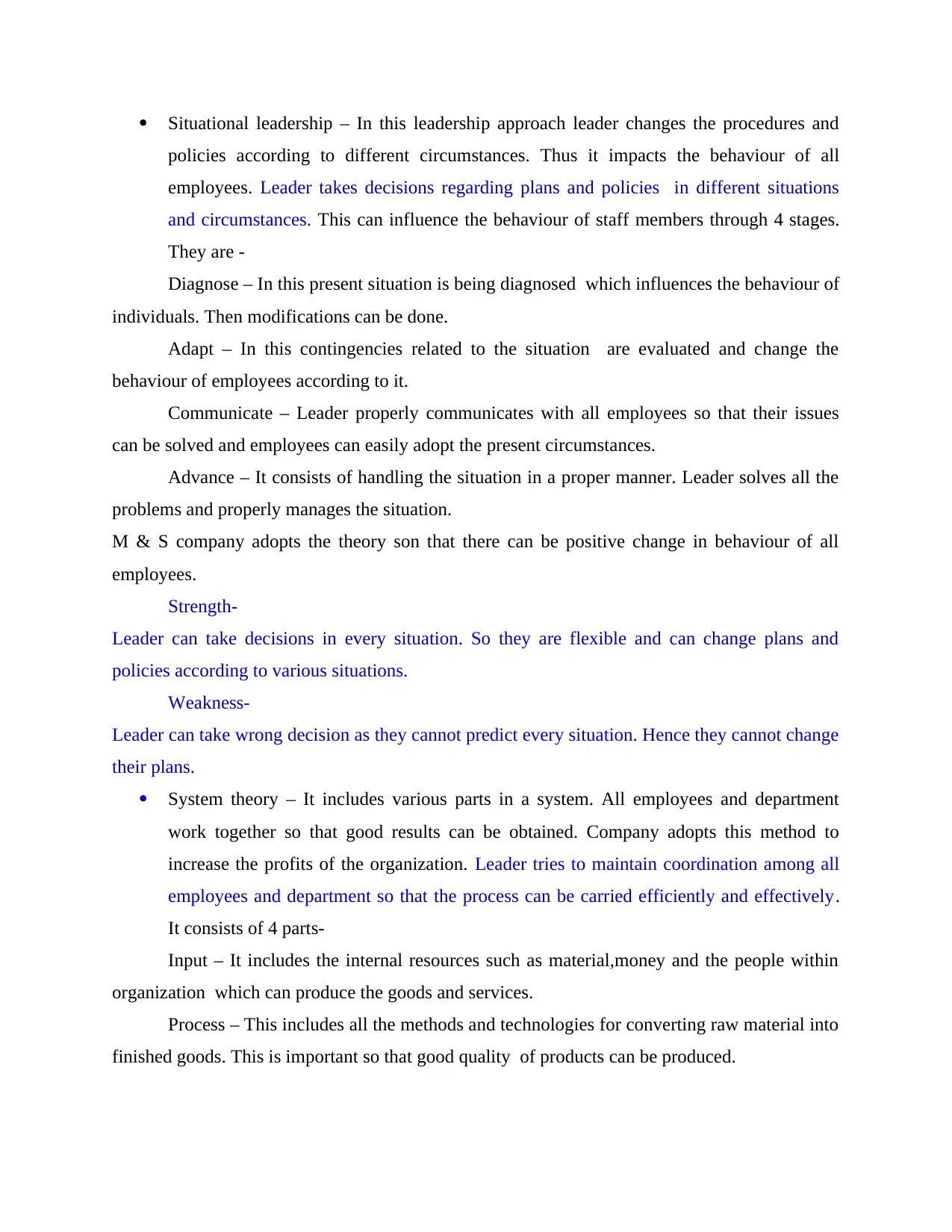
Situational leadership – In this leadership approach leader changes the procedures and
policies according to different circumstances. Thus it impacts the behaviour of all
employees. Leader takes decisions regarding plans and policies in different situations
and circumstances. This can influence the behaviour of staff members through 4 stages.
They are -
Diagnose – In this present situation is being diagnosed which influences the behaviour of
individuals. Then modifications can be done.
Adapt – In this contingencies related to the situation are evaluated and change the
behaviour of employees according to it.
Communicate – Leader properly communicates with all employees so that their issues
can be solved and employees can easily adopt the present circumstances.
Advance – It consists of handling the situation in a proper manner. Leader solves all the
problems and properly manages the situation.
M & S company adopts the theory son that there can be positive change in behaviour of all
employees.
Strength-
Leader can take decisions in every situation. So they are flexible and can change plans and
policies according to various situations.
Weakness-
Leader can take wrong decision as they cannot predict every situation. Hence they cannot change
their plans.
System theory – It includes various parts in a system. All employees and department
work together so that good results can be obtained. Company adopts this method to
increase the profits of the organization. Leader tries to maintain coordination among all
employees and department so that the process can be carried efficiently and effectively.
It consists of 4 parts-
Input – It includes the internal resources such as material,money and the people within
organization which can produce the goods and services.
Process – This includes all the methods and technologies for converting raw material into
finished goods. This is important so that good quality of products can be produced.
policies according to different circumstances. Thus it impacts the behaviour of all
employees. Leader takes decisions regarding plans and policies in different situations
and circumstances. This can influence the behaviour of staff members through 4 stages.
They are -
Diagnose – In this present situation is being diagnosed which influences the behaviour of
individuals. Then modifications can be done.
Adapt – In this contingencies related to the situation are evaluated and change the
behaviour of employees according to it.
Communicate – Leader properly communicates with all employees so that their issues
can be solved and employees can easily adopt the present circumstances.
Advance – It consists of handling the situation in a proper manner. Leader solves all the
problems and properly manages the situation.
M & S company adopts the theory son that there can be positive change in behaviour of all
employees.
Strength-
Leader can take decisions in every situation. So they are flexible and can change plans and
policies according to various situations.
Weakness-
Leader can take wrong decision as they cannot predict every situation. Hence they cannot change
their plans.
System theory – It includes various parts in a system. All employees and department
work together so that good results can be obtained. Company adopts this method to
increase the profits of the organization. Leader tries to maintain coordination among all
employees and department so that the process can be carried efficiently and effectively.
It consists of 4 parts-
Input – It includes the internal resources such as material,money and the people within
organization which can produce the goods and services.
Process – This includes all the methods and technologies for converting raw material into
finished goods. This is important so that good quality of products can be produced.
Output – This process includes the finished product, satisfaction of employees and
services in the company (Haksever and Render,2013) . Through this company can earn more
profits and can increase the productivity.
Feedback – It helps in receiving the information from all the activities and tasks which
are involved in giving the output (Jacobs, Chase and Lummus,2014). This helps the company to
evaluate the outcomes.
M & S company adopts the open approach in which firm take inputs from the external
environment and create good quality of products. These goods are given back to the customer.
Thus it results in increasing of customer satisfaction. Thus company can maintain positive
image in front of all the customers . Thus company can increase the production and can generate
more revenues. So it can give tough competition to other firms.
Strength -
Leaders can execute,compare and evaluate different activities very easily and efficiently.
Weakness-
It is complex system as it involves various process and methods.
Contingency theory – In this there is no best strategy to achieve the objectives of the
company. It depends on the internal and external conditions of the environment. So a
leader has to change the plans,policies and leadership style according to various
situations. Through this leader can analyse the situation properly and can take relevant
decisions. Leader can adopt democratic leadership in which suggestions from employees
can be taken and they can apply this in firm and this is done to increase the productivity
of employees.
Strength-
Leaders can handle every situation in efficient and effective manner.
Weakness
Leader cannot do empirical testing as various factors are involved in theory.
services in the company (Haksever and Render,2013) . Through this company can earn more
profits and can increase the productivity.
Feedback – It helps in receiving the information from all the activities and tasks which
are involved in giving the output (Jacobs, Chase and Lummus,2014). This helps the company to
evaluate the outcomes.
M & S company adopts the open approach in which firm take inputs from the external
environment and create good quality of products. These goods are given back to the customer.
Thus it results in increasing of customer satisfaction. Thus company can maintain positive
image in front of all the customers . Thus company can increase the production and can generate
more revenues. So it can give tough competition to other firms.
Strength -
Leaders can execute,compare and evaluate different activities very easily and efficiently.
Weakness-
It is complex system as it involves various process and methods.
Contingency theory – In this there is no best strategy to achieve the objectives of the
company. It depends on the internal and external conditions of the environment. So a
leader has to change the plans,policies and leadership style according to various
situations. Through this leader can analyse the situation properly and can take relevant
decisions. Leader can adopt democratic leadership in which suggestions from employees
can be taken and they can apply this in firm and this is done to increase the productivity
of employees.
Strength-
Leaders can handle every situation in efficient and effective manner.
Weakness
Leader cannot do empirical testing as various factors are involved in theory.
⊘ This is a preview!⊘
Do you want full access?
Subscribe today to unlock all pages.
Trusted by 1+ million students worldwide
Rose leadership model – This model discusses about the various changes in the firm and
can change the bureaucratic style into unique style. M & S company focuses on
increasing the commitment and the loyalty of all the employees. Through this all
employees willingly do the work in the company and do not left the firm. It results in
achieving of objectives and goals. It results in generation of more profits. Leaders
motivate all employees so that they are motivated to perform better. It increases the
loyalty of employees.
Strength
Leaders can create positive environment in the firm as leaders have applied democratic
leadership. So hence all employees are motivated.
Weakness
LO3
P.4 Key approaches to operational management and role of leaders and managers
Operational management is the administration of all the tasks in the firm so that can run
smoothly and successfully. This helps in increasing the productivity of the company and firm can
earn more profits. It also fulfils the requirements of all the customers by providing them good
quality of products. Thus customers can become satisfied. Approaches used by M & S are -
Lean production – In this process there is no wastage of resources in producing the goods
so that it increases the profits of the firm. They also educate the supplier so that they can
send the materials according to the demand of the company which leads to reducing the
wastage of resources. It results in proper utilization of the resources in the firm (Naphade
and et. al.,2011). Leaders take decision to provide training to the employees so that there
is no wastage of resources and produce good quality of products. While manager
implements the decision of leader and motivates the employees so that they can produce
efficient quality of product. Through this there is increase in productivity of the firm and
results in smooth functioning of the company.
can change the bureaucratic style into unique style. M & S company focuses on
increasing the commitment and the loyalty of all the employees. Through this all
employees willingly do the work in the company and do not left the firm. It results in
achieving of objectives and goals. It results in generation of more profits. Leaders
motivate all employees so that they are motivated to perform better. It increases the
loyalty of employees.
Strength
Leaders can create positive environment in the firm as leaders have applied democratic
leadership. So hence all employees are motivated.
Weakness
LO3
P.4 Key approaches to operational management and role of leaders and managers
Operational management is the administration of all the tasks in the firm so that can run
smoothly and successfully. This helps in increasing the productivity of the company and firm can
earn more profits. It also fulfils the requirements of all the customers by providing them good
quality of products. Thus customers can become satisfied. Approaches used by M & S are -
Lean production – In this process there is no wastage of resources in producing the goods
so that it increases the profits of the firm. They also educate the supplier so that they can
send the materials according to the demand of the company which leads to reducing the
wastage of resources. It results in proper utilization of the resources in the firm (Naphade
and et. al.,2011). Leaders take decision to provide training to the employees so that there
is no wastage of resources and produce good quality of products. While manager
implements the decision of leader and motivates the employees so that they can produce
efficient quality of product. Through this there is increase in productivity of the firm and
results in smooth functioning of the company.
Paraphrase This Document
Need a fresh take? Get an instant paraphrase of this document with our AI Paraphraser
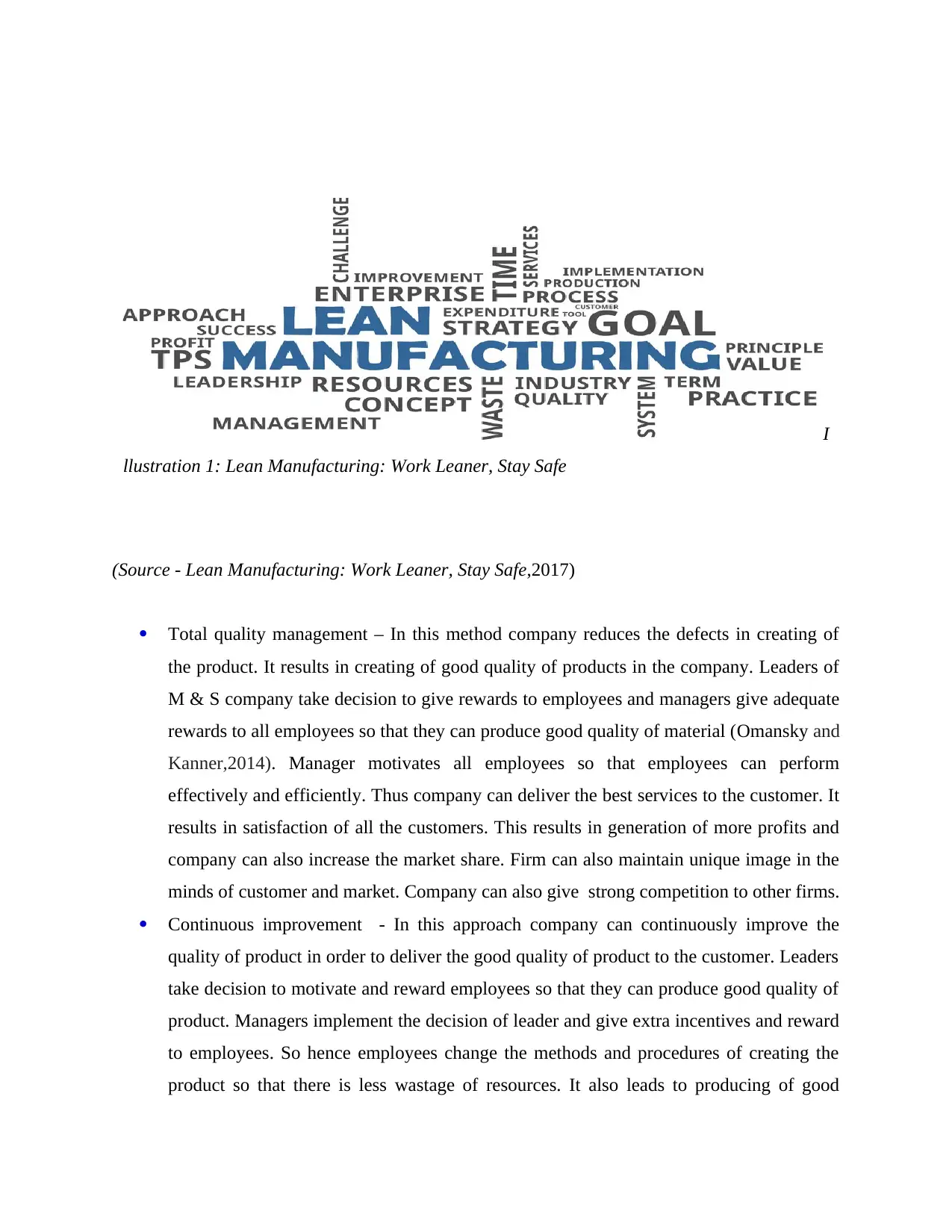
(Source - Lean Manufacturing: Work Leaner, Stay Safe,2017)
Total quality management – In this method company reduces the defects in creating of
the product. It results in creating of good quality of products in the company. Leaders of
M & S company take decision to give rewards to employees and managers give adequate
rewards to all employees so that they can produce good quality of material (Omansky and
Kanner,2014). Manager motivates all employees so that employees can perform
effectively and efficiently. Thus company can deliver the best services to the customer. It
results in satisfaction of all the customers. This results in generation of more profits and
company can also increase the market share. Firm can also maintain unique image in the
minds of customer and market. Company can also give strong competition to other firms.
Continuous improvement - In this approach company can continuously improve the
quality of product in order to deliver the good quality of product to the customer. Leaders
take decision to motivate and reward employees so that they can produce good quality of
product. Managers implement the decision of leader and give extra incentives and reward
to employees. So hence employees change the methods and procedures of creating the
product so that there is less wastage of resources. It also leads to producing of good
I
llustration 1: Lean Manufacturing: Work Leaner, Stay Safe
Total quality management – In this method company reduces the defects in creating of
the product. It results in creating of good quality of products in the company. Leaders of
M & S company take decision to give rewards to employees and managers give adequate
rewards to all employees so that they can produce good quality of material (Omansky and
Kanner,2014). Manager motivates all employees so that employees can perform
effectively and efficiently. Thus company can deliver the best services to the customer. It
results in satisfaction of all the customers. This results in generation of more profits and
company can also increase the market share. Firm can also maintain unique image in the
minds of customer and market. Company can also give strong competition to other firms.
Continuous improvement - In this approach company can continuously improve the
quality of product in order to deliver the good quality of product to the customer. Leaders
take decision to motivate and reward employees so that they can produce good quality of
product. Managers implement the decision of leader and give extra incentives and reward
to employees. So hence employees change the methods and procedures of creating the
product so that there is less wastage of resources. It also leads to producing of good
I
llustration 1: Lean Manufacturing: Work Leaner, Stay Safe
quality of product. This results in capturing of more customers and firm can generate
more profits. Firm can also increase the market share and can maintain strong
competitive edge on others.
There is particular process to develop product. First is generation and screening of idea .
Third is testing idea and fourth is doing business analysis and fifth is marketing tests. Sixth is
evaluating the technical capabilities and developing product. Lastly commercializing and
promoting product.
Key operational functions and role of managers
First is the management of financial resources in which they manages the raw materials
and other employees. They also take care of hiring and planning of people. Second is financial
management manager helps in evaluating and controlling all expenses related to activities in
company. Leader can motivate all employees so that all employees can perform efficiently and
effectively. They can give rewards to workers so that they can create products at minimum cost.
JIT approach is the approach through which there is no wastage and thus increases the
efficiency in producing good quality of product. Hence it decreases the inventory costs in
creation of product. Manager can create plans and policies to reduce the wastage in
manufacturing of product. Leader motivate all employees so that they can follow this approach.
P.5 Value and importance of operational management
Operational management is the managing of all resources so that good quality of
productions can be manufactured. It is important as it reduces the production cost of goods.
Thus it delivers the good quality of goods to the customers. Importance of operational
management in M & S are-
Quality – Through operational management company can manage the processes and
activities in an efficient manner (Singhal and Singhal,2012). Thus good quality of
products can be created. It leads to smooth functioning of activities in the organization.
So hence the firm can deliver the good quality of products to the customers. Thus firm
can capture more customers in shorter period of time. Firm can also maintain positive
image in minds of all customers. This leads to generation of more profits and company
can increase the market share. Thus it results in expansion and growth of the business.
more profits. Firm can also increase the market share and can maintain strong
competitive edge on others.
There is particular process to develop product. First is generation and screening of idea .
Third is testing idea and fourth is doing business analysis and fifth is marketing tests. Sixth is
evaluating the technical capabilities and developing product. Lastly commercializing and
promoting product.
Key operational functions and role of managers
First is the management of financial resources in which they manages the raw materials
and other employees. They also take care of hiring and planning of people. Second is financial
management manager helps in evaluating and controlling all expenses related to activities in
company. Leader can motivate all employees so that all employees can perform efficiently and
effectively. They can give rewards to workers so that they can create products at minimum cost.
JIT approach is the approach through which there is no wastage and thus increases the
efficiency in producing good quality of product. Hence it decreases the inventory costs in
creation of product. Manager can create plans and policies to reduce the wastage in
manufacturing of product. Leader motivate all employees so that they can follow this approach.
P.5 Value and importance of operational management
Operational management is the managing of all resources so that good quality of
productions can be manufactured. It is important as it reduces the production cost of goods.
Thus it delivers the good quality of goods to the customers. Importance of operational
management in M & S are-
Quality – Through operational management company can manage the processes and
activities in an efficient manner (Singhal and Singhal,2012). Thus good quality of
products can be created. It leads to smooth functioning of activities in the organization.
So hence the firm can deliver the good quality of products to the customers. Thus firm
can capture more customers in shorter period of time. Firm can also maintain positive
image in minds of all customers. This leads to generation of more profits and company
can increase the market share. Thus it results in expansion and growth of the business.
⊘ This is a preview!⊘
Do you want full access?
Subscribe today to unlock all pages.
Trusted by 1+ million students worldwide

1 out of 17


Related Documents


Your All-in-One AI-Powered Toolkit for Academic Success.
+13062052269
info@desklib.com
Available 24*7 on WhatsApp / Email
![[object Object]](/_next/static/media/star-bottom.7253800d.svg)
Unlock your academic potential
Copyright © 2020–2026 A2Z Services. All Rights Reserved. Developed and managed by ZUCOL.