Project Life Cycle in M&S Operations Management: A Detailed Review
VerifiedAdded on 2023/06/18
|15
|5040
|299
Report
AI Summary
This report examines the operations and project management strategies employed by Marks & Spencer (M&S), a leading British retailer. It delves into the day-to-day activities and strategic resource management within the company, founded in 1884. The report analyzes the effectiveness and efficiency of M&S's operations management, focusing on continuous improvement, the principles of the project life cycle, and the impact of technology, including the ICOS information system and supply chain management. It also explores various approaches to operations management, such as Taylor's theory, flexible specialization, lean production, mass customization, agile manufacturing, and Six Sigma, and their application within M&S. The report further assesses cross-functional teams and the administration of each phase of the project life cycle, highlighting necessary documentation and approval processes.

REVIEW AND CRTIQUE OF
OPERATION MANAGEMENT/
PROJECT LIFE CYCLE
OPERATION MANAGEMENT/
PROJECT LIFE CYCLE

Paraphrase This Document
Need a fresh take? Get an instant paraphrase of this document with our AI Paraphraser

Table of Contents
INTRODUCTION................................................................................................................................3
Operation and operation management.............................................................................................3
concept of continuous improvement in an operational context of M&S.........................................5
Administer each phase of PLC to project, generating necessary approving documentation .........8
Analysis and appraisal effectiveness of PLC in operation.............................................................10
CONCLUSION..................................................................................................................................13
REFERENCES...................................................................................................................................13
INTRODUCTION................................................................................................................................3
Operation and operation management.............................................................................................3
concept of continuous improvement in an operational context of M&S.........................................5
Administer each phase of PLC to project, generating necessary approving documentation .........8
Analysis and appraisal effectiveness of PLC in operation.............................................................10
CONCLUSION..................................................................................................................................13
REFERENCES...................................................................................................................................13

INTRODUCTION
The operation and project management. Operation deals with the day to day activity of the
business and strategy whereas, project management deals with the resources, planning,organising
staffing and controlling of the company. The aim of this report is to determine the operation and
project management of the M&S the evolution and changes in the environment. The Mark and
Spencer is the retail industry leading in a British it includes food, clothing and home appliances to
millions of consumer across the globe. company found in Leeds in 1884 company has 472 stores
all over the world. M&S also empowered more than 70 thousand people and majority of them are
females (About us,2021).
This report include the effectiveness and efficiency of operation management in M&S. Analyse the
concept of continuous improvement in the operation management and project management of the
company Principle of project life cycle in the context of M&S.
Operation and operation management
OPERATION OPERATION MANAGEMENT
Operation involves all those activities
that are needed to create and deliver the
product and service of the organization.
It involves the process of producing the
products, managing the quality and
offering the service.
For example : producing cloths and
delivering them.
Operation management is a strategy
which involves the complete
management which focuses on the
system that are used in order to create
goods and services.
It involves all the methods which can
be utilized in order to produce the
products and maintaining the quality.
For example: Acquiring the resources
and techniques which are needed in
order to produce cloths.
Thus, operation and operational management are inter-related concept. For understanding this in
deep, here is the concept of operation and operation management of the mark & spencer. It is a big
retailer firm.
Operation of the firm includes the production of cloths, foods, homeware and fashionable
items. The operation of the firm takes place by selling their products at the national and
international market. The firm sells its products in UK and in around 416 international stores. The
organization is creating different types of clothes for all age group. (Yu and et.al., 2020). Along with
this firm is producing the different range of food meals and home-wear products. The company
The operation and project management. Operation deals with the day to day activity of the
business and strategy whereas, project management deals with the resources, planning,organising
staffing and controlling of the company. The aim of this report is to determine the operation and
project management of the M&S the evolution and changes in the environment. The Mark and
Spencer is the retail industry leading in a British it includes food, clothing and home appliances to
millions of consumer across the globe. company found in Leeds in 1884 company has 472 stores
all over the world. M&S also empowered more than 70 thousand people and majority of them are
females (About us,2021).
This report include the effectiveness and efficiency of operation management in M&S. Analyse the
concept of continuous improvement in the operation management and project management of the
company Principle of project life cycle in the context of M&S.
Operation and operation management
OPERATION OPERATION MANAGEMENT
Operation involves all those activities
that are needed to create and deliver the
product and service of the organization.
It involves the process of producing the
products, managing the quality and
offering the service.
For example : producing cloths and
delivering them.
Operation management is a strategy
which involves the complete
management which focuses on the
system that are used in order to create
goods and services.
It involves all the methods which can
be utilized in order to produce the
products and maintaining the quality.
For example: Acquiring the resources
and techniques which are needed in
order to produce cloths.
Thus, operation and operational management are inter-related concept. For understanding this in
deep, here is the concept of operation and operation management of the mark & spencer. It is a big
retailer firm.
Operation of the firm includes the production of cloths, foods, homeware and fashionable
items. The operation of the firm takes place by selling their products at the national and
international market. The firm sells its products in UK and in around 416 international stores. The
organization is creating different types of clothes for all age group. (Yu and et.al., 2020). Along with
this firm is producing the different range of food meals and home-wear products. The company
⊘ This is a preview!⊘
Do you want full access?
Subscribe today to unlock all pages.

Trusted by 1+ million students worldwide

focuses on maintaining the quality standard in their products. The products of the firm ensures the
high standards in terms of quality.
Operation management of the firm involves using of high quality of resources in order to
produce products and along with this the firm is using highly updated technology equipments so the
efficiency of the products can increase more. In terms of delivering the products, the organization
has adapted a policy under which they have owned large number of stores at the conventional
places, so the customers can easily get the products. The firm has approached the method of
strategic and tactical for performing the operation management. The strategic method involves the
making of strategies related to the quality of the goods and on the other hand tactical involves
monitoring and gaining the complete information regarding the changing taste of the customers.
Various approaches of operation management
There are numbers of approaches for performing the operation management. The mark & spensor
has approached these methods.
Taylor's theory of scientific management
The firm has approached the theory of taylor. The theory says that all the work should be divided
into different parts so the productivity of the work can increased. For processing operations, the
firm has made different departments. (Ongkasuwan and Sookcharoen, 2018). The firm has created
different departments in order to arrange raw materials, managing technology, monitoring the
process, delivering the products. The different section of the work helping organization in achieving
the main goal of the operational management.
Flexible specialisation
This involves making separate parts under the value adding process and collaborating with different
suppliers in order to make whole products. The firm is producing clothing, food, homewear
products. In order to produce these goods the firm has made the contact from different suppliers and
all of them providing the firm resources and all of these resources from different suppliers has been
utilized by the firm in produce the whole product.
Lean production
It involves cutting down of extra waste during the process production. The organization has
approached this way under operation management so the waste can be discarded which results in
maintaining the adequate inventory. (Gammage and Jarre, 2020). This also helps in reducing the
cost of production. Lean production is done on the concept of lean principles. These principles
suggest that the extra wastage should be discarded.
high standards in terms of quality.
Operation management of the firm involves using of high quality of resources in order to
produce products and along with this the firm is using highly updated technology equipments so the
efficiency of the products can increase more. In terms of delivering the products, the organization
has adapted a policy under which they have owned large number of stores at the conventional
places, so the customers can easily get the products. The firm has approached the method of
strategic and tactical for performing the operation management. The strategic method involves the
making of strategies related to the quality of the goods and on the other hand tactical involves
monitoring and gaining the complete information regarding the changing taste of the customers.
Various approaches of operation management
There are numbers of approaches for performing the operation management. The mark & spensor
has approached these methods.
Taylor's theory of scientific management
The firm has approached the theory of taylor. The theory says that all the work should be divided
into different parts so the productivity of the work can increased. For processing operations, the
firm has made different departments. (Ongkasuwan and Sookcharoen, 2018). The firm has created
different departments in order to arrange raw materials, managing technology, monitoring the
process, delivering the products. The different section of the work helping organization in achieving
the main goal of the operational management.
Flexible specialisation
This involves making separate parts under the value adding process and collaborating with different
suppliers in order to make whole products. The firm is producing clothing, food, homewear
products. In order to produce these goods the firm has made the contact from different suppliers and
all of them providing the firm resources and all of these resources from different suppliers has been
utilized by the firm in produce the whole product.
Lean production
It involves cutting down of extra waste during the process production. The organization has
approached this way under operation management so the waste can be discarded which results in
maintaining the adequate inventory. (Gammage and Jarre, 2020). This also helps in reducing the
cost of production. Lean production is done on the concept of lean principles. These principles
suggest that the extra wastage should be discarded.
Paraphrase This Document
Need a fresh take? Get an instant paraphrase of this document with our AI Paraphraser

Mass customisation
The firm has adapted mass-customisation in order to meet the changing requirements of the
customers. The firm producing the goods according to the taste of the customer.
Agile manufacturing
It is adapted by the firm who produces different range of products. The company is producing
different ranges. Therefore, this approach has been adapted by them. With the help of this, the firm
is fulfilling customer's objectives.
Six sigma
The six sigma tools focuses on the quality control of the goods. The organization has a high
goodwill in terms of maintaining. They have this goodwill because of using six sigma tools. It
involves DMAIC. The DMAIC stands for define, measure, analyse, improve and control. The
company focuses on the problems which arises in the process of production and solves that problem
through six sigma tools. Under this, the problem has been defined and discussed with the
management team. Then the different measures has been taken and complete evaluation of all the
measures takes place. The effective measure is chosen by the firm in order to solve the problem.
And after the problem has been solved complete monitoring and controlling has been done by the
operation management team so, the problem will not arise again.
concept of continuous improvement in an operational context of M&S
Concept of continuous improvement is a planning that consist marketing strategy of the
company for producing their product and services more better. Continuous improvement in the
company help in identify the weak and strong point of the company and after identify the errors and
default in the organisation with the help of project management that is planning , organising ,
staffing and controlling (Butler, and et.al 2018). There are some essential step to prepare the
continuous improvement of the organisation. Evaluate the previous year net profit, analyse the
progress in order to comply with the standards of Mark and Spencer. Summarising the planning
process, compliance.
There are some approaches for the continuous improvement of the organisation. Some of these are:
lean principle to continuous improvement of an M&S operations.
Lean is a philosophy of continuous improvement. Lean focuses on the consumer and their
behaviours. This deals with the reducing wastage and improving the efficiency of the company.
Five lean principle explained:
defined value:- company have to understand their what value the customer assign for their product
The firm has adapted mass-customisation in order to meet the changing requirements of the
customers. The firm producing the goods according to the taste of the customer.
Agile manufacturing
It is adapted by the firm who produces different range of products. The company is producing
different ranges. Therefore, this approach has been adapted by them. With the help of this, the firm
is fulfilling customer's objectives.
Six sigma
The six sigma tools focuses on the quality control of the goods. The organization has a high
goodwill in terms of maintaining. They have this goodwill because of using six sigma tools. It
involves DMAIC. The DMAIC stands for define, measure, analyse, improve and control. The
company focuses on the problems which arises in the process of production and solves that problem
through six sigma tools. Under this, the problem has been defined and discussed with the
management team. Then the different measures has been taken and complete evaluation of all the
measures takes place. The effective measure is chosen by the firm in order to solve the problem.
And after the problem has been solved complete monitoring and controlling has been done by the
operation management team so, the problem will not arise again.
concept of continuous improvement in an operational context of M&S
Concept of continuous improvement is a planning that consist marketing strategy of the
company for producing their product and services more better. Continuous improvement in the
company help in identify the weak and strong point of the company and after identify the errors and
default in the organisation with the help of project management that is planning , organising ,
staffing and controlling (Butler, and et.al 2018). There are some essential step to prepare the
continuous improvement of the organisation. Evaluate the previous year net profit, analyse the
progress in order to comply with the standards of Mark and Spencer. Summarising the planning
process, compliance.
There are some approaches for the continuous improvement of the organisation. Some of these are:
lean principle to continuous improvement of an M&S operations.
Lean is a philosophy of continuous improvement. Lean focuses on the consumer and their
behaviours. This deals with the reducing wastage and improving the efficiency of the company.
Five lean principle explained:
defined value:- company have to understand their what value the customer assign for their product
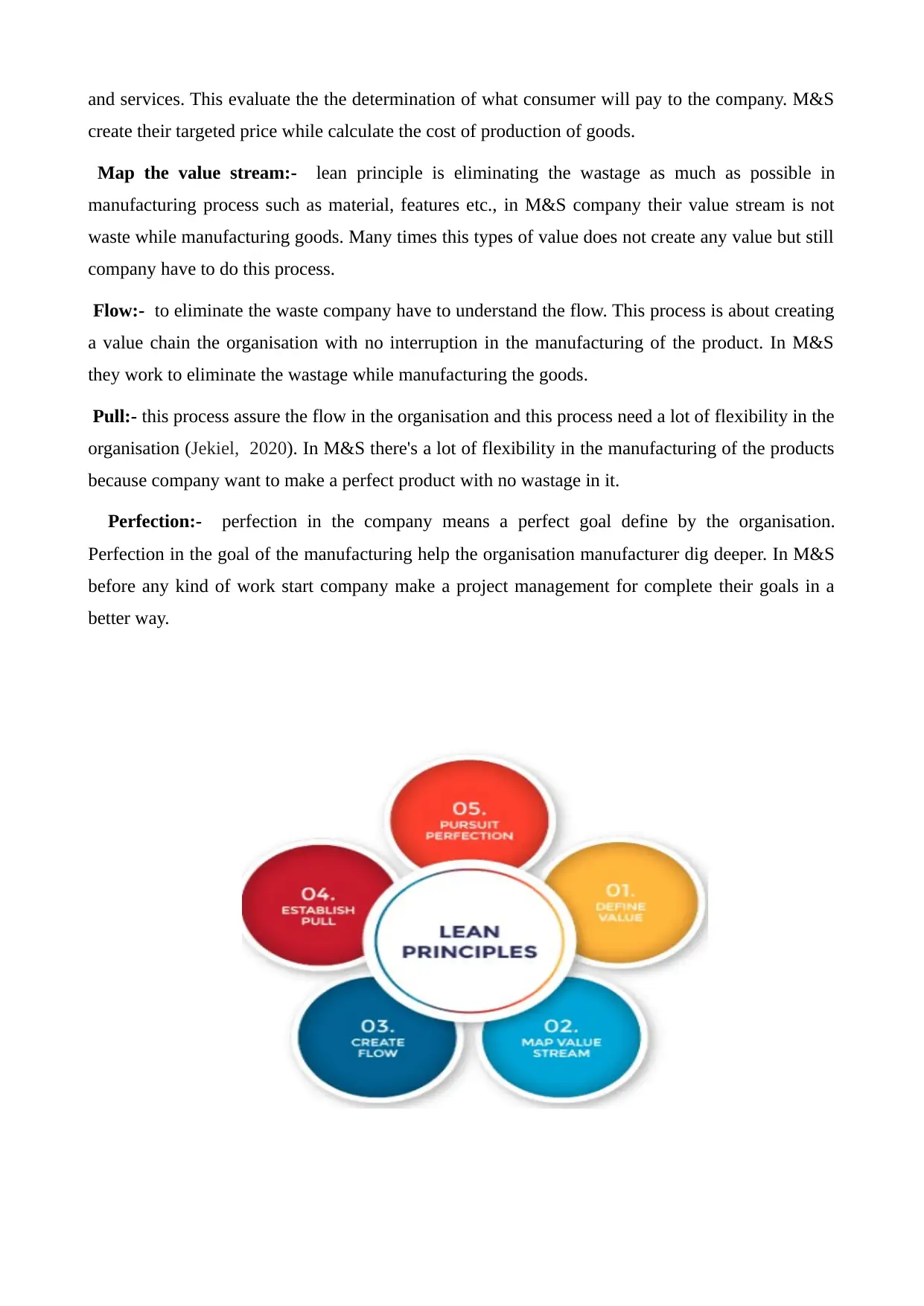
and services. This evaluate the the determination of what consumer will pay to the company. M&S
create their targeted price while calculate the cost of production of goods.
Map the value stream:- lean principle is eliminating the wastage as much as possible in
manufacturing process such as material, features etc., in M&S company their value stream is not
waste while manufacturing goods. Many times this types of value does not create any value but still
company have to do this process.
Flow:- to eliminate the waste company have to understand the flow. This process is about creating
a value chain the organisation with no interruption in the manufacturing of the product. In M&S
they work to eliminate the wastage while manufacturing the goods.
Pull:- this process assure the flow in the organisation and this process need a lot of flexibility in the
organisation (Jekiel, 2020). In M&S there's a lot of flexibility in the manufacturing of the products
because company want to make a perfect product with no wastage in it.
Perfection:- perfection in the company means a perfect goal define by the organisation.
Perfection in the goal of the manufacturing help the organisation manufacturer dig deeper. In M&S
before any kind of work start company make a project management for complete their goals in a
better way.
create their targeted price while calculate the cost of production of goods.
Map the value stream:- lean principle is eliminating the wastage as much as possible in
manufacturing process such as material, features etc., in M&S company their value stream is not
waste while manufacturing goods. Many times this types of value does not create any value but still
company have to do this process.
Flow:- to eliminate the waste company have to understand the flow. This process is about creating
a value chain the organisation with no interruption in the manufacturing of the product. In M&S
they work to eliminate the wastage while manufacturing the goods.
Pull:- this process assure the flow in the organisation and this process need a lot of flexibility in the
organisation (Jekiel, 2020). In M&S there's a lot of flexibility in the manufacturing of the products
because company want to make a perfect product with no wastage in it.
Perfection:- perfection in the company means a perfect goal define by the organisation.
Perfection in the goal of the manufacturing help the organisation manufacturer dig deeper. In M&S
before any kind of work start company make a project management for complete their goals in a
better way.
⊘ This is a preview!⊘
Do you want full access?
Subscribe today to unlock all pages.
Trusted by 1+ million students worldwide

Impact of technology on operational functions and information flows.
Technology is evolve daily in business and everywhere. It also moved towards from development
of goods into their design the use of the operation function in the organisation will help company to
reduce their cost and improve the quality of the goods. It also focus on the creating value for the
consumer of the company.
Integration of technology with production system :- technology derives rapidly in every
organisation, however it is complicated to put technology factor in the manufacturing department
but not for mark and Spencer company because the company is determine towards their work and
their procedure for manufacturing product is well organised and cost effective.
ICOS is an information system used by an M&S for various stores functions. This technology
comprises the all data of company which involve food, clothing , etc. in M&S every has a unique
identification code number that called UPC this number used while ordering.
Technology in manufacturing an design
in so many organisation technology is used to design the products and services. Current techniques
that used by an organisation are:
computer aided design ( CAD): This process facilitates the complex designs to a high level of
accuracy to deliver the product at high advancement.
Computer- aided manufacturing system( CAM):- This type of manufacturing need
professionalism support to handle and manufacture product at high level of accuracy.
Information system of integrated customer order service (ICOS):- M&S deals with many
issues while applying these kind of technology in the order processing. Because invested a lot in
that technology implementation. M&S start a information system that give a up to date information
about the ordering system. Company apply this technology in the organisation because it made
them different from their rivals.
Mark and Spencer tie up with amazon service in Europe this system synchronized information
system to company website. Company also apply DOS application and rumba server in their
organisation.
Critical assessment
ICOS replaced old fashion ordering through fax and other techniques which include the manually
data. This process is very effective and in this process the time consume is less and high
Technology is evolve daily in business and everywhere. It also moved towards from development
of goods into their design the use of the operation function in the organisation will help company to
reduce their cost and improve the quality of the goods. It also focus on the creating value for the
consumer of the company.
Integration of technology with production system :- technology derives rapidly in every
organisation, however it is complicated to put technology factor in the manufacturing department
but not for mark and Spencer company because the company is determine towards their work and
their procedure for manufacturing product is well organised and cost effective.
ICOS is an information system used by an M&S for various stores functions. This technology
comprises the all data of company which involve food, clothing , etc. in M&S every has a unique
identification code number that called UPC this number used while ordering.
Technology in manufacturing an design
in so many organisation technology is used to design the products and services. Current techniques
that used by an organisation are:
computer aided design ( CAD): This process facilitates the complex designs to a high level of
accuracy to deliver the product at high advancement.
Computer- aided manufacturing system( CAM):- This type of manufacturing need
professionalism support to handle and manufacture product at high level of accuracy.
Information system of integrated customer order service (ICOS):- M&S deals with many
issues while applying these kind of technology in the order processing. Because invested a lot in
that technology implementation. M&S start a information system that give a up to date information
about the ordering system. Company apply this technology in the organisation because it made
them different from their rivals.
Mark and Spencer tie up with amazon service in Europe this system synchronized information
system to company website. Company also apply DOS application and rumba server in their
organisation.
Critical assessment
ICOS replaced old fashion ordering through fax and other techniques which include the manually
data. This process is very effective and in this process the time consume is less and high
Paraphrase This Document
Need a fresh take? Get an instant paraphrase of this document with our AI Paraphraser

productivity. M&S understood their competitive benefits and company focused exclusively on the
corporate market strategy now a days. Now customer are satisfied by the fast ordering assessment.
Company investment turned out to raise a good profit to increase productivity of the company.
Supply chain
M&S invested in technology to better tracking of their product and services which provide
information about the new requirements and costumes in the products. This tech is helpful in the
goods importation from EU to UK and from all over the globe where company stores are situated
(Marks & Spencer: Accelerating Investment in Supply Chain,2020).
Cross- functional team
a cross functional team in organisation work as they divide the employee from different sector of
work and organised them as a team to collaborate and work together. Purpose for bring this cross
function apply to the company is better efficiency of the work and it reduce the repetition of the
same projects in the company (Walaszczyk, 2021). As M&S is clothing department if they don't
cross their team therefore, the work efficiency and repetitive design will get the buyer of
organisation less interested.
Administer each phase of PLC to project, generating necessary approving documentation
In these there are different phases of project life cycle that are designed in order to achieve
aims of projects in regard to M&S. Each project has starting and ending point from which exercise
move program towards integration and finish point. There are four stages of project life cycle that
are initiation, planning, implementation and closure which helps to determine path of project. These
are explained below;
Initiation Stage-
This is first phase of PLC, that refers to aims of projects and requirements are to be
determined in order to achieve objectives of project. A suitable feedback to need is non-fictional in
organization with justify answer of options. For this, expediency study is operated to searching
about that option of every address is suitable for project or not (Onyusheva, Thoesam and Baker,
2021.). From which final justifying aims of projects is identified that helps in running for smooth
functioning of project through this phase of it. When justifying clarification is approved by
organization, project is able to initiate in order to distribute passing solution and teams who
participated in works are determined. Also, group of program is able to take in structure according
to their starting. That approval is desired by leader of project to measure into accurate planning
stage.
Planning stage-
corporate market strategy now a days. Now customer are satisfied by the fast ordering assessment.
Company investment turned out to raise a good profit to increase productivity of the company.
Supply chain
M&S invested in technology to better tracking of their product and services which provide
information about the new requirements and costumes in the products. This tech is helpful in the
goods importation from EU to UK and from all over the globe where company stores are situated
(Marks & Spencer: Accelerating Investment in Supply Chain,2020).
Cross- functional team
a cross functional team in organisation work as they divide the employee from different sector of
work and organised them as a team to collaborate and work together. Purpose for bring this cross
function apply to the company is better efficiency of the work and it reduce the repetition of the
same projects in the company (Walaszczyk, 2021). As M&S is clothing department if they don't
cross their team therefore, the work efficiency and repetitive design will get the buyer of
organisation less interested.
Administer each phase of PLC to project, generating necessary approving documentation
In these there are different phases of project life cycle that are designed in order to achieve
aims of projects in regard to M&S. Each project has starting and ending point from which exercise
move program towards integration and finish point. There are four stages of project life cycle that
are initiation, planning, implementation and closure which helps to determine path of project. These
are explained below;
Initiation Stage-
This is first phase of PLC, that refers to aims of projects and requirements are to be
determined in order to achieve objectives of project. A suitable feedback to need is non-fictional in
organization with justify answer of options. For this, expediency study is operated to searching
about that option of every address is suitable for project or not (Onyusheva, Thoesam and Baker,
2021.). From which final justifying aims of projects is identified that helps in running for smooth
functioning of project through this phase of it. When justifying clarification is approved by
organization, project is able to initiate in order to distribute passing solution and teams who
participated in works are determined. Also, group of program is able to take in structure according
to their starting. That approval is desired by leader of project to measure into accurate planning
stage.
Planning stage-

Then comes phase of planning after initiating project, this stage is described in which
solution of project is refined as detailed in manner to achieve aims of projects. In order to do so,
they do several things to implementing plan in better aspect such as group determine that work is to
be done in positive way. Needs are examined for performing tasks of project, resources are also
determined from which get an idea about what should be required in different projects in together
with proper planning for generating them accordance to requirements of tasks. It is also known as
scope organization, because this stage creates many scopes for projects in several ways through
formation of plans. Project strategy is design to bordering exercises, work, dependencies and
intervals (Gao and et.al, 2021). Project leader correlative preparation of making cost of project that
is required to executing their plans by giving estimation budget for workers, tools and money
required for purchasing materials. Cost is essential part of it in order to execution of plan towards
making projects more productive for organization. In regard to M&S may uses this phase of project
life cycle, accordance to create proper structure of planning and helps in identifying resources and
budget required for project or particular tasks.
When project group will determine work that is made schedule for it and budget is estimated
by them then, the main elementary of process strategy are to be exhaustive or can say completed for
this phase. This is the best time to evaluate project shareholder and forms conversation plan
defining each information that is required in process of delivery. It helps in reaching to document
strategy for maintenance of quality, objectives etc. to attain more customers through their
acceptance. So, planning is stage in which formation of plan takes place by different criteria
towards achieving objectives of projects.
Implementation stage-
This is third stage, which refers to by determining that is essential to manage preserve and
interaction as required during phase. Development is seeing on daily basis, convenient arrangement
are made, also reported deviation from strategy of original. Project leader expend most time in
implementation phase. In these individual are getting out work and information related to project in
accordance of development is observed through continuously held of group meeting. That helps in
progressing each and every information which is collects. Project leader uses instruction to manage
supervision over way in which they have to go for project by comparison of developments reports
with strategy of tasks to measure work of exercising project and catch right action as required in it.
The strategy is must be updated on daily basis through which helps in improvising plan in better
way for attaining aims of project. Every project output formed that must be seen for quality and
determining across criteria of acceptance. When all things are to be done consumer accepts result
that driven from this, then project is ready for next phase.
Closure stage-
solution of project is refined as detailed in manner to achieve aims of projects. In order to do so,
they do several things to implementing plan in better aspect such as group determine that work is to
be done in positive way. Needs are examined for performing tasks of project, resources are also
determined from which get an idea about what should be required in different projects in together
with proper planning for generating them accordance to requirements of tasks. It is also known as
scope organization, because this stage creates many scopes for projects in several ways through
formation of plans. Project strategy is design to bordering exercises, work, dependencies and
intervals (Gao and et.al, 2021). Project leader correlative preparation of making cost of project that
is required to executing their plans by giving estimation budget for workers, tools and money
required for purchasing materials. Cost is essential part of it in order to execution of plan towards
making projects more productive for organization. In regard to M&S may uses this phase of project
life cycle, accordance to create proper structure of planning and helps in identifying resources and
budget required for project or particular tasks.
When project group will determine work that is made schedule for it and budget is estimated
by them then, the main elementary of process strategy are to be exhaustive or can say completed for
this phase. This is the best time to evaluate project shareholder and forms conversation plan
defining each information that is required in process of delivery. It helps in reaching to document
strategy for maintenance of quality, objectives etc. to attain more customers through their
acceptance. So, planning is stage in which formation of plan takes place by different criteria
towards achieving objectives of projects.
Implementation stage-
This is third stage, which refers to by determining that is essential to manage preserve and
interaction as required during phase. Development is seeing on daily basis, convenient arrangement
are made, also reported deviation from strategy of original. Project leader expend most time in
implementation phase. In these individual are getting out work and information related to project in
accordance of development is observed through continuously held of group meeting. That helps in
progressing each and every information which is collects. Project leader uses instruction to manage
supervision over way in which they have to go for project by comparison of developments reports
with strategy of tasks to measure work of exercising project and catch right action as required in it.
The strategy is must be updated on daily basis through which helps in improvising plan in better
way for attaining aims of project. Every project output formed that must be seen for quality and
determining across criteria of acceptance. When all things are to be done consumer accepts result
that driven from this, then project is ready for next phase.
Closure stage-
⊘ This is a preview!⊘
Do you want full access?
Subscribe today to unlock all pages.
Trusted by 1+ million students worldwide

It is final closing stage, which indicate that getting lastly result to consumer handing above
project representation to industry. In context to organization, hindmost contracts of supplier,
delivering resources and interacting with closing phase of project to shareholders in accordance to
attaining aims of project with this phase of project life cycle (Wadood and et.al, 2021). This final
step is to manage analysis of lessons that is learned from it in order to determine which is goes well
and which not. Hence, from this study, judgment of experience is shifted back to project, that helps
forthcoming of project groups. Through final phase of closure a completion of stage is get for
attaining requirements of consumer. This phase of project life cycle helps to determining proper
execution of plan by closure phase of it.
These phases of PLC helps in rationalizing of project by using this four stages of it in order to
determine operation management work is done. It helps in attaining objectives of projects in regard
to business through initiation that provides proper feedback for them, proper planning that made for
differentiating several objectives towards achieving aims of project, implementing these strategies
into plan of project and then final closure is determined in it.
Analysis and appraisal effectiveness of PLC in operation
Project impact is determining that how project effects business matters that arises in it from
various sources. Project life cycle is structure that is described to help leaders of project by proper
guiding towards their projects completely from starting to end point. That helps in attaining
objectives and aims of organization in order to attain operation management. The main criteria for
developing or maintaining simply structure which has been to followed by them to advisor projects
through project life cycle. It influences project through their phases and purpose for making which
is made for making project workable, diversified work of several features in order to make them
productive.
Performance measurement- Project life cycle is way of exercise that is necessary for achieving aims
of projects goals. It can have several aspects and levels of difficulty but size of business whether
small and large, can be diagrammed projects that maybe according to framework of life cycle. The
life cycle of project organization is normally run down into their stages which is four. It helps in
making path for the project from starting to finish line through their phases. So, it measures the
performance through PLC in order to achieve aims and objectives of organization. For controlling
performance at practical level which is target on aims of differentiate departments in regard to
M&S. In these arrangements of project performance of group is evaluated, that combines of all
phases for proper execution of measurement (Nudurupati, Garengo and Bititci, 2021). By creating
different targets as internally as well externally through symbol of performance in accordance to
project representation to industry. In context to organization, hindmost contracts of supplier,
delivering resources and interacting with closing phase of project to shareholders in accordance to
attaining aims of project with this phase of project life cycle (Wadood and et.al, 2021). This final
step is to manage analysis of lessons that is learned from it in order to determine which is goes well
and which not. Hence, from this study, judgment of experience is shifted back to project, that helps
forthcoming of project groups. Through final phase of closure a completion of stage is get for
attaining requirements of consumer. This phase of project life cycle helps to determining proper
execution of plan by closure phase of it.
These phases of PLC helps in rationalizing of project by using this four stages of it in order to
determine operation management work is done. It helps in attaining objectives of projects in regard
to business through initiation that provides proper feedback for them, proper planning that made for
differentiating several objectives towards achieving aims of project, implementing these strategies
into plan of project and then final closure is determined in it.
Analysis and appraisal effectiveness of PLC in operation
Project impact is determining that how project effects business matters that arises in it from
various sources. Project life cycle is structure that is described to help leaders of project by proper
guiding towards their projects completely from starting to end point. That helps in attaining
objectives and aims of organization in order to attain operation management. The main criteria for
developing or maintaining simply structure which has been to followed by them to advisor projects
through project life cycle. It influences project through their phases and purpose for making which
is made for making project workable, diversified work of several features in order to make them
productive.
Performance measurement- Project life cycle is way of exercise that is necessary for achieving aims
of projects goals. It can have several aspects and levels of difficulty but size of business whether
small and large, can be diagrammed projects that maybe according to framework of life cycle. The
life cycle of project organization is normally run down into their stages which is four. It helps in
making path for the project from starting to finish line through their phases. So, it measures the
performance through PLC in order to achieve aims and objectives of organization. For controlling
performance at practical level which is target on aims of differentiate departments in regard to
M&S. In these arrangements of project performance of group is evaluated, that combines of all
phases for proper execution of measurement (Nudurupati, Garengo and Bititci, 2021). By creating
different targets as internally as well externally through symbol of performance in accordance to
Paraphrase This Document
Need a fresh take? Get an instant paraphrase of this document with our AI Paraphraser

measuring performance from which helps in improvising their work in better way towards
overcoming effectiveness of project.
By using project checking to inform evaluation through which understand that from
monitoring of stage, includes seeing information which assemble from controlling and decision-
making is depended on it. As monitoring grants results, measure and practices which is to be report
and used for making decision. Through project monitoring helps in proper synchronizing data in
correct order to achieve aims of organization and also, through evaluation of information builds in
making planning for decision-making.
Benefits of reliability and validity in evaluation- There is beneficial interrelationship between them,
an estimation has very less reliability that will have also less validity. This reliable helps in
providing good results for them in order to derive continuous results of it to achieving targets of
organization. Also, gives good position to discover statements regarding reliability of an
assessment. While validity is important in evaluation to providing better coverage for nature of it, in
order to smooth functioning of work and running record by examining. They both are concepts that
used in evaluation to determine investigation of quality in accordance to which improvises quality
in most productive manner. So, reliability is measuring of flexibility and validity is area for
accuracy of data through evaluation.
Programme theory- This is theory that determines how intervention is under stable in order to
devote chain of outcomes that production of influence on intended is actually implemented. In this
comes two theories that are change of theory that defines by taking presumption in order to derive
influence of actions through three components that are study of situation, aiming and scoping and
chain result that is driven under these (VanderKaay and et.al, 2021). Other one is theory of action
that refers to by determining that what tasks to activate in this theory by their components that are
aspects of expected results, tasks nature and external elements, lastly resources that are used in it.
Logic models- It is framework that concrete depiction which commenced relationship among
resources, exercise, results etc (Kaveh, Motamed-Jahromi and Hassanipour, 2021). This
characterizes relationship among exercises of program and their effects. In these there are different
flows that explained below;
Inputs- By these resources are characterized for business like funding, staff etc. from which used in
organization of M&S to acknowledge planning which is depended on evidence and partnership to
determine their in regard to management.
Activities- This is exercises which is performed by business by bringing out in manner to changes
that takes place in business. For example, building of partnership among group in order to
overcoming effectiveness of project.
By using project checking to inform evaluation through which understand that from
monitoring of stage, includes seeing information which assemble from controlling and decision-
making is depended on it. As monitoring grants results, measure and practices which is to be report
and used for making decision. Through project monitoring helps in proper synchronizing data in
correct order to achieve aims of organization and also, through evaluation of information builds in
making planning for decision-making.
Benefits of reliability and validity in evaluation- There is beneficial interrelationship between them,
an estimation has very less reliability that will have also less validity. This reliable helps in
providing good results for them in order to derive continuous results of it to achieving targets of
organization. Also, gives good position to discover statements regarding reliability of an
assessment. While validity is important in evaluation to providing better coverage for nature of it, in
order to smooth functioning of work and running record by examining. They both are concepts that
used in evaluation to determine investigation of quality in accordance to which improvises quality
in most productive manner. So, reliability is measuring of flexibility and validity is area for
accuracy of data through evaluation.
Programme theory- This is theory that determines how intervention is under stable in order to
devote chain of outcomes that production of influence on intended is actually implemented. In this
comes two theories that are change of theory that defines by taking presumption in order to derive
influence of actions through three components that are study of situation, aiming and scoping and
chain result that is driven under these (VanderKaay and et.al, 2021). Other one is theory of action
that refers to by determining that what tasks to activate in this theory by their components that are
aspects of expected results, tasks nature and external elements, lastly resources that are used in it.
Logic models- It is framework that concrete depiction which commenced relationship among
resources, exercise, results etc (Kaveh, Motamed-Jahromi and Hassanipour, 2021). This
characterizes relationship among exercises of program and their effects. In these there are different
flows that explained below;
Inputs- By these resources are characterized for business like funding, staff etc. from which used in
organization of M&S to acknowledge planning which is depended on evidence and partnership to
determine their in regard to management.
Activities- This is exercises which is performed by business by bringing out in manner to changes
that takes place in business. For example, building of partnership among group in order to

enhancement of capacity. In these different activities is performed or made out to achieve aims and
goals of company.
Outputs- From getting outcomes from activities outputs are driven that provide witness of
implementing exercises. It is refers by determining that what is done in organization through getting
results of it and also helps in analysis of data to driven criteria.
Results- It is outcome that evaluate by series of changes that takes place in program through short
term, long way and intermediate results. That helps in driven results of changes of action seen in
management from various sources of this.
Assumptions- In these they determined assuming nature that helps in driving that used information
is correct by expectation of it that used in this is correct. Also, believes in manner that above facts
which is used in organization is to be true.
External Elements- Factors that are used as externally helps in determining to organization that it
can influence success of business through external elements. That are weather, economic framework
etc. that mainly impact on succession of results through several factors which affects it in their
achievements in regard to M&S.
Distinguish between small and large projects- There are differences between them through
determining of several aspects of it that differentiate projects of large and small scale size business.
Small projects is accomplished by people or group of small in order to perform specific tasks or
projects of management (Stefan, Hurmelinna-Laukkanen and Vanhaverbeke, 2021). These are
critical time for enhancing in series of hours to perform given tasks. It affirms projects that gets
done by placing in correct order. While large projects have team consisting of large group in
accordance to doing work to complete their tasks for performing to achieve aims of organization.
Also, takes months or years to complete particular projects in above these. Hence, preservation for
playing biggest duties in these due to their life cycle is long in timing of above project in regard to
organization.
CONCLUSION
An operation management evaluate to cost-effectiveness of the organization and The aim of
this unit is to create understanding of contemporary operations' theory as a function of a modern
organization. Continuous process is the ongoing process in the organization in which organization
can prove the quality and standard of the goods. Cross training of the employee also help in the
organization to improve. This report also consider the fundamentals of project management utilizing
the prescribed, but well-established, project life cycle and development of effective contribution of
the organization that control the cost and maintain the standard quality of the product. It has been
goals of company.
Outputs- From getting outcomes from activities outputs are driven that provide witness of
implementing exercises. It is refers by determining that what is done in organization through getting
results of it and also helps in analysis of data to driven criteria.
Results- It is outcome that evaluate by series of changes that takes place in program through short
term, long way and intermediate results. That helps in driven results of changes of action seen in
management from various sources of this.
Assumptions- In these they determined assuming nature that helps in driving that used information
is correct by expectation of it that used in this is correct. Also, believes in manner that above facts
which is used in organization is to be true.
External Elements- Factors that are used as externally helps in determining to organization that it
can influence success of business through external elements. That are weather, economic framework
etc. that mainly impact on succession of results through several factors which affects it in their
achievements in regard to M&S.
Distinguish between small and large projects- There are differences between them through
determining of several aspects of it that differentiate projects of large and small scale size business.
Small projects is accomplished by people or group of small in order to perform specific tasks or
projects of management (Stefan, Hurmelinna-Laukkanen and Vanhaverbeke, 2021). These are
critical time for enhancing in series of hours to perform given tasks. It affirms projects that gets
done by placing in correct order. While large projects have team consisting of large group in
accordance to doing work to complete their tasks for performing to achieve aims of organization.
Also, takes months or years to complete particular projects in above these. Hence, preservation for
playing biggest duties in these due to their life cycle is long in timing of above project in regard to
organization.
CONCLUSION
An operation management evaluate to cost-effectiveness of the organization and The aim of
this unit is to create understanding of contemporary operations' theory as a function of a modern
organization. Continuous process is the ongoing process in the organization in which organization
can prove the quality and standard of the goods. Cross training of the employee also help in the
organization to improve. This report also consider the fundamentals of project management utilizing
the prescribed, but well-established, project life cycle and development of effective contribution of
the organization that control the cost and maintain the standard quality of the product. It has been
⊘ This is a preview!⊘
Do you want full access?
Subscribe today to unlock all pages.
Trusted by 1+ million students worldwide

1 out of 15


Related Documents


Your All-in-One AI-Powered Toolkit for Academic Success.
+13062052269
info@desklib.com
Available 24*7 on WhatsApp / Email
![[object Object]](/_next/static/media/star-bottom.7253800d.svg)
Unlock your academic potential
Copyright © 2020–2026 A2Z Services. All Rights Reserved. Developed and managed by ZUCOL.