Importance of Contextualising Talent Management at M&S
VerifiedAdded on 2022/11/29
|26
|5289
|143
Report
AI Summary
This research report examines the importance of contextualizing talent management approaches within Marks & Spencer. The study delves into various talent management strategies employed by the company, such as employee-focused programs, training and development sessions, and transparent appraisal systems. It explores the significance of these strategies in enhancing business performance, improving market image, and streamlining organizational functions. Furthermore, the report identifies challenges faced by Marks & Spencer in implementing talent management, including disruptive company culture, employee career path cultivation, and disengaged employees. The methodology includes a deductive research approach, a survey strategy, and a mixed-methods approach to data collection and analysis, including frequency distribution tables. The findings are discussed in detail, providing insights into the practical application of talent management within a large retail organization, and it concludes with recommendations and implications for further research in the field of human resource management.
Part 2: Research Report
(“To identify the importance of contextualising
approaches to talent management within an
organisation”. A study on Marks & Spencer)
(“To identify the importance of contextualising
approaches to talent management within an
organisation”. A study on Marks & Spencer)

Paraphrase This Document
Need a fresh take? Get an instant paraphrase of this document with our AI Paraphraser
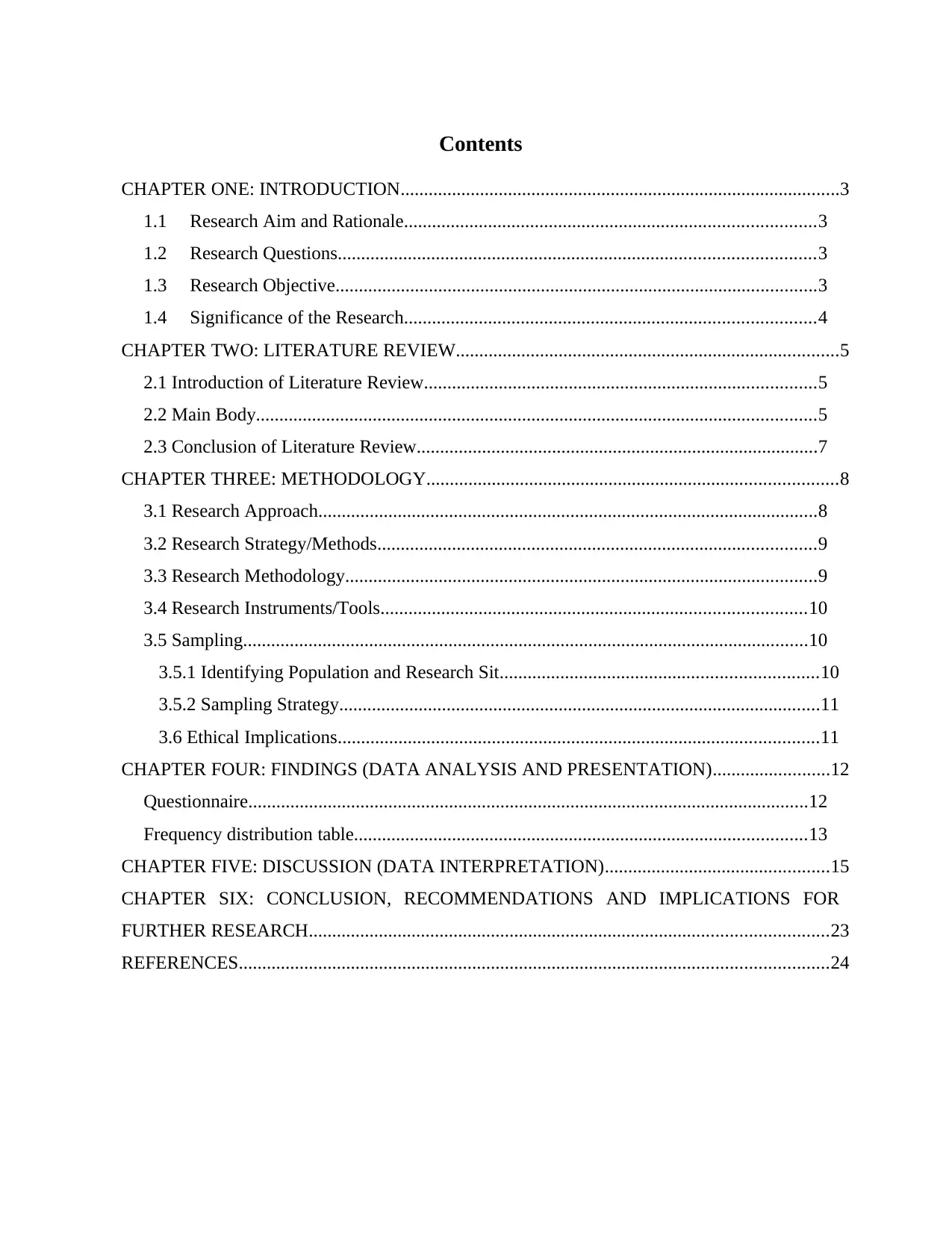
Contents
CHAPTER ONE: INTRODUCTION..............................................................................................3
1.1 Research Aim and Rationale........................................................................................3
1.2 Research Questions......................................................................................................3
1.3 Research Objective.......................................................................................................3
1.4 Significance of the Research........................................................................................4
CHAPTER TWO: LITERATURE REVIEW..................................................................................5
2.1 Introduction of Literature Review....................................................................................5
2.2 Main Body........................................................................................................................5
2.3 Conclusion of Literature Review......................................................................................7
CHAPTER THREE: METHODOLOGY........................................................................................8
3.1 Research Approach...........................................................................................................8
3.2 Research Strategy/Methods..............................................................................................9
3.3 Research Methodology.....................................................................................................9
3.4 Research Instruments/Tools...........................................................................................10
3.5 Sampling.........................................................................................................................10
3.5.1 Identifying Population and Research Sit....................................................................10
3.5.2 Sampling Strategy.......................................................................................................11
3.6 Ethical Implications.......................................................................................................11
CHAPTER FOUR: FINDINGS (DATA ANALYSIS AND PRESENTATION).........................12
Questionnaire........................................................................................................................12
Frequency distribution table.................................................................................................13
CHAPTER FIVE: DISCUSSION (DATA INTERPRETATION)................................................15
CHAPTER SIX: CONCLUSION, RECOMMENDATIONS AND IMPLICATIONS FOR
FURTHER RESEARCH...............................................................................................................23
REFERENCES..............................................................................................................................24
CHAPTER ONE: INTRODUCTION..............................................................................................3
1.1 Research Aim and Rationale........................................................................................3
1.2 Research Questions......................................................................................................3
1.3 Research Objective.......................................................................................................3
1.4 Significance of the Research........................................................................................4
CHAPTER TWO: LITERATURE REVIEW..................................................................................5
2.1 Introduction of Literature Review....................................................................................5
2.2 Main Body........................................................................................................................5
2.3 Conclusion of Literature Review......................................................................................7
CHAPTER THREE: METHODOLOGY........................................................................................8
3.1 Research Approach...........................................................................................................8
3.2 Research Strategy/Methods..............................................................................................9
3.3 Research Methodology.....................................................................................................9
3.4 Research Instruments/Tools...........................................................................................10
3.5 Sampling.........................................................................................................................10
3.5.1 Identifying Population and Research Sit....................................................................10
3.5.2 Sampling Strategy.......................................................................................................11
3.6 Ethical Implications.......................................................................................................11
CHAPTER FOUR: FINDINGS (DATA ANALYSIS AND PRESENTATION).........................12
Questionnaire........................................................................................................................12
Frequency distribution table.................................................................................................13
CHAPTER FIVE: DISCUSSION (DATA INTERPRETATION)................................................15
CHAPTER SIX: CONCLUSION, RECOMMENDATIONS AND IMPLICATIONS FOR
FURTHER RESEARCH...............................................................................................................23
REFERENCES..............................................................................................................................24

⊘ This is a preview!⊘
Do you want full access?
Subscribe today to unlock all pages.

Trusted by 1+ million students worldwide
CHAPTER ONE: INTRODUCTION
1.1 Research Aim and Rationale
Research aim
“To identify the importance of contextualising approaches to talent management within an
organisation”. A study on Marks & Spencer
Research rationale
The major rational behind selection to this topic is to understand regarding various
concepts of talent management strategies that can be used within an organisation in order to
attract and retain workforce. In current time talent management strategies are assisting the
business to gain such insight by which overall development can be seen and employees can be
engaged within business functions (Uddin and Arif, 2016). So executing this research will lead
in developing knowledge regarding management and its significance within the organisation.
The research is having higher interest in the field of HR and this is regarded as the prominent
reason that researcher is inclined with this topic. This research will lead in developing various
skills such as analytical skills, research skills, communication skills and many more. By
enhancing such skills researcher may use the same in their future working so that prominence
can be attained by them in their future conducted researches (Clark and et. al., 2019). This
research could be helpful in sharpening career path of individual in which they can get easy
access over their future work and projects.
1.2 Research Questions
What are the different talent management strategies that can be used by Marks & Spencer?
What is the importance of talent management strategies within workplace of Marks & Spencer?
What are the challenges faced by Marks & Spencer during contextualising talent management
strategies?
1.3 Research Objective
To explore various talent management strategies that can be used by on Marks & Spencer.
To identify importance of talent management strategies within workplace of Marks and
Spencer.
1.1 Research Aim and Rationale
Research aim
“To identify the importance of contextualising approaches to talent management within an
organisation”. A study on Marks & Spencer
Research rationale
The major rational behind selection to this topic is to understand regarding various
concepts of talent management strategies that can be used within an organisation in order to
attract and retain workforce. In current time talent management strategies are assisting the
business to gain such insight by which overall development can be seen and employees can be
engaged within business functions (Uddin and Arif, 2016). So executing this research will lead
in developing knowledge regarding management and its significance within the organisation.
The research is having higher interest in the field of HR and this is regarded as the prominent
reason that researcher is inclined with this topic. This research will lead in developing various
skills such as analytical skills, research skills, communication skills and many more. By
enhancing such skills researcher may use the same in their future working so that prominence
can be attained by them in their future conducted researches (Clark and et. al., 2019). This
research could be helpful in sharpening career path of individual in which they can get easy
access over their future work and projects.
1.2 Research Questions
What are the different talent management strategies that can be used by Marks & Spencer?
What is the importance of talent management strategies within workplace of Marks & Spencer?
What are the challenges faced by Marks & Spencer during contextualising talent management
strategies?
1.3 Research Objective
To explore various talent management strategies that can be used by on Marks & Spencer.
To identify importance of talent management strategies within workplace of Marks and
Spencer.
Paraphrase This Document
Need a fresh take? Get an instant paraphrase of this document with our AI Paraphraser
To analyse the challenges which are faced during contextualising talent management strategies
within workplace of Marks & Spencer.
1.4 Significance of the Research
Talent management is defined as the concept in which emphasise is seen over skilled
employees so that using their skills opportunities for business development can be obtained
(Golhar and Alex, 2017). With the help of talent management business succession planning can
be executed and the same may lead to gain long term sustainability (Ali and Guha, 2018). So
the current research is having significance in terms of managing business by dealing various
complexities using talent management as major tool. This research is based on Marks &
Spencer which is one of the greatest retailers dealing in food, clothing and accessories. The
company is having global presence which makes the company to use talent management
strategies as imperative tool.
within workplace of Marks & Spencer.
1.4 Significance of the Research
Talent management is defined as the concept in which emphasise is seen over skilled
employees so that using their skills opportunities for business development can be obtained
(Golhar and Alex, 2017). With the help of talent management business succession planning can
be executed and the same may lead to gain long term sustainability (Ali and Guha, 2018). So
the current research is having significance in terms of managing business by dealing various
complexities using talent management as major tool. This research is based on Marks &
Spencer which is one of the greatest retailers dealing in food, clothing and accessories. The
company is having global presence which makes the company to use talent management
strategies as imperative tool.
CHAPTER TWO: LITERATURE REVIEW
2.1 Introduction of Literature Review
Literature review is defined as a survey which is executed in order to perform depth
analysis regarding research topic and to study already published work related with research.
Within a research literature review holds higher degree of significance as this leads the
researcher to attain their research objectives in appropriate time (Sharma, Taggar and Jain,
2018). In the context of above research literature review is elaborated as under:
2.2 Main Body
What are the different talent management strategies that can be used by Marks & Spencer?
According to Aktas and Meng (2017), there are various talent management strategies
which are used by the business in order to execute and attain their business objectives in more
proficient manner. There are differentiated talent management strategies that can be used by the
business which are enumerated as under:
Introduction of employee emphasised programs: In order to get higher employee
contribution organisations are required to think for their employees. In this manner by
providing employee centred programs would lead the business manage talent management
strategies as well. In the context of an organisation their employees are treated as their assets so
when they are treated in significant manner then this will lead into providing business benefits
as in terms of managing talent management strategies.
Organising significant sessions of training and development: In order to boost skills and
capabilities of employees organising various training and development sessions could be
helpful as this leads working employee to sharpen their skills and this is regarded as one of the
most prominent tool of talent management.
Providing transparent appraisal system to employees: For retaining employees providing
monetary benefits are also necessary as this will not only enhance their retention but also
develop sense of accountability in them.
What is the importance of talent management strategies within workplace of Marks & Spencer?
2.1 Introduction of Literature Review
Literature review is defined as a survey which is executed in order to perform depth
analysis regarding research topic and to study already published work related with research.
Within a research literature review holds higher degree of significance as this leads the
researcher to attain their research objectives in appropriate time (Sharma, Taggar and Jain,
2018). In the context of above research literature review is elaborated as under:
2.2 Main Body
What are the different talent management strategies that can be used by Marks & Spencer?
According to Aktas and Meng (2017), there are various talent management strategies
which are used by the business in order to execute and attain their business objectives in more
proficient manner. There are differentiated talent management strategies that can be used by the
business which are enumerated as under:
Introduction of employee emphasised programs: In order to get higher employee
contribution organisations are required to think for their employees. In this manner by
providing employee centred programs would lead the business manage talent management
strategies as well. In the context of an organisation their employees are treated as their assets so
when they are treated in significant manner then this will lead into providing business benefits
as in terms of managing talent management strategies.
Organising significant sessions of training and development: In order to boost skills and
capabilities of employees organising various training and development sessions could be
helpful as this leads working employee to sharpen their skills and this is regarded as one of the
most prominent tool of talent management.
Providing transparent appraisal system to employees: For retaining employees providing
monetary benefits are also necessary as this will not only enhance their retention but also
develop sense of accountability in them.
What is the importance of talent management strategies within workplace of Marks & Spencer?
⊘ This is a preview!⊘
Do you want full access?
Subscribe today to unlock all pages.
Trusted by 1+ million students worldwide
According to Yong (2017), with the help of talent management various benefits can be
attained which are helpful for the business to grow and sustain. In this manner several benefits
are attained such as:
Intensified business performance: With the help of implementing talent management
strategies business performance can be increased and in this manner higher opportunities of
succession can be received by the organisation. Using such strategies of boosting employee
performance with the help of talent management strategies could be assisting the organisation
to intensify performance.
Increased market image: Impact of talent management strategies are directly linked with
performance of employees. In this manner when business performance get enhanced this will
lead into developing market image in tremendous manner. When market image of the
organisation get increased then this will lead into developing higher market prominence and
self-dependence as well.
Execution of organisational functions in effective manner: Strategies of talent management
are directly linked with employee and their performance so in this manner functions within
organisation can be executed in most impactful and significant manner.
What are the challenges faced by Marks & Spencer during contextualising talent management
strategies?
According to Deters (2017), at the time of implementing talent management strategies
there are various challenges which are being faced by the organisation such as:
Disruptive company culture: Sometimes the organisational culture is rigid in nature that
means employees are not happy for accepting any change which makes issues for the
organisation to implement talent management strategies.
Cultivation of career path for employee: For employee success within career path is very
necessary but in some cases when talent management strategies are adopted within business
then this become tough for the organisation to foster employee career as focus has been
diverted. In this situation various issues are faced by organisation which creates barrier in
overall success.
attained which are helpful for the business to grow and sustain. In this manner several benefits
are attained such as:
Intensified business performance: With the help of implementing talent management
strategies business performance can be increased and in this manner higher opportunities of
succession can be received by the organisation. Using such strategies of boosting employee
performance with the help of talent management strategies could be assisting the organisation
to intensify performance.
Increased market image: Impact of talent management strategies are directly linked with
performance of employees. In this manner when business performance get enhanced this will
lead into developing market image in tremendous manner. When market image of the
organisation get increased then this will lead into developing higher market prominence and
self-dependence as well.
Execution of organisational functions in effective manner: Strategies of talent management
are directly linked with employee and their performance so in this manner functions within
organisation can be executed in most impactful and significant manner.
What are the challenges faced by Marks & Spencer during contextualising talent management
strategies?
According to Deters (2017), at the time of implementing talent management strategies
there are various challenges which are being faced by the organisation such as:
Disruptive company culture: Sometimes the organisational culture is rigid in nature that
means employees are not happy for accepting any change which makes issues for the
organisation to implement talent management strategies.
Cultivation of career path for employee: For employee success within career path is very
necessary but in some cases when talent management strategies are adopted within business
then this become tough for the organisation to foster employee career as focus has been
diverted. In this situation various issues are faced by organisation which creates barrier in
overall success.
Paraphrase This Document
Need a fresh take? Get an instant paraphrase of this document with our AI Paraphraser
Disinterested employee: In an organisation there are various types of employees so some are
not interested in taking participation of talent management activities. In this manner restrictions
are imposed within organisation and barrier may be created.
2.3 Conclusion of Literature Review
From the above literature review this can be concluded that there are various strategies
of talent management that can be adopted by the business in order to involve their employees in
business functions and to gain growth opportunities in higher manner (Kjellman, 2016). Besides
this talent management may lead the business to get higher succession opportunities and market
image. At last there are various issues which are being faced by an organisation at the time of
implementing talent management strategies and these are creating barriers as well.
not interested in taking participation of talent management activities. In this manner restrictions
are imposed within organisation and barrier may be created.
2.3 Conclusion of Literature Review
From the above literature review this can be concluded that there are various strategies
of talent management that can be adopted by the business in order to involve their employees in
business functions and to gain growth opportunities in higher manner (Kjellman, 2016). Besides
this talent management may lead the business to get higher succession opportunities and market
image. At last there are various issues which are being faced by an organisation at the time of
implementing talent management strategies and these are creating barriers as well.
CHAPTER THREE: METHODOLOGY
Research methodology is one of the significant step within research as under this
various tools and techniques are mentioned which would be used during conducting the
research. Using appropriate research methodology research objectives can be attained in easy
manner. In a research project research methodology is playing essential role of aligning
objectives with research efforts which are exerted by researcher. Research methodology is
defined as accumulation of different plans and actions in which reliable information can be
collected and at the same time various issues which may be seen within research can be
mitigated. With the help of using significant research methodology efficiency can be attained
within research and this will lead into accomplishing research objectives on timely basis. For a
researcher choosing of right and accurate research methodology is the matter of concern and
when appropriate research methodology is selected then this will lead into converting collected
data into required information for the research and its execution. Research methodologies are
regarded as such collective efforts which are used for attaining research objectives in most
effective manner so that to gain succession opportunities as well. For researcher selecting
appropriate research methodology could be the primal function by which such efforts can be
exerted for gaining research outcomes. There are different types of research methodologies
used within this research and the same are discussed as under:
3.1 Research Approach
Research approach is considered as plans and processes which could be helpful for
researcher to frame research objectives in appropriate manner. Research approach is the manner
in which fruitful data will be gathered for conducting research in primal and most effective
manner. Research approaches are contextual framework which is used within the research and
these are based on several beliefs and values which help every dimension of research to get
success (Van den Berg and Struwig, 2017). Research approach is associated with gaining
accessibility within research and that can be used to attain research objectives in proficient
manner. There are two major types of research approaches that can be used by researcher in
order to attain research objectives and to frame significant path out of research. The major types
of research approaches are inductive and deductive and these can be selected by researcher as
Research methodology is one of the significant step within research as under this
various tools and techniques are mentioned which would be used during conducting the
research. Using appropriate research methodology research objectives can be attained in easy
manner. In a research project research methodology is playing essential role of aligning
objectives with research efforts which are exerted by researcher. Research methodology is
defined as accumulation of different plans and actions in which reliable information can be
collected and at the same time various issues which may be seen within research can be
mitigated. With the help of using significant research methodology efficiency can be attained
within research and this will lead into accomplishing research objectives on timely basis. For a
researcher choosing of right and accurate research methodology is the matter of concern and
when appropriate research methodology is selected then this will lead into converting collected
data into required information for the research and its execution. Research methodologies are
regarded as such collective efforts which are used for attaining research objectives in most
effective manner so that to gain succession opportunities as well. For researcher selecting
appropriate research methodology could be the primal function by which such efforts can be
exerted for gaining research outcomes. There are different types of research methodologies
used within this research and the same are discussed as under:
3.1 Research Approach
Research approach is considered as plans and processes which could be helpful for
researcher to frame research objectives in appropriate manner. Research approach is the manner
in which fruitful data will be gathered for conducting research in primal and most effective
manner. Research approaches are contextual framework which is used within the research and
these are based on several beliefs and values which help every dimension of research to get
success (Van den Berg and Struwig, 2017). Research approach is associated with gaining
accessibility within research and that can be used to attain research objectives in proficient
manner. There are two major types of research approaches that can be used by researcher in
order to attain research objectives and to frame significant path out of research. The major types
of research approaches are inductive and deductive and these can be selected by researcher as
⊘ This is a preview!⊘
Do you want full access?
Subscribe today to unlock all pages.
Trusted by 1+ million students worldwide
accordance with research objectives and method opted for attaining the same. In the terms of
inductive research approach is associated with using of new theory within research in order to
align overall objectives whereas deductive research approach is associated with using of
existing theory so that to gain overall objectives. Under this research deductive research
approach is being used by researcher in order to get in-depth analysis related to research and to
understand research topic in clear manner.
3.2 Research Strategy/Methods
Research strategy is defined as such set of actions those are helpful for researcher to
acquire such information out of existed data in most effective manner. Research strategy is
regarded as those collective efforts which are helpful in executing research plan in order to lead
the direction of attaining overall research objectives (Arora and et. al., 2016). Research strategy
is categorised as the overall action plan in which step-by-step plan of actions are enumerated so
that direction for efforts can be exerted by researcher in their research project. These are
regarded as one of the most impactful aspect within research which is helpful in gaining
appropriate knowledge and aims of research as well. There are various types of research
strategy such as case study, interview and survey. Under this research survey will be used as
research strategy that could be helpful in gaining overall research outcomes so that significant
edge can be attained within research.
3.3 Research Methodology
Research methodology is defined as the sum of such factors those are assisting the
researcher to execute overall research in most significant manner. With the help of significant
research methodology information within research can be collected using reliable sources so
that in systematic manner research can be executed. There are two major types of research
methodologies which are helpful in gaining and aligning research efforts with research
objectives in well-defined manner. Quantitative and qualitative are the two major types of
research methodologies. In terms of quantitative research methodology in terms of statistics
data is being collected and interpretation is drawn in similar way. Quantitative research
methodology is associated with gaining opinion from various respondents so that diversified
opinion can be attained (Mishra and Alok, 2017). On the other hand qualitative research
mythology is associated with gaining in depth knowledge regarding research so that accurate
inductive research approach is associated with using of new theory within research in order to
align overall objectives whereas deductive research approach is associated with using of
existing theory so that to gain overall objectives. Under this research deductive research
approach is being used by researcher in order to get in-depth analysis related to research and to
understand research topic in clear manner.
3.2 Research Strategy/Methods
Research strategy is defined as such set of actions those are helpful for researcher to
acquire such information out of existed data in most effective manner. Research strategy is
regarded as those collective efforts which are helpful in executing research plan in order to lead
the direction of attaining overall research objectives (Arora and et. al., 2016). Research strategy
is categorised as the overall action plan in which step-by-step plan of actions are enumerated so
that direction for efforts can be exerted by researcher in their research project. These are
regarded as one of the most impactful aspect within research which is helpful in gaining
appropriate knowledge and aims of research as well. There are various types of research
strategy such as case study, interview and survey. Under this research survey will be used as
research strategy that could be helpful in gaining overall research outcomes so that significant
edge can be attained within research.
3.3 Research Methodology
Research methodology is defined as the sum of such factors those are assisting the
researcher to execute overall research in most significant manner. With the help of significant
research methodology information within research can be collected using reliable sources so
that in systematic manner research can be executed. There are two major types of research
methodologies which are helpful in gaining and aligning research efforts with research
objectives in well-defined manner. Quantitative and qualitative are the two major types of
research methodologies. In terms of quantitative research methodology in terms of statistics
data is being collected and interpretation is drawn in similar way. Quantitative research
methodology is associated with gaining opinion from various respondents so that diversified
opinion can be attained (Mishra and Alok, 2017). On the other hand qualitative research
mythology is associated with gaining in depth knowledge regarding research so that accurate
Paraphrase This Document
Need a fresh take? Get an instant paraphrase of this document with our AI Paraphraser
and relatable information can be acquired. In this research quantitative research methodologies
are used in order to gain opinion from various respondents so that to gain research objectives.
In qualitative research methodology diversified analysis can be made so that appropriate results
can be carried out. Besides this in terms of quantitative research methodologies various
respondents are included in order to gain research insight and results as well. Under this
research quantitative research methodologies are used in order to attain research objectives in
effective manner.
3.4 Research Instruments/Tools
Research instrument is defined as the tool which is used by researcher in order to collect
and measure overall data so that according to the research objectives topic can be
conceptualised. Research instruments are used in order to gather data from various respondents
so that in appropriate manner overall results can be attained. There are various types research
instrument such as interview, questionnaire and many more (Brenni, 2016). Under this research
questionnaire has been used as this could be helpful in getting diversified opinion out of
number of population involved in the research.
3.5 Sampling
Sampling is defined as the process which is used within research in order to select group
from which data can be collected in most significant manner. In the context of research with the
help of sampling hypothesis can be drawn and this is significant in analysing characteristic of
population. Sampling is the process in which requisite data is collected by the researcher so that
they can acquire research objectives in least period of time (Alvi, 2016). There are two major
types of sampling in research which can be used by research in order to place research
objectives in significant manner. Probabilistic and non-probabilistic sampling, under
probabilistic sampling every member within population is having equal chances of getting
selected and in contrary for non-probabilistic sampling some prejudice has been selected in
prior basis. Under this research probabilistic sampling has been used and sample size is taken as
30 those are employees of Marks & Spencer.
3.5.1 Identifying Population and Research Sit
In order to attain research objectives population for research is being selected and in this
manner within this research the identified population is employees of Marks & Spencer as
are used in order to gain opinion from various respondents so that to gain research objectives.
In qualitative research methodology diversified analysis can be made so that appropriate results
can be carried out. Besides this in terms of quantitative research methodologies various
respondents are included in order to gain research insight and results as well. Under this
research quantitative research methodologies are used in order to attain research objectives in
effective manner.
3.4 Research Instruments/Tools
Research instrument is defined as the tool which is used by researcher in order to collect
and measure overall data so that according to the research objectives topic can be
conceptualised. Research instruments are used in order to gather data from various respondents
so that in appropriate manner overall results can be attained. There are various types research
instrument such as interview, questionnaire and many more (Brenni, 2016). Under this research
questionnaire has been used as this could be helpful in getting diversified opinion out of
number of population involved in the research.
3.5 Sampling
Sampling is defined as the process which is used within research in order to select group
from which data can be collected in most significant manner. In the context of research with the
help of sampling hypothesis can be drawn and this is significant in analysing characteristic of
population. Sampling is the process in which requisite data is collected by the researcher so that
they can acquire research objectives in least period of time (Alvi, 2016). There are two major
types of sampling in research which can be used by research in order to place research
objectives in significant manner. Probabilistic and non-probabilistic sampling, under
probabilistic sampling every member within population is having equal chances of getting
selected and in contrary for non-probabilistic sampling some prejudice has been selected in
prior basis. Under this research probabilistic sampling has been used and sample size is taken as
30 those are employees of Marks & Spencer.
3.5.1 Identifying Population and Research Sit
In order to attain research objectives population for research is being selected and in this
manner within this research the identified population is employees of Marks & Spencer as
internal people may have much knowledge about business strategies and the manner in which
functioning is adopted.
3.5.2 Sampling Strategy
This is the strategy which is associated with research plan in order to set research
objectives in prominent manner. In this research random sampling strategy of research has been
used which could lead the researcher to acquire overall results within research.
3.6 Ethical Implications
Ethical considerations are regarded as one of the essential part of the research in which
research dignity can be maintained. Under this research in terms of ethical considerations,
consent was collected from participants in order to make them a part of the research (Russo and
et. al., 2017). Besides this dignity of research participants are maintained and their identity has
not been disclosed. In this research no false information has been used and this leads the
research results to be reliable and advantageous.
CHAPTER FOUR: FINDINGS (DATA ANALYSIS AND
PRESENTATION)
Questionnaire
Q1: According to you is Marks & Spencer using various strategies of talent management for
providing benefits of their employees?
a) Yes
b) No
Q2: According to you are you satisfied with talent management strategies used by Marks &
Spencer as a process of employee satisfaction?
a) Satisfied
b) Strongly satisfied
c) Dissatisfied
Q3: What are the major talent management strategies utilised by Marks & Spencer
a) Introduction of employee emphasised programs
b) Organising significant sessions of training and development
functioning is adopted.
3.5.2 Sampling Strategy
This is the strategy which is associated with research plan in order to set research
objectives in prominent manner. In this research random sampling strategy of research has been
used which could lead the researcher to acquire overall results within research.
3.6 Ethical Implications
Ethical considerations are regarded as one of the essential part of the research in which
research dignity can be maintained. Under this research in terms of ethical considerations,
consent was collected from participants in order to make them a part of the research (Russo and
et. al., 2017). Besides this dignity of research participants are maintained and their identity has
not been disclosed. In this research no false information has been used and this leads the
research results to be reliable and advantageous.
CHAPTER FOUR: FINDINGS (DATA ANALYSIS AND
PRESENTATION)
Questionnaire
Q1: According to you is Marks & Spencer using various strategies of talent management for
providing benefits of their employees?
a) Yes
b) No
Q2: According to you are you satisfied with talent management strategies used by Marks &
Spencer as a process of employee satisfaction?
a) Satisfied
b) Strongly satisfied
c) Dissatisfied
Q3: What are the major talent management strategies utilised by Marks & Spencer
a) Introduction of employee emphasised programs
b) Organising significant sessions of training and development
⊘ This is a preview!⊘
Do you want full access?
Subscribe today to unlock all pages.
Trusted by 1+ million students worldwide

1 out of 26


Related Documents


Your All-in-One AI-Powered Toolkit for Academic Success.
+13062052269
info@desklib.com
Available 24*7 on WhatsApp / Email
![[object Object]](/_next/static/media/star-bottom.7253800d.svg)
Unlock your academic potential
Copyright © 2020–2026 A2Z Services. All Rights Reserved. Developed and managed by ZUCOL.