Financial Performance Analysis of Marriott International (2018-2019)
VerifiedAdded on 2023/01/10
|15
|3490
|75
Report
AI Summary
This report presents a financial analysis of Marriott International, a leading hotel and resort company. It examines the company's performance using various financial ratios, including profitability, liquidity, efficiency, and leverage, from 2018 to 2019. The analysis includes a discussion of each ratio family, providing insights into Marriott's financial health and operational efficiency. The report covers current, quick, gross profit, net profit, operating profit, debt-to-asset, and other crucial ratios. The student report identifies trends, and provides a comprehensive overview of Marriott's financial position, concluding with findings and recommendations for the company's financial management.

FINANCIAL MANAGEMENT FOR THE HOTEL
INDUSTRY
INDUSTRY

Paraphrase This Document
Need a fresh take? Get an instant paraphrase of this document with our AI Paraphraser
Table of Contents
1. EXECUTIVE SUMMARY.........................................................................................................3
2. Main Content...............................................................................................................................4
2.1 A Summary table...................................................................................................................4
2.2 Discussion of families............................................................................................................4
2.3 Analysis of each family.........................................................................................................6
Conclusion.....................................................................................................................................13
REFERENCES..............................................................................................................................14
1. EXECUTIVE SUMMARY.........................................................................................................3
2. Main Content...............................................................................................................................4
2.1 A Summary table...................................................................................................................4
2.2 Discussion of families............................................................................................................4
2.3 Analysis of each family.........................................................................................................6
Conclusion.....................................................................................................................................13
REFERENCES..............................................................................................................................14
1. EXECUTIVE SUMMARY
Marriott International, Inc. is a Fortune 500 organization with over 7,000 residences and resorts
in 130 countries and areas - highly remembered for the capital of Washington, DC, Maryland
and Virginia.
The group, which is headquartered in Bethesda, Maryland, was founded by J. Willard and Alice
S. Marriott in 1927, and by their son, J.W. "Bill" Marriott, Jr., has spanned more than 50 years
creating one of the world's leading driving accommodation agencies. Marriott is trusted as one of
the "best places to work" and is emerging with developments that build style, plan and
innovation.
This report is written in formal structure starting with summary of tabular results of all ratios’
profitability, efficiency, liquidity and liverage ratio; also known as families. This table has been
discussed with the help of diagram and analysis of each family has also been done. At last the
report is end with final conclusion; which includes finding and recommendation for the
company.
Marriott International, Inc. is a Fortune 500 organization with over 7,000 residences and resorts
in 130 countries and areas - highly remembered for the capital of Washington, DC, Maryland
and Virginia.
The group, which is headquartered in Bethesda, Maryland, was founded by J. Willard and Alice
S. Marriott in 1927, and by their son, J.W. "Bill" Marriott, Jr., has spanned more than 50 years
creating one of the world's leading driving accommodation agencies. Marriott is trusted as one of
the "best places to work" and is emerging with developments that build style, plan and
innovation.
This report is written in formal structure starting with summary of tabular results of all ratios’
profitability, efficiency, liquidity and liverage ratio; also known as families. This table has been
discussed with the help of diagram and analysis of each family has also been done. At last the
report is end with final conclusion; which includes finding and recommendation for the
company.
⊘ This is a preview!⊘
Do you want full access?
Subscribe today to unlock all pages.

Trusted by 1+ million students worldwide
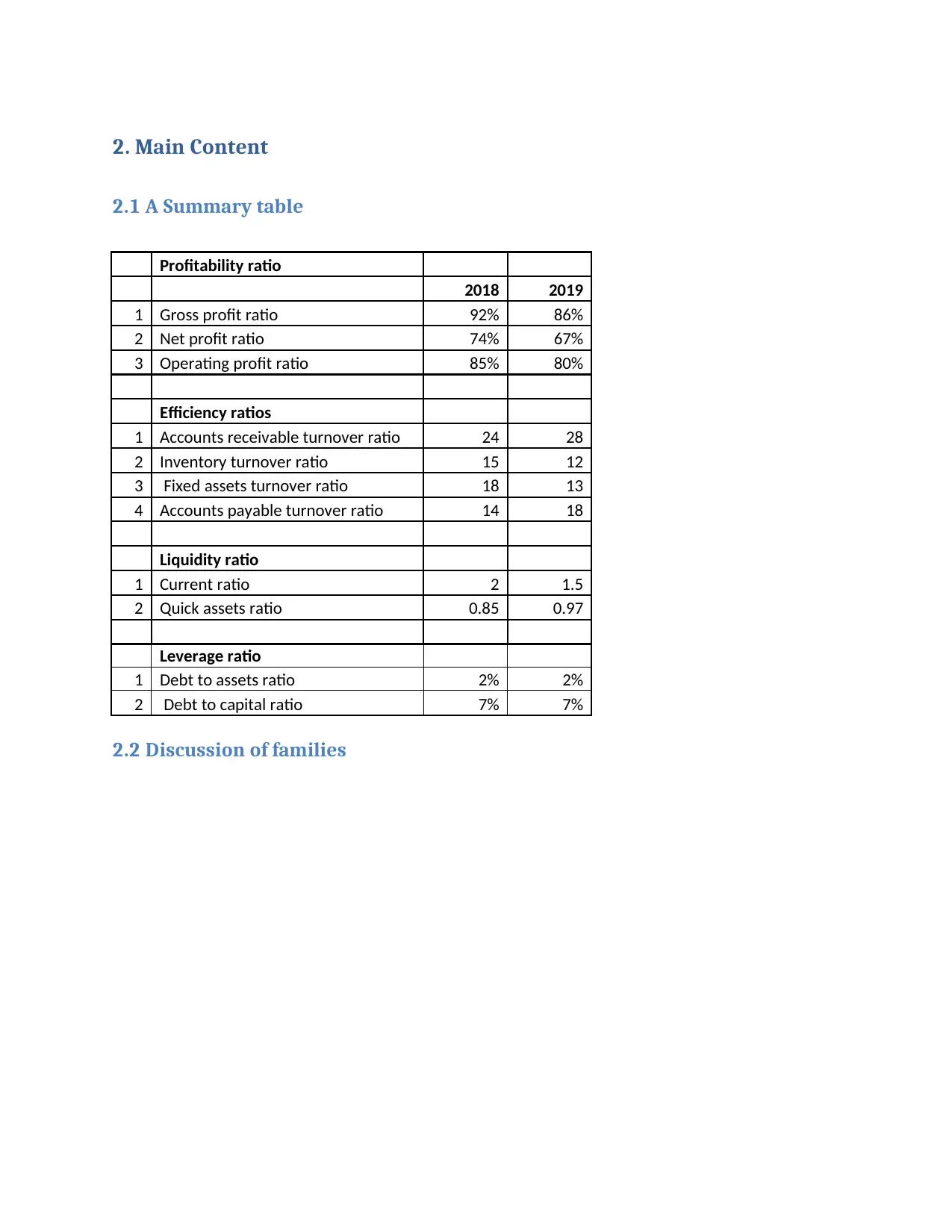
2. Main Content
2.1 A Summary table
Profitability ratio
2018 2019
1 Gross profit ratio 92% 86%
2 Net profit ratio 74% 67%
3 Operating profit ratio 85% 80%
Efficiency ratios
1 Accounts receivable turnover ratio 24 28
2 Inventory turnover ratio 15 12
3 Fixed assets turnover ratio 18 13
4 Accounts payable turnover ratio 14 18
Liquidity ratio
1 Current ratio 2 1.5
2 Quick assets ratio 0.85 0.97
Leverage ratio
1 Debt to assets ratio 2% 2%
2 Debt to capital ratio 7% 7%
2.2 Discussion of families
2.1 A Summary table
Profitability ratio
2018 2019
1 Gross profit ratio 92% 86%
2 Net profit ratio 74% 67%
3 Operating profit ratio 85% 80%
Efficiency ratios
1 Accounts receivable turnover ratio 24 28
2 Inventory turnover ratio 15 12
3 Fixed assets turnover ratio 18 13
4 Accounts payable turnover ratio 14 18
Liquidity ratio
1 Current ratio 2 1.5
2 Quick assets ratio 0.85 0.97
Leverage ratio
1 Debt to assets ratio 2% 2%
2 Debt to capital ratio 7% 7%
2.2 Discussion of families
Paraphrase This Document
Need a fresh take? Get an instant paraphrase of this document with our AI Paraphraser
Liquidity ratio:
Liquidity ratios are a large type of cash-related measures used to determine a debtor's ability to
pay attention to current compulsory commitments without rising outside capital. Liquidity ratios
measure an organization's ability to pay mandatory commitments and its benefit limit by
calculating measures including its current percentage, quick percentage and percentage of
income into work.
Current responsibilities are broken down by mobile resources to assess the introduction of
transition responsibilities in an emergency.
Profitability ratio:
The profitability ratio is used to evaluate an organization's ability to generate pay in relation to its
costs and other costs related to the age of payment at a given time. This part talks about the
organization's end product.
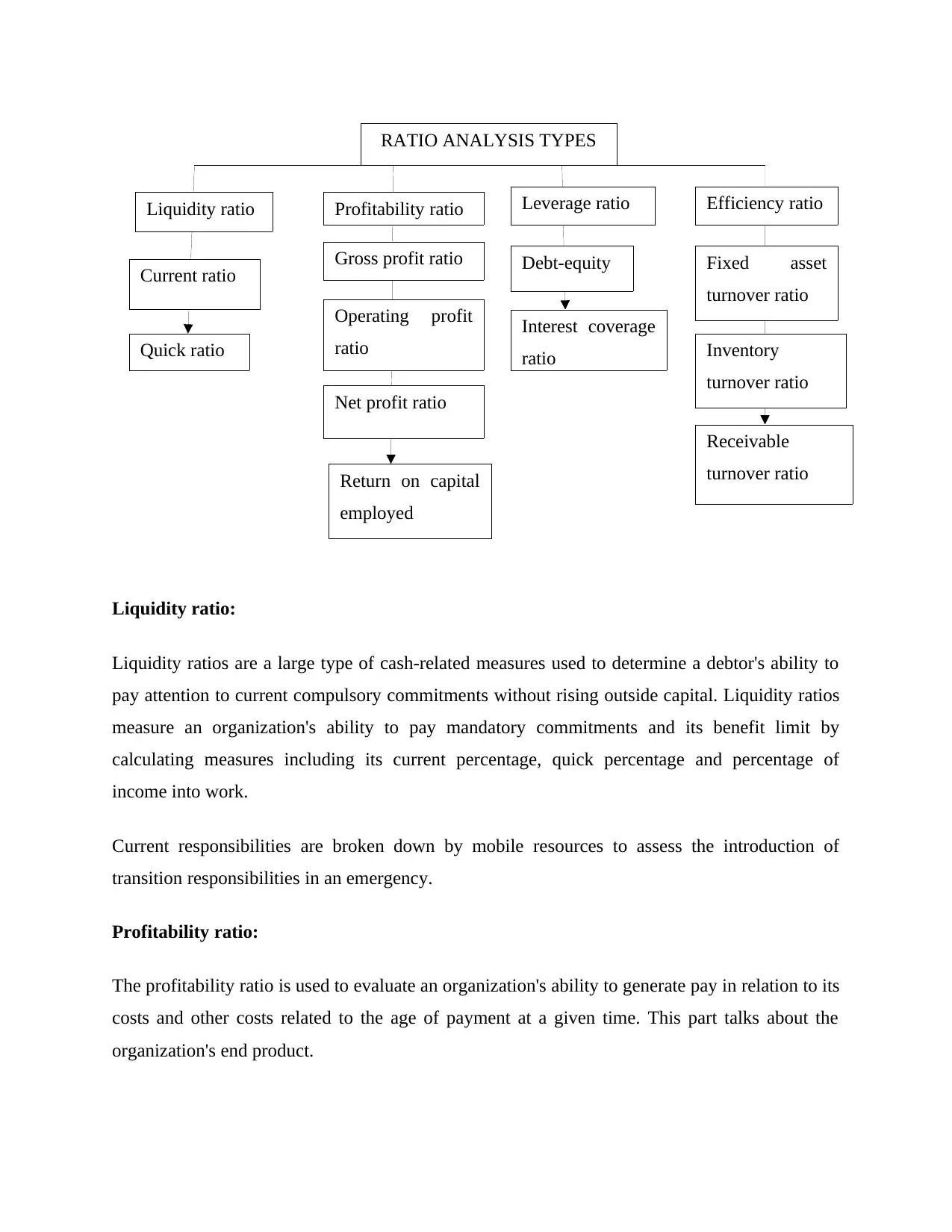
RATIO ANALYSIS TYPES
Liquidity ratio
Current ratio
Quick ratio
Profitability ratio
Gross profit ratio
Operating profit
ratio
Net profit ratio
Return on capital
employed
Leverage ratio
Debt-equity
ratio
Interest coverage
ratio
Efficiency ratio
Fixed asset
turnover ratio
Inventory
turnover ratio
Receivable
turnover ratio
Liquidity ratios are a large type of cash-related measures used to determine a debtor's ability to
pay attention to current compulsory commitments without rising outside capital. Liquidity ratios
measure an organization's ability to pay mandatory commitments and its benefit limit by
calculating measures including its current percentage, quick percentage and percentage of
income into work.
Current responsibilities are broken down by mobile resources to assess the introduction of
transition responsibilities in an emergency.
Profitability ratio:
The profitability ratio is used to evaluate an organization's ability to generate pay in relation to its
costs and other costs related to the age of payment at a given time. This part talks about the
organization's end product.
RATIO ANALYSIS TYPES
Liquidity ratio
Current ratio
Quick ratio
Profitability ratio
Gross profit ratio
Operating profit
ratio
Net profit ratio
Return on capital
employed
Leverage ratio
Debt-equity
ratio
Interest coverage
ratio
Efficiency ratio
Fixed asset
turnover ratio
Inventory
turnover ratio
Receivable
turnover ratio
Leverage ratio:
Leverage ratio is one of the few cash estimates that will make you think about the amount of
capital that comes in the form of bonds (credits) or assesses an organization's ability to meet its
cash commitments. The level of impact that is important is that organizations rely on a mix of
value and responsibility to fund their responsibilities and the level of responsibility that an
organization has is known to be useful in assessing whether it can take into account amazingly
due.
Efficiency ratio:
Efficiency ratio measures an organization's ability to use its benefits and successfully address
concerns in the current or current period. Despite the limited capacity limits, they are comparable
in that they measure the time it takes to take money or salary from a customer or swap shares.
The performance allowances include the stock conversion allowance, the asset conversion
allowance and the available conversion allowance. These allowances measure the effectiveness
with which an organization uses its revenue-generating resources and its ability to address these
benefits. With any cash-related allowance, it is extremely appropriate to compare an
organization's check with its competitors in a similar sector.
2.3 Analysis of each family
I. Liquidity ratio
Liquidity ratios are estimates that are used to examine a society's ability to pay attention to its
transition commitments. Liquidity ratios are typically used by upcoming banks and lending
experts to decide whether to extend credit or obligation to individual entities.
These allowances examine a number of moderately-privileged benefits combinations for
measuring current liabilities expressed in society's most recent accounting report. The higher the
proportion, the better a company's ability to repay its commitments in a unique way.
Types:
Leverage ratio is one of the few cash estimates that will make you think about the amount of
capital that comes in the form of bonds (credits) or assesses an organization's ability to meet its
cash commitments. The level of impact that is important is that organizations rely on a mix of
value and responsibility to fund their responsibilities and the level of responsibility that an
organization has is known to be useful in assessing whether it can take into account amazingly
due.
Efficiency ratio:
Efficiency ratio measures an organization's ability to use its benefits and successfully address
concerns in the current or current period. Despite the limited capacity limits, they are comparable
in that they measure the time it takes to take money or salary from a customer or swap shares.
The performance allowances include the stock conversion allowance, the asset conversion
allowance and the available conversion allowance. These allowances measure the effectiveness
with which an organization uses its revenue-generating resources and its ability to address these
benefits. With any cash-related allowance, it is extremely appropriate to compare an
organization's check with its competitors in a similar sector.
2.3 Analysis of each family
I. Liquidity ratio
Liquidity ratios are estimates that are used to examine a society's ability to pay attention to its
transition commitments. Liquidity ratios are typically used by upcoming banks and lending
experts to decide whether to extend credit or obligation to individual entities.
These allowances examine a number of moderately-privileged benefits combinations for
measuring current liabilities expressed in society's most recent accounting report. The higher the
proportion, the better a company's ability to repay its commitments in a unique way.
Types:
⊘ This is a preview!⊘
Do you want full access?
Subscribe today to unlock all pages.
Trusted by 1+ million students worldwide
Current ratio:
The current report measures a company's ability to cover its short-term cards. It is a standard
portion of a company's momentary liquidity. Auditors use the quote to decide whether to invest
resources or lend money to a company. To calculate the current allowance, subtract the total of
each conventional resource from the total by functionality. The recipe contains:
Current assets ÷ Current liabilities = Current ratio
Since the portion of existing structures is separated from current liabilities, the percentage
essentially states that current liabilities can be exchanged to pay for existing structures. He likes
a conventional 2: 1 allowance, with a lower rate that reflects the reduced ability to pay
appropriately.
The current relationship can offer disappointing results in the conditions that accompany them:
The counter part: at a time when the current utility figure is introducing a significant expansion
of investment facilities, as these benefits can be difficult to sell. This can be a particular problem
if executives use effective accounting methods to inflate the stock with unusually large amounts
of overhead, which further damages the size of the listed stock.
Pay off debt: the moment when an organization draws on its credit extension to take care of
outstanding things to pay, which means the cash balance is almost zero. For this scenario, the
current percentage may be quite low, but the proximity of credit expansion, despite everything,
allows the company to pay up to appropriate. In this situation, the association should take into
account loan owners the amount of the unused portion of the credit extension, which can be used
to cover additional cards. However, there is still a longer question as to whether the organization
will have the option of canceling the credit extension.
Comparison of sectors: Organizations in several companies have distinct cash-related structures,
so it is impossible to anticipate the current proportions of firms across industries. Instead, the use
of the current allowance for in-business collateral should be limited.
Quick acid test ratio
The current report measures a company's ability to cover its short-term cards. It is a standard
portion of a company's momentary liquidity. Auditors use the quote to decide whether to invest
resources or lend money to a company. To calculate the current allowance, subtract the total of
each conventional resource from the total by functionality. The recipe contains:
Current assets ÷ Current liabilities = Current ratio
Since the portion of existing structures is separated from current liabilities, the percentage
essentially states that current liabilities can be exchanged to pay for existing structures. He likes
a conventional 2: 1 allowance, with a lower rate that reflects the reduced ability to pay
appropriately.
The current relationship can offer disappointing results in the conditions that accompany them:
The counter part: at a time when the current utility figure is introducing a significant expansion
of investment facilities, as these benefits can be difficult to sell. This can be a particular problem
if executives use effective accounting methods to inflate the stock with unusually large amounts
of overhead, which further damages the size of the listed stock.
Pay off debt: the moment when an organization draws on its credit extension to take care of
outstanding things to pay, which means the cash balance is almost zero. For this scenario, the
current percentage may be quite low, but the proximity of credit expansion, despite everything,
allows the company to pay up to appropriate. In this situation, the association should take into
account loan owners the amount of the unused portion of the credit extension, which can be used
to cover additional cards. However, there is still a longer question as to whether the organization
will have the option of canceling the credit extension.
Comparison of sectors: Organizations in several companies have distinct cash-related structures,
so it is impossible to anticipate the current proportions of firms across industries. Instead, the use
of the current allowance for in-business collateral should be limited.
Quick acid test ratio
Paraphrase This Document
Need a fresh take? Get an instant paraphrase of this document with our AI Paraphraser
The term "acid-test report" is called a quick report. The audit standard is basically used to
determine if a Marriote pub has good portable amenities that can be exchanged in a modest
amount of money to pay upfront Marriote accommodation fees. To decide the benefit test piece,
the current activities of the organization must be broken down by current responsibilities.
The condition for the basic test package is:
Quick Asset = (Money + Credits + Bargaining Protection) / Current Liabilities
The stock isn't restricted from evaluating the part of the advantage test so well that it tends to be
hard for an organization to change over the whole stock into money in a brief time frame.
Barring stock from the formula a snappy part is a higher marker of a gathering's capacity to focus
on current duties than the customary bit that helps us to remember the stock for its condition.
II. Profitability ratio
Profitability reports are measures defined by the money that auditors and money experts use to
measure and evaluate a Marriott hotels ability to (benefit) in comparison future income, funds for
accounting, labor costs and respect for a financial expert during a given period. They
demonstrate how the Marriott residence uses its benefits to support return and motivation for
financial experts.
Most Marriott hotels mostly manage a check or a higher value, as this means that the
organization is doing very well on the subscription payment of revenue, benefits and
remuneration. Levels become increasingly important if separated by similar collections or in the
past. The most commonly used efficacy medicines are as follows:
Types:
Gross profit:
Gross profit margin: Examine the net benefits of revenue exchange. This shows the winning of
an organization, considering the significant costs of producing products and battles. A high level
of income reflects greater efficiency in internal operations, which means it can advance labor
determine if a Marriote pub has good portable amenities that can be exchanged in a modest
amount of money to pay upfront Marriote accommodation fees. To decide the benefit test piece,
the current activities of the organization must be broken down by current responsibilities.
The condition for the basic test package is:
Quick Asset = (Money + Credits + Bargaining Protection) / Current Liabilities
The stock isn't restricted from evaluating the part of the advantage test so well that it tends to be
hard for an organization to change over the whole stock into money in a brief time frame.
Barring stock from the formula a snappy part is a higher marker of a gathering's capacity to focus
on current duties than the customary bit that helps us to remember the stock for its condition.
II. Profitability ratio
Profitability reports are measures defined by the money that auditors and money experts use to
measure and evaluate a Marriott hotels ability to (benefit) in comparison future income, funds for
accounting, labor costs and respect for a financial expert during a given period. They
demonstrate how the Marriott residence uses its benefits to support return and motivation for
financial experts.
Most Marriott hotels mostly manage a check or a higher value, as this means that the
organization is doing very well on the subscription payment of revenue, benefits and
remuneration. Levels become increasingly important if separated by similar collections or in the
past. The most commonly used efficacy medicines are as follows:
Types:
Gross profit:
Gross profit margin: Examine the net benefits of revenue exchange. This shows the winning of
an organization, considering the significant costs of producing products and battles. A high level
of income reflects greater efficiency in internal operations, which means it can advance labor
costs, fixed costs, benefits and recession, while at the same time having a clean commitment to
revenue for the organization. In addition, low net profit considers the essential use of the
products sold, which can be attributed to a strange understanding, low business costs, low
business, advertising hard or wrong business promotion methods.
EBITA Margin:
EBITDA deals with revenue, revenue, depreciation and increases. Discuss the effectiveness of
Marriott’s arrangement before thinking about non-incentives and assessments, more or less non-
fiscal things like the recession. The advantage of reducing EBITDA margins at the Marriott hotel
is that it is far from difficult to compare and different in that it rejects costs that may be uncertain
or moderately specific. The barrier to EBTIDA is that it is generally the same as the net earnings
and actual pay period, which are better indicators of Marriott's logical presentation. EBITDA is
commonly used in various valuation methods.
Operating profit margin
Net working income - Take advantage of the professional rhythm of benefits before finding
individual academic expenses and commitments. High-wage Marriott accommodations are
generally organized to cover fixed costs and focus on activities, have a better chance of resisting
budget reduction, and are more prepared to pay more offer lower than its competitors who have
lower overall compensation. The net labor wage is regularly used to screen the nature of
Marriott's accommodation management because a legitimate organization can improve Marriott's
pub profit by taking care of its labor costs.
Net profit margin
Total benefit is the fundamental concern. It takes advantage of globalization and divides it into
total revenue. It provides a picture of how productive the Marriott pub is after considering all
costs, including interest and expenses. The incentive is to use total income. A negative part of
this step is that it presents a lot of "mess, for example, when costs and profits were made, which
makes it more difficult to stop a main show and its competitors.
revenue for the organization. In addition, low net profit considers the essential use of the
products sold, which can be attributed to a strange understanding, low business costs, low
business, advertising hard or wrong business promotion methods.
EBITA Margin:
EBITDA deals with revenue, revenue, depreciation and increases. Discuss the effectiveness of
Marriott’s arrangement before thinking about non-incentives and assessments, more or less non-
fiscal things like the recession. The advantage of reducing EBITDA margins at the Marriott hotel
is that it is far from difficult to compare and different in that it rejects costs that may be uncertain
or moderately specific. The barrier to EBTIDA is that it is generally the same as the net earnings
and actual pay period, which are better indicators of Marriott's logical presentation. EBITDA is
commonly used in various valuation methods.
Operating profit margin
Net working income - Take advantage of the professional rhythm of benefits before finding
individual academic expenses and commitments. High-wage Marriott accommodations are
generally organized to cover fixed costs and focus on activities, have a better chance of resisting
budget reduction, and are more prepared to pay more offer lower than its competitors who have
lower overall compensation. The net labor wage is regularly used to screen the nature of
Marriott's accommodation management because a legitimate organization can improve Marriott's
pub profit by taking care of its labor costs.
Net profit margin
Total benefit is the fundamental concern. It takes advantage of globalization and divides it into
total revenue. It provides a picture of how productive the Marriott pub is after considering all
costs, including interest and expenses. The incentive is to use total income. A negative part of
this step is that it presents a lot of "mess, for example, when costs and profits were made, which
makes it more difficult to stop a main show and its competitors.
⊘ This is a preview!⊘
Do you want full access?
Subscribe today to unlock all pages.
Trusted by 1+ million students worldwide
Revenue Margin
Income margin: Communicates the link between the remuneration received from a work activity
and the agreements made by the organization. Estimating Marriott's accommodation capacity to
negotiate cash contracts. The higher the wage level, the greater the liquidation obtained from
agreements with payment service providers, the benefits, assets and regulatory obligations, more
or less as you purchase capital goods. Negative revenue, however, means that regardless of
whether the organization provides concessions or benefits, it could lose money at this time. For a
low-priced meeting, Marriott's residence may decide to add or acquire facilities through money
experts to accelerate issues.
Subsequent employment is the path to the success of Marriott accommodation as adequate
revenues always limit costs (for example, keeping strategic distance from part-time costs late and
additional registration costs) and deny permission to Marriott inn to take advantage of additional
benefits or promotion openings that may arise (e.g. the ability to buy at a large discount when a
competitor leaves an organization)
Cash flow margin
Return on Assets (ROA), as the name suggests, shows the level of total compensation compared
to the general fund of the Marriott pub. Payment of ROA, in particular, is a measure of the
money-saving advantage that Marriott accommodation generates for every dollar of benefits it
has. It also measures the intensity of corporate profitability. The lower the profit per dollar of
profit, the greater the structure of the Marriott hotel. In particular, Marriott pubs that reduce high-
profit funds will have to purchase equipment and equipment to survive. Increasingly
sophisticated trade battles include mixed media exchange companies, automakers and railways.
Non-activity-based organizational activity allows Marriott's workplaces and scheduling
residences.
Efficiency ratio
Efficiency ratios measure an organization's ability to use its benefits and responsibilities for
doing business. A highly profitable company has limited its net commitment to assets, and in this
Income margin: Communicates the link between the remuneration received from a work activity
and the agreements made by the organization. Estimating Marriott's accommodation capacity to
negotiate cash contracts. The higher the wage level, the greater the liquidation obtained from
agreements with payment service providers, the benefits, assets and regulatory obligations, more
or less as you purchase capital goods. Negative revenue, however, means that regardless of
whether the organization provides concessions or benefits, it could lose money at this time. For a
low-priced meeting, Marriott's residence may decide to add or acquire facilities through money
experts to accelerate issues.
Subsequent employment is the path to the success of Marriott accommodation as adequate
revenues always limit costs (for example, keeping strategic distance from part-time costs late and
additional registration costs) and deny permission to Marriott inn to take advantage of additional
benefits or promotion openings that may arise (e.g. the ability to buy at a large discount when a
competitor leaves an organization)
Cash flow margin
Return on Assets (ROA), as the name suggests, shows the level of total compensation compared
to the general fund of the Marriott pub. Payment of ROA, in particular, is a measure of the
money-saving advantage that Marriott accommodation generates for every dollar of benefits it
has. It also measures the intensity of corporate profitability. The lower the profit per dollar of
profit, the greater the structure of the Marriott hotel. In particular, Marriott pubs that reduce high-
profit funds will have to purchase equipment and equipment to survive. Increasingly
sophisticated trade battles include mixed media exchange companies, automakers and railways.
Non-activity-based organizational activity allows Marriott's workplaces and scheduling
residences.
Efficiency ratio
Efficiency ratios measure an organization's ability to use its benefits and responsibilities for
doing business. A highly profitable company has limited its net commitment to assets, and in this
Paraphrase This Document
Need a fresh take? Get an instant paraphrase of this document with our AI Paraphraser
way needs less capital and bonds to stay in business. As a result of the gains, the productivity
ratios track the overall liquidation of the gains per firm or the cost of the items sold. As a result
of the liabilities, the required margin level divides the allowances to be added to purchases from
suppliers. To reflect on its execution, these extensions usually neglect the influence of some
Marriott pubs in a comparable class. The next stage is seen as limitations of capacity:
Accounts receivable turnover: Guaranteed as credit exchanges isolated from typical credit
records. A high change rate is gotten by basically indicating very good quality client the
executives, just as restricting the measure of credit given and partaking in lively grouping works
out.
Inventory turnover: Determined to be the expense of wares sold independently from normal
stocks. A high transformation rate is gotten by constraining stock levels, utilizing accuracy to
spare the creation casing and utilizing custom segments for all sent out items, between various
procedures.
Fixed asset turnover: characterized as agreements partitioned by standard fixed resources. A high
level of turnovers can be accomplished by redistributing a less fortunate asset creation to
providers, keeping up equipment use rates and discovering enthusiasm on the walk without
superfluous costs.
Accounts payable turnover: ensured as an all out buy from providers separated by standard
installments. Changes to this part are constrained by shrouded repayment terms concurred by the
providers.
ratios track the overall liquidation of the gains per firm or the cost of the items sold. As a result
of the liabilities, the required margin level divides the allowances to be added to purchases from
suppliers. To reflect on its execution, these extensions usually neglect the influence of some
Marriott pubs in a comparable class. The next stage is seen as limitations of capacity:
Accounts receivable turnover: Guaranteed as credit exchanges isolated from typical credit
records. A high change rate is gotten by basically indicating very good quality client the
executives, just as restricting the measure of credit given and partaking in lively grouping works
out.
Inventory turnover: Determined to be the expense of wares sold independently from normal
stocks. A high transformation rate is gotten by constraining stock levels, utilizing accuracy to
spare the creation casing and utilizing custom segments for all sent out items, between various
procedures.
Fixed asset turnover: characterized as agreements partitioned by standard fixed resources. A high
level of turnovers can be accomplished by redistributing a less fortunate asset creation to
providers, keeping up equipment use rates and discovering enthusiasm on the walk without
superfluous costs.
Accounts payable turnover: ensured as an all out buy from providers separated by standard
installments. Changes to this part are constrained by shrouded repayment terms concurred by the
providers.

Efficiency ratios are utilized to pass judgment on business the executives. If the advantage
stipend isn't high, this shows the administrative body is capable to apply an essential proportion
of advantages to a particular proportion of agreements. On the other hand, a generally safe
recompense recommends the board's operational limit, as installments are extending.
stipend isn't high, this shows the administrative body is capable to apply an essential proportion
of advantages to a particular proportion of agreements. On the other hand, a generally safe
recompense recommends the board's operational limit, as installments are extending.
⊘ This is a preview!⊘
Do you want full access?
Subscribe today to unlock all pages.
Trusted by 1+ million students worldwide

1 out of 15


Related Documents


Your All-in-One AI-Powered Toolkit for Academic Success.
+13062052269
info@desklib.com
Available 24*7 on WhatsApp / Email
![[object Object]](/_next/static/media/star-bottom.7253800d.svg)
Unlock your academic potential
Copyright © 2020–2026 A2Z Services. All Rights Reserved. Developed and managed by ZUCOL.