Marshfield Bakery Growth: Business Plan, Objectives, Exit & Succession
VerifiedAdded on 2023/06/18
|7
|1898
|331
Report
AI Summary
This report provides a comprehensive analysis of Marshfield Bakery's growth plan, focusing on key considerations for SMEs. It details the company's background, mission, vision, and strategic objectives, supported by a SWOT analysis to identify strengths, weaknesses, opportunities, and threats. The report outlines potential funding sources and a business plan designed to facilitate growth, including budget considerations. Furthermore, it assesses various exit and succession options for the small business, discussing the benefits and drawbacks of each, such as selling to a partner or investor and liquidation. The conclusion emphasizes the importance of planning for sustainable growth and recommends diversification strategies to increase market share in the UK food industry, making this business plan a crucial tool for Marshfield Bakery's future development.
Planning for Growth
Paraphrase This Document
Need a fresh take? Get an instant paraphrase of this document with our AI Paraphraser

Table of Contents
Introduction......................................................................................................................................3
Main Body.......................................................................................................................................3
P1, P2 and P3 covered in Brochure........................................................................................3
P4. Design the business plan for growth that discuss how to apply and business objectives
successfully.............................................................................................................................3
P5 Assess exit or succession options for a small business explaining the benefits and
drawbacks of each option.......................................................................................................5
Conclusion.......................................................................................................................................6
REFERNCES:..................................................................................................................................7
Books and Journals:................................................................................................................7
Introduction......................................................................................................................................3
Main Body.......................................................................................................................................3
P1, P2 and P3 covered in Brochure........................................................................................3
P4. Design the business plan for growth that discuss how to apply and business objectives
successfully.............................................................................................................................3
P5 Assess exit or succession options for a small business explaining the benefits and
drawbacks of each option.......................................................................................................5
Conclusion.......................................................................................................................................6
REFERNCES:..................................................................................................................................7
Books and Journals:................................................................................................................7

Introduction
Planning is the process of managing and organising the resources, man power and all the
essential resources together in a time frame in order to achieve successful outcomes. Planning for
growth is the essential for the developed and developing organisation in order to set the
strategies and direction to achieve organisational goals and objectives (Rahman and et. al.,
2018). The present report on planning for growth is the study of Marshfield bakery a leading and
established bakery located at Chippenham, United Kingdom. The report will discuss key
considerations of SMEs when planning for growth opportunities. Further sources of funding and
business plan and strategic objectives are discussed. At last, exit and succession options for small
business is stated with benefits and drawbacks.
Main Body
P1, P2 and P3 covered in Brochure
P4. Design the business plan for growth that discuss how to apply and business objectives
successfully
Executive summary
The business plan is the overall mapping of the new growth of business of the Marshfield Bakery
which help in proper execution of resources at right time and at right place. For this the
company's mission and vision are aligned with new business objectives and swot analysis is
conducted. The business plan also consist of the budget and financial breakdown.
Business Overview
The Marshfield Bakery limited is the small business organisation based in United Kingdom. The
company is the part of Bakeries and Tortilla manufacturing industry and was established in 1989.
the company has 82 employees with annual revenues generation of $6.59 millions in sales. The
company manufactures and distributes and sell handmade bakery products which are high in
quality. The products include cakes, snack bars, cookies, cupcakes, bread and other seasoning.
Mission and Vision
The mission of the Marshfield Bakery is to stablish as the global organisation with new
innovative products and to use the innovative cooking technique to create differentiation. The
vision statement of the company is to became the unique and customized bakery and to be the
most committed team (Rudolf, Kienast and Hersperger, 2018).
Planning is the process of managing and organising the resources, man power and all the
essential resources together in a time frame in order to achieve successful outcomes. Planning for
growth is the essential for the developed and developing organisation in order to set the
strategies and direction to achieve organisational goals and objectives (Rahman and et. al.,
2018). The present report on planning for growth is the study of Marshfield bakery a leading and
established bakery located at Chippenham, United Kingdom. The report will discuss key
considerations of SMEs when planning for growth opportunities. Further sources of funding and
business plan and strategic objectives are discussed. At last, exit and succession options for small
business is stated with benefits and drawbacks.
Main Body
P1, P2 and P3 covered in Brochure
P4. Design the business plan for growth that discuss how to apply and business objectives
successfully
Executive summary
The business plan is the overall mapping of the new growth of business of the Marshfield Bakery
which help in proper execution of resources at right time and at right place. For this the
company's mission and vision are aligned with new business objectives and swot analysis is
conducted. The business plan also consist of the budget and financial breakdown.
Business Overview
The Marshfield Bakery limited is the small business organisation based in United Kingdom. The
company is the part of Bakeries and Tortilla manufacturing industry and was established in 1989.
the company has 82 employees with annual revenues generation of $6.59 millions in sales. The
company manufactures and distributes and sell handmade bakery products which are high in
quality. The products include cakes, snack bars, cookies, cupcakes, bread and other seasoning.
Mission and Vision
The mission of the Marshfield Bakery is to stablish as the global organisation with new
innovative products and to use the innovative cooking technique to create differentiation. The
vision statement of the company is to became the unique and customized bakery and to be the
most committed team (Rudolf, Kienast and Hersperger, 2018).
⊘ This is a preview!⊘
Do you want full access?
Subscribe today to unlock all pages.

Trusted by 1+ million students worldwide

Strategic Objectives
The company has an objective to expand itself into the new market in the year 2022 with the
existing product to gain brand recognition new geographical area.
The company also has an aim of increasing the market share by 20% in next three years.
SWOT Analysis
Strengths
The quality and freshness of the products of the Marshfield Bakery with the large
number of flavours in cake is the biggest strength that company holds as the small
business operator.
The innovation and creativity of the products from their taste to the presentation
serves the advantage to the company and considered as the key strength in attracting
customers.
Weaknesses
The low sources of finance is the weakness of the company as this stops the firm from
innovation and expansion.
The company has slow compliance with the new baking tools and techniques due to
which company lacks in meeting high number of orders from clients (Syssner and Meijer,
2017).
Opportunities
With the growing trend of celebrations of baby showers, birthdays, weddings, farewells
etc. the company has an opportunity to enter into customization of cakes and hampers to
meet customer demands and also to create product differentiation.
There is huge trend of baking classes and workshops in the Bakery shops this provide an
opportunity to the Marshfield Bakery to organise such paid workshops (Welling and et.
al., 2019).
Threats
The Marshfield has the huge threat of competitors as the baking industry is full of
competitive rivalry and substitutes.
The Company also has huge threat of social media as there are many small online bakers
that are selling their business offering through social media channels.
Source of funding
The company has an objective to expand itself into the new market in the year 2022 with the
existing product to gain brand recognition new geographical area.
The company also has an aim of increasing the market share by 20% in next three years.
SWOT Analysis
Strengths
The quality and freshness of the products of the Marshfield Bakery with the large
number of flavours in cake is the biggest strength that company holds as the small
business operator.
The innovation and creativity of the products from their taste to the presentation
serves the advantage to the company and considered as the key strength in attracting
customers.
Weaknesses
The low sources of finance is the weakness of the company as this stops the firm from
innovation and expansion.
The company has slow compliance with the new baking tools and techniques due to
which company lacks in meeting high number of orders from clients (Syssner and Meijer,
2017).
Opportunities
With the growing trend of celebrations of baby showers, birthdays, weddings, farewells
etc. the company has an opportunity to enter into customization of cakes and hampers to
meet customer demands and also to create product differentiation.
There is huge trend of baking classes and workshops in the Bakery shops this provide an
opportunity to the Marshfield Bakery to organise such paid workshops (Welling and et.
al., 2019).
Threats
The Marshfield has the huge threat of competitors as the baking industry is full of
competitive rivalry and substitutes.
The Company also has huge threat of social media as there are many small online bakers
that are selling their business offering through social media channels.
Source of funding
Paraphrase This Document
Need a fresh take? Get an instant paraphrase of this document with our AI Paraphraser

for the Marshfield Bakery in the business plan it is very compulsory to introduce their source of
funds as they play huge role in the small business (Medeiros, 2017). For the development and the
growth of the business the Marshfield Bakery the company must use the low risk and high
security mode of funding.
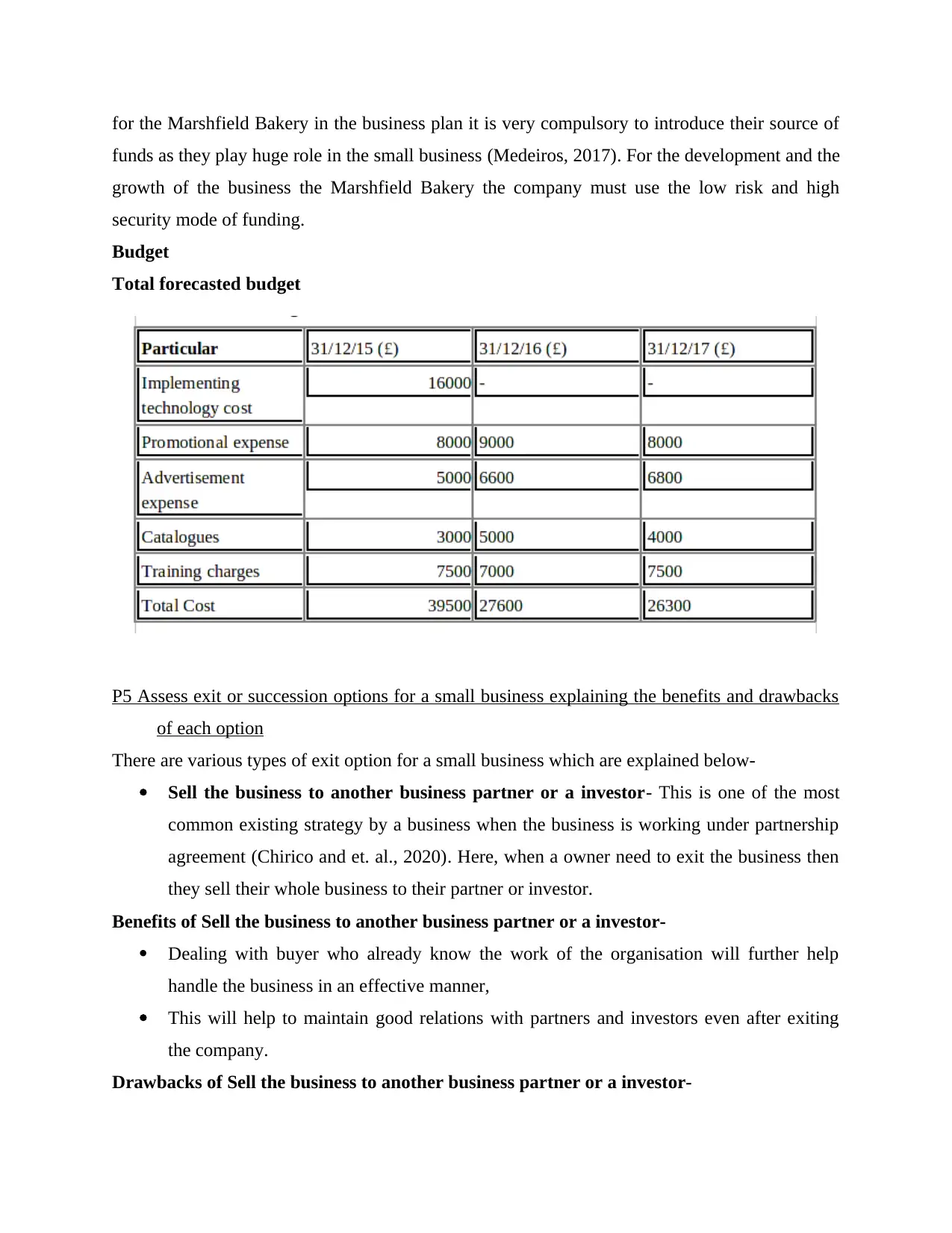
Budget
Total forecasted budget
P5 Assess exit or succession options for a small business explaining the benefits and drawbacks
of each option
There are various types of exit option for a small business which are explained below-
Sell the business to another business partner or a investor- This is one of the most
common existing strategy by a business when the business is working under partnership
agreement (Chirico and et. al., 2020). Here, when a owner need to exit the business then
they sell their whole business to their partner or investor.
Benefits of Sell the business to another business partner or a investor-
Dealing with buyer who already know the work of the organisation will further help
handle the business in an effective manner,
This will help to maintain good relations with partners and investors even after exiting
the company.
Drawbacks of Sell the business to another business partner or a investor-
funds as they play huge role in the small business (Medeiros, 2017). For the development and the
growth of the business the Marshfield Bakery the company must use the low risk and high
security mode of funding.
Budget
Total forecasted budget
P5 Assess exit or succession options for a small business explaining the benefits and drawbacks
of each option
There are various types of exit option for a small business which are explained below-
Sell the business to another business partner or a investor- This is one of the most
common existing strategy by a business when the business is working under partnership
agreement (Chirico and et. al., 2020). Here, when a owner need to exit the business then
they sell their whole business to their partner or investor.
Benefits of Sell the business to another business partner or a investor-
Dealing with buyer who already know the work of the organisation will further help
handle the business in an effective manner,
This will help to maintain good relations with partners and investors even after exiting
the company.
Drawbacks of Sell the business to another business partner or a investor-

It might be possible that owner did not find a appropriate buyer or investor to purchase
the business.
It might be possible that while selling the business to other business partner will create
misunderstanding between partners. Most of the investors or partners may set their mind
that the business might have some issues that's why the owner is selling it to another
partner.
Liquidation- This exit strategy consist of selling the assets to creditor so that the owner will pay
off their all debts and liabilities (Crane and et. al., 2020).
Benefits of liquidation-
It is beneficial for the company to adopt this option if they are having high liabilities.
It is consider as one of the most easiest way to exit the market because creditors are
interested to purchase the assets of the business.
Drawbacks of liquidation-
Assets are sold on depreciation value which means all the assets are sold on lower prices
as compared to their purchase prices.
It might be possible that there creditors refuses to purchase assets and they demanded to
pay off all the liabilities.
Conclusion
It is understood from the above information that growth is essential part of an enterprise
and in order to gain successful and sustainable growth planning is the most crucial factor. In the
small organisations like Marshfield Bakery in order to plan for growth growth opportunities are
considered by analysing the external environment through suitable frameworks. It is concluded
that company must adopt the diversification strategy in order to grab the growth and
development in the Bakery and also to increase the market share in the UK food industry. Thus
business plan will help the Marshfield Bakery in adequate planning of growth with budget and
sources of funding.
the business.
It might be possible that while selling the business to other business partner will create
misunderstanding between partners. Most of the investors or partners may set their mind
that the business might have some issues that's why the owner is selling it to another
partner.
Liquidation- This exit strategy consist of selling the assets to creditor so that the owner will pay
off their all debts and liabilities (Crane and et. al., 2020).
Benefits of liquidation-
It is beneficial for the company to adopt this option if they are having high liabilities.
It is consider as one of the most easiest way to exit the market because creditors are
interested to purchase the assets of the business.
Drawbacks of liquidation-
Assets are sold on depreciation value which means all the assets are sold on lower prices
as compared to their purchase prices.
It might be possible that there creditors refuses to purchase assets and they demanded to
pay off all the liabilities.
Conclusion
It is understood from the above information that growth is essential part of an enterprise
and in order to gain successful and sustainable growth planning is the most crucial factor. In the
small organisations like Marshfield Bakery in order to plan for growth growth opportunities are
considered by analysing the external environment through suitable frameworks. It is concluded
that company must adopt the diversification strategy in order to grab the growth and
development in the Bakery and also to increase the market share in the UK food industry. Thus
business plan will help the Marshfield Bakery in adequate planning of growth with budget and
sources of funding.
⊘ This is a preview!⊘
Do you want full access?
Subscribe today to unlock all pages.

Trusted by 1+ million students worldwide

REFERNCES:
Books and Journals:
Chirico, F. and et. al., 2020. To merge, sell, or liquidate? Socioemotional wealth, family control,
and the choice of business exit. Journal of Management, 46(8), pp.1342-1379.
Crane, L.D. and et. al., 2020. Business Exit During the COVID-19 Pandemic: Non-Traditional
Measures in Historical Context.
Egidi, G. and et. al., 2020. Land mismatches, urban growth and spatial planning: A contribution
to metropolitan sustainability. Environmental Impact Assessment Review, 84, p.106439.
Gomes, E., 2020. Sustainable population growth in low-density areas in a new technological era:
Prospective thinking on how to support planning policies using complex spatial
models. Land, 9(7), p.221.
Guță, A.J., 2017. The analysis of strategic alternatives using BCG matrix in a company. Quality-
Access to Success, 18.
Hollander, J.B., 2017. An ordinary city: planning for growth and decline in New Bedford,
Massachusetts. Springer.
Kairuz, A.R.P. and et. al., 2020. PESTEL analysis of environment state responsibility in
Ecuador. Neutrosophic Sets and Systems, 34, pp.70-78.
Lastra, O.R.E. and et. al., 2021. Neutrosophic Multicriteria Methods and PESTEL Analysis for
the Evaluation of Informal Trade Impact. Neutrosophic Sets and Systems, 44, pp.367-
377.
Liang, X. and et. al., 2018. Urban growth simulation by incorporating planning policies into a
CA-based future land-use simulation model. International Journal of Geographical
Information Science, 32(11), pp.2294-2316.
Madsen, D.O., 2017. Not dead yet: the rise, fall and persistence of the BCG Matrix. Problems
and Perspectives in Management, 15(1), pp.19-34.
Medeiros, E., 2017. From smart growth to European spatial planning: A new paradigm for EU
cohesion policy post-2020. European Planning Studies, 25(10), pp.1856-1875.
Ortega, R.G. and et. al., 2019. Pestel analysis based on neutrosophic cognitive maps and
neutrosophic numbers for the sinos river basin management. Infinite Study.
Rahman, Y.A. and et. al., 2018. Distributed generation’s integration planning involving growth
load models by means of genetic algorithm. Archives of Electrical Engineering, 67(3),
pp.667-682.
Rudolf, S.C., Kienast, F. and Hersperger, A.M., 2018. Planning for compact urban forms: local
growth-management approaches and their evolution over time. Journal of
environmental planning and management, 61(3), pp.474-492.
Song, J., Sun, Y. and Jin, L., 2017. PESTEL analysis of the development of the waste-to-energy
incineration industry in China. Renewable and Sustainable Energy Reviews, 80, pp.276-
289.
Syssner, J. and Meijer, M., 2017. Informal planning in depopulating rural areas: A resource-
based view on informal planning practices. European Countryside, 9(3), pp.458-472.
Welling, J. and et. al., 2019. Participatory planning under scenarios of glacier retreat and tourism
growth in southeast Iceland. Mountain Research and Development, 39(2), pp.D1-D13.
Zhou, Y. and et. al., 2017. The effect of land use planning (2006–2020) on construction land
growth in China. Cities, 68, pp.37-47.
Books and Journals:
Chirico, F. and et. al., 2020. To merge, sell, or liquidate? Socioemotional wealth, family control,
and the choice of business exit. Journal of Management, 46(8), pp.1342-1379.
Crane, L.D. and et. al., 2020. Business Exit During the COVID-19 Pandemic: Non-Traditional
Measures in Historical Context.
Egidi, G. and et. al., 2020. Land mismatches, urban growth and spatial planning: A contribution
to metropolitan sustainability. Environmental Impact Assessment Review, 84, p.106439.
Gomes, E., 2020. Sustainable population growth in low-density areas in a new technological era:
Prospective thinking on how to support planning policies using complex spatial
models. Land, 9(7), p.221.
Guță, A.J., 2017. The analysis of strategic alternatives using BCG matrix in a company. Quality-
Access to Success, 18.
Hollander, J.B., 2017. An ordinary city: planning for growth and decline in New Bedford,
Massachusetts. Springer.
Kairuz, A.R.P. and et. al., 2020. PESTEL analysis of environment state responsibility in
Ecuador. Neutrosophic Sets and Systems, 34, pp.70-78.
Lastra, O.R.E. and et. al., 2021. Neutrosophic Multicriteria Methods and PESTEL Analysis for
the Evaluation of Informal Trade Impact. Neutrosophic Sets and Systems, 44, pp.367-
377.
Liang, X. and et. al., 2018. Urban growth simulation by incorporating planning policies into a
CA-based future land-use simulation model. International Journal of Geographical
Information Science, 32(11), pp.2294-2316.
Madsen, D.O., 2017. Not dead yet: the rise, fall and persistence of the BCG Matrix. Problems
and Perspectives in Management, 15(1), pp.19-34.
Medeiros, E., 2017. From smart growth to European spatial planning: A new paradigm for EU
cohesion policy post-2020. European Planning Studies, 25(10), pp.1856-1875.
Ortega, R.G. and et. al., 2019. Pestel analysis based on neutrosophic cognitive maps and
neutrosophic numbers for the sinos river basin management. Infinite Study.
Rahman, Y.A. and et. al., 2018. Distributed generation’s integration planning involving growth
load models by means of genetic algorithm. Archives of Electrical Engineering, 67(3),
pp.667-682.
Rudolf, S.C., Kienast, F. and Hersperger, A.M., 2018. Planning for compact urban forms: local
growth-management approaches and their evolution over time. Journal of
environmental planning and management, 61(3), pp.474-492.
Song, J., Sun, Y. and Jin, L., 2017. PESTEL analysis of the development of the waste-to-energy
incineration industry in China. Renewable and Sustainable Energy Reviews, 80, pp.276-
289.
Syssner, J. and Meijer, M., 2017. Informal planning in depopulating rural areas: A resource-
based view on informal planning practices. European Countryside, 9(3), pp.458-472.
Welling, J. and et. al., 2019. Participatory planning under scenarios of glacier retreat and tourism
growth in southeast Iceland. Mountain Research and Development, 39(2), pp.D1-D13.
Zhou, Y. and et. al., 2017. The effect of land use planning (2006–2020) on construction land
growth in China. Cities, 68, pp.37-47.
1 out of 7
Related Documents
Your All-in-One AI-Powered Toolkit for Academic Success.
+13062052269
info@desklib.com
Available 24*7 on WhatsApp / Email
Unlock your academic potential
Copyright © 2020–2025 A2Z Services. All Rights Reserved. Developed and managed by ZUCOL.