Stochastic Analysis Assignment: Martingales, Ito Integrals, Processes

Verified

Added on  2023/04/20

|3
|630
|284
Homework Assignment
AI Summary
This assignment solution delves into stochastic analysis, addressing problems related to martingales, Ito integrals, and Brownian motion. It demonstrates that a given process is a martingale by showing that the conditional expectation satisfies the required property. The solution also explores the properties of Gaussian processes and their relationship to continuous paths, along with the mean and variance of Ito integrals, leveraging Ito's lemma for pathwise construction. The document also discusses the consistency of finite dimensional distributions in the context of stochastic processes. Desklib offers a wealth of similar solved assignments and study resources for students.
Document Page
Name:
Course: Stochastic Analysis
Due Date:
Professor:
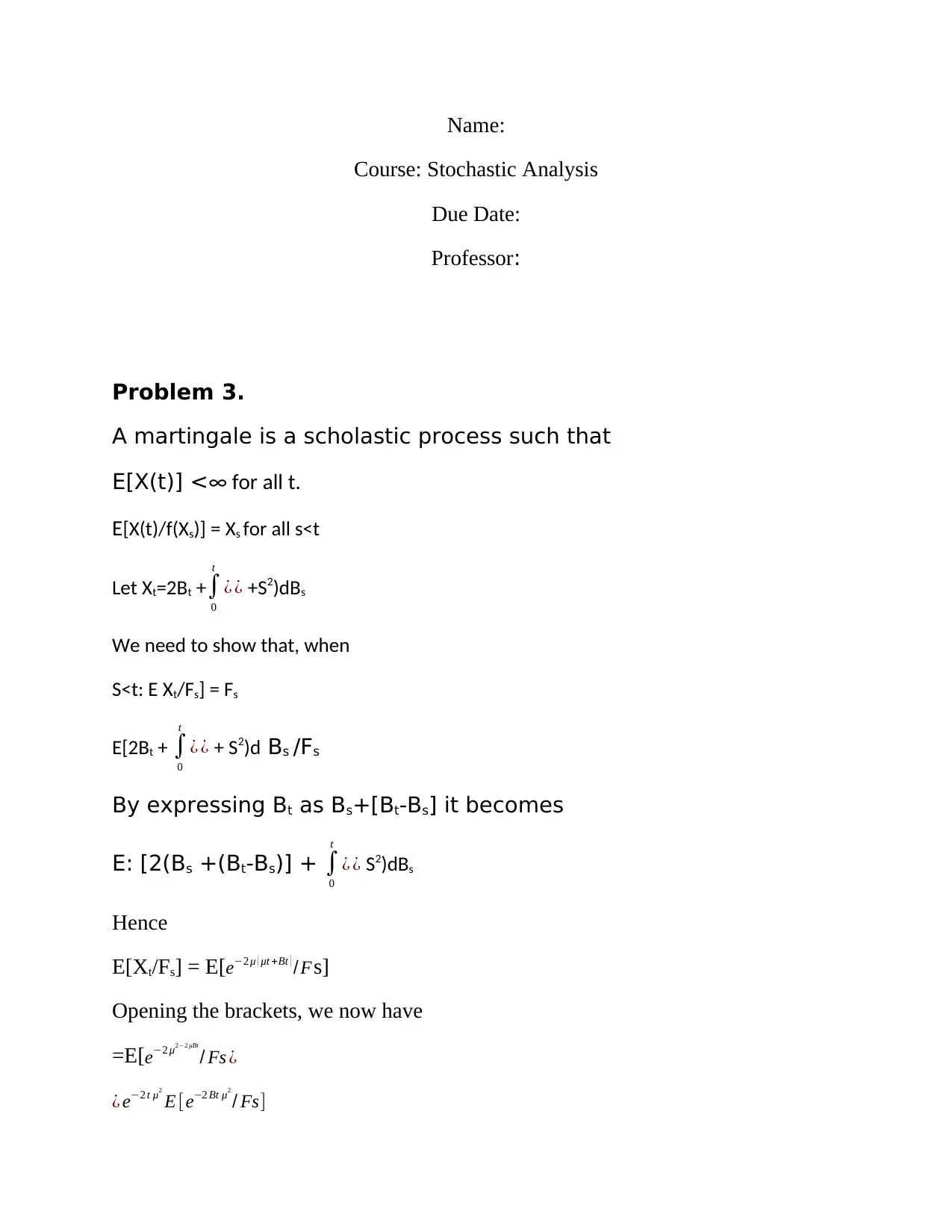
Problem 3.
A martingale is a scholastic process such that
E[X(t)] <∞ for all t.
E[X(t)/f(Xs)] = Xs for all s<t
Let Xt=2Bt +
0
t
¿ ¿ +S2)dBs
We need to show that, when
S<t: E Xt/Fs] = Fs
E[2Bt +
0
t
¿ ¿ + S2)d Bs /Fs
By expressing Bt as Bs+[Bt-Bs] it becomes
E: [2(Bs +(Bt-Bs)] +
0
t
¿ ¿ S2)dBs
Hence
E[Xt/Fs] = E[e2 μ ( μt +Bt ) /Fs]
Opening the brackets, we now have
=E[e2 μ22 μBt
/ Fs ¿
¿ e2 t μ2
E [e2 Bt μ2
/ Fs]
tabler-icon-diamond-filled.svg

Paraphrase This Document

Need a fresh take? Get an instant paraphrase of this document with our AI Paraphraser
Document Page
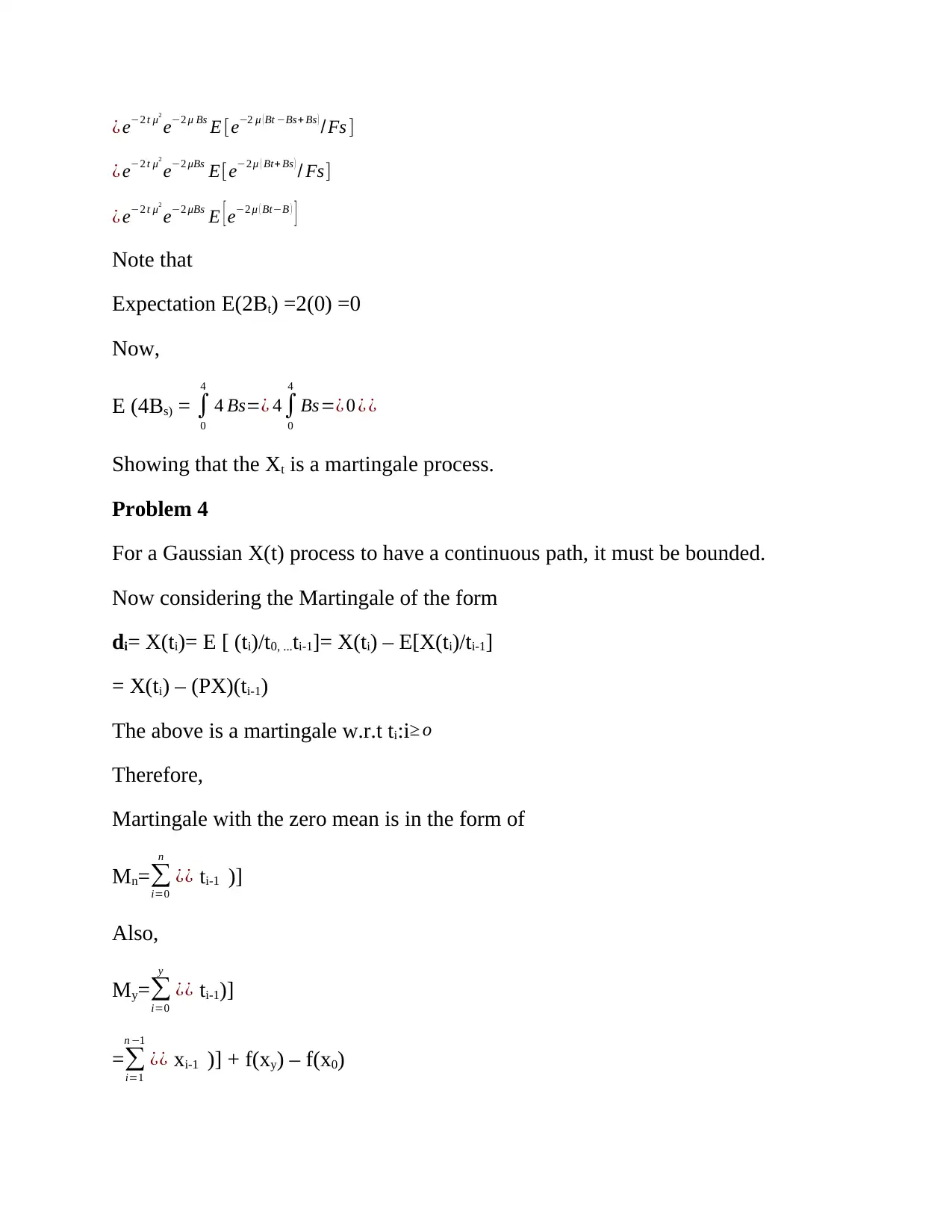
¿ e2 t μ2
e2 μ Bs E [e2 μ (Bt Bs+ Bs ) / Fs ]
¿ e2 t μ2
e2 μBs E[e2 μ ( Bt+ Bs ) / Fs]
¿ e2 t μ2
e2 μBs E [ e2 μ ( BtB ) ]
Note that
Expectation E(2Bt) =2(0) =0
Now,
E (4Bs) =
0
4
4 Bs=¿ 4
0
4
Bs=¿ 0 ¿ ¿
Showing that the Xt is a martingale process.
Problem 4
For a Gaussian X(t) process to have a continuous path, it must be bounded.
Now considering the Martingale of the form
di= X(ti)= E [ (ti)/t0, ...ti-1]= X(ti) – E[X(ti)/ti-1]
= X(ti) – (PX)(ti-1)
The above is a martingale w.r.t ti:i o
Therefore,
Martingale with the zero mean is in the form of
Mn=
i=0
n
¿¿ ti-1 )]
Also,
My=
i=0
y
¿¿ ti-1)]
=
i=1
n 1
¿¿ xi-1 )] + f(xy) – f(x0)
Document Page
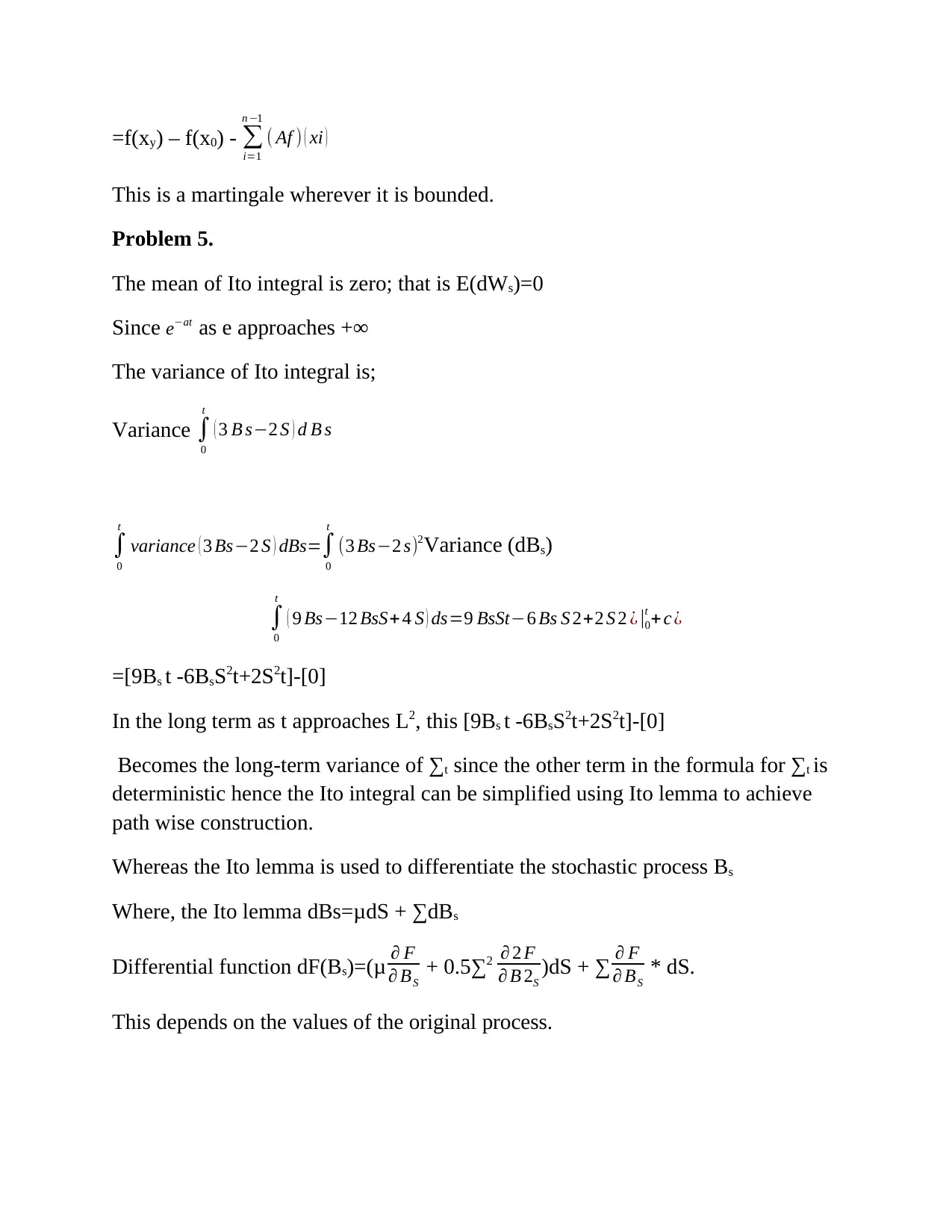
=f(xy) – f(x0) -
i=1
n 1
( Af ) ( xi )
This is a martingale wherever it is bounded.
Problem 5.
The mean of Ito integral is zero; that is E(dWs)=0
Since eat as e approaches +∞
The variance of Ito integral is;
Variance
0
t
( 3 B s2 S ) d B s

0
t
variance ( 3 Bs2 S ) dBs=
0
t
(3 Bs2 s)2Variance (dBs)

0
t
( 9 Bs12 BsS+ 4 S ) ds=9 BsSt6 Bs S 2+2 S 2 ¿|0
t +c ¿
=[9Bs t -6BsS2t+2S2t]-[0]
In the long term as t approaches L2, this [9Bs t -6BsS2t+2S2t]-[0]
Becomes the long-term variance of ∑t since the other term in the formula for ∑t is
deterministic hence the Ito integral can be simplified using Ito lemma to achieve
path wise construction.
Whereas the Ito lemma is used to differentiate the stochastic process Bs
Where, the Ito lemma dBs=μdS + ∑dBs
Differential function dF(Bs)=(μ F
BS
+ 0.5∑2 2 F
B 2S
)dS + ∑ F
BS
* dS.
This depends on the values of the original process.
chevron_up_icon
1 out of 3
circle_padding
hide_on_mobile
zoom_out_icon
[object Object]