Employee Motivation: A Critical Analysis of Maslow's Theory
VerifiedAdded on 2023/06/03
|9
|2131
|191
Essay
AI Summary
This essay provides an analysis of Maslow's Hierarchy of Needs and its application in the workplace to enhance employee motivation. It begins with an introduction to the concept of motivation and its importance in achieving organizational goals. The essay then delves into Maslow's theory, explaining the five levels of needs: physiological, safety, love and belonging, esteem, and self-actualization. It emphasizes that fulfilling these needs is crucial for employee satisfaction and productivity. The application of the theory is discussed, highlighting how employers can address each level of needs to create a motivated workforce. The essay concludes by reiterating the significance of Maslow's theory in fostering a positive work environment and achieving organizational success, underscoring the importance of considering employees' needs to improve overall performance and productivity.

Communication

Paraphrase This Document
Need a fresh take? Get an instant paraphrase of this document with our AI Paraphraser
COMMUNICATION
Table of Contents
Introduction...............................................................................................................1
Maslow theory of needs.............................................................................................1
Application of the theory...........................................................................................3
Conclusion.................................................................................................................4
References.................................................................................................................6
1
Table of Contents
Introduction...............................................................................................................1
Maslow theory of needs.............................................................................................1
Application of the theory...........................................................................................3
Conclusion.................................................................................................................4
References.................................................................................................................6
1
COMMUNICATION
Introduction
Motivation is considered as a wide concept in the business environment. It has been analyzed
that employees in the workplace should be motivated so that they can achieve their desired goals.
Motivation is a concept related to the needs, wants and desires of an individual. To achieve
growth in the market it is important for the employees to be motivated so that they can give their
best towards the assigned activities of the company.
If the employees of the company are not motivated then it can be risky for the company to
manage the entire activities of the workplace. Also it has been examined that motivated
employees give their best by enhancing the overall productivity which can lead to the overall
success of the company. The thesis statement relates to business motivation.
In this paper the discussion will be made on the motivation theory which is “Maslow theory of
needs”. It can be examined that Maslow’s theory of needs is related with the needs of the
employees which is important to be fulfilled so that they can feel motivated and happy towards
their assigned activities. Also when the employees are motivated they show efficiency towards
the overall goals of the organization.
To attain the goals it has been seen that motivation should be there in the workplace so that
positive outcome can be attained. Motivated employees in the workplace are only the reason
behind attaining the overall goals. Therefore, this paper highlights the overall need of the
Maslow theory in the workplace as it can help to maintain positive culture in the workplace.
Maslow theory of needs
It is one of the best theories in relation to the overall theories of motivation. It has been seen that
top management should take into consideration this theory so that it can be easy to achieve
positive outcome from the activities which are completed in the workplace. Maslow’s theory of
needs focuses on the requirement of the employees and the top management states that it should
be fulfilled so that employees can feel happy and positive towards the entire operations of the
company. Maslow theory of needs is considered as a psychology factor that takes into
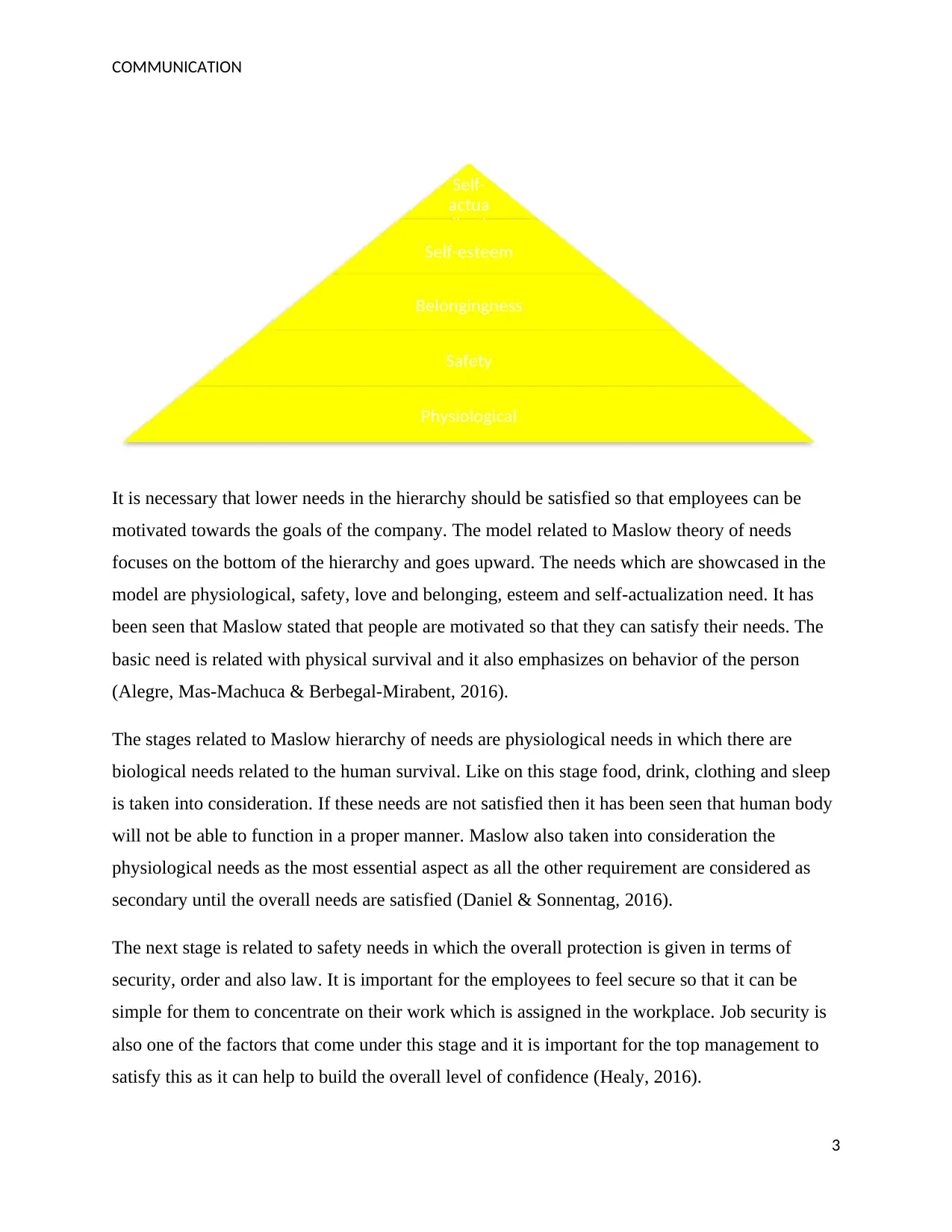
consideration the five factors related to the human wants (Acevedo, 2018). This theory is also
showcased in the form of pyramid.
2
Introduction
Motivation is considered as a wide concept in the business environment. It has been analyzed
that employees in the workplace should be motivated so that they can achieve their desired goals.
Motivation is a concept related to the needs, wants and desires of an individual. To achieve
growth in the market it is important for the employees to be motivated so that they can give their
best towards the assigned activities of the company.
If the employees of the company are not motivated then it can be risky for the company to
manage the entire activities of the workplace. Also it has been examined that motivated
employees give their best by enhancing the overall productivity which can lead to the overall
success of the company. The thesis statement relates to business motivation.
In this paper the discussion will be made on the motivation theory which is “Maslow theory of
needs”. It can be examined that Maslow’s theory of needs is related with the needs of the
employees which is important to be fulfilled so that they can feel motivated and happy towards
their assigned activities. Also when the employees are motivated they show efficiency towards
the overall goals of the organization.
To attain the goals it has been seen that motivation should be there in the workplace so that
positive outcome can be attained. Motivated employees in the workplace are only the reason
behind attaining the overall goals. Therefore, this paper highlights the overall need of the
Maslow theory in the workplace as it can help to maintain positive culture in the workplace.
Maslow theory of needs
It is one of the best theories in relation to the overall theories of motivation. It has been seen that
top management should take into consideration this theory so that it can be easy to achieve
positive outcome from the activities which are completed in the workplace. Maslow’s theory of
needs focuses on the requirement of the employees and the top management states that it should
be fulfilled so that employees can feel happy and positive towards the entire operations of the
company. Maslow theory of needs is considered as a psychology factor that takes into
consideration the five factors related to the human wants (Acevedo, 2018). This theory is also
showcased in the form of pyramid.
2
⊘ This is a preview!⊘
Do you want full access?
Subscribe today to unlock all pages.

Trusted by 1+ million students worldwide
COMMUNICATION
It is necessary that lower needs in the hierarchy should be satisfied so that employees can be
motivated towards the goals of the company. The model related to Maslow theory of needs
focuses on the bottom of the hierarchy and goes upward. The needs which are showcased in the
model are physiological, safety, love and belonging, esteem and self-actualization need. It has
been seen that Maslow stated that people are motivated so that they can satisfy their needs. The
basic need is related with physical survival and it also emphasizes on behavior of the person
(Alegre, Mas-Machuca & Berbegal-Mirabent, 2016).
The stages related to Maslow hierarchy of needs are physiological needs in which there are
biological needs related to the human survival. Like on this stage food, drink, clothing and sleep
is taken into consideration. If these needs are not satisfied then it has been seen that human body
will not be able to function in a proper manner. Maslow also taken into consideration the
physiological needs as the most essential aspect as all the other requirement are considered as
secondary until the overall needs are satisfied (Daniel & Sonnentag, 2016).
The next stage is related to safety needs in which the overall protection is given in terms of
security, order and also law. It is important for the employees to feel secure so that it can be
simple for them to concentrate on their work which is assigned in the workplace. Job security is
also one of the factors that come under this stage and it is important for the top management to
satisfy this as it can help to build the overall level of confidence (Healy, 2016).
3
Self-
actua
lisati
onSelf-esteem
Belongingness
Safety
Physiological
It is necessary that lower needs in the hierarchy should be satisfied so that employees can be
motivated towards the goals of the company. The model related to Maslow theory of needs
focuses on the bottom of the hierarchy and goes upward. The needs which are showcased in the
model are physiological, safety, love and belonging, esteem and self-actualization need. It has
been seen that Maslow stated that people are motivated so that they can satisfy their needs. The
basic need is related with physical survival and it also emphasizes on behavior of the person
(Alegre, Mas-Machuca & Berbegal-Mirabent, 2016).
The stages related to Maslow hierarchy of needs are physiological needs in which there are
biological needs related to the human survival. Like on this stage food, drink, clothing and sleep
is taken into consideration. If these needs are not satisfied then it has been seen that human body
will not be able to function in a proper manner. Maslow also taken into consideration the
physiological needs as the most essential aspect as all the other requirement are considered as
secondary until the overall needs are satisfied (Daniel & Sonnentag, 2016).
The next stage is related to safety needs in which the overall protection is given in terms of
security, order and also law. It is important for the employees to feel secure so that it can be
simple for them to concentrate on their work which is assigned in the workplace. Job security is
also one of the factors that come under this stage and it is important for the top management to
satisfy this as it can help to build the overall level of confidence (Healy, 2016).
3
Self-
actua
lisati
onSelf-esteem
Belongingness
Safety
Physiological
Paraphrase This Document
Need a fresh take? Get an instant paraphrase of this document with our AI Paraphraser
COMMUNICATION
Third stage is related with love and belongingness needs in which after physiological and safety
needs which are satisfied comes the third stage in which focus is given on the human needs
which is social and also considers the feeling of belongingness. The requirement for
interpersonal relations also motivates the overall behavior of the people which is necessary to be
considered so that positive culture in the workplace can be maintained. In this the examples can
be related to friendship, trust and the overall acceptance (Pinder, 2014).
Esteem needs is considered as the next stage in which Maslow divided it into two parts which
are esteem for oneself in which the focus is given on dignity, achievement and also
independence. The next part is related to the desire in context to the reputation and also respect
for the other person. In this the emphasis is given on status and prestige. In this it can be
examined that Maslow shows that need in relation to the respect and reputation is considered as
the important factor for the children and also for the employees as it helps to show status at the
time of completing the overall activities in the workplace (Osemeke & Adegboyega, 2017).
The last is related to the self-actualization needs in which focus is given on realizing the overall
personal potential and also the self-growth of the individual. It also takes into consideration the
personal growth. It is related with the desire to become everything if an individual has the
capability to become. So, this can be considered as the important stage on which the managers
should emphasize so that it can be easy to maintain the growth (D'Souza & Gurin, 2016).
Application of the theory
It has been seen by taking into consideration the theory of Maslow it can be simple for the top
management to control the entire operations in the workplace. It is examined that an employee
beginning focus on lower needs of thee physiology and also security.
In general it has been seen that an employee who is starting their career will focus on the
physiological needs like there should be proper wages given by the top management or stability
in the income. This is considered as an important factor that helps the person to grow in the
competitive market. So, it can be stated that an employee who is having good salary will meet
the basic needs of his or her family and will also want to have stability in the working
environment (Miner, 2015).
4
Third stage is related with love and belongingness needs in which after physiological and safety
needs which are satisfied comes the third stage in which focus is given on the human needs
which is social and also considers the feeling of belongingness. The requirement for
interpersonal relations also motivates the overall behavior of the people which is necessary to be
considered so that positive culture in the workplace can be maintained. In this the examples can
be related to friendship, trust and the overall acceptance (Pinder, 2014).
Esteem needs is considered as the next stage in which Maslow divided it into two parts which
are esteem for oneself in which the focus is given on dignity, achievement and also
independence. The next part is related to the desire in context to the reputation and also respect
for the other person. In this the emphasis is given on status and prestige. In this it can be
examined that Maslow shows that need in relation to the respect and reputation is considered as
the important factor for the children and also for the employees as it helps to show status at the
time of completing the overall activities in the workplace (Osemeke & Adegboyega, 2017).
The last is related to the self-actualization needs in which focus is given on realizing the overall
personal potential and also the self-growth of the individual. It also takes into consideration the
personal growth. It is related with the desire to become everything if an individual has the
capability to become. So, this can be considered as the important stage on which the managers
should emphasize so that it can be easy to maintain the growth (D'Souza & Gurin, 2016).
Application of the theory
It has been seen by taking into consideration the theory of Maslow it can be simple for the top
management to control the entire operations in the workplace. It is examined that an employee
beginning focus on lower needs of thee physiology and also security.
In general it has been seen that an employee who is starting their career will focus on the
physiological needs like there should be proper wages given by the top management or stability
in the income. This is considered as an important factor that helps the person to grow in the
competitive market. So, it can be stated that an employee who is having good salary will meet
the basic needs of his or her family and will also want to have stability in the working
environment (Miner, 2015).
4
COMMUNICATION
It has been investigated that the employees who’s basic or the low level need is not satisfied will
try to consider the decisions related to the job like safety, compensation and stability in the
environment. The employees will also revert in enhancing the overall satisfaction by fulfilling
their low level needs when the needs are not satisfied (Reeve, 2014).
It has been seen that it is important for the top management to act in proper humanity when the
decisions of the organization are taken like staff reductions. If difficult decisions are taken in the
workplace then it can affect the other employees in the workplace and it can create the feeling of
insecurity within them. The doubt can take place between the employees by taking into
consideration their capability of doing work in the workplace. They can also take their security
needs in context to these basic needs which are given by the top management (Rasskazova,
Ivanova & Sheldon, 2016).
Also it has been seen that one of the basic need is related to belongingness which should be met.
It is important to have the level of social interaction with the employees so that it can be easy for
them to share their ideas and views with each other. So, it can be stated that interpersonal
relations are important and top management can only create the environment in which the staff
cooperation is rewarded. This will emphasize on enhancing the overall interpersonal
effectiveness in the workplace and will motivate the employees to work with efficiency (Lepper
& Greene, 2015).
The social needs of the employees can also be satisfied if focus is given on the managerial
communication. It is necessary for the top management to consider cross training and also job
enrichment so that it can be easy to satisfy the employees with higher needs. The esteem needs of
the employees can be met when focus is given on giving chance to the employees to participate
in the process of decision making. Also, the symbols related to accomplishment like awards and
job perks are necessary for the employees esteem (Wlodkowski & Ginsberg, 2017).
Conclusion
So, by focusing on the overall concept related to Maslow needs theory it can be stated that it is
one of the important theory that should be considered by the top management. This theory can
directly affect the overall growth of the organization in the high level of competition. Also it will
enhance the confidence level of the employees which will impact the level of productivity. This
5
It has been investigated that the employees who’s basic or the low level need is not satisfied will
try to consider the decisions related to the job like safety, compensation and stability in the
environment. The employees will also revert in enhancing the overall satisfaction by fulfilling
their low level needs when the needs are not satisfied (Reeve, 2014).
It has been seen that it is important for the top management to act in proper humanity when the
decisions of the organization are taken like staff reductions. If difficult decisions are taken in the
workplace then it can affect the other employees in the workplace and it can create the feeling of
insecurity within them. The doubt can take place between the employees by taking into
consideration their capability of doing work in the workplace. They can also take their security
needs in context to these basic needs which are given by the top management (Rasskazova,
Ivanova & Sheldon, 2016).
Also it has been seen that one of the basic need is related to belongingness which should be met.
It is important to have the level of social interaction with the employees so that it can be easy for
them to share their ideas and views with each other. So, it can be stated that interpersonal
relations are important and top management can only create the environment in which the staff
cooperation is rewarded. This will emphasize on enhancing the overall interpersonal
effectiveness in the workplace and will motivate the employees to work with efficiency (Lepper
& Greene, 2015).
The social needs of the employees can also be satisfied if focus is given on the managerial
communication. It is necessary for the top management to consider cross training and also job
enrichment so that it can be easy to satisfy the employees with higher needs. The esteem needs of
the employees can be met when focus is given on giving chance to the employees to participate
in the process of decision making. Also, the symbols related to accomplishment like awards and
job perks are necessary for the employees esteem (Wlodkowski & Ginsberg, 2017).
Conclusion
So, by focusing on the overall concept related to Maslow needs theory it can be stated that it is
one of the important theory that should be considered by the top management. This theory can
directly affect the overall growth of the organization in the high level of competition. Also it will
enhance the confidence level of the employees which will impact the level of productivity. This
5
⊘ This is a preview!⊘
Do you want full access?
Subscribe today to unlock all pages.
Trusted by 1+ million students worldwide

COMMUNICATION
theory takes into consideration the basic needs of the employees which should be fulfilled so that
it can be easy to bring improvisation in the entire operation of the company. It will also help to
attain the overall goals.
6
theory takes into consideration the basic needs of the employees which should be fulfilled so that
it can be easy to bring improvisation in the entire operation of the company. It will also help to
attain the overall goals.
6
Paraphrase This Document
Need a fresh take? Get an instant paraphrase of this document with our AI Paraphraser
COMMUNICATION
References
Acevedo, A. (2018). A Personalistic Appraisal of Maslow’s Needs Theory of Motivation: From
“Humanistic” Psychology to Integral Humanism. Journal of Business Ethics, 148(4), 741-
763.
Alegre, I., Mas-Machuca, M., & Berbegal-Mirabent, J. (2016). Antecedents of employee job
satisfaction: Do they matter?. Journal of Business Research, 69(4), 1390-1395.
Daniel, S., & Sonnentag, S. (2016). Crossing the borders: The relationship between boundary
management, work–family enrichment and job satisfaction. The International Journal of
Human Resource Management, 27(4), 407-426.
D'Souza, J., & Gurin, M. (2016). The universal significance of Maslow’s concept of self-
actualization. The Humanistic Psychologist, 44(2), 210.
Healy, K. (2016). A Theory of Human Motivation by Abraham H. Maslow (1942)–
reflection. The British Journal of Psychiatry, 208(4), 313-313.
Lepper, M. R., & Greene, D. (Eds.). (2015). The hidden costs of reward: New perspectives on
the psychology of human motivation. Psychology Press.
Miner, J. B. (2015). Organizational behavior 1: Essential theories of motivation and leadership.
Routledge.
Osemeke, M., & Adegboyega, S. (2017). Critical Review and Comparism between Maslow,
Herzberg, and McClelland‟ s Theory of Needs. Funai Journal of Accounting, Business and
Finance, 1(1), 161-173.
Pinder, C. C. (2014). Work motivation in organizational behavior. Psychology Press.
Rasskazova, E., Ivanova, T., & Sheldon, K. (2016). Comparing the effects of low-level and high-
level worker need-satisfaction: A synthesis of the self-determination and Maslow need
theories. Motivation and Emotion, 40(4), 541-555.
Reeve, J. (2014). Understanding motivation and emotion. John Wiley & Sons.
7
References
Acevedo, A. (2018). A Personalistic Appraisal of Maslow’s Needs Theory of Motivation: From
“Humanistic” Psychology to Integral Humanism. Journal of Business Ethics, 148(4), 741-
763.
Alegre, I., Mas-Machuca, M., & Berbegal-Mirabent, J. (2016). Antecedents of employee job
satisfaction: Do they matter?. Journal of Business Research, 69(4), 1390-1395.
Daniel, S., & Sonnentag, S. (2016). Crossing the borders: The relationship between boundary
management, work–family enrichment and job satisfaction. The International Journal of
Human Resource Management, 27(4), 407-426.
D'Souza, J., & Gurin, M. (2016). The universal significance of Maslow’s concept of self-
actualization. The Humanistic Psychologist, 44(2), 210.
Healy, K. (2016). A Theory of Human Motivation by Abraham H. Maslow (1942)–
reflection. The British Journal of Psychiatry, 208(4), 313-313.
Lepper, M. R., & Greene, D. (Eds.). (2015). The hidden costs of reward: New perspectives on
the psychology of human motivation. Psychology Press.
Miner, J. B. (2015). Organizational behavior 1: Essential theories of motivation and leadership.
Routledge.
Osemeke, M., & Adegboyega, S. (2017). Critical Review and Comparism between Maslow,
Herzberg, and McClelland‟ s Theory of Needs. Funai Journal of Accounting, Business and
Finance, 1(1), 161-173.
Pinder, C. C. (2014). Work motivation in organizational behavior. Psychology Press.
Rasskazova, E., Ivanova, T., & Sheldon, K. (2016). Comparing the effects of low-level and high-
level worker need-satisfaction: A synthesis of the self-determination and Maslow need
theories. Motivation and Emotion, 40(4), 541-555.
Reeve, J. (2014). Understanding motivation and emotion. John Wiley & Sons.
7

COMMUNICATION
Wlodkowski, R. J., & Ginsberg, M. B. (2017). Enhancing adult motivation to learn: A
comprehensive guide for teaching all adults. John Wiley & Sons.
8
Wlodkowski, R. J., & Ginsberg, M. B. (2017). Enhancing adult motivation to learn: A
comprehensive guide for teaching all adults. John Wiley & Sons.
8
⊘ This is a preview!⊘
Do you want full access?
Subscribe today to unlock all pages.
Trusted by 1+ million students worldwide

1 out of 9


Related Documents


Your All-in-One AI-Powered Toolkit for Academic Success.
+13062052269
info@desklib.com
Available 24*7 on WhatsApp / Email
![[object Object]](/_next/static/media/star-bottom.7253800d.svg)
Unlock your academic potential
Copyright © 2020–2026 A2Z Services. All Rights Reserved. Developed and managed by ZUCOL.