HRM: Maslow's Hierarchy of Needs

Verified

Added on  2019/09/30

|3
|505
|150
Essay
AI Summary
This essay examines the relevance of Maslow's Hierarchy of Needs in Human Resource Management (HRM). It explains how the theory, which categorizes human needs into physiological, security, belongingness, esteem, and self-actualization, can be used by management to create effective employee policies. The essay highlights that understanding an employee's position within this hierarchy is crucial for addressing their needs and preventing issues like decreased productivity and high turnover. Failure to cater to employee needs at each level can lead to negative consequences for the organization. The essay concludes by referencing several academic sources that support the application of Maslow's theory in HRM.

Document Page
HUMAN RESOURCE
MANAGEMENT
1
tabler-icon-diamond-filled.svg

Paraphrase This Document

Need a fresh take? Get an instant paraphrase of this document with our AI Paraphraser
Document Page
Maslow’s Hierarchy of Needs
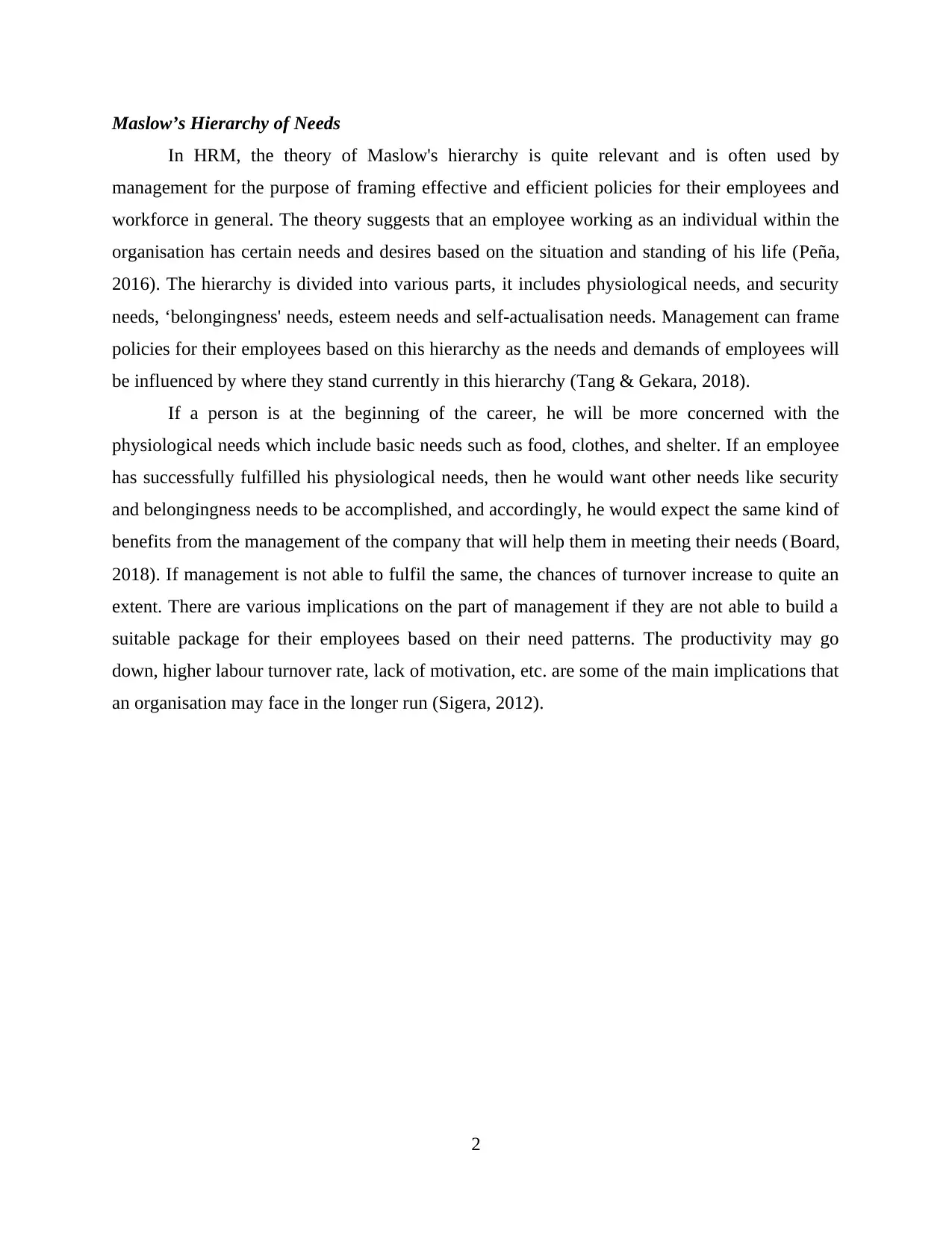
In HRM, the theory of Maslow's hierarchy is quite relevant and is often used by
management for the purpose of framing effective and efficient policies for their employees and
workforce in general. The theory suggests that an employee working as an individual within the
organisation has certain needs and desires based on the situation and standing of his life (Peña,
2016). The hierarchy is divided into various parts, it includes physiological needs, and security
needs, ‘belongingness' needs, esteem needs and self-actualisation needs. Management can frame
policies for their employees based on this hierarchy as the needs and demands of employees will
be influenced by where they stand currently in this hierarchy (Tang & Gekara, 2018).
If a person is at the beginning of the career, he will be more concerned with the
physiological needs which include basic needs such as food, clothes, and shelter. If an employee
has successfully fulfilled his physiological needs, then he would want other needs like security
and belongingness needs to be accomplished, and accordingly, he would expect the same kind of
benefits from the management of the company that will help them in meeting their needs (Board,
2018). If management is not able to fulfil the same, the chances of turnover increase to quite an
extent. There are various implications on the part of management if they are not able to build a
suitable package for their employees based on their need patterns. The productivity may go
down, higher labour turnover rate, lack of motivation, etc. are some of the main implications that
an organisation may face in the longer run (Sigera, 2012).
2
Document Page
REFERENCES
Books and Journals
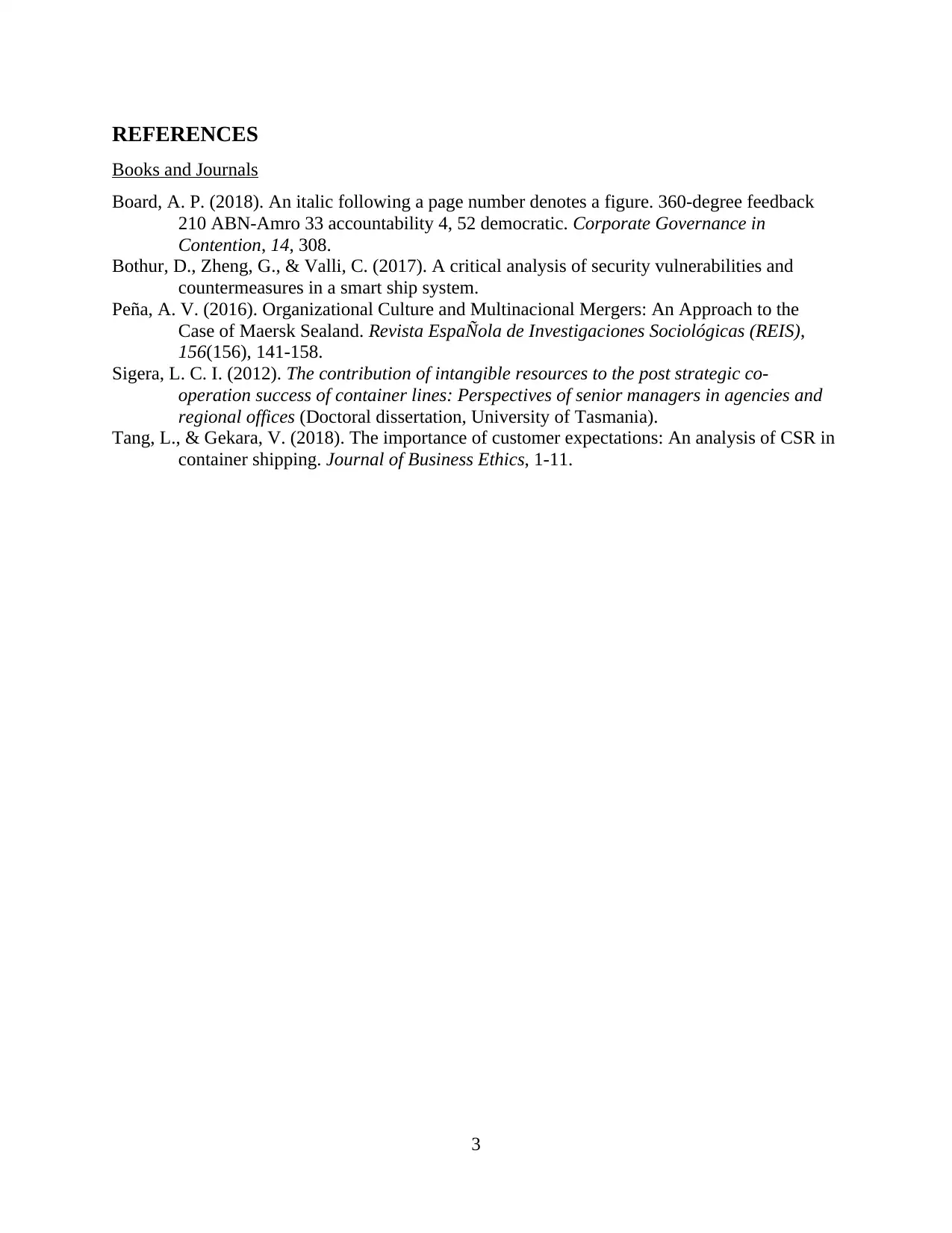
Board, A. P. (2018). An italic following a page number denotes a figure. 360-degree feedback
210 ABN-Amro 33 accountability 4, 52 democratic. Corporate Governance in
Contention, 14, 308.
Bothur, D., Zheng, G., & Valli, C. (2017). A critical analysis of security vulnerabilities and
countermeasures in a smart ship system.
Peña, A. V. (2016). Organizational Culture and Multinacional Mergers: An Approach to the
Case of Maersk Sealand. Revista EspaÑola de Investigaciones Sociológicas (REIS),
156(156), 141-158.
Sigera, L. C. I. (2012). The contribution of intangible resources to the post strategic co-
operation success of container lines: Perspectives of senior managers in agencies and
regional offices (Doctoral dissertation, University of Tasmania).
Tang, L., & Gekara, V. (2018). The importance of customer expectations: An analysis of CSR in
container shipping. Journal of Business Ethics, 1-11.
3
chevron_up_icon
1 out of 3
circle_padding
hide_on_mobile
zoom_out_icon
[object Object]