Healthcare Operations Assignment 1: Efficiency and Process Analysis
VerifiedAdded on  2022/08/31
|5
|1308
|31
Report
AI Summary
This report analyzes the Massachusetts General Hospital's Pre-Admission Testing Area (PATA) case study, focusing on inefficiencies and patient wait times. The assignment begins by identifying the core issue: only 65% of patients are being treated, leading to delays and incomplete pre-surgical procedures. The report explores potential causes, including delays in arrival, during the process, inter-procedure delays, and lack of resources, with the primary cause attributed to inter-process waiting time due to workforce limitations. The analysis examines the task force's proposed solutions, such as triaging and telemedicine, evaluating their potential impact and limitations. Furthermore, the report outlines a comprehensive approach to finding a solution, suggesting data collection and analysis of factors like data handling, transfer procedures, and time of day to pinpoint the root causes of delays and identify opportunities for improvement. The proposed solution involves analyzing data entry and processing times, patient turnaround times, and onsite inspections to assess and improve efficiency within the PATA.
Running head: HEALTHCARE OPERATIONS ASSIGNMENT 1
Healthcare Operations Assignment 1
Name of the Student
Name of the University
Author note
Healthcare Operations Assignment 1
Name of the Student
Name of the University
Author note
Paraphrase This Document
Need a fresh take? Get an instant paraphrase of this document with our AI Paraphraser

1HEALTHCARE OPERATIONS ASSIGNMENT 1
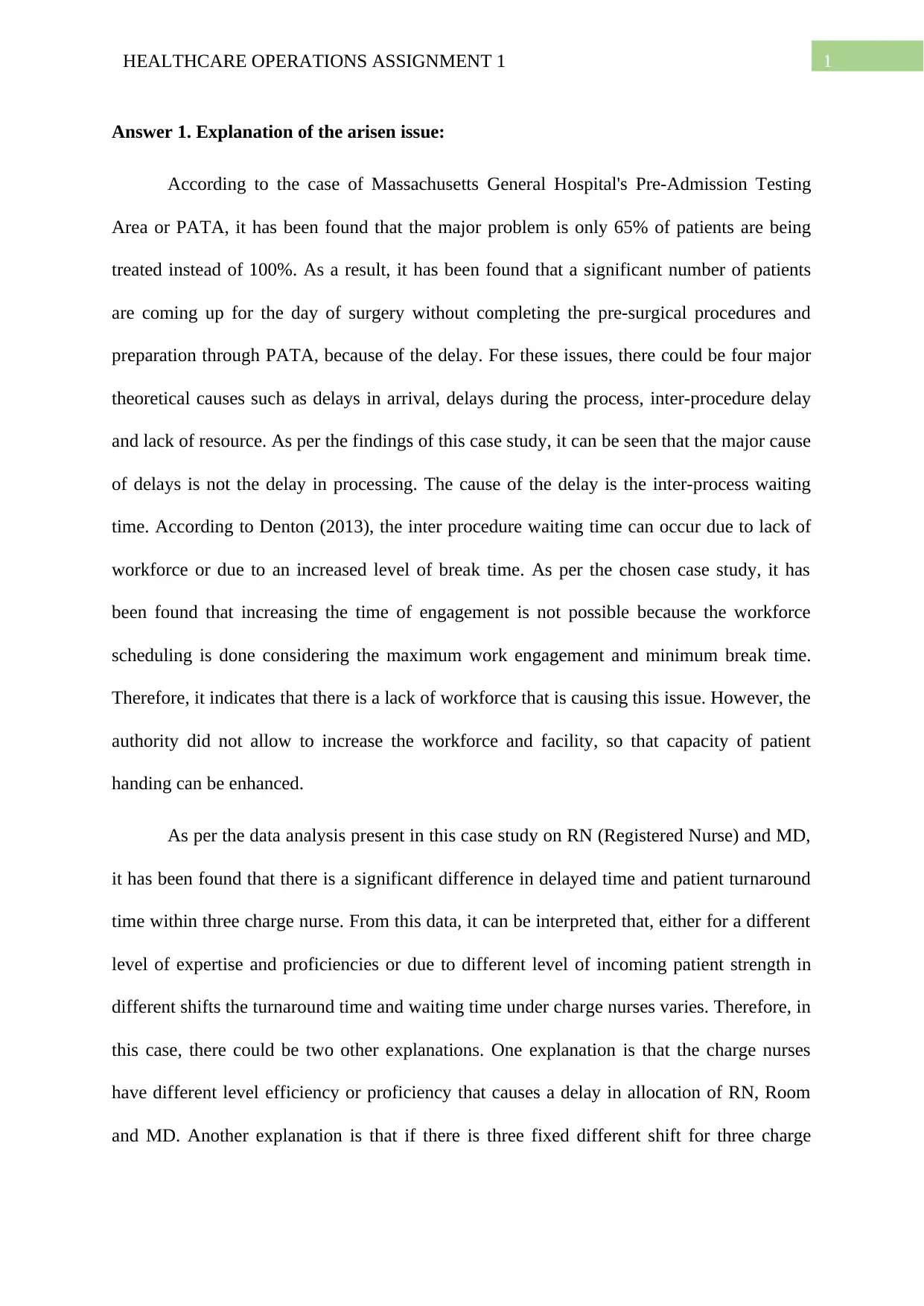
Answer 1. Explanation of the arisen issue:
According to the case of Massachusetts General Hospital's Pre-Admission Testing
Area or PATA, it has been found that the major problem is only 65% of patients are being
treated instead of 100%. As a result, it has been found that a significant number of patients
are coming up for the day of surgery without completing the pre-surgical procedures and
preparation through PATA, because of the delay. For these issues, there could be four major
theoretical causes such as delays in arrival, delays during the process, inter-procedure delay
and lack of resource. As per the findings of this case study, it can be seen that the major cause
of delays is not the delay in processing. The cause of the delay is the inter-process waiting
time. According to Denton (2013), the inter procedure waiting time can occur due to lack of
workforce or due to an increased level of break time. As per the chosen case study, it has
been found that increasing the time of engagement is not possible because the workforce
scheduling is done considering the maximum work engagement and minimum break time.
Therefore, it indicates that there is a lack of workforce that is causing this issue. However, the
authority did not allow to increase the workforce and facility, so that capacity of patient
handing can be enhanced.
As per the data analysis present in this case study on RN (Registered Nurse) and MD,
it has been found that there is a significant difference in delayed time and patient turnaround
time within three charge nurse. From this data, it can be interpreted that, either for a different
level of expertise and proficiencies or due to different level of incoming patient strength in
different shifts the turnaround time and waiting time under charge nurses varies. Therefore, in
this case, there could be two other explanations. One explanation is that the charge nurses
have different level efficiency or proficiency that causes a delay in allocation of RN, Room
and MD. Another explanation is that if there is three fixed different shift for three charge
Answer 1. Explanation of the arisen issue:
According to the case of Massachusetts General Hospital's Pre-Admission Testing
Area or PATA, it has been found that the major problem is only 65% of patients are being
treated instead of 100%. As a result, it has been found that a significant number of patients
are coming up for the day of surgery without completing the pre-surgical procedures and
preparation through PATA, because of the delay. For these issues, there could be four major
theoretical causes such as delays in arrival, delays during the process, inter-procedure delay
and lack of resource. As per the findings of this case study, it can be seen that the major cause
of delays is not the delay in processing. The cause of the delay is the inter-process waiting
time. According to Denton (2013), the inter procedure waiting time can occur due to lack of
workforce or due to an increased level of break time. As per the chosen case study, it has
been found that increasing the time of engagement is not possible because the workforce
scheduling is done considering the maximum work engagement and minimum break time.
Therefore, it indicates that there is a lack of workforce that is causing this issue. However, the
authority did not allow to increase the workforce and facility, so that capacity of patient
handing can be enhanced.
As per the data analysis present in this case study on RN (Registered Nurse) and MD,
it has been found that there is a significant difference in delayed time and patient turnaround
time within three charge nurse. From this data, it can be interpreted that, either for a different
level of expertise and proficiencies or due to different level of incoming patient strength in
different shifts the turnaround time and waiting time under charge nurses varies. Therefore, in
this case, there could be two other explanations. One explanation is that the charge nurses
have different level efficiency or proficiency that causes a delay in allocation of RN, Room
and MD. Another explanation is that if there is three fixed different shift for three charge

2HEALTHCARE OPERATIONS ASSIGNMENT 1
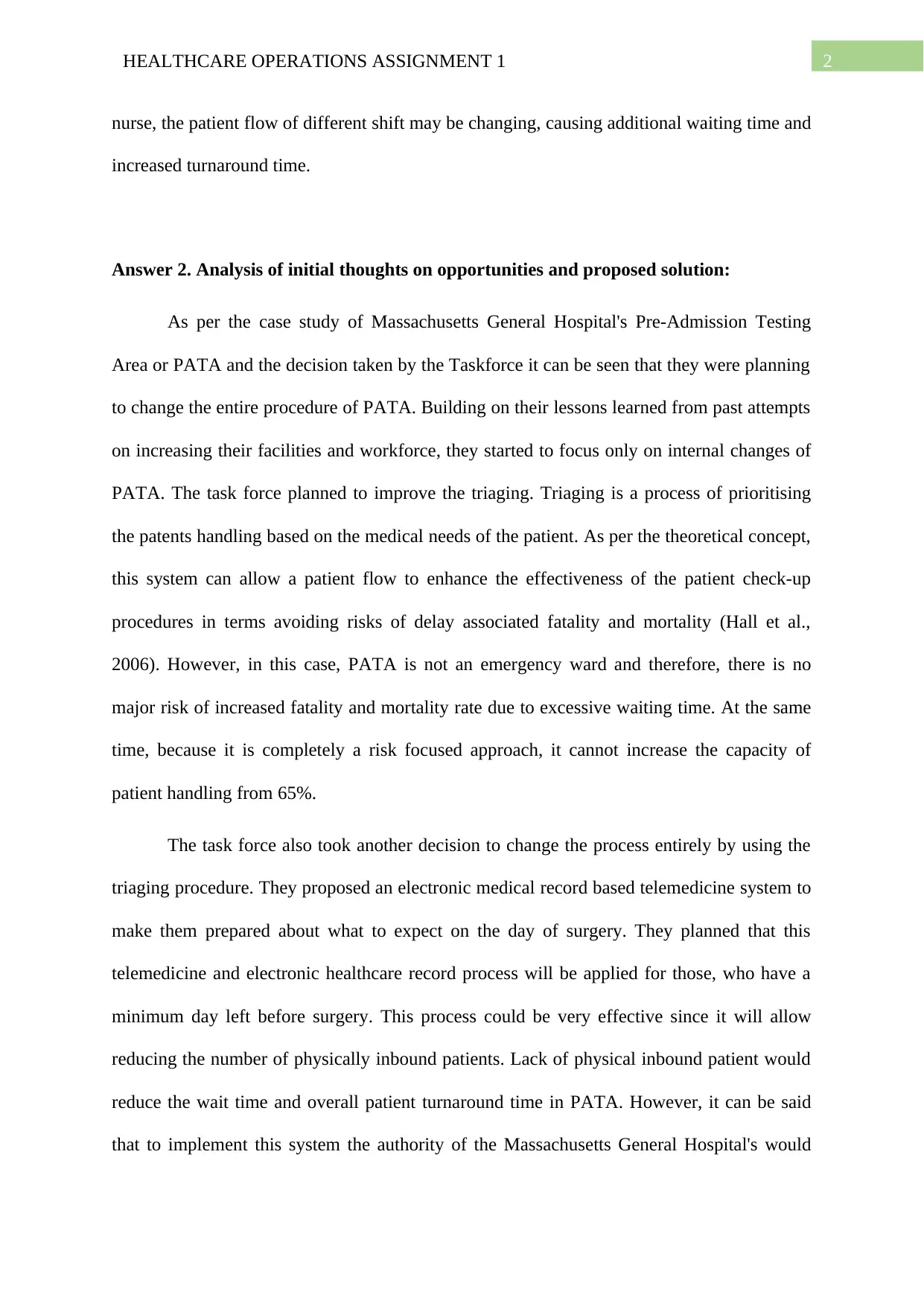
nurse, the patient flow of different shift may be changing, causing additional waiting time and
increased turnaround time.
Answer 2. Analysis of initial thoughts on opportunities and proposed solution:
As per the case study of Massachusetts General Hospital's Pre-Admission Testing
Area or PATA and the decision taken by the Taskforce it can be seen that they were planning
to change the entire procedure of PATA. Building on their lessons learned from past attempts
on increasing their facilities and workforce, they started to focus only on internal changes of
PATA. The task force planned to improve the triaging. Triaging is a process of prioritising
the patents handling based on the medical needs of the patient. As per the theoretical concept,
this system can allow a patient flow to enhance the effectiveness of the patient check-up
procedures in terms avoiding risks of delay associated fatality and mortality (Hall et al.,
2006). However, in this case, PATA is not an emergency ward and therefore, there is no
major risk of increased fatality and mortality rate due to excessive waiting time. At the same
time, because it is completely a risk focused approach, it cannot increase the capacity of
patient handling from 65%.
The task force also took another decision to change the process entirely by using the
triaging procedure. They proposed an electronic medical record based telemedicine system to
make them prepared about what to expect on the day of surgery. They planned that this
telemedicine and electronic healthcare record process will be applied for those, who have a
minimum day left before surgery. This process could be very effective since it will allow
reducing the number of physically inbound patients. Lack of physical inbound patient would
reduce the wait time and overall patient turnaround time in PATA. However, it can be said
that to implement this system the authority of the Massachusetts General Hospital's would
nurse, the patient flow of different shift may be changing, causing additional waiting time and
increased turnaround time.
Answer 2. Analysis of initial thoughts on opportunities and proposed solution:
As per the case study of Massachusetts General Hospital's Pre-Admission Testing
Area or PATA and the decision taken by the Taskforce it can be seen that they were planning
to change the entire procedure of PATA. Building on their lessons learned from past attempts
on increasing their facilities and workforce, they started to focus only on internal changes of
PATA. The task force planned to improve the triaging. Triaging is a process of prioritising
the patents handling based on the medical needs of the patient. As per the theoretical concept,
this system can allow a patient flow to enhance the effectiveness of the patient check-up
procedures in terms avoiding risks of delay associated fatality and mortality (Hall et al.,
2006). However, in this case, PATA is not an emergency ward and therefore, there is no
major risk of increased fatality and mortality rate due to excessive waiting time. At the same
time, because it is completely a risk focused approach, it cannot increase the capacity of
patient handling from 65%.
The task force also took another decision to change the process entirely by using the
triaging procedure. They proposed an electronic medical record based telemedicine system to
make them prepared about what to expect on the day of surgery. They planned that this
telemedicine and electronic healthcare record process will be applied for those, who have a
minimum day left before surgery. This process could be very effective since it will allow
reducing the number of physically inbound patients. Lack of physical inbound patient would
reduce the wait time and overall patient turnaround time in PATA. However, it can be said
that to implement this system the authority of the Massachusetts General Hospital's would
⊘ This is a preview!⊘
Do you want full access?
Subscribe today to unlock all pages.

Trusted by 1+ million students worldwide

3HEALTHCARE OPERATIONS ASSIGNMENT 1
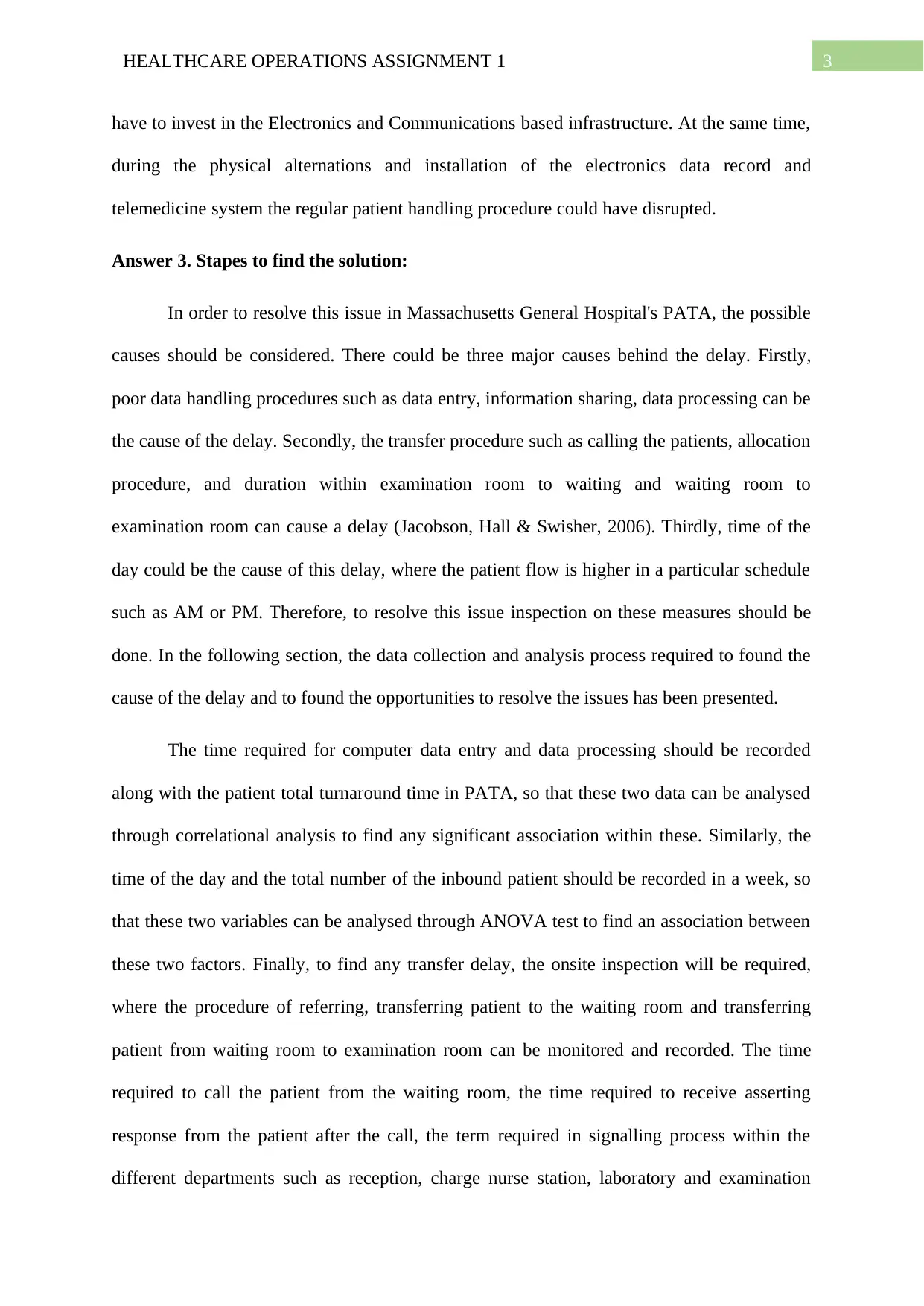
have to invest in the Electronics and Communications based infrastructure. At the same time,
during the physical alternations and installation of the electronics data record and
telemedicine system the regular patient handling procedure could have disrupted.
Answer 3. Stapes to find the solution:
In order to resolve this issue in Massachusetts General Hospital's PATA, the possible
causes should be considered. There could be three major causes behind the delay. Firstly,
poor data handling procedures such as data entry, information sharing, data processing can be
the cause of the delay. Secondly, the transfer procedure such as calling the patients, allocation
procedure, and duration within examination room to waiting and waiting room to
examination room can cause a delay (Jacobson, Hall & Swisher, 2006). Thirdly, time of the
day could be the cause of this delay, where the patient flow is higher in a particular schedule
such as AM or PM. Therefore, to resolve this issue inspection on these measures should be
done. In the following section, the data collection and analysis process required to found the
cause of the delay and to found the opportunities to resolve the issues has been presented.
The time required for computer data entry and data processing should be recorded
along with the patient total turnaround time in PATA, so that these two data can be analysed
through correlational analysis to find any significant association within these. Similarly, the
time of the day and the total number of the inbound patient should be recorded in a week, so
that these two variables can be analysed through ANOVA test to find an association between
these two factors. Finally, to find any transfer delay, the onsite inspection will be required,
where the procedure of referring, transferring patient to the waiting room and transferring
patient from waiting room to examination room can be monitored and recorded. The time
required to call the patient from the waiting room, the time required to receive asserting
response from the patient after the call, the term required in signalling process within the
different departments such as reception, charge nurse station, laboratory and examination
have to invest in the Electronics and Communications based infrastructure. At the same time,
during the physical alternations and installation of the electronics data record and
telemedicine system the regular patient handling procedure could have disrupted.
Answer 3. Stapes to find the solution:
In order to resolve this issue in Massachusetts General Hospital's PATA, the possible
causes should be considered. There could be three major causes behind the delay. Firstly,
poor data handling procedures such as data entry, information sharing, data processing can be
the cause of the delay. Secondly, the transfer procedure such as calling the patients, allocation
procedure, and duration within examination room to waiting and waiting room to
examination room can cause a delay (Jacobson, Hall & Swisher, 2006). Thirdly, time of the
day could be the cause of this delay, where the patient flow is higher in a particular schedule
such as AM or PM. Therefore, to resolve this issue inspection on these measures should be
done. In the following section, the data collection and analysis process required to found the
cause of the delay and to found the opportunities to resolve the issues has been presented.
The time required for computer data entry and data processing should be recorded
along with the patient total turnaround time in PATA, so that these two data can be analysed
through correlational analysis to find any significant association within these. Similarly, the
time of the day and the total number of the inbound patient should be recorded in a week, so
that these two variables can be analysed through ANOVA test to find an association between
these two factors. Finally, to find any transfer delay, the onsite inspection will be required,
where the procedure of referring, transferring patient to the waiting room and transferring
patient from waiting room to examination room can be monitored and recorded. The time
required to call the patient from the waiting room, the time required to receive asserting
response from the patient after the call, the term required in signalling process within the
different departments such as reception, charge nurse station, laboratory and examination
Paraphrase This Document
Need a fresh take? Get an instant paraphrase of this document with our AI Paraphraser

4HEALTHCARE OPERATIONS ASSIGNMENT 1
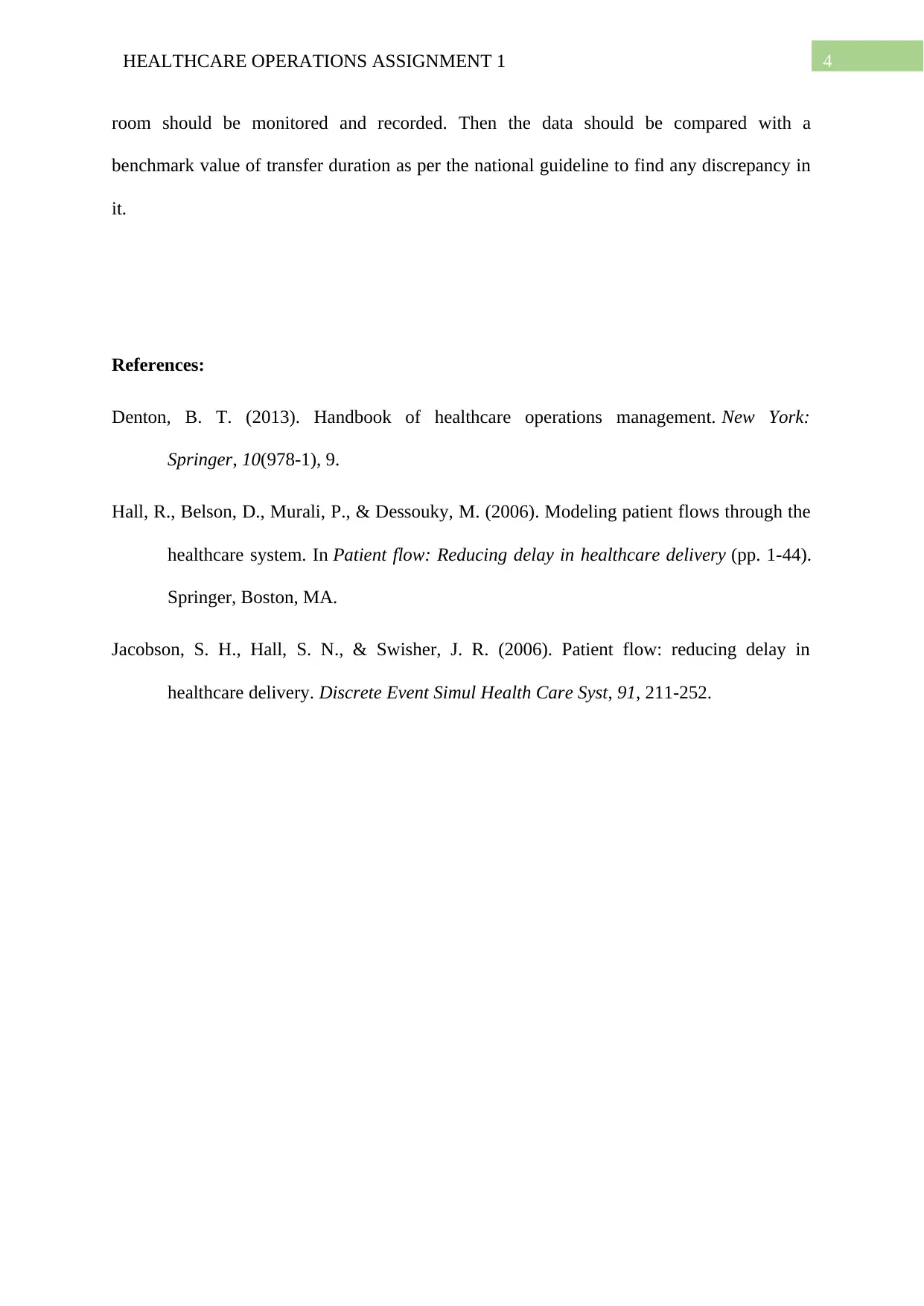
room should be monitored and recorded. Then the data should be compared with a
benchmark value of transfer duration as per the national guideline to find any discrepancy in
it.
References:
Denton, B. T. (2013). Handbook of healthcare operations management. New York:
Springer, 10(978-1), 9.
Hall, R., Belson, D., Murali, P., & Dessouky, M. (2006). Modeling patient flows through the
healthcare system. In Patient flow: Reducing delay in healthcare delivery (pp. 1-44).
Springer, Boston, MA.
Jacobson, S. H., Hall, S. N., & Swisher, J. R. (2006). Patient flow: reducing delay in
healthcare delivery. Discrete Event Simul Health Care Syst, 91, 211-252.
room should be monitored and recorded. Then the data should be compared with a
benchmark value of transfer duration as per the national guideline to find any discrepancy in
it.
References:
Denton, B. T. (2013). Handbook of healthcare operations management. New York:
Springer, 10(978-1), 9.
Hall, R., Belson, D., Murali, P., & Dessouky, M. (2006). Modeling patient flows through the
healthcare system. In Patient flow: Reducing delay in healthcare delivery (pp. 1-44).
Springer, Boston, MA.
Jacobson, S. H., Hall, S. N., & Swisher, J. R. (2006). Patient flow: reducing delay in
healthcare delivery. Discrete Event Simul Health Care Syst, 91, 211-252.
1 out of 5
Related Documents
Your All-in-One AI-Powered Toolkit for Academic Success.
 +13062052269
info@desklib.com
Available 24*7 on WhatsApp / Email
Unlock your academic potential
Copyright © 2020–2025 A2Z Services. All Rights Reserved. Developed and managed by ZUCOL.