Mastering Metrics Assignment: Customer Feedback for Nestlé Nigeria
VerifiedAdded on 2023/06/10
|19
|4478
|156
Report
AI Summary
This report analyzes customer feedback and marketing metrics within the context of Nestlé Nigeria's business operations. It begins with a brief background of Nestlé Nigeria, including its market position, competitors, and the Creating Shared Value approach. The report then delves into the internal and external factors that influence customer satisfaction, such as product quality, pricing, and competition, along with the use of marketing metrics to evaluate the efficiency of marketing activities. It also discusses the importance of quantitative and qualitative data in measuring customer feedback and addresses the significance of the evaluation system currently used to measure customer feedback, including the application of dashboards and churn rate analysis. The report incorporates insights from the McKinsey model of customer feedback improvements and concludes by emphasizing the importance of customer feedback in enhancing brand image and reducing promotional costs. The study provides a comprehensive overview of how Nestlé Nigeria can measure and improve customer feedback to drive customer satisfaction and business success within the competitive FMCG industry.

Running head: MASTERING METRICS
MASTERING METRICS
Name of the Student:
Name of the University:
Author note:
MASTERING METRICS
Name of the Student:
Name of the University:
Author note:

Paraphrase This Document
Need a fresh take? Get an instant paraphrase of this document with our AI Paraphraser
Task 1 (A)
Brief Background of Nestlé Nigeria
The first sale of Nestlé products in Nigeria dates back to the initial phase of the 20th
century. This was through the local importing agents who positioned their orders directly to
the British trading organizations who had been actively participating in the nation. The
industrial presence of Nestlé initiated in the year 1971 during the times when the country
witnessed steady rise in sales which encouraged the organization to introduce the packaging
system part of its wide range of production at the Ilupeja factory. Nestlé articulates its unique
Creating Shared Value approach to execute effective business operation whereby the action
related to the stakeholders must further formulate value for the communities where it develops
its operation along with the wider society (Nestlé Nigeria 2018). The activities of Nestlé
amount to around 60 million Naira with an employee base of around 4000 with two factories
in Nigeria namely Agbara manufacturing Complex and Flowergate. Two of the primary
competitors of Nestle Nigeria are Enfamil Nigeria and Yummy Tummies. Enfamil introduced
is also recognized as one of the most prominent producers of baby formula in Nigeria and rest
of the world. Enfamil contains a natural defence dual pre-biotics blend which is highly
nutritious for infants. However, though both the food products have similar composition it has
been noted that Nestle formulated in a way which is easily digestible to newborns in
comparison to Enfamil (Liechti, Pasquier and Reis 2017) . While Yummy Tummy is one of
the popular food products which are made from simple and easily accessible ingredients
which claim to have more nutritional value than other commercial food products with no
additives.
Brief Background of Nestlé Nigeria
The first sale of Nestlé products in Nigeria dates back to the initial phase of the 20th
century. This was through the local importing agents who positioned their orders directly to
the British trading organizations who had been actively participating in the nation. The
industrial presence of Nestlé initiated in the year 1971 during the times when the country
witnessed steady rise in sales which encouraged the organization to introduce the packaging
system part of its wide range of production at the Ilupeja factory. Nestlé articulates its unique
Creating Shared Value approach to execute effective business operation whereby the action
related to the stakeholders must further formulate value for the communities where it develops
its operation along with the wider society (Nestlé Nigeria 2018). The activities of Nestlé
amount to around 60 million Naira with an employee base of around 4000 with two factories
in Nigeria namely Agbara manufacturing Complex and Flowergate. Two of the primary
competitors of Nestle Nigeria are Enfamil Nigeria and Yummy Tummies. Enfamil introduced
is also recognized as one of the most prominent producers of baby formula in Nigeria and rest
of the world. Enfamil contains a natural defence dual pre-biotics blend which is highly
nutritious for infants. However, though both the food products have similar composition it has
been noted that Nestle formulated in a way which is easily digestible to newborns in
comparison to Enfamil (Liechti, Pasquier and Reis 2017) . While Yummy Tummy is one of
the popular food products which are made from simple and easily accessible ingredients
which claim to have more nutritional value than other commercial food products with no
additives.
1 (B) Internal and External Factors of Nestlé Nigeria Influencing the Level and
Value of Customer Satisfaction Evaluation
Customer satisfaction is regarded as a customer feedback in the form of assessment
following to the purchase of products or services in comparison with the expectation level of
the customer. As the idea of customer satisfaction is evaluated by using the customer
expectations with the level of performance of goods which can further accomplished the
demands and desires of the customer base, it has been stated that a satisfied consumer draws
similarities between the performance of the products and services with the anticipation level
of the consumer by further encouraging them to re-purchase the similar products (Verhoef and
Lemon 2013). It has been noted that customer feedback is established by the idea of quality
and price of the products desired by the customer along with the price which is considered as
a foundation to establish customer satisfaction level (Parveen, Jaafar and Ainin 2015).
Modern theorists are of the opinion that enhanced customer value can be compared to the
extent the competitors in the market will aim to deliver in order to create a satisfaction and
contentment level for the customer base for the develop their brand loyalty. Thus there have
been considerable rate of observations which comprehend the causality between product
quality and price with customer feedback between product quality and price with level of
customer satisfaction and between customer values with customer satisfaction (Laudon and
Laudon 2016). Furthermore research indicated that customer feedback has the propensity to
play a decisive role in developing satisfaction level of the customers (Lee 2013). For instance,
the FMCG industry in Nigeria is dominated by few significant brands namely Nestlé Nigeria,
Enfamil Nigeria, Yummy Tummies Diageo, and Flour Mills of Nigeria. However in the food
and beverages industry Nestlé Nigeria has attained a position among the top organisations
Value of Customer Satisfaction Evaluation
Customer satisfaction is regarded as a customer feedback in the form of assessment
following to the purchase of products or services in comparison with the expectation level of
the customer. As the idea of customer satisfaction is evaluated by using the customer
expectations with the level of performance of goods which can further accomplished the
demands and desires of the customer base, it has been stated that a satisfied consumer draws
similarities between the performance of the products and services with the anticipation level
of the consumer by further encouraging them to re-purchase the similar products (Verhoef and
Lemon 2013). It has been noted that customer feedback is established by the idea of quality
and price of the products desired by the customer along with the price which is considered as
a foundation to establish customer satisfaction level (Parveen, Jaafar and Ainin 2015).
Modern theorists are of the opinion that enhanced customer value can be compared to the
extent the competitors in the market will aim to deliver in order to create a satisfaction and
contentment level for the customer base for the develop their brand loyalty. Thus there have
been considerable rate of observations which comprehend the causality between product
quality and price with customer feedback between product quality and price with level of
customer satisfaction and between customer values with customer satisfaction (Laudon and
Laudon 2016). Furthermore research indicated that customer feedback has the propensity to
play a decisive role in developing satisfaction level of the customers (Lee 2013). For instance,
the FMCG industry in Nigeria is dominated by few significant brands namely Nestlé Nigeria,
Enfamil Nigeria, Yummy Tummies Diageo, and Flour Mills of Nigeria. However in the food
and beverages industry Nestlé Nigeria has attained a position among the top organisations
⊘ This is a preview!⊘
Do you want full access?
Subscribe today to unlock all pages.

Trusted by 1+ million students worldwide
within the span of 2010 to 2015 further denoting that the company has surpassed the other
leading FMCG organizations (Rainer et al. 2013).
Marketing metrics have been considered as statistical measurements which
organizations such as Nestlé Nigeria has been implementing in order to evaluate the efficiency
of the company’s marketing activities. However, the concept of marketing metrics is highly
reliant to the volume and the type of marketing strategy and campaign the company is using
(Plummer et al. 2013). In regards to the financial knowledge, marketing metrics primarily
sheds light on the response to the investment of the marketing strategy approaches Nestlé is
implementing in Nigeria. Quantitative data is a kind of data which cannot be evaluated with
the usage of statistical figures or metrics such as examining individualistic perceptions and
views by further focusing on characteristics or notions and is considered to be more
descriptive in nature (Tosti and Herbst 2014). Furthermore, quantitative statistics and figures
provide enhanced level of information to Nestlé Nigeria but also necessitate a considerable
degree of action in the collection and analysis phase. However, it has further been noted that
qualitative statistical figures in comparison to quantitative data can provide inclusive
understanding on things. Quantitative evaluation methods have gathered considerable rate of
recognition because of the collection being relatively comprehensive in comparison to other
quantitative metrics (Mintz and Currim 2013). Often the process of evaluating customer
feedback is executed with the implementation on certain significant statistical figures whereby
the lowest figure measured represents the stronger side if not comprehensive dissatisfaction
whereas the highest figure symbolizes higher side if not complete satisfaction level (Melián-
González et al. 2013). However, Nestlé Nigeria must keep in consideration that such
quantitative approaches of measuring the capacity and value of customer feedback can
leading FMCG organizations (Rainer et al. 2013).
Marketing metrics have been considered as statistical measurements which
organizations such as Nestlé Nigeria has been implementing in order to evaluate the efficiency
of the company’s marketing activities. However, the concept of marketing metrics is highly
reliant to the volume and the type of marketing strategy and campaign the company is using
(Plummer et al. 2013). In regards to the financial knowledge, marketing metrics primarily
sheds light on the response to the investment of the marketing strategy approaches Nestlé is
implementing in Nigeria. Quantitative data is a kind of data which cannot be evaluated with
the usage of statistical figures or metrics such as examining individualistic perceptions and
views by further focusing on characteristics or notions and is considered to be more
descriptive in nature (Tosti and Herbst 2014). Furthermore, quantitative statistics and figures
provide enhanced level of information to Nestlé Nigeria but also necessitate a considerable
degree of action in the collection and analysis phase. However, it has further been noted that
qualitative statistical figures in comparison to quantitative data can provide inclusive
understanding on things. Quantitative evaluation methods have gathered considerable rate of
recognition because of the collection being relatively comprehensive in comparison to other
quantitative metrics (Mintz and Currim 2013). Often the process of evaluating customer
feedback is executed with the implementation on certain significant statistical figures whereby
the lowest figure measured represents the stronger side if not comprehensive dissatisfaction
whereas the highest figure symbolizes higher side if not complete satisfaction level (Melián-
González et al. 2013). However, Nestlé Nigeria must keep in consideration that such
quantitative approaches of measuring the capacity and value of customer feedback can
Paraphrase This Document
Need a fresh take? Get an instant paraphrase of this document with our AI Paraphraser
sometimes fail to accomplish success as certain numerical data may fail to represent sincere
perceptions and views of the customer base (Liechti, Pasquier and Reis 2017). These
quantitative data may further develop the ability to conceal sincere emotions of the views
which symbolizes the opinion of the customer base as a figure.
However the decline in the top brand index of Nestlé Nigeria has been accounted due
to the immense rate of competition between other food and beverage organisations and
innovation. Thus several studies emphasized more on the observation of perception for Nestlé
Nigeria customer base which was segmented as a convenience product to the metropolitan
community (Hill and Brierley 2017). However it has been noted that the quality of the product
is not evaluated by the company perception and further is perceived through the standpoint of
the customer base. Customers perceive a certain price range way by the high and low price of
the product offered by the organisation can play a significant role on the degree of customer
intention to purchase the product (Khodakarami and Chan 2014). As a result consumers will
focus on the price range paid by other customers further emphasising one the product price
which will impact the perception of the customer base and further influence their willingness
to confirm the rate of commitment towards the specific brand (Laudon and Laudon 2016). As
the food and beverage industry is recognised as one of the major and oldest industries in the
world and most importantly the essential part in the economy of the whole world, the level of
steadiness and reliability along with growth are therefore recognised to be supreme to the
economic performance of the individual nations including Nigeria (Parveen, Jaafar and Ainin
2015). As nutrition serves a significant role in the lives of newborns and their mothers, the
primary strategy focus of Nestle Nigeria is to deliver distinctive benefits to its customer base.
As Nigeria, has a low rate in the child nutrition level, Nestle Nigeria aims to establish, share
perceptions and views of the customer base (Liechti, Pasquier and Reis 2017). These
quantitative data may further develop the ability to conceal sincere emotions of the views
which symbolizes the opinion of the customer base as a figure.
However the decline in the top brand index of Nestlé Nigeria has been accounted due
to the immense rate of competition between other food and beverage organisations and
innovation. Thus several studies emphasized more on the observation of perception for Nestlé
Nigeria customer base which was segmented as a convenience product to the metropolitan
community (Hill and Brierley 2017). However it has been noted that the quality of the product
is not evaluated by the company perception and further is perceived through the standpoint of
the customer base. Customers perceive a certain price range way by the high and low price of
the product offered by the organisation can play a significant role on the degree of customer
intention to purchase the product (Khodakarami and Chan 2014). As a result consumers will
focus on the price range paid by other customers further emphasising one the product price
which will impact the perception of the customer base and further influence their willingness
to confirm the rate of commitment towards the specific brand (Laudon and Laudon 2016). As
the food and beverage industry is recognised as one of the major and oldest industries in the
world and most importantly the essential part in the economy of the whole world, the level of
steadiness and reliability along with growth are therefore recognised to be supreme to the
economic performance of the individual nations including Nigeria (Parveen, Jaafar and Ainin
2015). As nutrition serves a significant role in the lives of newborns and their mothers, the
primary strategy focus of Nestle Nigeria is to deliver distinctive benefits to its customer base.
As Nigeria, has a low rate in the child nutrition level, Nestle Nigeria aims to establish, share
and apply nutrition awareness and knowledge and further empower its consumer base to make
informed decision making procedures about the food they feed their babies and its nutrition
level (Nestlé Nigeria 2018). Nestle in Nigeria have further establish with the most advanced
Research and Development association in the food and beverage industry. By sustaining itself
relevant in the globalized era, the company aims to deliver industry-centric progress by
persistently creating innovation and refurbishing the company’s portfolio.
It has been noted that Nestle Nigeria’s Q3 revenues has been regarded as the basis for
their valuation in the market in comparison to the its statistical figures in 2015 which revealed
the market revenue decline to around N790 from N 850 in 2015 (Beneke et al. 2013).
However, the revenue growth failed to commensurate for the period as it has impacted by the
financial expenditure of the foreign loans which raised by around 410% to N 22 billion from
around N 4.50billion in 2016.
Mc Kinsey Model of Customer Feedback
Improvements
informed decision making procedures about the food they feed their babies and its nutrition
level (Nestlé Nigeria 2018). Nestle in Nigeria have further establish with the most advanced
Research and Development association in the food and beverage industry. By sustaining itself
relevant in the globalized era, the company aims to deliver industry-centric progress by
persistently creating innovation and refurbishing the company’s portfolio.
It has been noted that Nestle Nigeria’s Q3 revenues has been regarded as the basis for
their valuation in the market in comparison to the its statistical figures in 2015 which revealed
the market revenue decline to around N790 from N 850 in 2015 (Beneke et al. 2013).
However, the revenue growth failed to commensurate for the period as it has impacted by the
financial expenditure of the foreign loans which raised by around 410% to N 22 billion from
around N 4.50billion in 2016.
Mc Kinsey Model of Customer Feedback
Improvements
⊘ This is a preview!⊘
Do you want full access?
Subscribe today to unlock all pages.
Trusted by 1+ million students worldwide
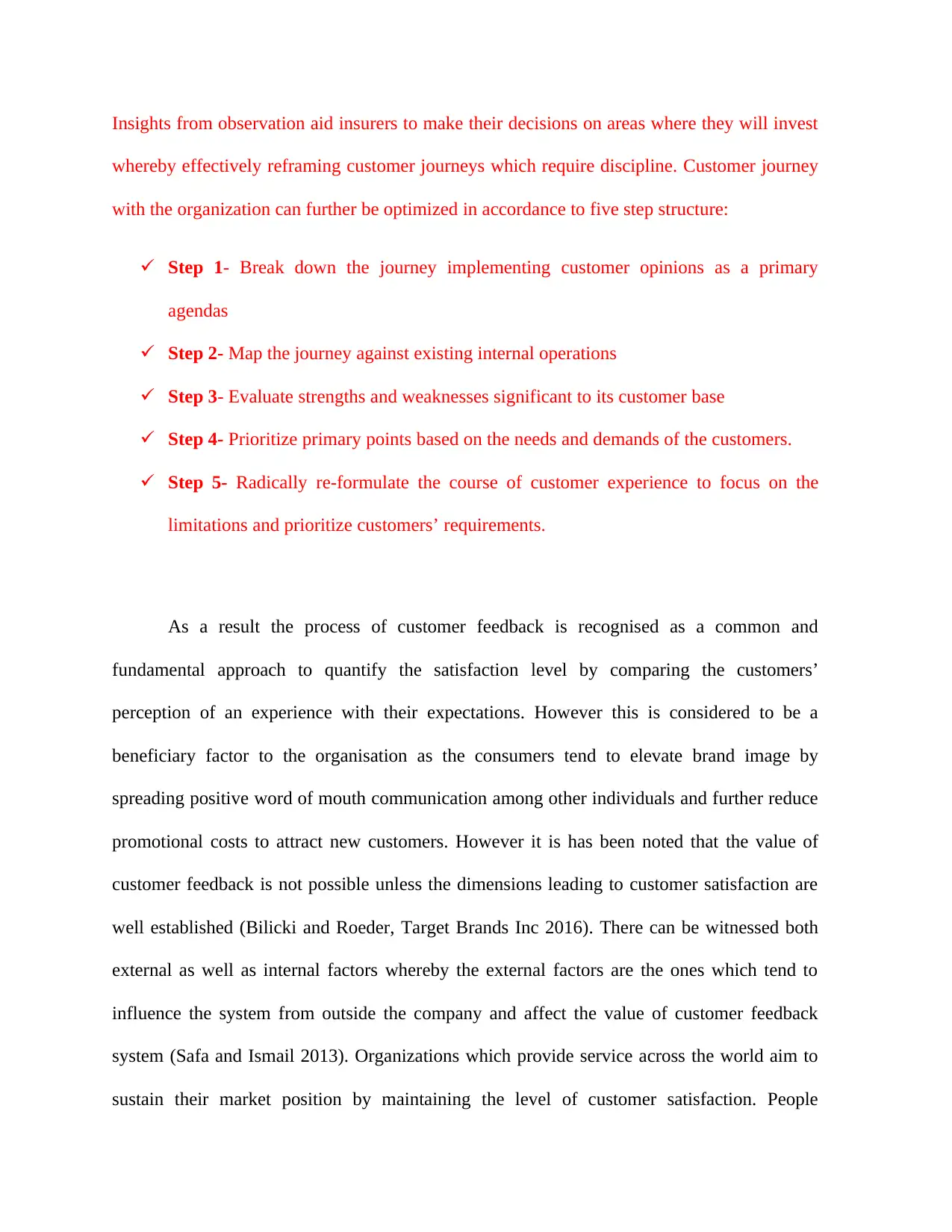
Insights from observation aid insurers to make their decisions on areas where they will invest
whereby effectively reframing customer journeys which require discipline. Customer journey
with the organization can further be optimized in accordance to five step structure:
Step 1- Break down the journey implementing customer opinions as a primary
agendas
Step 2- Map the journey against existing internal operations
Step 3- Evaluate strengths and weaknesses significant to its customer base
Step 4- Prioritize primary points based on the needs and demands of the customers.
Step 5- Radically re-formulate the course of customer experience to focus on the
limitations and prioritize customers’ requirements.
As a result the process of customer feedback is recognised as a common and
fundamental approach to quantify the satisfaction level by comparing the customers’
perception of an experience with their expectations. However this is considered to be a
beneficiary factor to the organisation as the consumers tend to elevate brand image by
spreading positive word of mouth communication among other individuals and further reduce
promotional costs to attract new customers. However it is has been noted that the value of
customer feedback is not possible unless the dimensions leading to customer satisfaction are
well established (Bilicki and Roeder, Target Brands Inc 2016). There can be witnessed both
external as well as internal factors whereby the external factors are the ones which tend to
influence the system from outside the company and affect the value of customer feedback
system (Safa and Ismail 2013). Organizations which provide service across the world aim to
sustain their market position by maintaining the level of customer satisfaction. People
whereby effectively reframing customer journeys which require discipline. Customer journey
with the organization can further be optimized in accordance to five step structure:
Step 1- Break down the journey implementing customer opinions as a primary
agendas
Step 2- Map the journey against existing internal operations
Step 3- Evaluate strengths and weaknesses significant to its customer base
Step 4- Prioritize primary points based on the needs and demands of the customers.
Step 5- Radically re-formulate the course of customer experience to focus on the
limitations and prioritize customers’ requirements.
As a result the process of customer feedback is recognised as a common and
fundamental approach to quantify the satisfaction level by comparing the customers’
perception of an experience with their expectations. However this is considered to be a
beneficiary factor to the organisation as the consumers tend to elevate brand image by
spreading positive word of mouth communication among other individuals and further reduce
promotional costs to attract new customers. However it is has been noted that the value of
customer feedback is not possible unless the dimensions leading to customer satisfaction are
well established (Bilicki and Roeder, Target Brands Inc 2016). There can be witnessed both
external as well as internal factors whereby the external factors are the ones which tend to
influence the system from outside the company and affect the value of customer feedback
system (Safa and Ismail 2013). Organizations which provide service across the world aim to
sustain their market position by maintaining the level of customer satisfaction. People
Paraphrase This Document
Need a fresh take? Get an instant paraphrase of this document with our AI Paraphraser
belonging from various backgrounds might pose factors of cultural differences towards the
brand further impacting the value of customer satisfaction.
1 (C)
Importance of evaluation system currently used to measure customer feedback
system in Nestlé Nigeria
Various Purposes of Dashboard in the Evaluation of Customer Feedback
As public services have undergone critical evaluation by the public, several societies
tend to reveal their inclination towards advanced digitalization and further generate increased
level of needs and demands from the citizens of Nigeria regarding service and product quality
of Nestlé as well as public accountability (Lemon and Verhoef 2016). Thus Nestlé has
considered customer feedback as an essential metric to establish a well-established ground for
communication with the key segment of their customer base. There has further been an
enhancement in the number of customer-centric models used by leading organizations which
has been established on the basis of five stage process of service mechanism design as well as
management (Kumar and Reinartz 2018). However modern theorists are of the opinion that
customer retention can further be measured from Churn rate which significantly refers to the
percentage of contractual customers or subscribers the company comprises that has the
propensity to leave a distributor during a given period. Thus churn rate is regarded as a
significant indicator of customer discontent, or better offers from the competition within the
customer life cycle. However, Nestle can overstate the churn rate while evaluating their
customer feedback when a customer refuses to take any services from the company but tends
to commence the same within a year (Retention Rate = 1 – (Churn Rate). Thus, the
brand further impacting the value of customer satisfaction.
1 (C)
Importance of evaluation system currently used to measure customer feedback
system in Nestlé Nigeria
Various Purposes of Dashboard in the Evaluation of Customer Feedback
As public services have undergone critical evaluation by the public, several societies
tend to reveal their inclination towards advanced digitalization and further generate increased
level of needs and demands from the citizens of Nigeria regarding service and product quality
of Nestlé as well as public accountability (Lemon and Verhoef 2016). Thus Nestlé has
considered customer feedback as an essential metric to establish a well-established ground for
communication with the key segment of their customer base. There has further been an
enhancement in the number of customer-centric models used by leading organizations which
has been established on the basis of five stage process of service mechanism design as well as
management (Kumar and Reinartz 2018). However modern theorists are of the opinion that
customer retention can further be measured from Churn rate which significantly refers to the
percentage of contractual customers or subscribers the company comprises that has the
propensity to leave a distributor during a given period. Thus churn rate is regarded as a
significant indicator of customer discontent, or better offers from the competition within the
customer life cycle. However, Nestle can overstate the churn rate while evaluating their
customer feedback when a customer refuses to take any services from the company but tends
to commence the same within a year (Retention Rate = 1 – (Churn Rate). Thus, the
company must take into account a distinctive requirements to be formulated between the
‘annual churn’ that is the aggregation of absolute associations along with the ‘net churn’ that
is referred to the overall loss of subscribers or members.
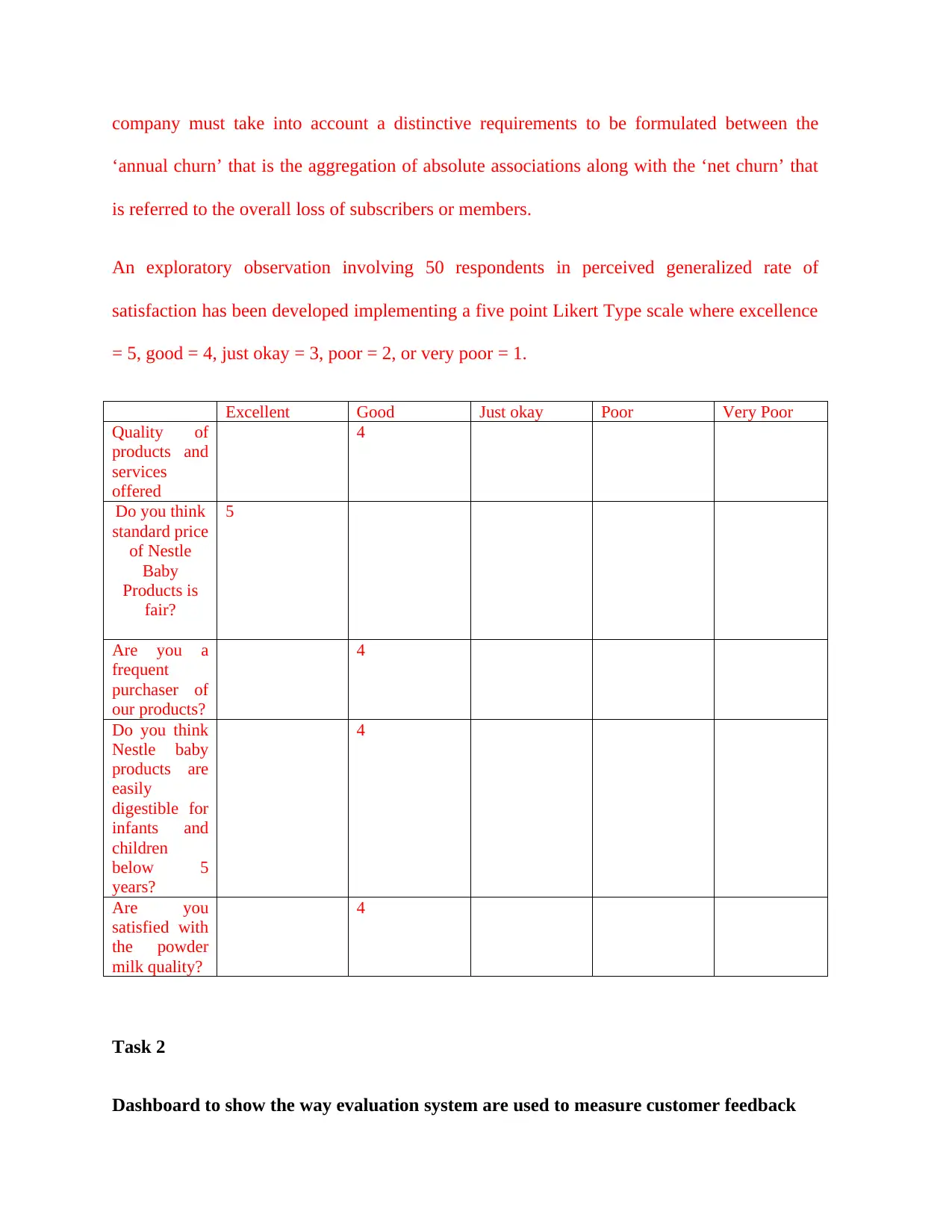
An exploratory observation involving 50 respondents in perceived generalized rate of
satisfaction has been developed implementing a five point Likert Type scale where excellence
= 5, good = 4, just okay = 3, poor = 2, or very poor = 1.
Excellent Good Just okay Poor Very Poor
Quality of
products and
services
offered
4
Do you think
standard price
of Nestle
Baby
Products is
fair?
5
Are you a
frequent
purchaser of
our products?
4
Do you think
Nestle baby
products are
easily
digestible for
infants and
children
below 5
years?
4
Are you
satisfied with
the powder
milk quality?
4
Task 2
Dashboard to show the way evaluation system are used to measure customer feedback
‘annual churn’ that is the aggregation of absolute associations along with the ‘net churn’ that
is referred to the overall loss of subscribers or members.
An exploratory observation involving 50 respondents in perceived generalized rate of
satisfaction has been developed implementing a five point Likert Type scale where excellence
= 5, good = 4, just okay = 3, poor = 2, or very poor = 1.
Excellent Good Just okay Poor Very Poor
Quality of
products and
services
offered
4
Do you think
standard price
of Nestle
Baby
Products is
fair?
5
Are you a
frequent
purchaser of
our products?
4
Do you think
Nestle baby
products are
easily
digestible for
infants and
children
below 5
years?
4
Are you
satisfied with
the powder
milk quality?
4
Task 2
Dashboard to show the way evaluation system are used to measure customer feedback
⊘ This is a preview!⊘
Do you want full access?
Subscribe today to unlock all pages.
Trusted by 1+ million students worldwide
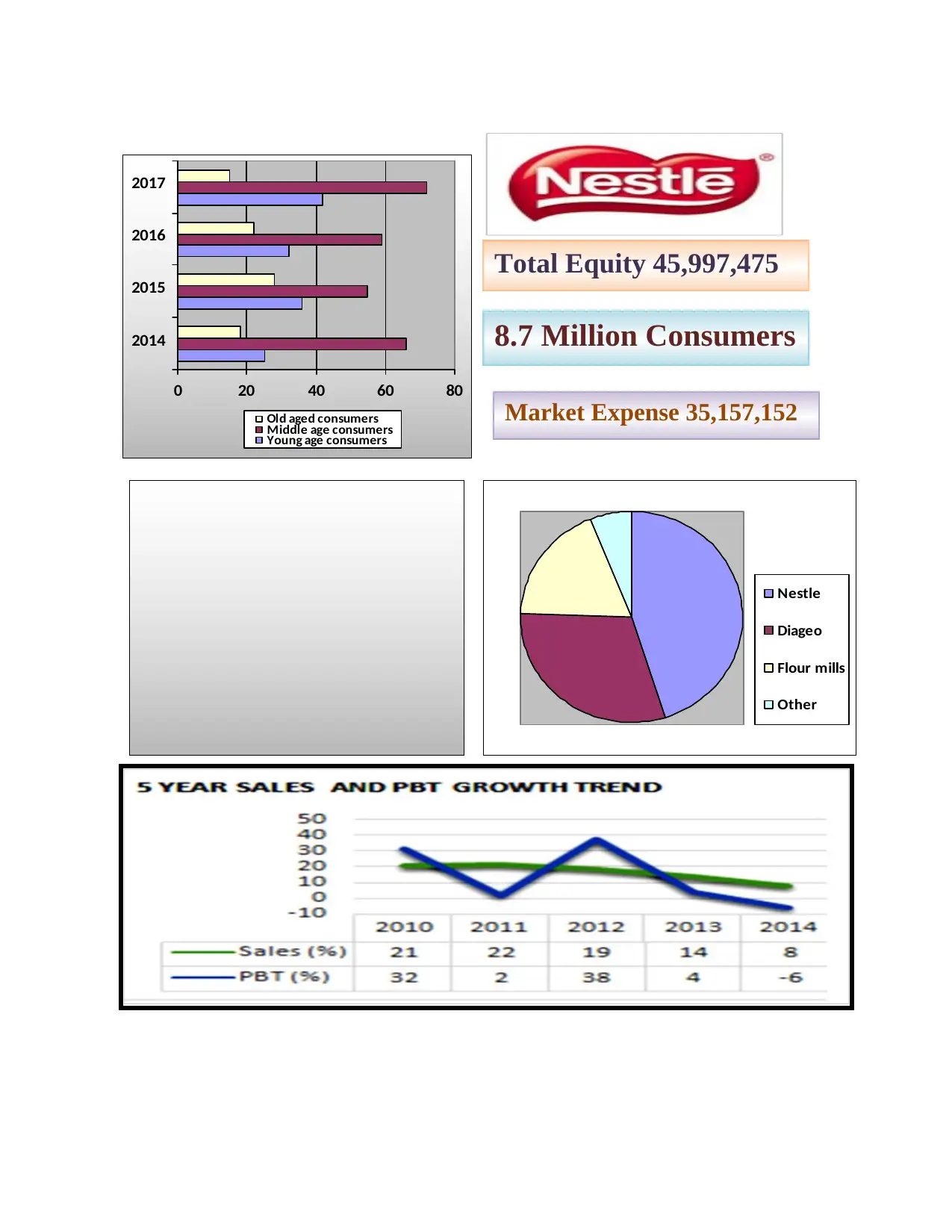
0 20 40 60 80
2014
2015
2016
2017
Old aged consumers
Middle age consumers
Young age consumers
Total Equity 45,997,475
8.7 Million Consumers
Market Expense 35,157,152
Nestle
Diageo
Flour mills
Other
2014
2015
2016
2017
Old aged consumers
Middle age consumers
Young age consumers
Total Equity 45,997,475
8.7 Million Consumers
Market Expense 35,157,152
Nestle
Diageo
Flour mills
Other
Paraphrase This Document
Need a fresh take? Get an instant paraphrase of this document with our AI Paraphraser
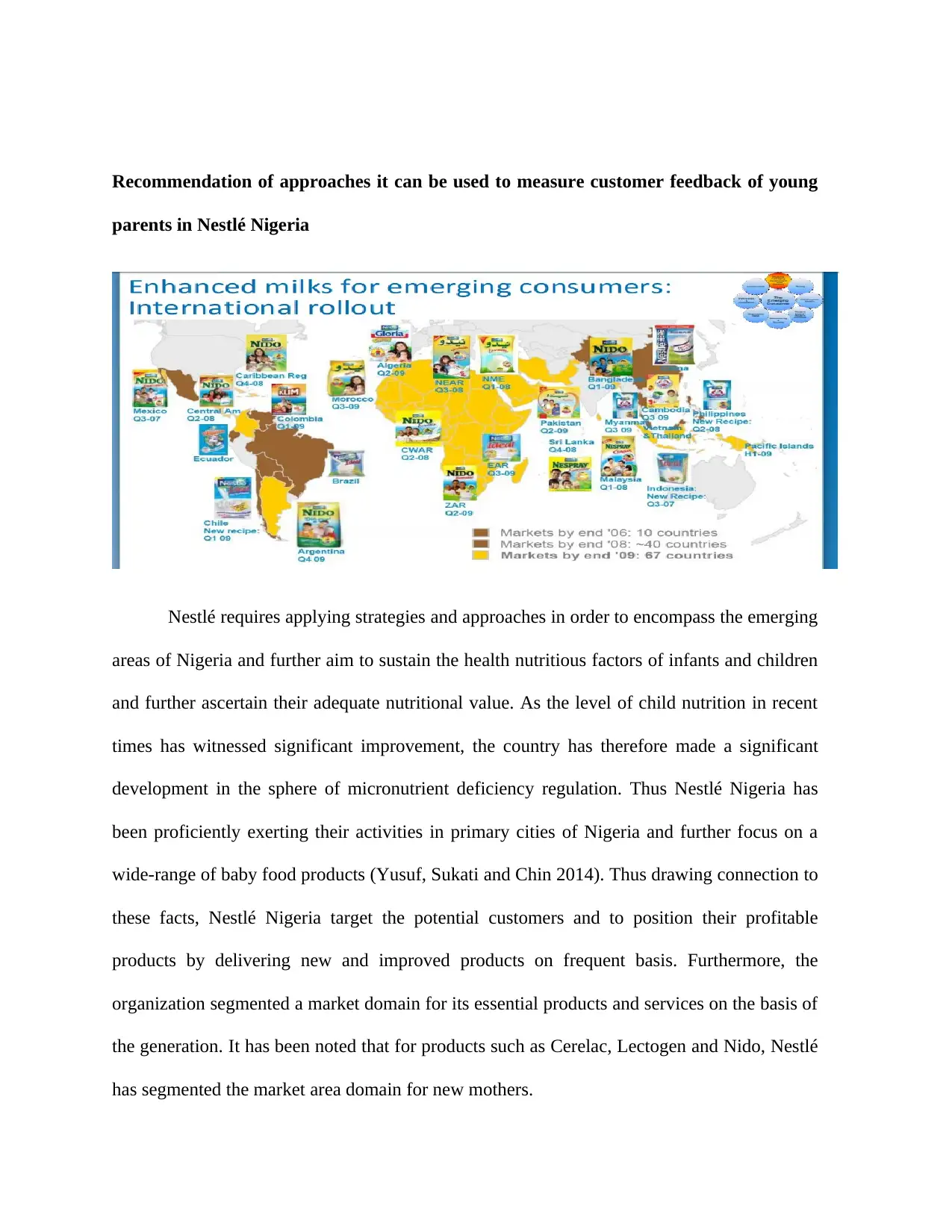
Recommendation of approaches it can be used to measure customer feedback of young
parents in Nestlé Nigeria
Nestlé requires applying strategies and approaches in order to encompass the emerging
areas of Nigeria and further aim to sustain the health nutritious factors of infants and children
and further ascertain their adequate nutritional value. As the level of child nutrition in recent
times has witnessed significant improvement, the country has therefore made a significant
development in the sphere of micronutrient deficiency regulation. Thus Nestlé Nigeria has
been proficiently exerting their activities in primary cities of Nigeria and further focus on a
wide-range of baby food products (Yusuf, Sukati and Chin 2014). Thus drawing connection to
these facts, Nestlé Nigeria target the potential customers and to position their profitable
products by delivering new and improved products on frequent basis. Furthermore, the
organization segmented a market domain for its essential products and services on the basis of
the generation. It has been noted that for products such as Cerelac, Lectogen and Nido, Nestlé
has segmented the market area domain for new mothers.
parents in Nestlé Nigeria
Nestlé requires applying strategies and approaches in order to encompass the emerging
areas of Nigeria and further aim to sustain the health nutritious factors of infants and children
and further ascertain their adequate nutritional value. As the level of child nutrition in recent
times has witnessed significant improvement, the country has therefore made a significant
development in the sphere of micronutrient deficiency regulation. Thus Nestlé Nigeria has
been proficiently exerting their activities in primary cities of Nigeria and further focus on a
wide-range of baby food products (Yusuf, Sukati and Chin 2014). Thus drawing connection to
these facts, Nestlé Nigeria target the potential customers and to position their profitable
products by delivering new and improved products on frequent basis. Furthermore, the
organization segmented a market domain for its essential products and services on the basis of
the generation. It has been noted that for products such as Cerelac, Lectogen and Nido, Nestlé
has segmented the market area domain for new mothers.
Recommendation of ways it can be used to measure customer feedback
Multi channel contact centres
A wide range of web-based as well as other information technologies has recently
been introduced to permit organizations like Nestle Nigeria to offer high rate of enhancements
who serve world-wide customers. The technologies are:
Integrated multi-channel contact allocate broad range of communication base
with the customers to be regulated in effortless approach by contact centre despite
their occurrence on the phone, by online chat or email or an amalgamation of
these media.
Interactive communication in real time by utilizing online chat, web mail or
video conferencing can understand the developments in the customer feedback of
Nestle as a major section of Nestlé’s customer base is new mothers whereby a
considerable proportion constitutes of young mothers; it facilitates the company
to maintain a database which offers a contact centre staff to handle enquiries with
an inclusive record of interactions with the customer base (Kumar and Reinartz
2018).
Furthermore, analytical mechanisms aid to track the behavioural of the mothers
on its website, evaluate the content of textual communications and further search
for improved patterns in the customer database.
Multi channel contact centres
A wide range of web-based as well as other information technologies has recently
been introduced to permit organizations like Nestle Nigeria to offer high rate of enhancements
who serve world-wide customers. The technologies are:
Integrated multi-channel contact allocate broad range of communication base
with the customers to be regulated in effortless approach by contact centre despite
their occurrence on the phone, by online chat or email or an amalgamation of
these media.
Interactive communication in real time by utilizing online chat, web mail or
video conferencing can understand the developments in the customer feedback of
Nestle as a major section of Nestlé’s customer base is new mothers whereby a
considerable proportion constitutes of young mothers; it facilitates the company
to maintain a database which offers a contact centre staff to handle enquiries with
an inclusive record of interactions with the customer base (Kumar and Reinartz
2018).
Furthermore, analytical mechanisms aid to track the behavioural of the mothers
on its website, evaluate the content of textual communications and further search
for improved patterns in the customer database.
⊘ This is a preview!⊘
Do you want full access?
Subscribe today to unlock all pages.
Trusted by 1+ million students worldwide

1 out of 19


Related Documents


Your All-in-One AI-Powered Toolkit for Academic Success.
+13062052269
info@desklib.com
Available 24*7 on WhatsApp / Email
![[object Object]](/_next/static/media/star-bottom.7253800d.svg)
Unlock your academic potential
Copyright © 2020–2026 A2Z Services. All Rights Reserved. Developed and managed by ZUCOL.