Mathematics Homework: Rectangle Toothpick Formula & Sequence Analysis

Verified

Added on  2023/04/22

|8
|1088
|219
Homework Assignment
AI Summary
This document presents a comprehensive solution to a mathematics assignment. The first part of the assignment involves deriving and justifying a formula to calculate the number of toothpicks needed to construct a rectangular grid of rows and columns. The solution details the formula, explains the underlying rules, and provides a worked example to illustrate its application. The second part of the assignment addresses problems related to number sequences. It includes the identification and analysis of different types of sequences, specifically arithmetic and geometric progressions, along with other patterns. For each sequence, the solution provides the formula for the nth term and calculates the next three terms in the sequence. The solution also provides references to support the methods used. This assignment offers students a detailed guide to understanding and solving problems related to mathematical sequences and geometric shapes.
Document Page
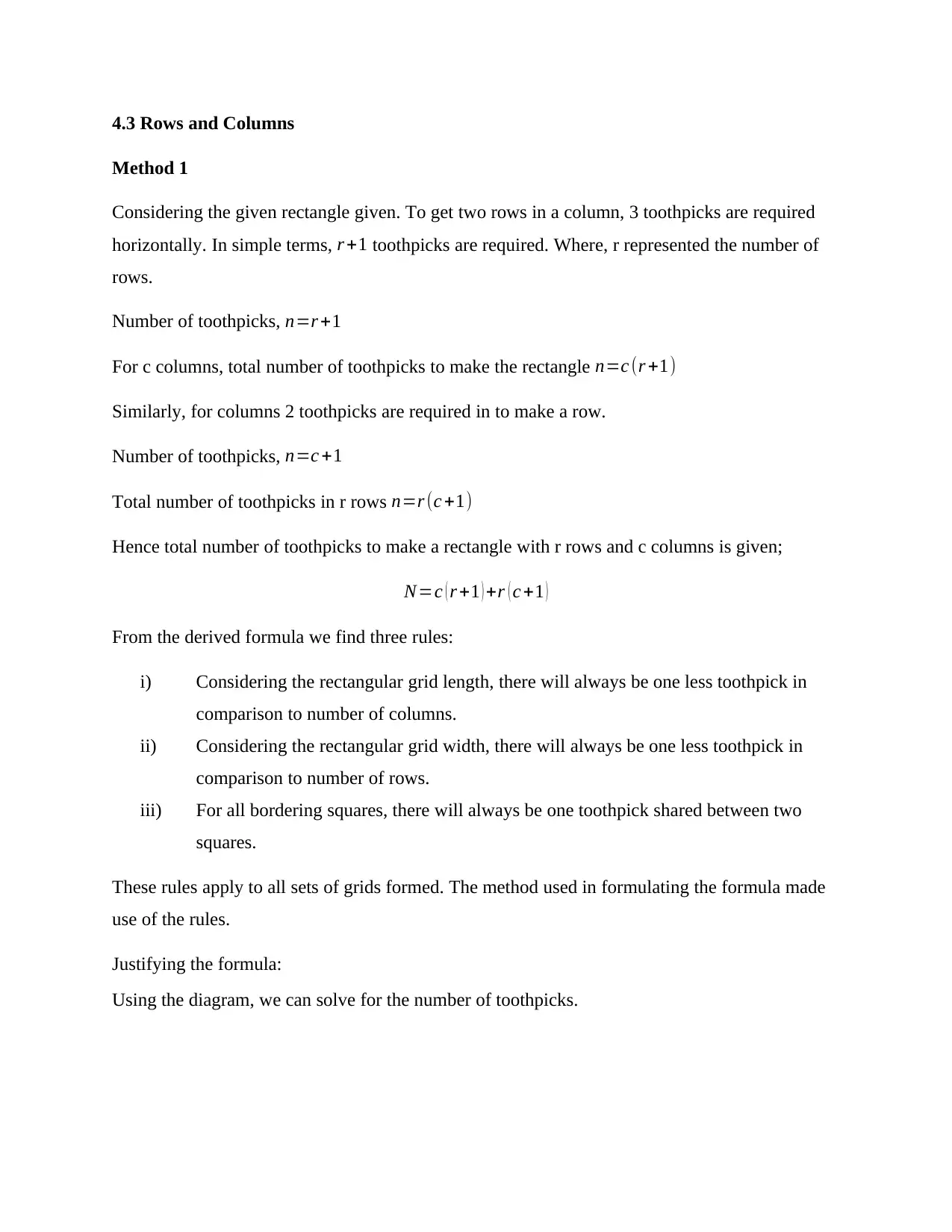
4.3 Rows and Columns
Method 1
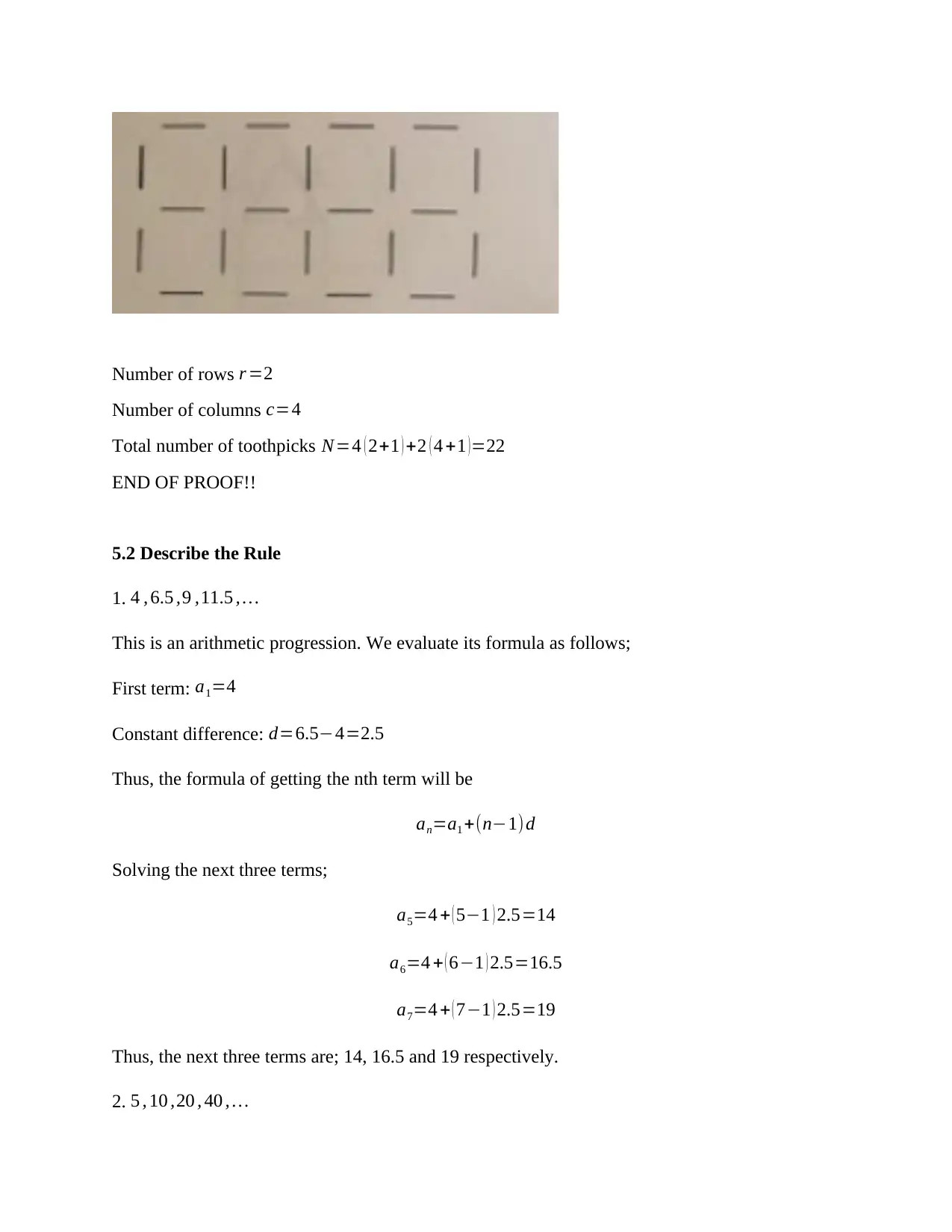
Considering the given rectangle given. To get two rows in a column, 3 toothpicks are required
horizontally. In simple terms, r +1 toothpicks are required. Where, r represented the number of
rows.
Number of toothpicks, n=r +1
For c columns, total number of toothpicks to make the rectangle n=c (r +1)
Similarly, for columns 2 toothpicks are required in to make a row.
Number of toothpicks, n=c +1
Total number of toothpicks in r rows n=r (c +1)
Hence total number of toothpicks to make a rectangle with r rows and c columns is given;
N=c ( r +1 ) +r ( c +1 )
From the derived formula we find three rules:
i) Considering the rectangular grid length, there will always be one less toothpick in
comparison to number of columns.
ii) Considering the rectangular grid width, there will always be one less toothpick in
comparison to number of rows.
iii) For all bordering squares, there will always be one toothpick shared between two
squares.
These rules apply to all sets of grids formed. The method used in formulating the formula made
use of the rules.
Justifying the formula:
Using the diagram, we can solve for the number of toothpicks.
tabler-icon-diamond-filled.svg

Paraphrase This Document

Need a fresh take? Get an instant paraphrase of this document with our AI Paraphraser
Document Page
Number of rows r =2
Number of columns c=4
Total number of toothpicks N=4 ( 2+1 ) +2 ( 4 +1 ) =22
END OF PROOF!!
5.2 Describe the Rule
1. 4 , 6.5 ,9 ,11.5 ,
This is an arithmetic progression. We evaluate its formula as follows;
First term: a1=4
Constant difference: d=6.54=2.5
Thus, the formula of getting the nth term will be
an=a1 +(n1)d
Solving the next three terms;
a5=4 + ( 51 ) 2.5=14
a6=4 + ( 61 ) 2.5=16.5
a7=4 + ( 71 ) 2.5=19
Thus, the next three terms are; 14, 16.5 and 19 respectively.
2. 5 , 10 ,20 , 40 ,
Document Page
This is a geometric progression.
First term: a1=5
Common ratio: r =10
5 =2
Thus, the nth term will be evaluated by the formula: an=a1 2n1
Solving the next three rems;
a5=5251 =524=80
a6=5261=525=160
a7=5271=526=320
Hence, the next three terms are; 80, 160 and 320 respectively.
3. 20 , 17 ,14 ,11 ,
This is an arithmetic progression series (Nunes, 2017).
First term: a1=20
Constant difference: d=1720=3
The nth term will be solved by the formula an=a1 + ( n1 ) d
Solving the next three terms,
a5=20+ ( 51 )3=8
a6=20+ ( 61 )3=5
a7=20+ ( 71 )3=2
Hence, the next three terms are; 8, 5 and 2 respectively.
4. 1 ,3 ,6 , 10 , 15 ,
The pattern displayed by the terms;
Document Page
a2a1=31=2
a3a2 =63=3
a4a3=106=4
From the pattern, the formula for nth term will be;
an=an1 +n
Solving the next three terms;
a6=a5 +6=15+6=21
a7=a6 +7=21+7=28
a8=a7 +8=28+ 8=36
Hence, the next three terms are; 21, 28 and 36 respectively.
5. 1
12 , 1
6 , 1
4 , 1
3 ,
This is an arithmetic progression. We evaluate as follows:
First term: a1= 1
12
Common difference: d= 1
6 1
12 = 1
12
The formula for getting nth term will be;
an=a1 + ( n1 )1
12
Solving for the next three terms;
a5= 1
12 + ( 51 ) 1
12 = 5
12
tabler-icon-diamond-filled.svg

Paraphrase This Document

Need a fresh take? Get an instant paraphrase of this document with our AI Paraphraser
Document Page
a6= 1
12 + ( 61 )1
12 =1
2
a7= 1
12 + ( 71 ) 1
12 = 7
12
Hence, the next three terms are; 5
12 , 1
2 , 7
12 respectively.
6. 12 , 6 ,3 , 3
2 ,
This is a geometric progression series (Thomas Bond, 2014).
First term: a1=12
Common ration: r = 6
12 = 1
2
The formula for obtaining nth term:
an= 1
2 rn1
The next three terms will be;
a5=12( 1
2 )51
= 3
4
a6=12( 1
2 )
61
= 3
8
a7=12( 1
2 )71
= 3
16
Thus, the next three terms are; 3
4 , 3
8 , 3
16 respectively.
7. 12 ,36 ,108 , 324 ,
This is a geometric progression series. It is evaluated as follows;
Document Page
First term: a1=12
Common ratio: r = 36
12 =3
The formula for obtaining nth term becomes;
an=12 (3 )n1
Solving for the next three terms;
a5=12 (3 )51=972
a6=12 (3 )61=2916
a7=12 (3 )71=8748
Hence, the next three terms are; -972, 2916 and -8748 respectively.
8. 1 ,3 ,8 , 16 , 27 ,
The following pattern is showed by the series;
a2a1=31=2
a3a2 =83=5
a4a3=168=8
a5a4=2716=11
From the pattern, we can see that difference between successive terms form a pattern of
increasing by 3. We can formulate a formula as follows;
a6a5 =11+3=14
a6=a5 +14=27+ 14=41
Solving for seventh term;
a7=a6 +14 +3=41+17=58
Solving for eighth term;
Document Page
a8=a7 +17 +3=58+ 20=78
The next three terms are; 41, 58 and 78 respectively.
tabler-icon-diamond-filled.svg

Paraphrase This Document

Need a fresh take? Get an instant paraphrase of this document with our AI Paraphraser
Document Page
References
Nunes, R. M., 2017. ON THE LEAST SQUAREFREE NUMBER IN AN ARITHMETIC PROGRESSION.. In:
s.l.:London Mathematical Society, pp. 53-99.
Thomas Bond, C. H., 2014. A-level Mathematics Challenging Drill Questions (Yellowreef). In:
s.l.:Yellowreef Limited, pp. 123-154.
chevron_up_icon
1 out of 8
circle_padding
hide_on_mobile
zoom_out_icon
[object Object]