MATH203 Assignment 1, Semester 2, 2019: Linear Algebra Problems

Verified

Added on  2022/09/28

|6
|1211
|19
Homework Assignment
AI Summary
This document presents the solutions to Assignment 1 for MATH203, a linear algebra course. The assignment covers several key concepts, including the transpose of a matrix, symmetric matrices, and vector spaces, demonstrating properties such as closure under addition and scalar multiplication. It explores upper-triangular matrices and their properties as subspaces, along with the concept of direct sums. The solutions also delve into polynomial spaces and their subspaces, specifically focusing on even and odd functions and their relationship within a function space. Furthermore, the assignment includes problems related to group theory, such as binary operations, matrix inverses, and the properties of associative structures within a group. The solutions are detailed, step-by-step, providing a comprehensive understanding of the concepts and problem-solving techniques.
Document Page
Surname 1
Student Name
Instructor Name
Course
15, August 2019
Assignment 1 for MATH203
Q1.
a.
Solution
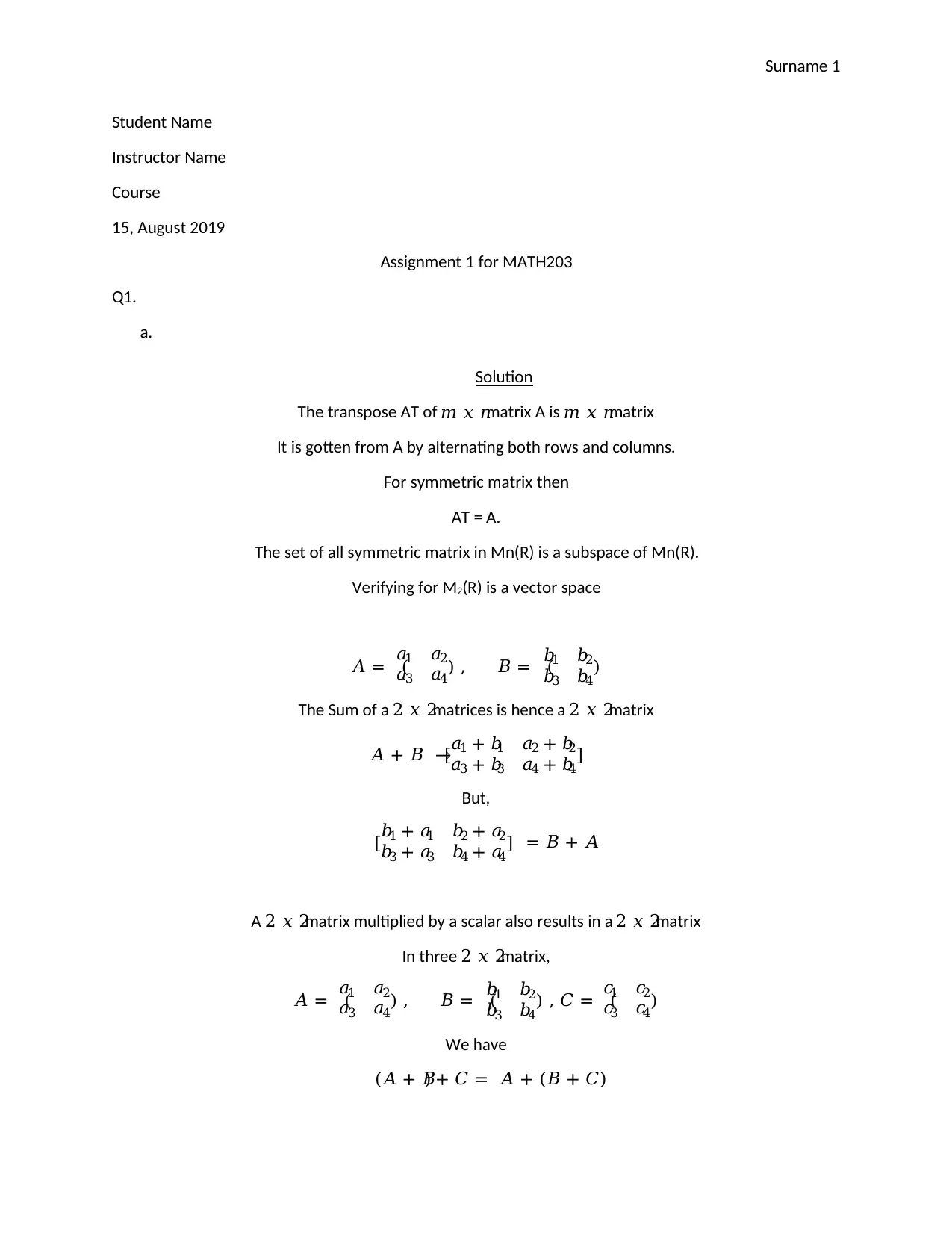
The transpose AT of 𝑚 𝑥 𝑛matrix A is 𝑚 𝑥 𝑛matrix
It is gotten from A by alternating both rows and columns.
For symmetric matrix then
AT = A.
The set of all symmetric matrix in Mn(R) is a subspace of Mn(R).
Verifying for M2(R) is a vector space
𝐴 = (
𝑎1 𝑎2
𝑎3 𝑎4) , 𝐵 = (
𝑏1 𝑏2
𝑏3 𝑏4
)
The Sum of a 2 𝑥 2matrices is hence a 2 𝑥 2matrix
𝐴 + 𝐵 [𝑎1 + 𝑏1 𝑎2 + 𝑏2
𝑎3 + 𝑏3 𝑎4 + 𝑏4
]
But,
[𝑏1 + 𝑎1 𝑏2 + 𝑎2
𝑏3 + 𝑎3 𝑏4 + 𝑎4
] = 𝐵 + 𝐴
A 2 𝑥 2matrix multiplied by a scalar also results in a 2 𝑥 2matrix
In three 2 𝑥 2matrix,
𝐴 = (
𝑎1 𝑎2
𝑎3 𝑎4) , 𝐵 = (
𝑏1 𝑏2
𝑏3 𝑏4
) , 𝐶 = (
𝑐1 𝑐2
𝑐3 𝑐4)
We have
(𝐴 + 𝐵) + 𝐶 = 𝐴 + (𝐵 + 𝐶)
tabler-icon-diamond-filled.svg

Paraphrase This Document

Need a fresh take? Get an instant paraphrase of this document with our AI Paraphraser
Document Page
Surname 2
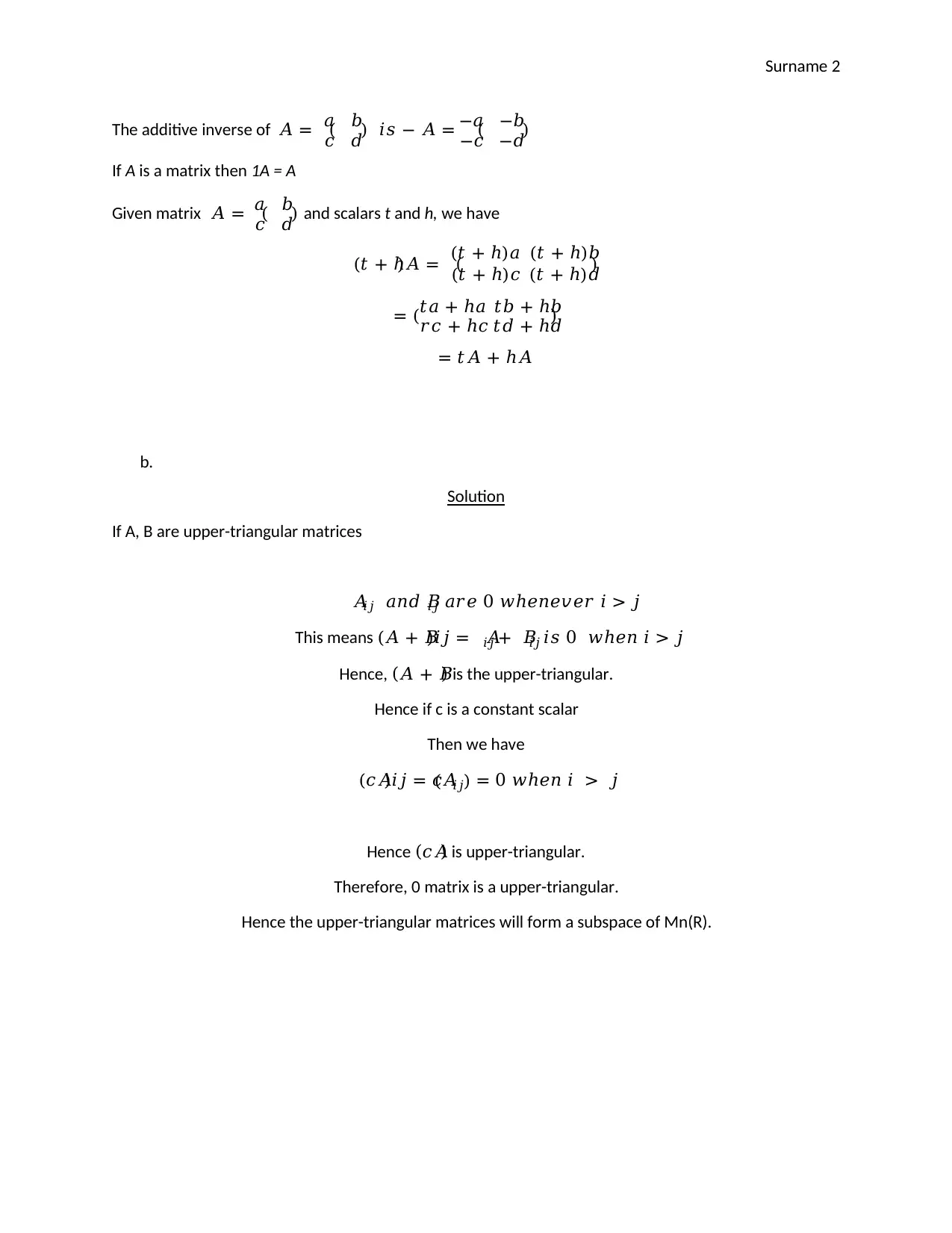
The additive inverse of 𝐴 = (
𝑎 𝑏
𝑐 𝑑) 𝑖𝑠 − 𝐴 = (
−𝑎 −𝑏
−𝑐 −𝑑)
If A is a matrix then 1A = A
Given matrix 𝐴 = (
𝑎 𝑏
𝑐 𝑑) and scalars t and h, we have
(𝑡 + ℎ)𝐴 = (
(𝑡 + ℎ)𝑎 (𝑡 + ℎ)𝑏
(𝑡 + ℎ)𝑐 (𝑡 + ℎ)𝑑
)
= (𝑡𝑎 + ℎ𝑎 𝑡𝑏 + ℎ𝑏
𝑟𝑐 + ℎ𝑐 𝑡𝑑 + ℎ𝑑
)
= 𝑡𝐴 + ℎ𝐴
b.
Solution
If A, B are upper-triangular matrices
𝐴𝑖𝑗 𝑎𝑛𝑑 𝐵𝑖𝑗 𝑎𝑟𝑒 0 𝑤ℎ𝑒𝑛𝑒𝑣𝑒𝑟 𝑖 > 𝑗
This means (𝐴 + 𝐵)𝑖𝑗 = 𝐴𝑖𝑗 + 𝐵𝑖𝑗 𝑖𝑠 0 𝑤ℎ𝑒𝑛 𝑖 > 𝑗
Hence, (𝐴 + 𝐵) is the upper-triangular.
Hence if c is a constant scalar
Then we have
(𝑐𝐴)𝑖𝑗 = 𝑐(𝐴𝑖𝑗) = 0 𝑤ℎ𝑒𝑛 𝑖 > 𝑗
Hence (𝑐𝐴) is upper-triangular.
Therefore, 0 matrix is a upper-triangular.
Hence the upper-triangular matrices will form a subspace of Mn(R).
Document Page
Surname 3
Q2.
Solution
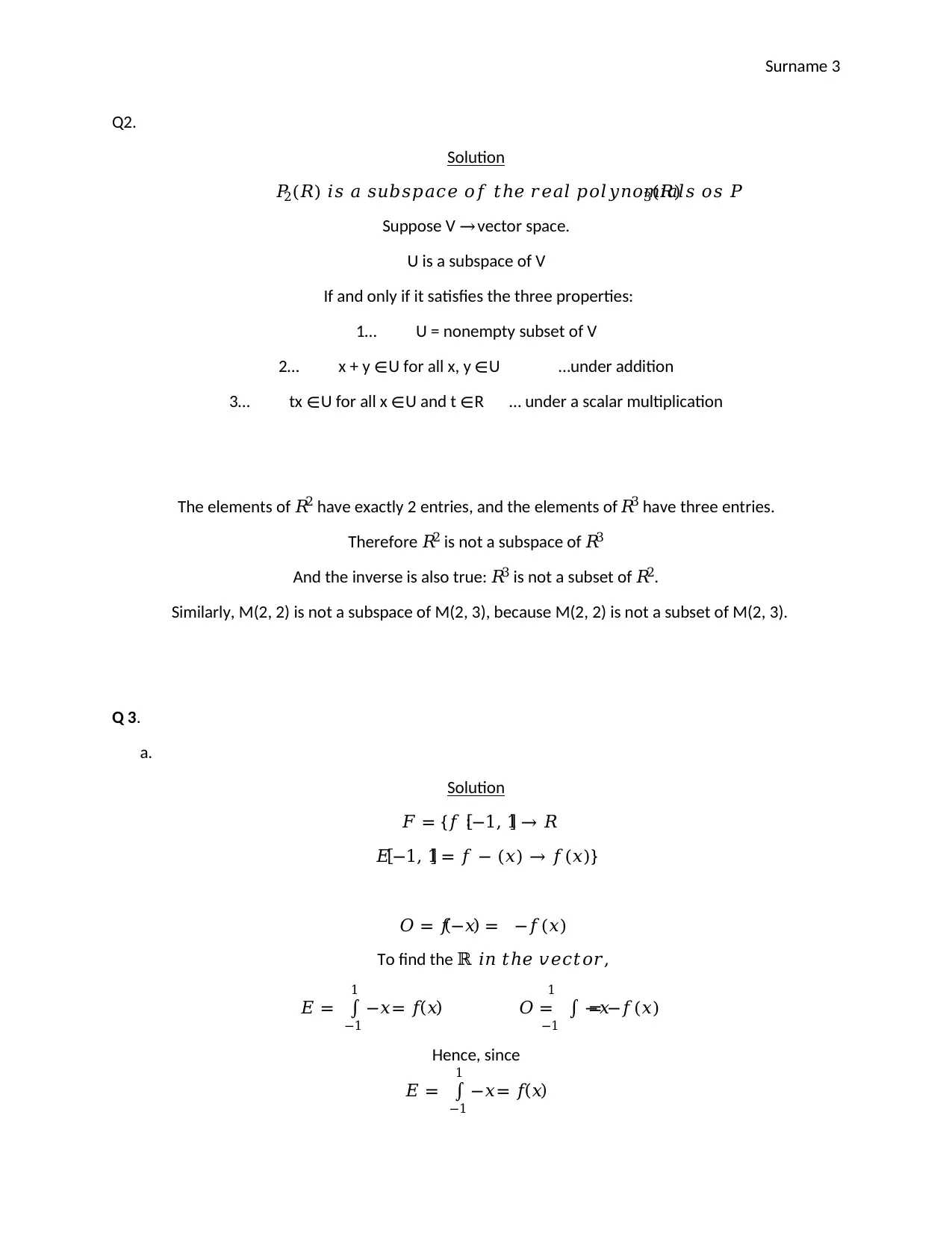
𝑃2(𝑅) 𝑖𝑠 𝑎 𝑠𝑢𝑏𝑠𝑝𝑎𝑐𝑒 𝑜𝑓 𝑡ℎ𝑒 𝑟𝑒𝑎𝑙 𝑝𝑜𝑙𝑦𝑛𝑜𝑚𝑖𝑎𝑙𝑠 𝑜𝑠 𝑃3(𝑅)
Suppose V vector space.
U is a subspace of V
If and only if it satisfies the three properties:
1… U = nonempty subset of V
2… x + y U for all x, y U under addition
3… tx U for all x U and t R under a scalar multiplication
The elements of 𝑅2 have exactly 2 entries, and the elements of 𝑅3 have three entries.
Therefore 𝑅2 is not a subspace of 𝑅3
And the inverse is also true: 𝑅3 is not a subset of 𝑅2.
Similarly, M(2, 2) is not a subspace of M(2, 3), because M(2, 2) is not a subset of M(2, 3).
Q 3.
a.
Solution
𝐹 = {𝑓 ∶[1, 1] → 𝑅
𝐸[1, 1] = 𝑓 − (𝑥) → 𝑓(𝑥)}
𝑂 = 𝑓(−𝑥) = −𝑓(𝑥)
To find the ℝ 𝑖𝑛 𝑡ℎ𝑒 𝑣𝑒𝑐𝑡𝑜𝑟,
𝐸 = ∫ −𝑥
1
1
= 𝑓(𝑥) 𝑂 = ∫ −𝑥
1
1
= −𝑓(𝑥)
Hence, since
𝐸 = ∫ −𝑥
1
1
= 𝑓(𝑥)
Document Page
Surname 4
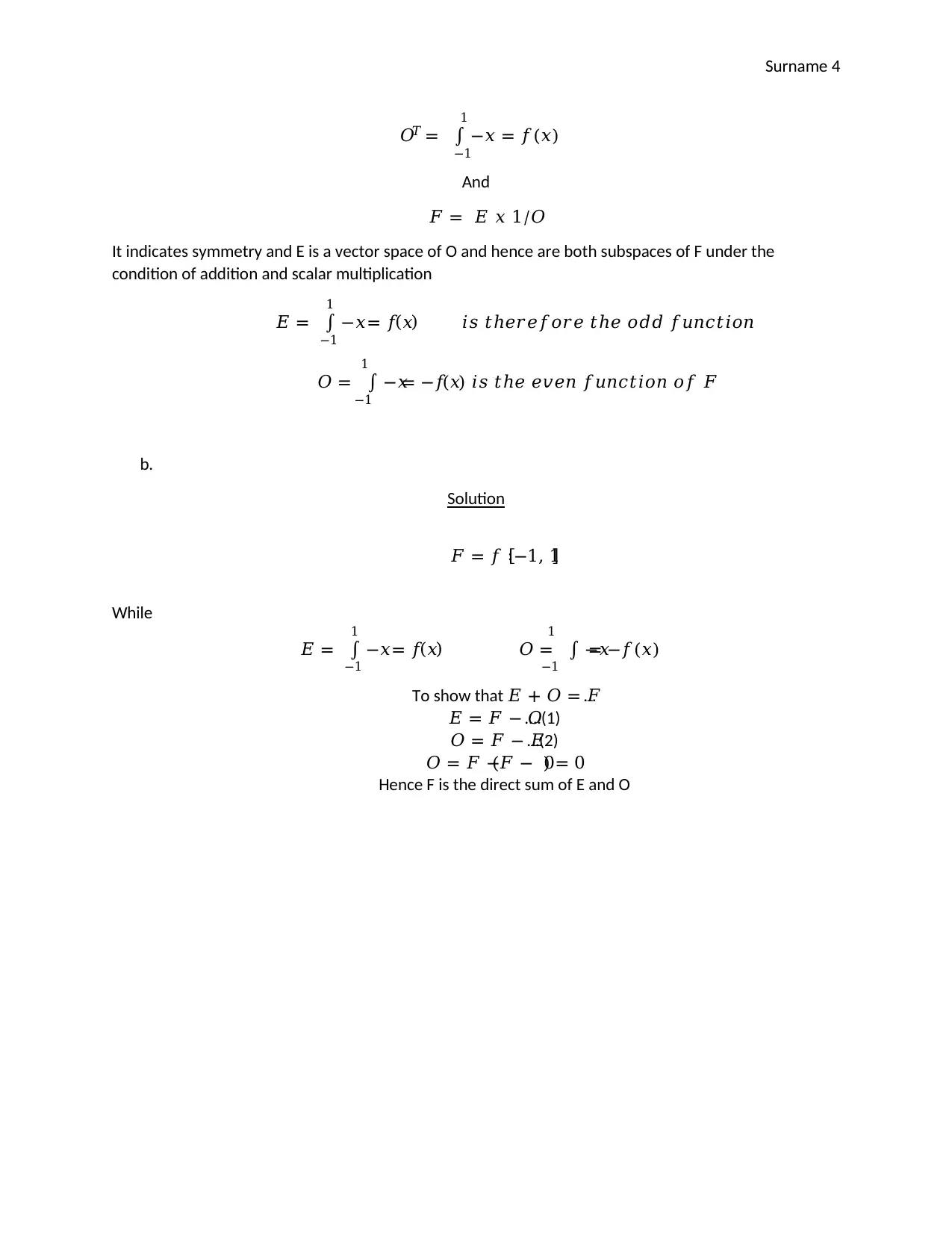
𝑂𝑇 = ∫ −𝑥
1
1
= 𝑓(𝑥)
And
𝐹 = 𝐸 𝑥 1/𝑂
It indicates symmetry and E is a vector space of O and hence are both subspaces of F under the
condition of addition and scalar multiplication
𝐸 = ∫ −𝑥
1
1
= 𝑓(𝑥) 𝑖𝑠 𝑡ℎ𝑒𝑟𝑒𝑓𝑜𝑟𝑒 𝑡ℎ𝑒 𝑜𝑑𝑑 𝑓𝑢𝑛𝑐𝑡𝑖𝑜𝑛
𝑂 = ∫ −𝑥
1
1
= −𝑓(𝑥) 𝑖𝑠 𝑡ℎ𝑒 𝑒𝑣𝑒𝑛 𝑓𝑢𝑛𝑐𝑡𝑖𝑜𝑛 𝑜𝑓 𝐹
b.
Solution
𝐹 = 𝑓 ∶[1, 1]
While
𝐸 = ∫ −𝑥
1
1
= 𝑓(𝑥) 𝑂 = ∫ −𝑥
1
1
= −𝑓(𝑥)
To show that 𝐸 + 𝑂 = 𝐹
𝐸 = 𝐹 − 𝑂.(1)
𝑂 = 𝐹 − 𝐸(2)
𝑂 = 𝐹 −(𝐹 − 0) = 0
Hence F is the direct sum of E and O
tabler-icon-diamond-filled.svg

Paraphrase This Document

Need a fresh take? Get an instant paraphrase of this document with our AI Paraphraser
Document Page
Surname 5
Q 4.
a.
Solution
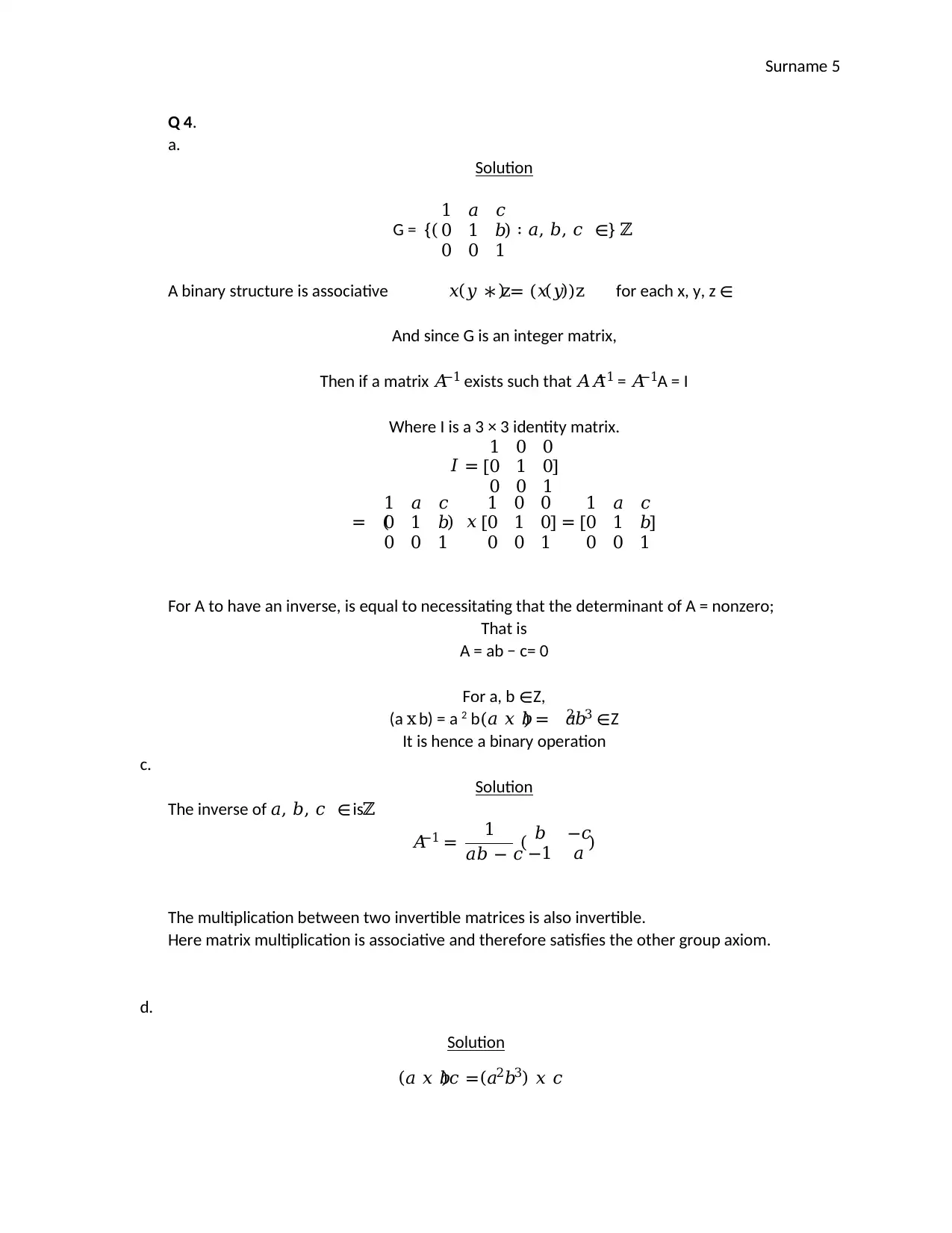
G = {(
1 𝑎 𝑐
0 1 𝑏
0 0 1
) ∶ 𝑎, 𝑏, 𝑐 }
A binary structure is associative 𝑥(𝑦 ∗ z) = (𝑥(𝑦))z for each x, y, z
And since G is an integer matrix,
Then if a matrix 𝐴1 exists such that 𝐴𝐴1 = 𝐴1A = I
Where I is a 3 × 3 identity matrix.
𝐼 = [
1 0 0
0 1 0
0 0 1
]
= (
1 𝑎 𝑐
0 1 𝑏
0 0 1
) 𝑥 [
1 0 0
0 1 0
0 0 1
] = [
1 𝑎 𝑐
0 1 𝑏
0 0 1
]
For A to have an inverse, is equal to necessitating that the determinant of A = nonzero;
That is
A = ab − c= 0
For a, b Z,
(a x b) = a 2 b(𝑎 𝑥 𝑏) = 𝑎2𝑏3 Z
It is hence a binary operation
c.
Solution
The inverse of 𝑎, 𝑏, 𝑐 is
𝐴1 = 1
𝑎𝑏 − 𝑐
( 𝑏 −𝑐
1 𝑎 )
The multiplication between two invertible matrices is also invertible.
Here matrix multiplication is associative and therefore satisfies the other group axiom.
d.
Solution
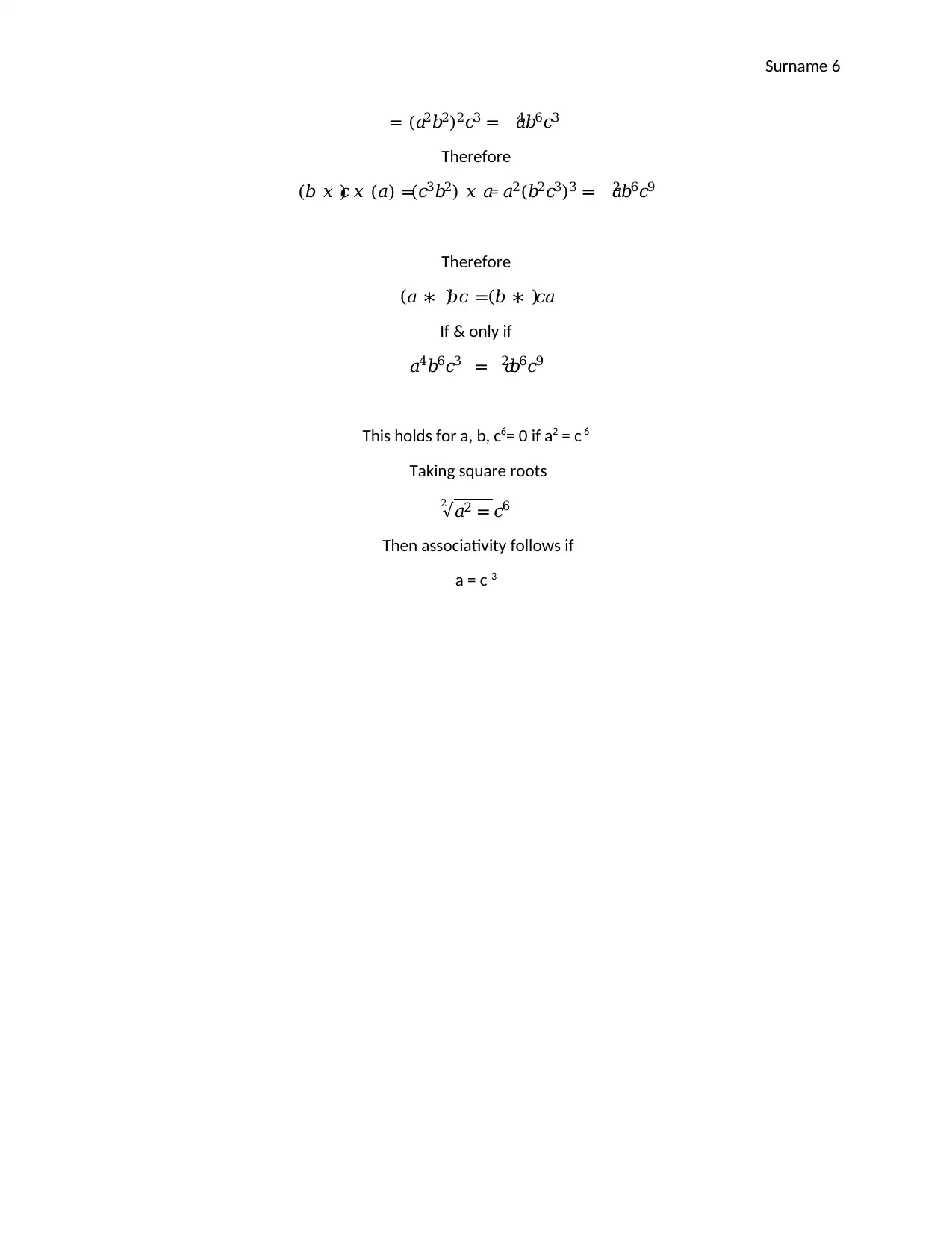
(𝑎 𝑥 𝑏)𝑐 =(𝑎2𝑏3) 𝑥 𝑐
Document Page
Surname 6
= (𝑎2𝑏2)2𝑐3 = 𝑎4𝑏6𝑐3
Therefore
(𝑏 𝑥 𝑐) 𝑥 (𝑎) =(𝑐3𝑏2) 𝑥 𝑎= 𝑎2(𝑏2𝑐3)3 = 𝑎2𝑏6𝑐9
Therefore
(𝑎 ∗ 𝑏) 𝑐 =(𝑏 ∗ 𝑐) 𝑎
If & only if
𝑎4𝑏6𝑐3 = 𝑎2𝑏6𝑐9
This holds for a, b, c6= 0 if a2 = c 6
Taking square roots
𝑎2 =
2
𝑐6
Then associativity follows if
a = c 3
chevron_up_icon
1 out of 6
circle_padding
hide_on_mobile
zoom_out_icon
[object Object]