University Report: Mathematical Induction in Discrete Mathematics

Verified

Added on  2022/08/15

|4
|554
|8
Report
AI Summary
This report presents a solution to a discrete mathematics assignment focusing on mathematical induction. The report begins by stating the problem: proving the sum of the first n natural numbers using mathematical induction. The solution demonstrates the proof, starting with a base case (n=0) and then applying the inductive step. The student explains the process of mathematical induction and its effectiveness in proving statements in discrete mathematics. The report highlights how the formula is applied, substituting n with n+1, and concluding that the LHS equals the RHS. The student reflects on the problem-solving process, noting the ease and efficiency of mathematical induction but also mentioning difficulties with substituting arbitrary values into the equations. The report concludes with a reference and bibliography.
Document Page
Running head: REPORT ON DISCRETE MATHEMATICS
REPORT
ON
DISCRETE MATHEMATICS
Name of the Student
Name of the University
Author Note:
tabler-icon-diamond-filled.svg

Paraphrase This Document

Need a fresh take? Get an instant paraphrase of this document with our AI Paraphraser
Document Page
1DISCRETE MATHEMATICS
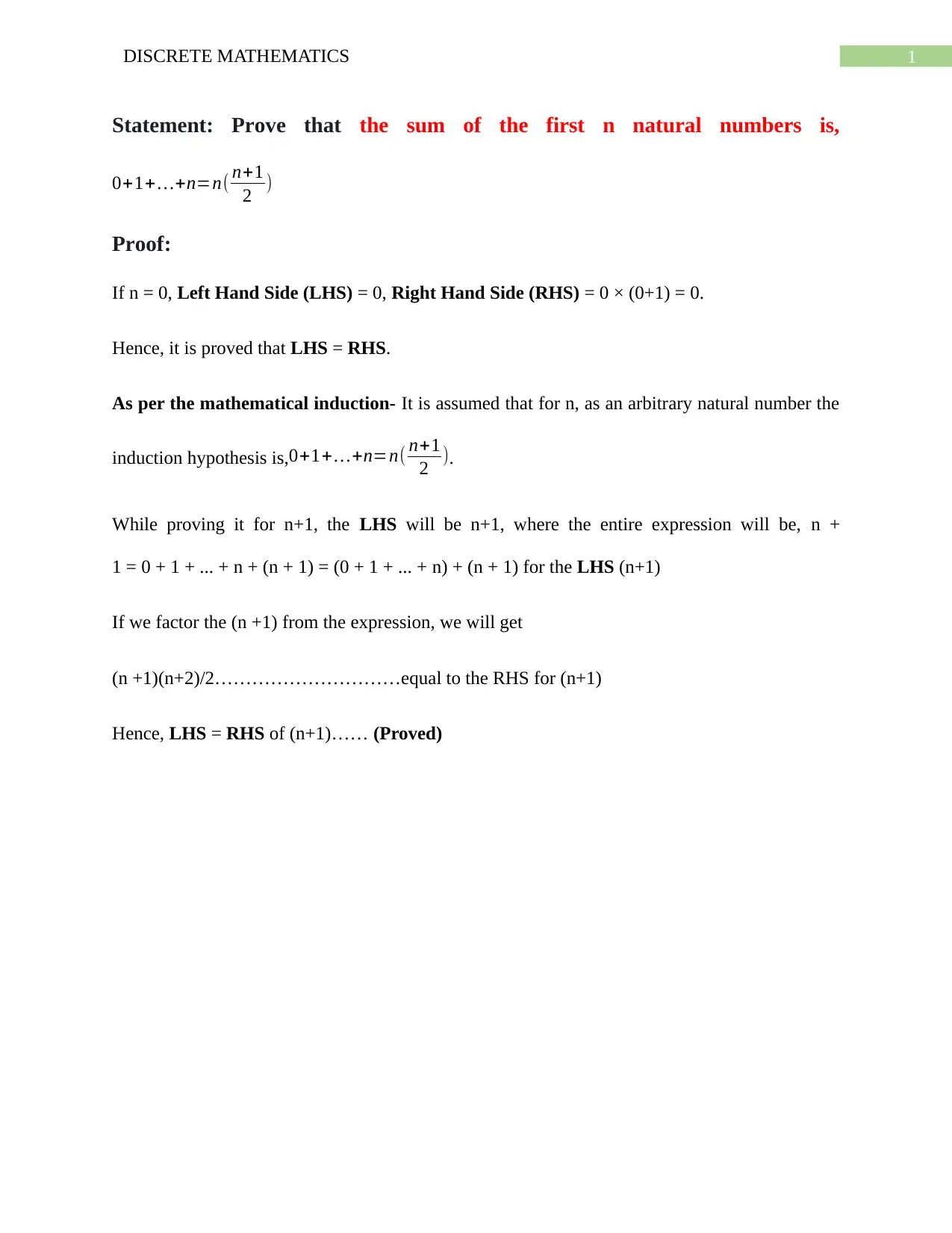
Statement: Prove that the sum of the first n natural numbers is,
0+1+ +n=n( n+1
2 )
Proof:
If n = 0, Left Hand Side (LHS) = 0, Right Hand Side (RHS) = 0 × (0+1) = 0.
Hence, it is proved that LHS = RHS.
As per the mathematical induction- It is assumed that for n, as an arbitrary natural number the
induction hypothesis is, 0+1+ +n=n( n+1
2 ).
While proving it for n+1, the LHS will be n+1, where the entire expression will be, n +
1 = 0 + 1 + ... + n + (n + 1) = (0 + 1 + ... + n) + (n + 1) for the LHS (n+1)
If we factor the (n +1) from the expression, we will get
(n +1)(n+2)/2…………………………equal to the RHS for (n+1)
Hence, LHS = RHS of (n+1)…… (Proved)
Document Page
2DISCRETE MATHEMATICS
Reflection:
In the field of mathematics, mathematical induction is one of the core practices that is
used to solve the reasoning and proof (Rosenthal, Rosenthal & Rosenthal 2018). Followed by
this concept while solving the above mentioned statement by mathematical induction it is
observed that the process of mathematical induction is one of effective process to prove the
statements of discrete mathematics. As the selected statement has several scope of solutions thus,
it is very essential to apply the mathematical induction process to solve the problem. The
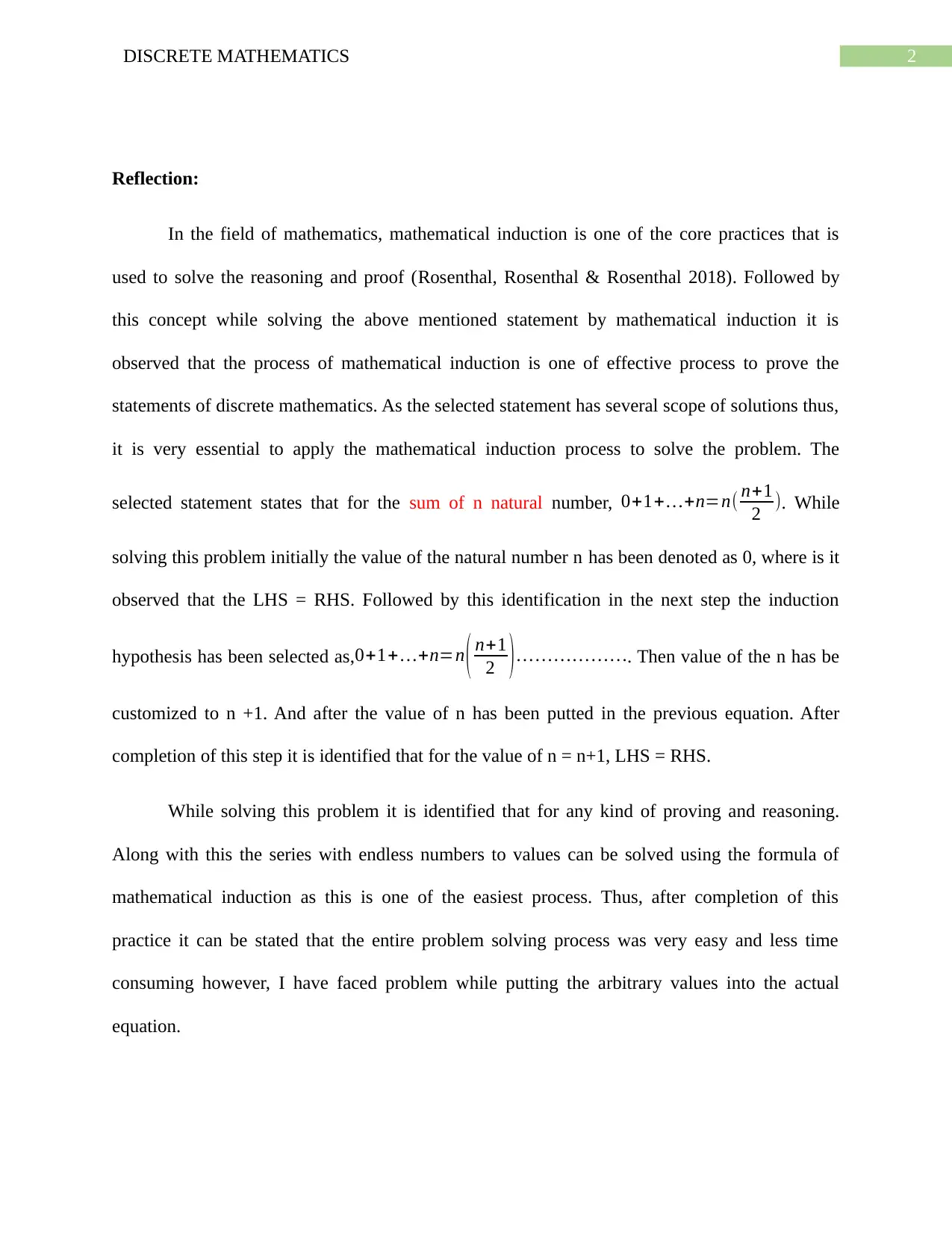
selected statement states that for the sum of n natural number, 0+1++n=n( n+1
2 ). While
solving this problem initially the value of the natural number n has been denoted as 0, where is it
observed that the LHS = RHS. Followed by this identification in the next step the induction
hypothesis has been selected as,0+1+ +n=n ( n+1
2 ) . Then value of the n has be
customized to n +1. And after the value of n has been putted in the previous equation. After
completion of this step it is identified that for the value of n = n+1, LHS = RHS.
While solving this problem it is identified that for any kind of proving and reasoning.
Along with this the series with endless numbers to values can be solved using the formula of
mathematical induction as this is one of the easiest process. Thus, after completion of this
practice it can be stated that the entire problem solving process was very easy and less time
consuming however, I have faced problem while putting the arbitrary values into the actual
equation.
Document Page
3DISCRETE MATHEMATICS
Reference:
Rosenthal, D., Rosenthal, D., & Rosenthal, P. (2018). Mathematical Induction. In A Readable
Introduction to Real Mathematics (pp. 9-22). Springer, Cham.
Bibliography:
Golovina, L. I., & Yaglom, I. M. (2019). Induction in geometry. Courier Dover Publications.
chevron_up_icon
1 out of 4
circle_padding
hide_on_mobile
zoom_out_icon
[object Object]