Mathematical Reasoning Assignment on Binary Relations

Verified

Added on  2020/05/08

|3
|598
|198
Homework Assignment
AI Summary
This assignment solution delves into mathematical reasoning, focusing on binary relations and related concepts. The solution begins by examining the properties of binary relations, specifically addressing reflexivity, symmetry, and transitivity. The assignment then explores operations within the context of these relations, defining addition and demonstrating how it functions within the given framework. Further, it defines subtraction and multiplication within the set Z, emphasizing the computations using natural numbers. The solution provides step-by-step explanations for each problem, making it a valuable resource for students studying mathematical reasoning. The assignment also touches upon the importance of the pendulum, hinting at the broader applications of mathematical principles.
Document Page
Running head: MATHEMATICAL REASONING 1
Mathematical Reasoning
Name
Institution
tabler-icon-diamond-filled.svg

Paraphrase This Document

Need a fresh take? Get an instant paraphrase of this document with our AI Paraphraser
Document Page
MATHEMATICAL REASONING 2
Mathematical Reasoning
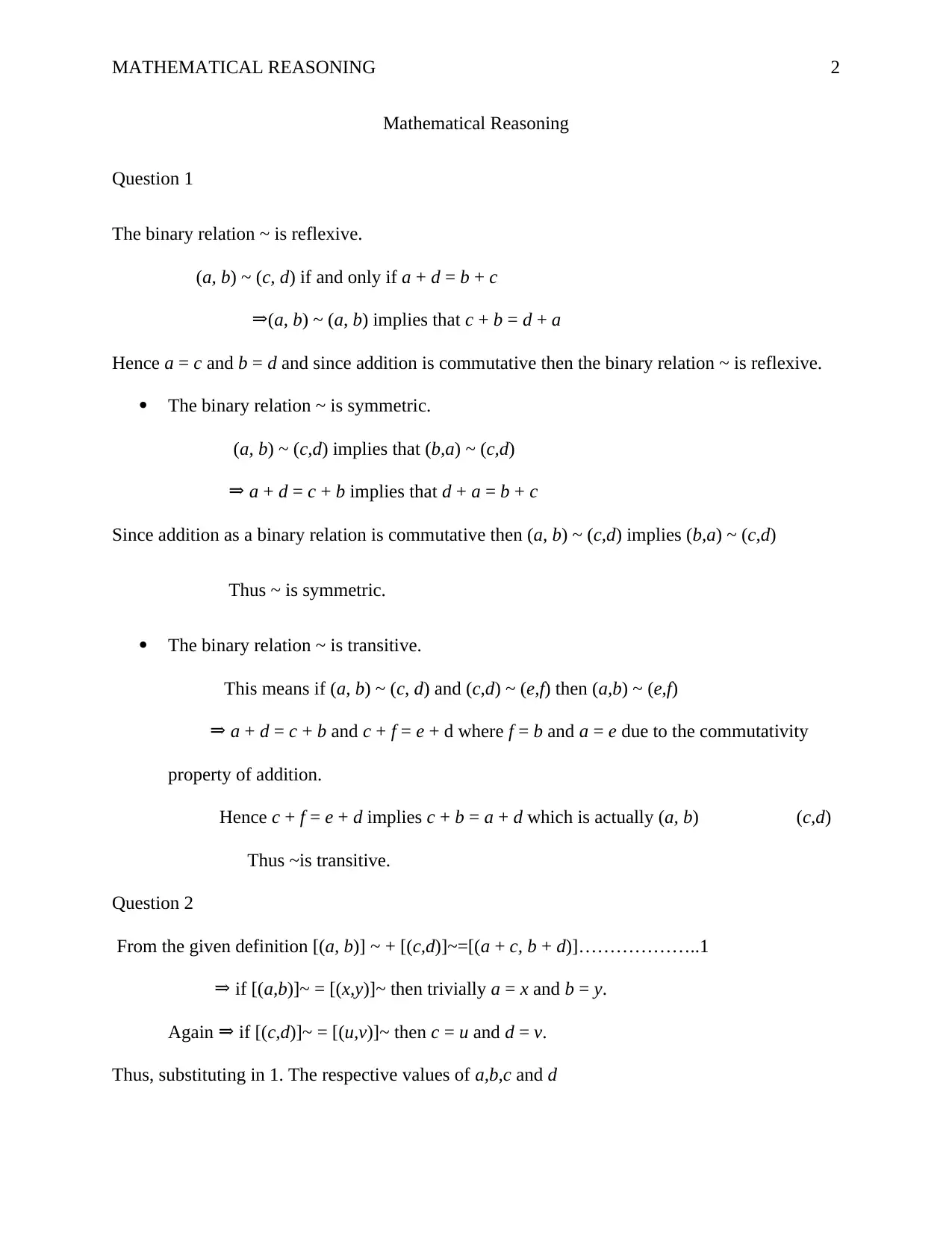
Question 1
The binary relation ~ is reflexive.
(a, b) ~ (c, d) if and only if a + d = b + c
(a, b) ~ (a, b) implies that c + b = d + a
Hence a = c and b = d and since addition is commutative then the binary relation ~ is reflexive.
The binary relation ~ is symmetric.
(a, b) ~ (c,d) implies that (b,a) ~ (c,d)
a + d = c + b implies that d + a = b + c
Since addition as a binary relation is commutative then (a, b) ~ (c,d) implies (b,a) ~ (c,d)
Thus ~ is symmetric.
The binary relation ~ is transitive.
This means if (a, b) ~ (c, d) and (c,d) ~ (e,f) then (a,b) ~ (e,f)
a + d = c + b and c + f = e + d where f = b and a = e due to the commutativity
property of addition.
Hence c + f = e + d implies c + b = a + d which is actually (a, b) (c,d)
Thus ~is transitive.
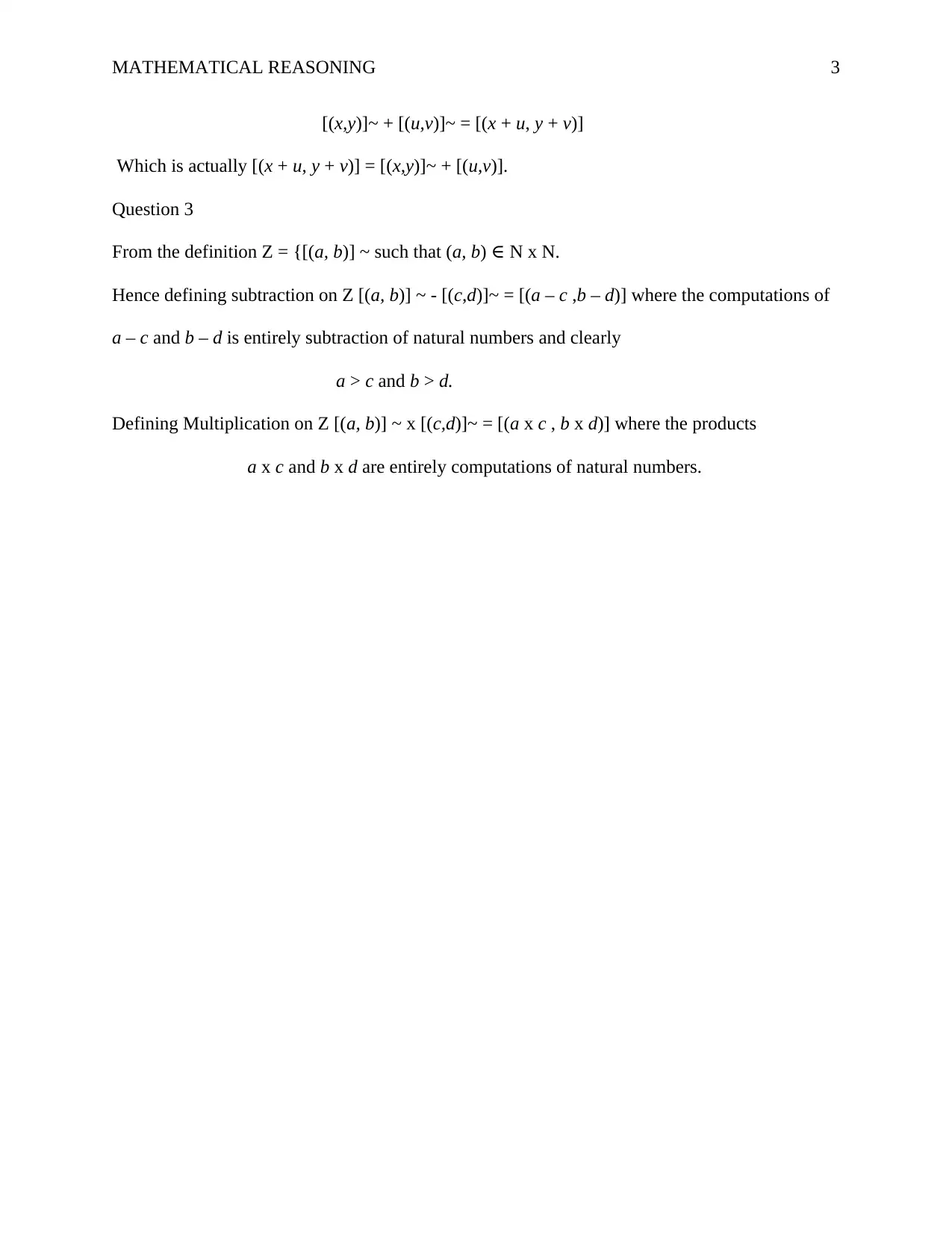
Question 2
From the given definition [(a, b)] ~ + [(c,d)]~=[(a + c, b + d)]………………..1
if [(a,b)]~ = [(x,y)]~ then trivially a = x and b = y.
Again if [(c,d)]~ = [(u,v)]~ then c = u and d = v.
Thus, substituting in 1. The respective values of a,b,c and d
Document Page
MATHEMATICAL REASONING 3
[(x,y)]~ + [(u,v)]~ = [(x + u, y + v)]
Which is actually [(x + u, y + v)] = [(x,y)]~ + [(u,v)].
Question 3
From the definition Z = {[(a, b)] ~ such that (a, b) N x N.
Hence defining subtraction on Z [(a, b)] ~ - [(c,d)]~ = [(a c ,b d)] where the computations of
a c and b d is entirely subtraction of natural numbers and clearly
a > c and b > d.
Defining Multiplication on Z [(a, b)] ~ x [(c,d)]~ = [(a x c , b x d)] where the products
a x c and b x d are entirely computations of natural numbers.
chevron_up_icon
1 out of 3
circle_padding
hide_on_mobile
zoom_out_icon
[object Object]