Comprehensive Analysis of Mathematical Patterns and Series Report

Verified

Added on  2022/10/12

|22
|3098
|274
Report
AI Summary
This report delves into the fascinating realm of mathematical patterns and series, providing a comprehensive overview of various sequences and series. It begins by defining and illustrating arithmetic sequences, highlighting the constant difference between consecutive terms, providing examples, and deriving the nth term formula. Similarly, it explores geometric sequences, where terms are determined by a common ratio, and provides examples and formulas for finding the nth term. The report then moves on to triangular, square, and cube number sequences, explaining their unique properties and applications. It also covers the Fibonacci sequence, emphasizing its recursive nature and widespread presence in nature and various fields. The report extends the discussion to series, defining them as the sum of terms in a sequence, and examines both geometric and arithmetic series, providing formulas for calculating their sums and demonstrating their applications in fields like finance, physics, and history. The report includes formulas, examples, and practical applications of each concept, making it an invaluable resource for students seeking to understand and apply mathematical patterns and series.
Document Page
Mathematics
Student Name:
University Name:
6th August 2019
tabler-icon-diamond-filled.svg

Paraphrase This Document

Need a fresh take? Get an instant paraphrase of this document with our AI Paraphraser
Document Page
PATTERNS
When a group of numbers is following a pattern depending on a specific rule then it qualifies
to be a sequence. There are different types of pattern that we shall have a look at.
The differences arise as a result of their definitions.
1. Arithmetic Sequence
An arithmetic sequence is where the difference between any two consecutive terms is a
constant. This difference is called common difference and it can be positive, negative or
fraction (Bayne, 2012). To get the common difference the succeeding term is subtracted from
the term before it in the sequence. It is worth noting that the difference between the two
consecutive terms must always be the same for the sequence to qualify as arithmetic sequence.
When the sequence has reducing terms the common difference will always be negative because
the succeeding term will be less than the term before it making their difference to be negative.
Example 1
1, 5, 9………………………………..
Example 2
9, 7, 5, 3, 1………………………………..
From example 1, the nth term may be determined using the steps shown below. These steps are
simple and hence easy to follow and understand (Bourbaki, 2015). Common difference d=5-1=
4 or Common difference d=9-5=4
Document Page
The first term a is 1
Nth term = a + (n-1) d
Conjecture Nth term =1+4(n-1)
Suppose we are asked to find the following terms shown in brackets, the steps followed are as
below;
(20th term)
In this example n=20, hence we shall have
20th term =1+4(20-1)
=1+80-4
= 77
(49th term)
In this example n=49, hence we shall have
49th term =1+4(49-1)
=1+4(48)
=193
Document Page
From example 2, the nth term may be determined using the steps shown below. These steps are
simple and hence easy to follow and understand (Duchet, 2015). Common difference d=7-9= -2
or Common difference d=5-7=-2
The first term a is 9
Nth term = a + (n-1) d
Conjecture Nth term =9-2(n-1)
Suppose we are asked to find the following terms shown in brackets, the steps followed are as
below;
(15th term)
In this example n=15, hence we shall have
15th term =9-2(15-1)
=9-2(14)
=9-28
= -19
(93rd term)
In this example n=93, hence we shall have
93rd term =9-2(93-1)
tabler-icon-diamond-filled.svg

Paraphrase This Document

Need a fresh take? Get an instant paraphrase of this document with our AI Paraphraser
Document Page
= 9 - 2(92)
=9-184
= -175
Applications
In geography, it is applied in calculating the time taken between eruptions by Old
faithful (natural geyser).
In mathematics suppose you are in a traffic ,it is used to predict the arrival of the next bus
if the movement of the traffic is uniform (Falcon, 2013).
2. Geometric Sequence
With geometric sequence the numbers follow a pattern where the next number in the sequence
can be determined by multiplying the previous term by a constant. The constant is called a
common ratio which can either be positive, negative or fraction. To get the common ratio the
succeeding term is divided by the term before it in the sequence (Gaughan, 2014). It is worth
noting that the ratio between the two consecutive terms must always be the same for the
sequence to qualify as geometric sequence.
When the sequence has reducing terms the common ratio will always be less than one because
the succeeding term will be less than the term before it making their ratio to be less than one.
On the other hand the sequence will have negative common ratio whenever the terms have
alternating signs.
Document Page
Example 1
2, 4, 8………………………………..
Example 2
125, 25, 5, 1………………………………..
From example 1, the nth term may be determined using the steps shown below. These steps are
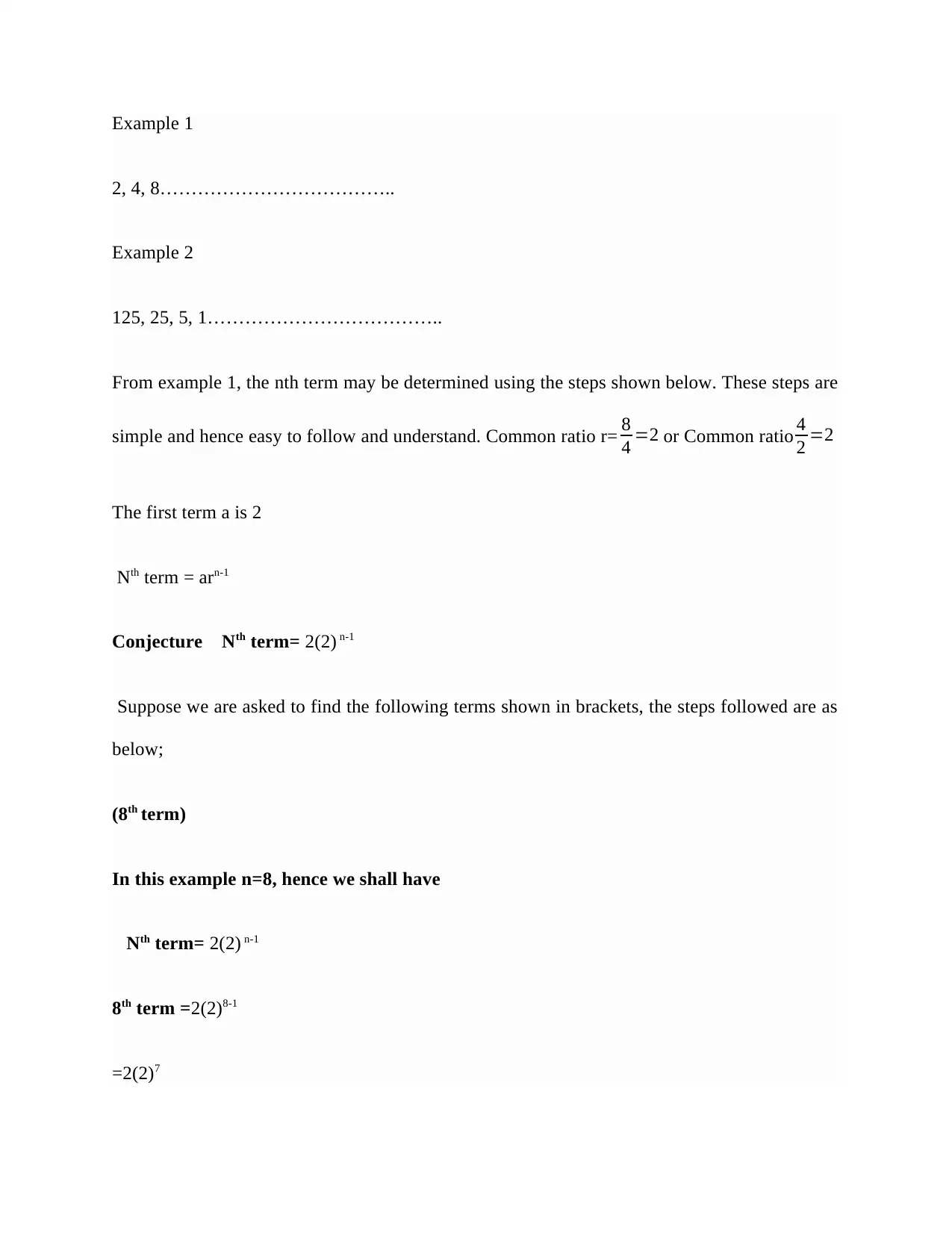
simple and hence easy to follow and understand. Common ratio r= 8
4 =2 or Common ratio 4
2 =2
The first term a is 2
Nth term = arn-1
Conjecture Nth term= 2(2) n-1
Suppose we are asked to find the following terms shown in brackets, the steps followed are as
below;
(8th term)
In this example n=8, hence we shall have
Nth term= 2(2) n-1
8th term =2(2)8-1
=2(2)7
Document Page
=256
(14th term)
In this example n=14, hence we shall have
Nth term= 2(2) n-1
8th term =2(2)14-1
=2(2)13
=16384
From example 2, the nth term may be determined using the steps shown below. These steps are
simple and hence easy to follow and understand.
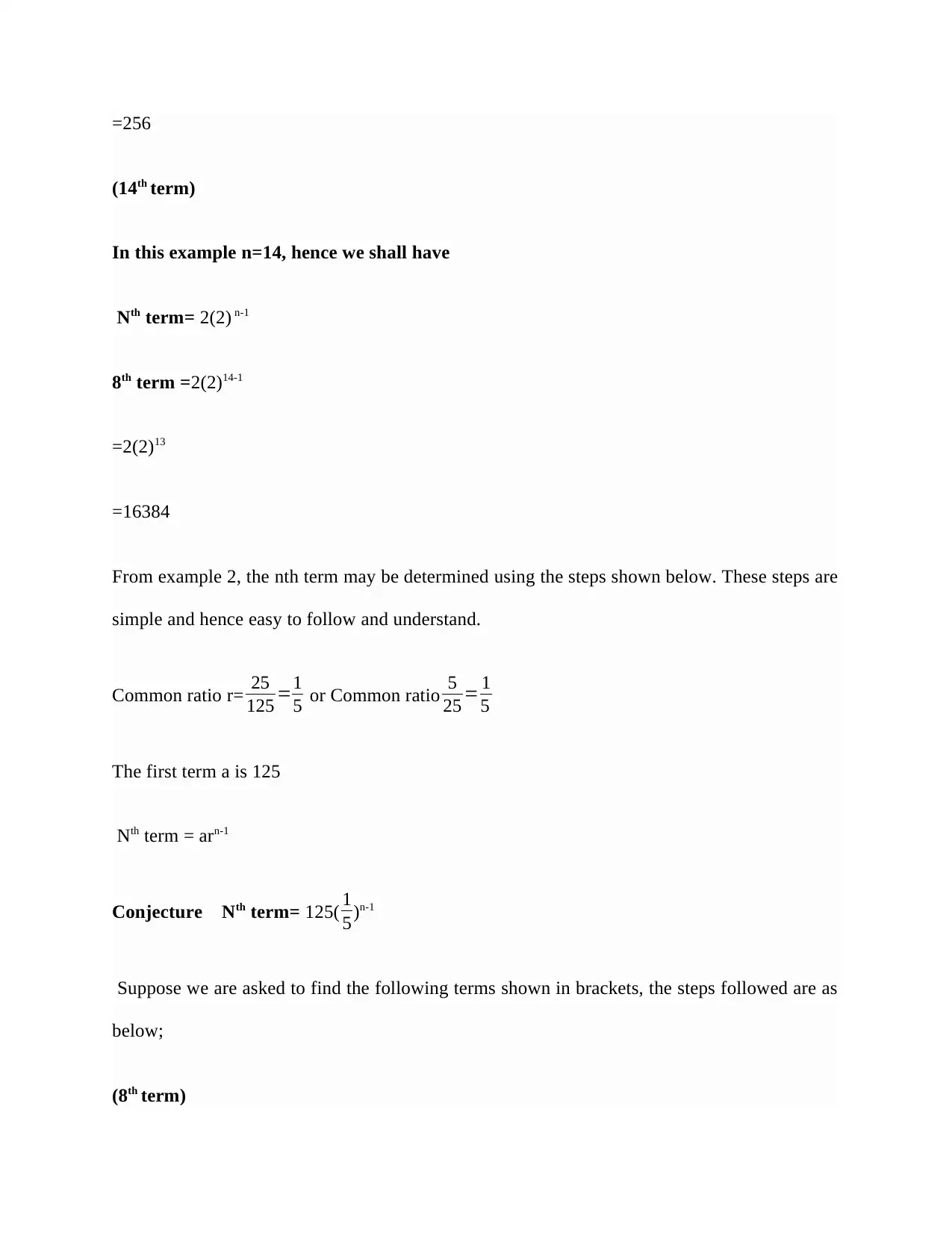
Common ratio r= 25
125 =1
5 or Common ratio 5
25 = 1
5
The first term a is 125
Nth term = arn-1
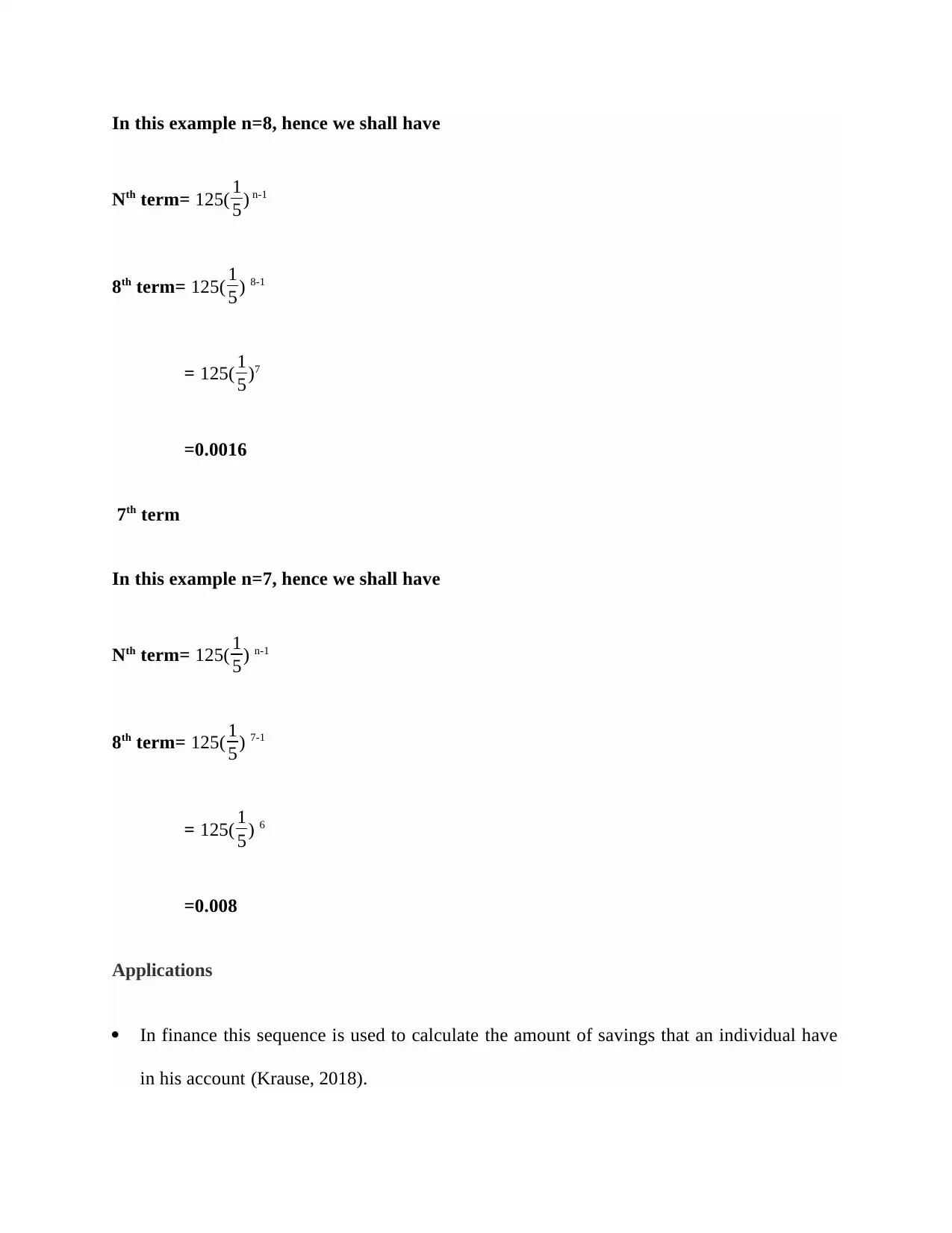
Conjecture Nth term= 125( 1
5)n-1
Suppose we are asked to find the following terms shown in brackets, the steps followed are as
below;
(8th term)
tabler-icon-diamond-filled.svg

Paraphrase This Document

Need a fresh take? Get an instant paraphrase of this document with our AI Paraphraser
Document Page
In this example n=8, hence we shall have
Nth term= 125( 1
5) n-1
8th term= 125( 1
5) 8-1
= 125( 1
5)7
=0.0016
7th term
In this example n=7, hence we shall have
Nth term= 125( 1
5) n-1
8th term= 125( 1
5) 7-1
= 125( 1
5) 6
=0.008
Applications
In finance this sequence is used to calculate the amount of savings that an individual have
in his account (Krause, 2018).
Document Page
In physics it is used to find the intensity of a radioactivity after a given number of years.
3. Triangular sequence
A triangular number counts the number of objects required to form an equilateral triangle.
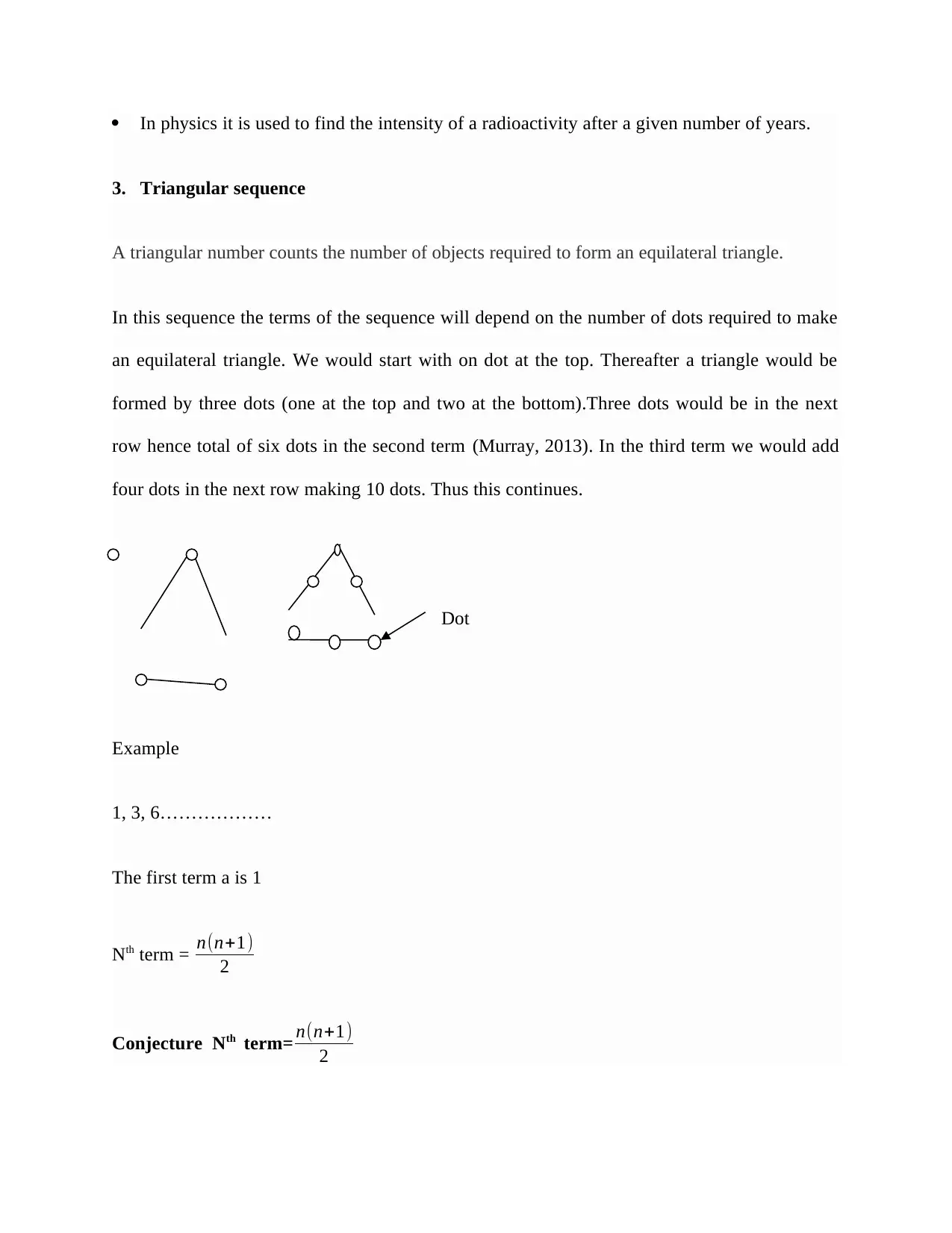
In this sequence the terms of the sequence will depend on the number of dots required to make
an equilateral triangle. We would start with on dot at the top. Thereafter a triangle would be
formed by three dots (one at the top and two at the bottom).Three dots would be in the next
row hence total of six dots in the second term (Murray, 2013). In the third term we would add
four dots in the next row making 10 dots. Thus this continues.
Dot
Example
1, 3, 6………………
The first term a is 1
Nth term = n(n+1)
2
Conjecture Nth term= n(n+1)
2
Document Page
Applications
In computer science it is used to establish networking between other many computing
devices..
In the field of sports the number of matches to be played in a tournament between n
teams will always be determined using triangular sequence (Remmert, 2011).
4. Square Number sequence
In a square number sequence, the position of the term in the sequence is squared to get that
particular term.
Example; 1, 4.9,
Nth term = n2
Conjecture Nth term=n2
Applications
In accounting we are able to find the total cost to pay for apples if the number of apples
bought equals the price per apple.
5. Cube Numbers
In a cube number sequence, the position of the term in the sequence is cubed to get that
particular term.
Taking n=1,2,………………………..,we get the cube numbers sequence shown below.
tabler-icon-diamond-filled.svg

Paraphrase This Document

Need a fresh take? Get an instant paraphrase of this document with our AI Paraphraser
Document Page
Example; 1, 8………………………..
Nth term = n3
Conjecture Nth term=n3
Applications
In engineering it is used in Curve Interpolation
This tool is vital in modeling of solids as well as application in graphics.
In mathematics it is used e.g. in getting exponents
6. Fibonacci Numbers sequence
In a Fibonacci number sequence, the two previous terms are summed to get the next term in the
sequence.
Example
0,1,1,2,3,5,8,13,21,34
Applications
The Fibonacci Numbers sequence has so many real life situations applications every day. These
applications are not restricted to specific fields but are wide spread as they are common across
different fields (Riley, Hobson, & Bence, 2010). However we shall list some of them but not all
of them as found in the different fields.
In biology, it used to predict tree branching and arrangement of leaves on the stem.
In mathematics it is used to convert miles to kilometer and vice-versa.
Document Page
SERIES
Having learnt more about the sequence, it would be prudent to proceed and then look at series.
In simple term series is defined as the sum of the terms in a sequence.
Types of Series
1. Geometric series.
This type of series is characterized by a common ratio i.e the ratio of two consecutive terms is
constant.
The common ratio can be positive, negative or fraction.
Example 1
8+32+128+384+……………………………………….
In this example 1 the common ratio r = 32
8 =384
128 =4
The sum of the first n terms Sn is given by the formula
Sn= a(r n1)
r1 where r is the common ratio while a is the first term. The number of terms is n.
In the above example to get the sum of the first n terms, having known a=8 and r=4.
Sn= 8(4n 1)
41 = 8( 4n 1)
3
chevron_up_icon
1 out of 22
circle_padding
hide_on_mobile
zoom_out_icon
[object Object]