Case Study: Analyzing Cognitive Demand in a Mathematics Classroom
VerifiedAdded on 2020/04/13
|6
|1491
|209
Case Study
AI Summary
This case study examines the relationship between a teacher's characteristics, classroom dynamics, and the cognitive demands of mathematical tasks. The study focuses on a classroom scenario where students were presented with a high-cognitive-demand problem involving bicycles and tricycles, requiring them to apply fundamental mathematical principles, problem-solving, and critical thinking. The students' discussions revealed their reasoning skills and conceptual understanding. The study emphasizes the importance of culturally relevant teaching and empowering non-deficit assessments. The case highlights the need for teachers to select tasks that encourage high-level thinking, maintain cognitive demand, and create opportunities for students to engage in meaningful mathematical tasks. It also underscores the significance of professional development for teachers to effectively manage high-cognitive-demand tasks and prepare students for a knowledge-based global economy. The research suggests that by using high cognitive demand tasks in classrooms and sustaining this cognitive demand during the implementation of the task leads to advances in the quality of both teaching and learning.
Running head: Case Study on Mathematics 1
Case Study on Mathematics
Name
Institution
Case Study on Mathematics
Name
Institution
Paraphrase This Document
Need a fresh take? Get an instant paraphrase of this document with our AI Paraphraser

Case Study on Mathematics 2
CASE STUDY ON MATHEMATICS
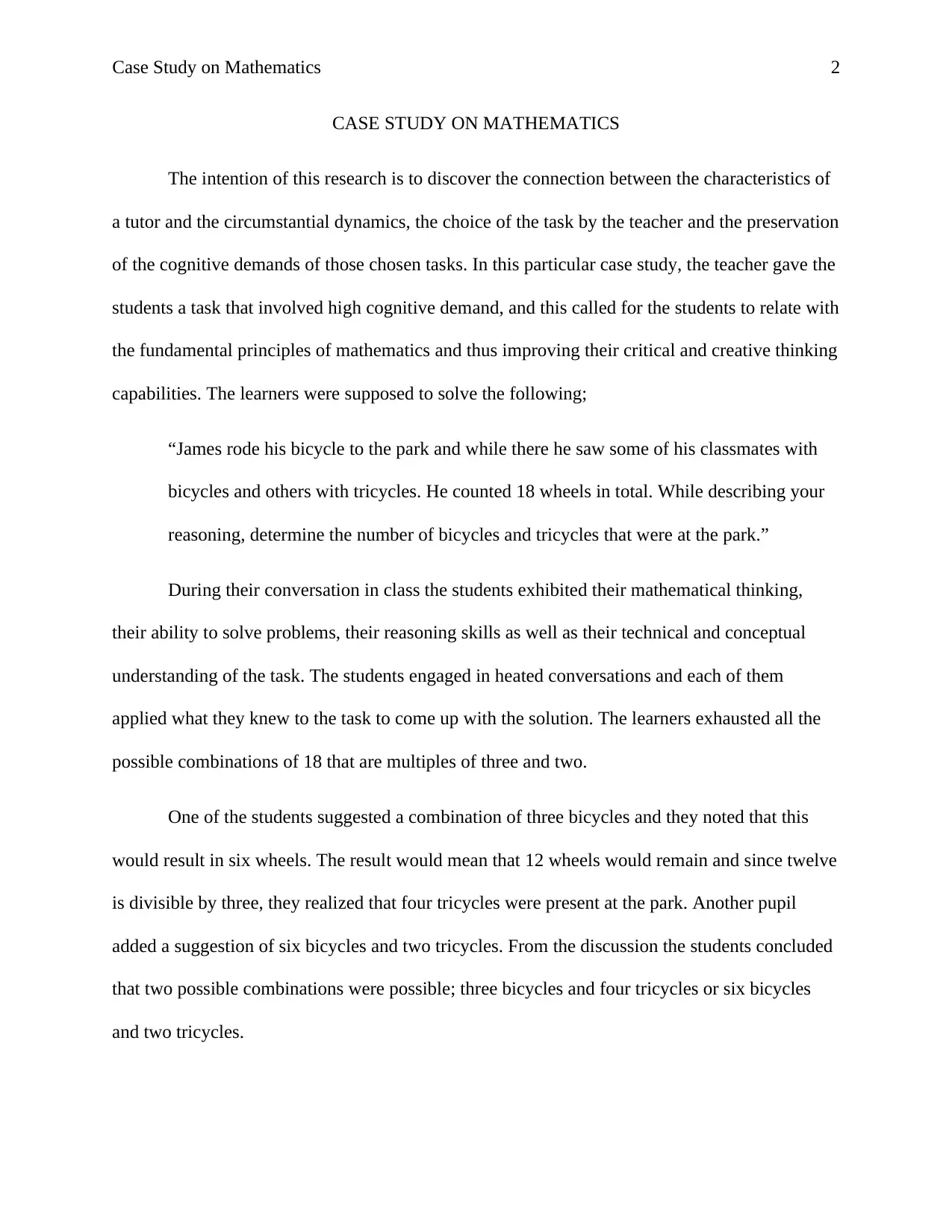
The intention of this research is to discover the connection between the characteristics of
a tutor and the circumstantial dynamics, the choice of the task by the teacher and the preservation
of the cognitive demands of those chosen tasks. In this particular case study, the teacher gave the
students a task that involved high cognitive demand, and this called for the students to relate with
the fundamental principles of mathematics and thus improving their critical and creative thinking
capabilities. The learners were supposed to solve the following;
“James rode his bicycle to the park and while there he saw some of his classmates with
bicycles and others with tricycles. He counted 18 wheels in total. While describing your
reasoning, determine the number of bicycles and tricycles that were at the park.”
During their conversation in class the students exhibited their mathematical thinking,
their ability to solve problems, their reasoning skills as well as their technical and conceptual
understanding of the task. The students engaged in heated conversations and each of them
applied what they knew to the task to come up with the solution. The learners exhausted all the
possible combinations of 18 that are multiples of three and two.
One of the students suggested a combination of three bicycles and they noted that this
would result in six wheels. The result would mean that 12 wheels would remain and since twelve
is divisible by three, they realized that four tricycles were present at the park. Another pupil
added a suggestion of six bicycles and two tricycles. From the discussion the students concluded
that two possible combinations were possible; three bicycles and four tricycles or six bicycles
and two tricycles.
CASE STUDY ON MATHEMATICS
The intention of this research is to discover the connection between the characteristics of
a tutor and the circumstantial dynamics, the choice of the task by the teacher and the preservation
of the cognitive demands of those chosen tasks. In this particular case study, the teacher gave the
students a task that involved high cognitive demand, and this called for the students to relate with
the fundamental principles of mathematics and thus improving their critical and creative thinking
capabilities. The learners were supposed to solve the following;
“James rode his bicycle to the park and while there he saw some of his classmates with
bicycles and others with tricycles. He counted 18 wheels in total. While describing your
reasoning, determine the number of bicycles and tricycles that were at the park.”
During their conversation in class the students exhibited their mathematical thinking,
their ability to solve problems, their reasoning skills as well as their technical and conceptual
understanding of the task. The students engaged in heated conversations and each of them
applied what they knew to the task to come up with the solution. The learners exhausted all the
possible combinations of 18 that are multiples of three and two.
One of the students suggested a combination of three bicycles and they noted that this
would result in six wheels. The result would mean that 12 wheels would remain and since twelve
is divisible by three, they realized that four tricycles were present at the park. Another pupil
added a suggestion of six bicycles and two tricycles. From the discussion the students concluded
that two possible combinations were possible; three bicycles and four tricycles or six bicycles
and two tricycles.

Case Study on Mathematics 3
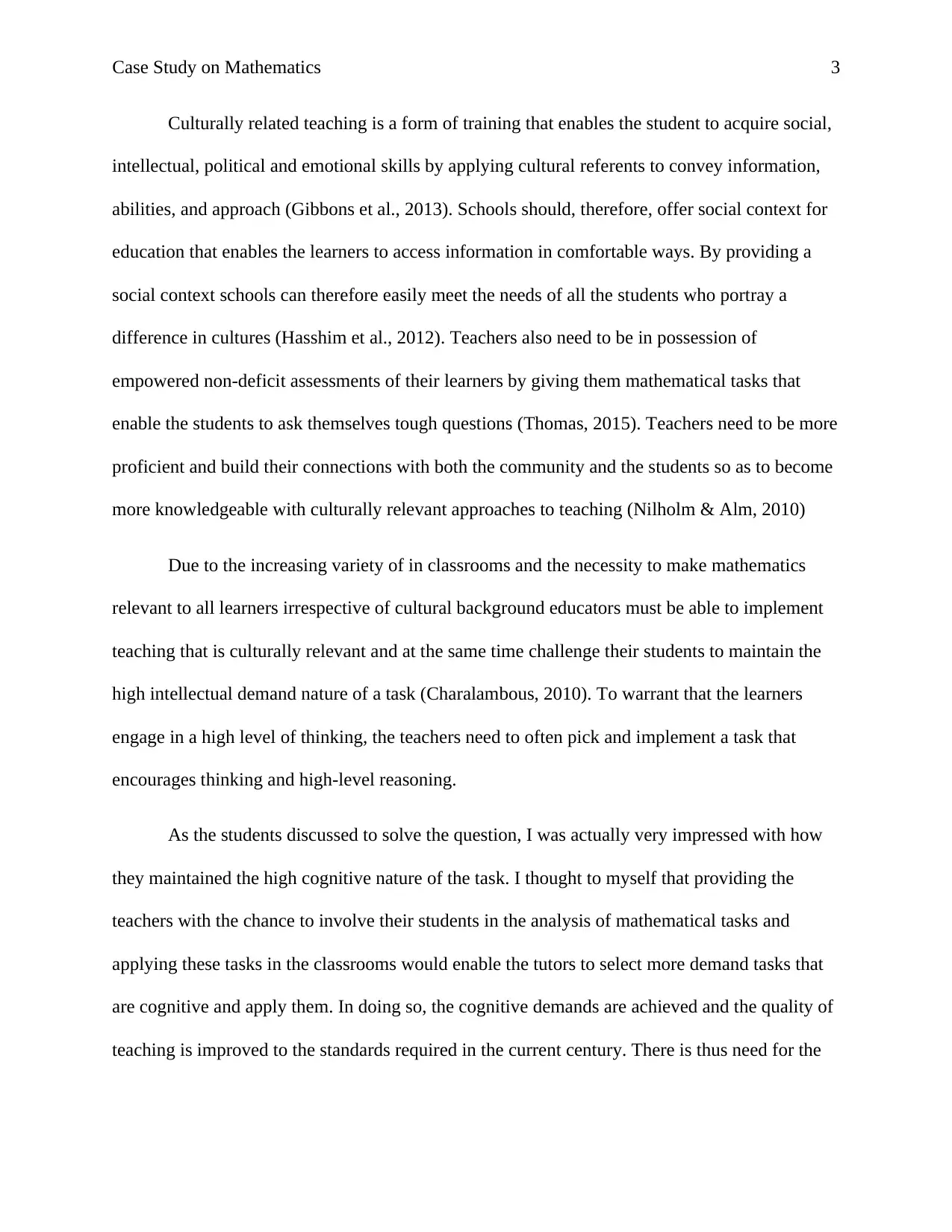
Culturally related teaching is a form of training that enables the student to acquire social,
intellectual, political and emotional skills by applying cultural referents to convey information,
abilities, and approach (Gibbons et al., 2013). Schools should, therefore, offer social context for
education that enables the learners to access information in comfortable ways. By providing a
social context schools can therefore easily meet the needs of all the students who portray a
difference in cultures (Hasshim et al., 2012). Teachers also need to be in possession of
empowered non-deficit assessments of their learners by giving them mathematical tasks that
enable the students to ask themselves tough questions (Thomas, 2015). Teachers need to be more
proficient and build their connections with both the community and the students so as to become
more knowledgeable with culturally relevant approaches to teaching (Nilholm & Alm, 2010)
Due to the increasing variety of in classrooms and the necessity to make mathematics
relevant to all learners irrespective of cultural background educators must be able to implement
teaching that is culturally relevant and at the same time challenge their students to maintain the
high intellectual demand nature of a task (Charalambous, 2010). To warrant that the learners
engage in a high level of thinking, the teachers need to often pick and implement a task that
encourages thinking and high-level reasoning.
As the students discussed to solve the question, I was actually very impressed with how
they maintained the high cognitive nature of the task. I thought to myself that providing the
teachers with the chance to involve their students in the analysis of mathematical tasks and
applying these tasks in the classrooms would enable the tutors to select more demand tasks that
are cognitive and apply them. In doing so, the cognitive demands are achieved and the quality of
teaching is improved to the standards required in the current century. There is thus need for the
Culturally related teaching is a form of training that enables the student to acquire social,
intellectual, political and emotional skills by applying cultural referents to convey information,
abilities, and approach (Gibbons et al., 2013). Schools should, therefore, offer social context for
education that enables the learners to access information in comfortable ways. By providing a
social context schools can therefore easily meet the needs of all the students who portray a
difference in cultures (Hasshim et al., 2012). Teachers also need to be in possession of
empowered non-deficit assessments of their learners by giving them mathematical tasks that
enable the students to ask themselves tough questions (Thomas, 2015). Teachers need to be more
proficient and build their connections with both the community and the students so as to become
more knowledgeable with culturally relevant approaches to teaching (Nilholm & Alm, 2010)
Due to the increasing variety of in classrooms and the necessity to make mathematics
relevant to all learners irrespective of cultural background educators must be able to implement
teaching that is culturally relevant and at the same time challenge their students to maintain the
high intellectual demand nature of a task (Charalambous, 2010). To warrant that the learners
engage in a high level of thinking, the teachers need to often pick and implement a task that
encourages thinking and high-level reasoning.
As the students discussed to solve the question, I was actually very impressed with how
they maintained the high cognitive nature of the task. I thought to myself that providing the
teachers with the chance to involve their students in the analysis of mathematical tasks and
applying these tasks in the classrooms would enable the tutors to select more demand tasks that
are cognitive and apply them. In doing so, the cognitive demands are achieved and the quality of
teaching is improved to the standards required in the current century. There is thus need for the
⊘ This is a preview!⊘
Do you want full access?
Subscribe today to unlock all pages.

Trusted by 1+ million students worldwide

Case Study on Mathematics 4
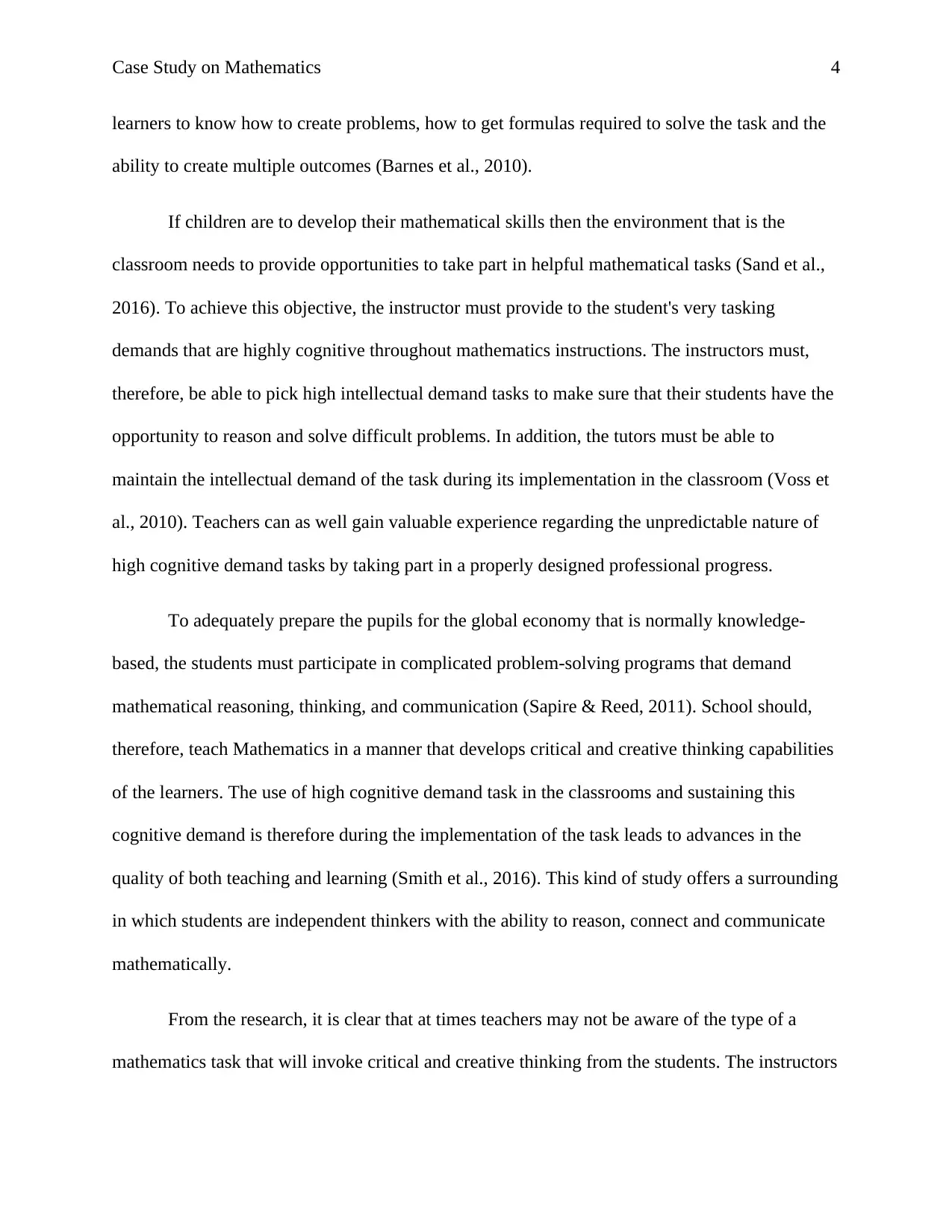
learners to know how to create problems, how to get formulas required to solve the task and the
ability to create multiple outcomes (Barnes et al., 2010).
If children are to develop their mathematical skills then the environment that is the
classroom needs to provide opportunities to take part in helpful mathematical tasks (Sand et al.,
2016). To achieve this objective, the instructor must provide to the student's very tasking
demands that are highly cognitive throughout mathematics instructions. The instructors must,
therefore, be able to pick high intellectual demand tasks to make sure that their students have the
opportunity to reason and solve difficult problems. In addition, the tutors must be able to
maintain the intellectual demand of the task during its implementation in the classroom (Voss et
al., 2010). Teachers can as well gain valuable experience regarding the unpredictable nature of
high cognitive demand tasks by taking part in a properly designed professional progress.
To adequately prepare the pupils for the global economy that is normally knowledge-
based, the students must participate in complicated problem-solving programs that demand
mathematical reasoning, thinking, and communication (Sapire & Reed, 2011). School should,
therefore, teach Mathematics in a manner that develops critical and creative thinking capabilities
of the learners. The use of high cognitive demand task in the classrooms and sustaining this
cognitive demand is therefore during the implementation of the task leads to advances in the
quality of both teaching and learning (Smith et al., 2016). This kind of study offers a surrounding
in which students are independent thinkers with the ability to reason, connect and communicate
mathematically.
From the research, it is clear that at times teachers may not be aware of the type of a
mathematics task that will invoke critical and creative thinking from the students. The instructors
learners to know how to create problems, how to get formulas required to solve the task and the
ability to create multiple outcomes (Barnes et al., 2010).
If children are to develop their mathematical skills then the environment that is the
classroom needs to provide opportunities to take part in helpful mathematical tasks (Sand et al.,
2016). To achieve this objective, the instructor must provide to the student's very tasking
demands that are highly cognitive throughout mathematics instructions. The instructors must,
therefore, be able to pick high intellectual demand tasks to make sure that their students have the
opportunity to reason and solve difficult problems. In addition, the tutors must be able to
maintain the intellectual demand of the task during its implementation in the classroom (Voss et
al., 2010). Teachers can as well gain valuable experience regarding the unpredictable nature of
high cognitive demand tasks by taking part in a properly designed professional progress.
To adequately prepare the pupils for the global economy that is normally knowledge-
based, the students must participate in complicated problem-solving programs that demand
mathematical reasoning, thinking, and communication (Sapire & Reed, 2011). School should,
therefore, teach Mathematics in a manner that develops critical and creative thinking capabilities
of the learners. The use of high cognitive demand task in the classrooms and sustaining this
cognitive demand is therefore during the implementation of the task leads to advances in the
quality of both teaching and learning (Smith et al., 2016). This kind of study offers a surrounding
in which students are independent thinkers with the ability to reason, connect and communicate
mathematically.
From the research, it is clear that at times teachers may not be aware of the type of a
mathematics task that will invoke critical and creative thinking from the students. The instructors
Paraphrase This Document
Need a fresh take? Get an instant paraphrase of this document with our AI Paraphraser

Case Study on Mathematics 5
may even attempt to lower the cognitive demand of a high cognitive task through making
decisions during in the process of instructions.
may even attempt to lower the cognitive demand of a high cognitive task through making
decisions during in the process of instructions.

Case Study on Mathematics 6
References
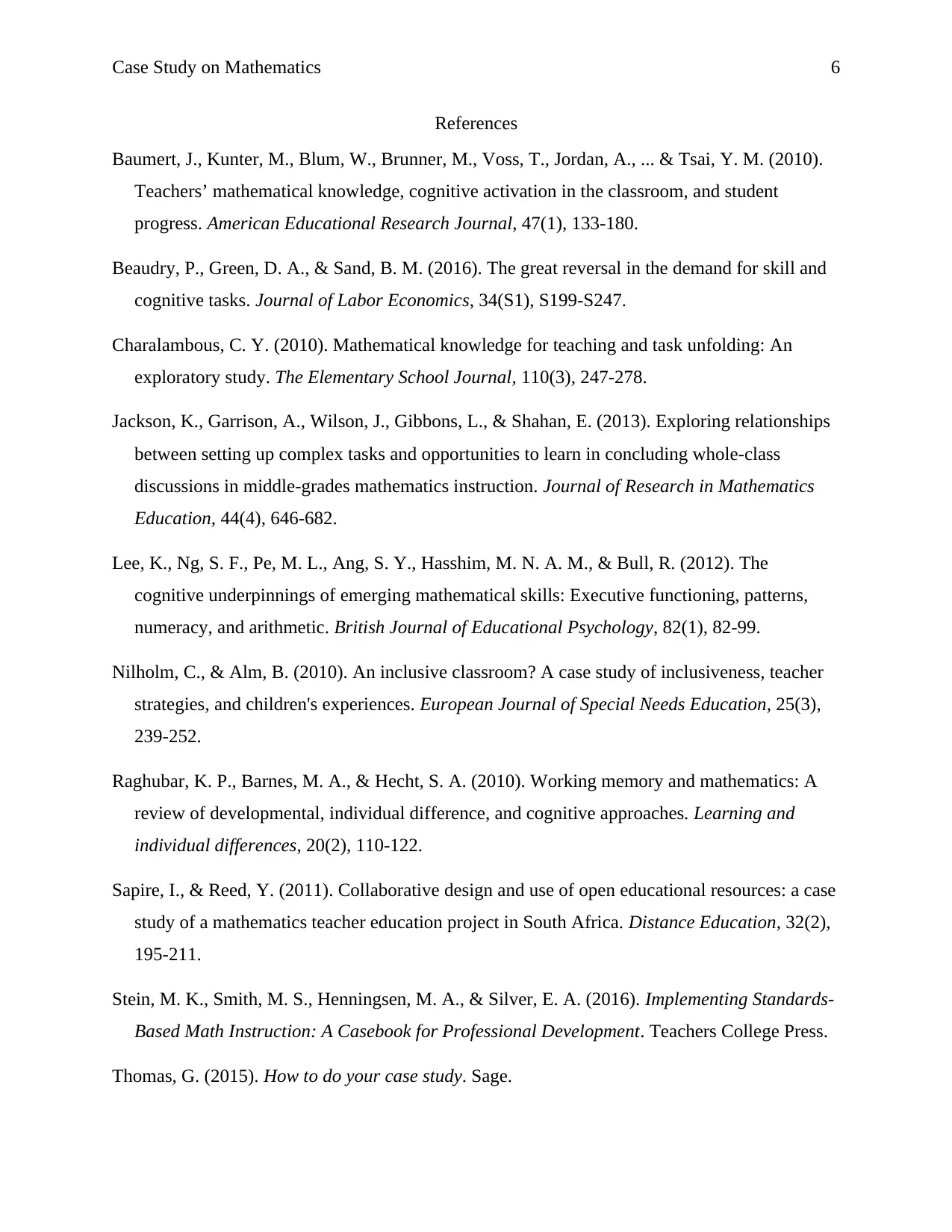
Baumert, J., Kunter, M., Blum, W., Brunner, M., Voss, T., Jordan, A., ... & Tsai, Y. M. (2010).
Teachers’ mathematical knowledge, cognitive activation in the classroom, and student
progress. American Educational Research Journal, 47(1), 133-180.
Beaudry, P., Green, D. A., & Sand, B. M. (2016). The great reversal in the demand for skill and
cognitive tasks. Journal of Labor Economics, 34(S1), S199-S247.
Charalambous, C. Y. (2010). Mathematical knowledge for teaching and task unfolding: An
exploratory study. The Elementary School Journal, 110(3), 247-278.
Jackson, K., Garrison, A., Wilson, J., Gibbons, L., & Shahan, E. (2013). Exploring relationships
between setting up complex tasks and opportunities to learn in concluding whole-class
discussions in middle-grades mathematics instruction. Journal of Research in Mathematics
Education, 44(4), 646-682.
Lee, K., Ng, S. F., Pe, M. L., Ang, S. Y., Hasshim, M. N. A. M., & Bull, R. (2012). The
cognitive underpinnings of emerging mathematical skills: Executive functioning, patterns,
numeracy, and arithmetic. British Journal of Educational Psychology, 82(1), 82-99.
Nilholm, C., & Alm, B. (2010). An inclusive classroom? A case study of inclusiveness, teacher
strategies, and children's experiences. European Journal of Special Needs Education, 25(3),
239-252.
Raghubar, K. P., Barnes, M. A., & Hecht, S. A. (2010). Working memory and mathematics: A
review of developmental, individual difference, and cognitive approaches. Learning and
individual differences, 20(2), 110-122.
Sapire, I., & Reed, Y. (2011). Collaborative design and use of open educational resources: a case
study of a mathematics teacher education project in South Africa. Distance Education, 32(2),
195-211.
Stein, M. K., Smith, M. S., Henningsen, M. A., & Silver, E. A. (2016). Implementing Standards-
Based Math Instruction: A Casebook for Professional Development. Teachers College Press.
Thomas, G. (2015). How to do your case study. Sage.
References
Baumert, J., Kunter, M., Blum, W., Brunner, M., Voss, T., Jordan, A., ... & Tsai, Y. M. (2010).
Teachers’ mathematical knowledge, cognitive activation in the classroom, and student
progress. American Educational Research Journal, 47(1), 133-180.
Beaudry, P., Green, D. A., & Sand, B. M. (2016). The great reversal in the demand for skill and
cognitive tasks. Journal of Labor Economics, 34(S1), S199-S247.
Charalambous, C. Y. (2010). Mathematical knowledge for teaching and task unfolding: An
exploratory study. The Elementary School Journal, 110(3), 247-278.
Jackson, K., Garrison, A., Wilson, J., Gibbons, L., & Shahan, E. (2013). Exploring relationships
between setting up complex tasks and opportunities to learn in concluding whole-class
discussions in middle-grades mathematics instruction. Journal of Research in Mathematics
Education, 44(4), 646-682.
Lee, K., Ng, S. F., Pe, M. L., Ang, S. Y., Hasshim, M. N. A. M., & Bull, R. (2012). The
cognitive underpinnings of emerging mathematical skills: Executive functioning, patterns,
numeracy, and arithmetic. British Journal of Educational Psychology, 82(1), 82-99.
Nilholm, C., & Alm, B. (2010). An inclusive classroom? A case study of inclusiveness, teacher
strategies, and children's experiences. European Journal of Special Needs Education, 25(3),
239-252.
Raghubar, K. P., Barnes, M. A., & Hecht, S. A. (2010). Working memory and mathematics: A
review of developmental, individual difference, and cognitive approaches. Learning and
individual differences, 20(2), 110-122.
Sapire, I., & Reed, Y. (2011). Collaborative design and use of open educational resources: a case
study of a mathematics teacher education project in South Africa. Distance Education, 32(2),
195-211.
Stein, M. K., Smith, M. S., Henningsen, M. A., & Silver, E. A. (2016). Implementing Standards-
Based Math Instruction: A Casebook for Professional Development. Teachers College Press.
Thomas, G. (2015). How to do your case study. Sage.
⊘ This is a preview!⊘
Do you want full access?
Subscribe today to unlock all pages.

Trusted by 1+ million students worldwide
1 out of 6
Your All-in-One AI-Powered Toolkit for Academic Success.
+13062052269
info@desklib.com
Available 24*7 on WhatsApp / Email
Unlock your academic potential
Copyright © 2020–2025 A2Z Services. All Rights Reserved. Developed and managed by ZUCOL.