MBA Leadership: Decision Making, Ethics, and Performance Measures

Verified

Added on  2023/06/11

|8
|1006
|433
Report
AI Summary
This MBA leadership assignment delves into key aspects of effective management, focusing on decision-making processes, the implementation of ethical principles, and the measurement of leadership performance. It highlights the importance of thorough cognizance of circumstances and consultation with credible sources in decision-making, using the example of introducing influencers as a marketing tactic. The assignment also discusses how to instill ethical principles in employees through policies, supervision, and ethical training, emphasizing the role of leaders as role models. Finally, it addresses how leadership performance is measured by sales volume, organizational growth, and employee cohesion, noting the importance of teamwork and democratic decision-making within the company. Desklib offers a range of resources including solved assignments and past papers for students.

Document Page
Student’s Name
Affiliate Institution
Date
tabler-icon-diamond-filled.svg

Paraphrase This Document

Need a fresh take? Get an instant paraphrase of this document with our AI Paraphraser
Document Page
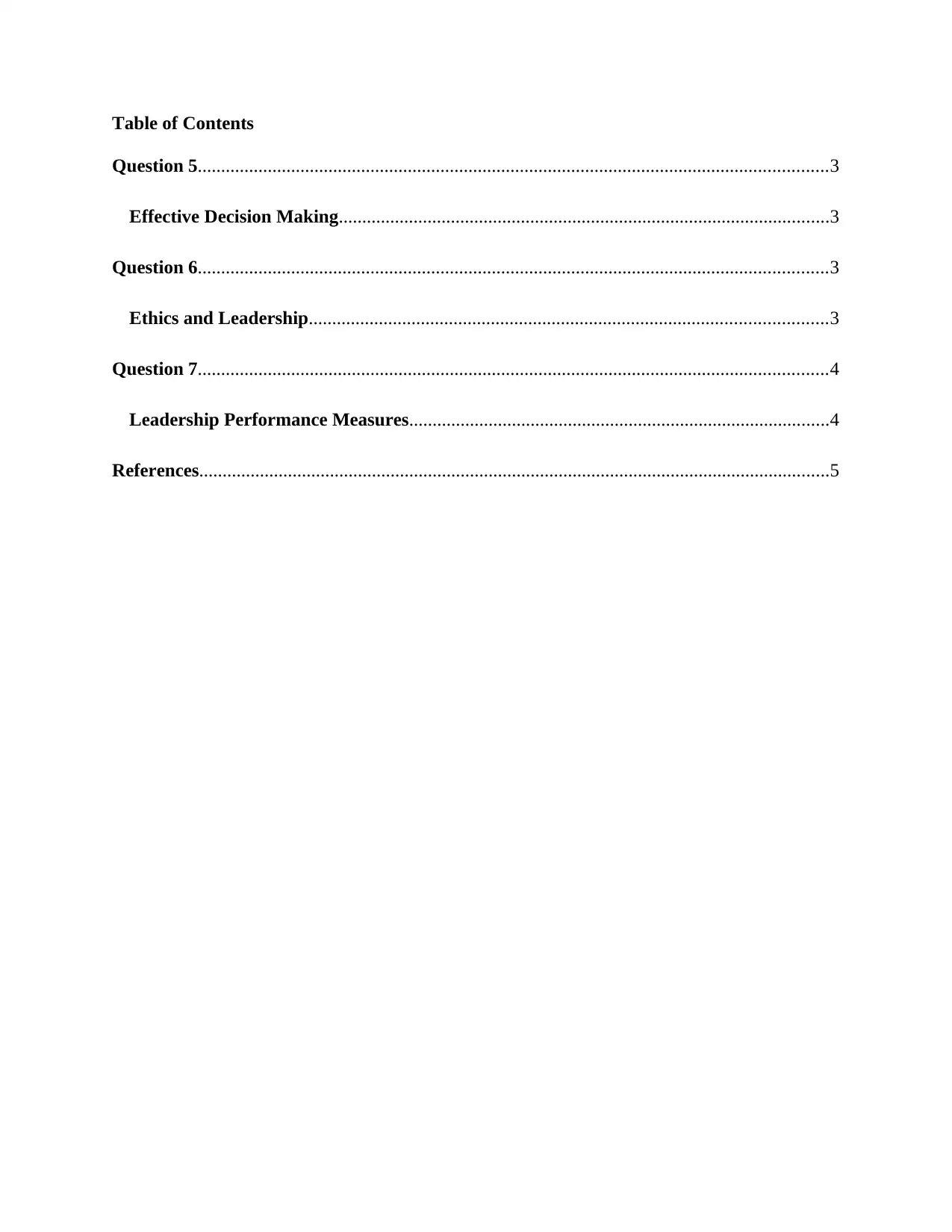
Table of Contents
Question 5.......................................................................................................................................3
Effective Decision Making.........................................................................................................3
Question 6.......................................................................................................................................3
Ethics and Leadership...............................................................................................................3
Question 7.......................................................................................................................................4
Leadership Performance Measures..........................................................................................4
References.......................................................................................................................................5
Document Page
Question 5
Effective Decision Making
Decision making is the process of selecting a course of action among several possible
alternatives.As the marketing manager in my organization, I am always involved in decision
making concerning various marketing strategies. The last decision I made entailed introducing
use of influencers as a marketing tactic to increase the consumer base of the company’s
sunglasses. There are more a few causes of effective decisions:
In order to make highly operative decisions, there is a great need for thorough cognizance of the
circumstances and the situation. This aids in speculating the possible impacts of the particular
decision on the performance of the organization (Mackenzie et al, 2018).
Consultation: a gathering of data from different sources enhances the effectiveness of the
decision made. It increases the knowledge of the decision maker regarding the situation thus
enables him to come up with more alternatives and pick the best choice. However, the decision
maker must ensure that his or her sources of this material are credible and unbiased in regards to
the decision (Kouzes and Posner, 2008).
Question 6
Ethics and Leadership
It is possible to instill ethical principles in employees as the leader or the manager of the
company ((Sekerka, 2009). This may include coming up with rules, regulations, and policies to
be adhered to by the workers. There should be a consequence for not following these regulations.
This is not necessarily to punish the unobedient employees but also to advance the cooperation
and the coordination of the organization (Shahid and Azhar, 2013). Supervision by the
Document Page
corporation’s leader is necessary to ensure that this system is running smoothly and there are
respect and good work ethic among its staffs.
Additionally, the manager or leader of the company should be a role model for all workers by
making sure that he adheres to the principles and policies (Silva, 2015). The ethical coordinator,
who is responsible for training the employees on issues of ethics should also follow his teachings
(Setiyawati and Nengzih, 2014). This makes it easier for the workers as they recognize the
fairness in the organization (Sekerka, 2009). Ethics are very beneficial to a company and it is,
therefore, vital to teach ethical values to the personnel for mutual understanding and respect
within the corporation (Roehrman, 2014).
Question 7
Leadership Performance Measures
My performance is determined by the results or the changes that occur between periods of
performance measurement. In this case, the performance is measured by the sales volume of the
product within a specified year. If the sales have increased, then it is established that the
marketing strategy employed was effective. On the other hand, if the sales volume goes down
my performance as the marketing manager is also said to have declined.
The leadership performance in the company is measured by the growth and development
(continuity) of the organization as well as the cohesion that exists among its employees
(Mackenzie et al, 2018). My company does not encourage competition but identifies teamwork
as a very important aspect in its progression (Berry and Kato, 2018). The leadership of the
corporation is democratic thus even the employees are sometimes involved in the decision-
tabler-icon-diamond-filled.svg

Paraphrase This Document

Need a fresh take? Get an instant paraphrase of this document with our AI Paraphraser
Document Page
making process (Rahim, 2017). As expected, however, the final decision is made by the
company’s Chief Executive Officer (CEO) (Madanchian et al, 2017).
Document Page
Document Page
References
Rahim, M.A., 2017. Managing conflict in organizations. Routledge.
Mackenzie, K.D., Golembiewski, R.T. and Rahim, M.A., 2018. Introduction. In Current Topics
in Management (pp. 9-24). Routledge.
Berry, D. and Kato, T., 2018. Introduction. In Employee Ownership and Employee Involvement
at Work: Case Studies (pp. 1-6). Emerald Publishing Limited.
Shahid, A. and Azhar, S.M., 2013. Gaining employee commitment: Linking to organizational
effectiveness. Journal of Management Research, 5(1), p.250.
Madanchian, M., Hussein, N., Noordin, F. and Taherdoost, H., 2017. Leadership Effectiveness
Measurement and Its Effect on Organization Outcomes. Procedia Engineering, 181, pp.1043-
1048.
Kouzes, J.M., and Posner, B.Z., 2008. We lead from the inside out. The Journal of Values-Based
Leadership, 1(1), p.5.
Setiyawati, H. and Nengzih, M., 2014. The Effect of the Implementation of Good Corporate
Governance Principles and the Effectiveness of Internal Control System Disclosure of
Environmental accounting and Its Implications On the Company Performance (Studies in State-
Owned and Private Hospitals in Jakarta). Research Journal of Finance and Accounting, 5(24),
pp.172-177.
Silva, A., 2015. An Integrated Leadership Theory. Journal of Perspectives in Organizational
Behavior, Management, & Leadership, 1(1), pp.5-9.
tabler-icon-diamond-filled.svg

Paraphrase This Document

Need a fresh take? Get an instant paraphrase of this document with our AI Paraphraser
Document Page
Sekerka, L.E., 2009. Organizational ethics education and training: A review of best practices and
their application. International Journal of Training and Development, 13(2), pp.77-95.
Roehrman, C., 2014. Value of Organizational Ethics Training: A Two-Fold Benefit. The Journal
of Values-Based Leadership, 7(2), p.9.
chevron_up_icon
1 out of 8
circle_padding
hide_on_mobile
zoom_out_icon
[object Object]