MBA502 - Designing a Professional EI, CI & Diversity Workshop
VerifiedAdded on 2023/04/19
|10
|2201
|129
Project
AI Summary
This document presents a professional development workshop design focusing on emotional intelligence, cultural intelligence, and diversity. The workshop includes a detailed schedule of practical activities, such as ice-breaker sessions, group activities, experience sharing, role-playing, unconscious bias tests, group discussions, and games. The workshop aims to provide participants with an understanding of their emotional and cultural stand in the workplace and real-life circumstances, utilizing tools like PowerPoint presentations, PANAS tests, and the Johari Window. The goal is to enhance self-awareness, improve emotional labor skills, and foster cultural empathy, ultimately increasing participants' practicability and job performance. Feedback from participants and the consultant's observations are included to assess the workshop's effectiveness and identify areas for future improvement. The document also contains a list of references used in the workshop's development. This assignment is available on Desklib, a platform providing study tools and resources for students.
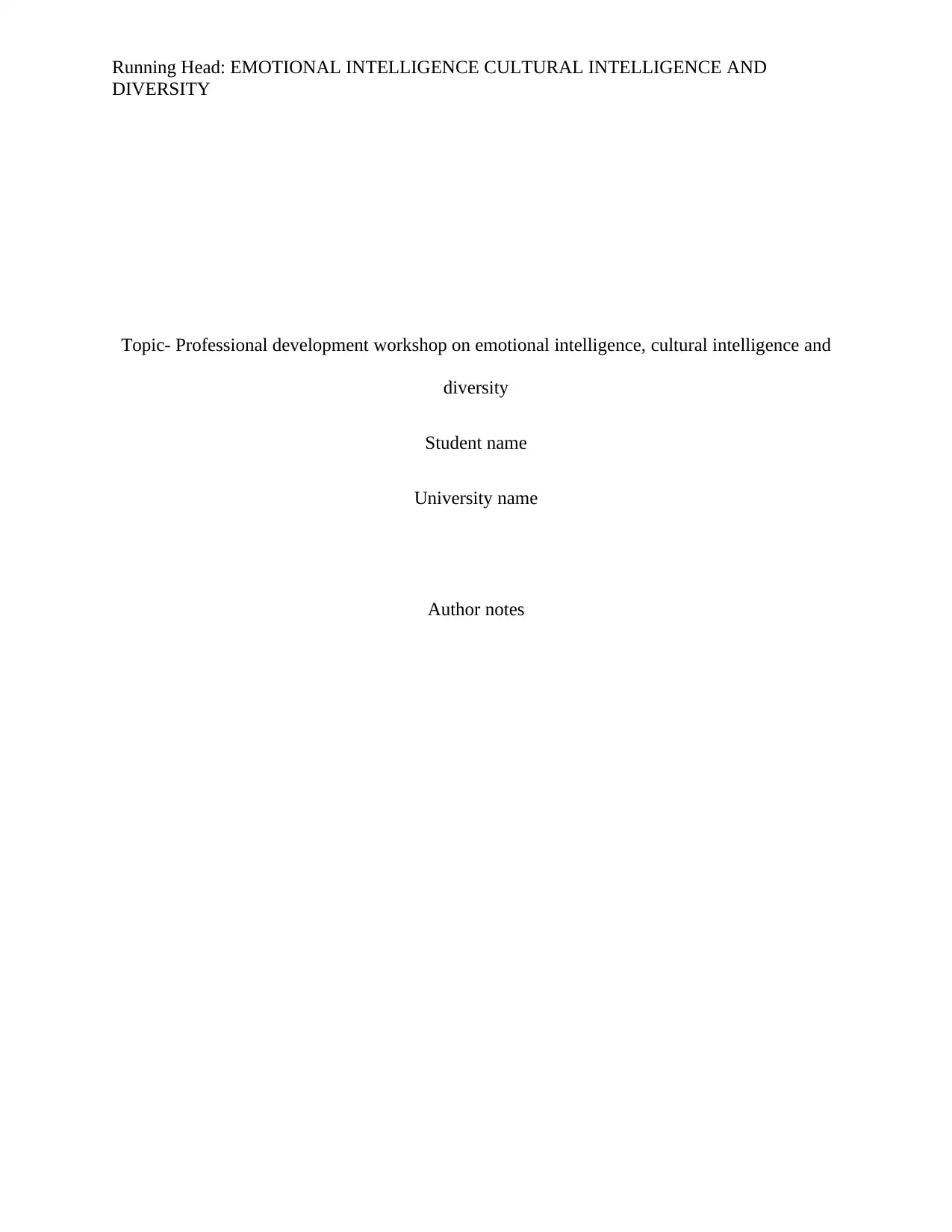
Running Head: EMOTIONAL INTELLIGENCE CULTURAL INTELLIGENCE AND
DIVERSITY
Topic- Professional development workshop on emotional intelligence, cultural intelligence and
diversity
Student name
University name
Author notes
DIVERSITY
Topic- Professional development workshop on emotional intelligence, cultural intelligence and
diversity
Student name
University name
Author notes

Paraphrase This Document
Need a fresh take? Get an instant paraphrase of this document with our AI Paraphraser
2EMOTIONAL INTELLIGENCE CULTURAL INTELLIGENCE AND DIVERSITY
WORKSHOP TOPIC
WEEK 2- THE ROLE OF EMOTION AND CULTURE FOR SUSTAINABLE CHANGE
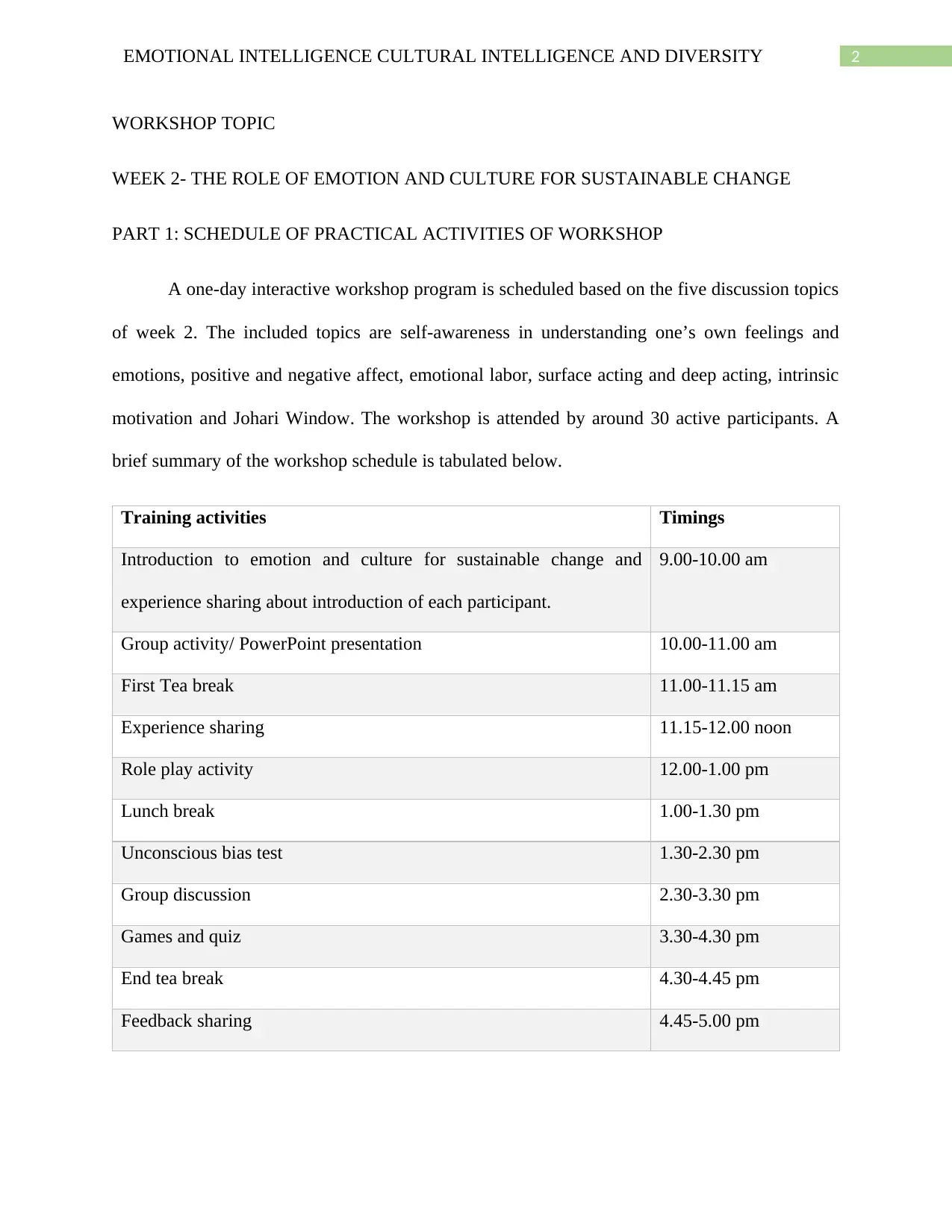
PART 1: SCHEDULE OF PRACTICAL ACTIVITIES OF WORKSHOP
A one-day interactive workshop program is scheduled based on the five discussion topics
of week 2. The included topics are self-awareness in understanding one’s own feelings and
emotions, positive and negative affect, emotional labor, surface acting and deep acting, intrinsic
motivation and Johari Window. The workshop is attended by around 30 active participants. A
brief summary of the workshop schedule is tabulated below.
Training activities Timings
Introduction to emotion and culture for sustainable change and
experience sharing about introduction of each participant.
9.00-10.00 am
Group activity/ PowerPoint presentation 10.00-11.00 am
First Tea break 11.00-11.15 am
Experience sharing 11.15-12.00 noon
Role play activity 12.00-1.00 pm
Lunch break 1.00-1.30 pm
Unconscious bias test 1.30-2.30 pm
Group discussion 2.30-3.30 pm
Games and quiz 3.30-4.30 pm
End tea break 4.30-4.45 pm
Feedback sharing 4.45-5.00 pm
WORKSHOP TOPIC
WEEK 2- THE ROLE OF EMOTION AND CULTURE FOR SUSTAINABLE CHANGE
PART 1: SCHEDULE OF PRACTICAL ACTIVITIES OF WORKSHOP
A one-day interactive workshop program is scheduled based on the five discussion topics
of week 2. The included topics are self-awareness in understanding one’s own feelings and
emotions, positive and negative affect, emotional labor, surface acting and deep acting, intrinsic
motivation and Johari Window. The workshop is attended by around 30 active participants. A
brief summary of the workshop schedule is tabulated below.
Training activities Timings
Introduction to emotion and culture for sustainable change and
experience sharing about introduction of each participant.
9.00-10.00 am
Group activity/ PowerPoint presentation 10.00-11.00 am
First Tea break 11.00-11.15 am
Experience sharing 11.15-12.00 noon
Role play activity 12.00-1.00 pm
Lunch break 1.00-1.30 pm
Unconscious bias test 1.30-2.30 pm
Group discussion 2.30-3.30 pm
Games and quiz 3.30-4.30 pm
End tea break 4.30-4.45 pm
Feedback sharing 4.45-5.00 pm
3EMOTIONAL INTELLIGENCE CULTURAL INTELLIGENCE AND DIVERSITY
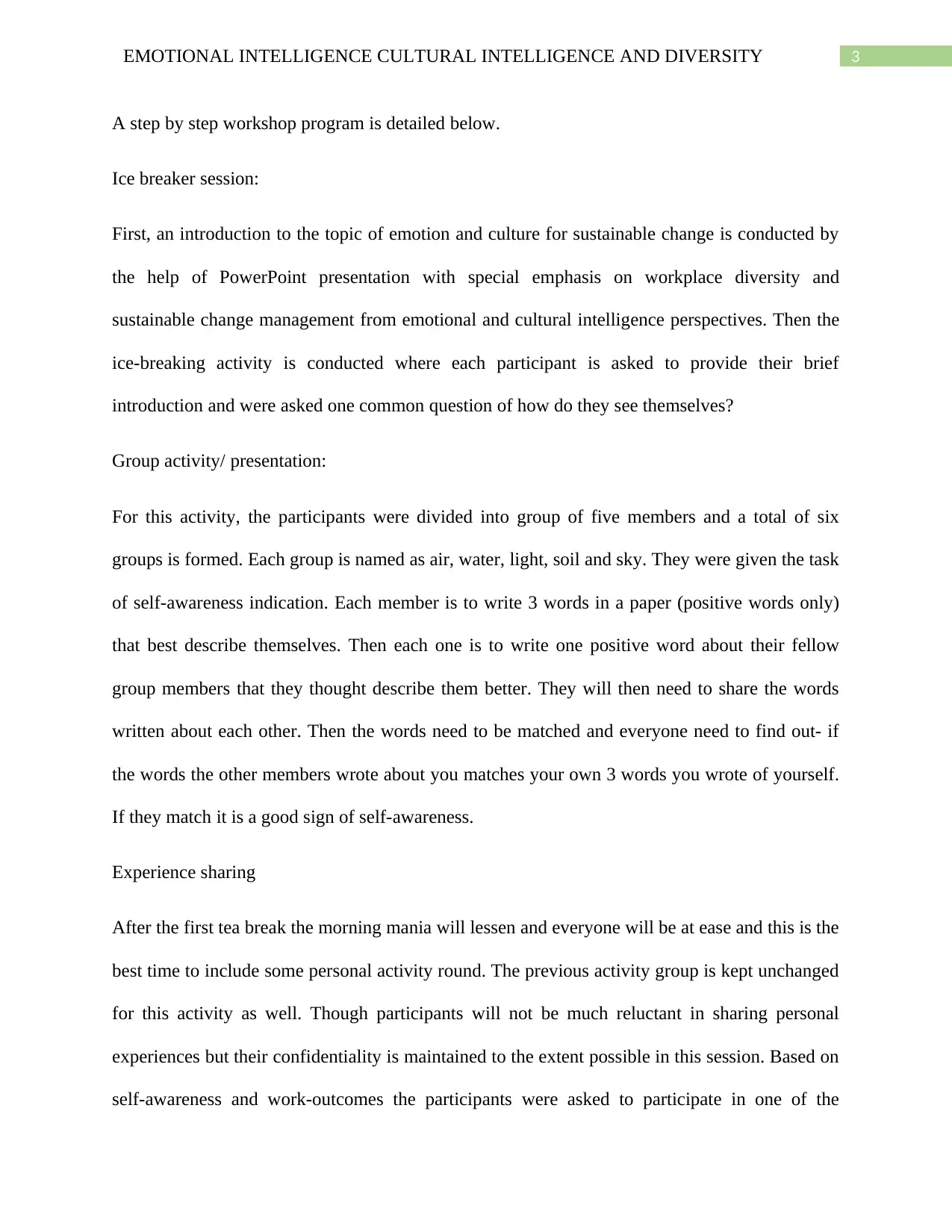
A step by step workshop program is detailed below.
Ice breaker session:
First, an introduction to the topic of emotion and culture for sustainable change is conducted by
the help of PowerPoint presentation with special emphasis on workplace diversity and
sustainable change management from emotional and cultural intelligence perspectives. Then the
ice-breaking activity is conducted where each participant is asked to provide their brief
introduction and were asked one common question of how do they see themselves?
Group activity/ presentation:
For this activity, the participants were divided into group of five members and a total of six
groups is formed. Each group is named as air, water, light, soil and sky. They were given the task
of self-awareness indication. Each member is to write 3 words in a paper (positive words only)
that best describe themselves. Then each one is to write one positive word about their fellow
group members that they thought describe them better. They will then need to share the words
written about each other. Then the words need to be matched and everyone need to find out- if
the words the other members wrote about you matches your own 3 words you wrote of yourself.
If they match it is a good sign of self-awareness.
Experience sharing
After the first tea break the morning mania will lessen and everyone will be at ease and this is the
best time to include some personal activity round. The previous activity group is kept unchanged
for this activity as well. Though participants will not be much reluctant in sharing personal
experiences but their confidentiality is maintained to the extent possible in this session. Based on
self-awareness and work-outcomes the participants were asked to participate in one of the
A step by step workshop program is detailed below.
Ice breaker session:
First, an introduction to the topic of emotion and culture for sustainable change is conducted by
the help of PowerPoint presentation with special emphasis on workplace diversity and
sustainable change management from emotional and cultural intelligence perspectives. Then the
ice-breaking activity is conducted where each participant is asked to provide their brief
introduction and were asked one common question of how do they see themselves?
Group activity/ presentation:
For this activity, the participants were divided into group of five members and a total of six
groups is formed. Each group is named as air, water, light, soil and sky. They were given the task
of self-awareness indication. Each member is to write 3 words in a paper (positive words only)
that best describe themselves. Then each one is to write one positive word about their fellow
group members that they thought describe them better. They will then need to share the words
written about each other. Then the words need to be matched and everyone need to find out- if
the words the other members wrote about you matches your own 3 words you wrote of yourself.
If they match it is a good sign of self-awareness.
Experience sharing
After the first tea break the morning mania will lessen and everyone will be at ease and this is the
best time to include some personal activity round. The previous activity group is kept unchanged
for this activity as well. Though participants will not be much reluctant in sharing personal
experiences but their confidentiality is maintained to the extent possible in this session. Based on
self-awareness and work-outcomes the participants were asked to participate in one of the
⊘ This is a preview!⊘
Do you want full access?
Subscribe today to unlock all pages.

Trusted by 1+ million students worldwide
4EMOTIONAL INTELLIGENCE CULTURAL INTELLIGENCE AND DIVERSITY
outcomes of strong performance, better judgement, creative problem solving and successful
negotiation. Each group is allocated one outcome area and they were asked to identify at least
five ways that self-awareness of their feelings could support those results in their workplace.
They will help in exploring further areas of feelings about positive affect and negative affect,
emotional labor and intrinsic motivation.
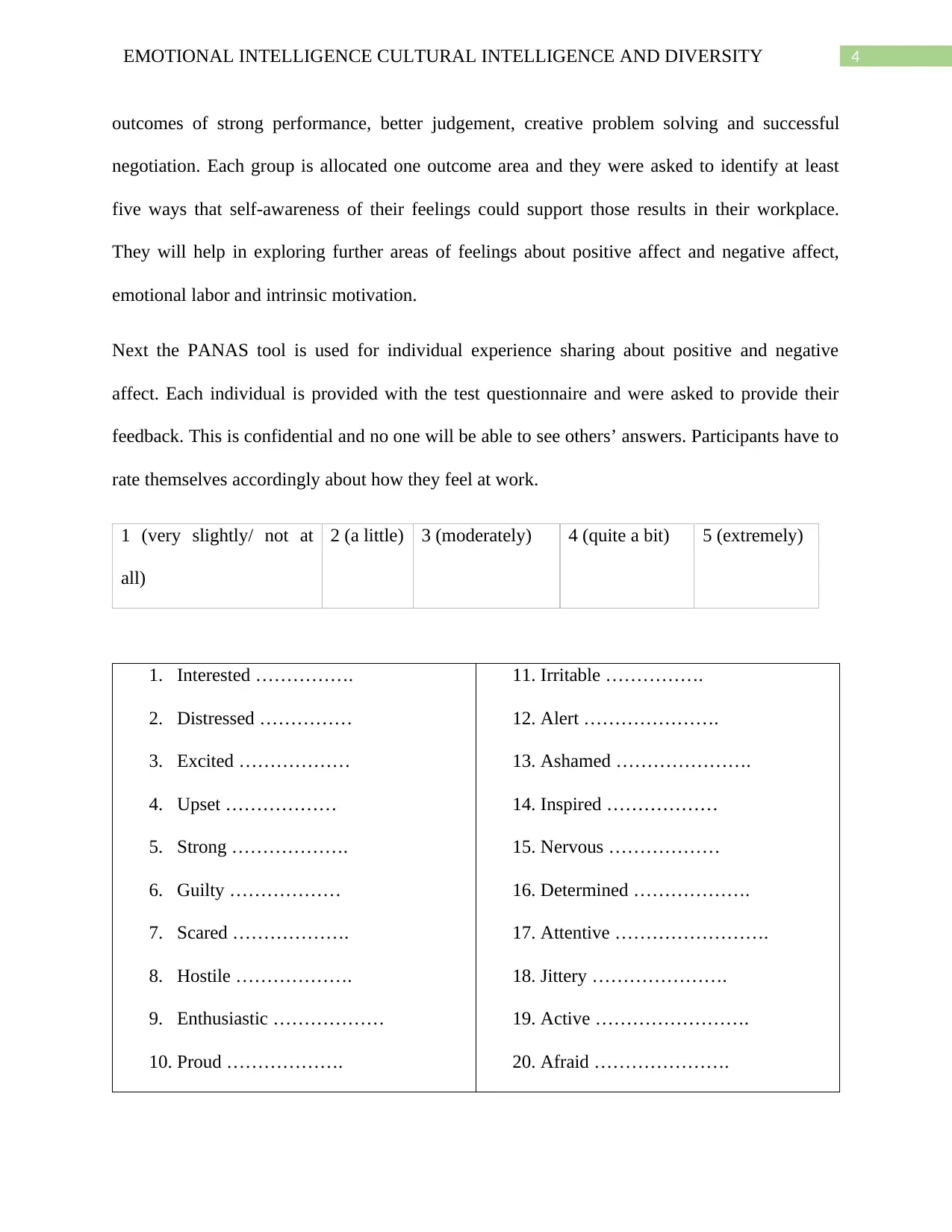
Next the PANAS tool is used for individual experience sharing about positive and negative
affect. Each individual is provided with the test questionnaire and were asked to provide their
feedback. This is confidential and no one will be able to see others’ answers. Participants have to
rate themselves accordingly about how they feel at work.
1 (very slightly/ not at
all)
2 (a little) 3 (moderately) 4 (quite a bit) 5 (extremely)
1. Interested …………….
2. Distressed ……………
3. Excited ………………
4. Upset ………………
5. Strong ……………….
6. Guilty ………………
7. Scared ……………….
8. Hostile ……………….
9. Enthusiastic ………………
10. Proud ……………….
11. Irritable …………….
12. Alert ………………….
13. Ashamed ………………….
14. Inspired ………………
15. Nervous ………………
16. Determined ……………….
17. Attentive …………………….
18. Jittery ………………….
19. Active …………………….
20. Afraid ………………….
outcomes of strong performance, better judgement, creative problem solving and successful
negotiation. Each group is allocated one outcome area and they were asked to identify at least
five ways that self-awareness of their feelings could support those results in their workplace.
They will help in exploring further areas of feelings about positive affect and negative affect,
emotional labor and intrinsic motivation.
Next the PANAS tool is used for individual experience sharing about positive and negative
affect. Each individual is provided with the test questionnaire and were asked to provide their
feedback. This is confidential and no one will be able to see others’ answers. Participants have to
rate themselves accordingly about how they feel at work.
1 (very slightly/ not at
all)
2 (a little) 3 (moderately) 4 (quite a bit) 5 (extremely)
1. Interested …………….
2. Distressed ……………
3. Excited ………………
4. Upset ………………
5. Strong ……………….
6. Guilty ………………
7. Scared ……………….
8. Hostile ……………….
9. Enthusiastic ………………
10. Proud ……………….
11. Irritable …………….
12. Alert ………………….
13. Ashamed ………………….
14. Inspired ………………
15. Nervous ………………
16. Determined ……………….
17. Attentive …………………….
18. Jittery ………………….
19. Active …………………….
20. Afraid ………………….
Paraphrase This Document
Need a fresh take? Get an instant paraphrase of this document with our AI Paraphraser
5EMOTIONAL INTELLIGENCE CULTURAL INTELLIGENCE AND DIVERSITY
Role play activity
Here again a new group of 6 participating members is formed and each group is given a story
line to act the situation accordingly. The situation is an emotional labor case related and includes
one common scenario, where an airline customer care executive is dealing with the loss of
separation from his wife on one hand and is happily attending customers on the other. Here,
each group is to engage in either surface acting or deep acting. The role play will be structured
based on the following questions,
What EL you would like to encounter?
When you are to experience it? provide workplace example.
How will you use EL tool to deal with such emotional dealings?
Unconscious bias test
Here individual participants were asked to list about the various intrinsic and extrinsic
motivators. And all major seven motivators namely challenge, curiosity, co-operation,
competition, control, fantasy, and recognition are considered for stimulating learning.
Participants were asked to choose one from the above that best motivates them and why?
Common motivators were formed a single group and were asked the question of how they will
use the motivator when they became low at workplace?
Group discussion
Role play activity
Here again a new group of 6 participating members is formed and each group is given a story
line to act the situation accordingly. The situation is an emotional labor case related and includes
one common scenario, where an airline customer care executive is dealing with the loss of
separation from his wife on one hand and is happily attending customers on the other. Here,
each group is to engage in either surface acting or deep acting. The role play will be structured
based on the following questions,
What EL you would like to encounter?
When you are to experience it? provide workplace example.
How will you use EL tool to deal with such emotional dealings?
Unconscious bias test
Here individual participants were asked to list about the various intrinsic and extrinsic
motivators. And all major seven motivators namely challenge, curiosity, co-operation,
competition, control, fantasy, and recognition are considered for stimulating learning.
Participants were asked to choose one from the above that best motivates them and why?
Common motivators were formed a single group and were asked the question of how they will
use the motivator when they became low at workplace?
Group discussion
6EMOTIONAL INTELLIGENCE CULTURAL INTELLIGENCE AND DIVERSITY
Here all participants were grouped into two divisions and are given two topics of, whether one
should ignore their weaknesses or should be aware of them and how it is possible for negative
affect to be positive as per situations. In-depth discussion on the topic is to supported by week
learning outcomes of positive and negative affect, strength-based approach, strengths vs
weaknesses, rectification of weaknesses, and other factors are considered so that the tool of
Johari window could be considered for help in the next session.
Games and quizzes
This comes to the end of the workshop and some light-hearted games are arranged for fun
purposes. Here some paper chits are kept in a box and participants were called randomly to
choose one chit out of the box. They were provided with questions from week 2’s topics and nee
to answer them as per their knowledge.
Feedback sharing
The end of the workshop session provides valuable feedback to the participants about their stand
and their feedback is also collected for conducting the next workshop in a more convenient
manner.
Some hindrances were there in the smooth progress of the workshop and it include the
time constraints and nature of participants. As participants were from different professional
backgrounds the responses varied enormously and as a result it was difficult to provide a general
stand of the success of the workshop. Moreover, individuals do not want to share their weak
areas and therefore originality of some activity areas was affected. Role playing was ok, but
many participants did not want to participate on the GD session on the topics as they lacked both
knowledge and confidence there. As I was the only individual consultant every detail of the
Here all participants were grouped into two divisions and are given two topics of, whether one
should ignore their weaknesses or should be aware of them and how it is possible for negative
affect to be positive as per situations. In-depth discussion on the topic is to supported by week
learning outcomes of positive and negative affect, strength-based approach, strengths vs
weaknesses, rectification of weaknesses, and other factors are considered so that the tool of
Johari window could be considered for help in the next session.
Games and quizzes
This comes to the end of the workshop and some light-hearted games are arranged for fun
purposes. Here some paper chits are kept in a box and participants were called randomly to
choose one chit out of the box. They were provided with questions from week 2’s topics and nee
to answer them as per their knowledge.
Feedback sharing
The end of the workshop session provides valuable feedback to the participants about their stand
and their feedback is also collected for conducting the next workshop in a more convenient
manner.
Some hindrances were there in the smooth progress of the workshop and it include the
time constraints and nature of participants. As participants were from different professional
backgrounds the responses varied enormously and as a result it was difficult to provide a general
stand of the success of the workshop. Moreover, individuals do not want to share their weak
areas and therefore originality of some activity areas was affected. Role playing was ok, but
many participants did not want to participate on the GD session on the topics as they lacked both
knowledge and confidence there. As I was the only individual consultant every detail of the
⊘ This is a preview!⊘
Do you want full access?
Subscribe today to unlock all pages.
Trusted by 1+ million students worldwide
7EMOTIONAL INTELLIGENCE CULTURAL INTELLIGENCE AND DIVERSITY
workshop was not documented due to resource constraint but have recorded the complete
workshop.
Activities were planned keeping in mind the personality diversity of the participants. It is
quite obvious that some will be good narrators, some will be good role players, some will be
good listeners, some will be good at observing others and some will be good in team work.
Based on these traits’ activities were divided into discussion session, speech delivery, role
playing, team support and task performance. Based on the overall results each individual is
provided their feedback and their areas of improvement were also mentioned. Their feedback is
also collected on an e-questionnaire form to show the ultimate aim of the workshop is achieved
or not.
PART 2
The workshop was developed with the objective of providing an understanding of the
current emotional and cultural stand of the participants in their workplace and also in real life
circumstances. The main tools used were PowerPoint presentation, experience sharing,
unconscious bias test, role playing and group discussion. Participants were divided in groups on
random sampling basis and every participant has to take active part in one or the other. The
session was a fun-filled interactive learning session and respondents were happy and satisfied in
the workshop outcomes. They have learnt new dimensions of emotional labor, as some find it
difficult to balance emotions at work and personal sphere, and have achieved tactics of how
effectively they can use their emotions. Cultural empathy is a major focus that need to be
developed in individuals that will help them in emotional dissonance and will provide better
work insights at workplace. The ultimate aim of increasing awareness of the participants in areas
of the workshop topics was successful and their feedback says it all. This is not the end of all,
workshop was not documented due to resource constraint but have recorded the complete
workshop.
Activities were planned keeping in mind the personality diversity of the participants. It is
quite obvious that some will be good narrators, some will be good role players, some will be
good listeners, some will be good at observing others and some will be good in team work.
Based on these traits’ activities were divided into discussion session, speech delivery, role
playing, team support and task performance. Based on the overall results each individual is
provided their feedback and their areas of improvement were also mentioned. Their feedback is
also collected on an e-questionnaire form to show the ultimate aim of the workshop is achieved
or not.
PART 2
The workshop was developed with the objective of providing an understanding of the
current emotional and cultural stand of the participants in their workplace and also in real life
circumstances. The main tools used were PowerPoint presentation, experience sharing,
unconscious bias test, role playing and group discussion. Participants were divided in groups on
random sampling basis and every participant has to take active part in one or the other. The
session was a fun-filled interactive learning session and respondents were happy and satisfied in
the workshop outcomes. They have learnt new dimensions of emotional labor, as some find it
difficult to balance emotions at work and personal sphere, and have achieved tactics of how
effectively they can use their emotions. Cultural empathy is a major focus that need to be
developed in individuals that will help them in emotional dissonance and will provide better
work insights at workplace. The ultimate aim of increasing awareness of the participants in areas
of the workshop topics was successful and their feedback says it all. This is not the end of all,
Paraphrase This Document
Need a fresh take? Get an instant paraphrase of this document with our AI Paraphraser
8EMOTIONAL INTELLIGENCE CULTURAL INTELLIGENCE AND DIVERSITY
their contact information was collected and they were asked to consult us anytime they wish as
our primary concern is helping them out in their job difficulties and workplace discrepancies.
Main focus was increased practicability of the topics and mere knowledge enhancement was
secondary. Because individuals have to face reality in a harsher manner and they will have to be
ready at every stage of life. So, the ultimate aim of the workshop was achieved and now they can
use the results in their job life and will have a better insight of the job world. Both participants
feedback of the workshop and workshop feedback of the participants were recorded for future
assessment needs in upcoming workshops. Maximum participants were happy and satisfied with
the session and they wish to be part of such sessions in future.
their contact information was collected and they were asked to consult us anytime they wish as
our primary concern is helping them out in their job difficulties and workplace discrepancies.
Main focus was increased practicability of the topics and mere knowledge enhancement was
secondary. Because individuals have to face reality in a harsher manner and they will have to be
ready at every stage of life. So, the ultimate aim of the workshop was achieved and now they can
use the results in their job life and will have a better insight of the job world. Both participants
feedback of the workshop and workshop feedback of the participants were recorded for future
assessment needs in upcoming workshops. Maximum participants were happy and satisfied with
the session and they wish to be part of such sessions in future.
9EMOTIONAL INTELLIGENCE CULTURAL INTELLIGENCE AND DIVERSITY
References
Ang, S. and Van Dyne, L., 2015. Handbook of cultural intelligence. Routledge.
Batool, B.F., 2013. Emotional intelligence and effective leadership. Journal of Business Studies
Quarterly, 4(3), p.84.
Collins, C.S. and Cooper, J.E., 2014. Emotional intelligence and the qualitative
researcher. International Journal of Qualitative Methods, 13(1), pp.88-103.
Crowne, K.A., 2013. Cultural exposure, emotional intelligence, and cultural intelligence: An
exploratory study. International Journal of Cross Cultural Management, 13(1), pp.5-22.
Druskat, V.U., Mount, G. and Sala, F., 2013. Linking emotional intelligence and performance at
work: Current research evidence with individuals and groups. Psychology Press.
Goleman, D., Boyatzis, R.E. and McKee, A., 2013. Primal leadership: Unleashing the power of
emotional intelligence. Harvard Business Press.
Hillson, D. and Murray-Webster, R., 2017. Understanding and managing risk attitude.
Routledge.
Huff, K.C., Song, P. and Gresch, E.B., 2014. Cultural intelligence, personality, and cross-cultural
adjustment: A study of expatriates in Japan. International Journal of Intercultural Relations, 38,
pp.151-157.
Jyoti, J. and Kour, S., 2015. Assessing the cultural intelligence and task performance equation:
Mediating role of cultural adjustment. Cross Cultural Management, 22(2), pp.236-258.
Livermore, D. and Soon, A.N.G., 2015. Leading with cultural intelligence: The real secret to
success. Amacom.
References
Ang, S. and Van Dyne, L., 2015. Handbook of cultural intelligence. Routledge.
Batool, B.F., 2013. Emotional intelligence and effective leadership. Journal of Business Studies
Quarterly, 4(3), p.84.
Collins, C.S. and Cooper, J.E., 2014. Emotional intelligence and the qualitative
researcher. International Journal of Qualitative Methods, 13(1), pp.88-103.
Crowne, K.A., 2013. Cultural exposure, emotional intelligence, and cultural intelligence: An
exploratory study. International Journal of Cross Cultural Management, 13(1), pp.5-22.
Druskat, V.U., Mount, G. and Sala, F., 2013. Linking emotional intelligence and performance at
work: Current research evidence with individuals and groups. Psychology Press.
Goleman, D., Boyatzis, R.E. and McKee, A., 2013. Primal leadership: Unleashing the power of
emotional intelligence. Harvard Business Press.
Hillson, D. and Murray-Webster, R., 2017. Understanding and managing risk attitude.
Routledge.
Huff, K.C., Song, P. and Gresch, E.B., 2014. Cultural intelligence, personality, and cross-cultural
adjustment: A study of expatriates in Japan. International Journal of Intercultural Relations, 38,
pp.151-157.
Jyoti, J. and Kour, S., 2015. Assessing the cultural intelligence and task performance equation:
Mediating role of cultural adjustment. Cross Cultural Management, 22(2), pp.236-258.
Livermore, D. and Soon, A.N.G., 2015. Leading with cultural intelligence: The real secret to
success. Amacom.
⊘ This is a preview!⊘
Do you want full access?
Subscribe today to unlock all pages.
Trusted by 1+ million students worldwide
10EMOTIONAL INTELLIGENCE CULTURAL INTELLIGENCE AND DIVERSITY
Murphy, K.R. ed., 2014. A critique of emotional intelligence: What are the problems and how
can they be fixed?. Psychology Press.
Saxena, P., 2015. JOHARI WINDOW: An Effective Model for Improving Interpersonal
Communication and Managerial Effectiveness. SIT Journal of Management, 5(2), pp.134-146.
Tran, B., 2018. Communication: The Role of the Johari Window on Effective Leadership
Communication in Multinational Corporations. In Social Issues in the Workplace:
Breakthroughs in Research and Practice (pp. 135-160). IGI Global.
Murphy, K.R. ed., 2014. A critique of emotional intelligence: What are the problems and how
can they be fixed?. Psychology Press.
Saxena, P., 2015. JOHARI WINDOW: An Effective Model for Improving Interpersonal
Communication and Managerial Effectiveness. SIT Journal of Management, 5(2), pp.134-146.
Tran, B., 2018. Communication: The Role of the Johari Window on Effective Leadership
Communication in Multinational Corporations. In Social Issues in the Workplace:
Breakthroughs in Research and Practice (pp. 135-160). IGI Global.

1 out of 10


Related Documents


Your All-in-One AI-Powered Toolkit for Academic Success.
+13062052269
info@desklib.com
Available 24*7 on WhatsApp / Email
![[object Object]](/_next/static/media/star-bottom.7253800d.svg)
Unlock your academic potential
Copyright © 2020–2026 A2Z Services. All Rights Reserved. Developed and managed by ZUCOL.