MBA506 Conflict Management: Interview Analysis and Evaluation Report
VerifiedAdded on 2023/04/23
|11
|2507
|288
Report
AI Summary
This report provides an in-depth analysis of a debate between Lemon, Camerota, and Reza regarding the relationship between Islam and terrorism. It examines the purpose, storytelling scenarios, and perceived threats of each participant, along with instances where opinions outweighed facts. The report evaluates the conflict management approaches of Camerota, Lemon, and Aslan, highlighting their strengths and weaknesses in promoting constructive dialogue. Camerota's generalizations about Islamic countries and women's rights are critiqued, while Lemon's presentation of an offensive video and questioning of Islam are also examined. Aslan's calm and fact-based rebuttals are praised. The report concludes by emphasizing the importance of understanding diverse perspectives and applying conflict management principles to navigate sensitive topics effectively. The document is available on Desklib, a platform offering study tools and resources for students.
Running Head: Conflict Management
0
Conflict Management
Student Name
1/24/2019
0
Conflict Management
Student Name
1/24/2019

Paraphrase This Document
Need a fresh take? Get an instant paraphrase of this document with our AI Paraphraser
Conflict Management
1
Introduction
The below report provides an in-depth analysis of the analysis of the debate which has
happened between Lemon, Camerota and Reza. The issue of debate was ‘Is Islam and
terrorism are the same'. The report also provides a deep analysis of each and every participant
present in the debate. It also contains the intention and perspective of every party of the
debate. In the end, the rights of women are also discussed in the report where each and every
participant has shown concern.
1
Introduction
The below report provides an in-depth analysis of the analysis of the debate which has
happened between Lemon, Camerota and Reza. The issue of debate was ‘Is Islam and
terrorism are the same'. The report also provides a deep analysis of each and every participant
present in the debate. It also contains the intention and perspective of every party of the
debate. In the end, the rights of women are also discussed in the report where each and every
participant has shown concern.
Conflict Management
2
Transcript Analysis
1. Purpose identification of each participant
The purpose of each of the participant is to discuss the issues of certain Islamic countries.
The main idea of the discussion is to analyse the core issue regarding the terrorism faced by
most Islamic countries in the world. The most famous comedian named Bill Maher linked
ISIS with the Muslim religion which caused the basic conflict between the participants. Mr
Aslan who strongly opposed to Bill by alleging various newspapers, journalists and
politicians are very conveniently stating one single incident to every Muslim country in the
world. Thus, there purpose of each participant is different which is likely to cause conflict.
2. Storytelling scenarios adopted by each participant
As per the interview, the participants in the interview were discussing the Islamic extremist
countries all around the world. The TV anchor questioned the justice system and Sharia law
of the most Islamic countries in the world. The TV anchors were analysing all the Islamic
countries at the same angle. Mr Aslan considered such views as ‘stupid’ and argued that its
irrational to compare Pakistan with Turkey or Saudi Arabia with Malaysia and Indonesia.
These were specific acts of vilification.
3. Instances where participants became threatened and why?
In the interview, the TV anchors asked Mr Aslan whether Islam promotes violence or not? It
can be considered as the specific act of threat where Mr Aslan had to explain that violence
can be committed by any individual where it may Islam, Christianity, Buddhism, Hinduism
etc. Mr Aslan has also had to clarify that people all around the world are painting two or three
incidents upon the Muslim community or the Muslim countries all around the world.
4. Instances where participants were relying on opinions rather than facts
2
Transcript Analysis
1. Purpose identification of each participant
The purpose of each of the participant is to discuss the issues of certain Islamic countries.
The main idea of the discussion is to analyse the core issue regarding the terrorism faced by
most Islamic countries in the world. The most famous comedian named Bill Maher linked
ISIS with the Muslim religion which caused the basic conflict between the participants. Mr
Aslan who strongly opposed to Bill by alleging various newspapers, journalists and
politicians are very conveniently stating one single incident to every Muslim country in the
world. Thus, there purpose of each participant is different which is likely to cause conflict.
2. Storytelling scenarios adopted by each participant
As per the interview, the participants in the interview were discussing the Islamic extremist
countries all around the world. The TV anchor questioned the justice system and Sharia law
of the most Islamic countries in the world. The TV anchors were analysing all the Islamic
countries at the same angle. Mr Aslan considered such views as ‘stupid’ and argued that its
irrational to compare Pakistan with Turkey or Saudi Arabia with Malaysia and Indonesia.
These were specific acts of vilification.
3. Instances where participants became threatened and why?
In the interview, the TV anchors asked Mr Aslan whether Islam promotes violence or not? It
can be considered as the specific act of threat where Mr Aslan had to explain that violence
can be committed by any individual where it may Islam, Christianity, Buddhism, Hinduism
etc. Mr Aslan has also had to clarify that people all around the world are painting two or three
incidents upon the Muslim community or the Muslim countries all around the world.
4. Instances where participants were relying on opinions rather than facts
⊘ This is a preview!⊘
Do you want full access?
Subscribe today to unlock all pages.

Trusted by 1+ million students worldwide
Conflict Management
3
The TV anchors were relying upon the opinions where they generalised the issue that Muslim
countries all over the world do not protect the rights and interest of women. However, Mr
Aslan said that they are generalising their opinion of two or three incidents to all the Muslim
country all around the world. He also further clarified the Muslim women in Malaysia,
Indonesia, Bangladesh, and Turkey etc. are living an independent and equal lifestyle in
comparison with men.
5. Conflict management evaluation
Conflict management is referred to the process which is implemented by the management in
order to limit the negative aspect of conflicts between employees and promoting positive
aspects. Its objective is to enhance learning and group outcomes while ensuring effectiveness
or performance in an organizational setting. The key principles of conflict management
include active listening, thinking before reacting, attacking the problem rather than each
other, using direct communication, looking for common interest, accepting responsibility and
focusing on the future. These principles will be applied below in the evaluation of the
transcript.
3
The TV anchors were relying upon the opinions where they generalised the issue that Muslim
countries all over the world do not protect the rights and interest of women. However, Mr
Aslan said that they are generalising their opinion of two or three incidents to all the Muslim
country all around the world. He also further clarified the Muslim women in Malaysia,
Indonesia, Bangladesh, and Turkey etc. are living an independent and equal lifestyle in
comparison with men.
5. Conflict management evaluation
Conflict management is referred to the process which is implemented by the management in
order to limit the negative aspect of conflicts between employees and promoting positive
aspects. Its objective is to enhance learning and group outcomes while ensuring effectiveness
or performance in an organizational setting. The key principles of conflict management
include active listening, thinking before reacting, attacking the problem rather than each
other, using direct communication, looking for common interest, accepting responsibility and
focusing on the future. These principles will be applied below in the evaluation of the
transcript.
Paraphrase This Document
Need a fresh take? Get an instant paraphrase of this document with our AI Paraphraser
Conflict Management
4
Evaluation of Camerota
According to the interview, Camerota started the debate between the participants that is Islam
a peaceful religion? She as a journalist has the duty and responsibility which do not hurt the
sentiments of the people who are following Islam all over the country. The video featured
Bill Maher who is a famous comedian who said various things on national television which
has hurt the feelings of people who are practising the religion (Powell, 2011). As per the
comments of Camerota on Islam were purely baseless and such comments lacked the facts
and figures against the religion. It can also be observed that Camerota also raised the concern
regarding the gender mutilation in the Islamic countries. However, it can be noted that she
was proved factually incurred where Mr Aslan argued that Muslim countries like Indonesia,
Malaysia etc. have equal rights to the women in comparison with men (Zunes, 2017).
Camerota should have supported the fact that Islam and terrorism are two different things
which would have not hurt the sentiments of the people practicing the religion (Kidd, 2013;
Agara, 2015). However, it should also be observed that Camerota also debated the rights and
interest of women living in Saudi Arabia and Iran where women are not allowed to drive or
to vote for the country. Camerota has generalized the incidents which are happening to
women in Saudi Arabia and Iran with the other Muslim countries which are very irrelevant
and which do not relates to real facts and circumstances (Andersen and Mayerl 2018). It can
be noted, Camerota as a responsible journalist shouldn't have raised questions upon the
Muslim religion. Camerota should also have argued against the question which Lemon asked
whether Islam promotes violence all over the world (Lyons, 2014). As a journalist, Camerota
should have presented facts to Mr Aslan rather than forming a generalized opinion against the
Muslim religion which has also hurt the faiths and beliefs of people practising Muslim
religion (Kessler and Raj 2017).
4
Evaluation of Camerota
According to the interview, Camerota started the debate between the participants that is Islam
a peaceful religion? She as a journalist has the duty and responsibility which do not hurt the
sentiments of the people who are following Islam all over the country. The video featured
Bill Maher who is a famous comedian who said various things on national television which
has hurt the feelings of people who are practising the religion (Powell, 2011). As per the
comments of Camerota on Islam were purely baseless and such comments lacked the facts
and figures against the religion. It can also be observed that Camerota also raised the concern
regarding the gender mutilation in the Islamic countries. However, it can be noted that she
was proved factually incurred where Mr Aslan argued that Muslim countries like Indonesia,
Malaysia etc. have equal rights to the women in comparison with men (Zunes, 2017).
Camerota should have supported the fact that Islam and terrorism are two different things
which would have not hurt the sentiments of the people practicing the religion (Kidd, 2013;
Agara, 2015). However, it should also be observed that Camerota also debated the rights and
interest of women living in Saudi Arabia and Iran where women are not allowed to drive or
to vote for the country. Camerota has generalized the incidents which are happening to
women in Saudi Arabia and Iran with the other Muslim countries which are very irrelevant
and which do not relates to real facts and circumstances (Andersen and Mayerl 2018). It can
be noted, Camerota as a responsible journalist shouldn't have raised questions upon the
Muslim religion. Camerota should also have argued against the question which Lemon asked
whether Islam promotes violence all over the world (Lyons, 2014). As a journalist, Camerota
should have presented facts to Mr Aslan rather than forming a generalized opinion against the
Muslim religion which has also hurt the faiths and beliefs of people practising Muslim
religion (Kessler and Raj 2017).
Conflict Management
5
Evaluation of Lemon
As per the interview, it can be noted that Lemon as journalist showed an offensive video
against the Muslims on national television of USA. As a responsible journalist Lemon should
have avoided such video on national television. Apart from such video Lemon also raised
questions on Islam and tried to demean the spirit of Islam in the minds of people of the
country (Yusof et al, 2013; Hiro, 2014). Lemon's arguments against Islam are completely
irrational which lacks the basic facts and figures. Lemon also argued in favour of women
where the rights and interest of women were being affected in the Islamic countries
(Mohamed, 2016; Sjoberg and Gentry 2011). However, the opinion was proved wrong and
completely irrelevant where Mr Aslan argued that the rights of women in certain Christian
countries were being affected than women in Islamic countries. It should be observed that
Lemon was presenting all the rational arguments which are against the Muslim religion. It
can also be noted that Lemon also listened to the arguments which were presented by Mr
Aslan. Lemon should have avoided the arguments presented by Camerota which are totally
baseless and without any facts. Moreover, Lemon should have also discussed the fact that the
rights of the women in Christian countries were being hampered than the rights and interest
of women in Muslim countries (Ali and Khattab, 2017; Menkhaus, 2013). The questions on
Islam have hurt the feelings of the Muslim community which lead to a conflict of issues
between the participants and the journalists (Bartolucci, 2012). As a responsible journalist
Lemon should have followed the process of ethical behaviour and rationality rather than
irrationality. The questions shall be presented in a presentable manner which would not hurt
the feelings of people of the Muslim community, apart from that Lemon should have focused
on facts rather than forming or arguing about the generalized opinion. Moreover, it can also
be said that Lemon gave a clear opportunity to Mr Aslan to provide the appropriate facts and
figures and also understood the point of Mr Aslan (Wright, 2016; Baker, 2010).
5
Evaluation of Lemon
As per the interview, it can be noted that Lemon as journalist showed an offensive video
against the Muslims on national television of USA. As a responsible journalist Lemon should
have avoided such video on national television. Apart from such video Lemon also raised
questions on Islam and tried to demean the spirit of Islam in the minds of people of the
country (Yusof et al, 2013; Hiro, 2014). Lemon's arguments against Islam are completely
irrational which lacks the basic facts and figures. Lemon also argued in favour of women
where the rights and interest of women were being affected in the Islamic countries
(Mohamed, 2016; Sjoberg and Gentry 2011). However, the opinion was proved wrong and
completely irrelevant where Mr Aslan argued that the rights of women in certain Christian
countries were being affected than women in Islamic countries. It should be observed that
Lemon was presenting all the rational arguments which are against the Muslim religion. It
can also be noted that Lemon also listened to the arguments which were presented by Mr
Aslan. Lemon should have avoided the arguments presented by Camerota which are totally
baseless and without any facts. Moreover, Lemon should have also discussed the fact that the
rights of the women in Christian countries were being hampered than the rights and interest
of women in Muslim countries (Ali and Khattab, 2017; Menkhaus, 2013). The questions on
Islam have hurt the feelings of the Muslim community which lead to a conflict of issues
between the participants and the journalists (Bartolucci, 2012). As a responsible journalist
Lemon should have followed the process of ethical behaviour and rationality rather than
irrationality. The questions shall be presented in a presentable manner which would not hurt
the feelings of people of the Muslim community, apart from that Lemon should have focused
on facts rather than forming or arguing about the generalized opinion. Moreover, it can also
be said that Lemon gave a clear opportunity to Mr Aslan to provide the appropriate facts and
figures and also understood the point of Mr Aslan (Wright, 2016; Baker, 2010).
⊘ This is a preview!⊘
Do you want full access?
Subscribe today to unlock all pages.
Trusted by 1+ million students worldwide
Conflict Management
6
Evaluation of Aslan
According to the interview or debate between the journalist and Mr Aslan, the language used
by the journalist against the Muslim religion is very offensive to the Muslim community and
Mr Aslan handled himself very well and argued on the basis of facts (Rausch, 2015). It can
be observed that Mr Aslam remained calm and reacted to such speech and of Bill Maher and
the arguments which were presented by the journalist in an ethical manner. Both the
journalist presented their arguments on the basis of general opinions rather than facts, Mr
Aslan presented the fact that the social media and different people of the society are
presenting facts on the basis of generalized opinion rather than focusing upon the facts. Mr
Aslann also argued about the rights of the women living all over the world (Von Sikorski,
Schmuck, Matthes, and Binder, 2017). Mr Aslan argued that Muslim countries have elected 6
to 7 national representatives on their own and the democratic country like the United States
was unable to present a female representative of the country in the form of President so far
(Von Sikorski et al,2017) Mr Aslan also justified the offensive questions which were asked
on Islamic terrorism, and such questions were duly answered with decency and simplicity by
saying that not all Muslim countries are suffering from terrorism and also argued that
terrorism has no religion. He also justified his comments by saying that there are violent
people in society and they are not considered a terrorist. He also proved that people have
formed opinions without understanding the facts and figures. However, it can be noted that
Mr Aslan has presented the facts in a more decent manner than the journalists who were
questioning the religion which might have proved offensive to Mr Aslan (Brown, Brown and
Richards, 2015).
6
Evaluation of Aslan
According to the interview or debate between the journalist and Mr Aslan, the language used
by the journalist against the Muslim religion is very offensive to the Muslim community and
Mr Aslan handled himself very well and argued on the basis of facts (Rausch, 2015). It can
be observed that Mr Aslam remained calm and reacted to such speech and of Bill Maher and
the arguments which were presented by the journalist in an ethical manner. Both the
journalist presented their arguments on the basis of general opinions rather than facts, Mr
Aslan presented the fact that the social media and different people of the society are
presenting facts on the basis of generalized opinion rather than focusing upon the facts. Mr
Aslann also argued about the rights of the women living all over the world (Von Sikorski,
Schmuck, Matthes, and Binder, 2017). Mr Aslan argued that Muslim countries have elected 6
to 7 national representatives on their own and the democratic country like the United States
was unable to present a female representative of the country in the form of President so far
(Von Sikorski et al,2017) Mr Aslan also justified the offensive questions which were asked
on Islamic terrorism, and such questions were duly answered with decency and simplicity by
saying that not all Muslim countries are suffering from terrorism and also argued that
terrorism has no religion. He also justified his comments by saying that there are violent
people in society and they are not considered a terrorist. He also proved that people have
formed opinions without understanding the facts and figures. However, it can be noted that
Mr Aslan has presented the facts in a more decent manner than the journalists who were
questioning the religion which might have proved offensive to Mr Aslan (Brown, Brown and
Richards, 2015).
Paraphrase This Document
Need a fresh take? Get an instant paraphrase of this document with our AI Paraphraser
Conflict Management
7
Conclusion
The above report includes a brief analysis of the debate which has happened between the
participants of the debate. It shows the perspective of people towards Islam and terrorism.
The debate focused on whether Islam and terrorism are the same? The participants of the
debate have presented the facts and figures of the case and principles of conflict management
were applied in the scenario to understand the perspective of each party. The debate has also
discussed the rights and interest of women in Islamic countries. In the end, the report
provides a brief discussion regarding the approach and perceptions of each participant in the
debate.
7
Conclusion
The above report includes a brief analysis of the debate which has happened between the
participants of the debate. It shows the perspective of people towards Islam and terrorism.
The debate focused on whether Islam and terrorism are the same? The participants of the
debate have presented the facts and figures of the case and principles of conflict management
were applied in the scenario to understand the perspective of each party. The debate has also
discussed the rights and interest of women in Islamic countries. In the end, the report
provides a brief discussion regarding the approach and perceptions of each participant in the
debate.
Conflict Management
8
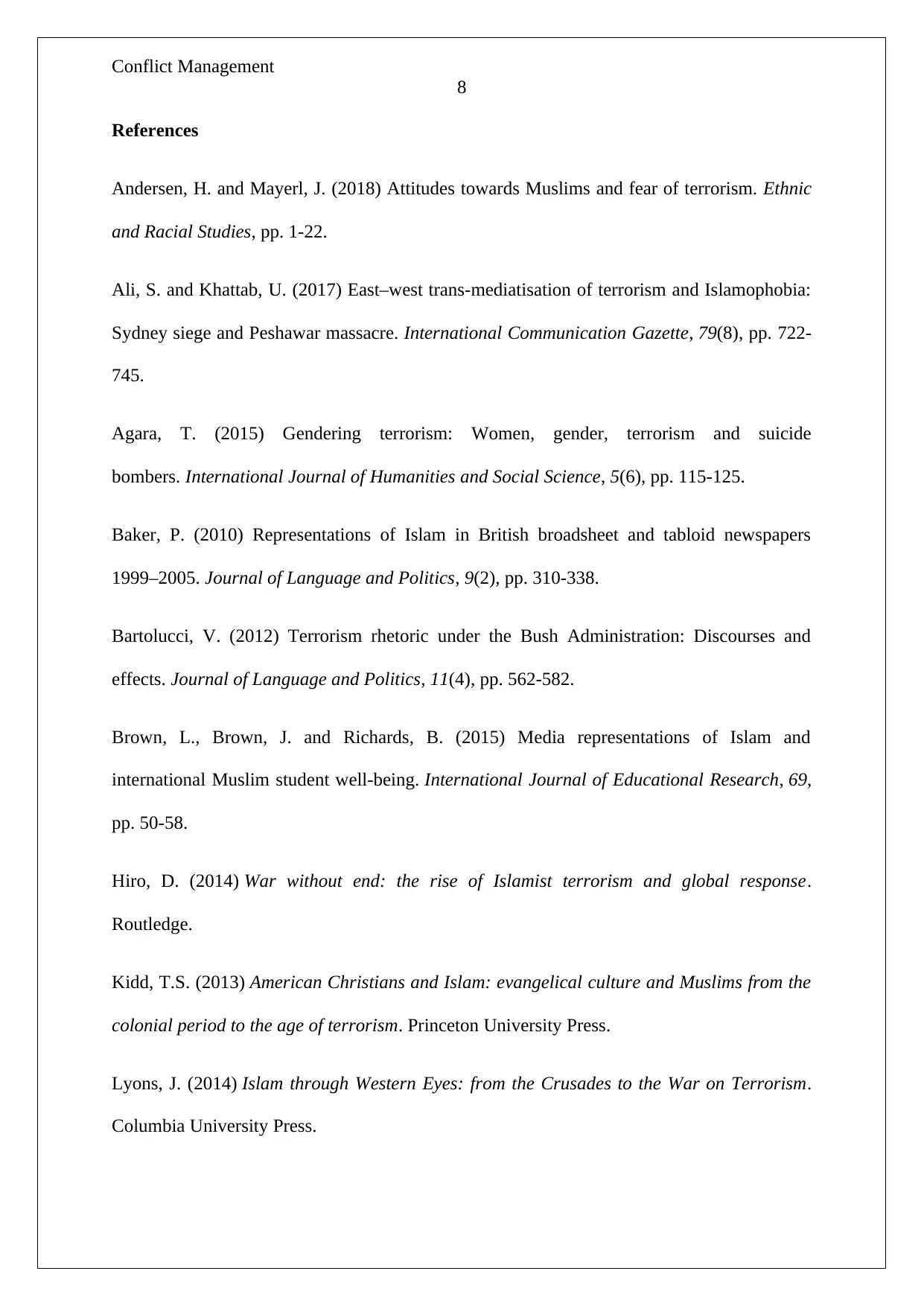
References
Andersen, H. and Mayerl, J. (2018) Attitudes towards Muslims and fear of terrorism. Ethnic
and Racial Studies, pp. 1-22.
Ali, S. and Khattab, U. (2017) East–west trans-mediatisation of terrorism and Islamophobia:
Sydney siege and Peshawar massacre. International Communication Gazette, 79(8), pp. 722-
745.
Agara, T. (2015) Gendering terrorism: Women, gender, terrorism and suicide
bombers. International Journal of Humanities and Social Science, 5(6), pp. 115-125.
Baker, P. (2010) Representations of Islam in British broadsheet and tabloid newspapers
1999–2005. Journal of Language and Politics, 9(2), pp. 310-338.
Bartolucci, V. (2012) Terrorism rhetoric under the Bush Administration: Discourses and
effects. Journal of Language and Politics, 11(4), pp. 562-582.
Brown, L., Brown, J. and Richards, B. (2015) Media representations of Islam and
international Muslim student well-being. International Journal of Educational Research, 69,
pp. 50-58.
Hiro, D. (2014) War without end: the rise of Islamist terrorism and global response.
Routledge.
Kidd, T.S. (2013) American Christians and Islam: evangelical culture and Muslims from the
colonial period to the age of terrorism. Princeton University Press.
Lyons, J. (2014) Islam through Western Eyes: from the Crusades to the War on Terrorism.
Columbia University Press.
8
References
Andersen, H. and Mayerl, J. (2018) Attitudes towards Muslims and fear of terrorism. Ethnic
and Racial Studies, pp. 1-22.
Ali, S. and Khattab, U. (2017) East–west trans-mediatisation of terrorism and Islamophobia:
Sydney siege and Peshawar massacre. International Communication Gazette, 79(8), pp. 722-
745.
Agara, T. (2015) Gendering terrorism: Women, gender, terrorism and suicide
bombers. International Journal of Humanities and Social Science, 5(6), pp. 115-125.
Baker, P. (2010) Representations of Islam in British broadsheet and tabloid newspapers
1999–2005. Journal of Language and Politics, 9(2), pp. 310-338.
Bartolucci, V. (2012) Terrorism rhetoric under the Bush Administration: Discourses and
effects. Journal of Language and Politics, 11(4), pp. 562-582.
Brown, L., Brown, J. and Richards, B. (2015) Media representations of Islam and
international Muslim student well-being. International Journal of Educational Research, 69,
pp. 50-58.
Hiro, D. (2014) War without end: the rise of Islamist terrorism and global response.
Routledge.
Kidd, T.S. (2013) American Christians and Islam: evangelical culture and Muslims from the
colonial period to the age of terrorism. Princeton University Press.
Lyons, J. (2014) Islam through Western Eyes: from the Crusades to the War on Terrorism.
Columbia University Press.
⊘ This is a preview!⊘
Do you want full access?
Subscribe today to unlock all pages.
Trusted by 1+ million students worldwide
Conflict Management
9
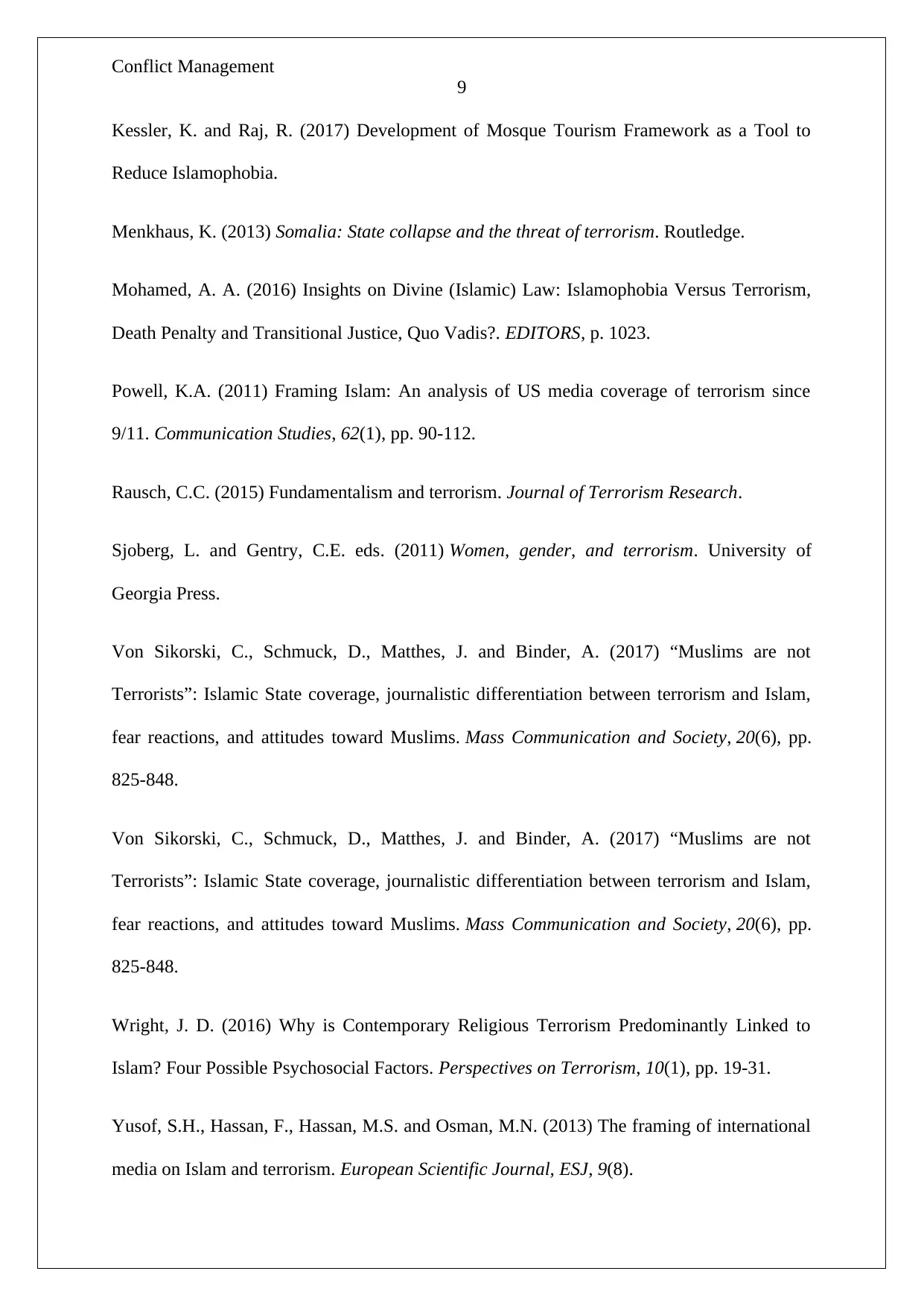
Kessler, K. and Raj, R. (2017) Development of Mosque Tourism Framework as a Tool to
Reduce Islamophobia.
Menkhaus, K. (2013) Somalia: State collapse and the threat of terrorism. Routledge.
Mohamed, A. A. (2016) Insights on Divine (Islamic) Law: Islamophobia Versus Terrorism,
Death Penalty and Transitional Justice, Quo Vadis?. EDITORS, p. 1023.
Powell, K.A. (2011) Framing Islam: An analysis of US media coverage of terrorism since
9/11. Communication Studies, 62(1), pp. 90-112.
Rausch, C.C. (2015) Fundamentalism and terrorism. Journal of Terrorism Research.
Sjoberg, L. and Gentry, C.E. eds. (2011) Women, gender, and terrorism. University of
Georgia Press.
Von Sikorski, C., Schmuck, D., Matthes, J. and Binder, A. (2017) “Muslims are not
Terrorists”: Islamic State coverage, journalistic differentiation between terrorism and Islam,
fear reactions, and attitudes toward Muslims. Mass Communication and Society, 20(6), pp.
825-848.
Von Sikorski, C., Schmuck, D., Matthes, J. and Binder, A. (2017) “Muslims are not
Terrorists”: Islamic State coverage, journalistic differentiation between terrorism and Islam,
fear reactions, and attitudes toward Muslims. Mass Communication and Society, 20(6), pp.
825-848.
Wright, J. D. (2016) Why is Contemporary Religious Terrorism Predominantly Linked to
Islam? Four Possible Psychosocial Factors. Perspectives on Terrorism, 10(1), pp. 19-31.
Yusof, S.H., Hassan, F., Hassan, M.S. and Osman, M.N. (2013) The framing of international
media on Islam and terrorism. European Scientific Journal, ESJ, 9(8).
9
Kessler, K. and Raj, R. (2017) Development of Mosque Tourism Framework as a Tool to
Reduce Islamophobia.
Menkhaus, K. (2013) Somalia: State collapse and the threat of terrorism. Routledge.
Mohamed, A. A. (2016) Insights on Divine (Islamic) Law: Islamophobia Versus Terrorism,
Death Penalty and Transitional Justice, Quo Vadis?. EDITORS, p. 1023.
Powell, K.A. (2011) Framing Islam: An analysis of US media coverage of terrorism since
9/11. Communication Studies, 62(1), pp. 90-112.
Rausch, C.C. (2015) Fundamentalism and terrorism. Journal of Terrorism Research.
Sjoberg, L. and Gentry, C.E. eds. (2011) Women, gender, and terrorism. University of
Georgia Press.
Von Sikorski, C., Schmuck, D., Matthes, J. and Binder, A. (2017) “Muslims are not
Terrorists”: Islamic State coverage, journalistic differentiation between terrorism and Islam,
fear reactions, and attitudes toward Muslims. Mass Communication and Society, 20(6), pp.
825-848.
Von Sikorski, C., Schmuck, D., Matthes, J. and Binder, A. (2017) “Muslims are not
Terrorists”: Islamic State coverage, journalistic differentiation between terrorism and Islam,
fear reactions, and attitudes toward Muslims. Mass Communication and Society, 20(6), pp.
825-848.
Wright, J. D. (2016) Why is Contemporary Religious Terrorism Predominantly Linked to
Islam? Four Possible Psychosocial Factors. Perspectives on Terrorism, 10(1), pp. 19-31.
Yusof, S.H., Hassan, F., Hassan, M.S. and Osman, M.N. (2013) The framing of international
media on Islam and terrorism. European Scientific Journal, ESJ, 9(8).
Paraphrase This Document
Need a fresh take? Get an instant paraphrase of this document with our AI Paraphraser
Conflict Management
10
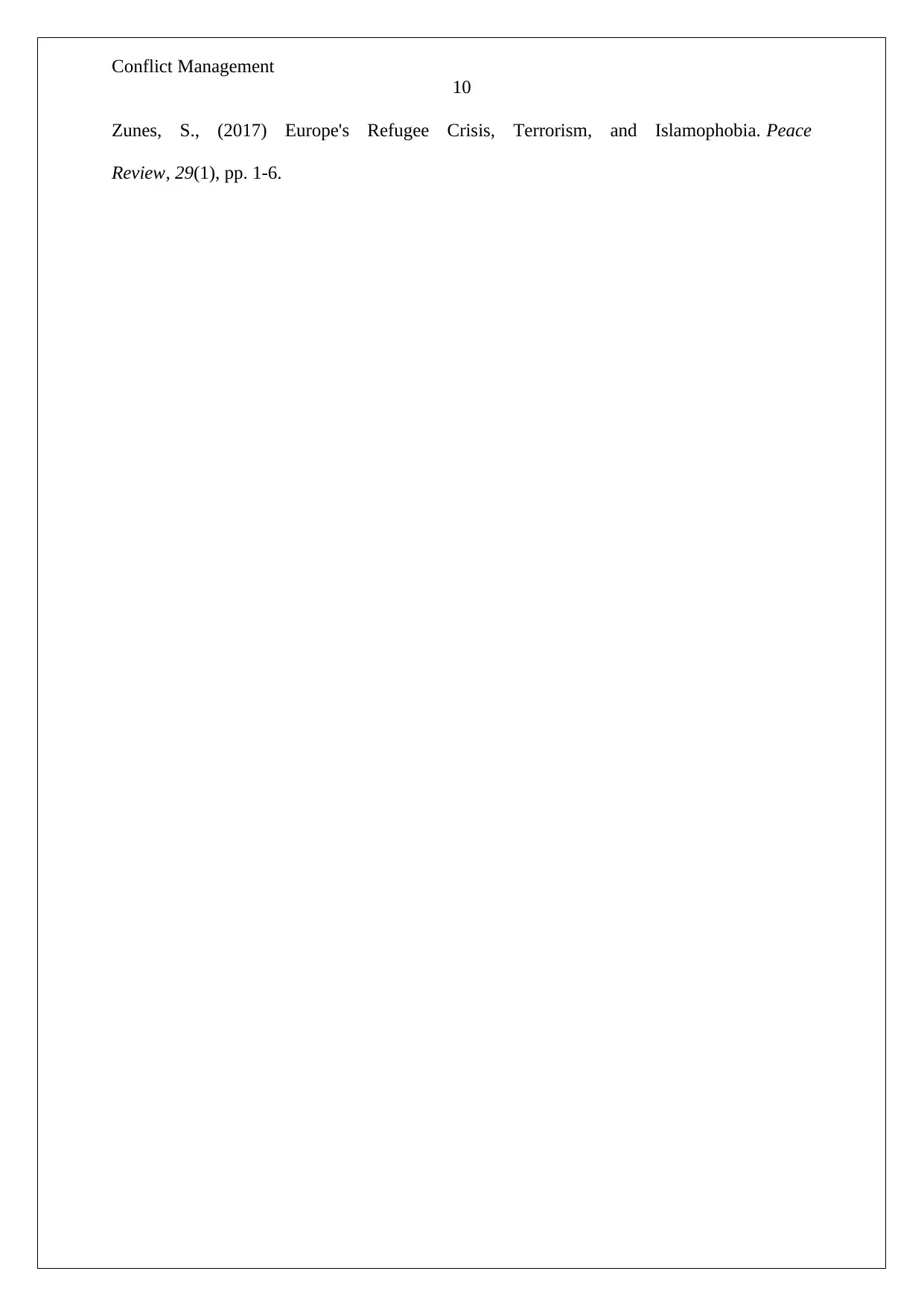
Zunes, S., (2017) Europe's Refugee Crisis, Terrorism, and Islamophobia. Peace
Review, 29(1), pp. 1-6.
10
Zunes, S., (2017) Europe's Refugee Crisis, Terrorism, and Islamophobia. Peace
Review, 29(1), pp. 1-6.

1 out of 11


Related Documents


Your All-in-One AI-Powered Toolkit for Academic Success.
+13062052269
info@desklib.com
Available 24*7 on WhatsApp / Email
![[object Object]](/_next/static/media/star-bottom.7253800d.svg)
Unlock your academic potential
Copyright © 2020–2026 A2Z Services. All Rights Reserved. Developed and managed by ZUCOL.