McDonald's Financial Statement Analysis: Comprehensive Report
VerifiedAdded on 2023/06/17
|15
|4358
|115
Report
AI Summary
This report provides a comprehensive financial statement analysis of McDonald's, a leading global fast-food company. It includes a tearsheet analysis of McDonald's stock price, a company profile with segmental analysis, and an industry analysis using SWOT and PESTEL frameworks. The report also features a competitor analysis using Porter's Five Forces model, a discussion of the company's business model and corporate strategy, and a summary analysis of McDonald's financial statements. Furthermore, it presents a full financial ratio analysis with trend analysis, comparison with industry ratios, and customized industry ratios, along with company valuations and a basic free cash flow model. The analysis covers key corporate events and macroeconomic factors influencing the company's performance, offering valuable insights into McDonald's financial health and strategic positioning within the fast-food industry.
Financial Statement
Analysis
Analysis

Paraphrase This Document
Need a fresh take? Get an instant paraphrase of this document with our AI Paraphraser
Contents
Introduction ..........................................................................................................................................3
TASK ......................................................................................................................................................3
I. Tearsheet........................................................................................................................................3
II. Company profile including a Segmental Analysis...........................................................................3
III. Industry Analysis ..........................................................................................................................4
IV. Competitor analysis, using Porter’s Five Forces model.................................................................7
V. Discussion of the company’s business model and corporate strategy...........................................8
VI Key Corporate events in McDonald's ............................................................................................8
VII. A summary analysis of the company’s financial statements........................................................9
VIII. A full financial ratio analysis, including trend analysis, comparison with industry ratios, the
identification and computation of customised industry ratios..........................................................9
IX. Company valuations ...................................................................................................................10
X Basic free cash flow model ...........................................................................................................11
Conclusion...........................................................................................................................................11
References ..........................................................................................................................................12
Appendices..........................................................................................................................................14
Introduction ..........................................................................................................................................3
TASK ......................................................................................................................................................3
I. Tearsheet........................................................................................................................................3
II. Company profile including a Segmental Analysis...........................................................................3
III. Industry Analysis ..........................................................................................................................4
IV. Competitor analysis, using Porter’s Five Forces model.................................................................7
V. Discussion of the company’s business model and corporate strategy...........................................8
VI Key Corporate events in McDonald's ............................................................................................8
VII. A summary analysis of the company’s financial statements........................................................9
VIII. A full financial ratio analysis, including trend analysis, comparison with industry ratios, the
identification and computation of customised industry ratios..........................................................9
IX. Company valuations ...................................................................................................................10
X Basic free cash flow model ...........................................................................................................11
Conclusion...........................................................................................................................................11
References ..........................................................................................................................................12
Appendices..........................................................................................................................................14
Introduction
Analysis is a process of establishing meaningful relation between two or more variable that
helps the analyst in decision making of different kinds. Financial analysis is one of the main
kinds of analysis done and in this the managers critically analyse the financial information of
the company (Monahan, 2018). The main components in analysing financial information are
the end term statements as these include all the necessary data required to perform the
accurate analysis. These statements are: Statement of financial performance, statement
showing profit/ loss, cash flow statement of the company. This report highlights how these
statements are used to analyse the financial data and how macroeconomic factors of the
company influence its working. The company chosen for this report is McDonald’s, an
American fast-food company.
TASK
I. Tearsheet
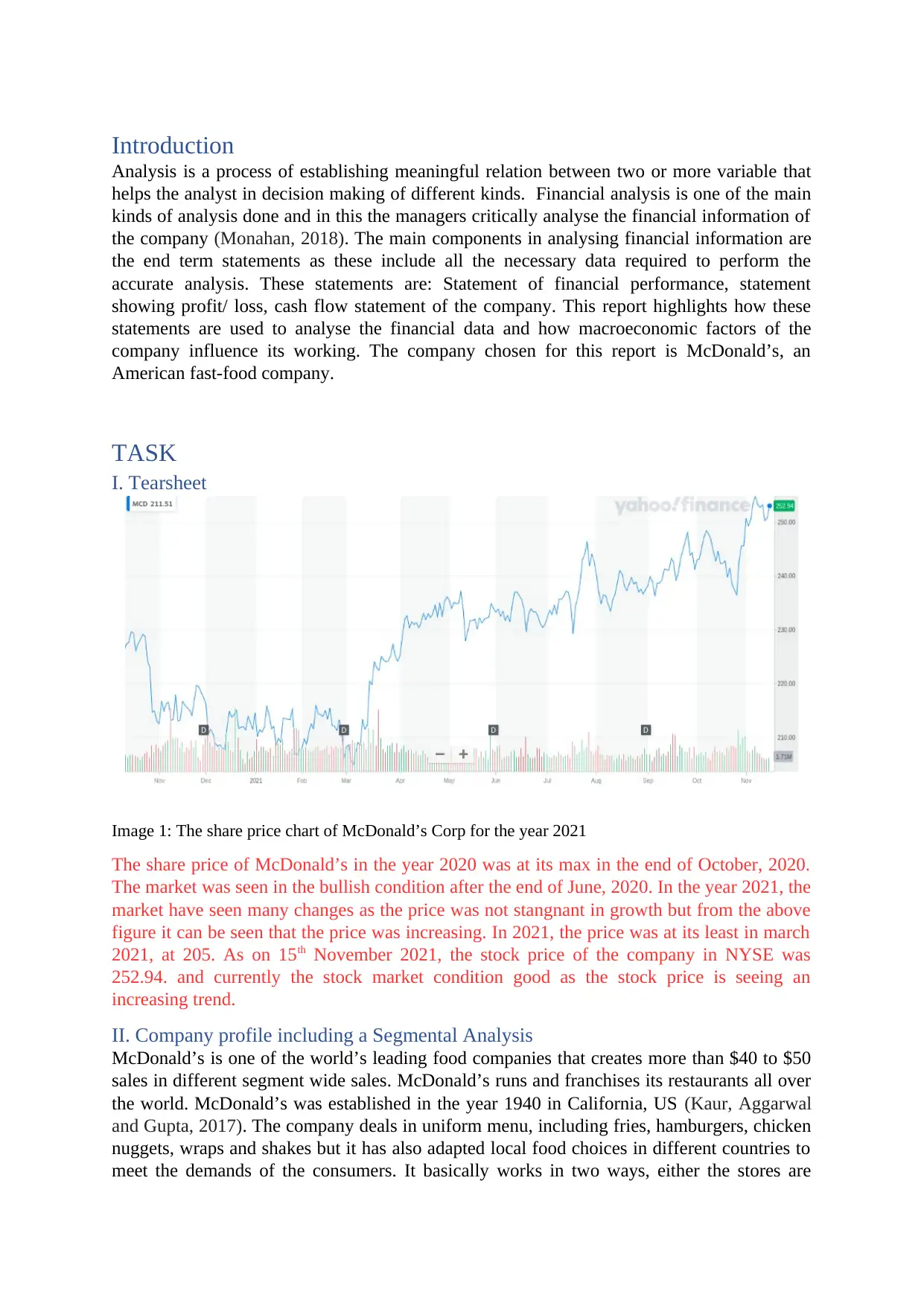
Image 1: The share price chart of McDonald’s Corp for the year 2021
The share price of McDonald’s in the year 2020 was at its max in the end of October, 2020.
The market was seen in the bullish condition after the end of June, 2020. In the year 2021, the
market have seen many changes as the price was not stangnant in growth but from the above
figure it can be seen that the price was increasing. In 2021, the price was at its least in march
2021, at 205. As on 15th November 2021, the stock price of the company in NYSE was
252.94. and currently the stock market condition good as the stock price is seeing an
increasing trend.
II. Company profile including a Segmental Analysis
McDonald’s is one of the world’s leading food companies that creates more than $40 to $50
sales in different segment wide sales. McDonald’s runs and franchises its restaurants all over
the world. McDonald’s was established in the year 1940 in California, US (Kaur, Aggarwal
and Gupta, 2017). The company deals in uniform menu, including fries, hamburgers, chicken
nuggets, wraps and shakes but it has also adapted local food choices in different countries to
meet the demands of the consumers. It basically works in two ways, either the stores are
Analysis is a process of establishing meaningful relation between two or more variable that
helps the analyst in decision making of different kinds. Financial analysis is one of the main
kinds of analysis done and in this the managers critically analyse the financial information of
the company (Monahan, 2018). The main components in analysing financial information are
the end term statements as these include all the necessary data required to perform the
accurate analysis. These statements are: Statement of financial performance, statement
showing profit/ loss, cash flow statement of the company. This report highlights how these
statements are used to analyse the financial data and how macroeconomic factors of the
company influence its working. The company chosen for this report is McDonald’s, an
American fast-food company.
TASK
I. Tearsheet
Image 1: The share price chart of McDonald’s Corp for the year 2021
The share price of McDonald’s in the year 2020 was at its max in the end of October, 2020.
The market was seen in the bullish condition after the end of June, 2020. In the year 2021, the
market have seen many changes as the price was not stangnant in growth but from the above
figure it can be seen that the price was increasing. In 2021, the price was at its least in march
2021, at 205. As on 15th November 2021, the stock price of the company in NYSE was
252.94. and currently the stock market condition good as the stock price is seeing an
increasing trend.
II. Company profile including a Segmental Analysis
McDonald’s is one of the world’s leading food companies that creates more than $40 to $50
sales in different segment wide sales. McDonald’s runs and franchises its restaurants all over
the world. McDonald’s was established in the year 1940 in California, US (Kaur, Aggarwal
and Gupta, 2017). The company deals in uniform menu, including fries, hamburgers, chicken
nuggets, wraps and shakes but it has also adapted local food choices in different countries to
meet the demands of the consumers. It basically works in two ways, either the stores are
⊘ This is a preview!⊘
Do you want full access?
Subscribe today to unlock all pages.

Trusted by 1+ million students worldwide
company-operated or they are franchised. The growth in the franchised stores have increased
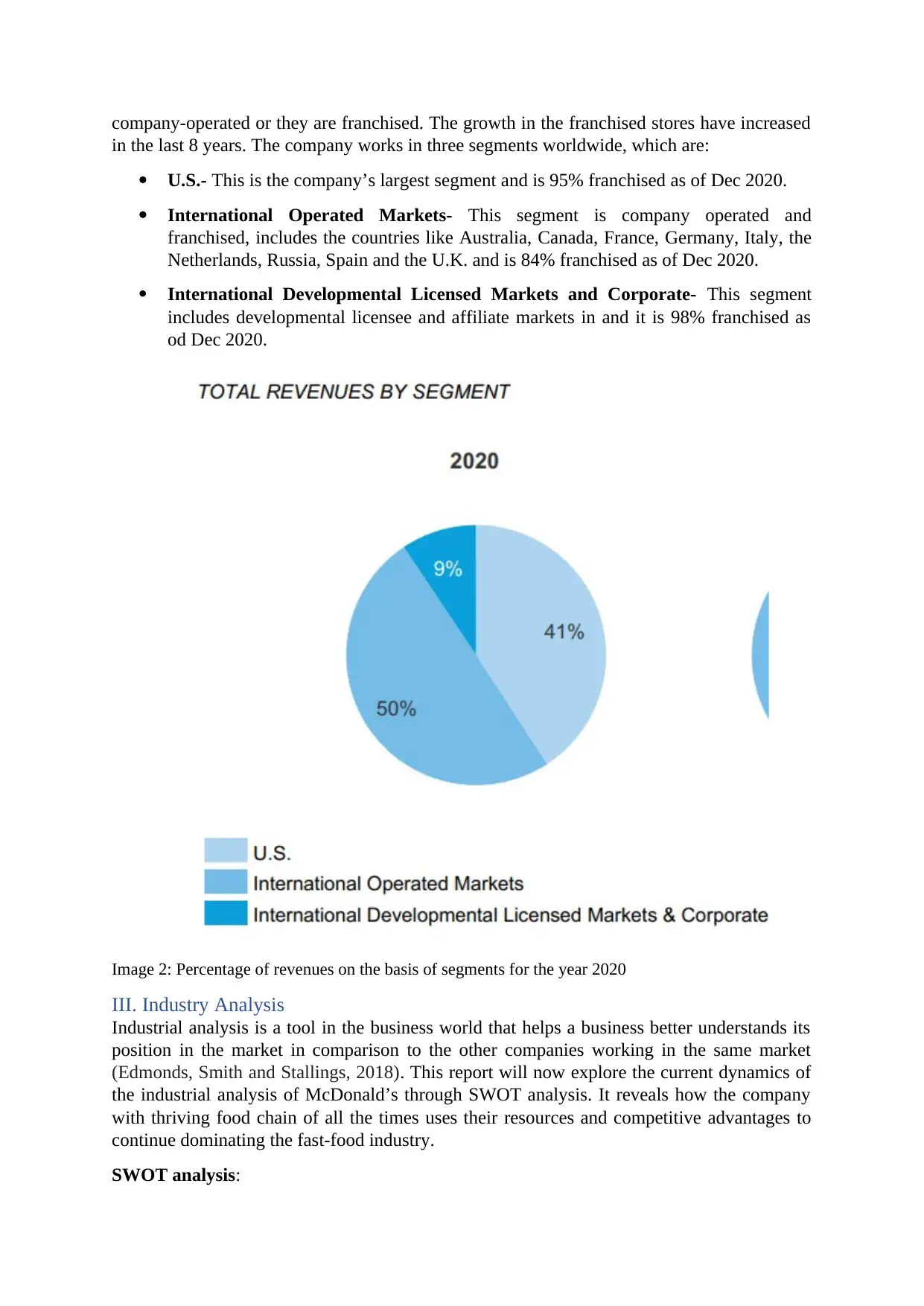
in the last 8 years. The company works in three segments worldwide, which are:
U.S.- This is the company’s largest segment and is 95% franchised as of Dec 2020.
International Operated Markets- This segment is company operated and
franchised, includes the countries like Australia, Canada, France, Germany, Italy, the
Netherlands, Russia, Spain and the U.K. and is 84% franchised as of Dec 2020.
International Developmental Licensed Markets and Corporate- This segment
includes developmental licensee and affiliate markets in and it is 98% franchised as
od Dec 2020.
Image 2: Percentage of revenues on the basis of segments for the year 2020
III. Industry Analysis
Industrial analysis is a tool in the business world that helps a business better understands its
position in the market in comparison to the other companies working in the same market
(Edmonds, Smith and Stallings, 2018). This report will now explore the current dynamics of
the industrial analysis of McDonald’s through SWOT analysis. It reveals how the company
with thriving food chain of all the times uses their resources and competitive advantages to
continue dominating the fast-food industry.
SWOT analysis:
in the last 8 years. The company works in three segments worldwide, which are:
U.S.- This is the company’s largest segment and is 95% franchised as of Dec 2020.
International Operated Markets- This segment is company operated and
franchised, includes the countries like Australia, Canada, France, Germany, Italy, the
Netherlands, Russia, Spain and the U.K. and is 84% franchised as of Dec 2020.
International Developmental Licensed Markets and Corporate- This segment
includes developmental licensee and affiliate markets in and it is 98% franchised as
od Dec 2020.
Image 2: Percentage of revenues on the basis of segments for the year 2020
III. Industry Analysis
Industrial analysis is a tool in the business world that helps a business better understands its
position in the market in comparison to the other companies working in the same market
(Edmonds, Smith and Stallings, 2018). This report will now explore the current dynamics of
the industrial analysis of McDonald’s through SWOT analysis. It reveals how the company
with thriving food chain of all the times uses their resources and competitive advantages to
continue dominating the fast-food industry.
SWOT analysis:
Paraphrase This Document
Need a fresh take? Get an instant paraphrase of this document with our AI Paraphraser
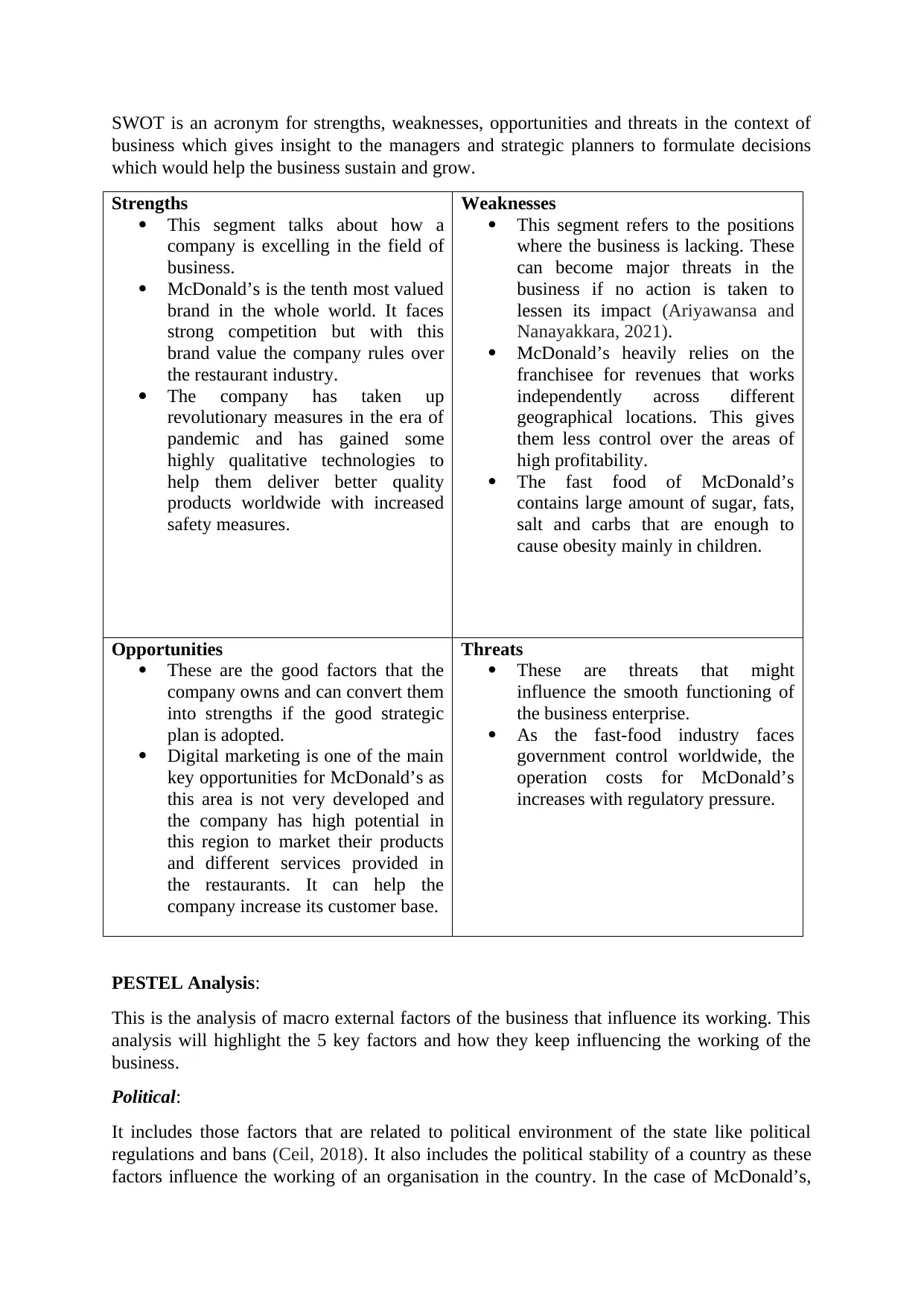
SWOT is an acronym for strengths, weaknesses, opportunities and threats in the context of
business which gives insight to the managers and strategic planners to formulate decisions
which would help the business sustain and grow.
Strengths
This segment talks about how a
company is excelling in the field of
business.
McDonald’s is the tenth most valued
brand in the whole world. It faces
strong competition but with this
brand value the company rules over
the restaurant industry.
The company has taken up
revolutionary measures in the era of
pandemic and has gained some
highly qualitative technologies to
help them deliver better quality
products worldwide with increased
safety measures.
Weaknesses
This segment refers to the positions
where the business is lacking. These
can become major threats in the
business if no action is taken to
lessen its impact (Ariyawansa and
Nanayakkara, 2021).
McDonald’s heavily relies on the
franchisee for revenues that works
independently across different
geographical locations. This gives
them less control over the areas of
high profitability.
The fast food of McDonald’s
contains large amount of sugar, fats,
salt and carbs that are enough to
cause obesity mainly in children.
Opportunities
These are the good factors that the
company owns and can convert them
into strengths if the good strategic
plan is adopted.
Digital marketing is one of the main
key opportunities for McDonald’s as
this area is not very developed and
the company has high potential in
this region to market their products
and different services provided in
the restaurants. It can help the
company increase its customer base.
Threats
These are threats that might
influence the smooth functioning of
the business enterprise.
As the fast-food industry faces
government control worldwide, the
operation costs for McDonald’s
increases with regulatory pressure.
PESTEL Analysis:
This is the analysis of macro external factors of the business that influence its working. This
analysis will highlight the 5 key factors and how they keep influencing the working of the
business.
Political:
It includes those factors that are related to political environment of the state like political
regulations and bans (Ceil, 2018). It also includes the political stability of a country as these
factors influence the working of an organisation in the country. In the case of McDonald’s,
business which gives insight to the managers and strategic planners to formulate decisions
which would help the business sustain and grow.
Strengths
This segment talks about how a
company is excelling in the field of
business.
McDonald’s is the tenth most valued
brand in the whole world. It faces
strong competition but with this
brand value the company rules over
the restaurant industry.
The company has taken up
revolutionary measures in the era of
pandemic and has gained some
highly qualitative technologies to
help them deliver better quality
products worldwide with increased
safety measures.
Weaknesses
This segment refers to the positions
where the business is lacking. These
can become major threats in the
business if no action is taken to
lessen its impact (Ariyawansa and
Nanayakkara, 2021).
McDonald’s heavily relies on the
franchisee for revenues that works
independently across different
geographical locations. This gives
them less control over the areas of
high profitability.
The fast food of McDonald’s
contains large amount of sugar, fats,
salt and carbs that are enough to
cause obesity mainly in children.
Opportunities
These are the good factors that the
company owns and can convert them
into strengths if the good strategic
plan is adopted.
Digital marketing is one of the main
key opportunities for McDonald’s as
this area is not very developed and
the company has high potential in
this region to market their products
and different services provided in
the restaurants. It can help the
company increase its customer base.
Threats
These are threats that might
influence the smooth functioning of
the business enterprise.
As the fast-food industry faces
government control worldwide, the
operation costs for McDonald’s
increases with regulatory pressure.
PESTEL Analysis:
This is the analysis of macro external factors of the business that influence its working. This
analysis will highlight the 5 key factors and how they keep influencing the working of the
business.
Political:
It includes those factors that are related to political environment of the state like political
regulations and bans (Ceil, 2018). It also includes the political stability of a country as these
factors influence the working of an organisation in the country. In the case of McDonald’s,
fast-food industry is always at target by the government due to concerns of food safety and
health of the consumers, if McDonald’s does not comply with the standards of the food and
provide safety to the consumers, the political powers may ask the business to shut in the said
country. Bad relations between the countries have led the businesses of McDonald’s shut in
the countries like Iran who has some animosity with US.
Economic factors:
It includes factors such as employment rate, inflation rate etc. This factor may influence how
the company set prices for its products and services. McDonald’s operates in more than 180
countries and maintaining the volatile fluctuations in the currency of these countries gets hard
and procurement of the raw materials has to be done strategically to face the lowest cost of
production with increased revenues. The recent recession in many parts of the world has
reduced the demand for fast food products, this affects the working of the McDonald’s
directly.
Social factors:
It includes the socio-cultural factors that can affect the business (Cui, Allan and Lin, 2019).
Society is important for a business to strategically plan the working in different countries as
these have varied cultures and social factors. As McDonald’s has outlets in different
countries, each country is entitled to their culture, living style, values and religions. Selling of
the beef related items in India are considered an offense due to the sentiments of the Hindus.
Thus, McDonald has created a menu for special vegetarian meal in order to cater to Indian
market. Therefore, McDonald has to provide a food with healthier ingredients for their
customers mainly children.
Technological factor:
It involves adaptation of technological advancement in the organization. Innovations in
technology may affect the market and consumer choices and buying power. McDonald’s has
faced a huge challenge regarding the disposal of waste. Furthermore, with the high-end
technology, the company has strengthened their brand image by offering various channels for
ordering by customers (online order and store self service) (Fozer, and et.al. 2017). During
this pandemic where people are rarely going outside for food, online ordering has enabled the
McDonald to serve their customers. It has also allowed the McDonald to collect customer’s
data and undertake personalised promotions and marketing. Lastly, it has enabled the
McDonald to reach target market and to undertake possible social media strategies in order to
engage their customers.
Environmental factors:
It includes those factors that can affect the environment at large. Businesses have to take in
consideration the protection of the ecosystem and how they can do better to reduce their
carbon footprint. In the case of McDonald’s, the sustainable packaging helps the business
meet its sustainability goals and comply with CSR needs. Sustainable agriculture is another
step taken up by the McDonald’s to get food ingredients in better conditions whild taking in
account the environmental factors at large.
Legal:
health of the consumers, if McDonald’s does not comply with the standards of the food and
provide safety to the consumers, the political powers may ask the business to shut in the said
country. Bad relations between the countries have led the businesses of McDonald’s shut in
the countries like Iran who has some animosity with US.
Economic factors:
It includes factors such as employment rate, inflation rate etc. This factor may influence how
the company set prices for its products and services. McDonald’s operates in more than 180
countries and maintaining the volatile fluctuations in the currency of these countries gets hard
and procurement of the raw materials has to be done strategically to face the lowest cost of
production with increased revenues. The recent recession in many parts of the world has
reduced the demand for fast food products, this affects the working of the McDonald’s
directly.
Social factors:
It includes the socio-cultural factors that can affect the business (Cui, Allan and Lin, 2019).
Society is important for a business to strategically plan the working in different countries as
these have varied cultures and social factors. As McDonald’s has outlets in different
countries, each country is entitled to their culture, living style, values and religions. Selling of
the beef related items in India are considered an offense due to the sentiments of the Hindus.
Thus, McDonald has created a menu for special vegetarian meal in order to cater to Indian
market. Therefore, McDonald has to provide a food with healthier ingredients for their
customers mainly children.
Technological factor:
It involves adaptation of technological advancement in the organization. Innovations in
technology may affect the market and consumer choices and buying power. McDonald’s has
faced a huge challenge regarding the disposal of waste. Furthermore, with the high-end
technology, the company has strengthened their brand image by offering various channels for
ordering by customers (online order and store self service) (Fozer, and et.al. 2017). During
this pandemic where people are rarely going outside for food, online ordering has enabled the
McDonald to serve their customers. It has also allowed the McDonald to collect customer’s
data and undertake personalised promotions and marketing. Lastly, it has enabled the
McDonald to reach target market and to undertake possible social media strategies in order to
engage their customers.
Environmental factors:
It includes those factors that can affect the environment at large. Businesses have to take in
consideration the protection of the ecosystem and how they can do better to reduce their
carbon footprint. In the case of McDonald’s, the sustainable packaging helps the business
meet its sustainability goals and comply with CSR needs. Sustainable agriculture is another
step taken up by the McDonald’s to get food ingredients in better conditions whild taking in
account the environmental factors at large.
Legal:
⊘ This is a preview!⊘
Do you want full access?
Subscribe today to unlock all pages.
Trusted by 1+ million students worldwide
It is concerned with compliance of laws and regulations of the state. The regulatory context
has a major impact on the success of a business (Gupta, Gupta, and Gupta, 2019). Higher
level of rules and regulations possible stifle the growth of a business, whilst lower level of
regulation allows the business to make profit. In India, McDonald’s has faced a real threat
due to closing of businesses in the north India due to legal suit of mismanagement.
Competitors have grown and set up their business in the restaurant industry.
IV. Competitor analysis, using Porter’s Five Forces model
Porter’s five forces model:
This model helps the business strategic managers to have a deep insight about the industry
and how the competitors of the company are working and how the company can hold a
competitive advantage in the industry.
Rivalry among the Competitors:
The fast-food industry is growing in a fast pace due to successful food chain which is making
the market competition intense (Thamprasert, Pastpipatkul, and Yamaka, 2018). McDonald’s
has value of 150,500 million USD and followed by the Starbucks with a value of 45,884
million USD. On the other hand, Dominos, KFC are indirect competitors (selling cheaper
pizzas and chicken fries) targeting similar customer group. Therefore, it can be considered
that rivalry among the competitors have strong force.
Bargaining power of supplies:
With the growing fast-food companies, the numbers of suppliers are also increasing. They are
selling raw materials, such as vegetables, chicken and other ingredients. For that reason, the
position of supplier is weak as there is no position to bargain and to increase a price of raw
products.
Bargaining power of buyers:
The customer has wide varieties of choices to buy in the fast-food industry. There are many
new fast-food companies offering best products at cheaper price (Dilip, and et.al. 2021). As a
result, the customer loyalty has become harder to get and McDonald’s intends to keep their
prices at best level for customer to return. Therefore, the bargaining power of customers is
high as they enjoy variety of choices.
Threats of new entry:
Internationally, many new companies have developed their outlets and competing with
McDonald’s food products. However, to become a successful fast-food company, a great
investment, great food recipes, lot of time are needed. Internationally it is difficult for new
entrants to attain success but at the local level there is a huge chance. The power of new entry
is neither strong nor weak or it can be considered as moderate.
Threats of products substitution:
There are many food substitutions on the market that often competes with McDonald’s food
products, such as bakeries, homemade foods and many more (Rodrigues, Nikhil and Jacob,
2021). All these factors pose a threat to the company, mainly in customer satisfaction as well
as quality. Also, the customers are tilted towards healthier options (to tackle obesity) and the
has a major impact on the success of a business (Gupta, Gupta, and Gupta, 2019). Higher
level of rules and regulations possible stifle the growth of a business, whilst lower level of
regulation allows the business to make profit. In India, McDonald’s has faced a real threat
due to closing of businesses in the north India due to legal suit of mismanagement.
Competitors have grown and set up their business in the restaurant industry.
IV. Competitor analysis, using Porter’s Five Forces model
Porter’s five forces model:
This model helps the business strategic managers to have a deep insight about the industry
and how the competitors of the company are working and how the company can hold a
competitive advantage in the industry.
Rivalry among the Competitors:
The fast-food industry is growing in a fast pace due to successful food chain which is making
the market competition intense (Thamprasert, Pastpipatkul, and Yamaka, 2018). McDonald’s
has value of 150,500 million USD and followed by the Starbucks with a value of 45,884
million USD. On the other hand, Dominos, KFC are indirect competitors (selling cheaper
pizzas and chicken fries) targeting similar customer group. Therefore, it can be considered
that rivalry among the competitors have strong force.
Bargaining power of supplies:
With the growing fast-food companies, the numbers of suppliers are also increasing. They are
selling raw materials, such as vegetables, chicken and other ingredients. For that reason, the
position of supplier is weak as there is no position to bargain and to increase a price of raw
products.
Bargaining power of buyers:
The customer has wide varieties of choices to buy in the fast-food industry. There are many
new fast-food companies offering best products at cheaper price (Dilip, and et.al. 2021). As a
result, the customer loyalty has become harder to get and McDonald’s intends to keep their
prices at best level for customer to return. Therefore, the bargaining power of customers is
high as they enjoy variety of choices.
Threats of new entry:
Internationally, many new companies have developed their outlets and competing with
McDonald’s food products. However, to become a successful fast-food company, a great
investment, great food recipes, lot of time are needed. Internationally it is difficult for new
entrants to attain success but at the local level there is a huge chance. The power of new entry
is neither strong nor weak or it can be considered as moderate.
Threats of products substitution:
There are many food substitutions on the market that often competes with McDonald’s food
products, such as bakeries, homemade foods and many more (Rodrigues, Nikhil and Jacob,
2021). All these factors pose a threat to the company, mainly in customer satisfaction as well
as quality. Also, the customers are tilted towards healthier options (to tackle obesity) and the
Paraphrase This Document
Need a fresh take? Get an instant paraphrase of this document with our AI Paraphraser
company may rethink to enhance their product quality and improvement. This threat is
strong in the industry.
V. Discussion of the company’s business model and corporate strategy
Business Model:
Business model refers to the basic plan of the company to earn profit. This refers to how the
business is going to work and what all things are to be done to earn revenue. It identifies the
products and services and the potential market place where the business is going to sell its
commodities.
In the case of McDonald’s, it follows franchised business model. Franchised business model
means that the company gives franchisee of its name and trademark to different investors all
around the world. As a result, the brand generated high revenue by becoming the leader of its
franchisee. Moreover, the revenue model of the company is an adaptation of franchisee and
strategy suppliers.
The business model includes three pillars:
To retain the customer.
To regain the customers by enhancing the quality and food taste, strong value and best
customer services.
Convert new customers to loyal one.
The transition to franchisee model is a part of the long-term strategy. Furthermore, as a rent
or a royalty income from franchisee offers more stable and predictable revenue stream with
low operating cost. McDonald is introducing subscription business model, which means the
franchisee has to pay a fixed amount.
Corporate strategy:
Corporate strategy refers to the long-term planning of a business with specific goals and
target within a precise time with the accessible resources (Zeller, Kostolansky, and Bozoudis,
2019). It is a organization plan created by the top level of management in order to make the
business runs in profit. Business strategy for the company is to make food fast available to its
consumers at a very low competitive price. Their franchisee offers the services around the
world, guide behaviour and actions getting competitive strategies. Their growth pillars are
solely built on MCD (Marketing, commit and delivery).
VI Key Corporate events in McDonald's
The modern McDonald's has been one of the fast growing fast food restaurants that have been
targeted by labor movements for the hiring practices. The company has faced many strikes in
the history of fast food corporations. This has lead to the fight for fifteen, to push the national
minimum wage to $15 an hour. In the year 1993, the company opened its first McCafe in
australia to run a coffee restaurant. By the year 2000, the company opened more than 11000
restaurants outside of the US. The company have grown at a really good pace in 2000s.
strong in the industry.
V. Discussion of the company’s business model and corporate strategy
Business Model:
Business model refers to the basic plan of the company to earn profit. This refers to how the
business is going to work and what all things are to be done to earn revenue. It identifies the
products and services and the potential market place where the business is going to sell its
commodities.
In the case of McDonald’s, it follows franchised business model. Franchised business model
means that the company gives franchisee of its name and trademark to different investors all
around the world. As a result, the brand generated high revenue by becoming the leader of its
franchisee. Moreover, the revenue model of the company is an adaptation of franchisee and
strategy suppliers.
The business model includes three pillars:
To retain the customer.
To regain the customers by enhancing the quality and food taste, strong value and best
customer services.
Convert new customers to loyal one.
The transition to franchisee model is a part of the long-term strategy. Furthermore, as a rent
or a royalty income from franchisee offers more stable and predictable revenue stream with
low operating cost. McDonald is introducing subscription business model, which means the
franchisee has to pay a fixed amount.
Corporate strategy:
Corporate strategy refers to the long-term planning of a business with specific goals and
target within a precise time with the accessible resources (Zeller, Kostolansky, and Bozoudis,
2019). It is a organization plan created by the top level of management in order to make the
business runs in profit. Business strategy for the company is to make food fast available to its
consumers at a very low competitive price. Their franchisee offers the services around the
world, guide behaviour and actions getting competitive strategies. Their growth pillars are
solely built on MCD (Marketing, commit and delivery).
VI Key Corporate events in McDonald's
The modern McDonald's has been one of the fast growing fast food restaurants that have been
targeted by labor movements for the hiring practices. The company has faced many strikes in
the history of fast food corporations. This has lead to the fight for fifteen, to push the national
minimum wage to $15 an hour. In the year 1993, the company opened its first McCafe in
australia to run a coffee restaurant. By the year 2000, the company opened more than 11000
restaurants outside of the US. The company have grown at a really good pace in 2000s.
VII. A summary analysis of the company’s financial statements
A financial summary is a report of a company’s current value (Lessambo, 2018). In the case
of McDonald’s, after analysing the financial reports for the year 2020 it has been summarised
that the net profit for the year 2020 were 4730.5 million which were approximately 1250
million less than the last year. The total assets and liabilities of the company were 52626.8
million which have been increased by 5100 million dollars. The cash and cash equivalents at
the end of the year were 3,449.1 million dollars which have seen significant rise from the last
year.
VIII. A full financial ratio analysis, including trend analysis, comparison with industry
ratios, the identification and computation of customised industry ratios
Financial Ratio Analysis is a tool in accounting which helps managers analyse the financial
information (Pouliasis, Papapostolou and Visvikis, 2018). (Graphical representation in
Appendices)
Liquidity Ratio: This ratio tells the company’s ability to pay its short-term debt
Current ratio= Current assets/ current liabilities
= 6,243.2/ 6,181.2
= 1.01
The current ratio of McDonald’s is 1.01. This means that the company can
cover its liabilities 1.01 times. Comparing this with the last FY, this year the
ratio has increased which interpret the company is doing better from last year.
The ideal current ratio lies in between one and three. In the industry, the
current ratio is 1.01 as well which means that McDonald’s performance is
moderate.
Quick Ratio= (Cash + Accounts receivables + Marketable securities)/current liabilities
= (3,449.1 + 2,110.3) / 6,181.2
= 5559.4 / 6181.2
= 0.89
The ideal ratio is supposed to be 1:1. McDonald’s has a quick ratio of 0.89,
which means that the firm’s liquid asset is not enough to meet its short-term
liability requirements. Compared to last year, the company has done better this
year. In the industry, the company has higher quick ratio compared to 61% of
the companies in fast-food industry.
Profitability Ratio: This tells how profitable the business is.
Profit Margin= Profit after tax/ Revenue
= (4,730.5/ 19,207.8) *100
= 0.246*100
= 24.6%
A financial summary is a report of a company’s current value (Lessambo, 2018). In the case
of McDonald’s, after analysing the financial reports for the year 2020 it has been summarised
that the net profit for the year 2020 were 4730.5 million which were approximately 1250
million less than the last year. The total assets and liabilities of the company were 52626.8
million which have been increased by 5100 million dollars. The cash and cash equivalents at
the end of the year were 3,449.1 million dollars which have seen significant rise from the last
year.
VIII. A full financial ratio analysis, including trend analysis, comparison with industry
ratios, the identification and computation of customised industry ratios
Financial Ratio Analysis is a tool in accounting which helps managers analyse the financial
information (Pouliasis, Papapostolou and Visvikis, 2018). (Graphical representation in
Appendices)
Liquidity Ratio: This ratio tells the company’s ability to pay its short-term debt
Current ratio= Current assets/ current liabilities
= 6,243.2/ 6,181.2
= 1.01
The current ratio of McDonald’s is 1.01. This means that the company can
cover its liabilities 1.01 times. Comparing this with the last FY, this year the
ratio has increased which interpret the company is doing better from last year.
The ideal current ratio lies in between one and three. In the industry, the
current ratio is 1.01 as well which means that McDonald’s performance is
moderate.
Quick Ratio= (Cash + Accounts receivables + Marketable securities)/current liabilities
= (3,449.1 + 2,110.3) / 6,181.2
= 5559.4 / 6181.2
= 0.89
The ideal ratio is supposed to be 1:1. McDonald’s has a quick ratio of 0.89,
which means that the firm’s liquid asset is not enough to meet its short-term
liability requirements. Compared to last year, the company has done better this
year. In the industry, the company has higher quick ratio compared to 61% of
the companies in fast-food industry.
Profitability Ratio: This tells how profitable the business is.
Profit Margin= Profit after tax/ Revenue
= (4,730.5/ 19,207.8) *100
= 0.246*100
= 24.6%
⊘ This is a preview!⊘
Do you want full access?
Subscribe today to unlock all pages.
Trusted by 1+ million students worldwide
This refers to the percentage of amount left after paying all the expenses.
McDonald’s have profit margin of 24.6%. this means that the business
managed to earn 24.6% of revenue for every worth of sales. Company is doing
great in the industry as the industry profit margin -1.9%.
Return on Equity= Net profit after tax/ shareholder’s equity
MacDonald’s has negative equity which means the percentage of
equity is very low to calculate ROE.
Return on Asset= Net profit after tax/ Total assets
= (4,730.5/52,626.8) *100
= 8.9 %
The return on assets measures the percentage of profit
company earns in response to total resources(Roshan,
and et.al. 2012). MacDonald’s earns 8.9% of profit in
response to its total assets which is better than most of
the companies in the industry. The industrial ratio is -
1.6%. but this has decreased from last year in case of
the company.
Trend Analysis
The company is struggling and managing to proceed into a solid trend (Reinganum, 1999).
The long-term trend has been up from 2020 December to 2021. This trend analysis
demonstrates the analysis of net sales, gross profit as well as operating cost on last 5 years.
US Million 2016 2017 2018 2019 2020
Gross Profit $10,205 $10,621 $10,833 $11,179 $9,752
Operating
Cost
$16,877 $13,268 $12,435 $12,295 $11.88
Net Income $24,622 $22,820 $21,258 $11,141 $9,719
IX. Company valuations
McDonald’s valuation is done hereunder:
Company has grown its market to 120 countries with 37,855 restaurants.
McDonald’s net worth at the end of year 2020 was 159 Billion dollars
The product range of McDonald’s is vast with variety of hamburgers and special local
food items for particular countries.
The share price of the company is 253.19 dollars
Market capitalization for the year 2020 was
Market capitalization= share price*total number of shares
McDonald’s have profit margin of 24.6%. this means that the business
managed to earn 24.6% of revenue for every worth of sales. Company is doing
great in the industry as the industry profit margin -1.9%.
Return on Equity= Net profit after tax/ shareholder’s equity
MacDonald’s has negative equity which means the percentage of
equity is very low to calculate ROE.
Return on Asset= Net profit after tax/ Total assets
= (4,730.5/52,626.8) *100
= 8.9 %
The return on assets measures the percentage of profit
company earns in response to total resources(Roshan,
and et.al. 2012). MacDonald’s earns 8.9% of profit in
response to its total assets which is better than most of
the companies in the industry. The industrial ratio is -
1.6%. but this has decreased from last year in case of
the company.
Trend Analysis
The company is struggling and managing to proceed into a solid trend (Reinganum, 1999).
The long-term trend has been up from 2020 December to 2021. This trend analysis
demonstrates the analysis of net sales, gross profit as well as operating cost on last 5 years.
US Million 2016 2017 2018 2019 2020
Gross Profit $10,205 $10,621 $10,833 $11,179 $9,752
Operating
Cost
$16,877 $13,268 $12,435 $12,295 $11.88
Net Income $24,622 $22,820 $21,258 $11,141 $9,719
IX. Company valuations
McDonald’s valuation is done hereunder:
Company has grown its market to 120 countries with 37,855 restaurants.
McDonald’s net worth at the end of year 2020 was 159 Billion dollars
The product range of McDonald’s is vast with variety of hamburgers and special local
food items for particular countries.
The share price of the company is 253.19 dollars
Market capitalization for the year 2020 was
Market capitalization= share price*total number of shares
Paraphrase This Document
Need a fresh take? Get an instant paraphrase of this document with our AI Paraphraser
= 253.19*429.69
= 108,793.2 dollars
Earnings per share for the FY 2020 were 5.04 dollars
P/E ratio of McDonald’s in 2020 was
P/E ratio= share price/ earnings per share
= 253.19/5.04
= 50.2
This means that market is willing to pay today
for a stock based on its future/past earnings. The
PE ratio of McDonald’s is relatively well.
X Basic free cash flow model
A basic free cash flow model gives the insights about the future projected cash flows of the
company. It is a smart tool used by the comapny to decide a company's investments and
spending in the current period. It is based on different assumptions. Mcdonald's projected free
cash flows are based on the assumptions of capital expenditure, revenue and its operating
cash flow. (see appendices for the model)
Conclusion
According to the above report it has been concluded that the financial reports of a company plays a
vital role in decision-making. It gives insights to the managers and strategic planners as to what is
supposed to be done. The report highlights critical analysis of the environment, SWOT analysis
and other factors that influence working of the company. The report highlights the ratio
analysis and financial summary of the chosen company. The company chosen for this report
is McDonald’s, an American fast-food company.
= 108,793.2 dollars
Earnings per share for the FY 2020 were 5.04 dollars
P/E ratio of McDonald’s in 2020 was
P/E ratio= share price/ earnings per share
= 253.19/5.04
= 50.2
This means that market is willing to pay today
for a stock based on its future/past earnings. The
PE ratio of McDonald’s is relatively well.
X Basic free cash flow model
A basic free cash flow model gives the insights about the future projected cash flows of the
company. It is a smart tool used by the comapny to decide a company's investments and
spending in the current period. It is based on different assumptions. Mcdonald's projected free
cash flows are based on the assumptions of capital expenditure, revenue and its operating
cash flow. (see appendices for the model)
Conclusion
According to the above report it has been concluded that the financial reports of a company plays a
vital role in decision-making. It gives insights to the managers and strategic planners as to what is
supposed to be done. The report highlights critical analysis of the environment, SWOT analysis
and other factors that influence working of the company. The report highlights the ratio
analysis and financial summary of the chosen company. The company chosen for this report
is McDonald’s, an American fast-food company.
References
Monahan, S.J., 2018. Financial statement analysis and earnings forecasting. Foundations and
Trends® in Accounting. 12(2). pp.105-215.
Kaur, M., Aggarwal, N. and Gupta, M., 2017. An Investigation into Returns from Financial
Statement Analysis among High Book-to-Market Stocks. Indian Journal of
Economics and Development. 13(2). pp.353-358.
Edmonds, M.A., Smith, D.B. and Stallings, M.A., 2018. Financial statement comparability
and segment disclosure. Research in Accounting Regulation. 30(2). pp.103-111.
Ariyawansa, H.D.G.R. and Nanayakkara, K.G.M., 2021. Financial statement informativeness
and intellectual capital disclosures: with special reference to listed companies in
srilanka.
Ceil, C., 2018. Business Strategy for ShakeAway Ltd. Available at SSRN 3519770.
Cui, J., Allan, A. and Lin, D., 2019. SWOT analysis and development strategies for
underground pedestrian systems. Tunnelling and Underground Space
Technology. 87. pp.127-133.
Fozer, D., and et.al. 2017. Life cycle, PESTLE and multi-criteria decision analysis of CCS
process alternatives. Journal of cleaner production. 147. pp.75-85.
Gupta, A., Gupta, N. and Gupta, M., 2019. British Airways-A SWOT and PESTLE Analysis-
The impact of Europe 2020 policy. NOLEGEIN-Journal of Corporate & Business
Laws, pp.1-11.
Dilip, D., and et.al. 2021. Effective/Differentiating Marketing Strategies of McDonald’s in
Malaysia And Indonesia. Journal of the Community Development in Asia
(JCDA). 4(1). pp.16-33.
Rodrigues, J., Nikhil, S. and Jacob, S., 2021. Promotional Strategies of McDonalds and
Market Effects. Journal of Management Research and Analysis. 3(1). pp.53-55.
Zeller, T., Kostolansky, J. and Bozoudis, M., 2019. An IFRS-based taxonomy of financial
ratios. Accounting Research Journal.
Lessambo, F.I., 2018. Audit tools: Financial ratios analysis. In Auditing, assurance services,
and forensics (pp. 371-394). Palgrave Macmillan, Cham.
Pouliasis, P.K., Papapostolou, N.C. and Visvikis, I.D., 2018. Investor Sentiment, Earnings
Growth, and Volatility: Strategies for Finance in International Shipping. In Finance
and Risk Management for International Logistics and the Supply Chain (pp. 109-
127). Elsevier.
Roshan, S.A., and et.al. 2012. Evaluation of factors affecting price earnings ratio of listed
companies in Tehran Stock.
Reinganum, M.R., 1999. The significance of market capitalization in portfolio management
over time. Journal of Portfolio Management. 25(4). p.39.
Thamprasert, K., Pastpipatkul, P. and Yamaka, W., 2018, January. Interval-valued estimation
for the five largest market capitalization stocks in the stock exchange of Thailand by
Monahan, S.J., 2018. Financial statement analysis and earnings forecasting. Foundations and
Trends® in Accounting. 12(2). pp.105-215.
Kaur, M., Aggarwal, N. and Gupta, M., 2017. An Investigation into Returns from Financial
Statement Analysis among High Book-to-Market Stocks. Indian Journal of
Economics and Development. 13(2). pp.353-358.
Edmonds, M.A., Smith, D.B. and Stallings, M.A., 2018. Financial statement comparability
and segment disclosure. Research in Accounting Regulation. 30(2). pp.103-111.
Ariyawansa, H.D.G.R. and Nanayakkara, K.G.M., 2021. Financial statement informativeness
and intellectual capital disclosures: with special reference to listed companies in
srilanka.
Ceil, C., 2018. Business Strategy for ShakeAway Ltd. Available at SSRN 3519770.
Cui, J., Allan, A. and Lin, D., 2019. SWOT analysis and development strategies for
underground pedestrian systems. Tunnelling and Underground Space
Technology. 87. pp.127-133.
Fozer, D., and et.al. 2017. Life cycle, PESTLE and multi-criteria decision analysis of CCS
process alternatives. Journal of cleaner production. 147. pp.75-85.
Gupta, A., Gupta, N. and Gupta, M., 2019. British Airways-A SWOT and PESTLE Analysis-
The impact of Europe 2020 policy. NOLEGEIN-Journal of Corporate & Business
Laws, pp.1-11.
Dilip, D., and et.al. 2021. Effective/Differentiating Marketing Strategies of McDonald’s in
Malaysia And Indonesia. Journal of the Community Development in Asia
(JCDA). 4(1). pp.16-33.
Rodrigues, J., Nikhil, S. and Jacob, S., 2021. Promotional Strategies of McDonalds and
Market Effects. Journal of Management Research and Analysis. 3(1). pp.53-55.
Zeller, T., Kostolansky, J. and Bozoudis, M., 2019. An IFRS-based taxonomy of financial
ratios. Accounting Research Journal.
Lessambo, F.I., 2018. Audit tools: Financial ratios analysis. In Auditing, assurance services,
and forensics (pp. 371-394). Palgrave Macmillan, Cham.
Pouliasis, P.K., Papapostolou, N.C. and Visvikis, I.D., 2018. Investor Sentiment, Earnings
Growth, and Volatility: Strategies for Finance in International Shipping. In Finance
and Risk Management for International Logistics and the Supply Chain (pp. 109-
127). Elsevier.
Roshan, S.A., and et.al. 2012. Evaluation of factors affecting price earnings ratio of listed
companies in Tehran Stock.
Reinganum, M.R., 1999. The significance of market capitalization in portfolio management
over time. Journal of Portfolio Management. 25(4). p.39.
Thamprasert, K., Pastpipatkul, P. and Yamaka, W., 2018, January. Interval-valued estimation
for the five largest market capitalization stocks in the stock exchange of Thailand by
⊘ This is a preview!⊘
Do you want full access?
Subscribe today to unlock all pages.
Trusted by 1+ million students worldwide

1 out of 15


Related Documents


Your All-in-One AI-Powered Toolkit for Academic Success.
+13062052269
info@desklib.com
Available 24*7 on WhatsApp / Email
![[object Object]](/_next/static/media/star-bottom.7253800d.svg)
Unlock your academic potential
Copyright © 2020–2026 A2Z Services. All Rights Reserved. Developed and managed by ZUCOL.