McDonald's Marketing and Management Strategies: A Detailed Report
VerifiedAdded on 2023/06/13
|31
|8873
|414
Report
AI Summary
This report delves into the marketing and management strategies employed by McDonald's, a globally recognized restaurant chain. It begins by outlining the marketing process and strategies adopted by McDonald's, emphasizing market segmentation and the marketing mix elements to effectively reach target customers and maintain a competitive stance. The report thoroughly evaluates McDonald's marketing mix, considering all seven elements relevant to the service industry. A SWOT analysis is conducted to assess the restaurant's capabilities, and the product life cycle is examined to understand the reasons behind potential sales declines. The report concludes with recommendations for McDonald's, focusing on employee training and service differentiation to enhance its competitive advantage in the fast-food market. Desklib provides access to similar reports and study resources for students.
Running head: MARKETING & MANAGEMENT
Marketing & Management
Name of Student
Name of University
Author Note
Marketing & Management
Name of Student
Name of University
Author Note

Paraphrase This Document
Need a fresh take? Get an instant paraphrase of this document with our AI Paraphraser
1
MARKETING & MANAGEMENT
Executive Summary
The report is based on the strategies that need to be applied while marketing and managing
products of an organisation. Marketing and management are two of the essential factors that
can help in the growth and development of an organisation as well as its products. The focus
of the report is on McDonald’s, a popular restaurant chain headquartered in California. The
report provides an overview of the marketing process and strategies that have been adopted
by McDonald’s. The marketing strategy of the restaurant depends on basic steps that help in
the analysis of the competitive market. McDonald’s puts emphasis on the marketing
segmentation and the elements of marketing mix so that it can reach the target customers and
focus on maintaining stability in the competitive market. Being a service industry, all the
seven elements of the marketing mix model of McDonald's have been analysed. The report
analyses the capabilities of the restaurant by conducting a SWOT analysis and identifying the
product life cycle of the restaurant. The product life cycle shows the reason for the decline of
the restaurant and its sales in the business market. Recommendations regarding product
training and development of employees and conducting a service differentiation is provided
for McDonald’s to remain competitive.
MARKETING & MANAGEMENT
Executive Summary
The report is based on the strategies that need to be applied while marketing and managing
products of an organisation. Marketing and management are two of the essential factors that
can help in the growth and development of an organisation as well as its products. The focus
of the report is on McDonald’s, a popular restaurant chain headquartered in California. The
report provides an overview of the marketing process and strategies that have been adopted
by McDonald’s. The marketing strategy of the restaurant depends on basic steps that help in
the analysis of the competitive market. McDonald’s puts emphasis on the marketing
segmentation and the elements of marketing mix so that it can reach the target customers and
focus on maintaining stability in the competitive market. Being a service industry, all the
seven elements of the marketing mix model of McDonald's have been analysed. The report
analyses the capabilities of the restaurant by conducting a SWOT analysis and identifying the
product life cycle of the restaurant. The product life cycle shows the reason for the decline of
the restaurant and its sales in the business market. Recommendations regarding product
training and development of employees and conducting a service differentiation is provided
for McDonald’s to remain competitive.
2
MARKETING & MANAGEMENT
Table of Contents
Introduction................................................................................................................................3
Application of theory to practise................................................................................................4
Marketing process and strategies............................................................................................4
Evaluation of marketing mix................................................................................................11
Role of marketing mix models.............................................................................................15
Conclusion and recommendation.............................................................................................23
Bibliography.............................................................................................................................25
MARKETING & MANAGEMENT
Table of Contents
Introduction................................................................................................................................3
Application of theory to practise................................................................................................4
Marketing process and strategies............................................................................................4
Evaluation of marketing mix................................................................................................11
Role of marketing mix models.............................................................................................15
Conclusion and recommendation.............................................................................................23
Bibliography.............................................................................................................................25
⊘ This is a preview!⊘
Do you want full access?
Subscribe today to unlock all pages.

Trusted by 1+ million students worldwide
3
MARKETING & MANAGEMENT
Introduction
Managing the marketing department is an important aspect of an organisation.
Without proper marketing skills, organisations cannot continue to function in an efficient
manner. According to Armstrong et al. (2015), marketing is essential so that a company can
reach out to its target market and continue to develop business strategies that can help in
gaining a competitive advantage. Marketing helps organisations to promote its products in the
market and ensure that they gain proper exposure. The analysis of the internal and external
factors can help in determining the longevity of a product or company in a business market.
The report analyses the manner in which McDonald’s continue its production in the
competitive business market. The theories related to the marketing principles are analysed
along with the process and strategies needed for conducting an evaluation of the market. The
marketing mix strategy of McDonald's has been evaluated along with the models used for
conducting an effective marketing mix. A SWOT analysis of the market has been analysed
along the product life cycle of the business. At the same time, recommendations have been
provided so that McDonald’s can improve its marketing opportunities and become the best
fast food restaurant in the region.
McDonald’s is one of the best fast food companies established in 1940. Richard and
Maurice McDonald’s founded the restaurant in California. In terms of revenue, McDonald’s
is the world’s largest restaurant chain and serves more than 69 million customers all over the
world on a daily basis. The franchise of McDonald’s has spread over 100 countries with a
number of outlets being up to 36,900 (Mcdonalds.com 2018). The most famous product of
McDonald’s is the hamburgers but in recent times, the company has managed to provide
other products such as chicken items, cheeseburgers, soft drinks and desserts. This is mainly
due to the response of the customers that stated that the restaurant provides monotonous and
MARKETING & MANAGEMENT
Introduction
Managing the marketing department is an important aspect of an organisation.
Without proper marketing skills, organisations cannot continue to function in an efficient
manner. According to Armstrong et al. (2015), marketing is essential so that a company can
reach out to its target market and continue to develop business strategies that can help in
gaining a competitive advantage. Marketing helps organisations to promote its products in the
market and ensure that they gain proper exposure. The analysis of the internal and external
factors can help in determining the longevity of a product or company in a business market.
The report analyses the manner in which McDonald’s continue its production in the
competitive business market. The theories related to the marketing principles are analysed
along with the process and strategies needed for conducting an evaluation of the market. The
marketing mix strategy of McDonald's has been evaluated along with the models used for
conducting an effective marketing mix. A SWOT analysis of the market has been analysed
along the product life cycle of the business. At the same time, recommendations have been
provided so that McDonald’s can improve its marketing opportunities and become the best
fast food restaurant in the region.
McDonald’s is one of the best fast food companies established in 1940. Richard and
Maurice McDonald’s founded the restaurant in California. In terms of revenue, McDonald’s
is the world’s largest restaurant chain and serves more than 69 million customers all over the
world on a daily basis. The franchise of McDonald’s has spread over 100 countries with a
number of outlets being up to 36,900 (Mcdonalds.com 2018). The most famous product of
McDonald’s is the hamburgers but in recent times, the company has managed to provide
other products such as chicken items, cheeseburgers, soft drinks and desserts. This is mainly
due to the response of the customers that stated that the restaurant provides monotonous and
Paraphrase This Document
Need a fresh take? Get an instant paraphrase of this document with our AI Paraphraser
4
MARKETING & MANAGEMENT
lack of choices in terms of products. Reports also claim that McDonald’s is the second largest
private employer in the world behind Walmart. The number of people in the different stores
of the restaurant is over 1.5 million (Mcdonalds.com 2018).
Application of theory to practice
Marketing process and strategies
According to Hatch and Howland (2015), marketing strategy is required to develop
any type of business. The lack of a proper marketing strategy can hamper the chances of a
business to attract clients. The objectives of a marketing plan are to ensure that the products
manufactured by a company fulfil the demands made by the customers. This can help in
maintaining a long relationship with the clients. Hence, to ensure that an effective marketing
strategy is made business need to maintain certain flexible techniques, which may be able to
provide a response to the concerns of the customers (Huang and Sarigöllü 2014). Thus, a
proper marketing strategy may help owners of business organisations to continue their
business in an efficient manner. Hence, a reputed company like McDonald’s need to follow a
systematic marketing process and strategy so that it can maintain its reputation in the
organisations.
In the case of McDonald's the restaurant had to undergo a huge struggle to reach the
current stage of the market that it enjoys now. During its initial years, doubts were cast over
the success of McDonald’s and the manners in which the business can grow develop.
However, with the application of proper business models the restaurant has managed to
continue its growth in the modern world. The introduction of the restaurant was in 1940 and
the first major achievement in the marketing segment that the restaurant received was in 1970
after it had opened Happy Meal (Mcdonalds.com 2018). This led the restaurant to search new
customers that can be attracted towards the products. According to Keegan and Green (2015),
MARKETING & MANAGEMENT
lack of choices in terms of products. Reports also claim that McDonald’s is the second largest
private employer in the world behind Walmart. The number of people in the different stores
of the restaurant is over 1.5 million (Mcdonalds.com 2018).
Application of theory to practice
Marketing process and strategies
According to Hatch and Howland (2015), marketing strategy is required to develop
any type of business. The lack of a proper marketing strategy can hamper the chances of a
business to attract clients. The objectives of a marketing plan are to ensure that the products
manufactured by a company fulfil the demands made by the customers. This can help in
maintaining a long relationship with the clients. Hence, to ensure that an effective marketing
strategy is made business need to maintain certain flexible techniques, which may be able to
provide a response to the concerns of the customers (Huang and Sarigöllü 2014). Thus, a
proper marketing strategy may help owners of business organisations to continue their
business in an efficient manner. Hence, a reputed company like McDonald’s need to follow a
systematic marketing process and strategy so that it can maintain its reputation in the
organisations.
In the case of McDonald's the restaurant had to undergo a huge struggle to reach the
current stage of the market that it enjoys now. During its initial years, doubts were cast over
the success of McDonald’s and the manners in which the business can grow develop.
However, with the application of proper business models the restaurant has managed to
continue its growth in the modern world. The introduction of the restaurant was in 1940 and
the first major achievement in the marketing segment that the restaurant received was in 1970
after it had opened Happy Meal (Mcdonalds.com 2018). This led the restaurant to search new
customers that can be attracted towards the products. According to Keegan and Green (2015),
5
MARKETING & MANAGEMENT
attracting and identifying customers is the first and foremost step that needs to be taken while
developing a marketing strategy. Thus, McDonald’s developed a target market that can
respond positively to the products sold by the restaurant.
One of the target markets of McDonald's were the young children. The introduction of the
Happy Meal was a big step in developing the attraction of the children towards the restaurant.
McDonald’s also incorporated toys for the children so that the sale of the products can be
enhanced. The children were the main influencers for the development of strategies for the
restaurant. The response of the children helped McDonald's develop and improve the Happy
Meal so that the concept attained longevity in the years to come. Currently, this marketing
strategy is used to attract children by aligning it with famous movie franchises. For example,
during the release of Star Wars: The Last Jedi, the restaurant started providing free toys of
actions figures and masks to attract the young people. As stated by Laszlo and
Zhexembayeva (2017) one of the reasons for the success of the company is the fact that it
provides emphasis on the satisfaction and retention of the customers.
Reports suggest that the investment of a proper marketing strategy of McDonald’s is
mainly done in the advertising and franchising model. McDonald’s has been adopting the
strategy since the 1960s during which the restaurant spent $2.3 million for its first national
advertising campaign. According to Pavlou and Stewart (2015), such an investment was
unheard of by any restaurant chain at the time. In the current period, the focus of marketing
strategy is more on the advertisement of the products. It has been seen that McDonald’s
believes in gaining the attraction of the people by using conventional advertisement methods.
During its inception in the early days, an advertisement has played a key role in the
promotion of McDonald’s and the products. As such, reports claim that McDonald's spend
about $2 billion in an advertisement of its product in order to attract its target market
(Mcdonalds.com 2018).
MARKETING & MANAGEMENT
attracting and identifying customers is the first and foremost step that needs to be taken while
developing a marketing strategy. Thus, McDonald’s developed a target market that can
respond positively to the products sold by the restaurant.
One of the target markets of McDonald's were the young children. The introduction of the
Happy Meal was a big step in developing the attraction of the children towards the restaurant.
McDonald’s also incorporated toys for the children so that the sale of the products can be
enhanced. The children were the main influencers for the development of strategies for the
restaurant. The response of the children helped McDonald's develop and improve the Happy
Meal so that the concept attained longevity in the years to come. Currently, this marketing
strategy is used to attract children by aligning it with famous movie franchises. For example,
during the release of Star Wars: The Last Jedi, the restaurant started providing free toys of
actions figures and masks to attract the young people. As stated by Laszlo and
Zhexembayeva (2017) one of the reasons for the success of the company is the fact that it
provides emphasis on the satisfaction and retention of the customers.
Reports suggest that the investment of a proper marketing strategy of McDonald’s is
mainly done in the advertising and franchising model. McDonald’s has been adopting the
strategy since the 1960s during which the restaurant spent $2.3 million for its first national
advertising campaign. According to Pavlou and Stewart (2015), such an investment was
unheard of by any restaurant chain at the time. In the current period, the focus of marketing
strategy is more on the advertisement of the products. It has been seen that McDonald’s
believes in gaining the attraction of the people by using conventional advertisement methods.
During its inception in the early days, an advertisement has played a key role in the
promotion of McDonald’s and the products. As such, reports claim that McDonald's spend
about $2 billion in an advertisement of its product in order to attract its target market
(Mcdonalds.com 2018).
⊘ This is a preview!⊘
Do you want full access?
Subscribe today to unlock all pages.
Trusted by 1+ million students worldwide
6
MARKETING & MANAGEMENT
It has been seen that McDonald’s focuses on three objectives that can help it to gain
customers by conducting good advertisement strategies. One such objective is to ensure that
people feel good about the products that it manufactures. According to Wagner III and
Hollenbeck (2014), the customers have linked McDonald’s to provide sub-standard quality of
food. Issues have been identified that have made people lose faith in the quality of food of the
restaurant. The issues consist of using un-fresh ingredients and monotonous nature of
products. This led to the loss of the restaurant and to mitigate this threat, the advertisement
campaign of McDonald’s is developed. The advertisement helps McDonald’s attain the
remaining two objectives of remembering the items and making the customers aware of the
items. At the same time, the franchising model of attracting customers is another important
marketing strategy that the restaurant uses. This model provides an estimation of the number
of restaurants that are owned by the restaurant (Caruana et al. 2015).
In order to understand the share it holds in the business, McDonald’s recently adopted
the franchising business strategy. Reports claim that McDonald’s only owns 15% of the total
number of restaurants. The remaining 85% has been owned by the franchises it conducts in
different business markets (Mcdonalds.com 2018). The restaurant chain follows the
framework in terms of training and monitoring of the employees that is conducted in the
franchises it works in. This helps the restaurant achieve good quality service, cleanliness and
value for the investments that it makes in the advertisements. The focus of this particular
marketing model is to ensure that the restaurant chain does not receive a negative response
due to the unhygienic environment. This particular strategy has helped McDonald’s to
increase its customer base and establish a reputation in the market (Eisingerich et al. 2016).
Hence, a marketing segmentation can be conducted.
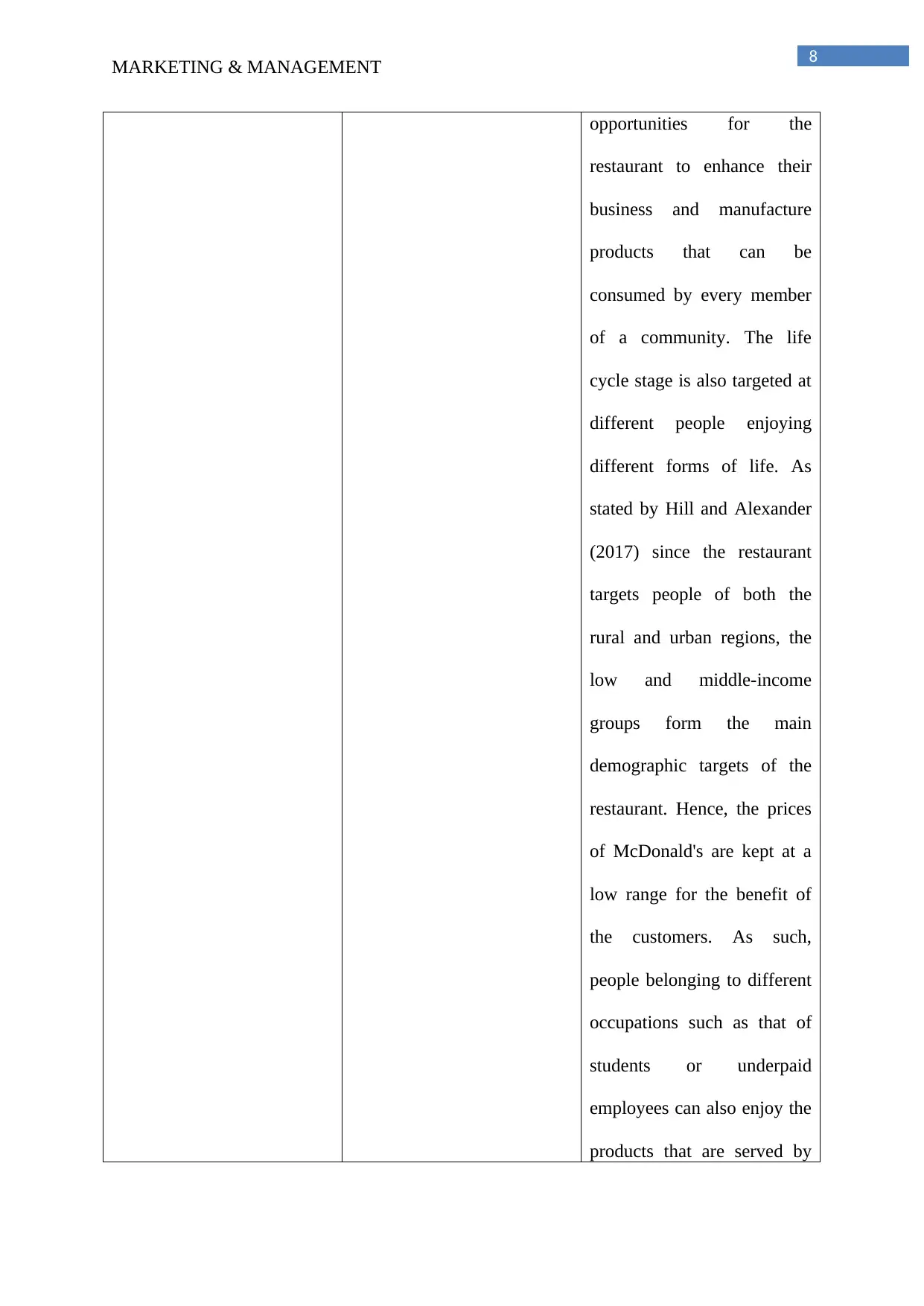
Segmentation type Segmentation criteria Target segment of
MARKETING & MANAGEMENT
It has been seen that McDonald’s focuses on three objectives that can help it to gain
customers by conducting good advertisement strategies. One such objective is to ensure that
people feel good about the products that it manufactures. According to Wagner III and
Hollenbeck (2014), the customers have linked McDonald’s to provide sub-standard quality of
food. Issues have been identified that have made people lose faith in the quality of food of the
restaurant. The issues consist of using un-fresh ingredients and monotonous nature of
products. This led to the loss of the restaurant and to mitigate this threat, the advertisement
campaign of McDonald’s is developed. The advertisement helps McDonald’s attain the
remaining two objectives of remembering the items and making the customers aware of the
items. At the same time, the franchising model of attracting customers is another important
marketing strategy that the restaurant uses. This model provides an estimation of the number
of restaurants that are owned by the restaurant (Caruana et al. 2015).
In order to understand the share it holds in the business, McDonald’s recently adopted
the franchising business strategy. Reports claim that McDonald’s only owns 15% of the total
number of restaurants. The remaining 85% has been owned by the franchises it conducts in
different business markets (Mcdonalds.com 2018). The restaurant chain follows the
framework in terms of training and monitoring of the employees that is conducted in the
franchises it works in. This helps the restaurant achieve good quality service, cleanliness and
value for the investments that it makes in the advertisements. The focus of this particular
marketing model is to ensure that the restaurant chain does not receive a negative response
due to the unhygienic environment. This particular strategy has helped McDonald’s to
increase its customer base and establish a reputation in the market (Eisingerich et al. 2016).
Hence, a marketing segmentation can be conducted.
Segmentation type Segmentation criteria Target segment of
Paraphrase This Document
Need a fresh take? Get an instant paraphrase of this document with our AI Paraphraser
7
MARKETING & MANAGEMENT
McDonald's
Geographic Region, density, age The target customers of
McDonald’s belong to both
domestic and international
market for its growth and
profitability. The people
residing in the urban and
rural areas can enjoy the
products as the positioning of
McDonald’s is situated for
the convenience of every
people. Moreover, the
restaurant also provides
home delivery facilities for
the convenience of the
people. As stated by Han and
Hyun (2015) the target
customers of the restaurant
range from 8 years of age to
45 years of age as it
manufactures products
enjoyable for all people.
Demographic Gender, lifecycle stage,
income, occupation
The demographic factors of
McDonald’s target both the
genders. This can open up
MARKETING & MANAGEMENT
McDonald's
Geographic Region, density, age The target customers of
McDonald’s belong to both
domestic and international
market for its growth and
profitability. The people
residing in the urban and
rural areas can enjoy the
products as the positioning of
McDonald’s is situated for
the convenience of every
people. Moreover, the
restaurant also provides
home delivery facilities for
the convenience of the
people. As stated by Han and
Hyun (2015) the target
customers of the restaurant
range from 8 years of age to
45 years of age as it
manufactures products
enjoyable for all people.
Demographic Gender, lifecycle stage,
income, occupation
The demographic factors of
McDonald’s target both the
genders. This can open up
8
MARKETING & MANAGEMENT
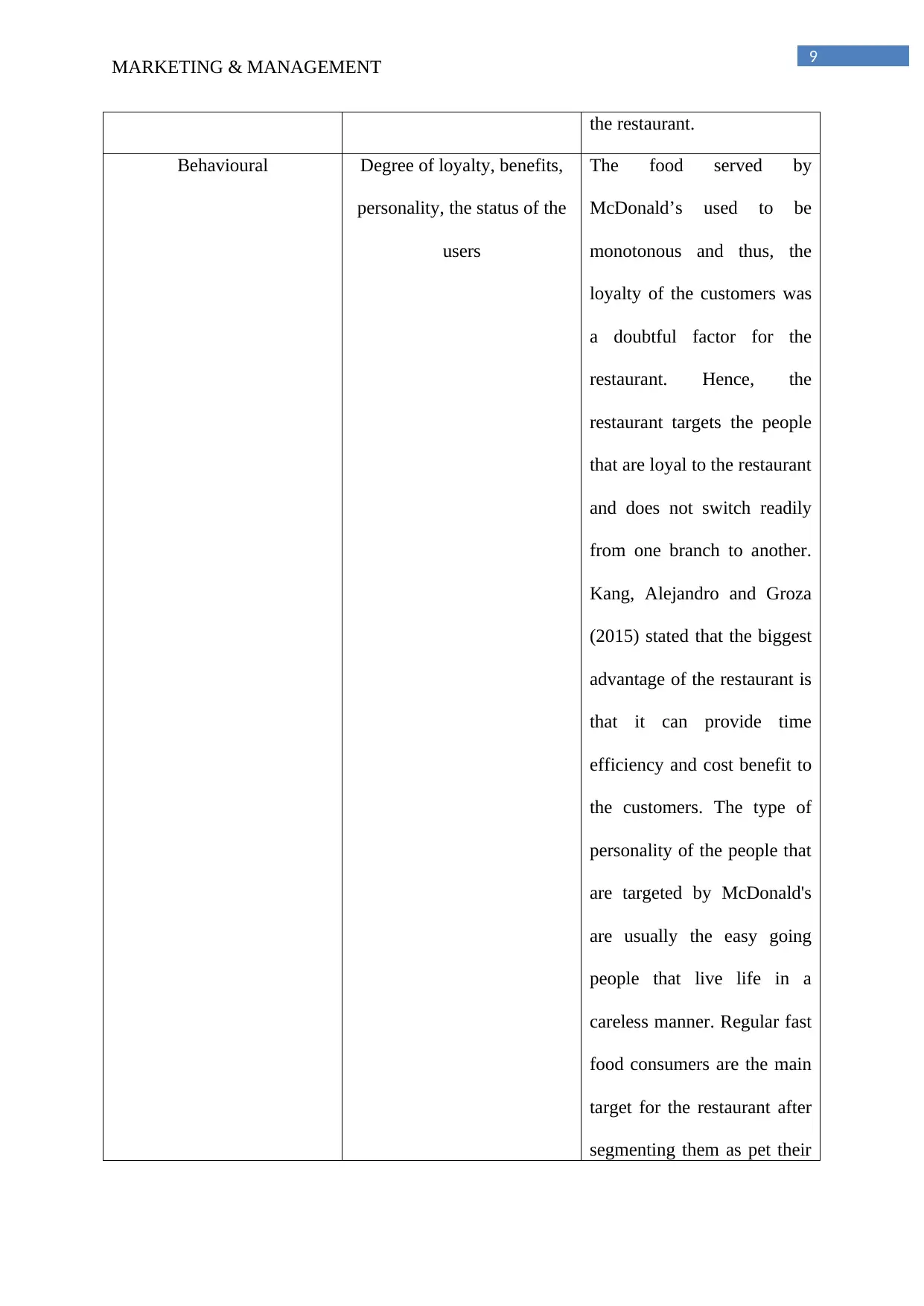
opportunities for the
restaurant to enhance their
business and manufacture
products that can be
consumed by every member
of a community. The life
cycle stage is also targeted at
different people enjoying
different forms of life. As
stated by Hill and Alexander
(2017) since the restaurant
targets people of both the
rural and urban regions, the
low and middle-income
groups form the main
demographic targets of the
restaurant. Hence, the prices
of McDonald's are kept at a
low range for the benefit of
the customers. As such,
people belonging to different
occupations such as that of
students or underpaid
employees can also enjoy the
products that are served by
MARKETING & MANAGEMENT
opportunities for the
restaurant to enhance their
business and manufacture
products that can be
consumed by every member
of a community. The life
cycle stage is also targeted at
different people enjoying
different forms of life. As
stated by Hill and Alexander
(2017) since the restaurant
targets people of both the
rural and urban regions, the
low and middle-income
groups form the main
demographic targets of the
restaurant. Hence, the prices
of McDonald's are kept at a
low range for the benefit of
the customers. As such,
people belonging to different
occupations such as that of
students or underpaid
employees can also enjoy the
products that are served by
⊘ This is a preview!⊘
Do you want full access?
Subscribe today to unlock all pages.
Trusted by 1+ million students worldwide
9
MARKETING & MANAGEMENT
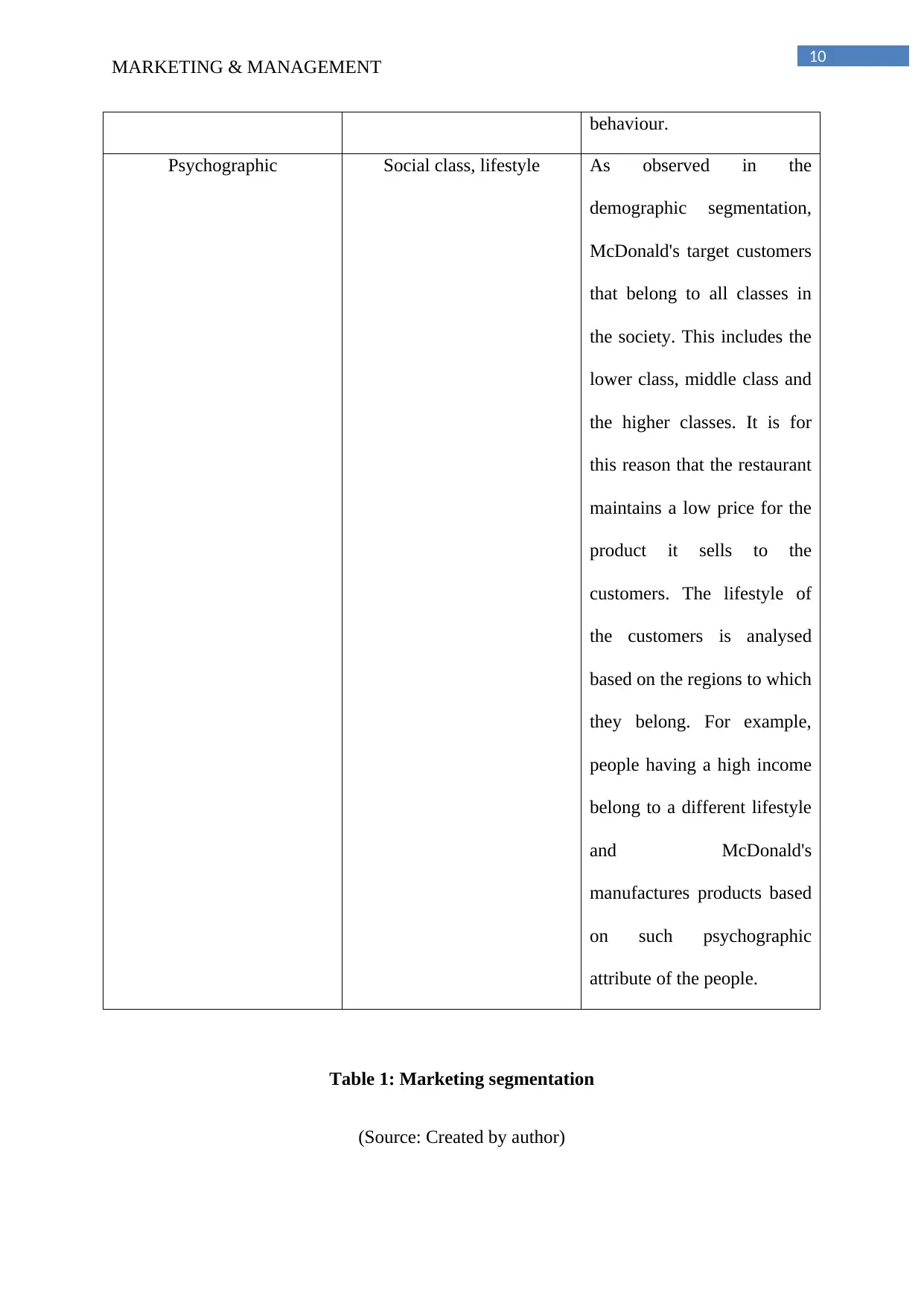
the restaurant.
Behavioural Degree of loyalty, benefits,
personality, the status of the
users
The food served by
McDonald’s used to be
monotonous and thus, the
loyalty of the customers was
a doubtful factor for the
restaurant. Hence, the
restaurant targets the people
that are loyal to the restaurant
and does not switch readily
from one branch to another.
Kang, Alejandro and Groza
(2015) stated that the biggest
advantage of the restaurant is
that it can provide time
efficiency and cost benefit to
the customers. The type of
personality of the people that
are targeted by McDonald's
are usually the easy going
people that live life in a
careless manner. Regular fast
food consumers are the main
target for the restaurant after
segmenting them as pet their
MARKETING & MANAGEMENT
the restaurant.
Behavioural Degree of loyalty, benefits,
personality, the status of the
users
The food served by
McDonald’s used to be
monotonous and thus, the
loyalty of the customers was
a doubtful factor for the
restaurant. Hence, the
restaurant targets the people
that are loyal to the restaurant
and does not switch readily
from one branch to another.
Kang, Alejandro and Groza
(2015) stated that the biggest
advantage of the restaurant is
that it can provide time
efficiency and cost benefit to
the customers. The type of
personality of the people that
are targeted by McDonald's
are usually the easy going
people that live life in a
careless manner. Regular fast
food consumers are the main
target for the restaurant after
segmenting them as pet their
Paraphrase This Document
Need a fresh take? Get an instant paraphrase of this document with our AI Paraphraser
10
MARKETING & MANAGEMENT
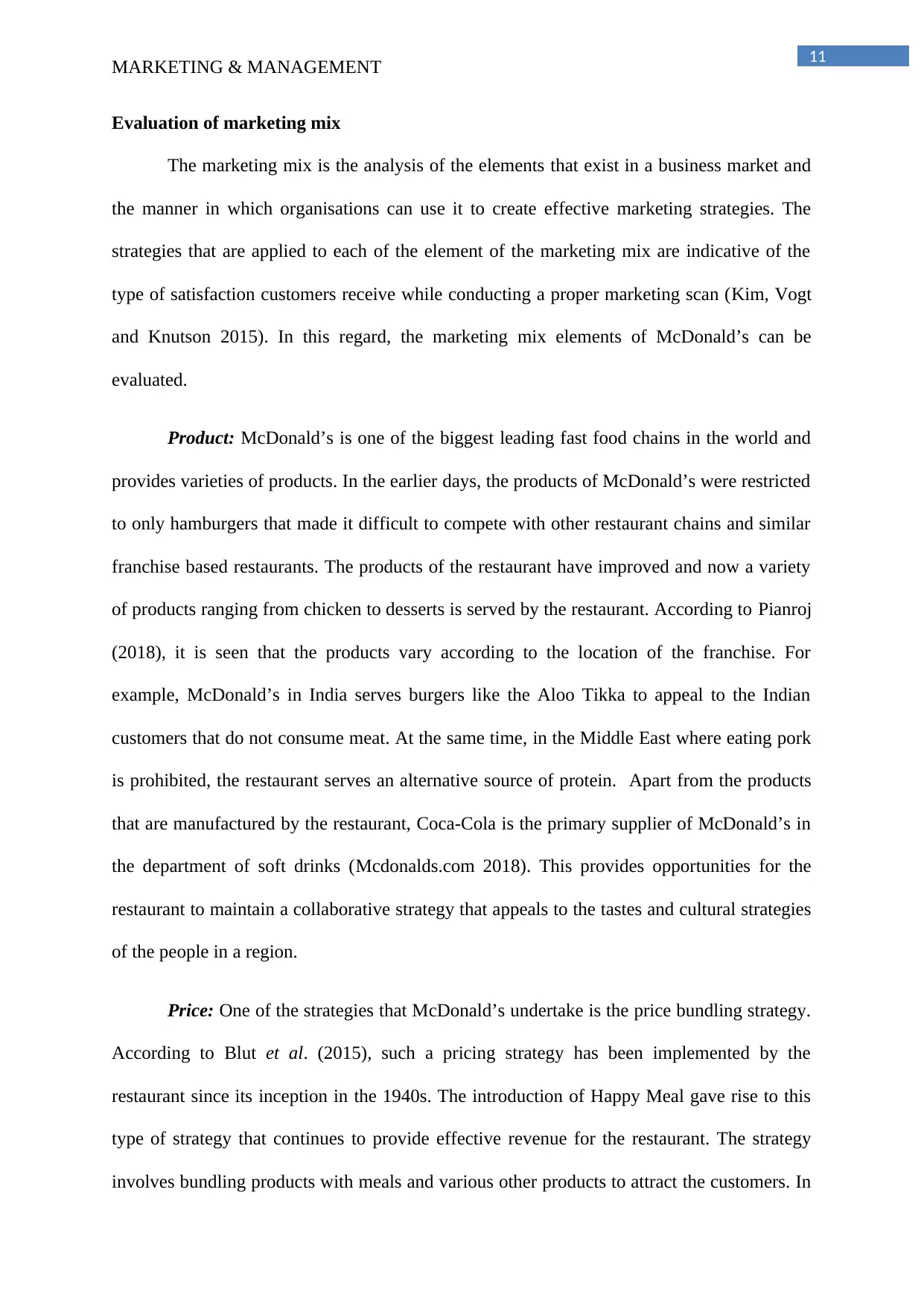
behaviour.
Psychographic Social class, lifestyle As observed in the
demographic segmentation,
McDonald's target customers
that belong to all classes in
the society. This includes the
lower class, middle class and
the higher classes. It is for
this reason that the restaurant
maintains a low price for the
product it sells to the
customers. The lifestyle of
the customers is analysed
based on the regions to which
they belong. For example,
people having a high income
belong to a different lifestyle
and McDonald's
manufactures products based
on such psychographic
attribute of the people.
Table 1: Marketing segmentation
(Source: Created by author)
MARKETING & MANAGEMENT
behaviour.
Psychographic Social class, lifestyle As observed in the
demographic segmentation,
McDonald's target customers
that belong to all classes in
the society. This includes the
lower class, middle class and
the higher classes. It is for
this reason that the restaurant
maintains a low price for the
product it sells to the
customers. The lifestyle of
the customers is analysed
based on the regions to which
they belong. For example,
people having a high income
belong to a different lifestyle
and McDonald's
manufactures products based
on such psychographic
attribute of the people.
Table 1: Marketing segmentation
(Source: Created by author)
11
MARKETING & MANAGEMENT
Evaluation of marketing mix
The marketing mix is the analysis of the elements that exist in a business market and
the manner in which organisations can use it to create effective marketing strategies. The
strategies that are applied to each of the element of the marketing mix are indicative of the
type of satisfaction customers receive while conducting a proper marketing scan (Kim, Vogt
and Knutson 2015). In this regard, the marketing mix elements of McDonald’s can be
evaluated.
Product: McDonald’s is one of the biggest leading fast food chains in the world and
provides varieties of products. In the earlier days, the products of McDonald’s were restricted
to only hamburgers that made it difficult to compete with other restaurant chains and similar
franchise based restaurants. The products of the restaurant have improved and now a variety
of products ranging from chicken to desserts is served by the restaurant. According to Pianroj
(2018), it is seen that the products vary according to the location of the franchise. For
example, McDonald’s in India serves burgers like the Aloo Tikka to appeal to the Indian
customers that do not consume meat. At the same time, in the Middle East where eating pork
is prohibited, the restaurant serves an alternative source of protein. Apart from the products
that are manufactured by the restaurant, Coca-Cola is the primary supplier of McDonald’s in
the department of soft drinks (Mcdonalds.com 2018). This provides opportunities for the
restaurant to maintain a collaborative strategy that appeals to the tastes and cultural strategies
of the people in a region.
Price: One of the strategies that McDonald’s undertake is the price bundling strategy.
According to Blut et al. (2015), such a pricing strategy has been implemented by the
restaurant since its inception in the 1940s. The introduction of Happy Meal gave rise to this
type of strategy that continues to provide effective revenue for the restaurant. The strategy
involves bundling products with meals and various other products to attract the customers. In
MARKETING & MANAGEMENT
Evaluation of marketing mix
The marketing mix is the analysis of the elements that exist in a business market and
the manner in which organisations can use it to create effective marketing strategies. The
strategies that are applied to each of the element of the marketing mix are indicative of the
type of satisfaction customers receive while conducting a proper marketing scan (Kim, Vogt
and Knutson 2015). In this regard, the marketing mix elements of McDonald’s can be
evaluated.
Product: McDonald’s is one of the biggest leading fast food chains in the world and
provides varieties of products. In the earlier days, the products of McDonald’s were restricted
to only hamburgers that made it difficult to compete with other restaurant chains and similar
franchise based restaurants. The products of the restaurant have improved and now a variety
of products ranging from chicken to desserts is served by the restaurant. According to Pianroj
(2018), it is seen that the products vary according to the location of the franchise. For
example, McDonald’s in India serves burgers like the Aloo Tikka to appeal to the Indian
customers that do not consume meat. At the same time, in the Middle East where eating pork
is prohibited, the restaurant serves an alternative source of protein. Apart from the products
that are manufactured by the restaurant, Coca-Cola is the primary supplier of McDonald’s in
the department of soft drinks (Mcdonalds.com 2018). This provides opportunities for the
restaurant to maintain a collaborative strategy that appeals to the tastes and cultural strategies
of the people in a region.
Price: One of the strategies that McDonald’s undertake is the price bundling strategy.
According to Blut et al. (2015), such a pricing strategy has been implemented by the
restaurant since its inception in the 1940s. The introduction of Happy Meal gave rise to this
type of strategy that continues to provide effective revenue for the restaurant. The strategy
involves bundling products with meals and various other products to attract the customers. In
⊘ This is a preview!⊘
Do you want full access?
Subscribe today to unlock all pages.
Trusted by 1+ million students worldwide

1 out of 31


Related Documents


Your All-in-One AI-Powered Toolkit for Academic Success.
+13062052269
info@desklib.com
Available 24*7 on WhatsApp / Email
![[object Object]](/_next/static/media/star-bottom.7253800d.svg)
Unlock your academic potential
Copyright © 2020–2026 A2Z Services. All Rights Reserved. Developed and managed by ZUCOL.