Critical Analysis: White Privilege - Unpacking the Invisible Knapsack

Verified

Added on  2023/06/08

|4
|660
|172
Essay
AI Summary
This essay delves into Peggy McIntosh's concept of "White Privilege: Unpacking the Invisible Knapsack," highlighting the unearned advantages that white individuals often possess. It explores the idea that white privilege, much like male privilege, is often overlooked and unacknowledged, perpetuating societal inequalities. The essay references various scholars who discuss the importance of recognizing and addressing these privileges, particularly in educational settings, to foster critical thinking and promote equality. While acknowledging the existence of white privilege, the essay also considers the perspectives of white individuals who may not feel privileged or benefit from the advantages typically associated with their race, suggesting that the experience of white privilege is not universal. Ultimately, the essay emphasizes the need to unpack the "Invisible Knapsack" and engage in open discussions about the effects of white privilege on individuals and society as a whole, encouraging efforts to dismantle the system of unearned advantages.
Document Page
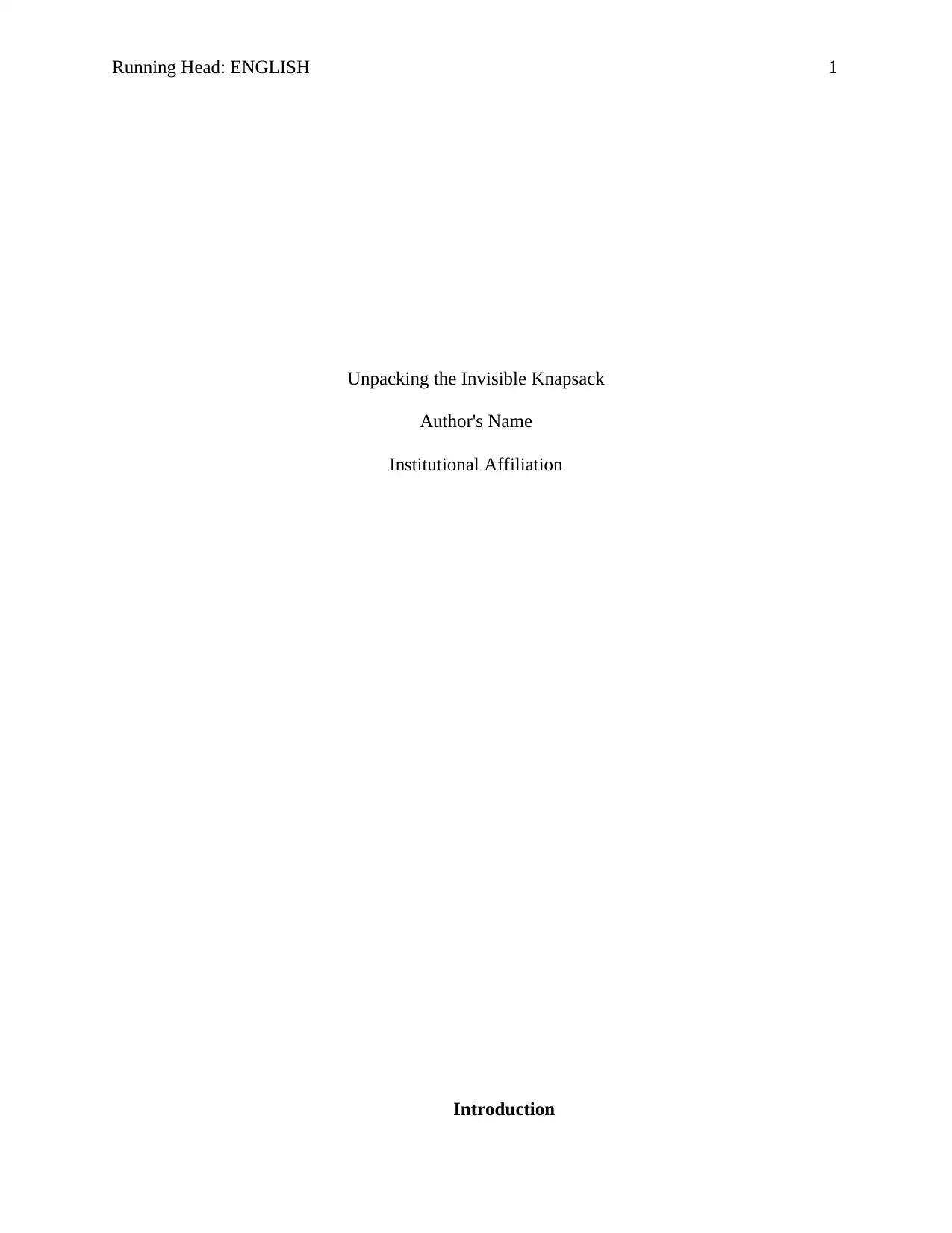
Running Head: ENGLISH 1
Unpacking the Invisible Knapsack
Author's Name
Institutional Affiliation
Introduction
tabler-icon-diamond-filled.svg

Paraphrase This Document

Need a fresh take? Get an instant paraphrase of this document with our AI Paraphraser
Document Page
EDUCATION 2
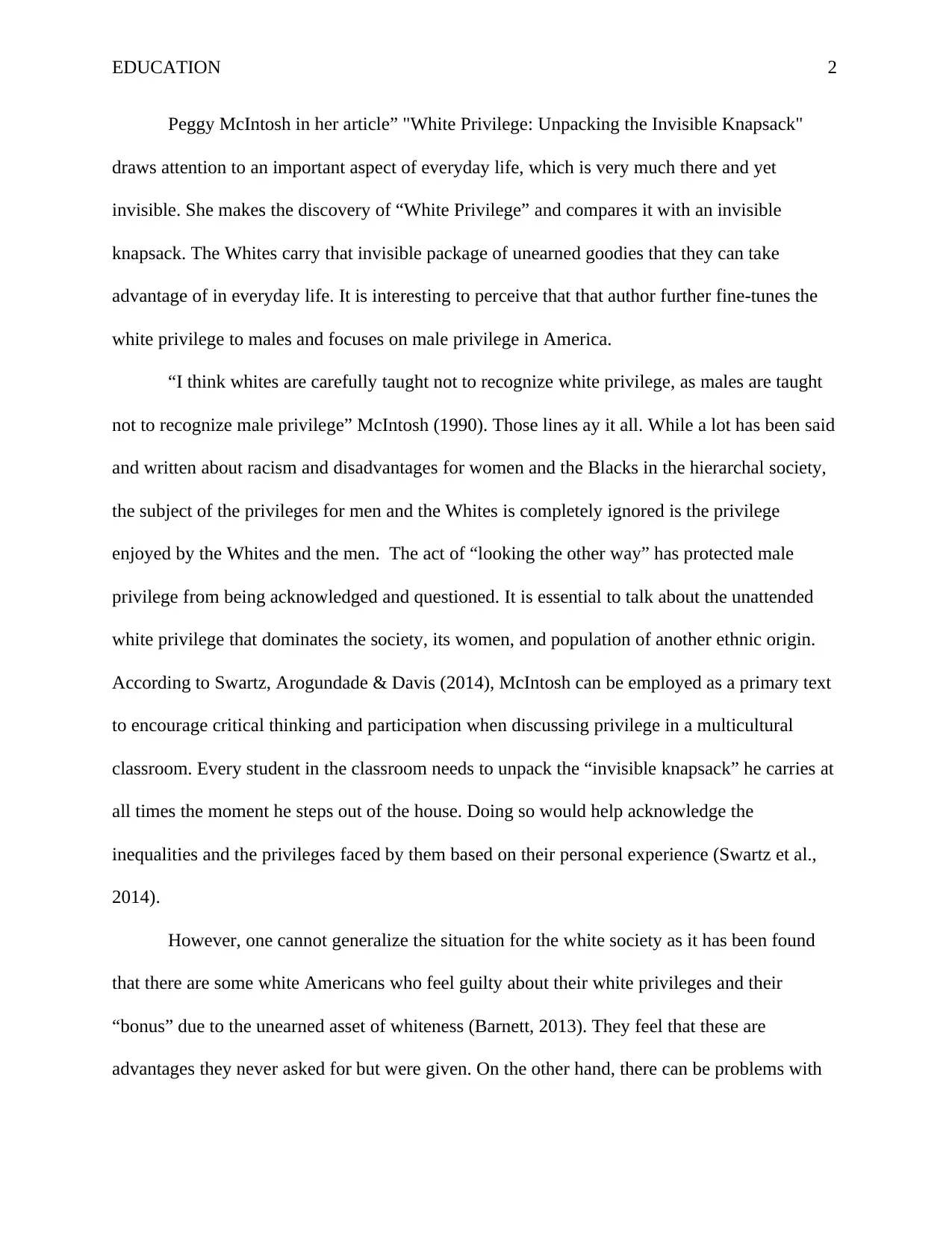
Peggy McIntosh in her article” "White Privilege: Unpacking the Invisible Knapsack"
draws attention to an important aspect of everyday life, which is very much there and yet
invisible. She makes the discovery of “White Privilege” and compares it with an invisible
knapsack. The Whites carry that invisible package of unearned goodies that they can take
advantage of in everyday life. It is interesting to perceive that that author further fine-tunes the
white privilege to males and focuses on male privilege in America.
“I think whites are carefully taught not to recognize white privilege, as males are taught
not to recognize male privilege” McIntosh (1990). Those lines ay it all. While a lot has been said
and written about racism and disadvantages for women and the Blacks in the hierarchal society,
the subject of the privileges for men and the Whites is completely ignored is the privilege
enjoyed by the Whites and the men. The act of “looking the other way” has protected male
privilege from being acknowledged and questioned. It is essential to talk about the unattended
white privilege that dominates the society, its women, and population of another ethnic origin.
According to Swartz, Arogundade & Davis (2014), McIntosh can be employed as a primary text
to encourage critical thinking and participation when discussing privilege in a multicultural
classroom. Every student in the classroom needs to unpack the “invisible knapsack” he carries at
all times the moment he steps out of the house. Doing so would help acknowledge the
inequalities and the privileges faced by them based on their personal experience (Swartz et al.,
2014).
However, one cannot generalize the situation for the white society as it has been found
that there are some white Americans who feel guilty about their white privileges and their
“bonus” due to the unearned asset of whiteness (Barnett, 2013). They feel that these are
advantages they never asked for but were given. On the other hand, there can be problems with
Document Page
EDUCATION 3
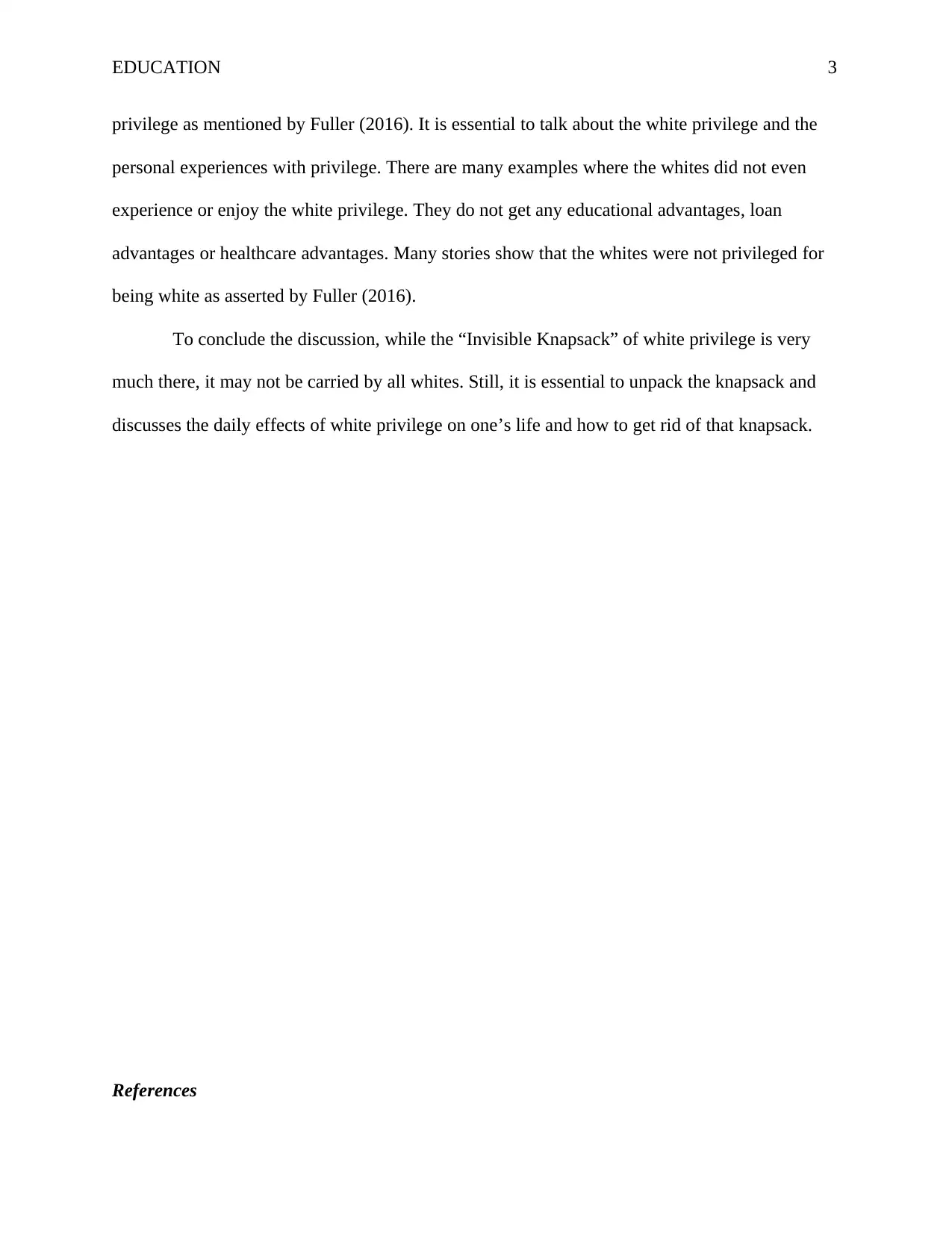
privilege as mentioned by Fuller (2016). It is essential to talk about the white privilege and the
personal experiences with privilege. There are many examples where the whites did not even
experience or enjoy the white privilege. They do not get any educational advantages, loan
advantages or healthcare advantages. Many stories show that the whites were not privileged for
being white as asserted by Fuller (2016).
To conclude the discussion, while the “Invisible Knapsack” of white privilege is very
much there, it may not be carried by all whites. Still, it is essential to unpack the knapsack and
discusses the daily effects of white privilege on one’s life and how to get rid of that knapsack.
References
Document Page
EDUCATION 4
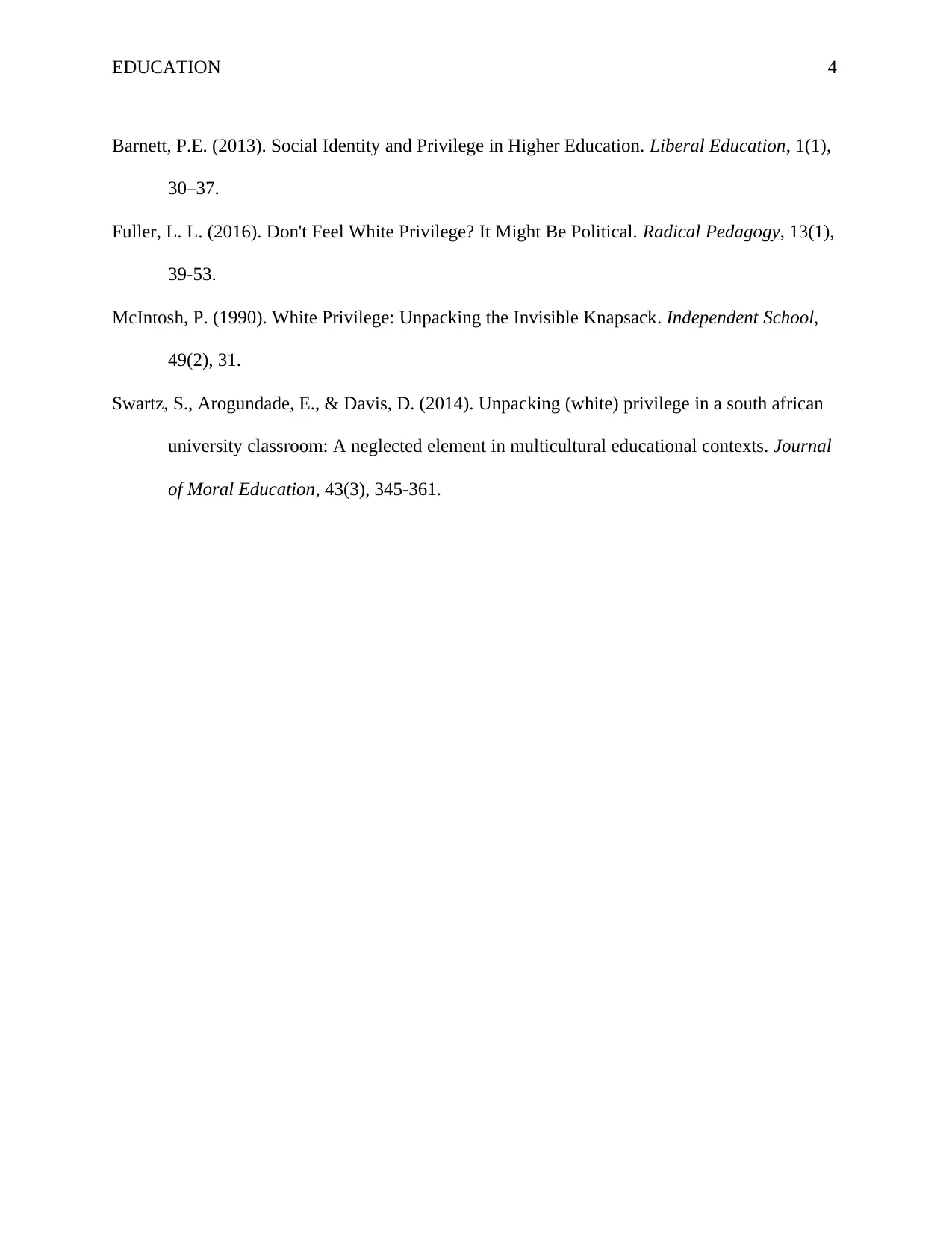
Barnett, P.E. (2013). Social Identity and Privilege in Higher Education. Liberal Education, 1(1),
30–37.
Fuller, L. L. (2016). Don't Feel White Privilege? It Might Be Political. Radical Pedagogy, 13(1),
39-53.
McIntosh, P. (1990). White Privilege: Unpacking the Invisible Knapsack. Independent School,
49(2), 31.
Swartz, S., Arogundade, E., & Davis, D. (2014). Unpacking (white) privilege in a south african
university classroom: A neglected element in multicultural educational contexts. Journal
of Moral Education, 43(3), 345-361.
chevron_up_icon
1 out of 4
circle_padding
hide_on_mobile
zoom_out_icon
[object Object]