Change Management in Organizations: A Report on McKinsey 7-S Model
VerifiedAdded on 2023/06/15
|12
|2721
|76
Report
AI Summary
This report delves into the complexities of change management within organizations, emphasizing the application of the McKinsey 7-S model. It explores key elements such as strategy, structure, systems, shared values, style, staff, and skills, highlighting their interconnectedness and impact on successful change implementation. The report discusses process studies, examining how changes emerge and evolve over time, particularly within the public sector. It addresses the challenges of resistance to change and the importance of adapting strategies to overcome these obstacles. The analysis extends to the unique characteristics of public sector organizations, considering the influence of stakeholders and governmental interference on the change process. The report concludes by advocating for a modified 7-S model that incorporates stakeholders as a critical element, providing a comprehensive framework for managing change effectively in today's dynamic environment. Desklib offers this and many other solved assignments to aid students in their studies.
Running head: CHANGE MANAGEMENT
Change Management
Name of the Student:
Name of the University:
Author note:
Change Management
Name of the Student:
Name of the University:
Author note:

Paraphrase This Document
Need a fresh take? Get an instant paraphrase of this document with our AI Paraphraser
1CHANGE MANAGEMENT
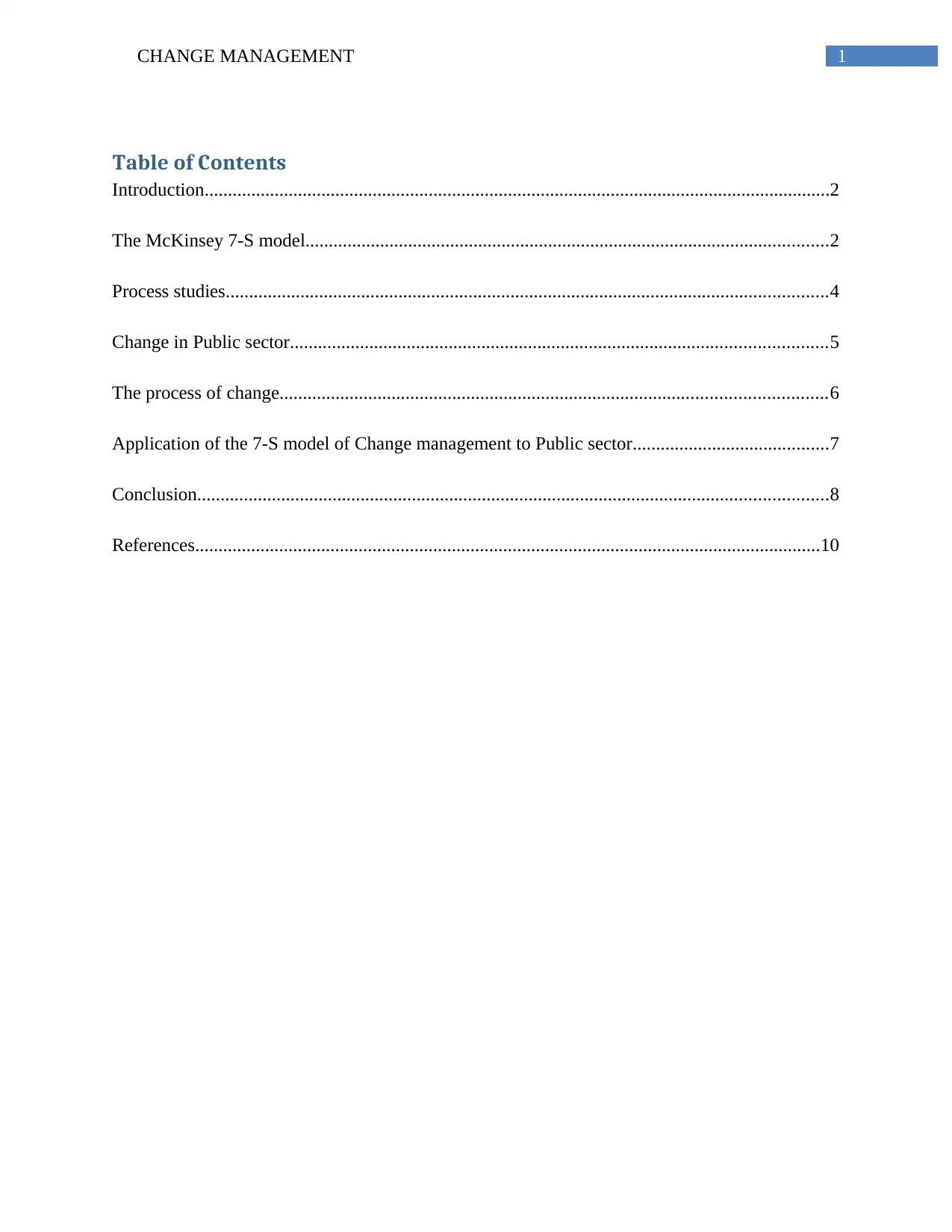
Table of Contents
Introduction......................................................................................................................................2
The McKinsey 7-S model................................................................................................................2
Process studies.................................................................................................................................4
Change in Public sector...................................................................................................................5
The process of change.....................................................................................................................6
Application of the 7-S model of Change management to Public sector..........................................7
Conclusion.......................................................................................................................................8
References......................................................................................................................................10
Table of Contents
Introduction......................................................................................................................................2
The McKinsey 7-S model................................................................................................................2
Process studies.................................................................................................................................4
Change in Public sector...................................................................................................................5
The process of change.....................................................................................................................6
Application of the 7-S model of Change management to Public sector..........................................7
Conclusion.......................................................................................................................................8
References......................................................................................................................................10
2CHANGE MANAGEMENT
Introduction
Change in organizations is not always taken in a positive way as people take in their
personal lives. In an organizational structure, change is not voluntary. The management often
imposes it. The purpose of change positive and constructive but the results are not always
constructive. It is not accepted most of the times. Some human beings have the tendency to resist
change. This resistance is one of the most challenging things in an organization. It can be said
that this resistance of change creates the need for Change management. Though it is not always
the resistance, generally any change requires to be dealt with a great deal of wisdom, as adopting
any new change is a challenge in itself. Organizations have different types of people with
different personalities, perceptions, attitudes and caliber (Van Oorschot et al. 2013). All these
things determine their reaction to Change. The following report would be focusing on various
journal articles and literature reviews for providing information about the recent theories and
concepts in Change Management.
The McKinsey 7-S model
There are seven aspects of change management of any organization. These seven factors
affect each other. The seven aspects of change management are
Strategy
Structure
Systems
Shared Values
Style
Introduction
Change in organizations is not always taken in a positive way as people take in their
personal lives. In an organizational structure, change is not voluntary. The management often
imposes it. The purpose of change positive and constructive but the results are not always
constructive. It is not accepted most of the times. Some human beings have the tendency to resist
change. This resistance is one of the most challenging things in an organization. It can be said
that this resistance of change creates the need for Change management. Though it is not always
the resistance, generally any change requires to be dealt with a great deal of wisdom, as adopting
any new change is a challenge in itself. Organizations have different types of people with
different personalities, perceptions, attitudes and caliber (Van Oorschot et al. 2013). All these
things determine their reaction to Change. The following report would be focusing on various
journal articles and literature reviews for providing information about the recent theories and
concepts in Change Management.
The McKinsey 7-S model
There are seven aspects of change management of any organization. These seven factors
affect each other. The seven aspects of change management are
Strategy
Structure
Systems
Shared Values
Style
⊘ This is a preview!⊘
Do you want full access?
Subscribe today to unlock all pages.

Trusted by 1+ million students worldwide
3CHANGE MANAGEMENT
Staff
Skills (Kuipers et al. 2014)
The assessment of strategy is required to be formal to let the organization move forward
with a purpose and to gain advantage over the competitors. The organization for assessment of
its strategies certain things are to be cleared first. The organization must be clear about their
objectives. The organization should identify the strategies they will be taking for achieving the
objectives. The measures the organization is taking to stay competitive in the market. Whether
those strategies will adapt to the situation is an important question if yes how. Next aspect is
structure. The structure of the organization is important as it determines what strategies
organizations must take. Ways in which the individual team members organize themselves and
the person responsible for taking the decisions in the organization. Methods used for
communicating the strategies. The frequency of the communication process within the
organization determines the awareness of the staff members about the strategies and changes that
are being implemented (Langley et al., 2013). The organization system needs to be analyzed.
Processes and their management are also equally important. Shared values are another important
aspect as it helps in determination of the shared values in the organization. Company culture and
team culture helps in gaining sufficient knowledge about reaction and attitude of employees to a
particular change. This will help the management to take measures that will be effective in case
of any resistance from the end of the customers. The organization needs to assess the style in
which the departments and teams are managed. The extent to which the organization’s leadership
and management are active helps in knowing the effectiveness of the management to motivate
people for accepting the change. The last most important factor is staff. It is important to
determine what the positions that have been filled and the skills the new employees possess.
Staff
Skills (Kuipers et al. 2014)
The assessment of strategy is required to be formal to let the organization move forward
with a purpose and to gain advantage over the competitors. The organization for assessment of
its strategies certain things are to be cleared first. The organization must be clear about their
objectives. The organization should identify the strategies they will be taking for achieving the
objectives. The measures the organization is taking to stay competitive in the market. Whether
those strategies will adapt to the situation is an important question if yes how. Next aspect is
structure. The structure of the organization is important as it determines what strategies
organizations must take. Ways in which the individual team members organize themselves and
the person responsible for taking the decisions in the organization. Methods used for
communicating the strategies. The frequency of the communication process within the
organization determines the awareness of the staff members about the strategies and changes that
are being implemented (Langley et al., 2013). The organization system needs to be analyzed.
Processes and their management are also equally important. Shared values are another important
aspect as it helps in determination of the shared values in the organization. Company culture and
team culture helps in gaining sufficient knowledge about reaction and attitude of employees to a
particular change. This will help the management to take measures that will be effective in case
of any resistance from the end of the customers. The organization needs to assess the style in
which the departments and teams are managed. The extent to which the organization’s leadership
and management are active helps in knowing the effectiveness of the management to motivate
people for accepting the change. The last most important factor is staff. It is important to
determine what the positions that have been filled and the skills the new employees possess.
Paraphrase This Document
Need a fresh take? Get an instant paraphrase of this document with our AI Paraphraser
4CHANGE MANAGEMENT
These factors will help in knowing whether the employees would be able to adapt to the change.
New changes are often made on the existing skills of the employees.
Process studies
In order to have understanding about change it is very important to have knowledge about
process studies. Process studies emphasizes on the reasons behind the emergence, development,
growth or termination of things over time. Time is an important factor for process studies as it
puts light on the role played by tensions and contradictions that become driving factors for
change and hence show how the interactions in different level affect change. The process studies
of change emphasizes on the world of process, evaluates the question regarding the managerial
and organizational phenomena emerges, and changes overtime. Earlier the concept of process
studies was not focused. One of the key findings from the previous works is that values of
employees in an organization are enduring and stable still values change with time. Interactions
and interpersonal relations among the employees tend to affect and change the values of the
employees. Values are distributive, relational, interactive and a continuous process. Innovative
organizational changes emerge with the help of sense establishing. In presence of diverse logics
and rational tends to create paradoxes which needs navigations. When people know about the
paradoxes they look for creative ways and if they do not have any knowledge about paradoxes
they tend stuck at the paradox (Van der Voet 2014). The changes in corporate strategies in four
different ways, focused, punctuated, temporarily switching and regular. Those companies that
keep changes regularly perform better than those companies that change irregularly. The
managers cannot predict the consequences of the decisions. Events that take place can be
negotiated but the outcomes of those events are dependent on many other factors that cannot be
controlled by the organization. Some outcomes are favorable while others are not in such case
These factors will help in knowing whether the employees would be able to adapt to the change.
New changes are often made on the existing skills of the employees.
Process studies
In order to have understanding about change it is very important to have knowledge about
process studies. Process studies emphasizes on the reasons behind the emergence, development,
growth or termination of things over time. Time is an important factor for process studies as it
puts light on the role played by tensions and contradictions that become driving factors for
change and hence show how the interactions in different level affect change. The process studies
of change emphasizes on the world of process, evaluates the question regarding the managerial
and organizational phenomena emerges, and changes overtime. Earlier the concept of process
studies was not focused. One of the key findings from the previous works is that values of
employees in an organization are enduring and stable still values change with time. Interactions
and interpersonal relations among the employees tend to affect and change the values of the
employees. Values are distributive, relational, interactive and a continuous process. Innovative
organizational changes emerge with the help of sense establishing. In presence of diverse logics
and rational tends to create paradoxes which needs navigations. When people know about the
paradoxes they look for creative ways and if they do not have any knowledge about paradoxes
they tend stuck at the paradox (Van der Voet 2014). The changes in corporate strategies in four
different ways, focused, punctuated, temporarily switching and regular. Those companies that
keep changes regularly perform better than those companies that change irregularly. The
managers cannot predict the consequences of the decisions. Events that take place can be
negotiated but the outcomes of those events are dependent on many other factors that cannot be
controlled by the organization. Some outcomes are favorable while others are not in such case
5CHANGE MANAGEMENT
changes either occur on their own or are required by the situation. According to the theory of
institutional change in which the society-level change, resource creates pressures of
organization-level. When there are deviations in the field values by the peripheral actors
triggering work by mid-status actors that aligns the societal, filed and organizational levels.
Some of the important factors of change, which cannot be escaped are, time, timing in the human
affairs, and the lives of people the people in an organization. Even after being an important
factor, time is often overlooked by many research scholars. Temporality has been one of the
important factors as discussed by many scholars of this field. According to Van Oorschot et al.
(2013) theory of decision trap in which the contemporary temporal activities are stretched at the
cost of reduction and elimination of the time available for upcoming activities. It shows that
decisions that appeared good once later turned destructive in another event. They show that in
case of mergers the balance between the political and economical factors changes over time,
which leads to taking up different management strategies. According to Klaner and Raisch
(2013) who have extracted the data from the annual reports 67 European insurance companies,
they have shown the data and coded it in six patterns of change. With the help of innovative,
multiple sequence alignment method that is being derived from biological sciences and then
shown that regularity in the ongoing organizational changes is related to the performance, with
the help of statistical methods of comparison.
Change in Public sector
Changes in the public sector are usually deliberate that are caused to the structures and
processes of public sector organizations aiming for better administration. In order to have a
fruitful impact on the system reform programs and measures needs to result in changes in the
work processes of public organizations and in the attitudes and behaviors of the staffs who work
changes either occur on their own or are required by the situation. According to the theory of
institutional change in which the society-level change, resource creates pressures of
organization-level. When there are deviations in the field values by the peripheral actors
triggering work by mid-status actors that aligns the societal, filed and organizational levels.
Some of the important factors of change, which cannot be escaped are, time, timing in the human
affairs, and the lives of people the people in an organization. Even after being an important
factor, time is often overlooked by many research scholars. Temporality has been one of the
important factors as discussed by many scholars of this field. According to Van Oorschot et al.
(2013) theory of decision trap in which the contemporary temporal activities are stretched at the
cost of reduction and elimination of the time available for upcoming activities. It shows that
decisions that appeared good once later turned destructive in another event. They show that in
case of mergers the balance between the political and economical factors changes over time,
which leads to taking up different management strategies. According to Klaner and Raisch
(2013) who have extracted the data from the annual reports 67 European insurance companies,
they have shown the data and coded it in six patterns of change. With the help of innovative,
multiple sequence alignment method that is being derived from biological sciences and then
shown that regularity in the ongoing organizational changes is related to the performance, with
the help of statistical methods of comparison.
Change in Public sector
Changes in the public sector are usually deliberate that are caused to the structures and
processes of public sector organizations aiming for better administration. In order to have a
fruitful impact on the system reform programs and measures needs to result in changes in the
work processes of public organizations and in the attitudes and behaviors of the staffs who work
⊘ This is a preview!⊘
Do you want full access?
Subscribe today to unlock all pages.
Trusted by 1+ million students worldwide
6CHANGE MANAGEMENT
in these organizations. The results of the public sector reforms are not always as expected.
According to Pollit and Dan (2013) differences between the anticipated results and the actual
results can be understood if the implementation of the reforms are evaluated carefully.
Researches on public sector reforms have shown that the implementation process of the change
management has always been overlooked which happens both at individual and organizational
level. Organizations comply with the various environmental pressures in their respective areas to
get the desired goals. Some approaches are focused on the role of the agencies in the change
process. The knowledge of change management can be gained from various epistemological and
ontological traditions. For instance as per some of the concepts of organizational change, it is a
temporary aspect of organizational upheaval while some approaches suggest that the idea of
organization change is an aspect of social construction. Some scholars emphasize on the large-
scale organizational turnarounds and focus on the planned organizational change. Some of the
authors focus on the emergent nature of change.
The process of change
Change management focuses on the process through which the change is being
implemented. Change management is largely dependent on the object of change, the content of
change and the process of change. This provides a way to manage organizational change. The
most applied approach is the planned approach to organizational change. The planned processes
are dependent on the role of management. The planned change implementation is a complex
thing as it requires proper evaluation and monitoring or else change would not be implemented
properly. Intentional and planned changes have purpose, which needs to be completed, or else
the change would not be effective (Ashkenas 2013). Although, implementation of Change might
see certain obstacles that affects the change process this can be caused by scarcity of resources or
in these organizations. The results of the public sector reforms are not always as expected.
According to Pollit and Dan (2013) differences between the anticipated results and the actual
results can be understood if the implementation of the reforms are evaluated carefully.
Researches on public sector reforms have shown that the implementation process of the change
management has always been overlooked which happens both at individual and organizational
level. Organizations comply with the various environmental pressures in their respective areas to
get the desired goals. Some approaches are focused on the role of the agencies in the change
process. The knowledge of change management can be gained from various epistemological and
ontological traditions. For instance as per some of the concepts of organizational change, it is a
temporary aspect of organizational upheaval while some approaches suggest that the idea of
organization change is an aspect of social construction. Some scholars emphasize on the large-
scale organizational turnarounds and focus on the planned organizational change. Some of the
authors focus on the emergent nature of change.
The process of change
Change management focuses on the process through which the change is being
implemented. Change management is largely dependent on the object of change, the content of
change and the process of change. This provides a way to manage organizational change. The
most applied approach is the planned approach to organizational change. The planned processes
are dependent on the role of management. The planned change implementation is a complex
thing as it requires proper evaluation and monitoring or else change would not be implemented
properly. Intentional and planned changes have purpose, which needs to be completed, or else
the change would not be effective (Ashkenas 2013). Although, implementation of Change might
see certain obstacles that affects the change process this can be caused by scarcity of resources or
Paraphrase This Document
Need a fresh take? Get an instant paraphrase of this document with our AI Paraphraser
7CHANGE MANAGEMENT
lack of improper planning. Therefore, the change management requires proper planning
beforehand.
Organizations require changes but it is not always positively accepted by the employees.
People do have the tendency to resist change that occurs in an organization. Changes in the
operatiponal system are one of the most common types of changes Technological changes are
usually difficult to be accepted by people. According to Klarner and Raisch (2013) companies in
order to outperform requires changing from time to time. However, the main thing is how change
is managed. Organizations are required to take measures to combat the resistance to change.
Application of the 7-S model of Change management to Public sector
Public sector organizations have a very complex structure and large size. Change
management in public sector is very difficult. The objective of public sector organizations are
usually development and the change is usually intentional. Changes in public sector takes a long
time as the system of operations in public sector is very formal and a number of procedures are
involve. The complexity in the operational system in public sector is because of its structure.
Public sectors have many stakeholders and there is too much of Government interference. Too
much interference from the end of Government usually makes the process complex. The core
values of public sector consist of a number of values of diverse employees working in that
organization (Pollitt and Dan 2013). Since there are many employees, there is diversity in their
personality, perception and thought process. The chances resistance to change increases, when
there are many stakeholders in any business resistance comes from external environment as well.
External resistance is often strong enough to hinder the change process. Depending on the
number of departments, staffs are recruited. The skills of the staff members vary from
lack of improper planning. Therefore, the change management requires proper planning
beforehand.
Organizations require changes but it is not always positively accepted by the employees.
People do have the tendency to resist change that occurs in an organization. Changes in the
operatiponal system are one of the most common types of changes Technological changes are
usually difficult to be accepted by people. According to Klarner and Raisch (2013) companies in
order to outperform requires changing from time to time. However, the main thing is how change
is managed. Organizations are required to take measures to combat the resistance to change.
Application of the 7-S model of Change management to Public sector
Public sector organizations have a very complex structure and large size. Change
management in public sector is very difficult. The objective of public sector organizations are
usually development and the change is usually intentional. Changes in public sector takes a long
time as the system of operations in public sector is very formal and a number of procedures are
involve. The complexity in the operational system in public sector is because of its structure.
Public sectors have many stakeholders and there is too much of Government interference. Too
much interference from the end of Government usually makes the process complex. The core
values of public sector consist of a number of values of diverse employees working in that
organization (Pollitt and Dan 2013). Since there are many employees, there is diversity in their
personality, perception and thought process. The chances resistance to change increases, when
there are many stakeholders in any business resistance comes from external environment as well.
External resistance is often strong enough to hinder the change process. Depending on the
number of departments, staffs are recruited. The skills of the staff members vary from
8CHANGE MANAGEMENT
department to department. Collaboration of these skills helps in effective implementation of
change. The 7-S model of change management can be applied effectively to present day public
sector organizations. The model however is more appropriate for private organizations as the
structure of public sector organizations are very complex. An additional ‘S’ has a major role to
play in the public sector organization. The eighth S of the public sector can be the stakeholders
because public sector has many stakeholders from employees to government bodies to public.
The changes are made as per either the stakeholders or the stakeholders affect the change process
both positively as well as negatively. The present day scenario has changed largely and
management of change needs more knowledge and skills. Certain factors have emerged within
the organization and outside that has greater role to play. For an instance, if a public sector today
is planning to bring a new technology for the operations. They will have to consider how will the
stakeholders like from affect the change where the technology be brought (suppliers), will the
employees be able to cope up with the new technology and what will be the impact of the
technology on operation and ultimately the customers and the public.
Conclusion
Change is an essential for any organization, what is more important is change
management. It can be concluded from the discussions that proper planning is required for
change management. In public sector, mostly change is intentional because it takes place for
efficiency improvement and development. There are certain changes that are forced changes for
which one has to adapt and it occurs due to an event or occurrence. Change management is
important so that the implementation is done in the proper way and the purpose of change can be
achieved. Process studies are very important for change management because in order to
implement the change the process is required to be analyzed. The application of 7-s model it was
department to department. Collaboration of these skills helps in effective implementation of
change. The 7-S model of change management can be applied effectively to present day public
sector organizations. The model however is more appropriate for private organizations as the
structure of public sector organizations are very complex. An additional ‘S’ has a major role to
play in the public sector organization. The eighth S of the public sector can be the stakeholders
because public sector has many stakeholders from employees to government bodies to public.
The changes are made as per either the stakeholders or the stakeholders affect the change process
both positively as well as negatively. The present day scenario has changed largely and
management of change needs more knowledge and skills. Certain factors have emerged within
the organization and outside that has greater role to play. For an instance, if a public sector today
is planning to bring a new technology for the operations. They will have to consider how will the
stakeholders like from affect the change where the technology be brought (suppliers), will the
employees be able to cope up with the new technology and what will be the impact of the
technology on operation and ultimately the customers and the public.
Conclusion
Change is an essential for any organization, what is more important is change
management. It can be concluded from the discussions that proper planning is required for
change management. In public sector, mostly change is intentional because it takes place for
efficiency improvement and development. There are certain changes that are forced changes for
which one has to adapt and it occurs due to an event or occurrence. Change management is
important so that the implementation is done in the proper way and the purpose of change can be
achieved. Process studies are very important for change management because in order to
implement the change the process is required to be analyzed. The application of 7-s model it was
⊘ This is a preview!⊘
Do you want full access?
Subscribe today to unlock all pages.
Trusted by 1+ million students worldwide
9CHANGE MANAGEMENT
seen that stakeholders had a major role to play in change management. It can be said that 7-S
model of the change management fails to completely describe the change process of modern day
public organization.
seen that stakeholders had a major role to play in change management. It can be said that 7-S
model of the change management fails to completely describe the change process of modern day
public organization.
Paraphrase This Document
Need a fresh take? Get an instant paraphrase of this document with our AI Paraphraser
10CHANGE MANAGEMENT
References
Ashkenas, R., 2013. Change management needs to change. Harvard Business Review, 16.
Klarner, P., & Raisch, S. 2013. Move to the beat: Rhythms of change and firm performance.
Academy of Management Journal, 56: 160-184.
Kuipers, B.S., Higgs, M., Kickert, W., Tummers, L., Grandia, J. and Van der Voet, J., 2014. The
management of change in public organizations: A literature review. Public
Administration, 92(1), pp.1-20.
Langley, A., Smallman, C., Tsoukas, H. and Van de Ven, A.H., 2013. Process studies of change
in organization and management: Unveiling temporality, activity, and flow. Academy of
Management Journal, 56(1), pp.1-13.
Pollitt, C. and Dan, S., 2013. Searching for impacts in performance-oriented management
reform: A review of the European literature. Public Performance & Management Review, 37(1),
pp.7-32.
Van der Voet, J., 2014. The effectiveness and specificity of change management in a public
organization: Transformational leadership and a bureaucratic organizational structure. European
Management Journal, 32(3), pp.373-382.
Van Oorschot, K.E., Akkermans, H., Sengupta, K. and Van Wassenhove, L.N., 2013. Anatomy
of a decision trap in complex new product development projects. Academy of Management
Journal, 56(1), pp.285-307.
References
Ashkenas, R., 2013. Change management needs to change. Harvard Business Review, 16.
Klarner, P., & Raisch, S. 2013. Move to the beat: Rhythms of change and firm performance.
Academy of Management Journal, 56: 160-184.
Kuipers, B.S., Higgs, M., Kickert, W., Tummers, L., Grandia, J. and Van der Voet, J., 2014. The
management of change in public organizations: A literature review. Public
Administration, 92(1), pp.1-20.
Langley, A., Smallman, C., Tsoukas, H. and Van de Ven, A.H., 2013. Process studies of change
in organization and management: Unveiling temporality, activity, and flow. Academy of
Management Journal, 56(1), pp.1-13.
Pollitt, C. and Dan, S., 2013. Searching for impacts in performance-oriented management
reform: A review of the European literature. Public Performance & Management Review, 37(1),
pp.7-32.
Van der Voet, J., 2014. The effectiveness and specificity of change management in a public
organization: Transformational leadership and a bureaucratic organizational structure. European
Management Journal, 32(3), pp.373-382.
Van Oorschot, K.E., Akkermans, H., Sengupta, K. and Van Wassenhove, L.N., 2013. Anatomy
of a decision trap in complex new product development projects. Academy of Management
Journal, 56(1), pp.285-307.
11CHANGE MANAGEMENT
Van der Voet, J., Kuipers, B.S. and Groeneveld, S., 2016. A Change Management
Perspective. Theory and Practice of Public Sector Reform, 27, p.79.
Van der Voet, J., Kuipers, B.S. and Groeneveld, S., 2016. A Change Management
Perspective. Theory and Practice of Public Sector Reform, 27, p.79.
⊘ This is a preview!⊘
Do you want full access?
Subscribe today to unlock all pages.
Trusted by 1+ million students worldwide

1 out of 12


Related Documents


Your All-in-One AI-Powered Toolkit for Academic Success.
+13062052269
info@desklib.com
Available 24*7 on WhatsApp / Email
![[object Object]](/_next/static/media/star-bottom.7253800d.svg)
Unlock your academic potential
Copyright © 2020–2026 A2Z Services. All Rights Reserved. Developed and managed by ZUCOL.