MD4044 - Entrepreneurship Theory: Self-Reflection on Team Dynamics
VerifiedAdded on 2023/06/13
|13
|2997
|202
Report
AI Summary
This assignment is a self-reflective report focusing on entrepreneurship and team building, drawing upon personal experiences and theoretical frameworks such as Schumpeter's innovation theory and Gibbs' reflective cycle. The student reflects on discovering a business idea for an online shopping portal, analyzing its potential and the challenges involved, including competition and resource constraints. The report further examines the student's risk-taking propensity and leadership attributes in managing team conflicts and fostering collaboration. The student evaluates their leadership skills, acknowledging areas for improvement and outlining an action plan for future development. The assignment concludes with a summary of key learnings and a list of references, providing insights into the practical application of entrepreneurial theory and the importance of teamwork and leadership in new ventures. Desklib offers similar solved assignments and past papers for students.
Running head: ENTREPRENEURSHIP AND TEAM BUILDING
Entrepreneurship and Team Building
Name of the Student:
Name of the University:
Author Note:
Entrepreneurship and Team Building
Name of the Student:
Name of the University:
Author Note:

Paraphrase This Document
Need a fresh take? Get an instant paraphrase of this document with our AI Paraphraser
1
ENTREPRENEURSHIP AND TEAM BUILDING
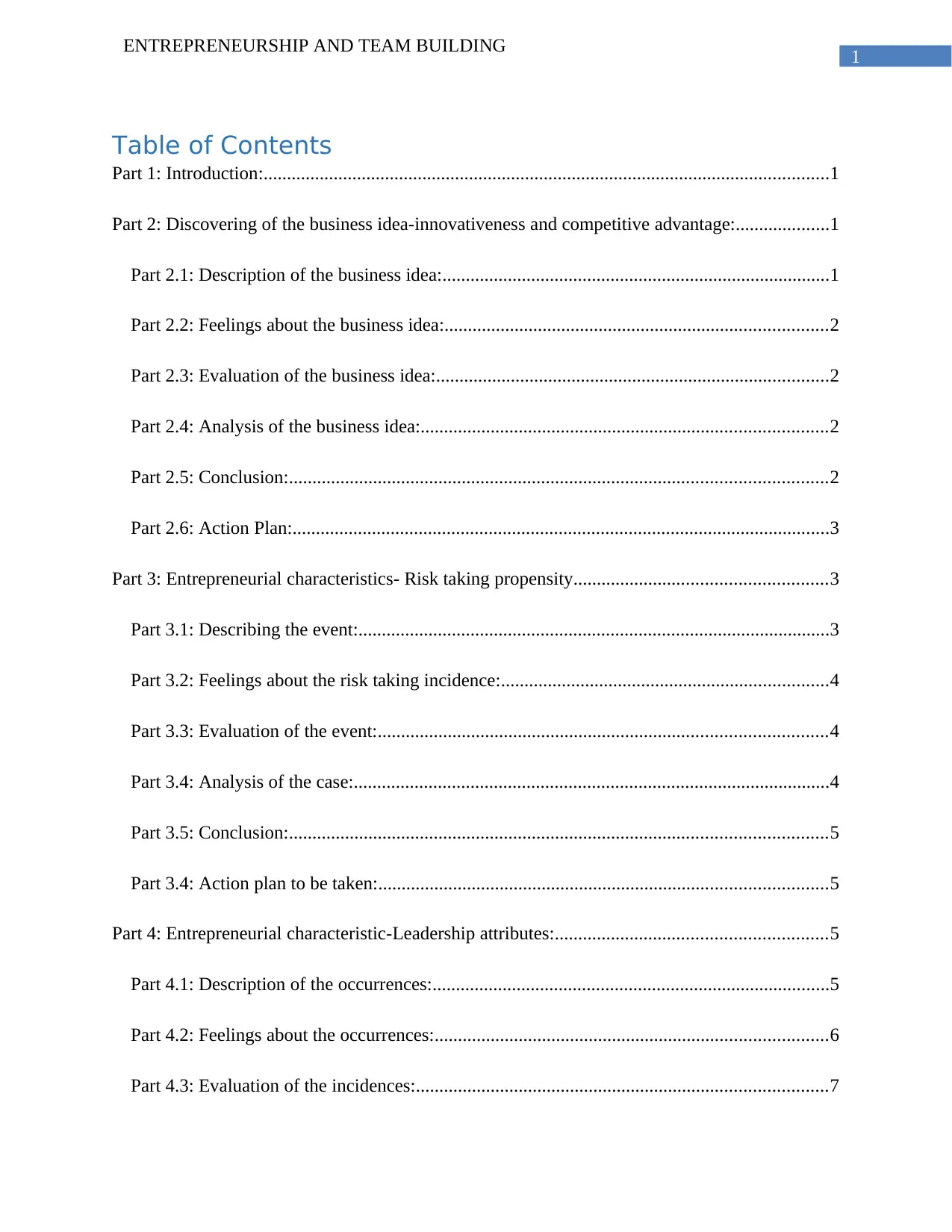
Table of Contents
Part 1: Introduction:.........................................................................................................................1
Part 2: Discovering of the business idea-innovativeness and competitive advantage:....................1
Part 2.1: Description of the business idea:...................................................................................1
Part 2.2: Feelings about the business idea:..................................................................................2
Part 2.3: Evaluation of the business idea:....................................................................................2
Part 2.4: Analysis of the business idea:.......................................................................................2
Part 2.5: Conclusion:...................................................................................................................2
Part 2.6: Action Plan:...................................................................................................................3
Part 3: Entrepreneurial characteristics- Risk taking propensity......................................................3
Part 3.1: Describing the event:.....................................................................................................3
Part 3.2: Feelings about the risk taking incidence:......................................................................4
Part 3.3: Evaluation of the event:................................................................................................4
Part 3.4: Analysis of the case:......................................................................................................4
Part 3.5: Conclusion:...................................................................................................................5
Part 3.4: Action plan to be taken:................................................................................................5
Part 4: Entrepreneurial characteristic-Leadership attributes:..........................................................5
Part 4.1: Description of the occurrences:.....................................................................................5
Part 4.2: Feelings about the occurrences:....................................................................................6
Part 4.3: Evaluation of the incidences:........................................................................................7
ENTREPRENEURSHIP AND TEAM BUILDING
Table of Contents
Part 1: Introduction:.........................................................................................................................1
Part 2: Discovering of the business idea-innovativeness and competitive advantage:....................1
Part 2.1: Description of the business idea:...................................................................................1
Part 2.2: Feelings about the business idea:..................................................................................2
Part 2.3: Evaluation of the business idea:....................................................................................2
Part 2.4: Analysis of the business idea:.......................................................................................2
Part 2.5: Conclusion:...................................................................................................................2
Part 2.6: Action Plan:...................................................................................................................3
Part 3: Entrepreneurial characteristics- Risk taking propensity......................................................3
Part 3.1: Describing the event:.....................................................................................................3
Part 3.2: Feelings about the risk taking incidence:......................................................................4
Part 3.3: Evaluation of the event:................................................................................................4
Part 3.4: Analysis of the case:......................................................................................................4
Part 3.5: Conclusion:...................................................................................................................5
Part 3.4: Action plan to be taken:................................................................................................5
Part 4: Entrepreneurial characteristic-Leadership attributes:..........................................................5
Part 4.1: Description of the occurrences:.....................................................................................5
Part 4.2: Feelings about the occurrences:....................................................................................6
Part 4.3: Evaluation of the incidences:........................................................................................7
2
ENTREPRENEURSHIP AND TEAM BUILDING
Part 4.4: Analysis of the incidences:............................................................................................7
Part 4.5: Conclusion:...................................................................................................................7
Part 4.6: Action plan:...................................................................................................................7
Part 5: Conclusion:..........................................................................................................................8
Part 6: References:...........................................................................................................................9
ENTREPRENEURSHIP AND TEAM BUILDING
Part 4.4: Analysis of the incidences:............................................................................................7
Part 4.5: Conclusion:...................................................................................................................7
Part 4.6: Action plan:...................................................................................................................7
Part 5: Conclusion:..........................................................................................................................8
Part 6: References:...........................................................................................................................9
⊘ This is a preview!⊘
Do you want full access?
Subscribe today to unlock all pages.

Trusted by 1+ million students worldwide
3
ENTREPRENEURSHIP AND TEAM BUILDING
Part 1: Introduction:
Entrepreneurial ventures require a lot skills like leadership and risk taking power. The
paper would deal with these two skills by taking the case study. It considers two theories, Gibbs
theory and Schumpeter’s theory.
Part 2: Discovering of the business idea-innovativeness and competitive advantage:
Part 2.1: Description of the business idea:
My team mates and I decided to launch an entrepreneurial venture of an online website
that would enable the users to shop a variety of products. The entrepreneurial business venture
necessitated us to brainstorm to bring about innovative ideas which often led to conflict of
opinions (Dees 2017).
I have inferred from my learning that the entrepreneurial theory which the new business
project would hold appropriate is Schumpeter’s theory of innovation According to the theory
innovation in the industrial and commercial sector lead to attraction of investments to bring
about new products and advanced versions of the existing products. I can point out that in the
light of the above theory, the new online shopping portal would have innovative attributes which
would enable it to provide customers with more benefits. These exclusive benefits would enable
the online shopping site create higher level of customer satisfaction and generate more revenue.
This would enable it to gain competitive advantage in the market (West and Bogers 2014).
I have understood that the new entrepreneurial business idea would consist of an online
shopping portal that would enable the consumers buy products. The online portal would offer
both economic range and premium range products, thus ensuring satisfaction of both upper and
middle class customers. The website would enable the customers choose from a wide range of
ENTREPRENEURSHIP AND TEAM BUILDING
Part 1: Introduction:
Entrepreneurial ventures require a lot skills like leadership and risk taking power. The
paper would deal with these two skills by taking the case study. It considers two theories, Gibbs
theory and Schumpeter’s theory.
Part 2: Discovering of the business idea-innovativeness and competitive advantage:
Part 2.1: Description of the business idea:
My team mates and I decided to launch an entrepreneurial venture of an online website
that would enable the users to shop a variety of products. The entrepreneurial business venture
necessitated us to brainstorm to bring about innovative ideas which often led to conflict of
opinions (Dees 2017).
I have inferred from my learning that the entrepreneurial theory which the new business
project would hold appropriate is Schumpeter’s theory of innovation According to the theory
innovation in the industrial and commercial sector lead to attraction of investments to bring
about new products and advanced versions of the existing products. I can point out that in the
light of the above theory, the new online shopping portal would have innovative attributes which
would enable it to provide customers with more benefits. These exclusive benefits would enable
the online shopping site create higher level of customer satisfaction and generate more revenue.
This would enable it to gain competitive advantage in the market (West and Bogers 2014).
I have understood that the new entrepreneurial business idea would consist of an online
shopping portal that would enable the consumers buy products. The online portal would offer
both economic range and premium range products, thus ensuring satisfaction of both upper and
middle class customers. The website would enable the customers choose from a wide range of
Paraphrase This Document
Need a fresh take? Get an instant paraphrase of this document with our AI Paraphraser
4
ENTREPRENEURSHIP AND TEAM BUILDING
products like apparel, grocery items and electronic items (Drucker 2014). The buyers would be
able to avail discounts every time they shop in addition to additional products at discounted
prices. These aspects of the new business model would make it profitable to customers.
However, this extensive would require support of all the team members.
Part 2.2: Feelings about the business idea:
My team mates readily agreed to embark on the project of the online shopping portal. I
felt really very happy and motivated at the support of my team mates.
Part 2.3: Evaluation of the business idea:
I can evaluate that the business idea of an online shopping portal requires immense
technical, financial and resource strength. A business firm starting such an initiative requires to
acquire immense market knowledge on customer preferences, primary and secondary consumers
and various other factors in order to conduct the business profitably. I can evaluate we require to
gain a lot of knowledge to be successful in running the venture profitably (Parker 2018).
Part 2.4: Analysis of the business idea:
I understood on analysing the entrepreneurial business idea that is a very promising and
would prove profitable. It can also analyse that the team mates including me have to conduct
extensive research to gain a sizeable amount of knowledge on the online shopping portals and
their operations (Burns 2016).
Part 2.5: Conclusion:
According to my opinion based on my learning the entrepreneurial business venture of
online shopping portal would be extremely profitable. However, it would require collaboration of
all the team members who would gain knowledge on various aspects like customer preferences.
ENTREPRENEURSHIP AND TEAM BUILDING
products like apparel, grocery items and electronic items (Drucker 2014). The buyers would be
able to avail discounts every time they shop in addition to additional products at discounted
prices. These aspects of the new business model would make it profitable to customers.
However, this extensive would require support of all the team members.
Part 2.2: Feelings about the business idea:
My team mates readily agreed to embark on the project of the online shopping portal. I
felt really very happy and motivated at the support of my team mates.
Part 2.3: Evaluation of the business idea:
I can evaluate that the business idea of an online shopping portal requires immense
technical, financial and resource strength. A business firm starting such an initiative requires to
acquire immense market knowledge on customer preferences, primary and secondary consumers
and various other factors in order to conduct the business profitably. I can evaluate we require to
gain a lot of knowledge to be successful in running the venture profitably (Parker 2018).
Part 2.4: Analysis of the business idea:
I understood on analysing the entrepreneurial business idea that is a very promising and
would prove profitable. It can also analyse that the team mates including me have to conduct
extensive research to gain a sizeable amount of knowledge on the online shopping portals and
their operations (Burns 2016).
Part 2.5: Conclusion:
According to my opinion based on my learning the entrepreneurial business venture of
online shopping portal would be extremely profitable. However, it would require collaboration of
all the team members who would gain knowledge on various aspects like customer preferences.
5
ENTREPRENEURSHIP AND TEAM BUILDING
Part 2.6: Action Plan:
The action plan as per my learning would consists of consist extensive research in
different fields like customer preferences and technological aspects of online portals. The team
mates of mine would study articles, books and other literary sources to gain knowledge about the
customers’ preferences as far as online portals are concerned. They should also consult
technological experts to gain more knowledge in the field of business (Huggins and Thompson
2015).
Part 3: Entrepreneurial characteristics- Risk taking propensity
Part 3.1: Describing the event:
I have learnt that one of the most significant entrepreneurial attributes as I can reflect is
risk taking propensity. It is this attribute which drives entrepreneurs to take risks in order to
exploit business opportunities existing in the market to benefit from them and gain profits.
I learnt that the entrepreneurial business venture would face several internal and external
risks. First of all, since the market of online shopping websites have become extremely
competitive with dominance of multinational ecommerce companies like Amazon. These
multinational companies would pose serious challenges to the new ecommerce companies. The
second challenge would be availability of funds. This is because new entrepreneurial business
ventures have no revenue base of their own which limits them their borrowing power
(Piperopoulos 2016). I can point out that new business ventures like the venture revolving on
online portal given in the case study require contribution from all the team members. This often
leads to conflict among the team members owing to conflict in opinion and ego among the team
members. I can point out that it is a challenge for the team leaders to ensure unity and
ENTREPRENEURSHIP AND TEAM BUILDING
Part 2.6: Action Plan:
The action plan as per my learning would consists of consist extensive research in
different fields like customer preferences and technological aspects of online portals. The team
mates of mine would study articles, books and other literary sources to gain knowledge about the
customers’ preferences as far as online portals are concerned. They should also consult
technological experts to gain more knowledge in the field of business (Huggins and Thompson
2015).
Part 3: Entrepreneurial characteristics- Risk taking propensity
Part 3.1: Describing the event:
I have learnt that one of the most significant entrepreneurial attributes as I can reflect is
risk taking propensity. It is this attribute which drives entrepreneurs to take risks in order to
exploit business opportunities existing in the market to benefit from them and gain profits.
I learnt that the entrepreneurial business venture would face several internal and external
risks. First of all, since the market of online shopping websites have become extremely
competitive with dominance of multinational ecommerce companies like Amazon. These
multinational companies would pose serious challenges to the new ecommerce companies. The
second challenge would be availability of funds. This is because new entrepreneurial business
ventures have no revenue base of their own which limits them their borrowing power
(Piperopoulos 2016). I can point out that new business ventures like the venture revolving on
online portal given in the case study require contribution from all the team members. This often
leads to conflict among the team members owing to conflict in opinion and ego among the team
members. I can point out that it is a challenge for the team leaders to ensure unity and
⊘ This is a preview!⊘
Do you want full access?
Subscribe today to unlock all pages.
Trusted by 1+ million students worldwide
6
ENTREPRENEURSHIP AND TEAM BUILDING
coordination among team members in spite of presence of conflicting ideas and interests among
team members (Woodside, Bernal and Coduras 2016).
Part 3.2: Feelings about the risk taking incidence:
I feeling extremely stressed due to several reasons. First, it was a new business venture
which required immense market research. This required immense collaboration among the team
members. Moreover, there was conflict among two of the team members which was about to
lead to the collapse of the team. It was under this intensely tensed condition that I took charge of
the team. Hence, considering the situation I was very stressed due to this conflict among two of
my team members (Carmody-Bubb, Duncan and Ree 2015).
Part 3.3: Evaluation of the event:
I can evaluate that I handled the conflict between two members very efficiently as a
leader. I could point out that the conflict between the two members was about to bring about
collapse of the team and consequently to the entrepreneurial venture of online shopping portal. I
can also point that I had to nullify the impact of the previous authoritative leader to establish
collaborative environment within the team (Hagen, Denicolai and Zucchella 2014).
Part 3.4: Analysis of the case:
I can analyse that I managed the risk very efficiently as a leader. I took the responsibility
of the team leader when the team members were suffering from lack of attachment to the team
and were planning to change their teams. I used my interpersonal skills to establish smooth
communication among the team members. I used Gibbs Theory to promote a healthy team
environment and taught the members to neglect minor faults of each other. I advocated on need
to build a healthy team culture which would eventually lead them towards attainment of the goal
of successful launching of the online shopping portal (Cahn and Abigail 2014).
ENTREPRENEURSHIP AND TEAM BUILDING
coordination among team members in spite of presence of conflicting ideas and interests among
team members (Woodside, Bernal and Coduras 2016).
Part 3.2: Feelings about the risk taking incidence:
I feeling extremely stressed due to several reasons. First, it was a new business venture
which required immense market research. This required immense collaboration among the team
members. Moreover, there was conflict among two of the team members which was about to
lead to the collapse of the team. It was under this intensely tensed condition that I took charge of
the team. Hence, considering the situation I was very stressed due to this conflict among two of
my team members (Carmody-Bubb, Duncan and Ree 2015).
Part 3.3: Evaluation of the event:
I can evaluate that I handled the conflict between two members very efficiently as a
leader. I could point out that the conflict between the two members was about to bring about
collapse of the team and consequently to the entrepreneurial venture of online shopping portal. I
can also point that I had to nullify the impact of the previous authoritative leader to establish
collaborative environment within the team (Hagen, Denicolai and Zucchella 2014).
Part 3.4: Analysis of the case:
I can analyse that I managed the risk very efficiently as a leader. I took the responsibility
of the team leader when the team members were suffering from lack of attachment to the team
and were planning to change their teams. I used my interpersonal skills to establish smooth
communication among the team members. I used Gibbs Theory to promote a healthy team
environment and taught the members to neglect minor faults of each other. I advocated on need
to build a healthy team culture which would eventually lead them towards attainment of the goal
of successful launching of the online shopping portal (Cahn and Abigail 2014).
Paraphrase This Document
Need a fresh take? Get an instant paraphrase of this document with our AI Paraphraser
7
ENTREPRENEURSHIP AND TEAM BUILDING
Part 3.5: Conclusion:
I can reflect upon the risk taking propensity of mine as an entrepreneur and as a team
leader and mention that I was efficient in the areas. I succeeded in reinstating collaboration
among the team members and managing conflict among them.
Part 3.4: Action plan to be taken:
I can reflect upon the risk taking capability of mine and set an action plan to improve it
further. I would read more books and articles to increase my knowledge on risk taking. I would
also attend seminars to interact with professionals to enhance my risk taking capacity (Way,
Jimmieson. and Bordia 2016).
Part 4: Entrepreneurial characteristic-Leadership attributes:
Part 4.1: Description of the occurrences:
I got the opportunity to showcase several leadership attributes of mine while leading the
entrepreneurial venture team. The first leadership quality which I exhibited was establishment of
unity among the team members and conflict management skills. There were certain team
members who had conflicting interests regarding certain matters. I used my conflict management
and communication skills to establish communication among the conflicting members (Kerzner
and Kerzner 2017).
The second leadership skill which I exhibited as the leader of the entrepreneurial team
was motivation. The entrepreneurial venture revolved around introducing online shopping
services which was very risky considering the fact that the ecommerce market already had
players like Amazon. Thus, the new entrepreneurial ventures was supposed to come under the
ENTREPRENEURSHIP AND TEAM BUILDING
Part 3.5: Conclusion:
I can reflect upon the risk taking propensity of mine as an entrepreneur and as a team
leader and mention that I was efficient in the areas. I succeeded in reinstating collaboration
among the team members and managing conflict among them.
Part 3.4: Action plan to be taken:
I can reflect upon the risk taking capability of mine and set an action plan to improve it
further. I would read more books and articles to increase my knowledge on risk taking. I would
also attend seminars to interact with professionals to enhance my risk taking capacity (Way,
Jimmieson. and Bordia 2016).
Part 4: Entrepreneurial characteristic-Leadership attributes:
Part 4.1: Description of the occurrences:
I got the opportunity to showcase several leadership attributes of mine while leading the
entrepreneurial venture team. The first leadership quality which I exhibited was establishment of
unity among the team members and conflict management skills. There were certain team
members who had conflicting interests regarding certain matters. I used my conflict management
and communication skills to establish communication among the conflicting members (Kerzner
and Kerzner 2017).
The second leadership skill which I exhibited as the leader of the entrepreneurial team
was motivation. The entrepreneurial venture revolved around introducing online shopping
services which was very risky considering the fact that the ecommerce market already had
players like Amazon. Thus, the new entrepreneurial ventures was supposed to come under the
8
ENTREPRENEURSHIP AND TEAM BUILDING
influence of intense market competition right at the initial phase. I motivated my team members
even though some of the members did not appreciate my efforts (Wong et al. 2018).
The third leadership quality I revealed was determination to lead the team towards
attainment of the goal. The previous team leader was authoritative and used his position to
impose his ideas on his fellow members. He treated them as subordinates and disregarded their
opinions and ideas. This led to a general lack of respect among the team members for each other.
I can point out that I used my determination to change the uncooperative and hostile mentality
among the team members. I succeeded by gaining cooperation from even the conflicting
members which further enhanced my qualities as a leader. I motivated the team members when
they lacked motivation and confidence. I however realised that I was not able to serve the
interests of all the team members (Rahim 2017).
Part 4.2: Feelings about the occurrences:
I can reflect that my feeling about leadership qualities are mixed. I was satisfied that I
was able to improve the team culture among the members. I was able to re-establish the lost team
cohesion due to the authoritative leadership style of the previous which ultimate eat into the team
values. I can also point out that I was able to manage the conflict among the two conflicting
members. I successfully motivated the team members when they lacked confidence when again
showed my motivating nature as a team leader. However, I also point it was not possible for me
to satisfy the demands of all the members. I feel confident and would lead teams successfully in
the future. I would also take up courses and read articles on famous corporate leaders to enhance
my leadership skills (Garaigordobil and Martínez-Valderrey 2015).
ENTREPRENEURSHIP AND TEAM BUILDING
influence of intense market competition right at the initial phase. I motivated my team members
even though some of the members did not appreciate my efforts (Wong et al. 2018).
The third leadership quality I revealed was determination to lead the team towards
attainment of the goal. The previous team leader was authoritative and used his position to
impose his ideas on his fellow members. He treated them as subordinates and disregarded their
opinions and ideas. This led to a general lack of respect among the team members for each other.
I can point out that I used my determination to change the uncooperative and hostile mentality
among the team members. I succeeded by gaining cooperation from even the conflicting
members which further enhanced my qualities as a leader. I motivated the team members when
they lacked motivation and confidence. I however realised that I was not able to serve the
interests of all the team members (Rahim 2017).
Part 4.2: Feelings about the occurrences:
I can reflect that my feeling about leadership qualities are mixed. I was satisfied that I
was able to improve the team culture among the members. I was able to re-establish the lost team
cohesion due to the authoritative leadership style of the previous which ultimate eat into the team
values. I can also point out that I was able to manage the conflict among the two conflicting
members. I successfully motivated the team members when they lacked confidence when again
showed my motivating nature as a team leader. However, I also point it was not possible for me
to satisfy the demands of all the members. I feel confident and would lead teams successfully in
the future. I would also take up courses and read articles on famous corporate leaders to enhance
my leadership skills (Garaigordobil and Martínez-Valderrey 2015).
⊘ This is a preview!⊘
Do you want full access?
Subscribe today to unlock all pages.
Trusted by 1+ million students worldwide
9
ENTREPRENEURSHIP AND TEAM BUILDING
Part 4.3: Evaluation of the incidences:
I can evaluate upon reflection upon my leadership skills that I am efficient as a leader but
I need to work on certain areas. I can point out that I was good in managing the conflict among
the team members and counteract the hostile team culture established by the previous leader. I
can further point out that I was good at motivating the team members and leading them towards
achievement of the goal. However, I was efficient in satisfying the demands of all the team
members which might have left some of the members resenting. I can point out upon evaluation
that I require to improve this area of my leadership style.
Part 4.4: Analysis of the incidences:
I can analyse the incidence and point out that I was quite efficient as a leader. I was able
to manage the conflicting situation within the team which the previous leader created. I was
confident and was able to motivate the team members when they lacked confidence. However, I
can point out that as a leader I require to further enhance my leadership skills to be able to tackle
more complex and challenging situation more efficiently.
Part 4.5: Conclusion:
I can conclude upon reflection that I am an efficient leader but need to work on my weak
areas. I would make certain action plan to hone my leadership skills to boost my professional
development in the future.
Part 4.6: Action plan:
I would attend seminars and conferences on leadership to sharpen my leadership
qualities. I would also read books, journals and articles to strengthen my leadership power. Then
I would also watch videos to leadership.
ENTREPRENEURSHIP AND TEAM BUILDING
Part 4.3: Evaluation of the incidences:
I can evaluate upon reflection upon my leadership skills that I am efficient as a leader but
I need to work on certain areas. I can point out that I was good in managing the conflict among
the team members and counteract the hostile team culture established by the previous leader. I
can further point out that I was good at motivating the team members and leading them towards
achievement of the goal. However, I was efficient in satisfying the demands of all the team
members which might have left some of the members resenting. I can point out upon evaluation
that I require to improve this area of my leadership style.
Part 4.4: Analysis of the incidences:
I can analyse the incidence and point out that I was quite efficient as a leader. I was able
to manage the conflicting situation within the team which the previous leader created. I was
confident and was able to motivate the team members when they lacked confidence. However, I
can point out that as a leader I require to further enhance my leadership skills to be able to tackle
more complex and challenging situation more efficiently.
Part 4.5: Conclusion:
I can conclude upon reflection that I am an efficient leader but need to work on my weak
areas. I would make certain action plan to hone my leadership skills to boost my professional
development in the future.
Part 4.6: Action plan:
I would attend seminars and conferences on leadership to sharpen my leadership
qualities. I would also read books, journals and articles to strengthen my leadership power. Then
I would also watch videos to leadership.
Paraphrase This Document
Need a fresh take? Get an instant paraphrase of this document with our AI Paraphraser
10
ENTREPRENEURSHIP AND TEAM BUILDING
Part 5: Conclusion:
I can conclude from the discussion that entrepreneurial ventures are dependent on team
work for their success. Entrepreneurs should concentrate on building team motivation in order to
attain their goals. They should build a smooth communication stream among the team members
and concentrate managing conflict. These strategies would strengthen the motivation among the
team members and they would work harder to attain team goals.
ENTREPRENEURSHIP AND TEAM BUILDING
Part 5: Conclusion:
I can conclude from the discussion that entrepreneurial ventures are dependent on team
work for their success. Entrepreneurs should concentrate on building team motivation in order to
attain their goals. They should build a smooth communication stream among the team members
and concentrate managing conflict. These strategies would strengthen the motivation among the
team members and they would work harder to attain team goals.
11
ENTREPRENEURSHIP AND TEAM BUILDING
Part 6: References:
Burns, P., 2016. Entrepreneurship and small business. Palgrave Macmillan Limited.
Cahn, D.D. and Abigail, R.A., 2014. Managing conflict through communication. Pearson.
Carmody-Bubb, M.A., Duncan, P.A. and Ree, M.J., 2015. Emotional intelligence and personality
predict conflict management style: examining relationships and factor structures. Journal of
Behavioral Studies in Business Volume.
Dees, J.G., 2017. 1 The Meaning of Social Entrepreneurship. In Case Studies in Social
Entrepreneurship and Sustainability(pp. 34-42). Routledge.
Drucker, P., 2014. Innovation and entrepreneurship. Routledge.
Garaigordobil, M. and Martínez-Valderrey, V., 2015. The effectiveness of Cyberprogram 2.0 on
conflict resolution strategies and self-esteem. Journal of Adolescent Health, 57(2), pp.229-234.
Hagen, B., Denicolai, S. and Zucchella, A., 2014. International entrepreneurship at the
crossroads between innovation and internationalization. Journal of International
Entrepreneurship, 12(2), pp.111-114.
Huggins, R. and Thompson, P., 2015. Entrepreneurship, innovation and regional growth: a
network theory. Small Business Economics, 45(1), pp.103-128.
Kerzner, H. and Kerzner, H.R., 2017. Project management: a systems approach to planning,
scheduling, and controlling. John Wiley & Sons.
Parker, S.C., 2018. The economics of entrepreneurship. Cambridge University Press.
Piperopoulos, P.G., 2016. Entrepreneurship, innovation and business clusters. Routledge.
ENTREPRENEURSHIP AND TEAM BUILDING
Part 6: References:
Burns, P., 2016. Entrepreneurship and small business. Palgrave Macmillan Limited.
Cahn, D.D. and Abigail, R.A., 2014. Managing conflict through communication. Pearson.
Carmody-Bubb, M.A., Duncan, P.A. and Ree, M.J., 2015. Emotional intelligence and personality
predict conflict management style: examining relationships and factor structures. Journal of
Behavioral Studies in Business Volume.
Dees, J.G., 2017. 1 The Meaning of Social Entrepreneurship. In Case Studies in Social
Entrepreneurship and Sustainability(pp. 34-42). Routledge.
Drucker, P., 2014. Innovation and entrepreneurship. Routledge.
Garaigordobil, M. and Martínez-Valderrey, V., 2015. The effectiveness of Cyberprogram 2.0 on
conflict resolution strategies and self-esteem. Journal of Adolescent Health, 57(2), pp.229-234.
Hagen, B., Denicolai, S. and Zucchella, A., 2014. International entrepreneurship at the
crossroads between innovation and internationalization. Journal of International
Entrepreneurship, 12(2), pp.111-114.
Huggins, R. and Thompson, P., 2015. Entrepreneurship, innovation and regional growth: a
network theory. Small Business Economics, 45(1), pp.103-128.
Kerzner, H. and Kerzner, H.R., 2017. Project management: a systems approach to planning,
scheduling, and controlling. John Wiley & Sons.
Parker, S.C., 2018. The economics of entrepreneurship. Cambridge University Press.
Piperopoulos, P.G., 2016. Entrepreneurship, innovation and business clusters. Routledge.
⊘ This is a preview!⊘
Do you want full access?
Subscribe today to unlock all pages.
Trusted by 1+ million students worldwide

1 out of 13


Related Documents


Your All-in-One AI-Powered Toolkit for Academic Success.
+13062052269
info@desklib.com
Available 24*7 on WhatsApp / Email
![[object Object]](/_next/static/media/star-bottom.7253800d.svg)
Unlock your academic potential
Copyright © 2020–2026 A2Z Services. All Rights Reserved. Developed and managed by ZUCOL.