MDR-TB Analysis: Epidemiology, Risk Factors, and Case Finding

Verified

Added on  2022/09/18

|2
|370
|24
Report
AI Summary
This report provides an analysis of Multidrug-Resistant Tuberculosis (MDR-TB), focusing on its epidemiology and associated risk factors, drawing from the provided articles. The report examines the strengths and weaknesses of each source, including Caminero's work on MDR-TB epidemiology and risk factors and Espinal's study on the global situation of MDR-TB. The analysis highlights the importance of understanding drug resistance patterns and the challenges in diagnosing and treating MDR-TB, particularly in developing countries. The report also underscores the need for comprehensive data and effective strategies for case finding and prevention, such as DOTS and second-line drugs, to combat the global spread of this public health threat. The report also emphasizes on the lack of detailed information regarding the onset of the disease.
Document Page
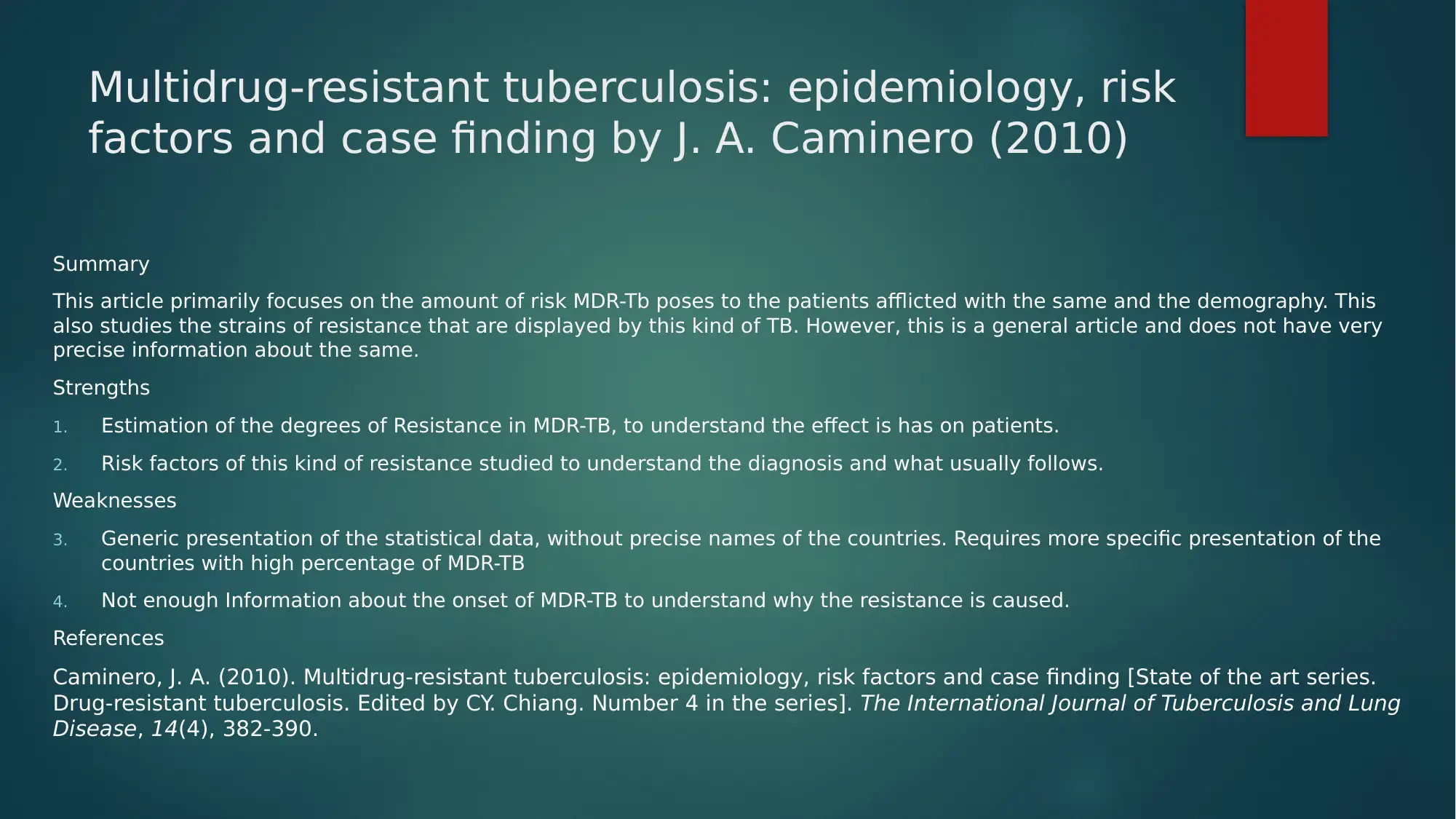
Multidrug-resistant tuberculosis: epidemiology, risk
factors and case finding by J. A. Caminero (2010)
Summary
This article primarily focuses on the amount of risk MDR-Tb poses to the patients afflicted with the same and the demography. This
also studies the strains of resistance that are displayed by this kind of TB. However, this is a general article and does not have very
precise information about the same.
Strengths
1. Estimation of the degrees of Resistance in MDR-TB, to understand the effect is has on patients.
2. Risk factors of this kind of resistance studied to understand the diagnosis and what usually follows.
Weaknesses
3. Generic presentation of the statistical data, without precise names of the countries. Requires more specific presentation of the
countries with high percentage of MDR-TB
4. Not enough Information about the onset of MDR-TB to understand why the resistance is caused.
References
Caminero, J. A. (2010). Multidrug-resistant tuberculosis: epidemiology, risk factors and case finding [State of the art series.
Drug-resistant tuberculosis. Edited by CY. Chiang. Number 4 in the series]. The International Journal of Tuberculosis and Lung
Disease, 14(4), 382-390.
tabler-icon-diamond-filled.svg

Paraphrase This Document

Need a fresh take? Get an instant paraphrase of this document with our AI Paraphraser
Document Page
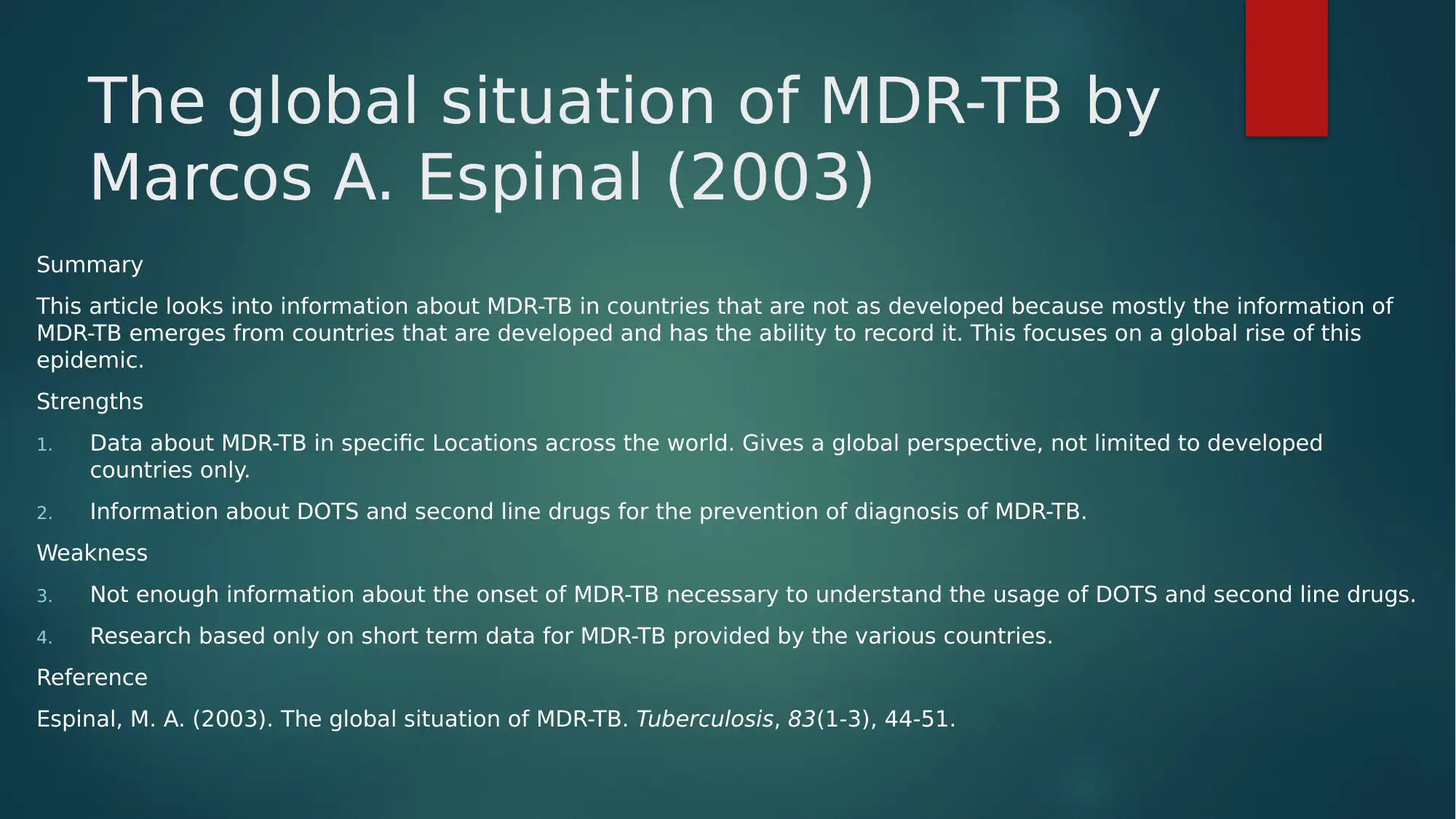
The global situation of MDR-TB by
Marcos A. Espinal (2003)
Summary
This article looks into information about MDR-TB in countries that are not as developed because mostly the information of
MDR-TB emerges from countries that are developed and has the ability to record it. This focuses on a global rise of this
epidemic.
Strengths
1. Data about MDR-TB in specific Locations across the world. Gives a global perspective, not limited to developed
countries only.
2. Information about DOTS and second line drugs for the prevention of diagnosis of MDR-TB.
Weakness
3. Not enough information about the onset of MDR-TB necessary to understand the usage of DOTS and second line drugs.
4. Research based only on short term data for MDR-TB provided by the various countries.
Reference
Espinal, M. A. (2003). The global situation of MDR-TB. Tuberculosis, 83(1-3), 44-51.
chevron_up_icon
1 out of 2
circle_padding
hide_on_mobile
zoom_out_icon
[object Object]