Year 1 Science: Mealworm External Features and Adaptation Report
VerifiedAdded on 2023/01/13
|17
|3221
|86
Report
AI Summary
This report provides an executive summary and detailed analysis of a Year 1 science lesson plan focused on the external features and adaptation of mealworms, aligning with the Australian curriculum. The assignment explores the effectiveness of the lesson, which incorporates play-based activities and focuses on the key concept of 'relationship' to help students understand how mealworms' features relate to their environmental adaptation. The report examines the prior knowledge strategy employed by the teacher, which involved focused questioning and discussion to assess student understanding. Findings from the analysis of student work samples reveal that the students developed a strong understanding of the topic. The report also suggests a follow-up lesson plan to reinforce the students' conceptual understanding of the mealworm life cycle. The report emphasizes the importance of connecting new knowledge with existing knowledge to enhance student learning and engagement.
Science Early Years
1
1

Paraphrase This Document
Need a fresh take? Get an instant paraphrase of this document with our AI Paraphraser
Executive Summary
The following report focused upon understanding the requirement of prior knowledge in building
children’s learning experience. In this context, it is noteworthy that the teacher helped the
students by selecting effective prior knowledge strategy and building session plan for reflecting
on children’s prior knowledge for building further knowledge and experience in a constructive
way.
2
The following report focused upon understanding the requirement of prior knowledge in building
children’s learning experience. In this context, it is noteworthy that the teacher helped the
students by selecting effective prior knowledge strategy and building session plan for reflecting
on children’s prior knowledge for building further knowledge and experience in a constructive
way.
2
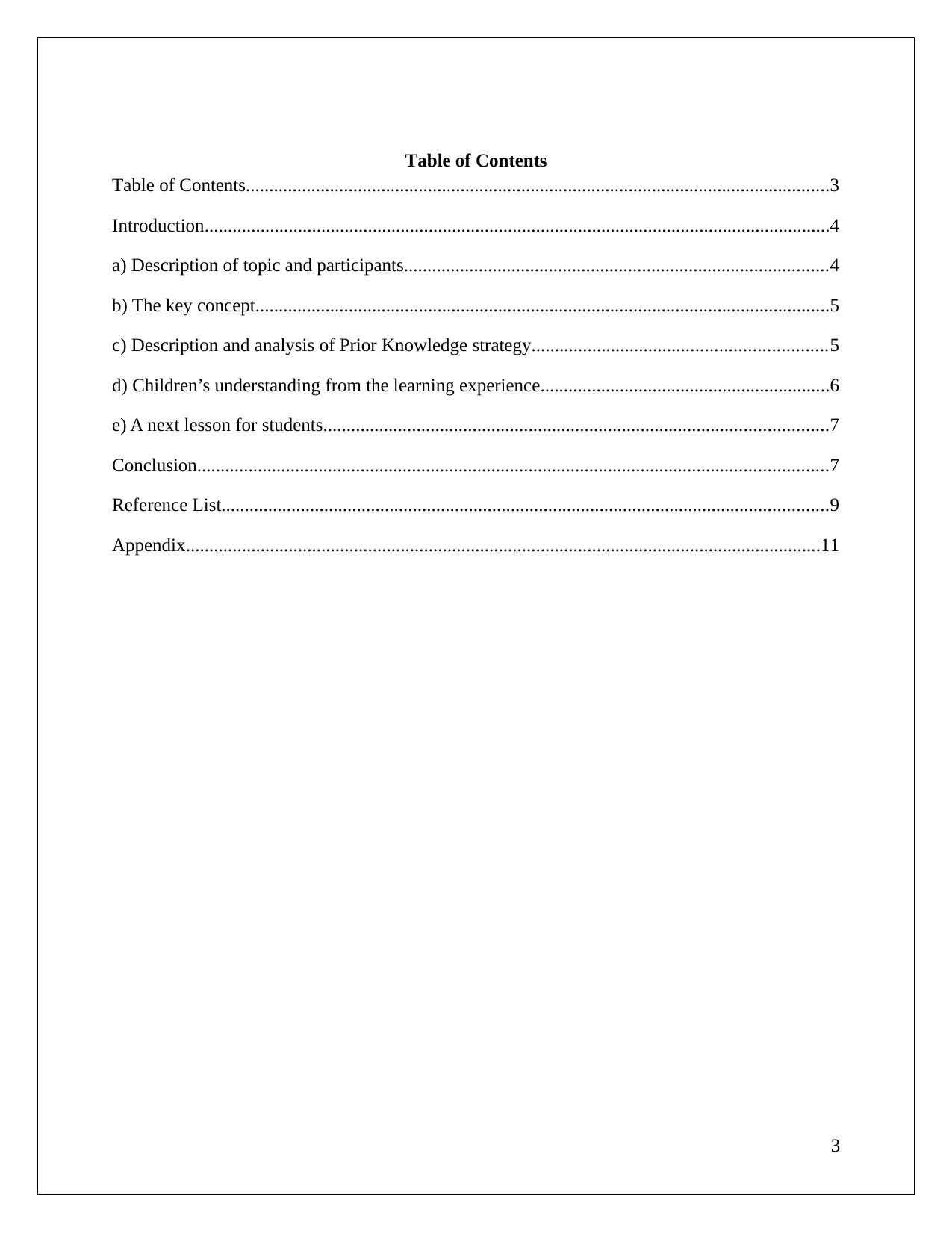
Table of Contents
Table of Contents.............................................................................................................................3
Introduction......................................................................................................................................4
a) Description of topic and participants...........................................................................................4
b) The key concept...........................................................................................................................5
c) Description and analysis of Prior Knowledge strategy...............................................................5
d) Children’s understanding from the learning experience..............................................................6
e) A next lesson for students............................................................................................................7
Conclusion.......................................................................................................................................7
Reference List..................................................................................................................................9
Appendix........................................................................................................................................11
3
Table of Contents.............................................................................................................................3
Introduction......................................................................................................................................4
a) Description of topic and participants...........................................................................................4
b) The key concept...........................................................................................................................5
c) Description and analysis of Prior Knowledge strategy...............................................................5
d) Children’s understanding from the learning experience..............................................................6
e) A next lesson for students............................................................................................................7
Conclusion.......................................................................................................................................7
Reference List..................................................................................................................................9
Appendix........................................................................................................................................11
3
⊘ This is a preview!⊘
Do you want full access?
Subscribe today to unlock all pages.

Trusted by 1+ million students worldwide
1. Introduction
The Australian curriculum for education and learning promotes the teachers to develop learning
plans based on the requirements of the students in different stage of development. In this context,
the following assignment is going to focus upon discussion about the science learning experience
of year 1 students, who have undergone learning session on the topic “external features and
adaptation of mealworms”. Considering the topic and the concepts selected for the learning
plan, the effectiveness of the learning plan would be discussed in the following report. In
addition, how effective the learning experience was for the year 1 students, would also be
demonstrated in the following report.
In the year 1 science curriculum in Australian education system, science contributes a vital part.
For year 1 student, the learning experience on the topic “external features and adaptation of
mealworms” have been demonstrated. This science topic helps the students to develop
knowledge about the mealworms, how they look, what are the anatomical features and what are
the functions. Mainly, they would attempt to observe the external features and the stages the
mealworms undergo through their adaptation. Not only theoretical learning has been given, in
addition play based practical learning has also been provided to the year 1 students.
The topic, which has been selected for the current lesson plan, is the “external features and
adaptation of mealworms”, which is the part of “animals study” in the Year 1 science
curriculum.
The key concept
It is crucial to base the lesson plan on a particular concept or idea. In the Australian Curriculum
for science, there are several key concepts, which are representing the key aspects related to the
scientific view of the world, while bridging knowledge and understanding through the science
disciplines. These key concepts are embedded in each year level description, for providing
guidance to the teachers, so that they could emphasize on particular concept in teaching or
learning practices, for the relevant year level (Donoghue and Hattie, 2018). These key concepts
are designed for supporting the developmental sequence in science knowledge through year
level. The key concepts frame the development of the concepts in the science understanding,
4
The Australian curriculum for education and learning promotes the teachers to develop learning
plans based on the requirements of the students in different stage of development. In this context,
the following assignment is going to focus upon discussion about the science learning experience
of year 1 students, who have undergone learning session on the topic “external features and
adaptation of mealworms”. Considering the topic and the concepts selected for the learning
plan, the effectiveness of the learning plan would be discussed in the following report. In
addition, how effective the learning experience was for the year 1 students, would also be
demonstrated in the following report.
In the year 1 science curriculum in Australian education system, science contributes a vital part.
For year 1 student, the learning experience on the topic “external features and adaptation of
mealworms” have been demonstrated. This science topic helps the students to develop
knowledge about the mealworms, how they look, what are the anatomical features and what are
the functions. Mainly, they would attempt to observe the external features and the stages the
mealworms undergo through their adaptation. Not only theoretical learning has been given, in
addition play based practical learning has also been provided to the year 1 students.
The topic, which has been selected for the current lesson plan, is the “external features and
adaptation of mealworms”, which is the part of “animals study” in the Year 1 science
curriculum.
The key concept
It is crucial to base the lesson plan on a particular concept or idea. In the Australian Curriculum
for science, there are several key concepts, which are representing the key aspects related to the
scientific view of the world, while bridging knowledge and understanding through the science
disciplines. These key concepts are embedded in each year level description, for providing
guidance to the teachers, so that they could emphasize on particular concept in teaching or
learning practices, for the relevant year level (Donoghue and Hattie, 2018). These key concepts
are designed for supporting the developmental sequence in science knowledge through year
level. The key concepts frame the development of the concepts in the science understanding,
4
Paraphrase This Document
Need a fresh take? Get an instant paraphrase of this document with our AI Paraphraser
while supporting the important aspects in the science inquiry skill strand. As a result, these
concepts are contributing in the development of the appreciation of students regarding the nature
of science.
2. Description of Prior Knowledge strategy
Several studies have identified prior knowledge as the key towards success of the pupil,
especially during the early stages of education. It helps students to connect the current
knowledge development with the existing knowledge. Planning short prior knowledge
experience helps the teacher to ascertain the conceptual knowledge and thinking. Teachers use a
range of prior knowledge strategy, including “having conversations, focusing on key questions,
asking children to complete a short task such as an annotated diagram or sorting objects with a
small group”. However, the prior knowledge strategy could vary based on the subject or
student’s key stage (Ferreras-Méndez et al., 2016). Here, in the current prior knowledge
experience plan, the teacher has selected the strategy of “focusing upon key questions”, for
assessing the prior knowledge of the learners. Initially, the teacher introduced the experience by
asking focused questions, to ensure that students have absorbed enough knowledge from the
previous session, which would contribute in shaping their future knowledge. In addition, through
an open discussion, the teacher enabled the students to clarify their doubts. It is indicating that
the strategy is appropriate for the lesson plan of year 1 students in science.
The key questions asked by the teacher to the learners are helping the learners to engage in the
learning process, while supporting them to challenge their pre-developed concepts and
knowledge on the particular subject. Through the conversation and questioning session, the
teacher has developed the experience and finally concluded it through engaging them into some
tasks, for assessing their prior knowledge experience (McVicaret al., 2015). Through the session,
the students were enabled to ask questions, challenge their ideas and clarify their doubts, which
helped them to construct knowledge from the learning, which they could utilize in real – life
context. Thus, it can be interpreted that the teacher’s prior knowledge strategy is constructive in
nature. The year 1 students are taught in different subjects, including English, mathematics and
science, along with other curriculum activities. Both theoretical as well as play based activities
are the parts of their lesson plans. In science, which has been emphasized in the current lesson,
5
concepts are contributing in the development of the appreciation of students regarding the nature
of science.
2. Description of Prior Knowledge strategy
Several studies have identified prior knowledge as the key towards success of the pupil,
especially during the early stages of education. It helps students to connect the current
knowledge development with the existing knowledge. Planning short prior knowledge
experience helps the teacher to ascertain the conceptual knowledge and thinking. Teachers use a
range of prior knowledge strategy, including “having conversations, focusing on key questions,
asking children to complete a short task such as an annotated diagram or sorting objects with a
small group”. However, the prior knowledge strategy could vary based on the subject or
student’s key stage (Ferreras-Méndez et al., 2016). Here, in the current prior knowledge
experience plan, the teacher has selected the strategy of “focusing upon key questions”, for
assessing the prior knowledge of the learners. Initially, the teacher introduced the experience by
asking focused questions, to ensure that students have absorbed enough knowledge from the
previous session, which would contribute in shaping their future knowledge. In addition, through
an open discussion, the teacher enabled the students to clarify their doubts. It is indicating that
the strategy is appropriate for the lesson plan of year 1 students in science.
The key questions asked by the teacher to the learners are helping the learners to engage in the
learning process, while supporting them to challenge their pre-developed concepts and
knowledge on the particular subject. Through the conversation and questioning session, the
teacher has developed the experience and finally concluded it through engaging them into some
tasks, for assessing their prior knowledge experience (McVicaret al., 2015). Through the session,
the students were enabled to ask questions, challenge their ideas and clarify their doubts, which
helped them to construct knowledge from the learning, which they could utilize in real – life
context. Thus, it can be interpreted that the teacher’s prior knowledge strategy is constructive in
nature. The year 1 students are taught in different subjects, including English, mathematics and
science, along with other curriculum activities. Both theoretical as well as play based activities
are the parts of their lesson plans. In science, which has been emphasized in the current lesson,
5
children learn about plants, animals including humans, everyday materials and seasonal changes
through the curriculum year. The prior knowledge strategy has the most effective value within
the field for the development of student and their activity. The teaching process have the most
suitable and effective value on the students by the help of suitable activities performed by the
teachers.
3. Findings from children understanding
From the annotated analysis of the work samples, it has been revealed that the students
developed an in – depth knowledge and grip on the particular topic in the science subject. For
instance, it has been revealed that children have learned a lot about the external features of
mealworm and they are able to relate their life adaptation with the environmental needs (Reece
and Walker, 2016). Therefore, the key concept in this area helped to promote the understanding
of children significantly. Reviewing the existing literatures, it has been revealed that the they are
able to relate the previous lessons related to the key body parts of mealworms in different stages
of their lives, with the reason for their environmental adaptation (McCormick and James, 2018).
Although from the prior knowledge assessment session, one child highlighted his difficulties to
remember the transition of the mealworm in their different stages of life. At that period, he has
been empowered to highlight the issues and ask questions to his peer. With the help of peer, the
child clarified his issues, which has been further strengthened by focused question strategy
utilized by the teacher, for assessing the prior knowledge of the student. In addition, it has also
been revealed that the play – based tasks in the session plan helped the children to be more
interested in completing their lesson plans.
For instance, the teacher used different resources, including play dough, drawings, video and
other play based resources (Nisbet and Shucksmith, 2017). Therefore, from this discussion, it can
be interpreted that it is crucial for the children to develop their interest on the subject, for
enhancing their learning potential. It can be done with the play-based learning, as utilized by the
teacher here. In the current lesson plan for the Year 1 students, the “relationship” has been
selected as the key concept. The key domain that this learning session is focusing is the “animal
bodies, including human”. Thus, selection of the “relationship” key concept would help the
students to explore and understand the relationship between the general structures and external
6
through the curriculum year. The prior knowledge strategy has the most effective value within
the field for the development of student and their activity. The teaching process have the most
suitable and effective value on the students by the help of suitable activities performed by the
teachers.
3. Findings from children understanding
From the annotated analysis of the work samples, it has been revealed that the students
developed an in – depth knowledge and grip on the particular topic in the science subject. For
instance, it has been revealed that children have learned a lot about the external features of
mealworm and they are able to relate their life adaptation with the environmental needs (Reece
and Walker, 2016). Therefore, the key concept in this area helped to promote the understanding
of children significantly. Reviewing the existing literatures, it has been revealed that the they are
able to relate the previous lessons related to the key body parts of mealworms in different stages
of their lives, with the reason for their environmental adaptation (McCormick and James, 2018).
Although from the prior knowledge assessment session, one child highlighted his difficulties to
remember the transition of the mealworm in their different stages of life. At that period, he has
been empowered to highlight the issues and ask questions to his peer. With the help of peer, the
child clarified his issues, which has been further strengthened by focused question strategy
utilized by the teacher, for assessing the prior knowledge of the student. In addition, it has also
been revealed that the play – based tasks in the session plan helped the children to be more
interested in completing their lesson plans.
For instance, the teacher used different resources, including play dough, drawings, video and
other play based resources (Nisbet and Shucksmith, 2017). Therefore, from this discussion, it can
be interpreted that it is crucial for the children to develop their interest on the subject, for
enhancing their learning potential. It can be done with the play-based learning, as utilized by the
teacher here. In the current lesson plan for the Year 1 students, the “relationship” has been
selected as the key concept. The key domain that this learning session is focusing is the “animal
bodies, including human”. Thus, selection of the “relationship” key concept would help the
students to explore and understand the relationship between the general structures and external
6
⊘ This is a preview!⊘
Do you want full access?
Subscribe today to unlock all pages.
Trusted by 1+ million students worldwide
visual structures within the famous animal bodies, which are composed of cells. The topic of the
current learning lesson is the “external features and adaptation of mealworms”. Therefore, the
concept of “relationship” would help the students to explore the relationship of the mealworm
growth and adaptation with the environment (Hasanet al., 2017). They would also be able to
explore how the nature of living of this organism in the environment, is influencing its life stage
adaptation.
4. A next lesson to help clarify or build on your students’ conceptual understanding
In the prior knowledge assessment session, the teacher has also highlighted the potential areas,
which needs to be focused in the next lesson for helping the children to clarify or build on their
conceptual understanding on the topic, i.e. topic related to animal body and external features.
Here, from the prior knowledge assessment plan, it has been revealed that the teacher has
highlighted some key areas, one of which is to “Provide children pictures and live mealworm
and beetle to introduce the lifecycle of the mealworm (egg, larva, pupa, adult)”. It is indicating
that the children would be able to build on their existing knowledge on the external features of a
mealworm and their adaptation, through the above mentioned lesson plan (Whittonet al., 2016).
It would also help them to connect the previous knowledge with the current scenario, thereby
enabling them to improve constructive knowledge. Another area for next lesson is “Observe and
discuss the features of the egg, larva, pupa, adult” (Kizilcecet al., 2017). It is also helping to
develop constructive knowledge by the students in the same way. further, to “Label the parts of
the body and the four stages of life cycle” and “Discuss about where the meal worm lives in
different places where their needs are met” are the other options for next lesson, proposed by
the teacher.
These areas are also indicating significant potential to develop constructive knowledge by the
children, as all these lessons would need help of student’s conceptual understanding from the
previous lesson (Cook, 2016). The year 1 students are the children, who get primary education in
the primary or elementary schools. In Australian education curriculum, Year 1 is the first year of
compulsory education. Mostly 6 to 8 years old children are provided to Year 1 education,
according to the Australian education curriculum, but there is slight variation in regards to the
age of the Year 1 children, in different states (Glogger-Frey et al., 2018). In the year 1 science
7
current learning lesson is the “external features and adaptation of mealworms”. Therefore, the
concept of “relationship” would help the students to explore the relationship of the mealworm
growth and adaptation with the environment (Hasanet al., 2017). They would also be able to
explore how the nature of living of this organism in the environment, is influencing its life stage
adaptation.
4. A next lesson to help clarify or build on your students’ conceptual understanding
In the prior knowledge assessment session, the teacher has also highlighted the potential areas,
which needs to be focused in the next lesson for helping the children to clarify or build on their
conceptual understanding on the topic, i.e. topic related to animal body and external features.
Here, from the prior knowledge assessment plan, it has been revealed that the teacher has
highlighted some key areas, one of which is to “Provide children pictures and live mealworm
and beetle to introduce the lifecycle of the mealworm (egg, larva, pupa, adult)”. It is indicating
that the children would be able to build on their existing knowledge on the external features of a
mealworm and their adaptation, through the above mentioned lesson plan (Whittonet al., 2016).
It would also help them to connect the previous knowledge with the current scenario, thereby
enabling them to improve constructive knowledge. Another area for next lesson is “Observe and
discuss the features of the egg, larva, pupa, adult” (Kizilcecet al., 2017). It is also helping to
develop constructive knowledge by the students in the same way. further, to “Label the parts of
the body and the four stages of life cycle” and “Discuss about where the meal worm lives in
different places where their needs are met” are the other options for next lesson, proposed by
the teacher.
These areas are also indicating significant potential to develop constructive knowledge by the
children, as all these lessons would need help of student’s conceptual understanding from the
previous lesson (Cook, 2016). The year 1 students are the children, who get primary education in
the primary or elementary schools. In Australian education curriculum, Year 1 is the first year of
compulsory education. Mostly 6 to 8 years old children are provided to Year 1 education,
according to the Australian education curriculum, but there is slight variation in regards to the
age of the Year 1 children, in different states (Glogger-Frey et al., 2018). In the year 1 science
7
Paraphrase This Document
Need a fresh take? Get an instant paraphrase of this document with our AI Paraphraser
set of courses in Australian teaching system, science contribute a vital part. For year 1 student,
the knowledge understanding on the subject “external characteristics as well as alteration of
mealworms” have been recognized. This science topic helps the students to develop knowledge
about the mealworms, how they look, what are the anatomical features and what are the
functions.
8
the knowledge understanding on the subject “external characteristics as well as alteration of
mealworms” have been recognized. This science topic helps the students to develop knowledge
about the mealworms, how they look, what are the anatomical features and what are the
functions.
8
Conclusion
In the above assignment, a lesson plan for the Year 1 science curriculum has been reviewed, with
the understanding about the need for prior knowledge assessment plan. It has been revealed that
prior knowledge assessment helps the children and teacher to follow systematic educational
process and connect existing knowledge with the current work, in a constructive way.
9
In the above assignment, a lesson plan for the Year 1 science curriculum has been reviewed, with
the understanding about the need for prior knowledge assessment plan. It has been revealed that
prior knowledge assessment helps the children and teacher to follow systematic educational
process and connect existing knowledge with the current work, in a constructive way.
9
⊘ This is a preview!⊘
Do you want full access?
Subscribe today to unlock all pages.
Trusted by 1+ million students worldwide
Reference List
australiancurriculumlessons.com.au. 2019. YEAR 1 SCIENCE LESSON PLANS. Online.
Available at: https://www.australiancurriculumlessons.com.au/category/science-lessons/science-
lessons-year-1/ [Accessed on: 2nd April 2019]
Cook, V., 2016. Second language learning and language teaching.Routledge.Abingdon.pp – 123
- 212
Donoghue, G.M. and Hattie, J.A., 2018. A model of learning: Optimizing the effectiveness of
learning strategies. In Contemporary Theories of Learning (pp. 97-113).Routledge.
Ferreras-Méndez, J.L., Fernández-Mesa, A. and Alegre, J., 2016. The relationship between
knowledge search strategies and absorptive capacity: A deeper look. Technovation, 54, pp.48-61.
Glogger-Frey, I., Deutscher, M. and Renkl, A., 2018.Student teachers' prior knowledge as
prerequisite to learn how to assess pupils' learning strategies. Teaching and Teacher
Education, 76, pp.227-241.
Hasan, A., Gushendra, R. and Yonantha, F., 2017.The Influence of Prior Knowledge on
Students’ Listening and Reading Comprehension. IJEE (Indonesian Journal of English
Education), 4(1), pp.1-15.
Kizilcec, R.F., Pérez-Sanagustín, M. and Maldonado, J.J., 2017. Self-regulated learning
strategies predict learner behavior and goal attainment in Massive Open Online
Courses. Computers & education, 104, pp.18-33.
McCormick, R. and James, M., 2018. Curriculum evaluation in schools.Routledge.Abingdon.pp
– 145 - 148
McVicar, A., Andrew, S. and Kemble, R., 2015. The ‘bioscience problem’for nursing students:
an integrative review of published evaluations of Year 1 bioscience, and proposed directions for
curriculum development. Nurse education today, 35(3), pp.500-509.
Nisbet, J. and Shucksmith, J., 2017. Learning strategies.Routledge.Abingdon.pp – 217 - 317
10
australiancurriculumlessons.com.au. 2019. YEAR 1 SCIENCE LESSON PLANS. Online.
Available at: https://www.australiancurriculumlessons.com.au/category/science-lessons/science-
lessons-year-1/ [Accessed on: 2nd April 2019]
Cook, V., 2016. Second language learning and language teaching.Routledge.Abingdon.pp – 123
- 212
Donoghue, G.M. and Hattie, J.A., 2018. A model of learning: Optimizing the effectiveness of
learning strategies. In Contemporary Theories of Learning (pp. 97-113).Routledge.
Ferreras-Méndez, J.L., Fernández-Mesa, A. and Alegre, J., 2016. The relationship between
knowledge search strategies and absorptive capacity: A deeper look. Technovation, 54, pp.48-61.
Glogger-Frey, I., Deutscher, M. and Renkl, A., 2018.Student teachers' prior knowledge as
prerequisite to learn how to assess pupils' learning strategies. Teaching and Teacher
Education, 76, pp.227-241.
Hasan, A., Gushendra, R. and Yonantha, F., 2017.The Influence of Prior Knowledge on
Students’ Listening and Reading Comprehension. IJEE (Indonesian Journal of English
Education), 4(1), pp.1-15.
Kizilcec, R.F., Pérez-Sanagustín, M. and Maldonado, J.J., 2017. Self-regulated learning
strategies predict learner behavior and goal attainment in Massive Open Online
Courses. Computers & education, 104, pp.18-33.
McCormick, R. and James, M., 2018. Curriculum evaluation in schools.Routledge.Abingdon.pp
– 145 - 148
McVicar, A., Andrew, S. and Kemble, R., 2015. The ‘bioscience problem’for nursing students:
an integrative review of published evaluations of Year 1 bioscience, and proposed directions for
curriculum development. Nurse education today, 35(3), pp.500-509.
Nisbet, J. and Shucksmith, J., 2017. Learning strategies.Routledge.Abingdon.pp – 217 - 317
10
Paraphrase This Document
Need a fresh take? Get an instant paraphrase of this document with our AI Paraphraser
Reece, I. and Walker, S., 2016. Teaching, training and learning: A practical guide. Business
Education Publishers Ltd.
Whitton, D., Barker, K.L., Nosworthy, M., Humphries, J. and Sinclair, C., 2016. Learning for
teaching: Teaching for learning.Cengage Learning Australia.URL:
https://cengage.com.au/product/title/learning-for-teaching-teaching-for-learning/isbn/
9780170263368 [Accessed on: 2nd April 2019]
11
Education Publishers Ltd.
Whitton, D., Barker, K.L., Nosworthy, M., Humphries, J. and Sinclair, C., 2016. Learning for
teaching: Teaching for learning.Cengage Learning Australia.URL:
https://cengage.com.au/product/title/learning-for-teaching-teaching-for-learning/isbn/
9780170263368 [Accessed on: 2nd April 2019]
11
Appendix
Learning Area: Science
Topic Focus:External features and Adaptation
Year Level: Year 1
1. The learning focus of the Learning Experience
What are the key science concepts being developed?
Meal worm belong to Tenebrionidae family.
Mealworm is like larva with a hard exoskeleton
Mealworm body is designed to eat, burrow, and store fat
Mealworm body has three distinct sections which are the head, thorax and abdomen
What are the key aspects of thinking and working scientifically being developed?
Students to draw diagrams
Students to label the parts and features of mealworm
Students to create mealworm using play dough
Description of the Learning Experience
Teacher Activity Learner Activity Learner
organisation &
resources
Time
12
Learning Area: Science
Topic Focus:External features and Adaptation
Year Level: Year 1
1. The learning focus of the Learning Experience
What are the key science concepts being developed?
Meal worm belong to Tenebrionidae family.
Mealworm is like larva with a hard exoskeleton
Mealworm body is designed to eat, burrow, and store fat
Mealworm body has three distinct sections which are the head, thorax and abdomen
What are the key aspects of thinking and working scientifically being developed?
Students to draw diagrams
Students to label the parts and features of mealworm
Students to create mealworm using play dough
Description of the Learning Experience
Teacher Activity Learner Activity Learner
organisation &
resources
Time
12
⊘ This is a preview!⊘
Do you want full access?
Subscribe today to unlock all pages.
Trusted by 1+ million students worldwide

1 out of 17


Related Documents


Your All-in-One AI-Powered Toolkit for Academic Success.
+13062052269
info@desklib.com
Available 24*7 on WhatsApp / Email
![[object Object]](/_next/static/media/star-bottom.7253800d.svg)
Unlock your academic potential
Copyright © 2020–2026 A2Z Services. All Rights Reserved. Developed and managed by ZUCOL.