Measuring Performance and Controlling Business: Models and Systems
VerifiedAdded on 2023/06/15
|43
|11092
|151
Report
AI Summary
This report examines the importance of implementing new models and systems for managers to measure performance and control business activities. It begins by defining performance measurement and control within a business context, highlighting the significance of strategic performance management systems and 360-degree feedback. The research questions address the necessity of adopting new models, aiming to identify the benefits and challenges associated with their implementation. The methodology involves a combination of deductive approaches, positivism philosophy, and quantitative research methods, including questionnaires for data collection. The literature review explores various performance measurement concepts and models such as graphic rating scales and 360-degree feedback, discussing their benefits and potential challenges. Findings from the research are interpreted to provide insights into the practical application of these models, ultimately leading to conclusions and recommendations for managers seeking to improve performance measurement and control within their organizations. The report concludes with suggestions for optimizing performance measurement strategies.
“MEASURING PERFORMANCE AND
CONTROLLING BUSINESS: MODELS AND
SYSTEMS FOR MANAGERS”
1
CONTROLLING BUSINESS: MODELS AND
SYSTEMS FOR MANAGERS”
1

Paraphrase This Document
Need a fresh take? Get an instant paraphrase of this document with our AI Paraphraser
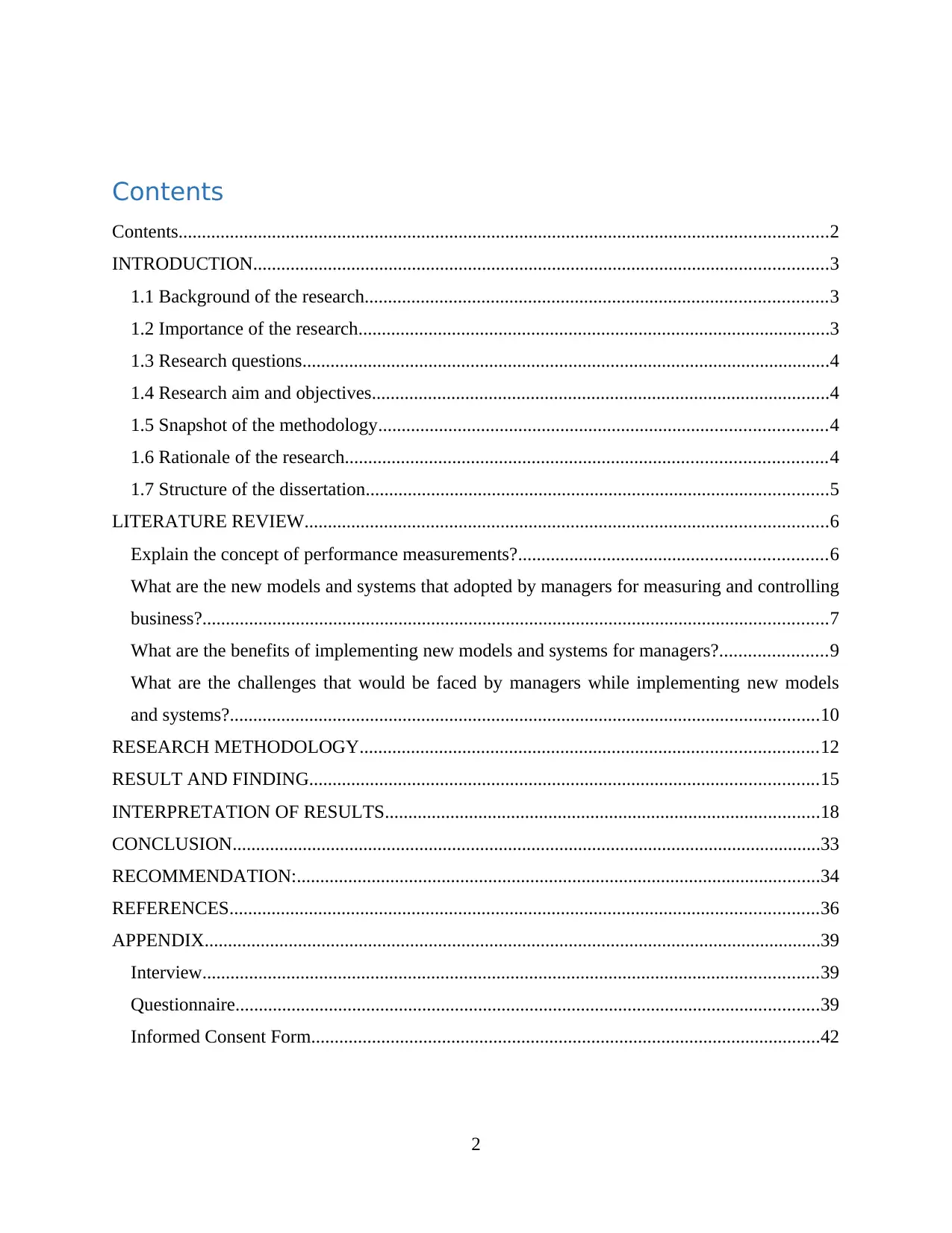
Contents
Contents...........................................................................................................................................2
INTRODUCTION...........................................................................................................................3
1.1 Background of the research...................................................................................................3
1.2 Importance of the research.....................................................................................................3
1.3 Research questions.................................................................................................................4
1.4 Research aim and objectives..................................................................................................4
1.5 Snapshot of the methodology................................................................................................4
1.6 Rationale of the research.......................................................................................................4
1.7 Structure of the dissertation...................................................................................................5
LITERATURE REVIEW................................................................................................................6
Explain the concept of performance measurements?..................................................................6
What are the new models and systems that adopted by managers for measuring and controlling
business?......................................................................................................................................7
What are the benefits of implementing new models and systems for managers?.......................9
What are the challenges that would be faced by managers while implementing new models
and systems?..............................................................................................................................10
RESEARCH METHODOLOGY..................................................................................................12
RESULT AND FINDING.............................................................................................................15
INTERPRETATION OF RESULTS.............................................................................................18
CONCLUSION..............................................................................................................................33
RECOMMENDATION:................................................................................................................34
REFERENCES..............................................................................................................................36
APPENDIX....................................................................................................................................39
Interview....................................................................................................................................39
Questionnaire.............................................................................................................................39
Informed Consent Form.............................................................................................................42
2
Contents...........................................................................................................................................2
INTRODUCTION...........................................................................................................................3
1.1 Background of the research...................................................................................................3
1.2 Importance of the research.....................................................................................................3
1.3 Research questions.................................................................................................................4
1.4 Research aim and objectives..................................................................................................4
1.5 Snapshot of the methodology................................................................................................4
1.6 Rationale of the research.......................................................................................................4
1.7 Structure of the dissertation...................................................................................................5
LITERATURE REVIEW................................................................................................................6
Explain the concept of performance measurements?..................................................................6
What are the new models and systems that adopted by managers for measuring and controlling
business?......................................................................................................................................7
What are the benefits of implementing new models and systems for managers?.......................9
What are the challenges that would be faced by managers while implementing new models
and systems?..............................................................................................................................10
RESEARCH METHODOLOGY..................................................................................................12
RESULT AND FINDING.............................................................................................................15
INTERPRETATION OF RESULTS.............................................................................................18
CONCLUSION..............................................................................................................................33
RECOMMENDATION:................................................................................................................34
REFERENCES..............................................................................................................................36
APPENDIX....................................................................................................................................39
Interview....................................................................................................................................39
Questionnaire.............................................................................................................................39
Informed Consent Form.............................................................................................................42
2
INTRODUCTION
1.1 Background of the research
Performance measurement introduces to the process of gathering, evaluating and reporting
information about the performance of a person, group or organisation. There are different models
of performance measurements such as balanced score card, value chain model, 360-degree and
many others. All these are main models that are effective for business in measuring their
employees as well as organisation performance effectively. Along with this, control within a
business setting involve the processes and procedures that guide, regulate and protect an
organisation (Beuster and et. al., 2021). Control management is important for an organisation as
it facilitates them to check errors as well as develop correction action, reducing deviation from
standards and keeps their project management on track. There are some traditional types of
control techniques in business management. These are budgetary control, standard costing,
financial ratio analysis, internal audit, break-even analysis and statistical control. All these are
effective and essential techniques of controlling business activities in effective and systematic
manner. There are also some modern techniques of control such as return of investment,
programme evaluation and review techniques, management audit and management information
system. Apart from this, it is important and necessary for manager to implement new models and
systems because it helps them in measuring performance and control business. This will also
beneficial for the growth and success of company as well as facilitate them in achieving long
term goals and objectives successfully.
1.2 Importance of the research
Implementing new model and systems are important part for organisation because these
helped them in improving their business performance as well as controlling unnecessary
activities. Strategic Performance Management Systems and 360-degree are effective ways in
measuring business performance effectively (Kavsak and et. al., 2021). Strategic Performance
Management Systems is a mechanism that links employees as well as organisational
performance to improve the performance orientation of the compensation system. It is defined as
an effective methodology to enhance performance measurements, monitoring and enhancement
to accomplish overall organisational goals and objectives. 360-degree is an essential tool of
3
1.1 Background of the research
Performance measurement introduces to the process of gathering, evaluating and reporting
information about the performance of a person, group or organisation. There are different models
of performance measurements such as balanced score card, value chain model, 360-degree and
many others. All these are main models that are effective for business in measuring their
employees as well as organisation performance effectively. Along with this, control within a
business setting involve the processes and procedures that guide, regulate and protect an
organisation (Beuster and et. al., 2021). Control management is important for an organisation as
it facilitates them to check errors as well as develop correction action, reducing deviation from
standards and keeps their project management on track. There are some traditional types of
control techniques in business management. These are budgetary control, standard costing,
financial ratio analysis, internal audit, break-even analysis and statistical control. All these are
effective and essential techniques of controlling business activities in effective and systematic
manner. There are also some modern techniques of control such as return of investment,
programme evaluation and review techniques, management audit and management information
system. Apart from this, it is important and necessary for manager to implement new models and
systems because it helps them in measuring performance and control business. This will also
beneficial for the growth and success of company as well as facilitate them in achieving long
term goals and objectives successfully.
1.2 Importance of the research
Implementing new model and systems are important part for organisation because these
helped them in improving their business performance as well as controlling unnecessary
activities. Strategic Performance Management Systems and 360-degree are effective ways in
measuring business performance effectively (Kavsak and et. al., 2021). Strategic Performance
Management Systems is a mechanism that links employees as well as organisational
performance to improve the performance orientation of the compensation system. It is defined as
an effective methodology to enhance performance measurements, monitoring and enhancement
to accomplish overall organisational goals and objectives. 360-degree is an essential tool of
3
⊘ This is a preview!⊘
Do you want full access?
Subscribe today to unlock all pages.

Trusted by 1+ million students worldwide
measuring employees along with organisational performance. Therefore, both are effective tools
used by managers for measuring performance as well as controlling business.
1.3 Research questions
“Is it necessary to implement new models and systems for managers to measure performance and
control business?”
1.4 Research aim and objectives
Research aim:
The aim of the current research is “To identify the importance of implementing new models and
systems for managers to measure performance and control business”.
Research Objectives:
To develop basic understanding regarding the performance measurements
To determine the new models and systems that adopted by managers for measuring and
controlling business
To discern the benefits of implementing new models and systems for managers
To examine the challenges that would be faced by managers while implementing new
models and systems
1.5 Snapshot of the methodology
Methodology is the process used by researcher for collecting and evaluating information
regarding a topic. There are different types of research methodologies that helps researcher in
gathering and analysing data regarding the importance of implementing new models and systems
for managers to measure performance and control business (Saura, Palacios-Marqués and
Iturricha-Fernández, 2021). These are deductive approach, positivism philosophy, quantitative
research, questionnaire and many others. All these are main methodologies that facilitate
researcher in attaining research aim and objectives in successful manner.
1.6 Rationale of the research
Main rationale behind conducting this research is to identify the importance of implementing
new models and systems for managers to measure performance and control business. This is a
main rationale regarding doing this research. Current research is important for different
stakeholders that are managers, business, researcher and students. For researcher, present
investigation is essential for them by improving their research skills that are data collection, time
4
used by managers for measuring performance as well as controlling business.
1.3 Research questions
“Is it necessary to implement new models and systems for managers to measure performance and
control business?”
1.4 Research aim and objectives
Research aim:
The aim of the current research is “To identify the importance of implementing new models and
systems for managers to measure performance and control business”.
Research Objectives:
To develop basic understanding regarding the performance measurements
To determine the new models and systems that adopted by managers for measuring and
controlling business
To discern the benefits of implementing new models and systems for managers
To examine the challenges that would be faced by managers while implementing new
models and systems
1.5 Snapshot of the methodology
Methodology is the process used by researcher for collecting and evaluating information
regarding a topic. There are different types of research methodologies that helps researcher in
gathering and analysing data regarding the importance of implementing new models and systems
for managers to measure performance and control business (Saura, Palacios-Marqués and
Iturricha-Fernández, 2021). These are deductive approach, positivism philosophy, quantitative
research, questionnaire and many others. All these are main methodologies that facilitate
researcher in attaining research aim and objectives in successful manner.
1.6 Rationale of the research
Main rationale behind conducting this research is to identify the importance of implementing
new models and systems for managers to measure performance and control business. This is a
main rationale regarding doing this research. Current research is important for different
stakeholders that are managers, business, researcher and students. For researcher, present
investigation is essential for them by improving their research skills that are data collection, time
4
Paraphrase This Document
Need a fresh take? Get an instant paraphrase of this document with our AI Paraphraser
management, decision making, presentation and many others. For managers, this research
facilitates them by providing accurate information regarding the benefits of implementing new
models and systems at workplace (Sercel and et. al., 2021). For students, present investigation
assists them by increasing their knowledge about the significance of implementing new models
and systems for managers to measure performance and control business. For business, this
research helps them in improving their business performance through the use of new models and
systems.
1.7 Structure of the dissertation
There are various chapters that helps researcher in completing full dissertation
systematically. These are mentioned below;
Chapter 1: Introduction: This is first chapter that includes research questions, research
aim and objectives and many others.
Chapter 2: Literature review: This chapter facilitate in collecting secondary
information from books, journals and many others sources.
Chapter 3: Research methodology: This chapter is essential in gathering data from
various methodologies that are deductive approach, positivism philosophy, quantitative
research and many others.
Chapter 4: Results and findings: This chapter helps in evaluating gathered information
through research analytical tool (Van Renterghem and et. al., 2022). Frequency
distribution analysis is used for evaluating quantitative data about the topic.
Chapter 5: Conclusion: This chapter includes information about all chapters in clear and
systematic manner that helps in accomplishment of research aim and objectives.
Chapter 6: Recommendations: This is a last chapter that helps in giving
recommendations to the managers about how to measures performance.
5
facilitates them by providing accurate information regarding the benefits of implementing new
models and systems at workplace (Sercel and et. al., 2021). For students, present investigation
assists them by increasing their knowledge about the significance of implementing new models
and systems for managers to measure performance and control business. For business, this
research helps them in improving their business performance through the use of new models and
systems.
1.7 Structure of the dissertation
There are various chapters that helps researcher in completing full dissertation
systematically. These are mentioned below;
Chapter 1: Introduction: This is first chapter that includes research questions, research
aim and objectives and many others.
Chapter 2: Literature review: This chapter facilitate in collecting secondary
information from books, journals and many others sources.
Chapter 3: Research methodology: This chapter is essential in gathering data from
various methodologies that are deductive approach, positivism philosophy, quantitative
research and many others.
Chapter 4: Results and findings: This chapter helps in evaluating gathered information
through research analytical tool (Van Renterghem and et. al., 2022). Frequency
distribution analysis is used for evaluating quantitative data about the topic.
Chapter 5: Conclusion: This chapter includes information about all chapters in clear and
systematic manner that helps in accomplishment of research aim and objectives.
Chapter 6: Recommendations: This is a last chapter that helps in giving
recommendations to the managers about how to measures performance.
5
LITERATURE REVIEW
Literature review is the chapter that takes out secondary information from different
secondary sources such as books, articles, newspapers, journals and many more. This is referred
as the scholar paper in which used and published information is utilised so that defined research
questions could be answered in a systematic way.
Explain the concept of performance measurements?
According to Wei and et. al., (2019), performance measurement is defined as the term
that happens in nearly every kind of company but an organisation uses different kinds of ways
for measuring it. Performance measurement is considered in an organisation to encourage
managers for making decisions that benefit the whole organisation and themselves. The
necessary element to good performance measurement technique is setting goals that are real and
that start decisions over which the managers have control. Performance measurement is quite
important in the corporation because it fosters organisational improvement. The importance of
having an great performance measurement procedure has only grown and developed as
companies large and small realise that long-term success and development depends upon
reaching greater goals with lower number of failures in today's competitive business world. The
significance of performance management is not at all easier task for justifying but it is essential
for the improvement in performance in the longer time. Effective and efficient performance
measurement is not an easy task because it requires great efforts as well as knowledge of
different methods of evaluating performance. Improvement in an individual, group or
organisational performance could not occur unless there is some method of getting feedback
about the performance (Halachmi, 2019). Feedback is generally defined as the results of work
conveyed to the employee, company or work group.
For an individual employee, performance measurements create a connection between
their own behaviour and the goals of the organisation. For the company or performance
measurement of work unit is the connection between decisions and company goals. It is being
recorded that before improving something, the company has to be able to evaluate and measure
it. These measurement could be done with the help of different techniques of measurement and
this can be quantified. Additionally, it has also seen that improvement in performance could give
outcome just from measuring it. Performance measurement is defined as the first step of the
6
Literature review is the chapter that takes out secondary information from different
secondary sources such as books, articles, newspapers, journals and many more. This is referred
as the scholar paper in which used and published information is utilised so that defined research
questions could be answered in a systematic way.
Explain the concept of performance measurements?
According to Wei and et. al., (2019), performance measurement is defined as the term
that happens in nearly every kind of company but an organisation uses different kinds of ways
for measuring it. Performance measurement is considered in an organisation to encourage
managers for making decisions that benefit the whole organisation and themselves. The
necessary element to good performance measurement technique is setting goals that are real and
that start decisions over which the managers have control. Performance measurement is quite
important in the corporation because it fosters organisational improvement. The importance of
having an great performance measurement procedure has only grown and developed as
companies large and small realise that long-term success and development depends upon
reaching greater goals with lower number of failures in today's competitive business world. The
significance of performance management is not at all easier task for justifying but it is essential
for the improvement in performance in the longer time. Effective and efficient performance
measurement is not an easy task because it requires great efforts as well as knowledge of
different methods of evaluating performance. Improvement in an individual, group or
organisational performance could not occur unless there is some method of getting feedback
about the performance (Halachmi, 2019). Feedback is generally defined as the results of work
conveyed to the employee, company or work group.
For an individual employee, performance measurements create a connection between
their own behaviour and the goals of the organisation. For the company or performance
measurement of work unit is the connection between decisions and company goals. It is being
recorded that before improving something, the company has to be able to evaluate and measure
it. These measurement could be done with the help of different techniques of measurement and
this can be quantified. Additionally, it has also seen that improvement in performance could give
outcome just from measuring it. Performance measurement is defined as the first step of the
6
⊘ This is a preview!⊘
Do you want full access?
Subscribe today to unlock all pages.
Trusted by 1+ million students worldwide
improvement. While evaluating and measuring is the procedure of quantification, its impact is to
increase positive action. Managers are aware that every measure has negative consequences if
they are considered incorrectly or in the wrong conditions and situations. Managers have studied
the environmental conditions and analysing these potential negative problems before adopting
performance measures. Performance measurement could be grouped into two basic kinds: some
which is related to outcomes such as financial performance or competitiveness and some that
focus on various determinants of the outcomes such as flexibility, quality, innovation and
resource utilisation (Pryshlakivsky and Searcy, 2017).
The performance measurement is an important activity for every organization as it is the
basis for organization to reward their employees for their effective and efficient performance
towards achievement of organizational goals they are the key on the basis of which business can
distinguish between the performance of its employees, its very important to carry out this task
effectively as there are various type of performance measurements out of which some can be
measured in terms of numbers or figures and the others are those which cannot be quantified
since those are based on some characteristics and affects of that person on the organization and
its environment. Managers of the resources are the ones who are directly in touch with the
employee, and they should regularly continue the two-way communication with their employees
that would help them to know the feedback of employees and bring any necessary changes if
required and also gives them opportunity to provide their feedback and inputs to the employees
that could improve his performance and contribution towards achievement of organizational
goals. Therefore, it is also necessary to make sure that once performance measurement activity is
completed, employees are provided with just benefits and rewards.
What are the new models and systems that adopted by managers for measuring and controlling
business?
According to Kamble and Gunasekaran (2020), there are various models which can be
used by the organisation in order to measure and control businesses. These are the practices
which are useful in order to attain business objectives and to acquire prominence into the market.
Using such practices would lead the business to deal with various issues in their business
management and business functions which are related with measuring employee performance
and controlling of the business. These models would be leading into managing their resources in
7
increase positive action. Managers are aware that every measure has negative consequences if
they are considered incorrectly or in the wrong conditions and situations. Managers have studied
the environmental conditions and analysing these potential negative problems before adopting
performance measures. Performance measurement could be grouped into two basic kinds: some
which is related to outcomes such as financial performance or competitiveness and some that
focus on various determinants of the outcomes such as flexibility, quality, innovation and
resource utilisation (Pryshlakivsky and Searcy, 2017).
The performance measurement is an important activity for every organization as it is the
basis for organization to reward their employees for their effective and efficient performance
towards achievement of organizational goals they are the key on the basis of which business can
distinguish between the performance of its employees, its very important to carry out this task
effectively as there are various type of performance measurements out of which some can be
measured in terms of numbers or figures and the others are those which cannot be quantified
since those are based on some characteristics and affects of that person on the organization and
its environment. Managers of the resources are the ones who are directly in touch with the
employee, and they should regularly continue the two-way communication with their employees
that would help them to know the feedback of employees and bring any necessary changes if
required and also gives them opportunity to provide their feedback and inputs to the employees
that could improve his performance and contribution towards achievement of organizational
goals. Therefore, it is also necessary to make sure that once performance measurement activity is
completed, employees are provided with just benefits and rewards.
What are the new models and systems that adopted by managers for measuring and controlling
business?
According to Kamble and Gunasekaran (2020), there are various models which can be
used by the organisation in order to measure and control businesses. These are the practices
which are useful in order to attain business objectives and to acquire prominence into the market.
Using such practices would lead the business to deal with various issues in their business
management and business functions which are related with measuring employee performance
and controlling of the business. These models would be leading into managing their resources in
7
Paraphrase This Document
Need a fresh take? Get an instant paraphrase of this document with our AI Paraphraser
such a manner that business may avail such benefits linked with sustainability. Some of the
models that can be used by businesses are elaborated as under:
Graphic rating scale: This is regarded as the performance appraisal method which is used by
the organisation to rate employees in respect of their traits and behaviour. These are essential to
be used by the businesses so that employee performance and productivity can be analysed and at
the same time effective results can be taken out (Tsan and Nguyen, 2017). When employees get
their rating on the basis of certain parameters so that improvement opportunities can be inhaled
by the organisation. The rating helps the employees to understand their behaviour towards work
and could be helpful in managing the same with higher improvement. This method of
performance appraisal can be a very useful tool for accessing employee attributes and how these
relates to their current job role. In this approach generally required data is gathered by the human
resource managers with the help of some questionnaires and these gathered data can shed the
focus and light on performance of the employee and engagement. It is suggested to make the
questionnaire as objective as possible and clearly define the criteria and desired criteria so that
the performance measurement can be done effectively.
360 degree feedback: This is the system of appraisal which is related with developing a system
in which confidential and anonymous feedbacks are taken from people those are working around.
Those people who are considered for the purpose of feedback can be different sources such as
colleagues, direct reports, clients etc. This is the feedback process in which from not only peers
but also from superiors feedback is taken so that evaluation can be performed. This is one of the
effective way which helps in overall development of the employees and in the same manner
commitment of the employees can be shown towards the company. It is a great method which
also benefits the individual in self development and improvement of his skills, knowledge and
performance. Moreover, it gives them way and feedback to improve their relationship with
people working around them. Often, groups are created and formed under this method depending
upon the people and their relationship with the appraisee for example senior, peer, junior, client
etc. This will help in providing the appraisee with his all-round performance feedback from
everyone around him and view his or her performance and do self-evaluation along with
organizational evaluation.
Management by objectives: This is a strategic model which is associated with improving of
organisational performance by clarifying objectives related with the organisation and individual
8
models that can be used by businesses are elaborated as under:
Graphic rating scale: This is regarded as the performance appraisal method which is used by
the organisation to rate employees in respect of their traits and behaviour. These are essential to
be used by the businesses so that employee performance and productivity can be analysed and at
the same time effective results can be taken out (Tsan and Nguyen, 2017). When employees get
their rating on the basis of certain parameters so that improvement opportunities can be inhaled
by the organisation. The rating helps the employees to understand their behaviour towards work
and could be helpful in managing the same with higher improvement. This method of
performance appraisal can be a very useful tool for accessing employee attributes and how these
relates to their current job role. In this approach generally required data is gathered by the human
resource managers with the help of some questionnaires and these gathered data can shed the
focus and light on performance of the employee and engagement. It is suggested to make the
questionnaire as objective as possible and clearly define the criteria and desired criteria so that
the performance measurement can be done effectively.
360 degree feedback: This is the system of appraisal which is related with developing a system
in which confidential and anonymous feedbacks are taken from people those are working around.
Those people who are considered for the purpose of feedback can be different sources such as
colleagues, direct reports, clients etc. This is the feedback process in which from not only peers
but also from superiors feedback is taken so that evaluation can be performed. This is one of the
effective way which helps in overall development of the employees and in the same manner
commitment of the employees can be shown towards the company. It is a great method which
also benefits the individual in self development and improvement of his skills, knowledge and
performance. Moreover, it gives them way and feedback to improve their relationship with
people working around them. Often, groups are created and formed under this method depending
upon the people and their relationship with the appraisee for example senior, peer, junior, client
etc. This will help in providing the appraisee with his all-round performance feedback from
everyone around him and view his or her performance and do self-evaluation along with
organizational evaluation.
Management by objectives: This is a strategic model which is associated with improving of
organisational performance by clarifying objectives related with the organisation and individual
8
employees as well. Since this method of appraisal and performance measurement is directly
based on the results of the company this is helping the organisation to compare actual and
forecasted performance of the individual so that better communication can be developed within
management and employees. Management by objective is supported by employees in which
success is claimed within executed efforts so that manager and other related people may
implement various processes aligned with the same. Under this the first step is related with
determining of organisational objectives for the company and the next step is related with
translating the same to employees so that active participation in setting organisational objectives.
Management by operation is related with creating goals that would be helpful in succession of
the organisation and such that employees can contribute their best with the help of their skill and
capabilities and the same would ultimately help in maximizing the results and benefits for the
company. (Bourne and et. al., 2018).
Behaviourally Anchored Rating Scale: This method of appraisal is also known by name
BARS. This scale is used in order to rate performance so that narrative benefits can be attained.
This is an appraisal method which is the combination of narrative benefits, critical incidents,
quantified rating and many other scale. This is designed in such a manner that quantitative and
qualitative benefits can be given to employees and organisation as well. This method tends to
measure performance of employee so that performance against specific examples can be
analysed. Establishment of specific behaviour grading is giving higher accuracy measures to
relate the performance of individual (Appelbaum and et. al., 2017). This is possible in this
method of appraisal because it relies on unique individual behaviour required for each individual
position within the organization instead of those set of behaviours that can be evaluated in any
position across the board. It is presumed that it minimized the subjectivity in using basic rating
scales.
What are the benefits of implementing new models and systems for managers?
According to Rantala, Ukko and Rantanen (2018), there are various benefits that can be
adopted by managers in order to manage the business and to acquire success as well. These
benefits will lead to provide such sustainability to the business in which employee may be added
in decision making and at the same time their skills and capabilities can also be increased. Some
of the benefits related with implementing new models for the managers are detailed as under:
9
based on the results of the company this is helping the organisation to compare actual and
forecasted performance of the individual so that better communication can be developed within
management and employees. Management by objective is supported by employees in which
success is claimed within executed efforts so that manager and other related people may
implement various processes aligned with the same. Under this the first step is related with
determining of organisational objectives for the company and the next step is related with
translating the same to employees so that active participation in setting organisational objectives.
Management by operation is related with creating goals that would be helpful in succession of
the organisation and such that employees can contribute their best with the help of their skill and
capabilities and the same would ultimately help in maximizing the results and benefits for the
company. (Bourne and et. al., 2018).
Behaviourally Anchored Rating Scale: This method of appraisal is also known by name
BARS. This scale is used in order to rate performance so that narrative benefits can be attained.
This is an appraisal method which is the combination of narrative benefits, critical incidents,
quantified rating and many other scale. This is designed in such a manner that quantitative and
qualitative benefits can be given to employees and organisation as well. This method tends to
measure performance of employee so that performance against specific examples can be
analysed. Establishment of specific behaviour grading is giving higher accuracy measures to
relate the performance of individual (Appelbaum and et. al., 2017). This is possible in this
method of appraisal because it relies on unique individual behaviour required for each individual
position within the organization instead of those set of behaviours that can be evaluated in any
position across the board. It is presumed that it minimized the subjectivity in using basic rating
scales.
What are the benefits of implementing new models and systems for managers?
According to Rantala, Ukko and Rantanen (2018), there are various benefits that can be
adopted by managers in order to manage the business and to acquire success as well. These
benefits will lead to provide such sustainability to the business in which employee may be added
in decision making and at the same time their skills and capabilities can also be increased. Some
of the benefits related with implementing new models for the managers are detailed as under:
9
⊘ This is a preview!⊘
Do you want full access?
Subscribe today to unlock all pages.
Trusted by 1+ million students worldwide
Boosting employee morale: With the help of implementing new models and systems by the
managers employee morale can be boosted as employee get such ease to manage businesses
functions. Employee morale are regarded as one of the major force which is helpful in
developing employee efforts within the organisation so that their efforts can be used within the
business in order to attain objectives. With the help of employee efforts overall benefits can be
enjoyed by the organisation in terms of managing business functions (Kusumaningrum,
Sumarsono and Gunawan, 2019).
Enhancing productivity: With the help of implementing new models and systems this is easier
to boost productivity in which organisational aims and objectives can be attained. With the help
of increased productivity specific edge can be attained in the competitive market so that separate
position can be gained in terms of competitors.
Good relation with subordinates: With the help of implementing new methods good relation
can be maintained as these are related with boosting communication which could be helpful to
share thoughts with each other. When employees are comfortable in making communication then
this will lead into coming of new ideas which is helpful in gaining business benefits (de Waal,
van Nierop and Sloot, 2017).
Higher performance: When new methods and processes are added in the businesses then the
sole objective is related with developing organisational performance. This is associated with
managing the business with such resources in which employee may contribute to the fullest and
at the same time business productivity can be also be developed (Kotler and Keller, 2016). Using
such methods appropriate assistance can be given to the business in terms of developing
performance on individual basis.
What are the challenges that would be faced by managers while implementing new models and
systems?
According to Hourneaux Jr and et. al., (2018), there are various challenges which are
being faced by managers during implementing new methods and systems within the business.
These are the challenges which are related with business management and managing the business
functions as well. Some of these challenges are examined as under:
Resource planning: Resource planning is the one of the major issue which is faced by the
manager during implementing new models and systems within the business. When a new system
is required to be started then various resources are needed such as human resources, financial
10
managers employee morale can be boosted as employee get such ease to manage businesses
functions. Employee morale are regarded as one of the major force which is helpful in
developing employee efforts within the organisation so that their efforts can be used within the
business in order to attain objectives. With the help of employee efforts overall benefits can be
enjoyed by the organisation in terms of managing business functions (Kusumaningrum,
Sumarsono and Gunawan, 2019).
Enhancing productivity: With the help of implementing new models and systems this is easier
to boost productivity in which organisational aims and objectives can be attained. With the help
of increased productivity specific edge can be attained in the competitive market so that separate
position can be gained in terms of competitors.
Good relation with subordinates: With the help of implementing new methods good relation
can be maintained as these are related with boosting communication which could be helpful to
share thoughts with each other. When employees are comfortable in making communication then
this will lead into coming of new ideas which is helpful in gaining business benefits (de Waal,
van Nierop and Sloot, 2017).
Higher performance: When new methods and processes are added in the businesses then the
sole objective is related with developing organisational performance. This is associated with
managing the business with such resources in which employee may contribute to the fullest and
at the same time business productivity can be also be developed (Kotler and Keller, 2016). Using
such methods appropriate assistance can be given to the business in terms of developing
performance on individual basis.
What are the challenges that would be faced by managers while implementing new models and
systems?
According to Hourneaux Jr and et. al., (2018), there are various challenges which are
being faced by managers during implementing new methods and systems within the business.
These are the challenges which are related with business management and managing the business
functions as well. Some of these challenges are examined as under:
Resource planning: Resource planning is the one of the major issue which is faced by the
manager during implementing new models and systems within the business. When a new system
is required to be started then various resources are needed such as human resources, financial
10
Paraphrase This Document
Need a fresh take? Get an instant paraphrase of this document with our AI Paraphraser
resources and many other. In order to get full results resource planning is the tool which is
needed and this is considered as the hardest part. As for manager this is difficult that to keep all
the dimensions into the mind (Goshu and Kitaw, 2017).
Employee engagement: Employee engagement is considered as process of involving employees
in decision making so that apt decisions can be taken and at the same time business objectives
can also be attained. For managers employee engagement is considered as the challenge which is
faced by them during introducing any new system or process. In this manner managers feel
issues in employee engagement due to resistance to change seen by employees.
Environment culture and behaviour: For implementing new process and system within the
organisation this is imperative that to have appropriate environment for that so that easy
implementation can be developed. When culture of the organisation is not appropriate then this
will develop issues for the managers in incorporating people in context of making positive
decisions. So it can be said that managers of the organisation are associated with the challenge of
examining business environment in relation to its implementation within the organisation
(Tomaževič, Tekavčič and Peljhan, 2017).
Resistance to change: It is a natural reaction or action of any human being to generally resist
towards any form of change as they tend to take away their comfort and the thing they are used
to do in their day to day activities. However, there is a flipside of this resistance that it takes
away the scope of future growth and development. Therefore, it can be certain that every
manager part of implementing any change in organization has to face this challenge of resistance
from the employees.
Lack of communication: It is important for success of any organization or team to establish a
healthy and effective communication process and mode among the juniors and managers else it
would make employees feel themselves as part of organization and any form of change and bring
out their concerns if any. But generally it is seen that there is a missing effective communication
between team and their managers and often that’s not 2 way as the result of which employees
fails to share their grievances and moreover they can’t take the message from their managers
positively (Morales and et. al., 2018). This can be a big challenge for managers while seeking
involvement and engagement from his team. Therefore, every manager has to establish a
effective communication process that would build trust and teamwork.
11
needed and this is considered as the hardest part. As for manager this is difficult that to keep all
the dimensions into the mind (Goshu and Kitaw, 2017).
Employee engagement: Employee engagement is considered as process of involving employees
in decision making so that apt decisions can be taken and at the same time business objectives
can also be attained. For managers employee engagement is considered as the challenge which is
faced by them during introducing any new system or process. In this manner managers feel
issues in employee engagement due to resistance to change seen by employees.
Environment culture and behaviour: For implementing new process and system within the
organisation this is imperative that to have appropriate environment for that so that easy
implementation can be developed. When culture of the organisation is not appropriate then this
will develop issues for the managers in incorporating people in context of making positive
decisions. So it can be said that managers of the organisation are associated with the challenge of
examining business environment in relation to its implementation within the organisation
(Tomaževič, Tekavčič and Peljhan, 2017).
Resistance to change: It is a natural reaction or action of any human being to generally resist
towards any form of change as they tend to take away their comfort and the thing they are used
to do in their day to day activities. However, there is a flipside of this resistance that it takes
away the scope of future growth and development. Therefore, it can be certain that every
manager part of implementing any change in organization has to face this challenge of resistance
from the employees.
Lack of communication: It is important for success of any organization or team to establish a
healthy and effective communication process and mode among the juniors and managers else it
would make employees feel themselves as part of organization and any form of change and bring
out their concerns if any. But generally it is seen that there is a missing effective communication
between team and their managers and often that’s not 2 way as the result of which employees
fails to share their grievances and moreover they can’t take the message from their managers
positively (Morales and et. al., 2018). This can be a big challenge for managers while seeking
involvement and engagement from his team. Therefore, every manager has to establish a
effective communication process that would build trust and teamwork.
11
RESEARCH METHODOLOGY
Research methodology is the chapter that assists in selecting research methods for the
accumulation and analysis of information (Ledford and Gast, 2018). It includes different kinds of
research methods so that defined aim and objectives could be easily attained.
Research Philosophy: Research philosophy is the method that assists investigator to
analyse information in systematic way. The philosophies may include: positivism, interpretivism
and realism philosophy. Investigator has chosen positivism philosophy so that gathered numeric
data could be analysed and evaluated. The major benefit of choosing the positivism philosophy is
it could easily provide diverse approach. This gives in-depth theory to analyse the information
about the various performance measurements. In simpler words, the major benefit of is
evaluation of numerical information and does not take longer period of time. On the other hand,
researcher also takes help of interpretivism philosophy because it evaluates qualitative piece of
information (Ørngreen and Levinsen, 2017).
Research Approach: Research approach is another methodology used for the procedure
of evaluating accumulated piece of information. The approaches are divided into three types that
are: inductive, deductive and abductive approach. Investigator has taken assistance of inductive
and deductive approach so that quantitative as well as qualitative information could be analysed
in an appropriate manner. Researcher has taken assistance of deductive approach because it
assists in analysing numerical piece of information. The major benefit of deductive approach is it
is scientific approach and has great contribution in analysing numerical data. On the other hand,
inductive approach is also used in the present research so that qualitative information could be
evaluated and examined (Snyder, 2019). Therefore, it can be summarised that researcher has
taken help of inductive as well as deductive approach.
Research Strategy: Research strategy is the methodology that assists in conducting the
investigation on measuring performance and controlling business. So for this there are several
kinds of strategies that may involve: interview, grounded theory, survey, archival research, case
study, systematic literature review and so on. The present research has taken helps of survey,
interview and systematic literature review for the collection of relevant and reliable information.
Survey is chosen as research strategy so that numerical and primary information could be
accumulated in minimum period of time. On the other hand, interview is also selected by
researcher because this assists in collecting in-depth information. In these respondents give out
12
Research methodology is the chapter that assists in selecting research methods for the
accumulation and analysis of information (Ledford and Gast, 2018). It includes different kinds of
research methods so that defined aim and objectives could be easily attained.
Research Philosophy: Research philosophy is the method that assists investigator to
analyse information in systematic way. The philosophies may include: positivism, interpretivism
and realism philosophy. Investigator has chosen positivism philosophy so that gathered numeric
data could be analysed and evaluated. The major benefit of choosing the positivism philosophy is
it could easily provide diverse approach. This gives in-depth theory to analyse the information
about the various performance measurements. In simpler words, the major benefit of is
evaluation of numerical information and does not take longer period of time. On the other hand,
researcher also takes help of interpretivism philosophy because it evaluates qualitative piece of
information (Ørngreen and Levinsen, 2017).
Research Approach: Research approach is another methodology used for the procedure
of evaluating accumulated piece of information. The approaches are divided into three types that
are: inductive, deductive and abductive approach. Investigator has taken assistance of inductive
and deductive approach so that quantitative as well as qualitative information could be analysed
in an appropriate manner. Researcher has taken assistance of deductive approach because it
assists in analysing numerical piece of information. The major benefit of deductive approach is it
is scientific approach and has great contribution in analysing numerical data. On the other hand,
inductive approach is also used in the present research so that qualitative information could be
evaluated and examined (Snyder, 2019). Therefore, it can be summarised that researcher has
taken help of inductive as well as deductive approach.
Research Strategy: Research strategy is the methodology that assists in conducting the
investigation on measuring performance and controlling business. So for this there are several
kinds of strategies that may involve: interview, grounded theory, survey, archival research, case
study, systematic literature review and so on. The present research has taken helps of survey,
interview and systematic literature review for the collection of relevant and reliable information.
Survey is chosen as research strategy so that numerical and primary information could be
accumulated in minimum period of time. On the other hand, interview is also selected by
researcher because this assists in collecting in-depth information. In these respondents give out
12
⊘ This is a preview!⊘
Do you want full access?
Subscribe today to unlock all pages.
Trusted by 1+ million students worldwide

1 out of 43


Related Documents


Your All-in-One AI-Powered Toolkit for Academic Success.
+13062052269
info@desklib.com
Available 24*7 on WhatsApp / Email
![[object Object]](/_next/static/media/star-bottom.7253800d.svg)
Unlock your academic potential
Copyright © 2020–2025 A2Z Services. All Rights Reserved. Developed and managed by ZUCOL.