Heat Transfer Assignment: Analysis of Heat Transfer Scenarios

Verified

Added on  2022/09/21

|9
|621
|25
Homework Assignment
AI Summary
This document presents solutions to three heat transfer problems. The first problem involves determining the heat transfer coefficient for a resistive heater embedded in a ceramic rod under different fluid flow conditions (water and air). The second problem focuses on fin analysis, comparing the thermal conductivity of two materials used in long fins. The third problem analyzes the transient heat transfer of a nickel ball with a ceramic coating dropped into oil, including the calculation of thermal resistances, Biot number, surface temperature over time, and the total heat transferred. The solutions include detailed calculations, schematic diagrams, and reference to relevant heat transfer principles and literature.
Document Page
1
Heat Transfer
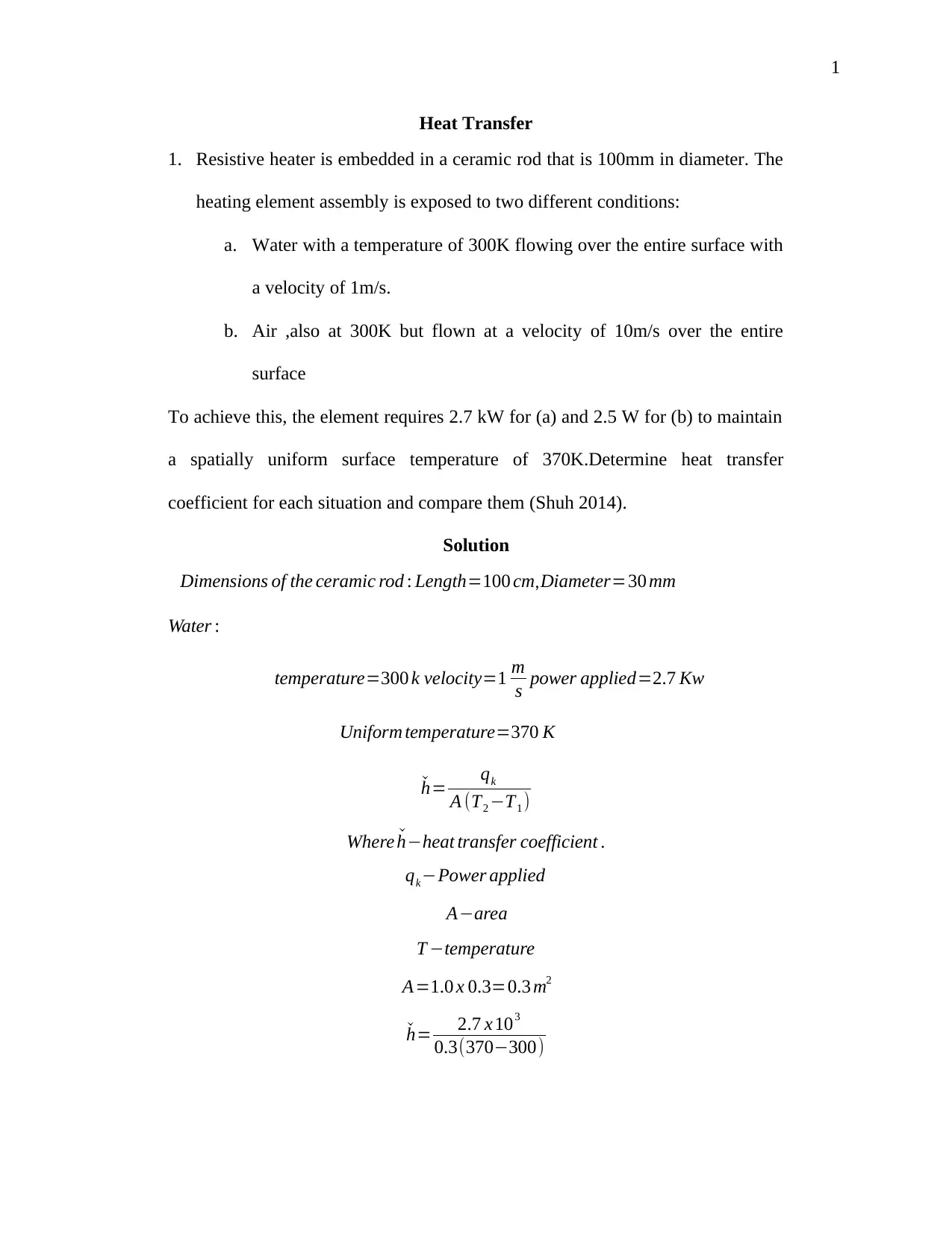
1. Resistive heater is embedded in a ceramic rod that is 100mm in diameter. The
heating element assembly is exposed to two different conditions:
a. Water with a temperature of 300K flowing over the entire surface with
a velocity of 1m/s.
b. Air ,also at 300K but flown at a velocity of 10m/s over the entire
surface
To achieve this, the element requires 2.7 kW for (a) and 2.5 W for (b) to maintain
a spatially uniform surface temperature of 370K.Determine heat transfer
coefficient for each situation and compare them (Shuh 2014).
Solution
Dimensions of the ceramic rod : Length=100 cm,Diameter=30 mm
Water :
temperature=300 k velocity=1 m
s power applied=2.7 Kw
Uniform temperature=370 K
ˇh= qk
A (T2 T1 )
Where ˇhheat transfer coefficient .
qkPower applied
Aarea
T temperature
A=1.0 x 0.3=0.3 m2
ˇh= 2.7 x 10³
0.3(370300)
tabler-icon-diamond-filled.svg

Paraphrase This Document

Need a fresh take? Get an instant paraphrase of this document with our AI Paraphraser
Document Page
2
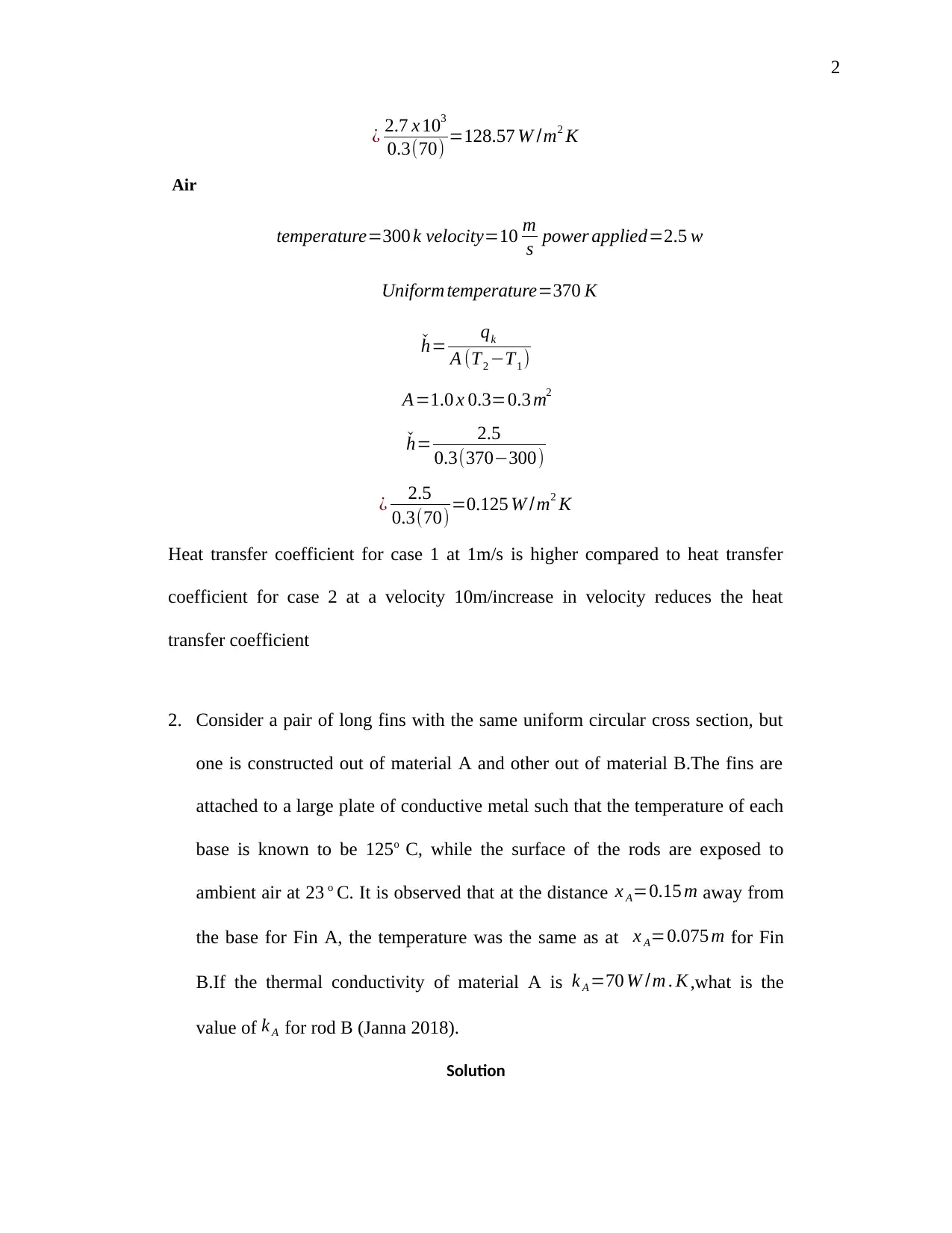
¿ 2.7 x 10³
0.3(70) =128.57 W /m2 K
Air
temperature=300 k velocity=10 m
s power applied=2.5 w
Uniform temperature=370 K
ˇh= qk
A (T2 T1 )
A=1.0 x 0.3=0.3 m2
ˇh= 2.5
0.3(370300)
¿ 2.5
0.3(70) =0.125 W /m2 K
Heat transfer coefficient for case 1 at 1m/s is higher compared to heat transfer
coefficient for case 2 at a velocity 10m/increase in velocity reduces the heat
transfer coefficient
2. Consider a pair of long fins with the same uniform circular cross section, but
one is constructed out of material A and other out of material B.The fins are
attached to a large plate of conductive metal such that the temperature of each
base is known to be 125o C, while the surface of the rods are exposed to
ambient air at 23 o C. It is observed that at the distance x A=0.15 m away from
the base for Fin A, the temperature was the same as at x A=0.075 m for Fin
B.If the thermal conductivity of material A is k A =70 W /m . K ,what is the
value of k A for rod B (Janna 2018).
Solution
Document Page
3
Material A
Temperature=12 5oC Ambient temperature=2 3oC x A=0.15 m
k A = 70 W
m . k
Material B
Temperature=12 5oC Ambient temperature=2 3oC x A=0.075 m
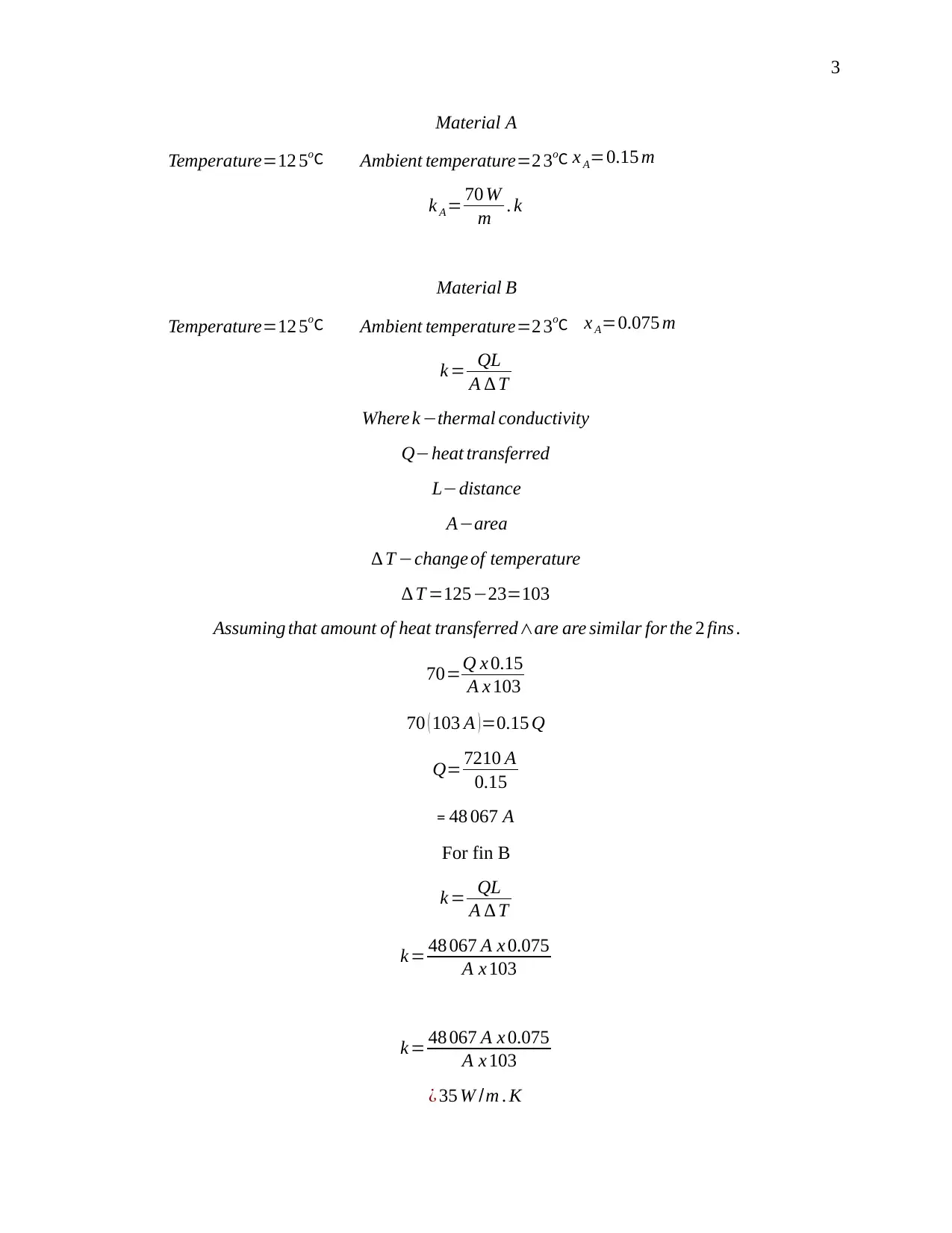
k = QL
A T
Where k thermal conductivity
Qheat transferred
Ldistance
Aarea
T change of temperature
T =12523=103
Assuming that amount of heat transferredare are similar for the 2 fins .
70=Q x 0.15
A x 103
70 ( 103 A )=0.15 Q
Q= 7210 A
0.15
= 48 067 A
For fin B
k = QL
A T
k = 48 067 A x 0.075
A x 103
k = 48 067 A x 0.075
A x 103
¿ 35 W /m . K
Document Page
4
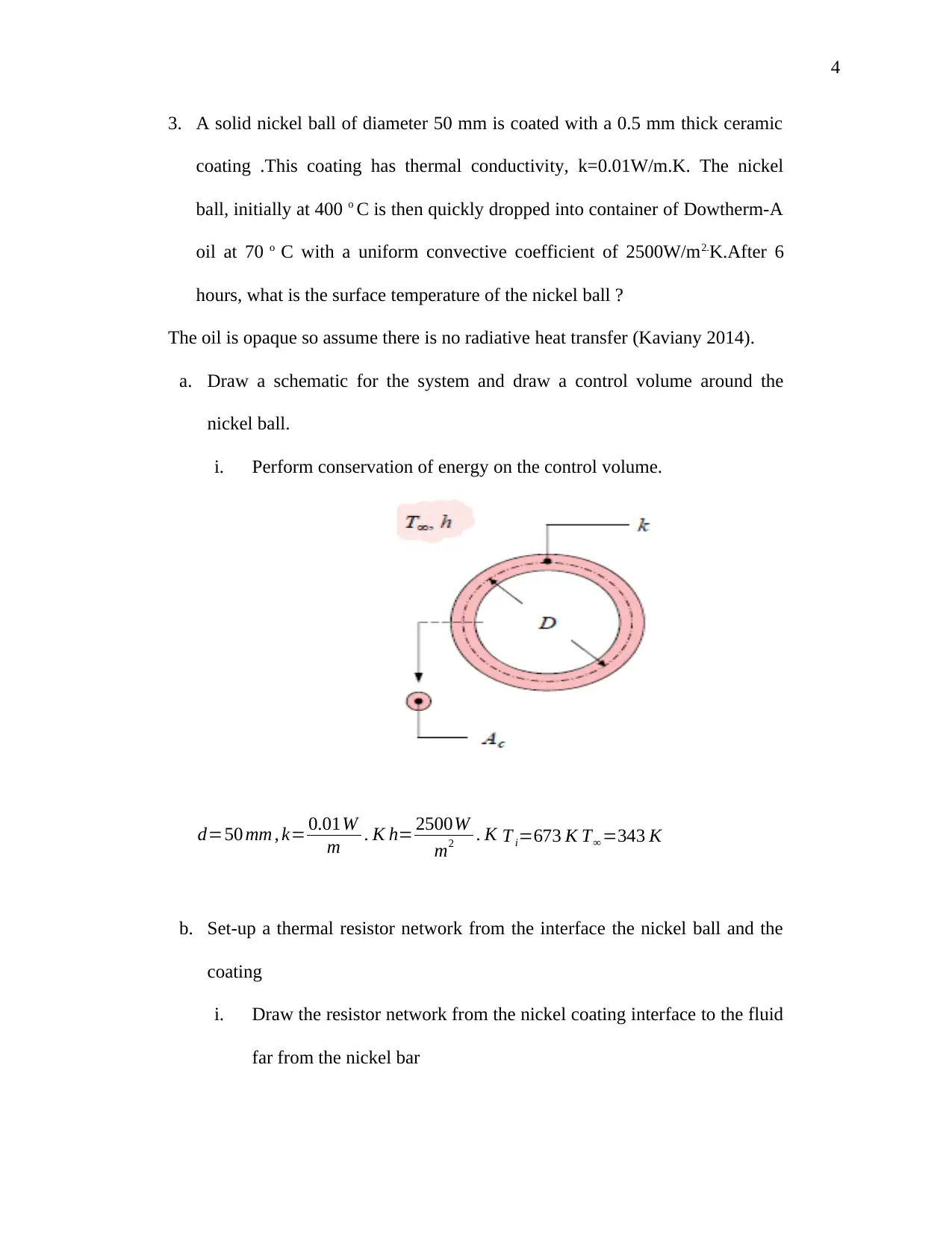
3. A solid nickel ball of diameter 50 mm is coated with a 0.5 mm thick ceramic
coating .This coating has thermal conductivity, k=0.01W/m.K. The nickel
ball, initially at 400 o C is then quickly dropped into container of Dowtherm-A
oil at 70 o C with a uniform convective coefficient of 2500W/m2.K.After 6
hours, what is the surface temperature of the nickel ball ?
The oil is opaque so assume there is no radiative heat transfer (Kaviany 2014).
a. Draw a schematic for the system and draw a control volume around the
nickel ball.
i. Perform conservation of energy on the control volume.
d=50 mm , k= 0.01W
m . K h= 2500W
m2 . K T i=673 K T =343 K
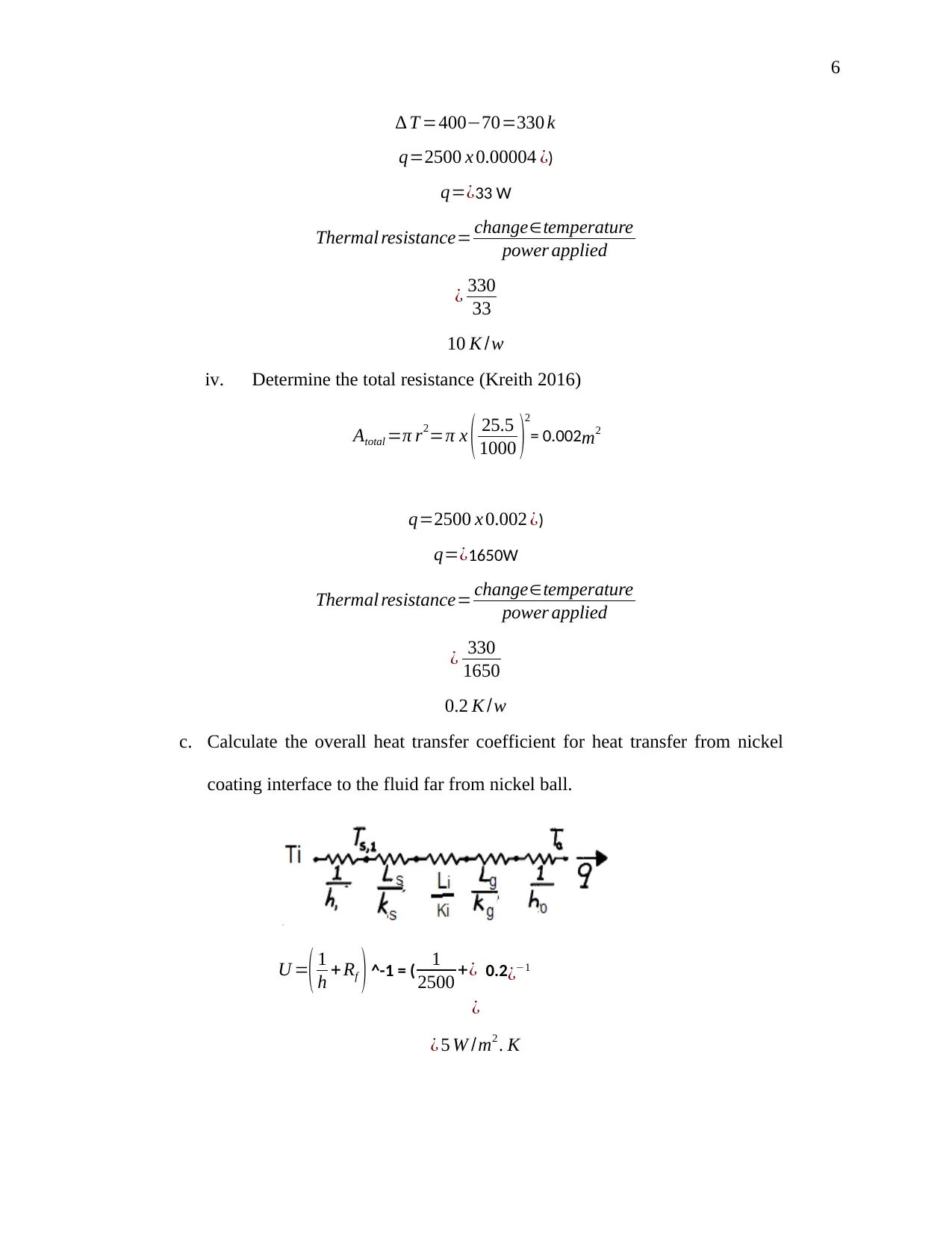
b. Set-up a thermal resistor network from the interface the nickel ball and the
coating
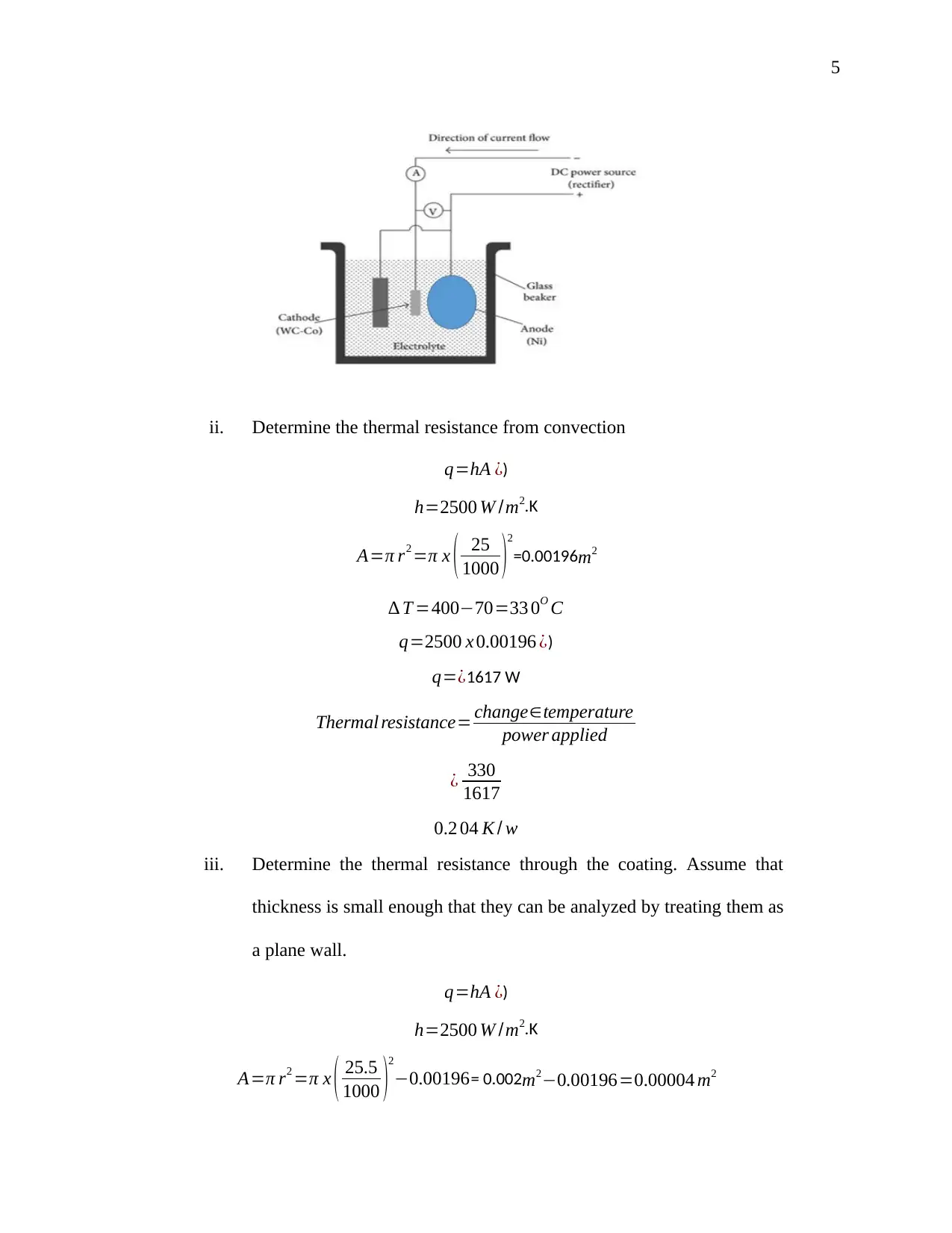
i. Draw the resistor network from the nickel coating interface to the fluid
far from the nickel bar
tabler-icon-diamond-filled.svg

Paraphrase This Document

Need a fresh take? Get an instant paraphrase of this document with our AI Paraphraser
Document Page
5
ii. Determine the thermal resistance from convection
q=hA ¿)
h=2500 W /m2.K
A=π r2 =π x ( 25
1000 )
2
=0.00196m2
T =40070=33 0O C
q=2500 x 0.00196 ¿)
q=¿1617 W
Thermal resistance= changetemperature
power applied
¿ 330
1617
0.2 04 K / w
iii. Determine the thermal resistance through the coating. Assume that
thickness is small enough that they can be analyzed by treating them as
a plane wall.
q=hA ¿)
h=2500 W /m2.K
A=π r2 =π x ( 25.5
1000 )
2
0.00196= 0.002m20.00196=0.00004 m2
Document Page
6
T =40070=330 k
q=2500 x 0.00004 ¿)
q=¿33 W
Thermal resistance= changetemperature
power applied
¿ 330
33
10 K /w
iv. Determine the total resistance (Kreith 2016)
Atotal =π r2=π x ( 25.5
1000 )
2
= 0.002m2
q=2500 x 0.002 ¿)
q=¿1650W
Thermal resistance= changetemperature
power applied
¿ 330
1650
0.2 K /w
c. Calculate the overall heat transfer coefficient for heat transfer from nickel
coating interface to the fluid far from nickel ball.
U =( 1
h +Rf ) ^-1 = ( 1
2500 +¿ 0.2¿1
¿
¿ 5 W /m2 . K
Document Page
7
d. Calculate the Biot number for the nickel ball in this situation (use the overall
heat transfer coefficient not the convection coefficient).
Bi= ˇh L
K , = 5 x 0.051
90.7
¿ 0.002811
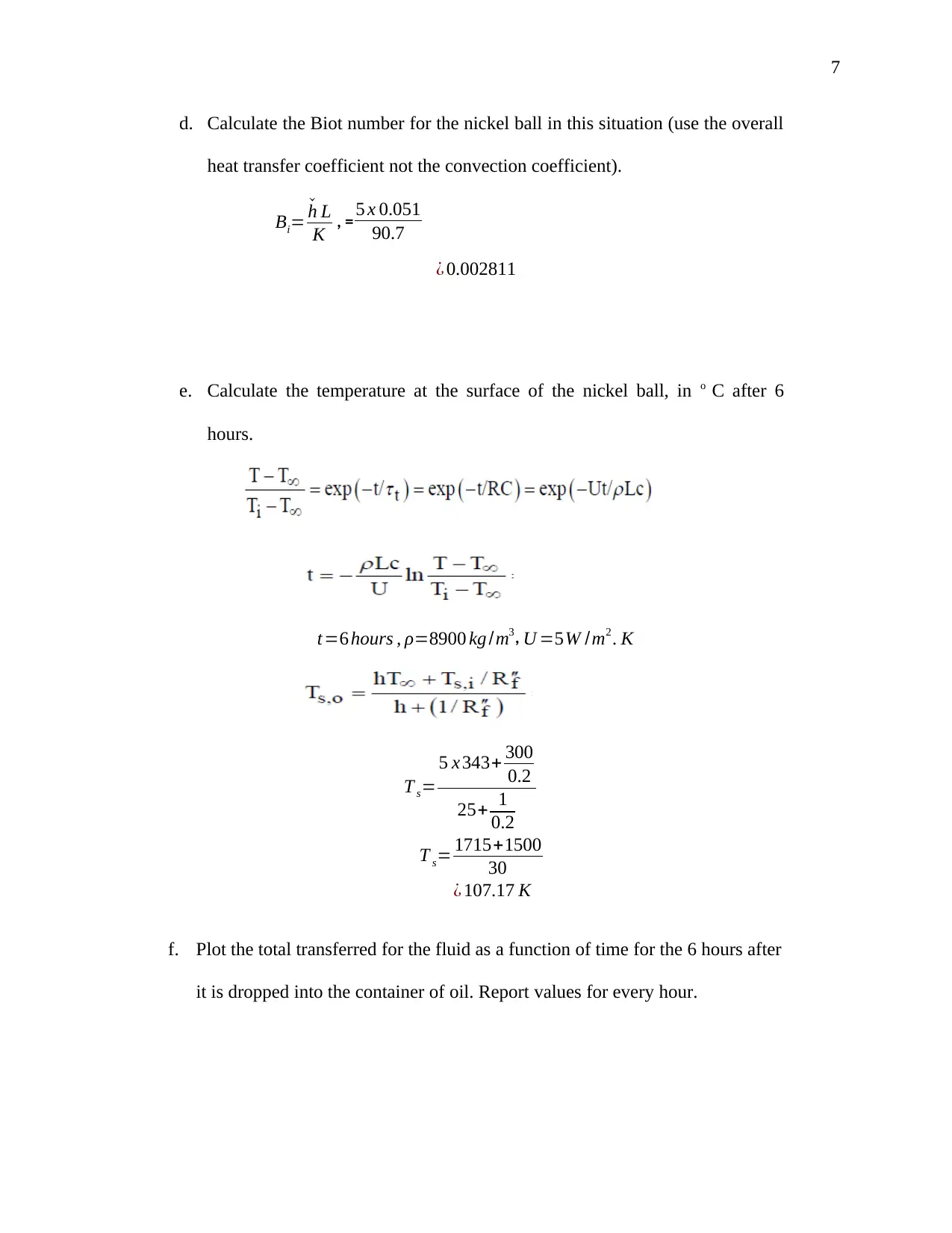
e. Calculate the temperature at the surface of the nickel ball, in o C after 6
hours.
t=6 hours , ρ=8900 kg /m3, U =5W /m2 . K
T s=
5 x 343+ 300
0.2
25+ 1
0.2
T s= 1715+1500
30
¿ 107.17 K
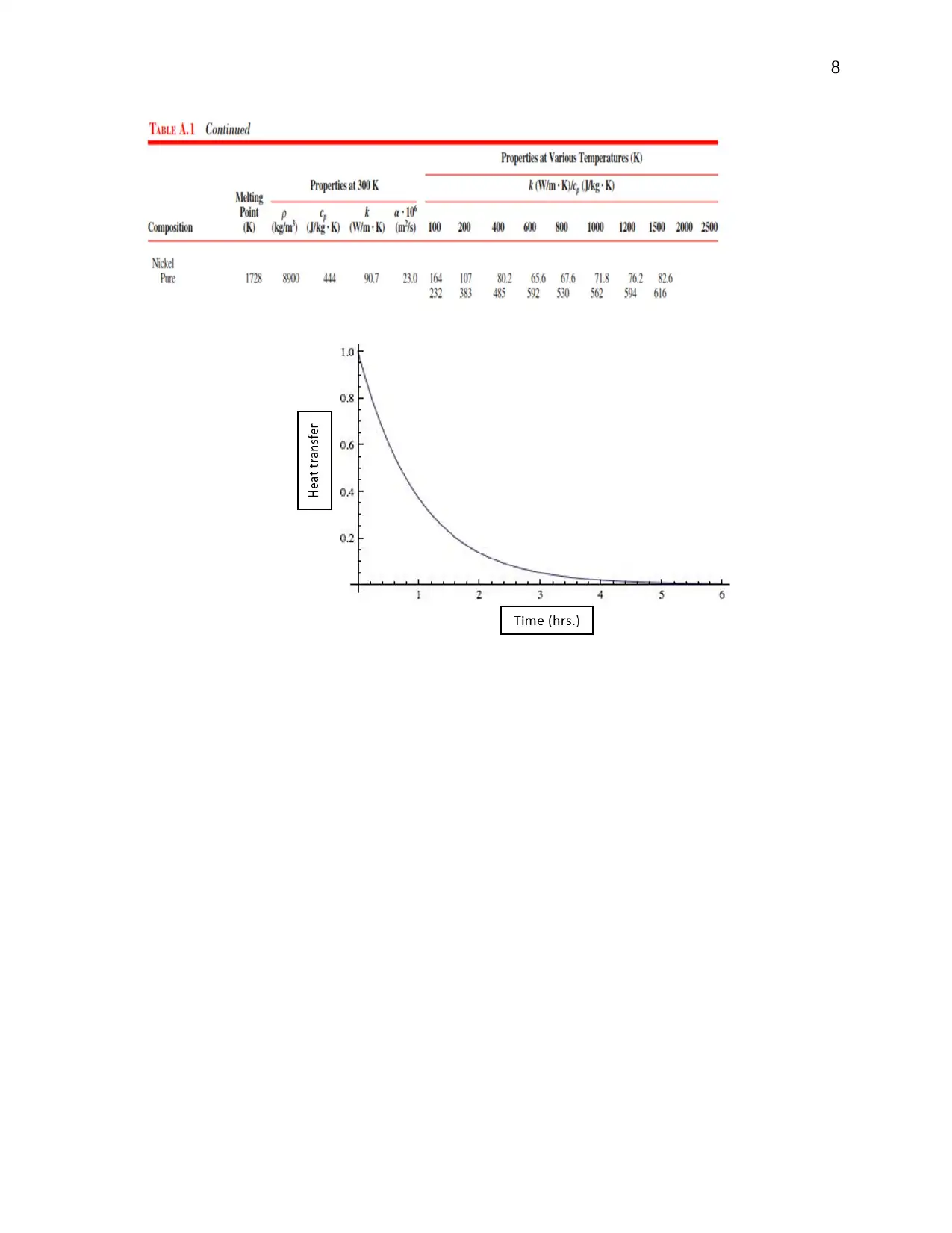
f. Plot the total transferred for the fluid as a function of time for the 6 hours after
it is dropped into the container of oil. Report values for every hour.
tabler-icon-diamond-filled.svg

Paraphrase This Document

Need a fresh take? Get an instant paraphrase of this document with our AI Paraphraser
Document Page
8
Document Page
9
References
Janna, William S. 2018. Engineering Heat Transfer. London : CRC press.
Kaviany, Masoud. 2014. Heat Transfer Physics. London: Cambridge University Press.
Kreith, Frank. 2016. Principle of Heat Transfer. New York: Cengage Learning.
Shuh, H. 2014. Heat Transfer in Structure. New York: Elsevier .
chevron_up_icon
1 out of 9
circle_padding
hide_on_mobile
zoom_out_icon
[object Object]