Analysis of Stress, Strain, and Torsion in Mechanical Systems
VerifiedAdded on 2023/06/03
|8
|1334
|71
Homework Assignment
AI Summary
This document presents a comprehensive solution to a mechanical engineering assignment. The assignment covers a range of topics including the concepts of strain, stress, and Young's modulus of elasticity, with explanations on how to measure strain experimentally using strain gauges. It then delves into the analysis of elongation, stress, and strain under applied forces, including calculations for different materials like aluminum, bronze, and steel. The assignment also explores the parallel axis theorem and its applications, along with torsion analysis, including assumptions and calculations. Furthermore, it addresses moment of inertia, angular and linear velocity, and the calculation of time, speed, and velocity in rotational motion scenarios. The solution provides detailed step-by-step calculations and explanations for each task, offering a complete understanding of the mechanical engineering principles involved.
Ali Talal Mohammed
Contents
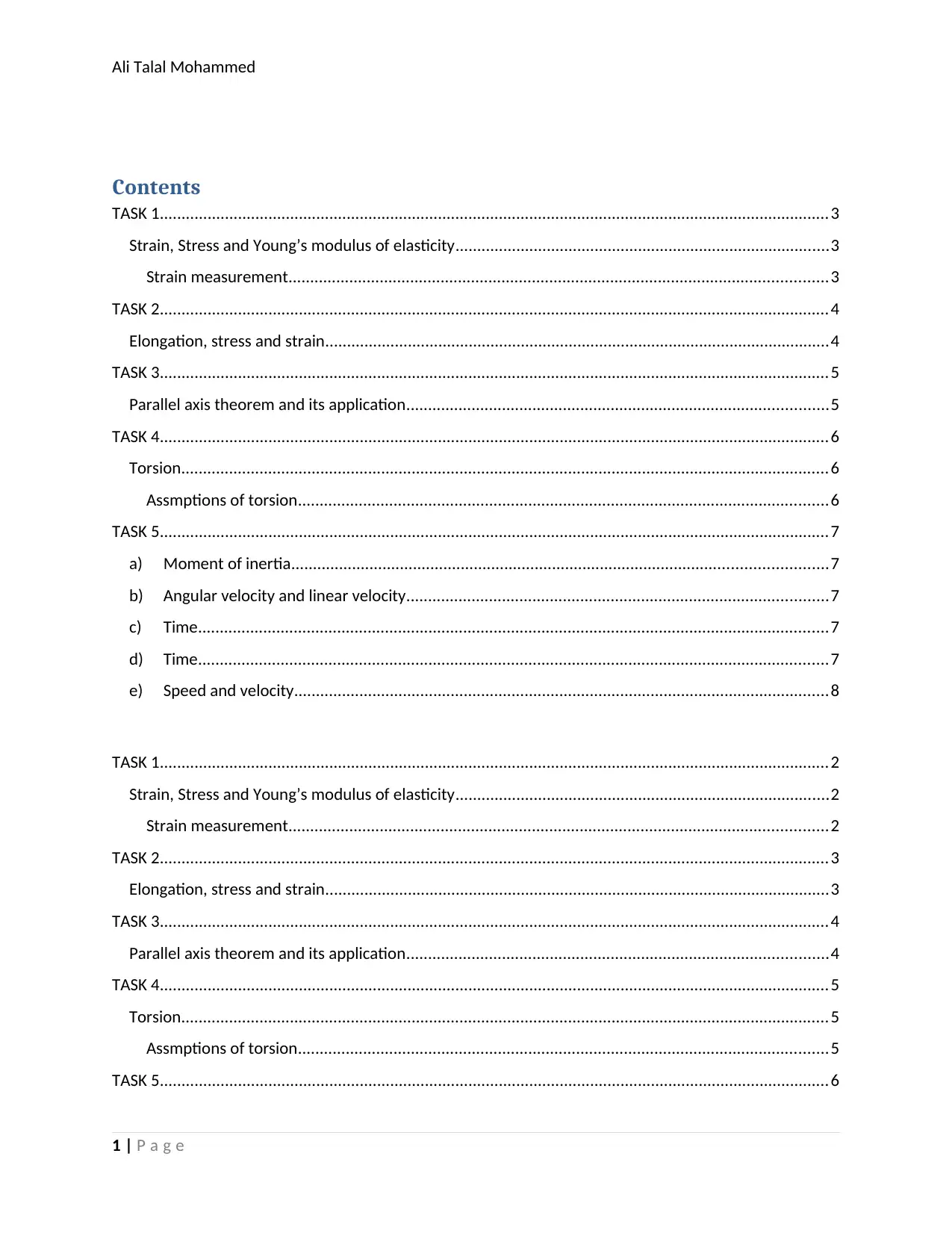
TASK 1..........................................................................................................................................................3
Strain, Stress and Young’s modulus of elasticity......................................................................................3
Strain measurement............................................................................................................................3
TASK 2..........................................................................................................................................................4
Elongation, stress and strain....................................................................................................................4
TASK 3..........................................................................................................................................................5
Parallel axis theorem and its application.................................................................................................5
TASK 4..........................................................................................................................................................6
Torsion.....................................................................................................................................................6
Assmptions of torsion..........................................................................................................................6
TASK 5..........................................................................................................................................................7
a) Moment of inertia...........................................................................................................................7
b) Angular velocity and linear velocity.................................................................................................7
c) Time.................................................................................................................................................7
d) Time.................................................................................................................................................7
e) Speed and velocity...........................................................................................................................8
TASK 1..........................................................................................................................................................2
Strain, Stress and Young’s modulus of elasticity......................................................................................2
Strain measurement............................................................................................................................2
TASK 2..........................................................................................................................................................3
Elongation, stress and strain....................................................................................................................3
TASK 3..........................................................................................................................................................4
Parallel axis theorem and its application.................................................................................................4
TASK 4..........................................................................................................................................................5
Torsion.....................................................................................................................................................5
Assmptions of torsion..........................................................................................................................5
TASK 5..........................................................................................................................................................6
1 | P a g e
Contents
TASK 1..........................................................................................................................................................3
Strain, Stress and Young’s modulus of elasticity......................................................................................3
Strain measurement............................................................................................................................3
TASK 2..........................................................................................................................................................4
Elongation, stress and strain....................................................................................................................4
TASK 3..........................................................................................................................................................5
Parallel axis theorem and its application.................................................................................................5
TASK 4..........................................................................................................................................................6
Torsion.....................................................................................................................................................6
Assmptions of torsion..........................................................................................................................6
TASK 5..........................................................................................................................................................7
a) Moment of inertia...........................................................................................................................7
b) Angular velocity and linear velocity.................................................................................................7
c) Time.................................................................................................................................................7
d) Time.................................................................................................................................................7
e) Speed and velocity...........................................................................................................................8
TASK 1..........................................................................................................................................................2
Strain, Stress and Young’s modulus of elasticity......................................................................................2
Strain measurement............................................................................................................................2
TASK 2..........................................................................................................................................................3
Elongation, stress and strain....................................................................................................................3
TASK 3..........................................................................................................................................................4
Parallel axis theorem and its application.................................................................................................4
TASK 4..........................................................................................................................................................5
Torsion.....................................................................................................................................................5
Assmptions of torsion..........................................................................................................................5
TASK 5..........................................................................................................................................................6
1 | P a g e

Paraphrase This Document
Need a fresh take? Get an instant paraphrase of this document with our AI Paraphraser
Ali Talal Mohammed
a) Moment of inertia...........................................................................................................................6
b) Angular velocity and linear velocity.................................................................................................6
c) Time.................................................................................................................................................6
d) Time.................................................................................................................................................6
e) Speed and velocity...........................................................................................................................7
2 | P a g e
a) Moment of inertia...........................................................................................................................6
b) Angular velocity and linear velocity.................................................................................................6
c) Time.................................................................................................................................................6
d) Time.................................................................................................................................................6
e) Speed and velocity...........................................................................................................................7
2 | P a g e
Ali Talal Mohammed
TASK 1
Strain, Stress and Young’s modulus of elasticity
a) Strain and how to measure it experimentally.
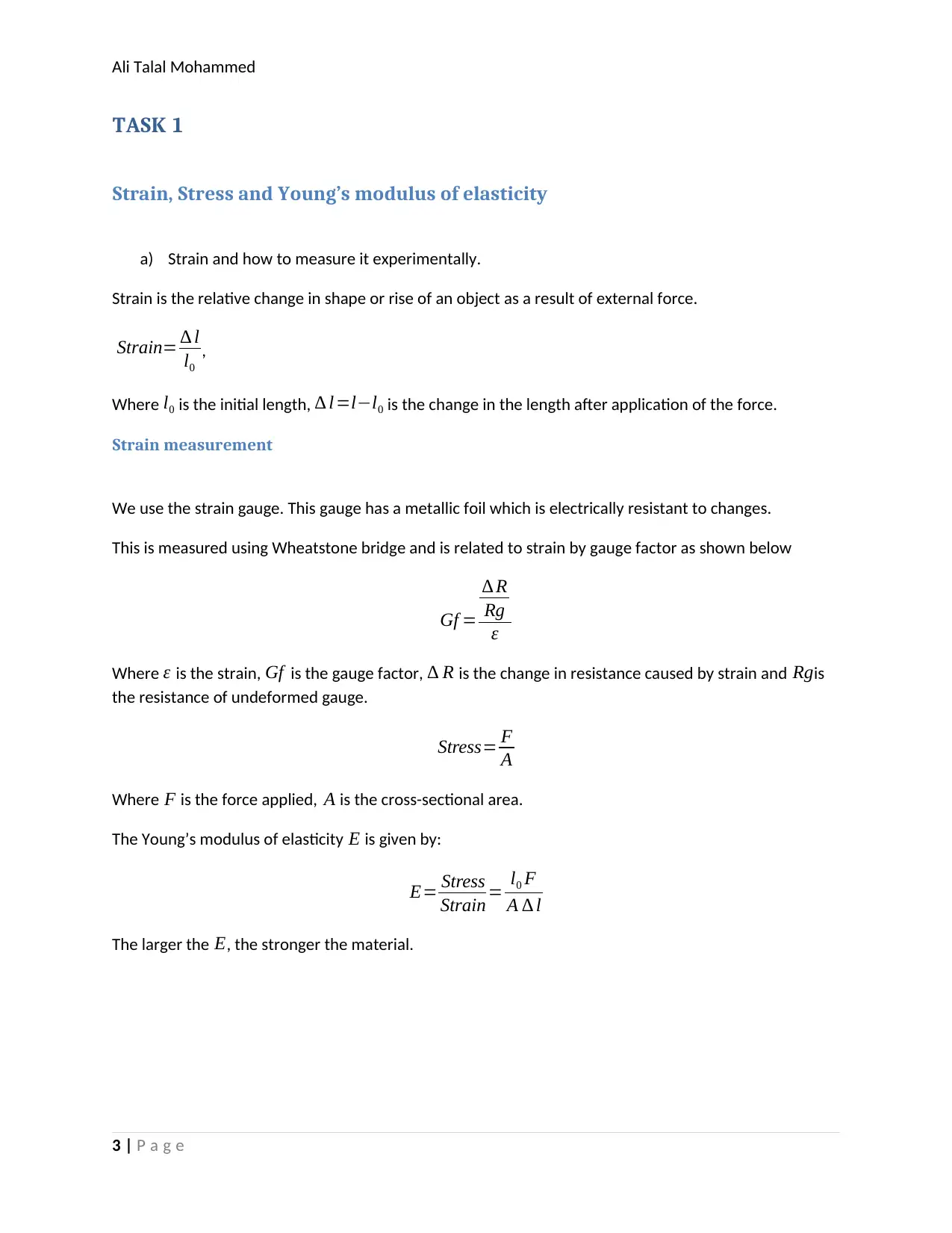
Strain is the relative change in shape or rise of an object as a result of external force.
Strain= ∆ l
l0
,
Where l0 is the initial length, ∆ l=l−l0 is the change in the length after application of the force.
Strain measurement
We use the strain gauge. This gauge has a metallic foil which is electrically resistant to changes.
This is measured using Wheatstone bridge and is related to strain by gauge factor as shown below
Gf =
∆ R
Rg
ε
Where ε is the strain, Gf is the gauge factor, ∆ R is the change in resistance caused by strain and Rgis
the resistance of undeformed gauge.
Stress= F
A
Where F is the force applied, A is the cross-sectional area.
The Young’s modulus of elasticity E is given by:
E= Stress
Strain = l0 F
A ∆ l
The larger the E, the stronger the material.
3 | P a g e
TASK 1
Strain, Stress and Young’s modulus of elasticity
a) Strain and how to measure it experimentally.
Strain is the relative change in shape or rise of an object as a result of external force.
Strain= ∆ l
l0
,
Where l0 is the initial length, ∆ l=l−l0 is the change in the length after application of the force.
Strain measurement
We use the strain gauge. This gauge has a metallic foil which is electrically resistant to changes.
This is measured using Wheatstone bridge and is related to strain by gauge factor as shown below
Gf =
∆ R
Rg
ε
Where ε is the strain, Gf is the gauge factor, ∆ R is the change in resistance caused by strain and Rgis
the resistance of undeformed gauge.
Stress= F
A
Where F is the force applied, A is the cross-sectional area.
The Young’s modulus of elasticity E is given by:
E= Stress
Strain = l0 F
A ∆ l
The larger the E, the stronger the material.
3 | P a g e
⊘ This is a preview!⊘
Do you want full access?
Subscribe today to unlock all pages.

Trusted by 1+ million students worldwide
Ali Talal Mohammed
TASK 2
Elongation, stress and strain
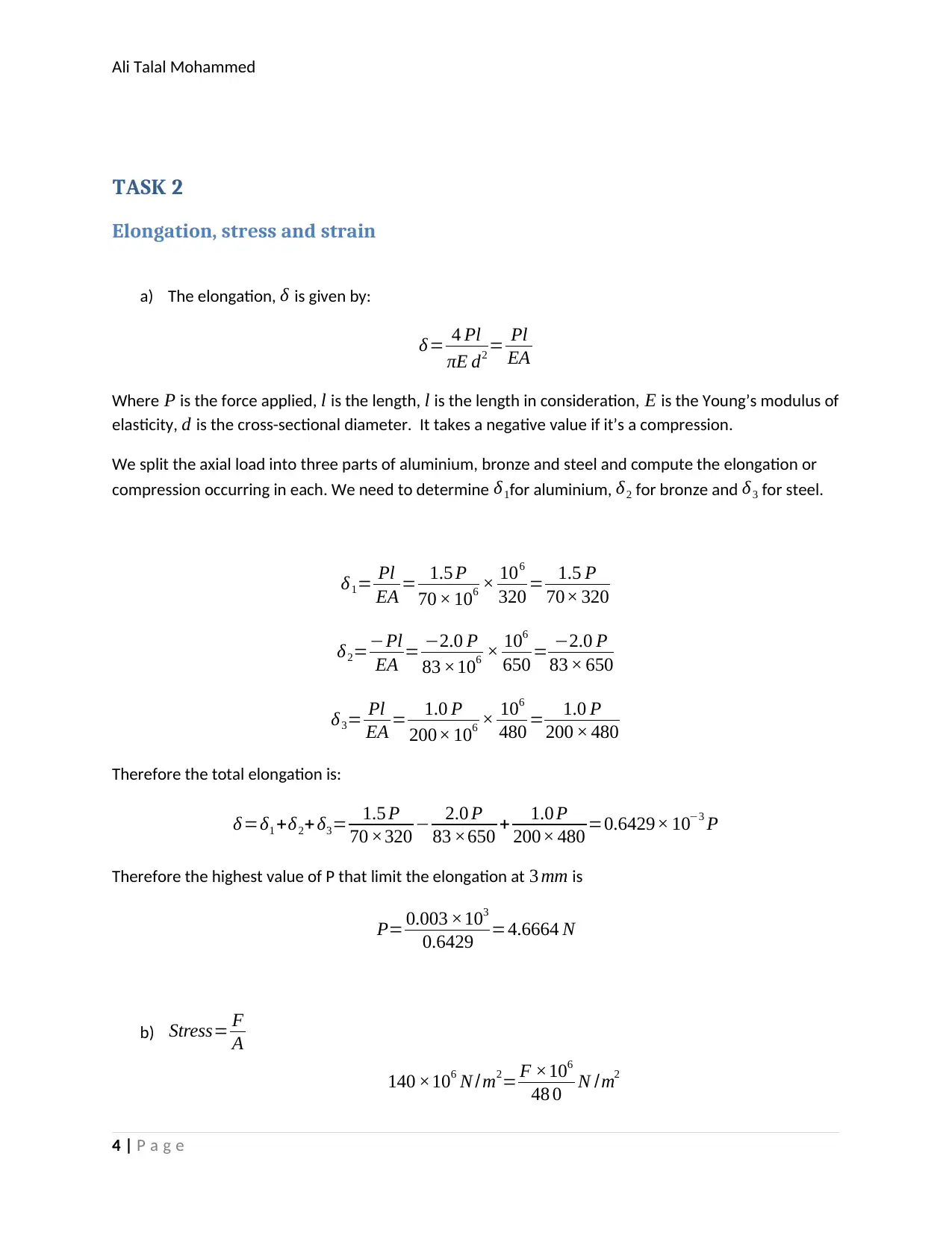
a) The elongation, δ is given by:
δ= 4 Pl
πE d2 = Pl
EA
Where P is the force applied, l is the length, l is the length in consideration, E is the Young’s modulus of
elasticity, d is the cross-sectional diameter. It takes a negative value if it’s a compression.
We split the axial load into three parts of aluminium, bronze and steel and compute the elongation or
compression occurring in each. We need to determine δ 1for aluminium, δ2 for bronze and δ3 for steel.
δ1= Pl
EA = 1.5 P
70 × 106 × 106
320 = 1.5 P
70× 320
δ 2=−Pl
EA = −2.0 P
83 ×106 × 106
650 = −2.0 P
83 × 650
δ3= Pl
EA = 1.0 P
200× 106 × 106
480 = 1.0 P
200 × 480
Therefore the total elongation is:
δ =δ1 +δ2+δ3= 1.5 P
70 ×320 − 2.0 P
83 ×650 + 1.0 P
200× 480 =0.6429× 10⁻³ P
Therefore the highest value of P that limit the elongation at 3 mm is
P= 0.003 ×10³
0.6429 =4.6664 N
b) Stress= F
A
140 ×106 N / m2= F ×106
48 0 N /m2
4 | P a g e
TASK 2
Elongation, stress and strain
a) The elongation, δ is given by:
δ= 4 Pl
πE d2 = Pl
EA
Where P is the force applied, l is the length, l is the length in consideration, E is the Young’s modulus of
elasticity, d is the cross-sectional diameter. It takes a negative value if it’s a compression.
We split the axial load into three parts of aluminium, bronze and steel and compute the elongation or
compression occurring in each. We need to determine δ 1for aluminium, δ2 for bronze and δ3 for steel.
δ1= Pl
EA = 1.5 P
70 × 106 × 106
320 = 1.5 P
70× 320
δ 2=−Pl
EA = −2.0 P
83 ×106 × 106
650 = −2.0 P
83 × 650
δ3= Pl
EA = 1.0 P
200× 106 × 106
480 = 1.0 P
200 × 480
Therefore the total elongation is:
δ =δ1 +δ2+δ3= 1.5 P
70 ×320 − 2.0 P
83 ×650 + 1.0 P
200× 480 =0.6429× 10⁻³ P
Therefore the highest value of P that limit the elongation at 3 mm is
P= 0.003 ×10³
0.6429 =4.6664 N
b) Stress= F
A
140 ×106 N / m2= F ×106
48 0 N /m2
4 | P a g e
Paraphrase This Document
Need a fresh take? Get an instant paraphrase of this document with our AI Paraphraser
Ali Talal Mohammed
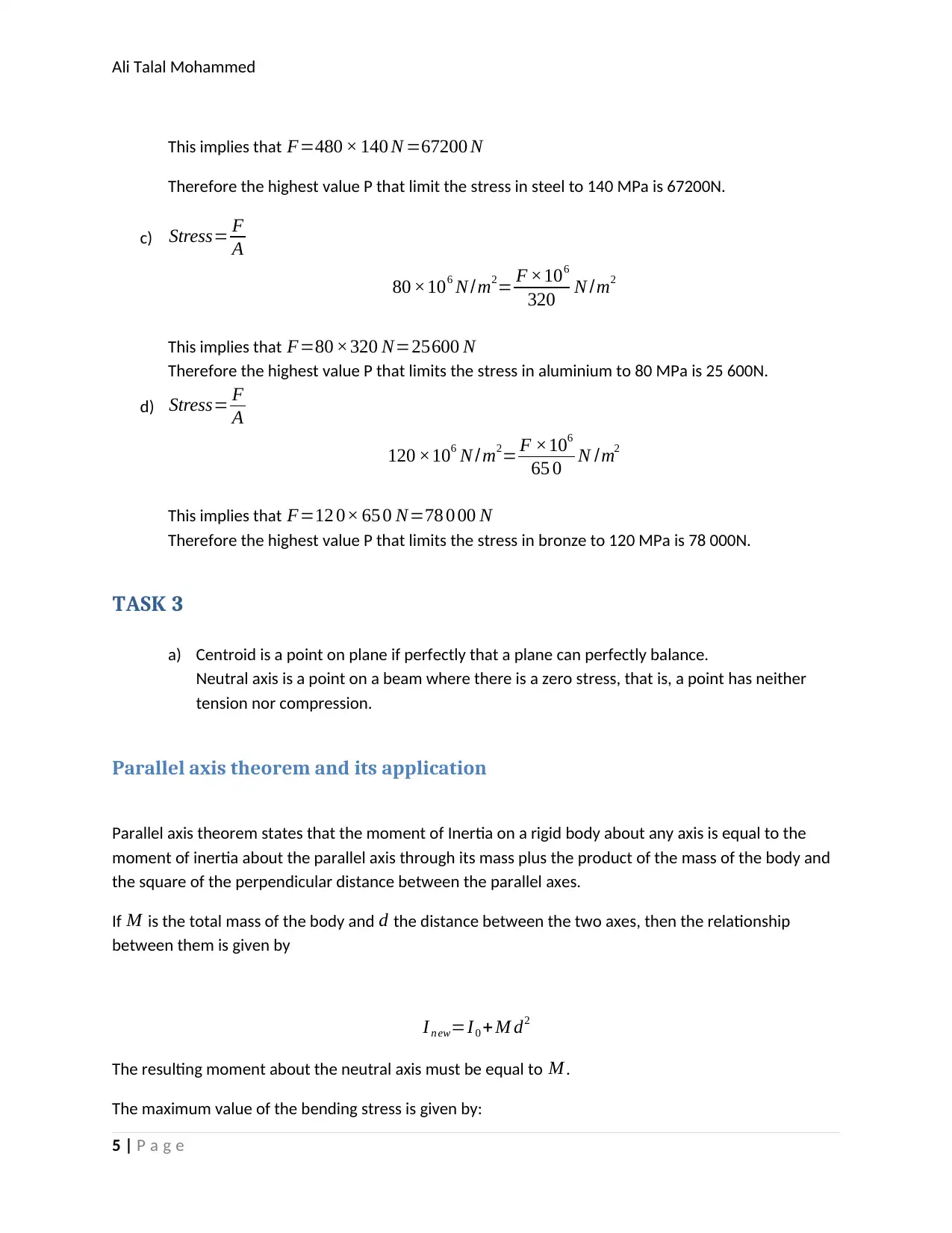
This implies that F=480 × 140 N =67200 N
Therefore the highest value P that limit the stress in steel to 140 MPa is 67200N.
c) Stress= F
A
80 ×106 N /m2= F ×106
320 N /m2
This implies that F=80 ×320 N=25600 N
Therefore the highest value P that limits the stress in aluminium to 80 MPa is 25 600N.
d) Stress= F
A
120 ×106 N / m2= F ×106
65 0 N /m2
This implies that F=12 0× 65 0 N=78 0 00 N
Therefore the highest value P that limits the stress in bronze to 120 MPa is 78 000N.
TASK 3
a) Centroid is a point on plane if perfectly that a plane can perfectly balance.
Neutral axis is a point on a beam where there is a zero stress, that is, a point has neither
tension nor compression.
Parallel axis theorem and its application
Parallel axis theorem states that the moment of Inertia on a rigid body about any axis is equal to the
moment of inertia about the parallel axis through its mass plus the product of the mass of the body and
the square of the perpendicular distance between the parallel axes.
If M is the total mass of the body and d the distance between the two axes, then the relationship
between them is given by
I n ew=I0 + M d2
The resulting moment about the neutral axis must be equal to M .
The maximum value of the bending stress is given by:
5 | P a g e
This implies that F=480 × 140 N =67200 N
Therefore the highest value P that limit the stress in steel to 140 MPa is 67200N.
c) Stress= F
A
80 ×106 N /m2= F ×106
320 N /m2
This implies that F=80 ×320 N=25600 N
Therefore the highest value P that limits the stress in aluminium to 80 MPa is 25 600N.
d) Stress= F
A
120 ×106 N / m2= F ×106
65 0 N /m2
This implies that F=12 0× 65 0 N=78 0 00 N
Therefore the highest value P that limits the stress in bronze to 120 MPa is 78 000N.
TASK 3
a) Centroid is a point on plane if perfectly that a plane can perfectly balance.
Neutral axis is a point on a beam where there is a zero stress, that is, a point has neither
tension nor compression.
Parallel axis theorem and its application
Parallel axis theorem states that the moment of Inertia on a rigid body about any axis is equal to the
moment of inertia about the parallel axis through its mass plus the product of the mass of the body and
the square of the perpendicular distance between the parallel axes.
If M is the total mass of the body and d the distance between the two axes, then the relationship
between them is given by
I n ew=I0 + M d2
The resulting moment about the neutral axis must be equal to M .
The maximum value of the bending stress is given by:
5 | P a g e
Ali Talal Mohammed
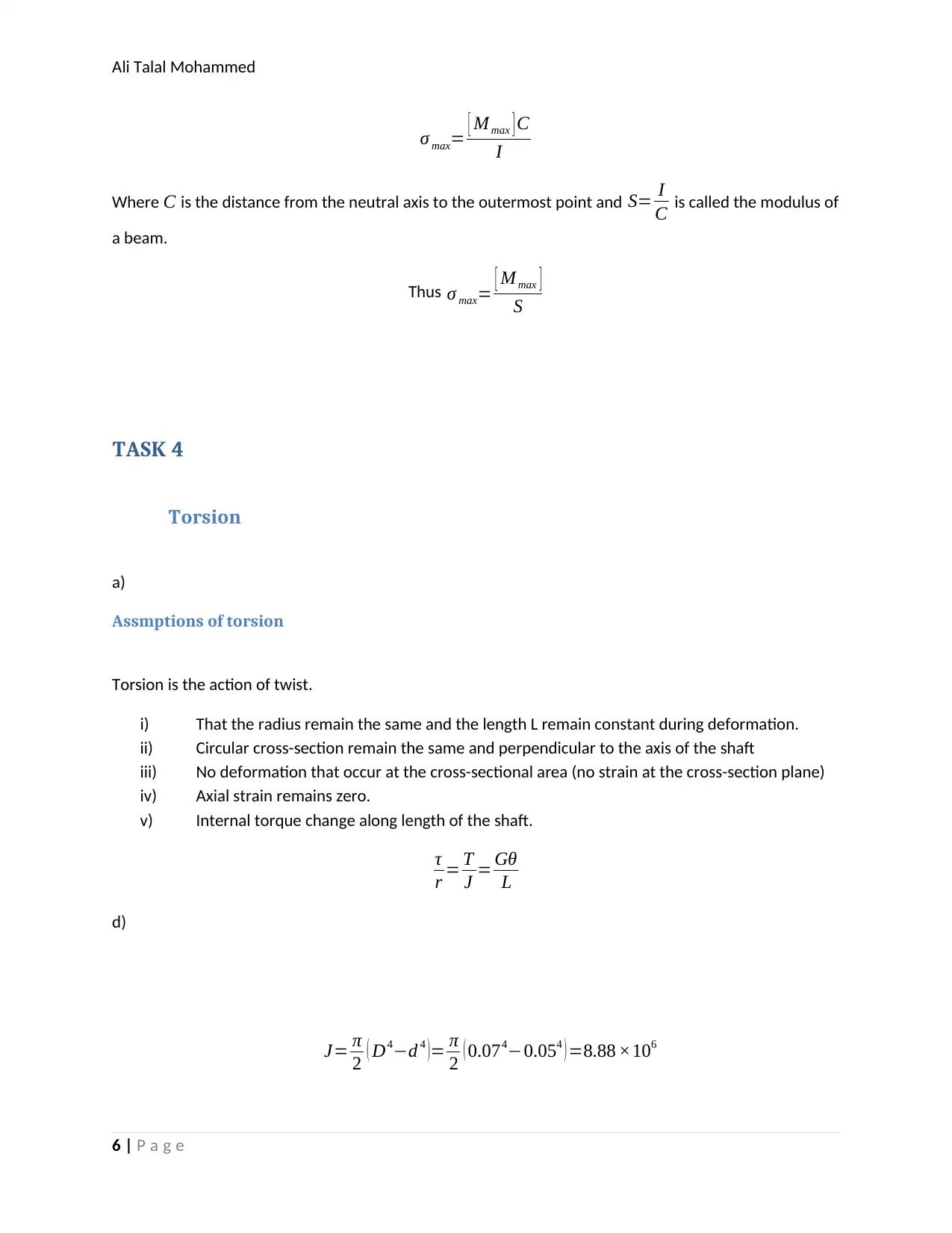
σ max= [ M max ] C
I
Where C is the distance from the neutral axis to the outermost point and S= I
C is called the modulus of
a beam.
Thus σ max= [ M max ]
S
TASK 4
Torsion
a)
Assmptions of torsion
Torsion is the action of twist.
i) That the radius remain the same and the length L remain constant during deformation.
ii) Circular cross-section remain the same and perpendicular to the axis of the shaft
iii) No deformation that occur at the cross-sectional area (no strain at the cross-section plane)
iv) Axial strain remains zero.
v) Internal torque change along length of the shaft.
τ
r = T
J = Gθ
L
d)
J= π
2 ( D4−d 4 )= π
2 ( 0.074−0.054 ) =8.88 ×10⁶
6 | P a g e
σ max= [ M max ] C
I
Where C is the distance from the neutral axis to the outermost point and S= I
C is called the modulus of
a beam.
Thus σ max= [ M max ]
S
TASK 4
Torsion
a)
Assmptions of torsion
Torsion is the action of twist.
i) That the radius remain the same and the length L remain constant during deformation.
ii) Circular cross-section remain the same and perpendicular to the axis of the shaft
iii) No deformation that occur at the cross-sectional area (no strain at the cross-section plane)
iv) Axial strain remains zero.
v) Internal torque change along length of the shaft.
τ
r = T
J = Gθ
L
d)
J= π
2 ( D4−d 4 )= π
2 ( 0.074−0.054 ) =8.88 ×10⁶
6 | P a g e
⊘ This is a preview!⊘
Do you want full access?
Subscribe today to unlock all pages.
Trusted by 1+ million students worldwide
Ali Talal Mohammed
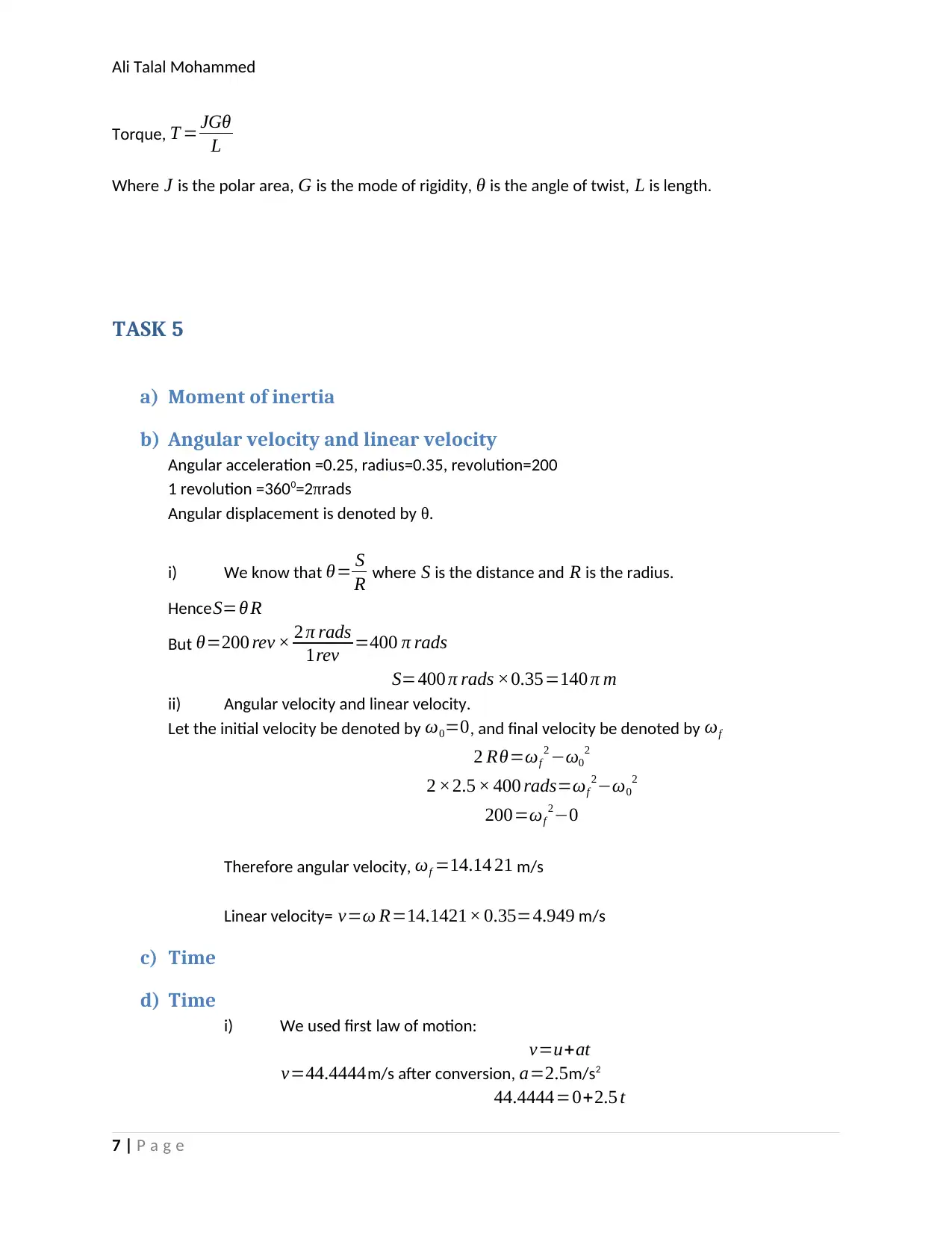
Torque, T = JGθ
L
Where J is the polar area, G is the mode of rigidity, θ is the angle of twist, L is length.
TASK 5
a) Moment of inertia
b) Angular velocity and linear velocity
Angular acceleration =0.25, radius=0.35, revolution=200
1 revolution =3600=2πrads
Angular displacement is denoted by θ.
i) We know that θ= S
R where S is the distance and R is the radius.
Hence S=θ R
But θ=200 rev × 2 π rads
1rev =400 π rads
S=400 π rads ×0.35=140 π m
ii) Angular velocity and linear velocity.
Let the initial velocity be denoted by ω0=0, and final velocity be denoted by ωf
2 Rθ=ωf
2 −ω0
2
2 ×2.5 × 400 rads=ωf
2−ω0
2
200=ωf
2−0
Therefore angular velocity, ωf =14.14 21 m/s
Linear velocity= v=ω R=14.1421× 0.35=4.949 m/s
c) Time
d) Time
i) We used first law of motion:
v=u+at
v=44.4444m/s after conversion, a=2.5m/s2
44.4444=0+2.5 t
7 | P a g e
Torque, T = JGθ
L
Where J is the polar area, G is the mode of rigidity, θ is the angle of twist, L is length.
TASK 5
a) Moment of inertia
b) Angular velocity and linear velocity
Angular acceleration =0.25, radius=0.35, revolution=200
1 revolution =3600=2πrads
Angular displacement is denoted by θ.
i) We know that θ= S
R where S is the distance and R is the radius.
Hence S=θ R
But θ=200 rev × 2 π rads
1rev =400 π rads
S=400 π rads ×0.35=140 π m
ii) Angular velocity and linear velocity.
Let the initial velocity be denoted by ω0=0, and final velocity be denoted by ωf
2 Rθ=ωf
2 −ω0
2
2 ×2.5 × 400 rads=ωf
2−ω0
2
200=ωf
2−0
Therefore angular velocity, ωf =14.14 21 m/s
Linear velocity= v=ω R=14.1421× 0.35=4.949 m/s
c) Time
d) Time
i) We used first law of motion:
v=u+at
v=44.4444m/s after conversion, a=2.5m/s2
44.4444=0+2.5 t
7 | P a g e
Paraphrase This Document
Need a fresh take? Get an instant paraphrase of this document with our AI Paraphraser
Ali Talal Mohammed
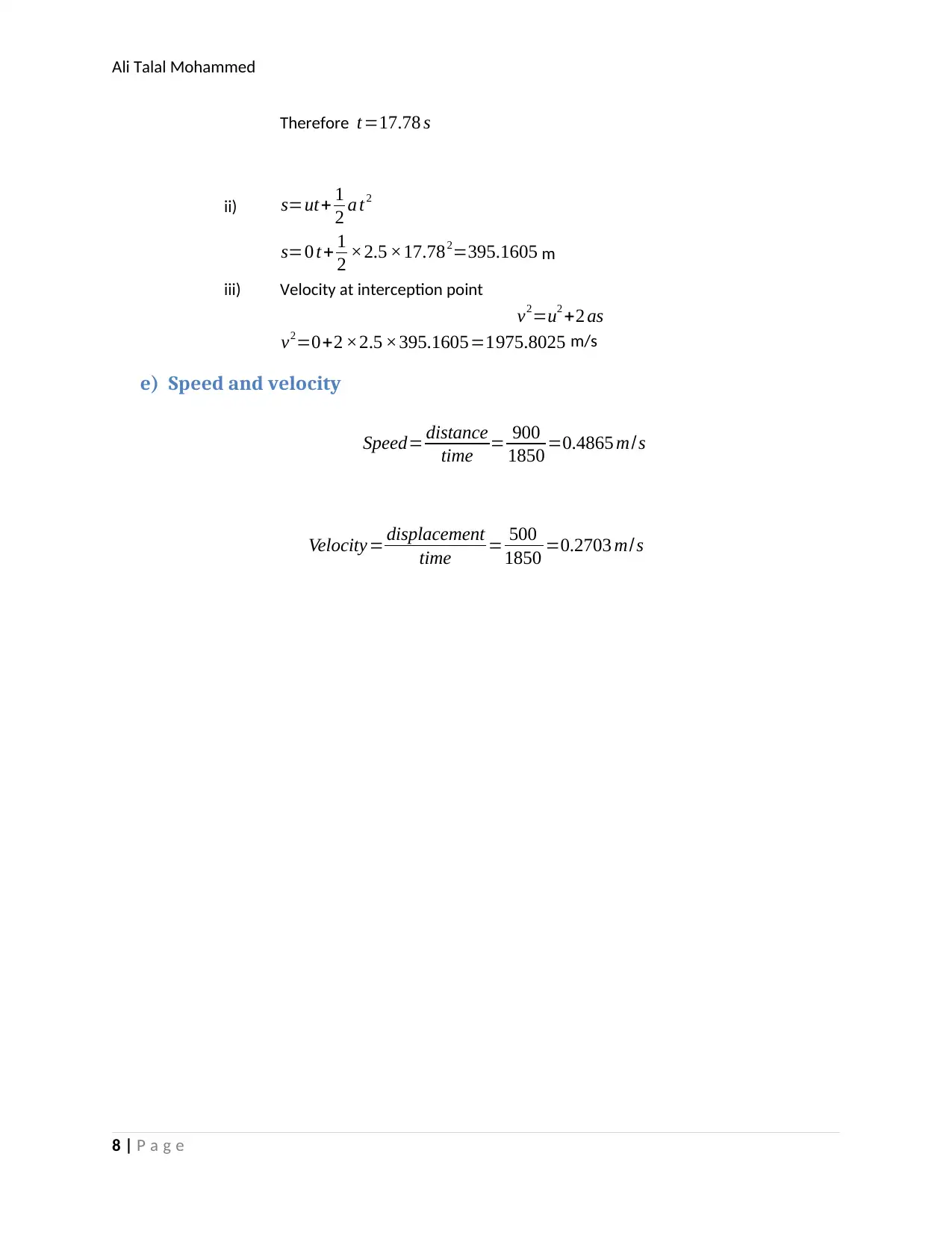
Therefore t=17.78 s
ii) s=ut+ 1
2 a t2
s=0 t + 1
2 ×2.5 ×17.782=395.1605 m
iii) Velocity at interception point
v2=u2 +2 as
v2=0+2 ×2.5 ×395.1605=1975.8025 m/s
e) Speed and velocity
Speed= distance
time = 900
1850 =0.4865 m/s
Velocity= displacement
time = 500
1850 =0.2703 m/s
8 | P a g e
Therefore t=17.78 s
ii) s=ut+ 1
2 a t2
s=0 t + 1
2 ×2.5 ×17.782=395.1605 m
iii) Velocity at interception point
v2=u2 +2 as
v2=0+2 ×2.5 ×395.1605=1975.8025 m/s
e) Speed and velocity
Speed= distance
time = 900
1850 =0.4865 m/s
Velocity= displacement
time = 500
1850 =0.2703 m/s
8 | P a g e

1 out of 8


Your All-in-One AI-Powered Toolkit for Academic Success.
+13062052269
info@desklib.com
Available 24*7 on WhatsApp / Email
![[object Object]](/_next/static/media/star-bottom.7253800d.svg)
Unlock your academic potential
Copyright © 2020–2025 A2Z Services. All Rights Reserved. Developed and managed by ZUCOL.