Kinetics Tutorial Problems and Solutions - Mechanical Engineering

Verified

Added on  2023/01/17

|3
|475
|71
Homework Assignment
AI Summary
This document contains detailed solutions to a kinetics tutorial, addressing various problems related to mechanical engineering principles. The solutions cover a range of topics, including the analysis of a lift's motion, calculating tension in cables and ropes, determining torque requirements, and computing work done by forces. The problems involve concepts such as acceleration, mass, gravity, friction, and angular motion of flywheels. Each solution includes step-by-step calculations, ensuring a clear understanding of the problem-solving process. The tutorial encompasses diverse scenarios, from lift dynamics and winch drum calculations to the movement of tanks and the power required to overcome friction. This resource is designed to assist students in understanding and mastering the fundamentals of kinetics in mechanical engineering. The document provides a comprehensive guide to solving problems related to the dynamics of rigid bodies, making it an invaluable resource for students seeking to improve their grasp of the subject matter.

Document Page
Dynamic Tutorial
Kinetics
tabler-icon-diamond-filled.svg

Paraphrase This Document

Need a fresh take? Get an instant paraphrase of this document with our AI Paraphraser
Document Page
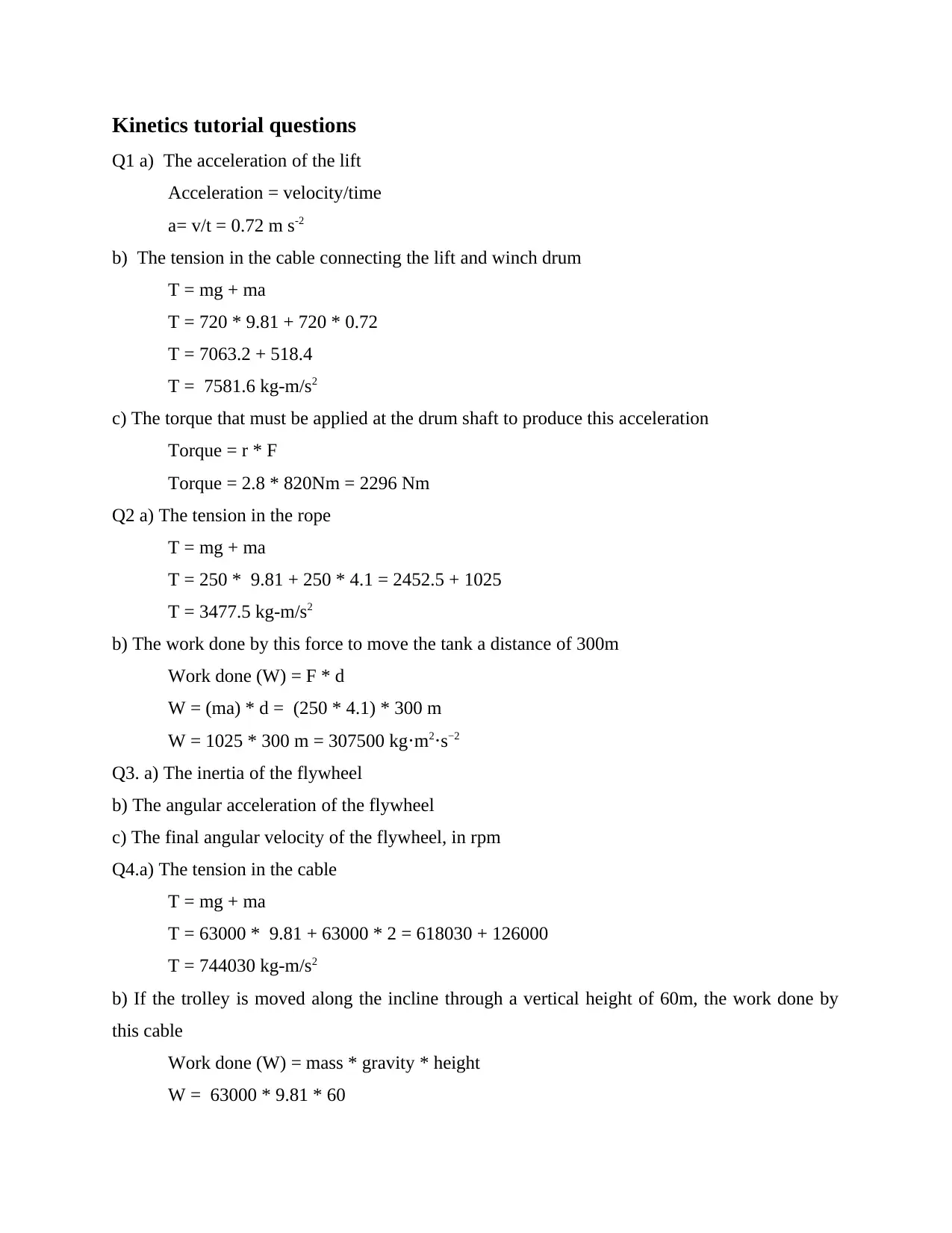
Kinetics tutorial questions
Q1 a) The acceleration of the lift
Acceleration = velocity/time
a= v/t = 0.72 m s-2
b) The tension in the cable connecting the lift and winch drum
T = mg + ma
T = 720 * 9.81 + 720 * 0.72
T = 7063.2 + 518.4
T = 7581.6 kg-m/s2
c) The torque that must be applied at the drum shaft to produce this acceleration
Torque = r * F
Torque = 2.8 * 820Nm = 2296 Nm
Q2 a) The tension in the rope
T = mg + ma
T = 250 * 9.81 + 250 * 4.1 = 2452.5 + 1025
T = 3477.5 kg-m/s2
b) The work done by this force to move the tank a distance of 300m
Work done (W) = F * d
W = (ma) * d = (250 * 4.1) * 300 m
W = 1025 * 300 m = 307500 kg m 2 s −2
Q3. a) The inertia of the flywheel
b) The angular acceleration of the flywheel
c) The final angular velocity of the flywheel, in rpm
Q4.a) The tension in the cable
T = mg + ma
T = 63000 * 9.81 + 63000 * 2 = 618030 + 126000
T = 744030 kg-m/s2
b) If the trolley is moved along the incline through a vertical height of 60m, the work done by
this cable
Work done (W) = mass * gravity * height
W = 63000 * 9.81 * 60
Document Page
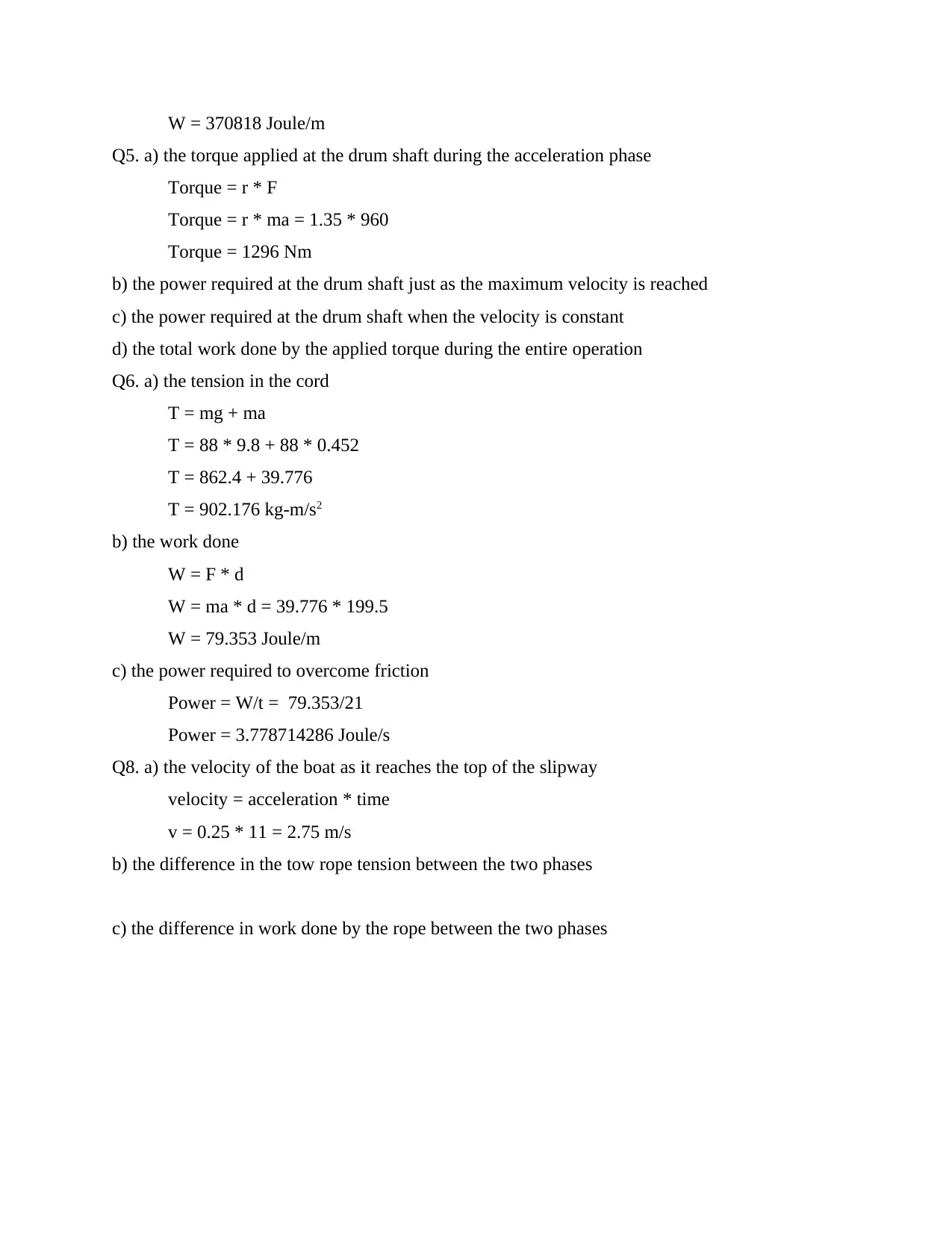
W = 370818 Joule/m
Q5. a) the torque applied at the drum shaft during the acceleration phase
Torque = r * F
Torque = r * ma = 1.35 * 960
Torque = 1296 Nm
b) the power required at the drum shaft just as the maximum velocity is reached
c) the power required at the drum shaft when the velocity is constant
d) the total work done by the applied torque during the entire operation
Q6. a) the tension in the cord
T = mg + ma
T = 88 * 9.8 + 88 * 0.452
T = 862.4 + 39.776
T = 902.176 kg-m/s2
b) the work done
W = F * d
W = ma * d = 39.776 * 199.5
W = 79.353 Joule/m
c) the power required to overcome friction
Power = W/t = 79.353/21
Power = 3.778714286 Joule/s
Q8. a) the velocity of the boat as it reaches the top of the slipway
velocity = acceleration * time
v = 0.25 * 11 = 2.75 m/s
b) the difference in the tow rope tension between the two phases
c) the difference in work done by the rope between the two phases
chevron_up_icon
1 out of 3
circle_padding
hide_on_mobile
zoom_out_icon
[object Object]