Media and Crime: Examining the Complex Relationship and Impact
VerifiedAdded on 2020/05/16
|6
|1997
|1418
Essay
AI Summary
This essay delves into the intricate relationship between media and crime, presenting two contrasting arguments. The first argument posits that media can be a cause of crime, potentially influencing aggressive behavior and providing criminals with ideas. The essay examines how media, through dramatization, human-interest stories, and fictional representations, can impact individual behavior and societal mores, particularly among children and adolescents. The second argument, however, suggests that media can also be a cure for crime by highlighting its control values, educating the public, and providing a platform for awareness and transparency. The essay explores the role of social media in shaping perceptions of crime and assisting criminal justice institutions, concluding that media and crime are interdependent, each influencing the other.
Running head: MEDIA AND CRIME
Media and crime
Name of the student
Name of the university
Author note
Media and crime
Name of the student
Name of the university
Author note
Paraphrase This Document
Need a fresh take? Get an instant paraphrase of this document with our AI Paraphraser

1MEDIA AND CRIME
Crime and media has a relation between them. Media in many cases turns out to be
the cause of crime and sometimes it is just the extreme opposite. It turns out to be the cure of
crime. It is because of the media that that many crime gets highlighted that happens to occur
in some uncommon and remote places. The essay comprises two arguments. The first
argument is that media is the cause of crime and the other argument that stands in contrast
with the previous one is that media is the cure of crime. Generally, media is usually seen to
exaggerate the crime. The crime is brought to the notice of the entire world with the help of
the media. The media is thought to a powerful forum to bring out the crime in front of the
entire world. In this way, it acts as a cure and on the other hand, the criminals get ideas from
the crime series of how to do the crime. They get innovative ideas of committing the crime.
This is how media influences the persons to commit the crime and therefore they are known
to be the cause of the crime.
The first argument is the fact that media is the cause of crime. In many case the
idea prevails that viewing violence in the media turned out to influence the aggressive
behavior of an individual. However, it has been argued by many critics that the relation
between crime and media turns out to be weak. The other factors such as the environmental
factors are to be considered in many cases. There are certain key factors that influence the
selection of the crime stories. These stories include the dramatization of many crimes in the
media that represents the action and the excitement, which serves as the motivator of
committing crimes. The human-interest stories about crimes are another example of
committing the crimes. This includes violence and sexual crimes. The fictional
representations of crime are the strong motivator of the crime. The representation of crime in
different forms of media that is on television, TV and novels are considered as one of the
important source of crime. In many cases, it has been found that the individuals got inspired
from the fictional stories and they committed similar crimes as shown in the television. After
Crime and media has a relation between them. Media in many cases turns out to be
the cause of crime and sometimes it is just the extreme opposite. It turns out to be the cure of
crime. It is because of the media that that many crime gets highlighted that happens to occur
in some uncommon and remote places. The essay comprises two arguments. The first
argument is that media is the cause of crime and the other argument that stands in contrast
with the previous one is that media is the cure of crime. Generally, media is usually seen to
exaggerate the crime. The crime is brought to the notice of the entire world with the help of
the media. The media is thought to a powerful forum to bring out the crime in front of the
entire world. In this way, it acts as a cure and on the other hand, the criminals get ideas from
the crime series of how to do the crime. They get innovative ideas of committing the crime.
This is how media influences the persons to commit the crime and therefore they are known
to be the cause of the crime.
The first argument is the fact that media is the cause of crime. In many case the
idea prevails that viewing violence in the media turned out to influence the aggressive
behavior of an individual. However, it has been argued by many critics that the relation
between crime and media turns out to be weak. The other factors such as the environmental
factors are to be considered in many cases. There are certain key factors that influence the
selection of the crime stories. These stories include the dramatization of many crimes in the
media that represents the action and the excitement, which serves as the motivator of
committing crimes. The human-interest stories about crimes are another example of
committing the crimes. This includes violence and sexual crimes. The fictional
representations of crime are the strong motivator of the crime. The representation of crime in
different forms of media that is on television, TV and novels are considered as one of the
important source of crime. In many cases, it has been found that the individuals got inspired
from the fictional stories and they committed similar crimes as shown in the television. After

2MEDIA AND CRIME
a long analysis, it can be stated that the media have a huge influence on the portrayal of
crime. The media gives the opportunity to view the images, films and videos that justify
crimes that include robbery, murders, carjacking and other similar violence. The main reason
for which media can be held responsible for committing the crime is the change of behaviors
of the individuals. The change is seen not only in the behavior but also in the attitude of the
individuals. The media portrays the crime in order to make the common people aware of the
crimes occurring around the entire world. Many people take this otherwise. A change occurs
in the behavior of the attitudes of the individuals after viewing the crime series. It results in
the change of the mores of the society (Caterini, 2015).
The influence of media has been witnessed more on the children and the adolescents.
The impact of violence has been seen on people regardless of their age, gender, class, and
ethnicity. The problem increases while the aggressor is left unpunished. These are the evil
consequences that the media has on the society. At present the issues that is shown in media
revolves around the effect of the sexual media and sexual behavior. There are many examples
where the people got aroused, their thoughts and emotions got aroused, and there was an
increase in the crimes. There is a huge competition among the different forms of media like
the magazines, television, cinema and other similar forms. They all have the pressure of
gaining attention of the audiences with some interesting news (Fuchs, 2017). The news of
crime is taken as a form of entertainment to the audiences. There are many such examples
where some friends while having conversation with each other talks about what is printed in
the newspaper and what has been shown in the news channel in the television. This gives a
notion where the news can be treated only as the means of entertainment. This has worst
effect on somebody and this might not have bad effect on others. Media has the power to
influence the common mass (Shelby & Hatch, 2014). The media has the power of influencing
the behavior of people. This is best understood with the help of an example. There have been
a long analysis, it can be stated that the media have a huge influence on the portrayal of
crime. The media gives the opportunity to view the images, films and videos that justify
crimes that include robbery, murders, carjacking and other similar violence. The main reason
for which media can be held responsible for committing the crime is the change of behaviors
of the individuals. The change is seen not only in the behavior but also in the attitude of the
individuals. The media portrays the crime in order to make the common people aware of the
crimes occurring around the entire world. Many people take this otherwise. A change occurs
in the behavior of the attitudes of the individuals after viewing the crime series. It results in
the change of the mores of the society (Caterini, 2015).
The influence of media has been witnessed more on the children and the adolescents.
The impact of violence has been seen on people regardless of their age, gender, class, and
ethnicity. The problem increases while the aggressor is left unpunished. These are the evil
consequences that the media has on the society. At present the issues that is shown in media
revolves around the effect of the sexual media and sexual behavior. There are many examples
where the people got aroused, their thoughts and emotions got aroused, and there was an
increase in the crimes. There is a huge competition among the different forms of media like
the magazines, television, cinema and other similar forms. They all have the pressure of
gaining attention of the audiences with some interesting news (Fuchs, 2017). The news of
crime is taken as a form of entertainment to the audiences. There are many such examples
where some friends while having conversation with each other talks about what is printed in
the newspaper and what has been shown in the news channel in the television. This gives a
notion where the news can be treated only as the means of entertainment. This has worst
effect on somebody and this might not have bad effect on others. Media has the power to
influence the common mass (Shelby & Hatch, 2014). The media has the power of influencing
the behavior of people. This is best understood with the help of an example. There have been
⊘ This is a preview!⊘
Do you want full access?
Subscribe today to unlock all pages.

Trusted by 1+ million students worldwide

3MEDIA AND CRIME
many such cases where the readers read in the newspaper about a suicidal teen acted
imitating her favorite actor. It is similar to case presented on a television program for the
purpose of entertainment in which a person was influenced by a movie, and was set a ticket
boot on fire in one of the subway in New York. The person tried to imitate part of her favorite
movie. The other example is the news that appeared in the year 1974, where four other girls
with a glass bottle raped a girl. While enquiry was done they came up with the explanation
that they were inspired by a movie named, ‘Born innocent’. These are the cases where the
people are unable to separate fantasy from reality. It is because of this reasons that the media
is held responsible for maximum crimes (Carpentier, 2016).
On the other hand, there is another theory which states that media is the cure for
crime (van Uhm, 2016). This statement is justified as media takes all the efforts to stress on
the control values of crime. The function of media is to educate the common public about the
crimes that was going around the world. The media serves as a prime source of the
information related to crime (Beck, 2015). Media gives the first hand information about
crime to the public. The public is sometimes made aware of certain crimes through media
itself as live telecast of the crimes are sometimes shown in national as well as international
television. Social media has been reported to change the way people commit the crimes in the
recent times. The social media has turned out to be one of the most powerful platforms of
making a crime highlight to a maximum amount of people (Marsh & Melville, 2014). In the
21st century, the social media has acted as an important forum for posting the worst
consequences of the crime therefore making people aware of the crime and therefore healing
the pain of the victim of the crime (Jewkes, 2015). The social media has served as a powerful
platform to convey the consequences of the crime. The social media platform includes
Facebook, Twitter and Snapchat. The social media transformed the way the individuals
understand and experience the crime and victimization. Media has been beneficial for some
many such cases where the readers read in the newspaper about a suicidal teen acted
imitating her favorite actor. It is similar to case presented on a television program for the
purpose of entertainment in which a person was influenced by a movie, and was set a ticket
boot on fire in one of the subway in New York. The person tried to imitate part of her favorite
movie. The other example is the news that appeared in the year 1974, where four other girls
with a glass bottle raped a girl. While enquiry was done they came up with the explanation
that they were inspired by a movie named, ‘Born innocent’. These are the cases where the
people are unable to separate fantasy from reality. It is because of this reasons that the media
is held responsible for maximum crimes (Carpentier, 2016).
On the other hand, there is another theory which states that media is the cure for
crime (van Uhm, 2016). This statement is justified as media takes all the efforts to stress on
the control values of crime. The function of media is to educate the common public about the
crimes that was going around the world. The media serves as a prime source of the
information related to crime (Beck, 2015). Media gives the first hand information about
crime to the public. The public is sometimes made aware of certain crimes through media
itself as live telecast of the crimes are sometimes shown in national as well as international
television. Social media has been reported to change the way people commit the crimes in the
recent times. The social media has turned out to be one of the most powerful platforms of
making a crime highlight to a maximum amount of people (Marsh & Melville, 2014). In the
21st century, the social media has acted as an important forum for posting the worst
consequences of the crime therefore making people aware of the crime and therefore healing
the pain of the victim of the crime (Jewkes, 2015). The social media has served as a powerful
platform to convey the consequences of the crime. The social media platform includes
Facebook, Twitter and Snapchat. The social media transformed the way the individuals
understand and experience the crime and victimization. Media has been beneficial for some
Paraphrase This Document
Need a fresh take? Get an instant paraphrase of this document with our AI Paraphraser

4MEDIA AND CRIME
criminal justice institutions. Nowadays even the conversations of the police can be seen on
social media (Berger, Free & Searles, 2015). This has turned out to be an important tool in
the investigation of the police. The broadcasting of the criminal trials has added an extra level
of transparency to the criminal proceedings. There was an incident where a woman was killed
after being kidnapped from a store. However, her facebook page helped in finding the finding
the real criminal. The media has a huge influence on the people. The publication of the crime
on media creates an amount of fear and among the general people. It acts as a healer in such
case. The consequences of committing the crime that is the punishment or any kind of painful
penalty creates a fear among the public. This is how crime acts a healer and it is a cure to the
crime (Greer & Reiner, 2015).
There has always a deep relation between media and crime. This relationship can be
well understood with the help of dependency. Media and crime are dependent upon each
other. Both cannot work without each other (Reid, 2015). Media now has the power to bring
about a change in the decisions made during any crime is occurred. The media has the power
to reach out to maximum amount of people. The crimes that even occur in the remote areas
are highlighted and brought out in front of the entire world. The media crime stories serves as
a piece of news as well as a form of entertainment to the audiences (Surette, 2014). The cases
like sexual harassments, physical tortures and similar cases that are kept hidden from the
world are highlighted because of the media. This can be termed as the strength of the media.
Therefore while concluding this can firmly be stated that media and crime has always
remained dependent upon each other since a longer period. The two arguments that were
discussed in the essay are right from both perspectives. The media sometimes is the cause of
crime and sometimes it is the cure of crime. In every sense crime is related to media and the
vice versa.
criminal justice institutions. Nowadays even the conversations of the police can be seen on
social media (Berger, Free & Searles, 2015). This has turned out to be an important tool in
the investigation of the police. The broadcasting of the criminal trials has added an extra level
of transparency to the criminal proceedings. There was an incident where a woman was killed
after being kidnapped from a store. However, her facebook page helped in finding the finding
the real criminal. The media has a huge influence on the people. The publication of the crime
on media creates an amount of fear and among the general people. It acts as a healer in such
case. The consequences of committing the crime that is the punishment or any kind of painful
penalty creates a fear among the public. This is how crime acts a healer and it is a cure to the
crime (Greer & Reiner, 2015).
There has always a deep relation between media and crime. This relationship can be
well understood with the help of dependency. Media and crime are dependent upon each
other. Both cannot work without each other (Reid, 2015). Media now has the power to bring
about a change in the decisions made during any crime is occurred. The media has the power
to reach out to maximum amount of people. The crimes that even occur in the remote areas
are highlighted and brought out in front of the entire world. The media crime stories serves as
a piece of news as well as a form of entertainment to the audiences (Surette, 2014). The cases
like sexual harassments, physical tortures and similar cases that are kept hidden from the
world are highlighted because of the media. This can be termed as the strength of the media.
Therefore while concluding this can firmly be stated that media and crime has always
remained dependent upon each other since a longer period. The two arguments that were
discussed in the essay are right from both perspectives. The media sometimes is the cause of
crime and sometimes it is the cure of crime. In every sense crime is related to media and the
vice versa.

5MEDIA AND CRIME
References
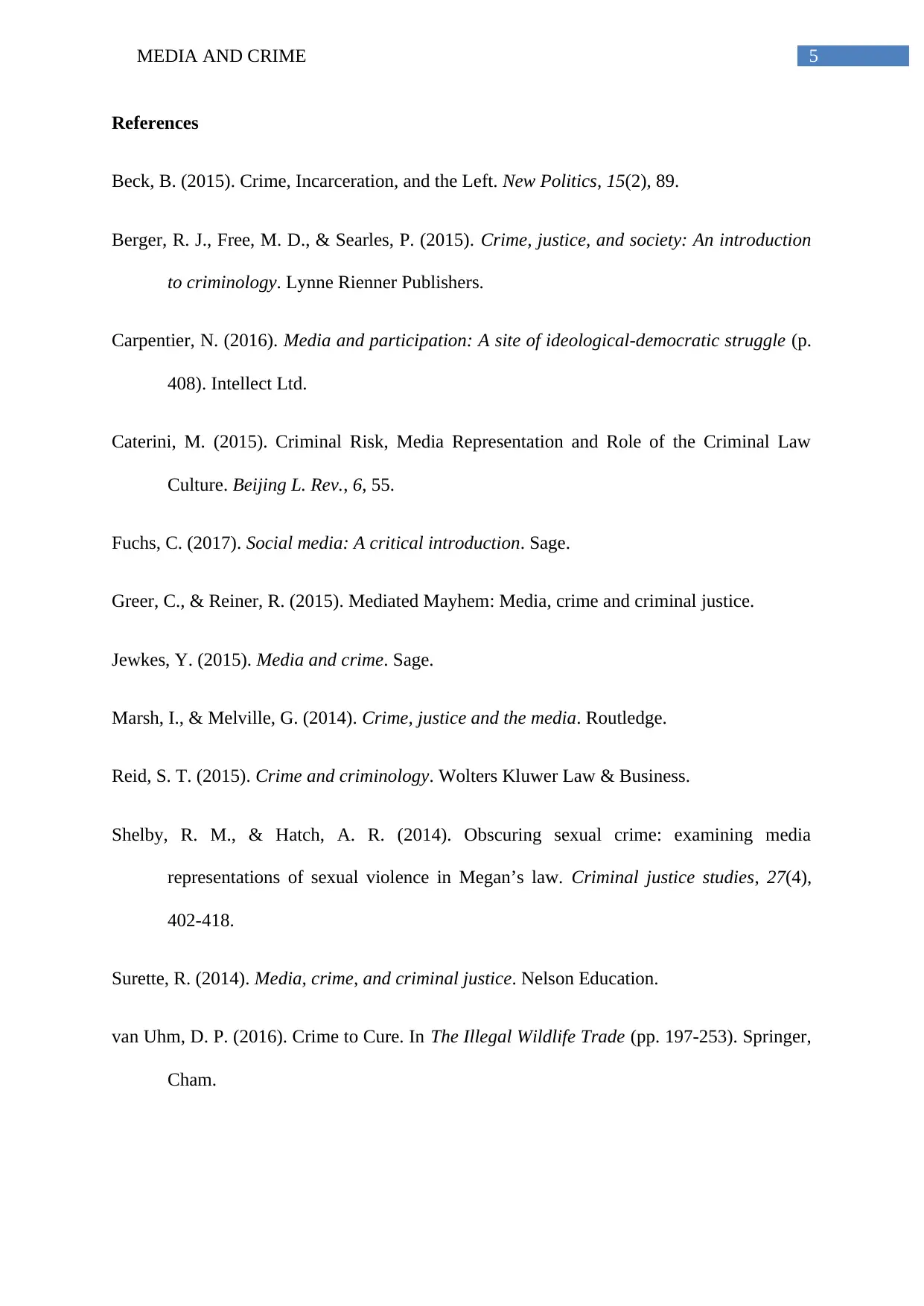
Beck, B. (2015). Crime, Incarceration, and the Left. New Politics, 15(2), 89.
Berger, R. J., Free, M. D., & Searles, P. (2015). Crime, justice, and society: An introduction
to criminology. Lynne Rienner Publishers.
Carpentier, N. (2016). Media and participation: A site of ideological-democratic struggle (p.
408). Intellect Ltd.
Caterini, M. (2015). Criminal Risk, Media Representation and Role of the Criminal Law
Culture. Beijing L. Rev., 6, 55.
Fuchs, C. (2017). Social media: A critical introduction. Sage.
Greer, C., & Reiner, R. (2015). Mediated Mayhem: Media, crime and criminal justice.
Jewkes, Y. (2015). Media and crime. Sage.
Marsh, I., & Melville, G. (2014). Crime, justice and the media. Routledge.
Reid, S. T. (2015). Crime and criminology. Wolters Kluwer Law & Business.
Shelby, R. M., & Hatch, A. R. (2014). Obscuring sexual crime: examining media
representations of sexual violence in Megan’s law. Criminal justice studies, 27(4),
402-418.
Surette, R. (2014). Media, crime, and criminal justice. Nelson Education.
van Uhm, D. P. (2016). Crime to Cure. In The Illegal Wildlife Trade (pp. 197-253). Springer,
Cham.
References
Beck, B. (2015). Crime, Incarceration, and the Left. New Politics, 15(2), 89.
Berger, R. J., Free, M. D., & Searles, P. (2015). Crime, justice, and society: An introduction
to criminology. Lynne Rienner Publishers.
Carpentier, N. (2016). Media and participation: A site of ideological-democratic struggle (p.
408). Intellect Ltd.
Caterini, M. (2015). Criminal Risk, Media Representation and Role of the Criminal Law
Culture. Beijing L. Rev., 6, 55.
Fuchs, C. (2017). Social media: A critical introduction. Sage.
Greer, C., & Reiner, R. (2015). Mediated Mayhem: Media, crime and criminal justice.
Jewkes, Y. (2015). Media and crime. Sage.
Marsh, I., & Melville, G. (2014). Crime, justice and the media. Routledge.
Reid, S. T. (2015). Crime and criminology. Wolters Kluwer Law & Business.
Shelby, R. M., & Hatch, A. R. (2014). Obscuring sexual crime: examining media
representations of sexual violence in Megan’s law. Criminal justice studies, 27(4),
402-418.
Surette, R. (2014). Media, crime, and criminal justice. Nelson Education.
van Uhm, D. P. (2016). Crime to Cure. In The Illegal Wildlife Trade (pp. 197-253). Springer,
Cham.
⊘ This is a preview!⊘
Do you want full access?
Subscribe today to unlock all pages.

Trusted by 1+ million students worldwide
1 out of 6
Related Documents
Your All-in-One AI-Powered Toolkit for Academic Success.
+13062052269
info@desklib.com
Available 24*7 on WhatsApp / Email
Unlock your academic potential
Copyright © 2020–2025 A2Z Services. All Rights Reserved. Developed and managed by ZUCOL.